Nhon dissertation 2021
Luận án Nhon 2021 trình bày kết quả nghiên cứu chuyên sâu. Cung cấp phân tích chi tiết, kết luận và đề xuất có giá trị cho lĩnh vực học thuật.
Georgia Institute of Technology
Chemistry and Biochemistry
Luan An
luận án
Năm xuất bản
Số trang
408
Thời gian đọc
1 giờ 2 phút
Lượt xem
0
Lượt tải
0
Phí lưu trữ
60 Point
Tổng quan nhanh
- Chủ đề:
- Nhon Dissertation: π-Conjugated Organic Chromophores Research
- Số trang:
- 408 trang
- Trường:
- Georgia Institute of Technology
- Chuyên ngành:
- Chemistry and Biochemistry
- Tác giả:
- Linda Nhon
- Năm:
- 2021
Tóm tắt nội dung luận án
I.Nhon Dissertation π Conjugated Organic Chromophores Research
Luận án "DANCING WITH LIGHT" của Linda Nhon giới thiệu nghiên cứu đột phá về các chromophore hữu cơ π-liên hợp rời rạc. Công trình này tập trung vào sự tương tác của các vật liệu này với ánh sáng, mở ra tiềm năng ứng dụng rộng lớn. Mục tiêu chính là phát triển các hệ thống hóa học mới có khả năng chuyển đổi năng lượng hiệu quả. Nghiên cứu đóng góp vào lĩnh vực hóa học vật liệu tiên tiến, đặc biệt là trong bối cảnh nhu cầu năng lượng bền vững. Luận án trình bày chi tiết các phương pháp tổng hợp và đặc tính hóa học, vật lý của các hợp chất này. Khám phá này tạo tiền đề cho các công nghệ năng lượng xanh. Công trình này hướng tới việc tối ưu hóa hiệu suất quang hóa của các hệ thống phức tạp, từ đó thúc đẩy các ứng dụng thực tiễn trong ngành năng lượng. Vật liệu hữu cơ π-liên hợp là trọng tâm chính.
1.1. Mục tiêu luận án Khám phá vật liệu hữu cơ mới
Luận án Nhon 2021 đặt ra mục tiêu tổng hợp và đặc trưng các chromophore hữu cơ mới. Các vật liệu này được thiết kế để thể hiện tính chất quang hóa và điện hóa độc đáo. Công trình khám phá mối quan hệ cấu trúc-tính chất, điều chỉnh các đặc tính mong muốn. Mục tiêu cốt lõi là tạo ra nền tảng vật liệu cho các giải pháp năng lượng hiệu quả. Nền tảng khoa học cơ bản này hỗ trợ phát triển các công nghệ tiên tiến. Việc hiểu sâu về cấu trúc phân tử rất quan trọng.
1.2. Trọng tâm nghiên cứu Cấu trúc π liên hợp và ánh sáng
Trọng tâm chính của nghiên cứu là các cấu trúc π-liên hợp rời rạc. Chúng được nghiên cứu về khả năng tương tác với ánh sáng. Sự tương tác này bao gồm hấp thụ, phát xạ và chuyển đổi năng lượng. Khả năng điều chỉnh cấu trúc phân tử mang lại tiềm năng kiểm soát các quá trình này. Nghiên cứu làm rõ cơ chế tương tác quang học, từ đó tối ưu hóa thiết kế vật liệu. Vật liệu hữu cơ π-liên hợp là chìa khóa cho nhiều ứng dụng.
II.Solar Fuel Cell Applications Advanced Chromophore Design
Luận án khám phá ứng dụng của chromophore hữu cơ π-liên hợp trong pin nhiên liệu mặt trời. Các vật liệu này đóng vai trò quan trọng trong việc thu nhận và chuyển đổi năng lượng ánh sáng thành năng lượng hóa học. Công trình tập trung vào việc thiết kế chromophore để tối ưu hóa khả năng hấp thụ quang phổ và hiệu suất chuyển đổi. Nghiên cứu này hướng tới việc tạo ra các hệ thống năng lượng tái tạo hiệu quả hơn. Sự phát triển của các chromophore mới có thể cải thiện đáng kể công nghệ pin nhiên liệu mặt trời hiện có. Việc hiểu rõ cơ chế tương tác ánh sáng ở cấp độ phân tử là chìa khóa. Các phát hiện cung cấp cái nhìn sâu sắc về cách nâng cao hiệu suất tổng thể của các thiết bị này. Đây là bước tiến quan trọng cho pin nhiên liệu thế hệ mới.
2.1. Nâng cao hiệu suất Chromophore trong pin nhiên liệu mặt trời
Chromophore hữu cơ được thiết kế để cải thiện hiệu suất của pin nhiên liệu mặt trời. Chúng tăng cường khả năng hấp thụ photon và hiệu quả tách điện tích. Mục tiêu là đạt được hiệu suất chuyển đổi năng lượng cao hơn. Việc tối ưu hóa cấu trúc chromophore trực tiếp ảnh hưởng đến đầu ra của thiết bị. Nghiên cứu này cung cấp chiến lược thiết kế vật liệu hiệu quả. Nó hỗ trợ phát triển các hệ thống năng lượng mặt trời bền vững.
2.2. Cơ chế chuyển hóa Ánh sáng thành năng lượng hóa học
Nghiên cứu đi sâu vào cơ chế chuyển hóa năng lượng ánh sáng thành năng lượng hóa học. Các chromophore hoạt động như bộ phận thu hoạch ánh sáng, khởi đầu quá trình quang hóa. Phân tích chi tiết các bước cơ bản của quá trình chuyển hóa năng lượng. Việc kiểm soát các quá trình này ở cấp độ phân tử là trọng tâm. Hiểu biết sâu sắc về cơ chế cho phép tạo ra các hệ thống chuyển đổi năng lượng tốt hơn. Công trình đóng góp vào khoa học năng lượng tái tạo.
III.Electrochromic Technologies Light Interacting Materials
Ngoài pin nhiên liệu, luận án cũng nghiên cứu ứng dụng của chromophore hữu cơ trong các công nghệ điện sắc. Các vật liệu điện sắc có khả năng thay đổi màu sắc hoặc độ trong suốt khi có điện trường. Điều này mang lại tiềm năng lớn cho "kính thông minh" và màn hình hiển thị tiên tiến. Nghiên cứu tập trung vào việc tổng hợp và đặc trưng các chromophore thể hiện tính chất điện sắc mạnh mẽ. Mục tiêu là phát triển vật liệu bền vững, phản ứng nhanh và có thể điều khiển chính xác. Công nghệ này có thể giảm tiêu thụ năng lượng trong các tòa nhà bằng cách kiểm soát lượng ánh sáng và nhiệt đi vào. Luận án cung cấp các phương pháp để thiết kế vật liệu với hiệu suất điện sắc vượt trội. Các vật liệu này có thể ứng dụng trong nhiều thiết bị.
3.1. Vật liệu đổi màu Ứng dụng trong kính thông minh
Chromophore hữu cơ thể hiện tiềm năng lớn trong ứng dụng kính thông minh. Chúng cho phép điều khiển độ mờ và màu sắc của kính thông qua điện áp. Điều này giúp tối ưu hóa ánh sáng tự nhiên và cách nhiệt trong các tòa nhà. Vật liệu điện sắc có thể thay đổi trạng thái quang học một cách thuận tiện. Nghiên cứu này mở đường cho các cửa sổ tiết kiệm năng lượng, thân thiện với người dùng. Công nghệ kính thông minh hứa hẹn cải thiện hiệu quả năng lượng.
3.2. Kiểm soát ánh sáng Các hệ thống điện sắc động
Luận án khám phá các hệ thống điện sắc động cho phép kiểm soát ánh sáng linh hoạt. Các chromophore phản ứng với điện trường, thay đổi màu sắc và độ trong suốt. Điều này có thể được áp dụng trong màn hình hiển thị, cảm biến và thiết bị quang học. Mục tiêu là tạo ra các vật liệu có thời gian phản hồi nhanh và chu kỳ bền vững. Khả năng điều chỉnh các đặc tính quang học mang lại nhiều lợi ích. Nghiên cứu thúc đẩy sự phát triển của công nghệ kiểm soát ánh sáng chủ động.
IV.Georgia Tech PhD Research Chemistry Biochemistry Focus
Nghiên cứu này được thực hiện trong chương trình Tiến sĩ tại Trường Hóa học và Hóa sinh, Viện Công nghệ Georgia. Luận án thể hiện mức độ nghiêm ngặt học thuật và đổi mới khoa học. Công trình được giám sát bởi một hội đồng gồm các giáo sư hàng đầu. Quá trình nghiên cứu bao gồm sự hợp tác với các chuyên gia trong khuôn khổ các dự án EFRC và AFOSR. Những tương tác này đã mở rộng phạm vi và chiều sâu của công việc. Viện Công nghệ Georgia cung cấp môi trường nghiên cứu hỗ trợ mạnh mẽ. Nơi đây thúc đẩy tư duy phản biện và giải quyết vấn đề phức tạp. Nghiên cứu này là minh chứng cho sự cống hiến của Georgia Tech trong việc thúc đẩy khoa học cơ bản và ứng dụng. Các nguồn lực từ Georgia Tech đóng vai trò quan trọng trong thành công của luận án.
4.1. Nghiên cứu tại Georgia Tech Khoa Hóa học Hóa sinh
Nghiên cứu được thực hiện tại một trong những trường đại học hàng đầu về khoa học. Khoa Hóa học và Hóa sinh của Georgia Tech cung cấp cơ sở vật chất và chuyên môn. Môi trường học thuật tại đây khuyến khích sự đổi mới và khám phá. Luận án phản ánh chất lượng cao của chương trình đào tạo tiến sĩ. Các sinh viên được trang bị kiến thức và kỹ năng cần thiết. Georgia Tech cam kết thúc đẩy nghiên cứu đột phá.
4.2. Cộng tác khoa học Mở rộng tầm nhìn và tác động
Luận án hưởng lợi từ các dự án cộng tác với các chuyên gia hàng đầu. Sự hợp tác trong khuôn khổ EFRC và AFOSR mang lại cái nhìn đa chiều. Các ý kiến phản hồi từ các nhà khoa học uy tín đã nâng cao chất lượng công trình. Mạng lưới cộng tác này mở rộng tác động của nghiên cứu. Nó tạo điều kiện cho việc giải quyết các thách thức khoa học phức tạp. Cộng đồng khoa học đóng vai trò quan trọng trong quá trình này.
V.Innovations in Energy Materials Future Applications
Luận án này đại diện cho một bước tiến quan trọng trong lĩnh vực vật liệu năng lượng. Các khám phá về chromophore hữu cơ π-liên hợp có tiềm năng cách mạng hóa công nghệ năng lượng sạch. Nghiên cứu mở ra cánh cửa cho việc phát triển các thiết bị hiệu quả hơn và bền vững hơn. Nó cung cấp nền tảng vững chắc cho các nghiên cứu trong tương lai về quang điện và điện sắc. Các nguyên tắc thiết kế vật liệu được trình bày có thể áp dụng cho nhiều hệ thống khác. Công trình thúc đẩy sự hiểu biết về tương tác ánh sáng-vật chất ở cấp độ cơ bản. Mục tiêu cuối cùng là đóng góp vào một tương lai năng lượng bền vững. Luận án này là một đóng góp có giá trị cho khoa học vật liệu và kỹ thuật. Nó đặt nền móng cho các ứng dụng công nghệ trong tương lai.
5.1. Tiềm năng đột phá Hướng tới năng lượng sạch
Nghiên cứu Nhon 2021 mang lại tiềm năng đột phá cho các giải pháp năng lượng sạch. Việc phát triển các chromophore hiệu quả hơn có thể đẩy nhanh quá trình chuyển đổi năng lượng. Công trình hỗ trợ tạo ra các thiết bị thu hoạch năng lượng mặt trời tốt hơn. Nó cũng góp phần vào các công nghệ tiết kiệm năng lượng khác. Tiềm năng của các vật liệu này là rất lớn, hướng tới một hành tinh xanh hơn. Các phát hiện này có ý nghĩa quan trọng cho tương lai.
5.2. Đóng góp khoa học Thiết kế vật liệu thế hệ mới
Luận án đóng góp vào khoa học vật liệu thông qua việc giới thiệu các nguyên tắc thiết kế mới. Nó cung cấp kiến thức sâu sắc về cách tổng hợp và điều chỉnh chromophore. Công trình này là nền tảng cho việc phát triển vật liệu thế hệ mới. Các vật liệu này có đặc tính quang học và điện hóa vượt trội. Nó sẽ thúc đẩy nghiên cứu và phát triển trong lĩnh vực hóa học vật liệu. Sự đổi mới trong thiết kế vật liệu là trọng tâm chính.
Mục lục chi tiết luận án
Tải xuống file đầy đủ để xem toàn bộ nội dung
Tải đầy đủ (408 trang)Trích đoạn nội dung luận án
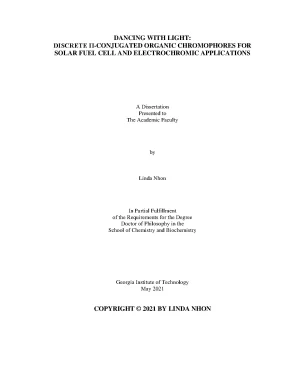
Tải xuống để đọc toàn bộDANCING WITH LIGHT: DISCRETE Π-CONJUGATED ORGANIC CHROMOPHORES FOR SOLAR FUEL CELL AND ELECTROCHROMIC APPLICATIONS A Dissertation Presented to The Academic Faculty by Linda Nhon In Partial Fulfillment of the Requirements for the Degree Doctor of Philosophy in the School of Chemistry and Biochemistry Georgia Institute of Technology May 2021 COPYRIGHT © 2021 BY LINDA NHON DANCING WITH LIGHT: DISCRETE Π-CONJUGATED ORGANIC CHROMOPHORES FOR SOLAR FUEL CELL AND ELECTROCHROMIC APPLICATIONS Approved by: Dr. Reynolds, Advisor Dr. Jake Soper School of Chemistry and Biochemistry; School of Chemistry and Biochemistry School of Material Science and Engineering Georgia Institute of Technology Georgia Institute of Technology Dr. Stefan France Dr.
Jesse McDaniel School of Chemistry and Biochemistry School of Chemistry and Biochemistry Georgia Institute of Technology Georgia Institute of Technology Dr. Elsa Reichmanis School of Chemical and Biochemical Engineering Georgia Institute of Technology Date Approved: [March 30, 2021] “If science, like art, is to perform its mission truly and fully, its achievements must enter not only superficially but with their inner meaning into the consciousness of people,” – Albert Einstein, 1939 New York World’s Fair: Dawn of a New Day To my father and mother, Nhơn, Thành Tài & Tăng, Thi Tơi Luận văn này được dành tặng cho Nhơn, Thành Tài và Tăng, Thi Tơi. Cảm ơn ba mẹ. ACKNOWLEDGEMENTS The work described in this dissertation would certainly not have been possible without the contribution and support from a community of scientists, professors, family, and friends.
I was handed several bizarre obstacles during this journey, such as getting kicked out of a lab, outrunning a category 5 hurricane, facing death, and finishing this course under a pandemic. The following people helped me grow professionally and personally, and for that, I owe them my sincere gratitude. First, I want to thank Dr. John Reynolds for taking the chance and accepting me into his group.
Despite my biology background and lack of synthetic experience, he was willing to work with me on my weakness (scientific knowledge and confidence) and build on my strengths. From a professional standpoint, he pushed me to focus on the details using a fine-tooth comb. Through the collaborations in the EFRC and AFOSR projects, he showed me the art form of working with different personalities to form cohesive teams. I always appreciated Dr.
Reynolds's work ethic as well as his adamant belief in work-life balance. I always looked forward to the annual Christmas parties because it reminds me of my own large family gatherings. I will miss the awkward Greek dances, outrageous white elephant surprises, and simply being all together during the holiday time. Reynolds and Ms.
Dianne Reynolds have been a tremendous emotional support through this journey. While I tried to keep it together inside and battled between work and difficult family matters, they were always there to remind me: "Family first. Take care of yourself." Thank you so much to both of you. iv By participating in the EFRC and AFOSR programs, I had the unique privilege of working with top experts in their respective fields and meticulous scientists.
Their perspectives and scientific insight pushed me to expand my initial hypothesis and thinking. They helped me dive deeper into the experimental work and, as a result, elevated the quality of the manuscripts. I am grateful for their constant communication and feedback; they truly set an example of a successful team that can work across different geographic boundaries and time zones. I want to give a special thanks to my collaborators: Dr.
Kirk Schanze, Dr. Thomas Meyer, Dr. Bing Shan, Dr. Kyle Brennaman, Dr.
Aaron Taggart, Dr. Taylor Moot, and Dr. I also appreciate my committee for their continued support and flexibility, especially during the COVID-19 period: Dr. Stefan France, Dr.
Elsa Reichmanis, Dr. Jesse McDaniel, and Dr. My career aspirations were sculpted in large part to my involvement in the Sam Nunn National Security Fellowship. I want to extend my deepest gratitude to the director and the 2018- 2019 cohort: Dr.
Margaret Kosal, for giving me a platform to showcase my authentic voice and daring me to dream; Karim Farhat, Azell Francis, Dr. Alex Akins, Wesley Meredith, Gerald B. Paritosh Ramanan, Heather Regnault, Allison Mercer, and Dr. Mentorship also played an essential role in my growth during the PhD program.
Within the Reynolds synthesis family or the "downstairs crew," I want to thank a few key mentors who helped me speak up, overcome synthetic hurdles, and know when to put down the hammer. My synthetic toolbox would be empty without the initial and thorough guidance from Dr. His question-and-answer teaching tactic put me through many mazes, but somehow, I was able to arrive at an answer along with other unexpected v details. The following mentors also pushed me to be brave in the lab and handle reaction failures with their unorthodox quotes: Dr.
Kin Lo ("have standards"), Dr. Graham Collier ("rip it and grip it"), Dr. Austin Jones ("do better"), Dr. Additionally, my gratitude also goes to Dr.
Anna Österholm, Dr. Eric Shen, and Dr. Lisa Savagian for showing me the tricks of the trade in electrochemistry. The following colleagues made my everyday experience in the lab and our special outings to Cypress (it's 5:00 somewhere), shooting the hooch, and kickball at Piedmont park memorable: Abigail Advincula, Dr.
Dylan Christiansen, Dr. Zachary Siebers, Dr. Sandra Pittelli, Dr. Augustus Lang, Dr.
Brian Schmatz, Dr. Bing Xu, Dr. Ian Pelse, Brandon DiTullio, and Josh Rinehart. The last six and a half years have been one of the most challenging periods in my life.
I would not have been able to overcome the emotional and mental hurdles without the support of family and friends. I am fortunate to call Atlanta my second home and am lucky to have my second family as a support group here: Dani Thach, Dr. Josue Moran, Kimly Reth, Nattalie Avila, Dr. Lou Kavar, Crystal Bell (thanks for being my number one roommate), and George Tan.
I cannot begin to express my thanks to my sisters who tolerated my hour-long phone rants, reminded me to throw out the negative vibes, and stood by my side in masks in the darkest hours: Tahirih Thach, Julie Vuu, Mavic Francisco, May Thach, Thuy Luong, Dany Son, and Tresson Canley. I am also very grateful for my brother and his mini family for their unwavering support, from helping me move to Atlanta to taking their annual trips to visit me during the summer holidays. Thank you, Vu Nhon, Brennen Nhon, and Kayleah Nhon, for making life seem so light-hearted and goofy. Unlimited thanks go to Ronald Prasad for your enduring patience, understanding, and love as I tumbled through conflicting thoughts, anxious moments, and rivers of tears.
vi I am forever in debt to my parents Tai T. Nhon and Toi T. Tang, whose unconditional love kept me anchored and motivated as I weathered the storms. Thank you for showing me to fight with grace and never giving up.
I love you both. Finally, I consider myself very lucky. Thank you Buddha, for laying the dharma foundation and equipping me with the tools to build my spiritual strength. Namo tassa bhagavato arahato samma sambuddhassa Namo tassa bhagavato arahato samma sambuddhassa Namo tassa bhagavato arahato samma sambuddhassa vii TABLE OF CONTENTS ACKNOWLEDGEMENTS iv LIST OF TABLES xi LIST OF FIGURES xiv LIST OF SCHEMES xxv LIST OF SYMBOLS AND ABBREVIATIONS xxvi SUMMARY xxxi CHAPTER 1.1 General Photophysical Processes 3 1.1 Light and Matter 4 1.3 Absorption, Emission, and Measurable Parameters 9 1.2 Conjugated Organic Material: Donor-Acceptor Molecules 14 1.3 Dye Sensitized Photoelectrosynthesis Cell 17 1.1 Operation Principles Overview 17 1.2 Organic Chromophore Designs 21 1.3 Current Challenges and Target Metrics 27 1.1 Cathodically versus Anodically Coloring Electrochromic Material 29 1.2 Charged States of Discrete Molecules 32 1.3 Surface Adsorption onto Nano-ITO 41 1.5 Thesis of Dissertation 52 CHAPTER 2.
Experimental MEthods and Synthesis Optimizations 54 2.1 Material and Reagents 54 2.6 (Photo)Electrode and Film Preparations 62 2.7 Photoelectrochemical Measurements using a Hydrogen Collection Cell 64 2.2 Optimized Stille Conditions 72 2.4 Synthetic Route towards Various Acceptors 86 viii CHAPTER 3. Organic Chromophores Designed for Hole Injection into Wide- bandgap Metal Oxides for Solar Fuel Applications 89 3.2 Results and Discussion 93 3.1 Design and Synthesis of Donor-Acceptor-Donor Chromophores 93 3.2 Photophysical Properties of Donor-Acceptor-Donor Chromophores 97 3.3 Systematically Tuning the Redox Potentials of Chromophores through DAD Design 105 3.4 Chromophores Exhibit Photocathodic Behavior on PbTiO3 111 3.3 Conclusion and Outlook 119 3.4 Synthesis and Electrochemistry Details 121 3. Influence of Surface and Structural Variations in Donor−Acceptor−Donor Sensitizers on Photoelectrocatalytic Water Splitting 132 4.2 Results and Discussion 135 4.1 Synthesis, X-Ray Structures, and Absorption 135 4.3 Chromophore Surface Coverage on Metal Oxides 147 4.4 Photophysics and Charge Injection into Wide Band-Gap Metal Oxides 150 4.5 Chromophore-Catalyst Assemblies 153 4.6 Transient Absorption Study 161 4.3 Conclusion- Summary and Perspective 164 4.4 Synthetic Details 166 CHAPTER 5. Electrochromic Blues: Discrete All-Donor bis(2-(3,4- ethylenedioxy)thienyl) Molecules for Anodically Coloring Applications 169 5.2 Results and Discussion 172 5.1 Chromophore Design Rationale 172 5.2 Excited-State Analysis 173 5.3 Calculated Geometry: Torsion Angles and Atomic Distances 178 5.4 Selection and Synthesis of BEDOT-X Chromophores 182 5.6 Neutral State Absorbance 187 5.10 Oxidized State Absorbance Properties 200 5.3 Conclusion and Outlook 204 5.4 Synthetic Details 218 ix 5.5 A Special Observation: Plastic Behavior in BEDOT-2,5-DMOB 227 5.6 Proof-of-concept: Adsorption of Anodically Coloring Electrochromes onto Metal-Oxide Surfaces 233 5.1 Motivation for Calculations: PA1 Experimental Results 234 5.2 Summary of Study 242 5.3 Synthetic Details 244 CHAPTER 6.
Perspective and Outlook 247 6.2 Concluding Remarks 256 APPENDIX A. X-Ray Crystallographic data 258 A.1 Di-tert-butyl-2,2'-(benzo[2,1,3]thiadiazole-4,7-diyl)bis(thiophene-3- carboxylate)BTD1-E, T2-BTD-E 258 A.2 Di-tert-butyl 2,2'-(benzo[2,1,3]thiadiazole-4,7-diyl)bis(thiophene-4- carboxylate)T2-BTD4-E 270 A.3 Di-tert-butyl-2,2'-(benzo[2,1,3]thiadiazole-4,7-diyl)bis(thiophene-3- carboxylate), BTD2-E 283 A.4 1, 4-Bis[ 2-( 5-(hexylthio)-3, 4-ethylenedioxy )thienyl ]-methoxyphenylene, BEDOT-MOB 291 A.5 1, 4-Bis[ 2-( 5-(hexylthio)-3, 4-ethylenedioxy )thienyl ]-2,5- dimethoxyphenylene, BEDOT-2,5-DMOB 303 REFERENCES 316 x LIST OF TABLES Table 2.1 Summary of reaction conditions, entries 1-10, used to synthesize 75 T2-BTD. Palladium catalysts, phosphine ligands, temperature, solvent (toluene or THF), and time were varied. 5 mol% of each catalyst was used, ligand ratio was 2.5 equivalence to catalyst percent yields were calculated by 1H NMR.2 Summary of reaction conditions used to synthesize BEDOT-B.
79 Different catalysts, ligands, solvents, and temperatures were tested. 5 mol% of catalyst with 4 molar equivalence of ligand was used. Percent yields were calculated by 1H NMR.1 Summary of the optical and photophysical properties of DAD 100 chromophores (maximum absorbance; λmax, maximum fluorescence; λf, molar absorptivity; ε, optical bandgap; Egopt, singlet state lifetime; τf, and relative quantum yield; φf) of the DAD dyes. λmax and λf were obtained from the dyes’ absorbance and emission spectra, respectively).
ε values were extrapolated from the slope of the Beer-Lambert’s plot of each dye. Egopt was calculated using the following equation: Egopt = 1240/Absonset nm. τf was collected using the time-correlated single-photon counting (TCSPC) technique339. φf measurements were taken in acetonitrile with quinine hemisulfate as the actinometer in 0.
Absolute φf was obtained using an integrating sphere.2 Ground- and excited- state redox potentials of DAD 107 chromophores Table 4.1 Calculations between experimental and calculated molecular 142 orbitals.2 Summary of redox properties of BTD1 and BTD2 145 Table 4.3 Surface coverages (Г in nmol/cm2) for BTD1 and BTD2 on MOx 148 films.4 Injection efficiencies (ηinj) a and injection driving forces (Ginj , in 152 eV)b for BTD1 and BTD2.5 Calculated Faradaic Efficiencies for BTD1 and BTD2 at the 160 photocathode and photoanode.1 Summary of excited-state electronic transitions of PA1E and PA1 239 Table S5. 1 Summary of photophysical properties of BEDOT-X neutral 206 species. 2 Summary of photophysical properties of BEDOT-X radical cation 207 species. 3 An examination of the radical cation oscillator strengths in which 208 each absorbance lambda max and its corresponding oscillator strength listed and ranked.
After ranking the chromophores in each of the two sections, they were ranked from most to least optically desirable.
Nội dung được bảo vệ bản quyền — Tải xuống đầy đủ
Trích dẫn luận án này
Linda Nhon (2021). Nhon dissertation 2021 [Luận án tiến sĩ, Georgia Institute of Technology]. LuanAn.net. https://luanan.net/giao-duc-hoc/nhon-dissertation-2021
Câu hỏi thường gặp
Luận án "Nhon dissertation 2021" nghiên cứu về vấn đề gì?
Luận án Nhon 2021 trình bày kết quả nghiên cứu chuyên sâu. Cung cấp phân tích chi tiết, kết luận và đề xuất có giá trị cho lĩnh vực học thuật.
Luận án "Nhon dissertation 2021" được bảo vệ tại trường nào?
Luận án này được bảo vệ tại Georgia Institute of Technology. Năm bảo vệ: 2021.
Luận án "Nhon dissertation 2021" thuộc chuyên ngành gì?
Luận án "Nhon dissertation 2021" thuộc chuyên ngành Chemistry and Biochemistry. Danh mục: Giáo Dục Học.
Luận án "Nhon dissertation 2021" có bao nhiêu trang?
Luận án "Nhon dissertation 2021" có 408 trang. Bạn có thể xem trước một phần tài liệu ngay trên trang web trước khi tải về.
Cách tải luận án "Nhon dissertation 2021" về máy như thế nào?
Để tải luận án về máy, bạn nhấn nút "Tải xuống ngay" trên trang này, sau đó hoàn tất thanh toán phí lưu trữ. File sẽ được tải xuống ngay sau khi thanh toán thành công. Hỗ trợ qua Zalo: 0559 297 239.