Nghiên cứu Nguyên tắc Andragogy giúp sinh viên Tiến sĩ hoàn thành luận án
Luận án Tiến sĩ khám phá nguyên tắc Andragogy, ứng dụng vào đào tạo người lớn. Phân tích sâu về lý thuyết và thực tiễn giáo dục.
Lindenwood University
Education / Educational Methods
Luan An
Luận án Tiến sĩ
Năm xuất bản
Số trang
388
Thời gian đọc
59 phút
Lượt xem
0
Lượt tải
0
Phí lưu trữ
60 Point
Tổng quan nhanh
- Chủ đề:
- Thúc đẩy Hoàn thành Luận án Tiến sĩ: Vấn đề chính
- Số trang:
- 388 trang
- Trường:
- Lindenwood University
- Chuyên ngành:
- Education / Educational Methods
- Tác giả:
- Bernice Bush
- Năm:
- 2020
Tóm tắt nội dung luận án
I.Thúc đẩy Hoàn thành Luận án Tiến sĩ Vấn đề chính
Chương trình Tiến sĩ là đỉnh cao trong giáo dục, thể hiện thành tựu học thuật cao nhất. Tuy nhiên, tỷ lệ bỏ học 50% kéo dài qua nhiều thập kỷ tại các trường đại học toàn cầu. Tình trạng này gây cản trở đáng kể đến việc hoàn thành bằng cấp. Hiện tượng "All-But-Dissertation" (ABD), khi nhiều ứng viên không thể hoàn tất luận án, là một thách thức lớn. Các nhà nghiên cứu đã dành nhiều thời gian tìm kiếm nguyên nhân, xem xét các yếu tố ảnh hưởng từ sinh viên đến các giải pháp của trường học. Tuy nhiên, những nỗ lực này chưa cải thiện đáng kể các số liệu thống kê. Việc hiểu rõ các rào cản là bước đầu để tìm ra giải pháp hiệu quả, đặc biệt trong bối cảnh nhu cầu về lực lượng lao động tri thức và đổi mới ngày càng tăng.
1.1. Tỷ lệ bỏ học cao trong chương trình tiến sĩ
Nhiều sinh viên tiến sĩ không hoàn thành chương trình. Tỷ lệ bỏ học lên tới 50% đã tồn tại trong nhiều thập kỷ. Điều này cho thấy một vấn đề sâu sắc trong cấu trúc và hỗ trợ của chương trình. Các ngành công nghiệp cần những người có tư duy cao. Việc mất đi những tài năng này ảnh hưởng đến sự đổi mới. Tìm kiếm giải pháp là điều cần thiết để duy trì nguồn lực trí tuệ.
1.2. Hiện tượng ABD gây cản trở hoàn thành
Hiện tượng "All-But-Dissertation" (ABD) là một trở ngại lớn. Sinh viên hoàn tất khóa học nhưng không thể viết hoặc bảo vệ luận án. Đây là một giai đoạn làm trì hoãn hoặc ngăn cản hoàn tất bằng cấp. Các nguyên nhân có thể đa dạng, từ thiếu hỗ trợ đến khó khăn trong nghiên cứu. Việc giải quyết tình trạng ABD sẽ cải thiện đáng kể tỷ lệ tốt nghiệp.
II.Nguyên tắc Andragogy Nâng cao Trải nghiệm Học Tiến sĩ
Nghiên cứu này khám phá cách các Nguyên tắc Andragogy có thể tăng cường sự kiên trì của sinh viên tiến sĩ. Andragogy, hay Giáo dục người lớn, tập trung vào nhu cầu và đặc điểm riêng của người học trưởng thành. Các nguyên tắc này bao gồm tự định hướng học tập, kinh nghiệm làm nền tảng, sẵn sàng học tập và định hướng giải quyết vấn đề. Bằng cách áp dụng Andragogy, các chương trình đào tạo tiến sĩ có thể được thiết kế lại. Mục tiêu là tạo ra môi trường học tập hỗ trợ và phù hợp hơn. Điều này giúp sinh viên vượt qua các rào cản. Tăng cường động lực học tập nội tại là một yếu tố then chốt. Việc tập trung vào trải nghiệm cá nhân của sinh viên giúp họ gắn kết hơn với quá trình học tập.
2.1. Nền tảng Giáo dục người lớn của Andragogy
Andragogy là lý thuyết về Giáo dục người lớn do Malcolm Knowles phát triển. Lý thuyết này cho rằng người lớn học khác với trẻ em. Người lớn có kinh nghiệm phong phú. Họ có động lực nội tại để học. Việc học phải liên quan đến cuộc sống và mục tiêu của họ. Các chương trình cần nhận ra những khác biệt này để hiệu quả.
2.2. Áp dụng Andragogy để tăng cường sự kiên trì
Việc áp dụng Nguyên tắc Andragogy có thể cải thiện sự kiên trì. Sinh viên tiến sĩ là những người học trưởng thành. Họ cần được trao quyền tự chủ trong học tập. Hướng dẫn nên tập trung vào việc giải quyết vấn đề thực tế. Phản hồi và hỗ trợ cá nhân hóa cũng rất quan trọng. Điều này giúp sinh viên duy trì động lực và hoàn thành luận án.
III.Nghiên cứu Định tính về Kinh nghiệm Sinh viên Tiến sĩ
Nghiên cứu sử dụng mô hình nghiên cứu định tính. Phương pháp này bao gồm phép tam giác để khám phá cảm xúc và trải nghiệm. Mục tiêu là tìm ra các điểm chung làm suy yếu khả năng hoàn thành luận án. Nghiên cứu cũng tìm kiếm tiềm năng trong các Nguyên tắc Andragogy để hỗ trợ sinh viên đang gặp khó khăn. Phép tam giác là một phương pháp mạnh mẽ. Nó cho phép xác minh và tăng cường độ tin cậy của dữ liệu. Bằng cách lắng nghe trực tiếp từ sinh viên, nghiên cứu thu thập được những hiểu biết sâu sắc. Đây là những yếu tố mà các phương pháp định lượng khó có thể nắm bắt. Phương pháp nghiên cứu này cung cấp cái nhìn toàn diện về thách thức và cơ hội.
3.1. Mô hình Nghiên cứu Định tính được sử dụng
Nghiên cứu này là một nghiên cứu định tính. Nó tập trung vào sự hiểu biết sâu sắc về trải nghiệm cá nhân. Không tập trung vào số liệu thống kê. Mô hình này phù hợp để khám phá các yếu tố phức tạp. Các yếu tố này ảnh hưởng đến sự kiên trì của sinh viên tiến sĩ. Nó cho phép tìm hiểu "tại sao" và "như thế nào" của các hiện tượng.
3.2. Thu thập dữ liệu và phân tích trải nghiệm
Dữ liệu được thu thập thông qua các cuộc phỏng vấn. Các cuộc phỏng vấn khám phá cảm xúc và suy nghĩ của sinh viên. Phương pháp phép tam giác được dùng để phân tích dữ liệu. Điều này giúp xác định các chủ đề và mô hình chung. Từ đó, nghiên cứu đưa ra những hiểu biết mới về các rào cản và giải pháp. Các yếu tố này ảnh hưởng đến việc hoàn thành luận án.
IV.Malcolm Knowles và Động lực Học tập Suốt đời
Malcolm Knowles là một nhân vật trung tâm trong lĩnh vực Giáo dục người lớn. Các nguyên tắc của ông về Andragogy nhấn mạnh tầm quan trọng của tự định hướng học tập. Sinh viên tiến sĩ có khả năng và mong muốn kiểm soát quá trình học của mình. Họ sử dụng kinh nghiệm sống làm nguồn học tập phong phú. Việc sẵn sàng học tập của họ gắn liền với nhu cầu giải quyết các vấn đề thực tế. Động lực học tập nội tại thúc đẩy họ vượt qua khó khăn. Các chương trình đào tạo cần tạo cơ hội cho sự tự chủ này. Chúng cần khuyến khích học tập kinh nghiệm. Điều này giúp sinh viên phát triển kỹ năng và kiến thức cần thiết. Mục tiêu là không chỉ hoàn thành luận án mà còn đạt được Học tập suốt đời.
4.1. Vai trò của Tự định hướng Học tập
Tự định hướng học tập là một nguyên tắc cốt lõi của Andragogy. Người học trưởng thành muốn tự chịu trách nhiệm. Họ muốn kiểm soát việc học của mình. Trong môi trường tiến sĩ, điều này đặc biệt quan trọng. Sinh viên tự chọn đề tài, tự nghiên cứu. Hỗ trợ cho sự tự định hướng này là chìa khóa. Nó giúp họ duy trì cam kết và vượt qua thách thức.
4.2. Học tập Kinh nghiệm và Động lực nội tại
Người lớn học hiệu quả nhất khi kiến thức liên quan đến kinh nghiệm của họ. Học tập kinh nghiệm cung cấp bối cảnh thực tế. Nó làm tăng tính ứng dụng của kiến thức. Động lực học tập nội tại thúc đẩy sinh viên tiến sĩ. Họ tìm kiếm sự thành thạo và phát triển cá nhân. Việc nhận biết và nuôi dưỡng động lực này là rất quan trọng. Điều này giúp họ duy trì sự kiên trì trong suốt quá trình nghiên cứu dài.
V.Cải thiện Chiến lược Giáo dục Người lớn cho Tiến sĩ
Việc áp dụng các Nguyên tắc Andragogy mang lại nhiều lợi ích. Nó giúp cải thiện đáng kể tỷ lệ hoàn thành luận án tiến sĩ. Các trường đại học cần xem xét lại thiết kế chương trình. Cần tích hợp các chiến lược hỗ trợ dựa trên Giáo dục người lớn. Điều này bao gồm việc cung cấp cố vấn hiệu quả hơn. Cần tạo ra môi trường khuyến khích sự tự chủ và tư duy phản biện. Hỗ trợ sinh viên phát triển kỹ năng nghiên cứu khoa học là thiết yếu. Việc tập trung vào định hướng giải quyết vấn đề trong luận án giúp sinh viên thấy rõ giá trị công việc. Mục tiêu là giúp sinh viên không chỉ đạt được bằng cấp. Mà còn để nuôi dưỡng tinh thần Học tập suốt đời và đóng góp vào xã hội.
5.1. Cải thiện chương trình đào tạo tiến sĩ
Chương trình tiến sĩ cần được cải tiến. Cần tập trung vào nhu cầu của người học trưởng thành. Điều này bao gồm việc linh hoạt hóa lịch trình. Nó cũng bao gồm việc cung cấp các nguồn lực phù hợp. Các buổi hội thảo về phương pháp nghiên cứu nên được tổ chức thường xuyên. Việc hỗ trợ cá nhân hóa giúp sinh viên vượt qua khó khăn.
5.2. Hỗ trợ sinh viên để đạt Học tập suốt đời
Hỗ trợ sinh viên vượt qua giai đoạn luận án là quan trọng. Nhưng mục tiêu rộng hơn là thúc đẩy Học tập suốt đời. Các trường đại học cần trang bị cho sinh viên kỹ năng. Kỹ năng này giúp họ tiếp tục học hỏi sau khi tốt nghiệp. Khuyến khích tư duy phản biện và tự học. Đây là những yếu tố quan trọng cho sự phát triển liên tục.
Mục lục chi tiết luận án
Tải xuống file đầy đủ để xem toàn bộ nội dung
Tải đầy đủ (388 trang)Trích đoạn nội dung luận án
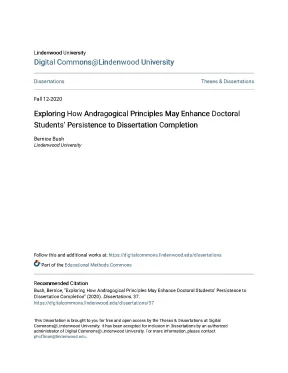
Tải xuống để đọc toàn bộLindenwood University Digital Commons@Lindenwood University Dissertations Theses & Dissertations Fall 12-2020 Exploring How Andragogical Principles May Enhance Doctoral Students’ Persistence to Dissertation Completion Bernice Bush Lindenwood University Follow this and additional works at: https://digitalcommons.edu/dissertations Part of the Educational Methods Commons Recommended Citation Bush, Bernice, "Exploring How Andragogical Principles May Enhance Doctoral Students’ Persistence to Dissertation Completion" (2020).edu/dissertations/37 This Dissertation is brought to you for free and open access by the Theses & Dissertations at Digital Commons@Lindenwood University. It has been accepted for inclusion in Dissertations by an authorized administrator of Digital Commons@Lindenwood University. For more information, please contact phuffman@lindenwood. Exploring How Andragogical Principles May Enhance Doctoral Students’ Persistence to Dissertation Completion by Bernice Bush A Dissertation Submitted to the Education Faculty of Lindenwood University in partial fulfillment of the requirements for the degree of Doctor of Education School of Education i Exploring How Andragogical Principles May Enhance Doctoral Students’ Persistence to Dissertation Completion by Bernice Bush This dissertation has been approved in partial fulfillment of the requirements for the degree of Doctor of Education at Lindenwood University by the School of Education __Sherrie Wisdom ____________________ __12/18/2020_______ Dr.
Sherrie Wisdom, Committee Member Date ii Declaration of Originality I do hereby declare and attest to the fact that this is an original study based solely upon my own scholarly work here at Lindenwood University and that I have not submitted it for any other college or university course or degree here or elsewhere. Full Legal Name: Bernice Bush iii Acknowledgments First and foremost, I want to thank my Lord and Savior, Jesus Christ, who is the Word of God. Knowing my thoughts and purposes, He gave me the words to compose my doctoral experiences into a viable research study and qualifying dissertation. I am so grateful! Thank you, John Manoogian, my first professor, for thinking that I would be able to complete a doctorate.
Thank you, Dr. Cindy Manjounes, my undergraduate and master’s advisor, for believing I would be able to earn my own beret. Thank you, Dr. Tina Grosso, my master’s program professor, for knowing that I could write a dissertation.
Thank you, also, for inviting Dr. Henschke to our class; I decided that evening to continue pursuing lifelong learning. Thank you very much to each member of my Committee; your gifts have helped make this document a reality. I am so appreciative, Dr.
Susan Lundry, for all your contributions to this study, including your swift and accurate proofreading. I am so very thankful, Dr. Sherrie Wisdom, for all of your administrative and academic assistance, as well as your friendship and kindness during this doctoral process. I am so grateful, Dr.
John Henschke, for your constant mentorship throughout this entire course. Thank you for Chairing this dissertation within your retirement; your passion for learning and commitment to learners is a worthy role to model. Thank you, Dr. Somanita Kheagn; you absolutely rescued me from dissertation despair when you suggested I first research what my obstacles were.
My plight became my topic and successfully completing this degree developed into a purpose to help other struggling students. iv Thank each and every interviewee for your essential participation in this research endeavor; our stories are meaningful. Thank you, Jim, my dear husband and best friend, as well as my daughter, Emily, and my dog, Ryder; I appreciate your patience and understanding of the time and attention this project required. We will have more time together now.
v Abstract The Doctorate is a terminal degree, in that, a student has accomplished the ultimate academic achievement within an educational field of domain. Although industries worldwide continually demand ever-advancing scholarly workforces and the innovation developments of higher thinkers, this degree has been impeded by a staggering 50% attrition rate among colleges and universities for decades. Also obstructive to degree attainment has been the phenomenological trend of the All-But-Dissertation (ABD) phase experienced by multitudes of candidates within their courses’ timelines. Researchers have studied these issues over the last century, specifically seeking relevant sources of influence among dozens of student attributes and pursuing all indications with corresponding collegiate remedies.
Yet, the statistics have remained steady. Through the qualitative study model of triangulation, the Research Investigator explores the sentiments of collegiate experiences for commonalities which undermine dissertation accomplishment and the possibilities within the Andragogical principles for bolstering students struggling with project progress. The three angles highlighted are the prior sentiments as reported of students from previously researched studies, the transcribed testimonies of several current-era doctoral graduates and former students who opted to drop out, as well as the future-focused narratives of this Author as the candidate persisting toward degree achievement. The Andragogical principles of a Teacher’s empathy with, trust in, and sensitivity toward their students is being explored as a potential attempt to resolve the outstanding issues of doctorate degree attrition among educational institutions.
It is believed that each of these three characteristics are powerful means for developing positive modes of communication. Combined together, empathy, vi trust, and sensitivity are the staples of lasting relationships. When shared in reciprocity through the focused efforts of independent research, the tenets of scholarly mentorship will be achieved, and students will be rallied to persistence in their degree pursuits. vii Table of Contents Acknowledgments.
vi Table of Contents. viii Chapter One: Introduction. 1 Statement of the Problem. 1 Purpose of the Study.
5 Rationale of the Study. 6 Questions Addressed in Research. 8 Definition of Relevant Terms. 10 All-But-Dissertation (ABD).
12 Modified Instructional Perspectives Inventory (MIPI). 12 Other Previously Researched Studies. 13 viii Prior Research Findings. 13 Phases of Adult Learning.
13 Readiness to learn. 13 Self-Directed Learning. 14 Time-to-degree (TTD). 14 Limitations Within Study.
17 Methodology of Study. 21 Chapter Two: Literature Review. 23 Itinerary of Exploration. 23 Background of Attrition Studies in General.
24 Andragogy as An Answer. 27 Student Perceptions as Contributing Condition of Attrition. 27 Origins of Attrition Rate Statistics. 29 Clarification of Variables Surrounding Attrition.
31 Recommendations to Seek Student Perceptions. 33 Reasons for Attrition. 34 Relating to faculty/university complaints. 34 Relating to topic/project issues.
35 Relating to personal life role conflicts. 35 Doctoral Perceptions Aligned with Reasons for Attrition. 36 A negative relationship or even conflict between the student and advisor/ faculty. 36 ix Students disappointed in or dissatisfied with their doctoral programs.
38 Psychological Assumptions Surrounding Dropouts. 39 Consideration of Erikson’s Life Stages theory. 40 Consideration of Blum’s Clinical Vignette. 42 Consideration of Maslow’s Hierarchy of Needs.
43 Consideration of Knowles’ work “Releasing the Energy of Others”. 45 Knowles’ Consideration of Lindemann. 48 Knowles’ Consideration of Rogers. 49 Knowles’ Consideration of Houle.
50 Knowles’ Consideration of Tough. 50 Assumptions of Adult Learners. 51 Self-Direction within Adult Learners. 59 Henschke: Mentee to Mentor.
68 Chapter Three: Methodology. 70 Procedures of Method. 70 Research Study Design. 71 Research Project Process.
72 Respondents as Interviewees. 74 Participant Responses as Data. 75 Intended Alignment of Data. 77 Addressing Trustworthiness of Research.
80 Research Questions Presented. 83 Presenting Andragogical Principles. 85 Chapter Four: Results of Investigation. 89 Driving Needs for Higher Education.
89 x Answering the Research Questions. 90 The Empathetic Andragogue feels fully prepared to teach. 186 The Empathetic Andragogue notices and acknowledges to learners positive changes in them. 188 The Empathetic Andragogue balances her/his efforts between learner content, acquisition, and motivation.
188 The Empathetic Andragogue expresses appreciation to learners who actively participate. 190 The Empathetic Andragogue Promotes positive self-esteem in learners. 190 The Trustworthy Andragogue purposefully communicates to learners that they are each uniquely important. 191 The Trustworthy Andragogue believes learners know what their goals, dreams, and realities are like.
192 The Trustworthy Andragogue expresses confidence that learners will develop the skills they need. 192 The Trustworthy Andragogue prizes the learners to learn what is needed. 193 The Trustworthy Andragogue feels learners’ need to be aware of and communicate their thoughts and feelings. 194 The Trustworthy Andragogue enables learners to evaluate their own progress in learning.
194 The Trustworthy Andragogue hears learners indicate what their learning needs are. 196 The Trusworthy Andragogue engages learners in clarifying their own aspirations. 197 The Trustworthy Andragogue develops a supportive relationship with learners. 197 The Trustworthy Andragogue experiences unconditional positive regard for learners.
198 The Trustworthy Andragogue respects the dignity and integrity of learners. 199 The Sensitive Andragogue makes certain to understand the learner’s point of view. 200 xi The Sensitive Andragogue takes pains and time to get her/his point across to learners. 201 The Sensitive Andragogue exercises patience in helping all learners’ progress.
202 The Sensitive Andragogue overcomes any frustration with learner apathy. 203 The Sensitive Andragogue will use whatever time learners need to grasp various concepts. 204 The Sensitive Andragogue thoroughly allows learners to ask all the questions they need addressed. 204 The Sensitive Andragogue resists in her/himself any irritation at learner inattentiveness in the learning setting.
205 Chapter Five: Conclusion and Recommendation. 218 Recommendations for Promoting Academic Mentoring. 354 xiii Chapter One: Introduction Statement of the Problem The dissertation is the writing assignment within the research project of a doctoral degree program (Katz, 1995). The parameters of this project are so specific that a dual application process is necessary to screen for qualifying doctoral candidates.
Students vying for a doctoral degree will have several prerequisite classes to attend prior to conducting a personal research study and writing the corresponding dissertation. It is imperative that the topic of this investigative endeavor be relevant to the objectives underlying the host degree while focusing on a gap within the literature encompassing the subject. This is a crucial point in the doctoral degree program as each student becomes an individual researcher working independent of other classmates. Some doctoral candidates will navigate the processes of their research undertakings, write their dissertations, present a defense of their findings, and successfully complete their degree programs in a timely manner.
Other students will spend much more time at the process as they flounder between the responsibilities related to their personal roles in life, as well as the requisites encountered through this extended educational experience. This period of limbo has been deemed the All But Dissertation (ABD) phenomenon (Allen & Dory, 2001; Bair & Haworth, 1999; Blanchard, 2018; Blum, 2010; Bowen & Rudenstine, 1992; Brill, Balcanoff, Land, Gogarty, & Turner, 2014; Garbarini, 2017; Green, 1995; Green & Kluever, 1997; Holmes, Robinson, & Seay, 2010; Jimenez, Gokalp, Pena, Fischer, & Gupton, 2010; Johnson, Green, & Kluever, 2000; Katz, 1995; Kelley & Salisbury- Glennon, 2016; Kluever, 1995; Lenz, 1995; Long, 2018; Miller, 1995). EXPLORING ANDRAGOGICAL PRINCIPLES 2 The regulation course length of the doctoral program affords a generous amount of time to complete each degree, with appropriate extensions granted upon formal Institutional Review Board (IRB) request. Yet, nearly half of all struggling doctoral students will succumb to attrition and drop out of their programs.
This tragedy held constant for more than 50 years, as revealed through prior research findings (Astin, 1972; Bair et al., 1999; Blanchard, 2018; Bowen et al., 1992; Brill et al., 2014; Faghihi, Rakow, & Ethington, 1999; Garbarini, 2017; Golde, 1994, 2000, 2005; Green, 1995; Hunter & Devine, 2016; Iffert, 1958; Jimenez et al., 2010; Johnson et al., 2000; Katz, 1995; Kelley et al., 2016; Kluever, 1995; Lundsford, 2012; Morrison, 2014; Pauley, Cunningham, & Toth, 1999; Rigler, Bowlin, Seat, Watts, & Throne, 2017; Schneider, 2015; Smith, 1981; Summerskill, 1962). Several of these studies concluded that there remains a need to explore the ABD status doctoral students (Bair et al., 1999; Dupont, Meert, Galand, & Nils, 2013; Faghihi et al., 1999; Gagne, 2017; Grant, 2018; Hunter et al., 2016; Kelley et al. It is believed, if the ABD plight could be understood, the universities could bolster their doctoral candidates through appropriate program remedies, and subsequently, boost their student retention rates (Bair et al., 1999; Brill et al.
Nội dung được bảo vệ bản quyền — Tải xuống đầy đủ
Trích dẫn luận án này
Bernice Bush (2020). Nguyên tắc Andragogy và luận án Tiến sĩ [Luận án tiến sĩ, Lindenwood University]. LuanAn.net. https://luanan.net/giao-duc-hoc/nguyen-tac-andragogy-luuan-tien-si
Câu hỏi thường gặp
Luận án "Nguyên tắc Andragogy và luận án Tiến sĩ" nghiên cứu về vấn đề gì?
Luận án Tiến sĩ khám phá nguyên tắc Andragogy, ứng dụng vào đào tạo người lớn. Phân tích sâu về lý thuyết và thực tiễn giáo dục.
Luận án "Nguyên tắc Andragogy và luận án Tiến sĩ" được bảo vệ tại trường nào?
Luận án này được bảo vệ tại Lindenwood University. Năm bảo vệ: 2020.
Luận án "Nguyên tắc Andragogy và luận án Tiến sĩ" thuộc chuyên ngành gì?
Luận án "Nguyên tắc Andragogy và luận án Tiến sĩ" thuộc chuyên ngành Education / Educational Methods. Danh mục: Giáo Dục Học.
Luận án "Nguyên tắc Andragogy và luận án Tiến sĩ" có bao nhiêu trang?
Luận án "Nguyên tắc Andragogy và luận án Tiến sĩ" có 388 trang. Bạn có thể xem trước một phần tài liệu ngay trên trang web trước khi tải về.
Cách tải luận án "Nguyên tắc Andragogy và luận án Tiến sĩ" về máy như thế nào?
Để tải luận án về máy, bạn nhấn nút "Tải xuống ngay" trên trang này, sau đó hoàn tất thanh toán phí lưu trữ. File sẽ được tải xuống ngay sau khi thanh toán thành công. Hỗ trợ qua Zalo: 0559 297 239.