Luận án: Mức độ sẵn sàng học M-learning của giáo viên và học sinh EFL (Phương pháp hỗn hợp)
Luận án nghiên cứu mức độ sẵn sàng của giáo viên và sinh viên trong học tập di động (m-learning) theo phương pháp hỗn hợp.
University of Foreign Languages, Hue University
Luan An
Luận án Tiến sĩ
Năm xuất bản
Số trang
187
Thời gian đọc
29 phút
Lượt xem
0
Lượt tải
0
Phí lưu trữ
50 Point
Tổng quan nhanh
- Chủ đề:
- 1. Sự sẵn sàng học M-learning: Khảo sát giáo viên & học sinh EFL
- Số trang:
- 187 trang
- Trường:
- University of Foreign Languages, Hue University
- Chuyên ngành:
- Theory and Methodology of English Language Teaching
- Tác giả:
- Vo Thuy Linh
- Năm:
- 2022
Tóm tắt nội dung luận án
I. Sự sẵn sàng học M learning Khảo sát giáo viên học sinh EFL
Phần này giới thiệu tổng quan về sự sẵn sàng học M-learning của giáo viên và học sinh EFL. M-learning, hay học tập di động, đang trở thành xu hướng quan trọng. Nó cho phép học tập linh hoạt, truy cập nội dung mọi lúc mọi nơi. Trong bối cảnh giảng dạy tiếng Anh như một ngoại ngữ (EFL), M-learning mở ra nhiều cơ hội. Giáo viên và học sinh cần thích nghi với công nghệ mới. Nghiên cứu này tập trung vào việc đánh giá mức độ sẵn sàng này. Mục tiêu là hiểu rõ các yếu tố ảnh hưởng đến việc chấp nhận M-learning. Phương pháp hỗn hợp được sử dụng để thu thập dữ liệu toàn diện. Điều này bao gồm bảng hỏi, phỏng vấn sâu và quan sát lớp học. Kết quả cung cấp cái nhìn sâu sắc về tiềm năng và thách thức của M-learning.
1.1. Tổng quan M learning và bối cảnh EFL
M-learning là hình thức học tập sử dụng thiết bị di động. Nó cung cấp sự linh hoạt, truy cập nội dung mọi lúc, mọi nơi. Trong bối cảnh EFL (English as a Foreign Language), M-learning có tiềm năng lớn. Nó hỗ trợ học sinh tiếp cận tài liệu tiếng Anh, cải thiện kỹ năng ngôn ngữ. Giáo viên EFL cũng có thể tận dụng để nâng cao chất lượng giảng dạy. M-learning bổ sung cho phương pháp học truyền thống. Sự hiểu biết về M-learning là cần thiết. Khảo sát sự sẵn sàng học M-learning là trọng tâm.
1.2. Mục tiêu và phương pháp nghiên cứu hỗn hợp
Nghiên cứu này đánh giá sự sẵn sàng học M-learning của giáo viên và học sinh EFL. Mục tiêu bao gồm xác định nhận thức, thái độ, khả năng sử dụng thiết bị di động. Phương pháp nghiên cứu hỗn hợp được áp dụng. Dữ liệu định lượng thu thập từ bảng hỏi. Dữ liệu định tính đến từ phỏng vấn sâu, quan sát lớp học. Cách tiếp cận này mang lại cái nhìn toàn diện. Nó giúp hiểu rõ hơn các yếu tố ảnh hưởng đến sự sẵn sàng.
1.3. Vai trò của MALL trong học tiếng Anh
MALL (Mobile-Assisted Language Learning) là một lĩnh vực con của M-learning. MALL tập trung vào việc sử dụng thiết bị di động để hỗ trợ học ngôn ngữ. Ứng dụng di động học tiếng Anh rất đa dạng. Chúng bao gồm từ điển, ứng dụng luyện ngữ pháp, phát âm, giao tiếp. MALL tăng cường sự tương tác, cá nhân hóa trải nghiệm học. MALL cung cấp tài nguyên phong phú. Nó khuyến khích học sinh tự học, thực hành thường xuyên.
II. Các yếu tố ảnh hưởng sự sẵn sàng học M learning EFL
Phần này đi sâu vào các yếu tố chính ảnh hưởng đến sự sẵn sàng học M-learning. Mô hình chấp nhận công nghệ (TAM) là khung lý thuyết chủ đạo. TAM giải thích cách người dùng chấp nhận công nghệ mới dựa trên nhận thức về sự hữu ích và dễ sử dụng. Việc đánh giá các yếu tố này giúp xác định những động lực và rào cản. Hiểu rõ các yếu tố này giúp thiết kế các chương trình hỗ trợ phù hợp. Nó cũng giúp phát triển ứng dụng di động học tiếng Anh hiệu quả hơn cho giáo viên và học sinh EFL.
2.1. Mô hình chấp nhận công nghệ TAM và ứng dụng
Mô hình chấp nhận công nghệ (TAM) là khung lý thuyết chính. TAM giải thích ý định sử dụng công nghệ mới. Hai yếu tố chính là "nhận thức về tính hữu ích" và "nhận thức về sự dễ sử dụng". Nghiên cứu này áp dụng TAM để phân tích sự sẵn sàng học M-learning. Mô hình giúp hiểu tại sao giáo viên và học sinh chấp nhận hoặc từ chối M-learning. TAM cung cấp một cấu trúc rõ ràng. Nó hỗ trợ việc đánh giá các yếu tố ảnh hưởng đến sự chấp nhận.
2.2. Nhận thức về sự dễ sử dụng PEOU
PEOU (Perceived Ease of Use) là mức độ người dùng tin rằng việc sử dụng một hệ thống sẽ không tốn công sức. Đối với M-learning, PEOU liên quan đến khả năng thao tác thiết bị di động. Nó bao gồm sự đơn giản trong việc sử dụng ứng dụng di động học tiếng Anh. Nếu giáo viên và học sinh thấy M-learning dễ sử dụng, họ có xu hướng chấp nhận hơn. Sự phức tạp trong giao diện hoặc thao tác là rào cản. Đánh giá PEOU là quan trọng. Nó giúp cải thiện thiết kế ứng dụng.
2.3. Nhận thức về tính hữu ích của M learning
Perceived Usefulness là mức độ người dùng tin rằng việc sử dụng một hệ thống sẽ nâng cao hiệu suất công việc. Trong bối cảnh M-learning, điều này có nghĩa là giáo viên thấy M-learning giúp giảng dạy hiệu quả hơn. Học sinh thấy M-learning cải thiện kết quả học tập tiếng Anh. Tính hữu ích có thể bao gồm khả năng truy cập tài liệu đa dạng. Nó còn là cải thiện kỹ năng nghe, nói, đọc, viết. Nếu M-learning mang lại lợi ích rõ ràng, sự sẵn sàng học M-learning sẽ tăng.
III. Nhận thức thái độ về M learning của giáo viên học sinh
Phần này phân tích sâu về nhận thức và thái độ của giáo viên và học sinh EFL đối với M-learning. Thái độ tích cực từ cả hai phía là yếu tố quan trọng thúc đẩy việc áp dụng thành công công nghệ di động. Nghiên cứu xem xét cách giáo viên nhìn nhận vai trò của M-learning trong giảng dạy. Nó cũng đánh giá nhận thức của học sinh về lợi ích của M-learning trong việc học tiếng Anh. Sự đồng thuận và ủng hộ lẫn nhau tạo ra một môi trường học tập và giảng dạy hiệu quả. Các kết quả này giúp xây dựng chiến lược truyền thông và đào tạo phù hợp.
3.1. Thái độ giáo viên với M learning trong giảng dạy
Thái độ giáo viên với M-learning là yếu tố quyết định. Thái độ tích cực thúc đẩy việc áp dụng công nghệ. Giáo viên EFL cần sẵn sàng khám phá công cụ mới. Họ cần tích hợp ứng dụng di động học tiếng Anh vào bài giảng. Các yếu tố như kinh nghiệm sử dụng công nghệ, đào tạo hỗ trợ thái độ này. Sự sẵn lòng thay đổi phương pháp dạy cũng quan trọng. Những giáo viên có thái độ cởi mở thường là người tiên phong. Họ chấp nhận M-learning dễ dàng hơn.
3.2. Nhận thức học sinh về M learning trong học tập
Nhận thức học sinh về M-learning cũng đóng vai trò then chốt. Học sinh có thể coi thiết bị di động là công cụ giải trí. Việc chuyển đổi nhận thức sang công cụ học tập là cần thiết. Nhận thức về M-learning bao gồm hiểu rõ lợi ích của nó. Học sinh cần thấy M-learning giúp họ học tiếng Anh hiệu quả hơn. Sự chủ động, hứng thú học tập qua di động là dấu hiệu tích cực. Khuyến khích học sinh sử dụng ứng dụng di động học tiếng Anh rất quan trọng.
3.3. Sự đồng thuận sử dụng công nghệ di động
Sự đồng thuận từ cả giáo viên và học sinh tạo môi trường thuận lợi. Khi cả hai bên đều ủng hộ M-learning, việc triển khai sẽ suôn sẻ. Sự đồng thuận không chỉ là chấp nhận sử dụng. Nó còn là sự tin tưởng vào khả năng của công nghệ. Sự tương tác giữa giáo viên và học sinh qua thiết bị di động cũng cải thiện. Sự đồng thuận này góp phần vào sự thành công của MALL. Nó thúc đẩy sự sẵn sàng học M-learning chung trong cộng đồng.
IV. Khả năng ứng dụng M learning Thiết bị kỹ năng số
Để M-learning thành công, khả năng ứng dụng thực tế là rất quan trọng. Phần này xem xét tính sẵn có của thiết bị di động và kỹ năng số cần thiết. Hầu hết giáo viên và học sinh EFL đều sở hữu thiết bị thông minh. Tuy nhiên, mức độ thành thạo trong việc sử dụng chúng cho mục đích học tập còn khác nhau. Kỹ năng số của giáo viên EFL là yếu tố then chốt để tích hợp công nghệ vào bài giảng. Khả năng thích ứng với sự thay đổi liên tục của công nghệ cũng vô cùng cần thiết. Điều này đảm bảo M-learning có thể duy trì và phát triển bền vững.
4.1. Tính sẵn có của thiết bị di động cá nhân
Tính sẵn có của thiết bị di động là điều kiện tiên quyết. Hầu hết giáo viên và học sinh EFL đều sở hữu smartphone, tablet. Tuy nhiên, chất lượng và khả năng tương thích của thiết bị khác nhau. Các thiết bị này cần đủ mạnh để chạy ứng dụng học tập. Kết nối internet ổn định cũng rất quan trọng. Đảm bảo mọi người có quyền truy cập thiết bị phù hợp thúc đẩy sự sẵn sàng học M-learning. Sự thiếu hụt thiết bị gây ra rào cản lớn.
4.2. Kỹ năng số của giáo viên EFL cần thiết
Kỹ năng số của giáo viên EFL là yếu tố không thể thiếu. Giáo viên cần biết cách sử dụng thiết bị di động hiệu quả. Họ cần thành thạo các ứng dụng dạy học, phần mềm trình chiếu. Kỹ năng quản lý lớp học qua thiết bị di động cũng quan trọng. Đào tạo liên tục giúp giáo viên nâng cao kỹ năng số. Điều này giúp họ tự tin hơn khi triển khai M-learning. Kỹ năng số mạnh mẽ tạo nền tảng vững chắc.
4.3. Khả năng thích ứng với công nghệ di động
Công nghệ di động thay đổi liên tục. Giáo viên và học sinh cần có khả năng thích ứng cao. Họ phải sẵn lòng học hỏi tính năng mới, ứng dụng mới. Sự linh hoạt trong việc thay đổi phương pháp học/dạy là cần thiết. Khả năng thích ứng giúp vượt qua những thách thức công nghệ. Nó đảm bảo sự liên tục và hiệu quả của M-learning. Sự sẵn sàng học M-learning đòi hỏi cả sự thích nghi.
V. Lợi ích thách thức M learning trong giảng dạy tiếng Anh
Phần cuối cùng này tóm tắt những lợi ích và thách thức khi triển khai M-learning trong giảng dạy tiếng Anh. M-learning mang lại tiềm năng to lớn, đặc biệt qua các ứng dụng di động học tiếng Anh đa dạng. Tuy nhiên, nhiều trở ngại vẫn còn tồn tại, từ vấn đề kỹ thuật đến các yếu tố sư phạm. Để M-learning phát triển bền vững, cần có những chiến lược rõ ràng. Điều này bao gồm việc giải quyết các thách thức hiện có và tạo ra một môi trường hỗ trợ mạnh mẽ. Nỗ lực chung từ nhà trường, giáo viên và học sinh là cần thiết để khai thác tối đa tiềm năng của M-learning.
5.1. Tiềm năng ứng dụng di động học tiếng Anh
M-learning mở ra nhiều cơ hội cho việc học tiếng Anh. Ứng dụng di động học tiếng Anh cung cấp tài nguyên đa dạng. Học sinh có thể luyện phát âm, từ vựng, ngữ pháp bất cứ lúc nào. Các hoạt động tương tác, trò chơi giáo dục tăng cường hứng thú. Giáo viên có thể cá nhân hóa bài học, giao bài tập qua thiết bị di động. MALL mang lại môi trường học tập linh hoạt. Nó hỗ trợ phát triển kỹ năng tự học. Sự sẵn sàng học M-learning khai thác tối đa tiềm năng này.
5.2. Các trở ngại khi triển khai M learning
Bên cạnh lợi ích, M-learning đối mặt nhiều thách thức. Vấn đề kết nối internet không ổn định là một rào cản. Sự phân tâm từ các ứng dụng giải trí cũng ảnh hưởng đến hiệu quả học tập. Chi phí thiết bị, dữ liệu di động có thể là gánh nặng. Thiếu đào tạo cho giáo viên về kỹ năng số là một vấn đề. Các lo ngại về bảo mật dữ liệu cũng tồn tại. Việc giải quyết những trở ngại này là cần thiết. Nó giúp tăng cường sự sẵn sàng học M-learning.
5.3. Hướng phát triển M learning bền vững
Để M-learning phát triển bền vững, cần có chiến lược rõ ràng. Cần đầu tư vào cơ sở hạ tầng công nghệ. Các chương trình đào tạo kỹ năng số cho giáo viên EFL cần được tăng cường. Phát triển các ứng dụng di động học tiếng Anh chất lượng cao là trọng tâm. Chính sách hỗ trợ từ nhà trường, Bộ Giáo dục cũng quan trọng. Khuyến khích nghiên cứu thêm về các yếu tố ảnh hưởng đến sự sẵn sàng học M-learning. Điều này giúp tối ưu hóa việc sử dụng công nghệ di động trong giáo dục.
Mục lục chi tiết luận án
Tải xuống file đầy đủ để xem toàn bộ nội dung
Tải đầy đủ (187 trang)Trích đoạn nội dung luận án
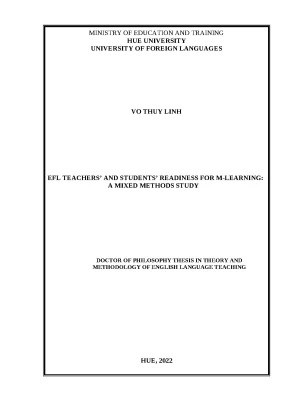
Tải xuống để đọc toàn bộMINISTRY OF EDUCATION AND TRAINING HUE UNIVERSITY UNIVERSITY OF FOREIGN LANGUAGES VO THUY LINH EFL TEACHERS’ AND STUDENTS’ READINESS FOR M-LEARNING: A MIXED METHODS STUDY DOCTOR OF PHILOSOPHY THESIS IN THEORY AND METHODOLOGY OF ENGLISH LANGUAGE TEACHING HUE, 2022 MINISTRY OF EDUCATION AND TRAINING HUE UNIVERSITY UNIVERSITY OF FOREIGN LANGUAGES VO THUY LINH EFL TEACHERS’ AND STUDENTS’ READINESS FOR M-LEARNING: A MIXED METHODS STUDY CODE: 9 14 01 11 DOCTOR OF PHILOSOPHY THESIS IN THEORY AND METHODOLOGY OF ENGLISH LANGUAGE TEACHING Supervisors: Assoc. Le Pham Hoai Huong Assoc. Nguyen Ngoc Vu HUE, 2022 TABLE OF CONTENTS PAGE STATEMENT OF AUTHORSHIP. Error! Bookmark not defined.viii LIST OF TABLES.
ix LIST OF FIGURES. x LIST OF ABBREVIATIONS. xi CHAPTER ONE: INTRODUCTION. Significance of the study.
Scope of the study. 4 CHAPTER TWO: LITERATURE REVIEW. An Overview of M-Learning. Definitions of M-Learning.
Face to face learning (FTF learning). Benefits of M-learning. Drawbacks of M-learning. Mobile technology in English teaching and learning.
EFL teachers and learners. Mobile technology readiness. Readiness of teachers and students for M-learning. Attitudes to use mobile technology in English teaching and learning.
Willingness to use mobile technology in English teaching and learning. Acceptance to use mobile technology in English teaching and learning. Continuous changes in mobile technology. Technology Acceptance Model (TAM) as the theoretical framework in the current study.
Perceived ease of use (PEOU). Review of previous studies. The research gaps and justification for the current study. Contributions from the thesis.
37 CHAPTER THREE: RESEARCH METHODOLOGY. Mixed methods approach. The research site and population. EFL teacher participants.
EFL student participants. The roles of the researcher. In-depth interviews. Data collection procedures.
The pilot study. The main study. Quantitative data analysis. In-depth interview analysis.
Classroom observation analysis. Summary of data analysis. Reliability and validity. 56 CHAPTER FOUR: RESEARCH RESULTS.
Results from the questionnaire. Demographics of EFL teachers and students. EFL teachers‟ and students‟ ownership of mobile devices. Reliability statistics for both EFL teacher and student questionnaires.
EFL teachers‟ perceptions of the use of mobile devices in teaching English 61 4. EFL students‟ perceptions of the use of mobile devices in learning English. EFL teachers‟ manipulation of mobile devices in teaching English. EFL students‟ manipulation of mobile devices for English learning.
EFL teachers‟ perceived usefulness of mobile devices to teach English. EFL students‟ perceived usefulness of mobile devices to learn English. EFL teachers‟ willingness to adapt to the constant changes of mobile technology. EFL students‟ willingness to adapt to the constant changes of mobile technology.
Results of EFL teachers‟ and students‟ questionnaire through One sample T- Test. In-depth interview data analysis. Attitudes toward using mobile devices in English teaching and learning: perceptions and agreement. EFL teachers‟ perceptions of M-learning.
EFL students‟ perceptions of M-learning. EFL teachers‟ agreement for M-learning. EFL students‟ agreement for M-learning. Abilities to use M-learning: adaptation and ownership.
EFL teachers‟ adaptation to changes of mobile technology. EFL students‟ adaptation on mobile devices. Mobile device ownership of EFL teachers. Mobile device ownership of EFL students.
Perceived ease of use mobile devices in English teaching and learning: equipment and adaptation. EFL teachers‟ assessment on equipment for M-learning. EFL students‟ assessment of equipment for M-learning. Perceived usefulness of mobile devices in English teaching and learning: Usefulness and expenditure.
Usefulness of M-learning in English teaching. Usefulness of M-learning in English learning. EFL teachers‟ assessment on expenditure of M-learning. EFL students‟ assessment on expenditure of M-learning.
Analysis of classroom observation data. Use of mobile devices in the pronunciation class. EFL teacher‟s use of mobile devices. EFL students‟ use of mobile devices.
Use of mobile devices in the listening class. EFL teacher‟s use of mobile devices. EFL students‟ use of mobile devices. Use of mobile devices in the writing class.
EFL teacher‟s use of mobile devices. EFL students‟ use of mobile devices. Use of mobile devices in the reading class. EFL teacher‟s use of mobile devices.
EFL students‟ use of mobile devices. Use of mobile devices in the grammar class. EFL teacher‟s use of mobile devices. EFL students‟ use of mobile devices.
EFL teachers‟ and students‟ perceptions of M-learning in teaching and learning English. EFL teachers‟ and students‟ perceptions of M-learning in teaching and learning English. EFL teachers‟ and students‟ perceived abilities/manipulation of mobile devices in English teaching and learning. EFL teachers‟ and students‟ perceived usefulness of M-learning in English teaching and learning.
EFL teachers‟ and students‟ willingness to adapt to changes in mobile technology. EFL teachers‟ and students‟ readiness for M-learning in English teaching and learning. 107 CHAPTER FIVE: CONCLUSIONS AND IMPLICATIONS. Summary of the key findings.
Recommendations from thesis. Implications for future research. Limitations of the study. 116 THE AUTHOR’S WORKS RELATED TO THE THESIS.
169 v STATEMENT OF AUTHORSHIP I certify my authorship of the current thesis submitted today entitled: “EFL Teachers’ and Students’ Readiness for M-Learning: A Mixed Methods Study” for the degree of Doctor of Education is the result of my own work. This work has not been submitted elsewhere for a higher degree at any other institution. To the best of my knowledge, the thesis contains no material previously published or written by other people except where the references are made in this thesis. Author‟s signature Vo Thuy Linh vi ACKNOWLEDGMENTS I would like to extend my gratitude to the distinguished professors who have supported the completion of my thesis.
First and foremost, I respectfully express my gratitude to my supervisors, Assoc. Le Pham Hoai Huong, and Assoc. Nguyen Ngoc Vu, for their emotional, mental, and intellectual support. Second, I would like to express my gratitude to Assoc.
Pham Thi Hong Nhung, the rector of Hue University of Foreign Languages. Throughout my PhD study, she was a strong supporter and encourager of my learning. Third, I am grateful to all of the lecturers at Hue University of Foreign Languages, as well as my former lecturers and many other academic panels, who have spent a significant amount of time reading and commenting on my thesis. In addition, I would like to thank the Department of Academic Affairs of Hue University of Foreign Languages.
Furthermore, I would like to express my heartfelt gratitude to the Rector Board and Department of Personnel at Sai Gon University for approving my doctoral study, supporting me with administrative documents, and allowing me to take time off for my research. I would also like to express my gratitude to all of the EFL participants for their willing and active involvement in my survey. To my parents, two hardworking farmers who instilled in me a strong drive to learn and investigate. I owe them a great debt of gratitude for allowing me to pursue my doctorate.
Let me express my heartfelt gratitude to my mother, the most wonderful woman who encouraged my studying spirit and assisted me in caring for my children while also shouldering my family's financial burden during my studies. I would also like to thank my two adorable and devoted girls, who have always been my spiritual support in helping me overcome obstacles during my studies. vii ABSTRACT This study aims to investigate EFL teachers‟ and students‟ perceptions of M- learning in English teaching and learning, as well as their readiness for the adoption of M-learning. The study adopted the theoretical framework of Technology Acceptance Model (TAM) and a mixed methods approach with the use of questionnaire, in-depth interviews, and classroom observations to collect and analyze data.
The participants included 69 teachers and 300 students who were teaching and learning English as a foreign language (EFL) at a university in Vietnam. The analysis of quantitative data revealed that the majority of the participants had positive attitudes toward M-learning and that most of them had already owned appropriate mobile devices for teaching and learning English. By adopting TAM, the current study explored the EFL teachers‟ and students‟ readiness through their perceived ease of use (PEU) and perceived usefulness (PU) or their claimed abilities, and manipulation of mobile devices in teaching and learning English. The questionnaire data indicated that EFL teachers had the ability to employ mobile devices in their classrooms and the capability of adopting M-learning into the lessons.
In comparison, EFL students tended to have a firmer claimed ability to adopt M-learning with higher mean scores achieved. In the interviews, both groups expressed their confidence in manipulating mobile devices‟ functions for their English teaching and learning. Besides, the class observations revealed that both teachers and students were apparently confident in using mobile devices during English lessons, and that when any technical problems appeared, the teachers and students were able to rely on themselves to tackle the problems. Another finding of the current study about readiness in perceived abilities revealed that the EFL teachers were in a position to adapt to the constant changes of mobile technology with their knowledge and experience of using mobile devices.
Similarly, EFL students tended to regard mobile devices in their English learning as valuable instruments to help them with their study, contact, communication, and materials. In the interviews and classroom observations, both EFL teachers and students reported that they all owned and utilized mobile devices for their English teaching and learning. Either were they well capable of adapting to the constant changes of mobile technology to serve their remote teaching and learning. From the findings of the study, further suggestions are put forward for the adoption of the mobile devices in English teaching and learning.
viii LIST OF TABLES Page Table 2.1: Differences between E-learning and M-learning. Quantitative data analysis. Qualitative data analysis. Profile of respondents.
EFL teachers‟ and students‟ mobile device ownership. Reliability Statistics for each cluster of both EFL teachers‟ and students‟ questionnaires. Reliability Statistics for both EFL teachers‟ and students‟ questionnaires. Summary of mean scores of teachers‟ and students‟ questionnaires.
Teachers‟ perceptions of the use of mobile devices in English teaching. EFL students‟ perceptions of the use of mobile devices in English learning. EFL teachers‟ manipulation of mobile devices in teaching English. EFL students‟ manipulation of mobile devices for English learning.
EFL teachers‟ perceived usefulness of mobile devices to teach English. EFL students‟ perceived usefulness of mobile devices. EFL teachers‟ willingness to adapt to constant changes of mobile technology. EFL students‟ willingness to adapt to the constant changes of mobile technology.
One sample T-Test of EFL teachers‟ questionnaire (N=69). One sample T-Test of EFL students‟ questionnaire (N=300). EFL teachers‟ perceptions of M-learning. EFL students‟ perceptions of M-learning.
EFL teachers‟ agreement for M-learning. EFL students‟ agreement for M-learning. EFL teachers‟ adaptation to changes of mobile technology. EFL students‟ adaptation on mobile devices.
Mobile device ownership of EFL teachers. Mobile device ownership of EFL students. EFL teachers‟ assessment on equipment for M-learning. EFL students‟ assessment of equipment for M-learning.
Usefulness of M-learning in English teaching. Usefulness of M-learning in English learning. EFL teachers‟ assessment on expenditure of M-learning. EFL students‟ assessment on expenditure of M-learning.92 ix LIST OF FIGURES Page Figure 2.
A Model of Mobile Learning Application (Zhong et al. The Wireless Virtual Learning Environment of „Today‟ (Keegan, 2005). Relationships between D- Learning, E- Learning, and M-Learning (Thurmond & Wambach, 2004). A Hierarchy of learning methodologies (Williams, 2009, p.
Technology Acceptance Model (TAM) (Davis, 1986). Technology Acceptance Model 2 (Venkatesh & Davis, 2000). Adapted TAM as the Theoretical Framework for the Current Study. Adopted theoretical frameworks for the current thesis.
The triangulation of a mixed methods study design model (Creswell & Clark, 2007).2: Research data analysis. Outline of research analysis and findings. Units of Analysis.
Nội dung được bảo vệ bản quyền — Tải xuống đầy đủ
Trích dẫn luận án này
Vo Thuy Linh (2022). Sẵn sàng học M-learning của giáo viên và học sinh EFL [Luận án tiến sĩ, University of Foreign Languages, Hue University]. LuanAn.net. https://luanan.net/giao-duc-hoc/muc-do-san-sang-hoc-m-learning-giao-vien-hoc-sinh-efl
Câu hỏi thường gặp
Luận án "Sẵn sàng học M-learning của giáo viên và học sinh EFL" nghiên cứu về vấn đề gì?
Luận án nghiên cứu mức độ sẵn sàng của giáo viên và sinh viên trong học tập di động (m-learning) theo phương pháp hỗn hợp.
Luận án "Sẵn sàng học M-learning của giáo viên và học sinh EFL" được bảo vệ tại trường nào?
Luận án này được bảo vệ tại University of Foreign Languages, Hue University. Năm bảo vệ: 2022.
Luận án "Sẵn sàng học M-learning của giáo viên và học sinh EFL" thuộc chuyên ngành gì?
Luận án "Sẵn sàng học M-learning của giáo viên và học sinh EFL" thuộc chuyên ngành Theory and Methodology of English Language Teaching. Danh mục: Giáo Dục Học.
Luận án "Sẵn sàng học M-learning của giáo viên và học sinh EFL" có bao nhiêu trang?
Luận án "Sẵn sàng học M-learning của giáo viên và học sinh EFL" có 187 trang. Bạn có thể xem trước một phần tài liệu ngay trên trang web trước khi tải về.
Cách tải luận án "Sẵn sàng học M-learning của giáo viên và học sinh EFL" về máy như thế nào?
Để tải luận án về máy, bạn nhấn nút "Tải xuống ngay" trên trang này, sau đó hoàn tất thanh toán phí lưu trữ. File sẽ được tải xuống ngay sau khi thanh toán thành công. Hỗ trợ qua Zalo: 0559 297 239.