Macaulay alexander s 200308 phd
Luận án tiến sĩ 200308 của Macaulay Alexander: phân tích sâu các thuật toán, phương pháp nghiên cứu, và đóng góp cho lĩnh vực chuyên môn.
University of Georgia
Luan An
Luận án tiến sĩ (Doctor of Philosophy Dissertation)
Năm xuất bản
Số trang
377
Thời gian đọc
57 phút
Lượt xem
0
Lượt tải
0
Phí lưu trữ
60 Point
Tổng quan nhanh
- Chủ đề:
- Alexander S. Macaulay: PhD Dissertation Summary
- Số trang:
- 377 trang
- Trường:
- University of Georgia
- Chuyên ngành:
- Lịch sử (History)
- Tác giả:
- Alexander Stephens Macaulay, Jr.
- Năm:
- 2003
Tóm tắt nội dung luận án
I. Macaulay PhD Dissertation Summary
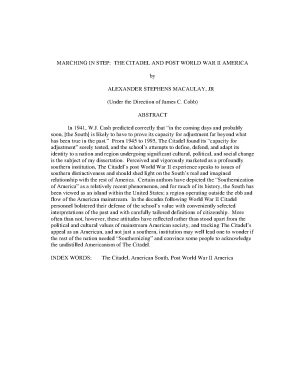
This section introduces the significant doctoral thesis by Alexander S. Macaulay, Jr. Titled "MARCHING IN STEP: THE CITADEL AND POST WORLD WAR II AMERICA," the work provides an in-depth analysis of The Citadel's institutional evolution. Dr. Macaulay's PhD dissertation investigates how this prominent Southern military college navigated profound societal shifts from 1945 to 1995. The research topic centers on The Citadel's continuous efforts to define, defend, and adapt its unique identity. This period witnessed vast cultural, political, and social transformations across America. The dissertation stands as a crucial contribution to understanding regional identity within a national context. It illuminates the challenges faced by traditional institutions in an era of rapid change. This academic endeavor showcases Alexander S. Macaulay's rigorous scholarly approach.
1.1. Doctoral Thesis Overview by Alexander S. Macaulay
Alexander S. Macaulay's doctoral thesis, submitted in 2003, offers a comprehensive study of The Citadel. The dissertation examines the school's response to American changes between 1945 and 1995. It questions the historical perception of the American South as isolated from mainstream trends. The research suggests The Citadel's experience may reflect broader national values. This perspective challenges conventional narratives about Southern distinctiveness. Dr. Macaulay's work provides valuable insights into institutional adaptation.
1.2. Research Topic The Citadel s Post WWII Identity Shift
The primary research topic for Alexander S. Macaulay's work is The Citadel's identity formation post-World War II. The institution, perceived as profoundly Southern, faced immense pressure to adjust. The dissertation explores how The Citadel defined its value and citizenship in a changing landscape. It investigates the school's efforts to balance tradition with national developments. This focus sheds light on the complex relationship between regional and national identities. Dr. Macaulay's analysis reveals evolving interpretations of the past.
II.The Citadel s Adaptation Post WWII Identity Research
Dr. Macaulay's PhD dissertation deeply explores The Citadel's "capacity for adjustment" during a critical half-century. From 1945 to 1995, the institution encountered significant external pressures. This research meticulously tracks the school's attempts to maintain its core values while responding to a nation in flux. The study emphasizes the cultural, political, and social changes sweeping through post-World War II America. Alexander S. Macaulay's analysis details how The Citadel strategically articulated its identity. It examines the use of historical interpretations and specific definitions of citizenship. This period marked a crucial test for the institution's resilience and relevance. The findings provide a nuanced understanding of institutional survival and evolution.
2.1. The Citadel s Capacity for Adjustment 1945 1995
The period 1945-1995 presented unique challenges for The Citadel. W. Cash's prediction of the South's need for adjustment proved accurate. The Citadel found its identity tested by significant societal shifts. The institution actively sought to define, defend, and adapt its image. This struggle is central to Dr. Macaulay's research. It highlights the dynamic interplay between tradition and progress within a prominent educational setting. The doctoral thesis meticulously documents these fifty years of adaptation.
2.2. Southern Distinctiveness vs. American Mainstream Debate
Alexander S. Macaulay's research engages with the debate surrounding Southern distinctiveness. The Citadel's experience is presented as a case study. Many authors portray the South as an "island" outside the American mainstream. However, this PhD dissertation questions this long-held view. It investigates whether The Citadel's attitudes truly stood apart or reflected mainstream American values. The findings contribute to a richer understanding of the South's real and imagined ties to the rest of the nation.
III. Macaulay UGA PhD
The academic journey culminating in Dr. Macaulay's comprehensive doctoral thesis was undertaken at a prestigious institution. Alexander S. Macaulay, Jr. successfully completed the requirements for the Degree of Doctor of Philosophy at The University of Georgia. This academic affiliation highlights the rigorous standards and scholarly environment supporting the research. The dissertation was officially approved in August 2003, marking a significant milestone in graduate studies. The University of Georgia provided the intellectual framework and resources necessary for this extensive historical examination. This institutional backing underscores the credibility and depth of the research presented by Alexander S. Macaulay.
3.1. Academic Institution The University of Georgia PhD
Alexander S. Macaulay, Jr.'s PhD dissertation was submitted to the Graduate Faculty of The University of Georgia. This esteemed academic institution conferred the Doctor of Philosophy degree in 2003. The university's strong graduate studies program provided a fertile ground for historical inquiry. Its resources supported Dr. Macaulay's extensive research into The Citadel's post-WWII history. This affiliation connects the work to a respected academic tradition.
3.2. PhD Supervisor James C. Cobb s Mentorship Role
The success of Alexander S. Macaulay's doctoral thesis owes much to the guidance of his major professor, James C. Cobb. Professor Cobb served as a crucial PhD supervisor, offering invaluable support and scholarly direction. The dissertation committee also included Emory Thomas, Bryant Simon, and Robert A. Dyer. Their collective expertise enriched the research process. This strong supervisory committee reflects the quality of graduate studies at The University of Georgia. The mentorship ensured academic rigor throughout the project.
IV. Research
Alexander S. Macaulay's PhD dissertation offers profound insights, particularly challenging prevailing historical narratives. The research meticulously tracks The Citadel's appeal not merely as a Southern entity but as an American institution. This perspective questions the notion that the rest of the nation required "Southernizing." Dr. Macaulay's findings suggest an "undistilled Americanism" present within The Citadel's values and actions. This re-evaluation reshapes understanding of regional identity and national integration. The thesis posits that The Citadel's attitudes often mirrored, rather than diverged from, mainstream American political and cultural values. This critical analysis contributes significantly to post-World War II American studies.
4.1. Challenging Southernization of America Narrative
A central insight from Dr. Macaulay's research challenges the idea of "Southernization of America." This phenomenon is often depicted as relatively recent. However, the doctoral thesis by Alexander S. Macaulay argues against a simple unidirectional influence. It suggests that Southern institutions, like The Citadel, often reflected national trends. This view offers a more complex interpretation of cultural exchange. The work provides evidence that "Southernization" may be a misnomer in some contexts.
4.2. The Citadel as an American Institution Not Just Southern
Alexander S. Macaulay's research illuminates The Citadel's identity beyond regional stereotypes. The institution, while deeply rooted in the South, often aligned with broader American ideals. Its defense of values, though framed regionally, often resonated nationally. The dissertation invites observers to acknowledge The Citadel's inherent Americanism. This finding encourages a re-evaluation of institutional identity within diverse national landscapes. It suggests a strong American core, even in institutions perceived as distinctively Southern.
V. Macaulay s Research
The comprehensive research conducted by Alexander S. Macaulay, Jr., as part of his graduate studies, leaves a lasting impact on historical scholarship. This PhD dissertation provides a rich resource for understanding post-World War II America, particularly concerning institutional adaptation and regional identity. Dr. Macaulay's meticulous approach to The Citadel's history offers a model for future historical inquiry. The thesis contributes to ongoing debates about the South's place within the United States. Its insights encourage further exploration into how regional characteristics interact with national narratives. The work by Alexander S. Macaulay serves as a benchmark for scholarly excellence in Southern history.
5.1. Contributions to Post World War II American History
Alexander S. Macaulay's doctoral thesis significantly enriches the historiography of Post World War II America. It provides a detailed case study of how a Southern institution responded to a half-century of intense change. The analysis of cultural, political, and social dynamics offers valuable context for national developments. Dr. Macaulay's work sheds new light on the complexities of institutional identity during periods of rapid societal evolution. Its contribution to American history is substantial.
5.2. Alexander S. Macaulay s Scholarly Impact Future Research
The scholarly impact of Dr. Macaulay's PhD dissertation extends to future research avenues. It encourages scholars to re-examine regional institutions through a national lens. The nuanced understanding of "Southern distinctiveness" versus "American mainstream" provides a framework for new studies. Alexander S. Macaulay's meticulous research methodology serves as an example. His work inspires continued academic exploration into identity, adaptation, and the South's evolving relationship with the United States.
Tải xuống file đầy đủ để xem toàn bộ nội dung
Tải đầy đủ (377 trang)Trích đoạn nội dung luận án
Tải xuống để đọc toàn bộMARCHING IN STEP: THE CITADEL AND POST WORLD WAR II AMERICA by ALEXANDER STEPHENS MACAULAY, JR (Under the Direction of James C. Cobb) ABSTRACT In 1941, W. Cash predicted correctly that “in the coming days and probably soon, [the South] is likely to have to prove its capacity for adjustment far beyond what has been true in the past.” From 1945 to 1995, The Citadel found its “capacity for adjustment” sorely tested, and the school’s attempts to define, defend, and adapt its identity to a nation and region undergoing significant cultural, political, and social change is the subject of my dissertation. Perceived and vigorously marketed as a profoundly southern institution, The Citadel’s post World War II experience speaks to issues of southern distinctiveness and should shed light on the South’s real and imagined relationship with the rest of America.
Certain authors have depicted the “Southernization of America” as a relatively recent phenomenon, and for much of its history, the South has been viewed as an island within the United States; a region operating outside the ebb and flow of the American mainstream. In the decades following World War II Citadel personnel bolstered their defense of the school’s value with conveniently selected interpretations of the past and with carefully tailored definitions of citizenship. More often than not, however, these attitudes have reflected rather than stood apart from the political and cultural values of mainstream American society, and tracking The Citadel’s appeal as an American, and not just a southern, institution may well lead one to wonder if the rest of the nation needed “Southernizing” and convince some people to acknowledge the undistilled Americanism of The Citadel. INDEX WORDS: The Citadel, American South, Post World War II America MARCHING IN STEP: THE CITADEL AND POST WORLD WAR II AMERICA by ALEXANDER STEPHENS MACAULAY, JR., The University of Tennessee, 1998 A Dissertation Submitted to the Graduate Faculty of the University of Georgia in Partial Fulfillment of the Requirements for the Degree DOCTOR OF PHILOSPOHY ATHENS, GEORGIA 2003 © 2003 Alexander Stephens Macaulay, Jr.
All Rights Reserved MARCHING IN STEP: THE CITADEL AND POST WORLD WAR II AMERICA by ALEXANDER STEPHENS MACAULAY, JR. Major Professor: James C. Cobb Committee: Emory Thomas Bryant Simon Robert A. Dyer Electronic Version Approved: Maureen Grasso Dean of the Graduate School The University of Georgia August 2003 ACKNOWLEDGEMENTS Since I wrote my dissertation on The Citadel, it seems fitting that I thank Citadel people first.
Jane Yates, the school’s archivist and museum director, has been an invaluable help and a wonderful friend over the past several years. Not only has she helped me track down sources and find out what happened and when, she has been a source of encouragement and a voice of reason, letting me know when it was time to get down to the business of writing. She does a wonderful job with The Citadel Archives and Museum and I am glad we share a mutual interest in history. The alumni who took time out of their busy schedules to talk with me about their experiences reinforce the theory that all not all Citadel graduates fit the same mold.
I thank them for their candor and honesty, and while speaking with them, it became evident that our conversations were driven by a commitment to improving our alma mater. The five members of my dissertation committee have set a standard of scholarly excellence that I doubt I could match, but it would be foolish of me not to try. James Cobb once characterized his mentoring approach as one of “benign neglect.” I can assure you, while working with him I have never felt neglected and, if you ever read the comments he scrawled on rough drafts of this dissertation, the word “benign” would not pop into your head. Cobb has done is provided me with invaluable personal and professional guidance.
His patience with me as well as his interest in me have given me greater confidence in my own abilities, and besides, it helps to know that if someone iv from Hartwell, Georgia can do this job then surely someone from Walhalla, South Carolina can excel at it. Bryant Simon has made me a better writer, a better historian, and a better basketball player. I find his work ethic, enthusiasm, and intellectual curiosity inspiring, and I absolutely enjoy every conversation I have with him. As good a scholar and teacher as he is though, Dr.
Simon has been an even better neighbor and friend. Speaking of good neighbors, Emory and Fran Thomas helped make Hill Street a special place to live when Eleanor and I first arrived in Athens. Thomas’ excitement for and interest in not only my academic work but my (rapidly) growing family means a lot to me, and although he hails from Virginia, he seems to have a soft spot for South Carolina which endears him to me even further. I encourage anyone who still thinks that college professors work and live in an “ivory tower” to visit the bottom floor of Leconte Hall and talk with Robert Pratt.
He exudes confidence without a trace of egotism or pretension, and besides that, he read my dissertation while on vacation at Myrtle Beach, a fact which shoots down the theory that teachers get their summers off. My relationship with Dr. Tom Dyer has been relatively brief, but he has worked hard to help make this dissertation better in addition to performing myriad other duties for the University of Georgia. Of course, while these five professors only had to put up with me for brief periods, my fellow graduate students tolerated my quirks and endless references to Walhalla on a regular basis.
I am absolutely positive I owe all of them a beer; I am not saying I will buy them one, but at least I acknowledge the debt. I have shared an office with Anne Marshall for the past five years, and she remains one of the most impressive individuals I have ever met. I sat next to Jim Giesen at orientation five years ago. He v thought my name was “Elk” and this is still the nicest thing he has ever called me.
Both of them have made Athens fun for Eleanor, Eliza, Lee, and me. Tammy Ingram may look dumb, but we all know different, and her passion for fudge, whiskey and tator tots makes her all the more wonderful. From the days when he would lie to get me to come downtown and do a shot of El Presidente to his all to infrequent visits back to Athens, Matt Brodsky has also made my Athens experience memorable as well as a little fuzzy. I also thank the Drive By Truckers.
My family, of course, are the ones who have made my accomplishments worthwhile, memorable, and possible. My mother and father do not always agree with me, but they have always supported me. In doing so, they have given me a sense of security and comfort that all people should receive and that I truly value. My in-laws have made me feel welcome from the first day I met them, and they never asked me when I was going to finish and “get a real job.” To a graduate student, that is a big deal.
My greatest thanks go to Eleanor, Eliza and Lee. I might have been able to write this without Eleanor’s help, but the finished product would have suffered. Besides, beyond her editorial and analytical prowess, knowing Eleanor has made me a better person. I cannot express how much she means to me or how much I love her so I will not try.
I am fairly certain I could have written this without Lee and Eliza. But nothing in the world compares to walking in the door of our home and seeing a beautiful little girl running at me, grinning behind her pacifier, saying “heeeeyyyy,” while right behind her, her equally beautiful brother crawls across the floor and lifts his arms up for me to hold him. They have provided the inspiration to try to make the world we live in a better place. vi TABLE OF CONTENTS Page ACKNOWLEDGEMENTS.1 CHAPTER ONE: “AN AMERICAN EPIC”.14 CHAPTER TWO: SOARING WITH THE AMERICAN EAGLE.59 CHAPTER THREE: BLACK, WHITE AND GRAY.102 CHAPTER FOUR: AN “OASIS OF ORDER” .148 CHAPTER FIVE: AN EPITAPH FOR THE CITADEL, 1970-1975 .183 CHAPTER SIX: THE SPIRIT OF ’76 .223 CHAPTER SEVEN: REAGAN’S AMERICA, GRIMSLEY’S CITADEL.272 CHAPTER EIGHT: SAVE THE MALES .354 vii INTRODUCTION In his travel guide to the neo-Confederate South, Tony Horowitz calls The Citadel “arguably the most mummified institution in America.” Numerous observers have echoed Horowitz’s sentiments.
Following a tumultuous and frustrating year as the school’s president, an embittered Vice Admiral James Stockdale grumbled “the place is locked in pre-Civil War concrete.” A historian of Charleston and a former professor at The Citadel claims “perhaps more than any other institution of higher education The Citadel best reflects the cultural values of the Old South.” In a recent essay, Timothy Tyson calls the school “perhaps the most hidebound institution in tradition-steeped South Carolina.”1 While some may find it convenient and even reassuring to depict The Citadel as timeless and immutable, such an assessment fuels distorted views of the South and the United States. In Stiffed, Susan Faludi recognizes that “institutions that boast of their insularity, whether convents or military academies, are commonly pictured in the public imagination as static, unchanging abstractions, impervious to the ebb and flow of current events.” She adds though that despite their often purposeful and well cultivated 1 Tony Horowitz, Confederates In the Attic: Dispatches From the Unfinished Civil War (New York: Vintage Books, 1998), 66; Newsweek, 1 September 1980, 83; Charles Reagan Wilson and William Ferris, eds, The Encyclopedia of Southern Culture (Chapel Hill: University of North Carolina Press, 1989), 277; Timothy B. Tyson, “Dynamite and the ‘Silent South’: A Story from the Second Reconstruction in South Carolina,” Jumpin’ Jim Crow: Southern Politics from Civil War to Civil Rights, eds. Jane Dailey, Glenda Elizabeth Gilmore, and Bryant Simon (Princeton: Princeton University Press, 2000), 279-280.
1 reputations as bulwarks of tradition, places such as The Citadel have “functioned more as a barometer of national anxieties than as a stalwart garrison against them.”2 Dismissing The Citadel as backward and archaic contributes to a one-dimensional assessment of the school’s historical and cultural value and downplays the massive changes that have occurred in the nation and the South since the end of World War II. Cash predicted correctly that “In the coming days and probably soon, [the South] is likely to have to prove its capacity for adjustment far beyond what has been true in the past.” Like the South at large, from 1945 to 1995, The Citadel found its “capacity for adjustment” sorely tested as well.3 The Citadel was perceived and vigorously promoted as a profoundly southern institution. Its post World War II experience speaks to issues of southern cultural distinctiveness and should shed light on the South’s real and imagined relationship with the rest of America. As the college’s alumni, students, and administrators responded to the changes in American society, their reform impulse was tempered by the traditional, regional, and institutional fear that “too much change” would cost the school and its students their unique identity.
Challenges to the college’s rules, regulations, and traditions met resistance from those who howled that “The Citadel must not become just another Clemson.” Frequently, Citadel personnel bolstered their defense of the school’s importance with conveniently selected interpretations of the institution’s, the South’s, and the nation’s past. Fitzhugh Brundage has argued that “If characterizations of southern 2 Susan Faludi, Stiffed: The Betrayal of the American Man (New York: William Morrow and Company, Inc. Cash, The Mind of the South (New York: Alfred A., 1941, reprint, New York: Vintage Books, 1991), 429.
Nội dung được bảo vệ bản quyền — Tải xuống đầy đủ
Trích dẫn luận án này
Alexander Stephens Macaulay, Jr. (2003). Macaulay alexander s 200308 phd [Luận án tiến sĩ, University of Georgia]. LuanAn.net. https://luanan.net/giao-duc-hoc/macaulay-alexander-s-200308-phd
Câu hỏi thường gặp
Luận án "Macaulay alexander s 200308 phd" nghiên cứu về vấn đề gì?
Luận án tiến sĩ 200308 của Macaulay Alexander: phân tích sâu các thuật toán, phương pháp nghiên cứu, và đóng góp cho lĩnh vực chuyên môn.
Luận án "Macaulay alexander s 200308 phd" được bảo vệ tại trường nào?
Luận án này được bảo vệ tại University of Georgia. Năm bảo vệ: 2003.
Luận án "Macaulay alexander s 200308 phd" thuộc chuyên ngành gì?
Luận án "Macaulay alexander s 200308 phd" thuộc chuyên ngành Lịch sử (History). Danh mục: Giáo Dục Học.
Luận án "Macaulay alexander s 200308 phd" có bao nhiêu trang?
Luận án "Macaulay alexander s 200308 phd" có 377 trang. Bạn có thể xem trước một phần tài liệu ngay trên trang web trước khi tải về.
Cách tải luận án "Macaulay alexander s 200308 phd" về máy như thế nào?
Để tải luận án về máy, bạn nhấn nút "Tải xuống ngay" trên trang này, sau đó hoàn tất thanh toán phí lưu trữ. File sẽ được tải xuống ngay sau khi thanh toán thành công. Hỗ trợ qua Zalo: 0559 297 239.