Lesley mres dissertation final february 2017
Luận án: Lesley mres dissertation final february 2017. Xem tóm tắt và tải về tại LuanAn.net
The Open University
Research Skills / Online and Distance Education
Luan An
Luận văn thạc sĩ
Năm xuất bản
Số trang
81
Thời gian đọc
13 phút
Lượt xem
0
Lượt tải
0
Phí lưu trữ
40 Point
Tổng quan nhanh
- Chủ đề:
- MRes Dissertation: Learning Networks & Engagement
- Số trang:
- 81 trang
- Trường:
- The Open University
- Chuyên ngành:
- Research Skills / Online and Distance Education
- Tác giả:
- Lesley Boyd
- Năm:
- 2017
Tóm tắt nội dung luận án
I.MRes Dissertation Learning Networks Engagement
This academic dissertation presents a Master of Research (MRes) thesis. Its focus lies on technology-enabled learning networks (TELNs). The research explores their utility in achieving practical improvement outcomes. The document represents a significant postgraduate research effort. Lesley Boyd authored this research thesis in February 2017. It details a pilot project conducted at The Open University (OU). The project specifically targets enhancing student engagement. Organisational learning is crucial for public service improvement. Rashman et al. (2009) highlight this observation. However, knowledge gaps exist concerning TELN mechanisms. Specifically, their role in achieving tangible improvements remains unclear. Existing TELN work often focuses on individual knowledge. It improves individual practice or academic understanding. This postgraduate research addresses this identified gap. It seeks to understand systemic improvement mechanisms. The research aimed to address a critical need. It sought to increase student engagement. This goal was applied within the Masters in Online and Distance Education (MAODE) program. The program operates at the OU Institute of Educational Technology (IET). A specific intervention was employed. Student-made engagement videos were introduced. The project investigated the videos' impact. It explored how they fostered a sense of community engagement.
1.1. Introduction to the Academic Dissertation
This academic dissertation presents a Master of Research (MRes) thesis. Its focus lies on technology-enabled learning networks (TELNs). The research explores their utility in achieving practical improvement outcomes. The document represents a significant postgraduate research effort. Lesley Boyd authored this research thesis in February 2017. It details a pilot project conducted at The Open University (OU). The project specifically targets enhancing student engagement.
1.2. Problem Statement in Postgraduate Research
Organisational learning is crucial for public service improvement. Rashman et al. (2009) highlight this observation. However, knowledge gaps exist concerning TELN mechanisms. Specifically, their role in achieving tangible improvements remains unclear. Existing TELN work often focuses on individual knowledge. It improves individual practice or academic understanding. This postgraduate research addresses this identified gap. It seeks to understand systemic improvement mechanisms.
1.3. Aim Boosting Student Engagement in MAODE
The research aimed to address a critical need. It sought to increase student engagement. This goal was applied within the Masters in Online and Distance Education (MAODE) program. The program operates at the OU Institute of Educational Technology (IET). A specific intervention was employed. Student-made engagement videos were introduced. The project investigated the videos' impact. It explored how they fostered a sense of community engagement.
II.Technology Enabled Learning Networks Research
A clear definition of technology-enabled learning networks (TELNs) guides this academic dissertation. Koper (2009) defines TELNs as technology-supported communities. These communities consist of individuals. They help each other understand and manage events or concepts. This understanding applies to work or life contexts. The concept underpins the entire research thesis. It provides a foundational understanding for the study. The research explores the practical application of this definition. A literature review informed the research context. It examined organizational learning in public service. Learning within and between organizations is vital. It drives public service improvement processes. This insight comes from Rashman et al. (2009). Despite this, mechanisms for technology-enabled organizational learning are less understood. The existing body of knowledge focuses on individual-level learning. This postgraduate research sought to move beyond this individual focus. This Master of Research project utilized an innovative approach. It employed technology-enabled participatory action research. This research methodology simultaneously pursues improvement outcomes. It also reflects on the learning processes. This dual objective is central to action research. The approach was chosen to directly address the identified research gap. It investigates how TELNs contribute to practical, systemic improvements.
2.1. Defining Technology Enabled Learning Networks
A clear definition of technology-enabled learning networks (TELNs) guides this academic dissertation. Koper (2009) defines TELNs as technology-supported communities. These communities consist of individuals. They help each other understand and manage events or concepts. This understanding applies to work or life contexts. The concept underpins the entire research thesis. It provides a foundational understanding for the study. The research explores the practical application of this definition.
2.2. Context of Organizational Learning Review
A literature review informed the research context. It examined organizational learning in public service. Learning within and between organizations is vital. It drives public service improvement processes. This insight comes from Rashman et al. (2009). Despite this, mechanisms for technology-enabled organizational learning are less understood. The existing body of knowledge focuses on individual-level learning. This postgraduate research sought to move beyond this individual focus.
2.3. Bridging Research Gaps with Action Research
This Master of Research project utilized an innovative approach. It employed technology-enabled participatory action research. This research methodology simultaneously pursues improvement outcomes. It also reflects on the learning processes. This dual objective is central to action research. The approach was chosen to directly address the identified research gap. It investigates how TELNs contribute to practical, systemic improvements.
III.Research Methodology Data Analysis Approach
The chosen research methodology was participatory action research. This approach is iterative. It involves cycles of planning, acting, observing, and reflecting. A learning network was established. This network served as the case study environment. It operated within the MAODE program at IET. This method facilitates collaborative learning. It also supports continuous improvement. The project aimed for both practical outcomes and learning insights. A literature review identified three conceptual frameworks. These frameworks were central to the analysis. They were compared, applied, and evaluated. Their utility within the established learning network was assessed. The application tested their descriptive power. It examined their ability to explain network dynamics. This step was crucial for evaluating existing theory. It prepared for potential framework development. Data analysis involved thematic analysis. Interactions within the learning network generated data. This qualitative research method identified patterns and themes. It determined the utility of the three identified frameworks. The analysis also explored the justification for a new framework. This new framework would support the innovative action research approach. It aimed to provide deeper insights into learning mechanisms.
3.1. Participatory Action Research Methodology
The chosen research methodology was participatory action research. This approach is iterative. It involves cycles of planning, acting, observing, and reflecting. A learning network was established. This network served as the case study environment. It operated within the MAODE program at IET. This method facilitates collaborative learning. It also supports continuous improvement. The project aimed for both practical outcomes and learning insights.
3.2. Literature Review on Conceptual Frameworks
A literature review identified three conceptual frameworks. These frameworks were central to the analysis. They were compared, applied, and evaluated. Their utility within the established learning network was assessed. The application tested their descriptive power. It examined their ability to explain network dynamics. This step was crucial for evaluating existing theory. It prepared for potential framework development.
3.3. Thematic Data Analysis of Interactions
Data analysis involved thematic analysis. Interactions within the learning network generated data. This qualitative research method identified patterns and themes. It determined the utility of the three identified frameworks. The analysis also explored the justification for a new framework. This new framework would support the innovative action research approach. It aimed to provide deeper insights into learning mechanisms.
IV.Student Engagement Improvement Outcomes Findings
The learning network encountered numerous challenges. Despite these, the project reached its evaluation stage. This occurred in the first cycle of the action research spiral. Students provided insightful and useful feedback. This feedback offered valuable perspectives. Two additional student-made videos were produced. These outcomes demonstrate practical improvements. They highlight the potential of the approach. The three applied frameworks offered descriptive utility. They helped analyze component parts of the learning network. They also identified critical success factors. However, a significant limitation was noted. These frameworks did not adequately identify the mechanism. Specifically, they failed to explain how learning happens within the network. This observation highlights a theoretical gap. The project faced various operational challenges. These impacted the network's progress. Yet, reflections on collaborative learning occurred. The process itself yielded improvement suggestions. Future work could integrate these. This involves establishing the network's ongoing operation. It also includes embracing a more systemic approach. Success in achieving practical outcomes requires ongoing evaluation.
4.1. Practical Outcomes Student Feedback Videos
The learning network encountered numerous challenges. Despite these, the project reached its evaluation stage. This occurred in the first cycle of the action research spiral. Students provided insightful and useful feedback. This feedback offered valuable perspectives. Two additional student-made videos were produced. These outcomes demonstrate practical improvements. They highlight the potential of the approach.
4.2. Evaluating Frameworks Descriptive Tools
The three applied frameworks offered descriptive utility. They helped analyze component parts of the learning network. They also identified critical success factors. However, a significant limitation was noted. These frameworks did not adequately identify the mechanism. Specifically, they failed to explain how learning happens within the network. This observation highlights a theoretical gap.
4.3. Challenges and Reflections on Learning
The project faced various operational challenges. These impacted the network's progress. Yet, reflections on collaborative learning occurred. The process itself yielded improvement suggestions. Future work could integrate these. This involves establishing the network's ongoing operation. It also includes embracing a more systemic approach. Success in achieving practical outcomes requires ongoing evaluation.
V.New Frameworks Future Postgraduate Research
The data analysis strongly suggests a new framework is justified. This new framework would combine necessary elements. It would draw from the three frameworks identified in the literature review. Crucially, it would integrate a narrative-based series of events. This narrative would represent collaborative mechanisms. It aims to explain how technology-enabled organizational learning occurs. Future project work has clear directions. It includes establishing the ongoing operation of the learning network. This would be within the IET context. Implementing improvement suggestions is another key step. Embracing a more systemic approach is vital. Success in achieving practical improvement outcomes requires continuous evaluation. This would build upon the initial research thesis. The proposed new framework holds significant potential. It could form the basis for further PhD research. Such postgraduate research would delve deeper. It would explore the mechanisms of technology-enabled learning. This advancement could contribute substantially to the field. It represents a valuable next step in academic writing and inquiry.
5.1. Justification for a Novel Research Framework
The data analysis strongly suggests a new framework is justified. This new framework would combine necessary elements. It would draw from the three frameworks identified in the literature review. Crucially, it would integrate a narrative-based series of events. This narrative would represent collaborative mechanisms. It aims to explain how technology-enabled organizational learning occurs.
5.2. Future Directions for Academic Dissertation
Future project work has clear directions. It includes establishing the ongoing operation of the learning network. This would be within the IET context. Implementing improvement suggestions is another key step. Embracing a more systemic approach is vital. Success in achieving practical improvement outcomes requires continuous evaluation. This would build upon the initial research thesis.
5.3. Potential for PhD Research and Development
The proposed new framework holds significant potential. It could form the basis for further PhD research. Such postgraduate research would delve deeper. It would explore the mechanisms of technology-enabled learning. This advancement could contribute substantially to the field. It represents a valuable next step in academic writing and inquiry.
Mục lục chi tiết luận án
Tải xuống file đầy đủ để xem toàn bộ nội dung
Tải đầy đủ (81 trang)Trích đoạn nội dung luận án
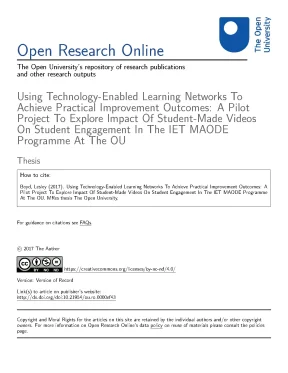
Tải xuống để đọc toàn bộOpen Research Online The Open University’s repository of research publications and other research outputs Using Technology-Enabled Learning Networks To Achieve Practical Improvement Outcomes: A Pilot Project To Explore Impact Of Student-Made Videos On Student Engagement In The IET MAODE Programme At The OU Thesis How to cite: Boyd, Lesley (2017). Using Technology-Enabled Learning Networks To Achieve Practical Improvement Outcomes: A Pilot Project To Explore Impact Of Student-Made Videos On Student Engagement In The IET MAODE Programme At The OU. MRes thesis The Open University. For guidance on citations see FAQs.
c 2017 The Author https://creativecommons.org/licenses/by-nc-nd/4.0/ Version: Version of Record Link(s) to article on publisher’s website: http://dx.0000ef43 Copyright and Moral Rights for the articles on this site are retained by the individual authors and/or other copyright owners. For more information on Open Research Online’s data policy on reuse of materials please consult the policies page.uk Using technology-enabled learning networks to achieve practical improvement outcomes: a pilot project to explore impact of student-made videos on student engagement in the IET MAODE programme at the OU Dissertation for Masters in Research Skills Lesley Boyd February 2017 Learning networks MRes Dissertation – Lesley Boyd Version 4.2 February 2017 Abstract This project investigated how technology-enabled learning networks can be used to achieve practical improvement outcomes at the OU. Koper (2009) defines a technology-enabled learning network as ‘a technology supported community of people who are helping each other to better understand and handle certain events and concepts in work or life’. In a literature review of organisational learning in public service organisations in the UK, Rashman et al.
(2009) observe that ‘learning within and between organisations has been identified as central to the processes of public service improvement’. However, little is known about the mechanisms of technology-enabled organisational learning to achieve practical improvement outcomes. Existing work on technology-enabled learning networks tends to be dominated by academic or professional learning, the primary objective being the improvement of knowledge or practice residing in individuals. The aim of this research is to address that gap, using an innovative technology-enabled participatory action research approach.
Action research simultaneously seeks improvement outcomes whilst reflecting on the learning taking place. The project established a learning network, using the Masters in Online and Distance Education (MAODE) programme in the OU Institute of Educational Technology, as a case study. The practical improvement outcome sought was to increase the sense of student engagement with the MAODE learning community, by using student-made engagement videos. The project investigated the extent to which student-made videos assisted in providing the student with a sense of engagement within their learning community.
It then reflected on the collaborative learning taking place in seeking the improvement. Learning networks MRes Dissertation – Lesley Boyd Version 4.2 February 2017 Three conceptual frameworks from the literature were compared, applied to the learning network, and evaluated. Data from the learning network interactions was thematically analysed to determine the utility of the three identified frameworks, and whether a new framework was justified which would support the innovative technology-enabled participatory action research approach. Despite numerous challenges, the learning network was able to proceed as far as the evaluation stage in the first cycle of an action research spiral.
Some insightful and useful feedback was provided by students, and two additional videos were produced. Future project work could include establishing the ongoing operation of the learning network within IET, following through the improvement suggestions which have been made, embracing a more systemic approach, and evaluating success in achieving practical improvement outcomes. The three applications of the identified frameworks to the learning network illustrated that they are indeed descriptive tools which can help to analyse component parts and critical success factors necessary in a learning network environment. However it appears that they are still not adequate in identifying the mechanism by which the learning happens.
The data analysis suggests there is some justification for a new framework, potentially combining the necessary elements of the three frameworks identified in the literature, with a narrative based series of events which represent the collaborative mechanisms by which technology-enabled organisational learning may occur. This may form the basis of further PhD research. Learning networks MRes Dissertation – Lesley Boyd Version 4.2 February 2017 Contents Chapter 1: Aims and objectives .1 Introduction and rationale .2 What do we mean by learning to improve and the achievement of practical outcomes? 3 1.3 Overall aim of the research. 5 Chapter 2: Literature review .1 Communities of Practice: Value creation in communities and networks .2 Cultural Historical Activity Theory .3 Activity-centred analytic framework .4 Comparison of the three frameworks.5 Pilot project research questions and objectives.
15 Chapter 3: Research methodology & methods of data collection.2 Why action research? .3 The process of action research .4 Identification and development of the case study project. 21 Identification and rejection of case study project A. 21 Identification and rejection of case study project B. 22 Identification and adoption of the final case study project – plan C .5 What do we mean by student engagement? .6 Capturing the student feedback data .7 Identifying a technical platform for the learning network .9 Justification for data analysis method .10 Ensuring ethical conduct throughout duration of the project.
38 Learning networks MRes Dissertation – Lesley Boyd Version 4.11 Managing project risks .12 Approval from the Student Research Project Panel for an innovative project .13 Summary of methodology and approach. 42 Chapter 4: Collecting and analysing the data.1 Collecting the student feedback data .2 Analysis of the student feedback data .3 Collecting the discussion forum data .4 Challenges in data collection .5 Analysis of the discussion forum data. 48 Chapter 5: Interpreting the data .1 Assessment of findings .2 Limitations of study. 70 Learning networks MRes Dissertation – Lesley Boyd Version 4.2 February 2017 Chapter 1: Aims and objectives 1.1 Introduction and rationale Since the advent of the internet and web-based communications technologies, the analysis and research of the impact of technology-enabled learning networks has been a growing inter-disciplinary endeavour (Carvalho and Goodyear, 2014).
Koper (2009) defines a technology-enabled learning network as ‘a technology supported community of people who are helping each other to better understand and handle certain events and concepts in work or life’. Today, online networks are used extensively across the globe to share knowledge, resources, experiences and insights about aspects of professional practice. Web portals, discussion forums, blogs, wikis and social networking tools are being combined to enable communication, interaction and learning on an unprecedented scale. A 2011 United Nations publication Networks for Prosperity: Achieving Development Goals Through Knowledge Sharing observes that ‘networks, formal and informal, local and global, are increasingly important channels for pursuing policy goals in a globalizing world’ (UNIDO, 2011).
In the UK, technology-enabled learning networks have been widely implemented in the public sector in answer to the call for self improvement, based on the voluntary sharing of good practices between and within organisations. Internationally, one example is the One Laptop Per Child (OLPC) not-for-profit foundation which provides rugged, low-cost laptops with customised software to children in developing and disadvantaged regions of the world (Carvalho and Goodyear, 2014). In OLPC Australia, a Yammer network forms part of the project, the purpose of which is to nurture exchanges amongst educators about their experiences in using the laptops and software in the classroom, with a focus on remote, rural or disadvantaged communities. The network helps to build knowledge and connections for participants who would otherwise be isolated, and helps to re-inforce the culture of the OLPC project (Carvalho and Goodyear, 2014).
Learning networks MRes Dissertation – Lesley Boyd Version 4.2 February 2017 Page 1 of 74 Therefore technology-enabled learning networks possess the capability to engender individual, group and organisational learning, connecting people together across different contexts and boundaries to share information and learn in a collaborative fashion. Recognising that public service organisations possess important distinctive characteristics for the study of organisational learning, Rashman et al. (2009) conducted a systematic literature review. They observed that ‘learning within and between organisations has been identified as central to the processes of public service improvement’.
They confirm that organisational learning can be thought of as a ‘process of individual and shared thought and action’, in contrast to organisational knowledge which is a resource or asset that can be aggregated, codified, stored and shared. Organisational learning puts knowledge into action. Rashman et al. (2009) conclude that organisational learning in general is under-researched in relation to the (UK) public sector context, that ‘foundational and classic works in the field rarely consider the public organisational domain’, and a fragmented debate has ‘centered on theoretical conceptualisations and operational features, with less emphasis on managerial implications and the means to recognise, enact and measure organisational learning’.
In addition, the mechanism of organisational and inter-organisational learning using web- based communications technologies is an emerging field. Current research and the body of expertise being established on technology-enabled learning networks tends to be dominated by academic or professional learning, the primary objective being the improvement of knowledge or practice residing in individuals. This individual learning can take the form of academic education, professional development, or freely available learning platforms such as MOOCs. Learning networks MRes Dissertation – Lesley Boyd Version 4.2 February 2017 Page 2 of 74 As Rashman et al.
(2009) observe, there is, however, an ‘action’ element to organisational learning, which embraces the achievement of organisational outcomes in comparison to individual learning outcomes. Learning to improve on some organisational aspect involves the achievement of a practical outcome. General examples of practical outcomes which could be contemplated include: changes or improvements to working practice acquiring shared visibility and understanding of organisational processes and associated guidelines and operating standards achieving more efficient / rapid project co-ordination, especially when using temporary consultants or other staff problem solving and learning lessons from previous problematic scenarios designing and implementing completely new forms of work practice. Therefore, research is required about the mechanisms of technology-enabled organisational learning and improvement in public service, and about practical improvement outcomes that may be contemplated or achieved using technology-enabled learning networks.2 What do we mean by learning to improve and the achievement of practical outcomes? In an international example of a project with practical improvement outcomes (as opposed to academic or individual learning), Fresen and Boyd (2005) describe a web-based learning network facilitated for an e-learning design and production unit at a South African university.
It was implemented in 2002 as a Quality Management System (QMS) to seek improvements in response to defined managerial problems. The system was co-created to become a vehicle for different role players to learn about the steps involved in the instructional design process, to collaboratively evaluate and refine them, and to provide an immediate and enabling view of current practice at the university to all interested stakeholders and new joiners. Learning networks MRes Dissertation – Lesley Boyd Version 4.2 February 2017 Page 3 of 74 The outcomes of this project were evaluated in 2006 by the instructional designers who contributed to it, and written up in a European CEN-ISSS Workshop report on Quality Development in Learning Technologies (Fresen and Boyd, 2007). The instructional designers considered the position of the online QMS on Gartner’s hype cycle1 which reflects how any innovation tends to go through progressive stages of ‘peak of inflated expectations’, ‘trough of disillusionment’, ‘slope of enlightenment’ and finally ‘plateau of productivity’, usually measured in years rather than months.
The evaluation confirmed that some immediate benefits were fairly readily agreed upon by the community, but some became apparent only in the medium term. Short term improvements included formalising existing documentation, establishing new pilot procedures, streamlining checklists and forms, and replacing certain terms in use that were considered negative or undesirable. Medium term improvements especially concerned the induction of new staff.
Nội dung được bảo vệ bản quyền — Tải xuống đầy đủ
Trích dẫn luận án này
Lesley Boyd (2017). Lesley mres dissertation final february 2017 [Luận án tiến sĩ, The Open University]. LuanAn.net. https://luanan.net/giao-duc-hoc/lesley-mres-dissertation-final-february-2017
Câu hỏi thường gặp
Luận án "Lesley mres dissertation final february 2017" nghiên cứu về vấn đề gì?
Luận án: Lesley mres dissertation final february 2017. Xem tóm tắt và tải về tại LuanAn.net
Luận án "Lesley mres dissertation final february 2017" được bảo vệ tại trường nào?
Luận án này được bảo vệ tại The Open University. Năm bảo vệ: 2017.
Luận án "Lesley mres dissertation final february 2017" thuộc chuyên ngành gì?
Luận án "Lesley mres dissertation final february 2017" thuộc chuyên ngành Research Skills / Online and Distance Education. Danh mục: Giáo Dục Học.
Luận án "Lesley mres dissertation final february 2017" có bao nhiêu trang?
Luận án "Lesley mres dissertation final february 2017" có 81 trang. Bạn có thể xem trước một phần tài liệu ngay trên trang web trước khi tải về.
Cách tải luận án "Lesley mres dissertation final february 2017" về máy như thế nào?
Để tải luận án về máy, bạn nhấn nút "Tải xuống ngay" trên trang này, sau đó hoàn tất thanh toán phí lưu trữ. File sẽ được tải xuống ngay sau khi thanh toán thành công. Hỗ trợ qua Zalo: 0559 297 239.