Psychagogia: Nghiên cứu về truyền thống hùng biện Plato từ Cổ đại đến Trung cổ bởi John J. Jasso
Khám phá luận văn ETD của John Jasso. Tìm hiểu sâu về các nghiên cứu và công trình khoa học, đóng góp vào sự phát triển tri thức.
University of Pittsburgh
Communication / Arts and Sciences (Doctor of Philosophy)
Luan An
Luận án tiến sĩ
Năm xuất bản
Số trang
308
Thời gian đọc
47 phút
Lượt xem
0
Lượt tải
0
Phí lưu trữ
60 Point
Tổng quan nhanh
- Chủ đề:
- Psychagogia: Platonic Rhetoric's Soul-Guiding Research
- Số trang:
- 308 trang
- Trường:
- University of Pittsburgh
- Chuyên ngành:
- Communication / Arts and Sciences (Doctor of Philosophy)
- Tác giả:
- John Joseph Jasso
- Năm:
- 2014
Tóm tắt nội dung luận án
I.Psychagogia Platonic Rhetoric s Soul Guiding Research
This doctoral dissertation explores "Psychagogia," a central concept in Platonic rhetoric. Psychagogia posits rhetoric's capacity to guide souls towards improvement. The graduate research traces this enduring idea from Plato through the Middle Ages. It investigates how rhetoric facilitates an ascent along a metaphysical hierarchy. This ascent involves beauty, goodness, and truth, leading to fuller participation in being. The study maps the structural framework of the Platonic intellectual tradition. It identifies conditions necessary for rhetorical activity under a tripartite metaphysics. Rhetoric, in this tradition, represents humanity's mechanism for intellectual, spiritual, and societal betterment. This scholarly work highlights rhetoric's definitive role in spiritual formation for Platonists. The electronic thesis and dissertation argues for a tripartite rhetoric: rational, spiritual, and emotive. This culminates in a rhetoric of ascent within the soul. This research topic transcends typical history of rhetoric studies. It engages broader issues of language's nature and its relationship with human rationality and the divine. The academic publication provides a truly organic intellectual framework.
1.1. Examining Psychagogia s Core Concept
Psychagogia defines rhetoric's ability to lead souls. This concept endures in rhetorical theory from Plato to Weaver. The doctoral dissertation clarifies Psychagogia as guiding individuals towards self-improvement. It details a journey through metaphysical realms. This journey involves principles of beauty, goodness, and truth. The aim is a deeper connection with existence. The graduate research provides a historical account of this idea. It presents rhetoric as a tool for profound personal and spiritual development. Plato's original vision informs this long tradition. The study examines how this concept manifests across different historical periods. Understanding Psychagogia reveals rhetoric's ultimate purpose in Platonic thought.
1.2. Rhetoric s Ascendant Journey
Rhetoric's function within the Platonic tradition involves an ascent. This ascent is hierarchical, moving towards higher truths. The electronic thesis and dissertation maps this journey precisely. It shows how rhetoric helps souls climb a metaphysical ladder. This process involves the pursuit of beauty, goodness, and truth. The ultimate goal is a more complete participation in being. The scholarly work compares parallel structures in reality, language, and the mind. It illustrates rhetoric's critical role. Rhetoric becomes the machinery for achieving intellectual and spiritual amelioration. This section details the steps and stages of this ascendant process. It underscores rhetoric's transformative power in the Platonic worldview.
1.3. Cosmology Theology Psychology Links
The Platonic tradition sees intricate connections. Cosmology, theology, psychology, and language are deeply intertwined. This academic publication explores these replicating hierarchies. It shows how these fields influence rhetorical theory. The study reveals how language reflects cosmic order and divine principles. Human psychology, too, mirrors these structures. The research topic delves into these complex interrelationships. It demonstrates rhetoric's central position within this holistic framework. Saint Bonaventure's insights affirm rhetoric's philosophical culmination. This highlights the inquiry's broader scope beyond standard rhetorical history. The doctoral dissertation demonstrates an organic intellectual framework resulting from these connections.
II.Platonic Rhetoric Tradition Antiquity to Middle Ages
This doctoral dissertation traces the Platonic tradition of rhetoric. Its scope spans from antiquity through the Middle Ages. The graduate research provides a comprehensive historical mapping. It examines the evolution of Psychagogia across centuries. The study identifies key figures and their contributions. Plato, Augustine, and Bonaventure are central to this historical narrative. This scholarly work investigates the structural framework of this intellectual tradition. It reveals continuity and transformation in rhetorical thought. The electronic thesis and dissertation analyzes conditions necessary for rhetorical activity. This occurs under a tripartite metaphysics inherent in Platonic philosophy. The study demonstrates how philosophical tensions evolve. It shows how they are brought into dialectical synthesis over time. This offers an organic understanding of rhetorical development.
2.1. Mapping Historical Rhetorical Frameworks
The doctoral dissertation meticulously maps historical frameworks. It traces the Platonic intellectual tradition. The journey begins in antiquity and extends to the Middle Ages. This graduate research uncovers enduring patterns. It reveals transformations in rhetorical theory over time. The study identifies key periods and pivotal thinkers. This mapping establishes a chronological understanding of Psychagogia's development. It shows how different eras interpreted rhetoric's soul-guiding function. The academic publication provides insights into the historical continuity of ideas. It outlines the foundational structures of Platonic thought concerning rhetoric. This historical context illuminates the concept's long-term significance.
2.2. Pre Platonic Psychagogical Structures
Before Plato, nascent psychagogical structures existed. This scholarly work explores these early forms. Homer's works offer examples. The Judgment of Paris and the Shield of Achilles present insights. The Embassy to Achilles and Dialogue with Priam also show early concepts. Heraclitus's views on Logos and Psyche provide further groundwork. Gorgias's understanding of Logos and Psyche also contributes. The electronic thesis and dissertation examines how these early ideas foreshadow Plato's Psychagogia. It highlights the intellectual precursors to the Platonic tradition. This foundational analysis enriches the historical narrative. It demonstrates the deep roots of rhetoric's soul-leading potential.
2.3. Augustine Bonaventure s Platonic Contributions
Saint Augustine and Saint Bonaventure are crucial figures. They significantly advanced the Platonic tradition. The doctoral dissertation details their contributions. Augustine's periagogic rhetoric is analyzed. His methodology concerning Plato is explored. Bonaventure's views on rational philosophy and rhetoric are examined. His assertion that philosophy culminates in rhetoric is central. This academic publication shows how these thinkers engaged with and adapted Platonic ideas. They integrated Platonic concepts into Christian theology. Their interpretations enriched the understanding of rhetoric's spiritual dimensions. This section highlights the synthesis of classical philosophy with medieval thought. It demonstrates the enduring vitality of the Platonic legacy.
III.Rhetoric s Role in Spiritual Formation Metaphysics
This doctoral dissertation emphasizes rhetoric's definitive role. It focuses on spiritual formation within a Platonic framework. The graduate research explores intricate connections between various disciplines. Cosmology, theology, psychology, and language are intertwined. These replicating hierarchies form the basis of the Platonic tradition. The study contends that rhetoric plays a crucial part. It guides individuals in an ascent along a metaphysical hierarchy. This process involves truth, goodness, and beauty. The scholarly work investigates language's relationship with human rationality. It also examines its analogy with the divine. Rhetoric becomes the primary mechanism for intellectual and spiritual amelioration. This academic publication maps the structural framework of this tradition. It identifies conditions necessary for effective rhetorical activity. This is viewed through the lens of a tripartite metaphysics.
3.1. Language Rationality Divine Analogy
Language holds profound significance within the Platonic tradition. This doctoral dissertation explores its deep connections. Language relates intimately with human rationality. It also draws an analogy with the divine. The graduate research argues that understanding language is key. It unlocks insights into cosmology, theology, and psychology. The study shows how verbal expression mirrors metaphysical structures. This analogy highlights rhetoric's sacred potential. Language does not merely convey ideas. It actively shapes the soul and its journey. This section unpacks these intricate relationships. It demonstrates how rhetoric transcends simple communication. It becomes a medium for divine engagement.
3.2. Tripartite Metaphysics Rhetorical Activity
Platonic metaphysics is fundamentally tripartite. This structure underpins rhetorical activity. The electronic thesis and dissertation maps this framework. It identifies conditions for rhetoric's effectiveness. Reality, knowledge, and language are seen as living things. They possess parallel tripartite structures. This scholarly work compares these inherent structures. It shows how rhetoric functions within this comprehensive system. Rhetoric's operation is contingent on these underlying metaphysical principles. This provides a deep philosophical grounding for its power. The study demonstrates how rhetoric becomes an essential tool. It enables spiritual formation within this specific worldview.
3.3. Synthesizing Philosophical Tensions
The Platonic tradition addresses philosophical tensions directly. This academic publication explores how these are synthesized. Concepts often seen as diametrically opposed find resolution. Plato's rationalism, idealism, and realism interact with skepticism, aestheticism, and mysticism. The doctoral dissertation investigates these complex interactions. It reveals a truly organic intellectual framework. This framework informs a vital rhetorical theory. The result is a tripartite rhetoric: rational, spiritual, and emotive. This culminating rhetoric assists in the soul's ascent. The study illustrates how such models provide a dialectical synthesis. It offers a holistic understanding of philosophical and rhetorical thought.
IV.John Jasso s Doctoral Dissertation Platonic Theory
This doctoral dissertation represents John Joseph Jasso's significant contribution. It explores "Psychagogia: A Study in the Platonic Tradition of Rhetoric from Antiquity Through the Middle Ages." The graduate research was submitted to the Graduate Faculty of the Kenneth P. Dietrich School of Arts and Sciences. It fulfills requirements for the Doctor of Philosophy degree at the University of Pittsburgh in 2014. This academic publication builds on Jasso's prior degrees. These include B. and M. from Kansas State University and M. from the University of Pittsburgh. The scholarly work focuses on rhetoric's power to guide souls. It details its historical development within Platonic thought. The study is a comprehensive research topic on an enduring idea. It offers deep insights into the nature of language and its connection to the divine.
4.1. Comprehensive Graduate Research Overview
John Jasso's graduate research provides a comprehensive overview. The doctoral dissertation covers the history of Psychagogia. Its scope extends from antiquity to the Middle Ages. The scholarly work maps the structural framework of the Platonic tradition. It identifies conditions for rhetorical activity under a tripartite metaphysics. The academic publication compares structures in reality, language, and mind. It argues for rhetoric's definitive role in spiritual formation. The research topic delves into Plato's skepticism, aestheticism, and mysticism. It also examines Augustine and Bonaventure. This overview demonstrates a deep engagement with complex philosophical ideas.
4.2. University of Pittsburgh s Academic Publication
This academic publication originates from the University of Pittsburgh. It is a doctoral dissertation approved by its faculty. The Kenneth P. Dietrich School of Arts and Sciences oversaw its completion. The university repository now hosts this scholarly work. Its submission in 2014 marks a key milestone. This electronic thesis and dissertation contributes to the institution's legacy. It represents rigorous graduate research within its communication and classical studies departments. The open access thesis expands knowledge within rhetorical theory. It exemplifies the high standards of academic output from the University of Pittsburgh.
4.3. Thesis Defense Approval Process
The thesis defense occurred on April 25, 2014. This crucial stage confirmed the doctoral dissertation's merit. Dr. Rita Copeland, Dr. John Lyne, and Dr. Mitchell approved the work. Dr. John Poulakos served as Dissertation Advisor. Their endorsements validate the graduate research's quality. This rigorous approval process ensures academic integrity. It confirms the originality and scholarly contribution of the electronic thesis and dissertation. The successful defense signifies the completion of advanced scholarly work. It makes this academic publication officially recognized and available.
V.Academic Publication Psychagogia Platonic Thought
This academic publication centers on Psychagogia within Platonic thought. It is a doctoral dissertation that explores an enduring idea. Rhetoric's capacity to guide souls towards betterment is its core research topic. The scholarly work maps the structural framework of the Platonic intellectual tradition. It spans from antiquity through the Middle Ages. The study reveals how rhetoric acts as a mechanism for intellectual and spiritual amelioration. This electronic thesis and dissertation examines the interplay of rationalism, idealism, and realism. It also considers skepticism, aestheticism, and mysticism in Plato. Augustine and Bonaventure are similarly analyzed. The graduate research demonstrates a truly organic intellectual framework. This framework informs a vital tripartite rhetorical theory.
5.1. Enduring Idea in Rhetorical Theory
Psychagogia represents an enduring idea in rhetorical theory. This academic publication traces its longevity. From Plato to Weaver, the concept persists. The idea is rhetoric's power to lead souls to betterment. This guidance involves an ascent along a metaphysical hierarchy. The doctoral dissertation highlights this foundational principle. It shows how this research topic has shaped rhetorical thought for millennia. The scholarly work emphasizes the continuous relevance of this ancient concept. Its analysis provides a deeper understanding of rhetoric's ultimate goals.
5.2. Investigating Plato s Skepticism Mysticism
Plato's philosophy is complex. The electronic thesis and dissertation investigates its multifaceted nature. It explores interactions between Plato's rationalism, idealism, and realism. Crucially, it also examines his skepticism, aestheticism, and mysticism. The graduate research challenges simplistic interpretations of Plato. It reveals a more organic intellectual framework. Augustine and Bonaventure within the Platonic tradition are similarly analyzed. This scholarly work demonstrates how seemingly opposing philosophical tensions synthesize. The study contributes to a nuanced understanding of Platonic thought and its rhetorical implications.
5.3. Rhetoric as Machinery for Amelioration
For the Platonist, rhetoric represents essential machinery. It enables humanity to achieve amelioration. This amelioration is intellectual, spiritual, and societal. The doctoral dissertation argues for rhetoric's definitive role. It facilitates spiritual formation. The academic publication details how this process unfolds. Rhetoric guides souls towards beauty, goodness, and truth. This leads to a fuller participation in being. This research topic underscores rhetoric's profound transformative potential. It is not merely persuasion. It is a vital tool for human flourishing and ascent.
VI.University Repository Rhetoric Philosophy Research
This electronic thesis and dissertation is available through a university repository. It constitutes significant graduate research by John Joseph Jasso. The scholarly work delves into "Psychagogia: A Study in the Platonic Tradition of Rhetoric from Antiquity Through the Middle Ages." As an open access thesis, it provides broad access to specialized knowledge. The academic publication explores rhetoric's capacity to guide souls. It traces this concept across historical periods. The research topic connects cosmology, theology, psychology, and language. This doctoral dissertation offers a comprehensive analysis. It investigates how Platonic ideas influenced rhetorical theory's evolution. It serves as a valuable resource for academics and researchers worldwide.
6.1. Accessing Scholarly Work on Platonic Rhetoric
Access to this scholarly work is provided through a university repository. It offers a comprehensive study of Platonic rhetoric. The electronic thesis and dissertation explores Psychagogia. This open access thesis ensures wide availability. Researchers can delve into the history of an idea. The doctoral dissertation traces rhetoric's soul-guiding role. It spans from antiquity to the Middle Ages. This resource is invaluable for graduate research. It supports studies in rhetorical theory, philosophy, and classical studies. The repository makes advanced academic output readily discoverable.
6.2. Open Access Thesis Historical Rhetorical Inquiry
This open access thesis conducts a profound historical rhetorical inquiry. The doctoral dissertation investigates the Platonic tradition. It examines Psychagogia across centuries. The scholarly work is freely available, promoting wider academic discourse. Its accessibility enhances graduate research opportunities. The study maps an intricate intellectual framework. It details the evolution of rhetoric's role in spiritual formation. This electronic thesis and dissertation serves as a model. It shows how historical philosophical tensions can be synthesized. Its open status encourages further engagement with the research topic.
6.3. Graduate Research on Rhetorical Theory Evolution
This graduate research provides detailed insight into rhetorical theory's evolution. The doctoral dissertation focuses on the Platonic tradition. It traces Psychagogia's development from antiquity to the Middle Ages. The scholarly work examines key figures like Plato, Augustine, and Bonaventure. It analyzes their contributions to rhetoric's soul-guiding function. This electronic thesis and dissertation highlights an organic intellectual framework. It demonstrates how rhetoric can be rational, spiritual, and emotive. The research topic offers a deep understanding of historical rhetorical practices. It is an essential resource for those studying the philosophical underpinnings of communication.
Tải xuống file đầy đủ để xem toàn bộ nội dung
Tải đầy đủ (308 trang)Trích đoạn nội dung luận án
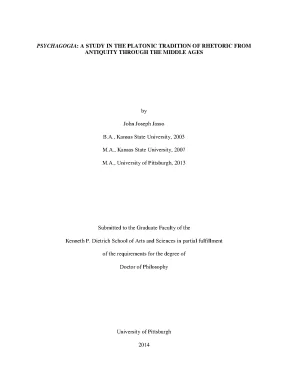
Tải xuống để đọc toàn bộPSYCHAGOGIA: A STUDY IN THE PLATONIC TRADITION OF RHETORIC FROM ANTIQUITY THROUGH THE MIDDLE AGES by John Joseph Jasso B., Kansas State University, 2003 M., Kansas State University, 2007 M., University of Pittsburgh, 2013 Submitted to the Graduate Faculty of the Kenneth P. Dietrich School of Arts and Sciences in partial fulfillment of the requirements for the degree of Doctor of Philosophy University of Pittsburgh 2014 UNIVERSITY OF PITTSBURGH KENNETH P. DIETRICH SCHOOL OF ARTS AND SCIENCES This dissertation was presented by John Joseph Jasso It was defended on April 25, 2014 and approved by Dr. Rita Copeland, Professor, Departments of Classical Studies and English, University of Pennsylvania Dr.
John Lyne, Professor, Department of Communication Dr. Mitchell, Associate Professor, Department of Communication Dissertation Advisor: Dr. John Poulakos, Associate Professor, Department of Communication ii Copyright © by John J. Jasso 2014 iii PSYCHAGOGIA: A STUDY IN THE PLATONIC TRADITION OF RHETORIC FROM ANTIQUITY THROUGH THE MIDDLE AGES John J.
Jasso, PhD University of Pittsburgh, 2014 This dissertation is a history of an idea that has endured in rhetorical theory from Plato to Weaver – the idea that rhetoric can lead souls to their own betterment; that is, guide them in an ascent along a metaphysical hierarchy through beauty, goodness, and truth to a fuller participation in being. This is a study of what Plato calls psychagogia. Comprising replicating hierarchies, the Platonic tradition saw intricate connections between cosmology, theology, psychology, and language. At the height of this tradition, St.
Bonaventure notes that rational philosophy is consummated in rhetoric, indicating that such an inquiry transcends the disciplinary sub-field of “the history of rhetoric” and engages much larger issues concerning the nature of language, language’s relationship with human rationality, and its analogy with the divine. Thus, this study maps the structural framework of the Platonic intellectual tradition from antiquity to the Middle Ages in order to identify the conditions necessary for rhetorical activity under a tripartite metaphysics. By comparing the parallel structures inherent in reality, language, and the mind, I contend that rhetoric plays a definitive role for the Platonist in the process of spiritual formation. Indeed, in some cases it represents the only machinery that humanity has to achieve intellectual, spiritual, and societal amelioration.
But reality, knowledge, and language for the Platonist were all living things. So while I do not deny Plato’s rationalism, idealism, or realism in this study, I seek to investigate their interaction with his own skepticism, aestheticism, iv and above all, mysticism. The same is true for Augustine, Bonaventure, and the Platonic tradition as a whole. Such models as the Platonists provide can illustrate how philosophical tensions now thought to be in diametrical opposition can be brought into dialectical synthesis.
The result is a truly organic intellectual framework that informs a rhetorical theory of equal vitality – a tripartite rhetoric, at once rational, spiritual, and emotive, culminating in the soul in a rhetoric of ascent. v TABLE OF CONTENTS PREFACE .0 INTRODUCTION: PSYCHAGOGIA AS A RHETORICAL CONCEPT .2 ASSUMPTIONS AND DEFINTIONS .0 METHODOLOGY CONCERNING PLATO AND RHETORIC .1 PLATONIC RHETORIC AND THE TERM RHETORIKE .2 RHETORICAL FETISHISM IN PLATO .3 KEYWORDS AND PATTERNS.4 A PRIMA FACIE RENDERING OF THE PLATONIC PSYCHE .1 The Rational Element .2 The Spirited Element .3 The Appetitive Element .4 Harmony, Justice, and the Whole Soul .0 PRE-PLATONIC PSYCHAGOGIA .1 NASCENT PSYCHAGOGICAL STRUCTURES IN HOMER.1 The Judgment of Paris .2 The Shield of Achilles .3 The Embassy to Achilles .4 Dialogue with Priam .2 LOGOS AND PSYCHE IN HERACLITUS.1 Logos in Heraclitus .2 Psyche in Heraclitus .3 Hints towards Tripartition .1 Tripartition in Psyche .2 Tripartition in Logos.3 LOGOS AND PSYCHE IN GORGIAS .1 Logos in On Not Being or, On Nature .2 Logos and Psyche in the Encomium of Helen .4 THE TERM PSYCHAGOGIA .0 PSYCHAGOGIC RHETORIC IN THE PLATONIC CORPUS .1 PLATO’S GRAMMA OF MOTIVES .2 THE TRIPARTITE LOGOS IN PLATO .1 The Wise Logos .2 The Courageous Logos .1 The Courage to be Wise.2 The Mathematics of Morality .3 The Spirit of Integrity .3 The Temperate Logos .1 The Aristocratic Logos .2 The Timocratic Logos .3 The Oligarchic Logos .4 The Democratic Logos .5 The Tyrannical Logos .4 THE MAP OF THE PSYCHIC JOURNEY .0 THE PERIAGOGIC RHETORIC OF SAINT AUGUSTINE .1 METHODOLOGY CONCERNING PLATO AND AUGUSTINE .1 The Incarnation and Philosophy in Etienne Gilson .2 Rhetoric as Theology in John J.3 The Incarnation as Symbolic Communication in Robert J.4 Un-Critical Reception .2 THE TRANSMISSION OF THE PLATONIC TRADITION .1 The Tripartite Soul in the Tusculan Disputations .2 The Virtues in De Inventione .1 Ascent and Conversion in Plotinus.1 Language, Psychology and Trinitarian Thought .2 Neoplatonic Rhetorical Theory .4 The Cure of Souls .3 THE PLATONIC NATURE OF SAINT AUGUSTINE’S RHETORIC.1 Rhetoric as Love .2 The “Platonic Heresy” .3 The Integrity of Rhetorical Activity .4 Reduction to Invention and Expression .4 SAINT AUGUSTINE’S RHETORIC OF CONVERSION .1 The Psychology of Desire .3 The Psychology of Persuasion and Ascent .4 The Rhetoric of Conversion .0 SAINT BONAVENTURE’S ANAGOGIC THEOLOGY OF LANGUAGE .2 PLATONIC PSYCHAGOGY IN THE MIDDLE AGES .1 Dionysius and the Hierarchy of Macrocosm and Microcosm .2 Hugh of Saint Victor’s Pedagogy of Re-Formation .3 SAINT BONAVENTURE’S TRIVIUM OF ASCENT .1 The Reduction of the Trivium .3 The Consummation of Rational Philosophy .1 FROM HERE TO MODERNITY .2 SOME NEO-MEDIEVAL IMPLICATIONS .2 Moving the Soul. 276 x PREFACE As this project comes to an end, there are a number of people and institutions that I must thank. First, I must recognize the generosity of the University of Pittsburgh, without which such an endeavor would not have been possible.
I am grateful for the chance to begin my doctoral studies as a K. Leroy Irvis Fellow; for the numerous Summer Research Grants; for the resources of the Medieval and Renaissance Studies Program; for the support of the Provost Development Fund; and for the Dean’s Tuition Scholarship that helped me through my final semester. I must also thank the University of Kansas for access to the Watson Library as I finished writing from afar; as well as their Department of Communication which served as a welcoming home for a displaced scholar. The conversation and camaraderie of David Tell is especially appreciated.
I was humbled to enter my doctoral education with an outstanding group of critical thinkers quickly dubbed the “demon cohort” for their collective wit, audacity, and irreverence. So for the fellowship of Brita Anderson, Josh Beaty, David Landes, Joseph Packer, Thomas Dunn, Heather Liebling, and Candi Carter Olson I am truly thankful. Thanks also to George Gittinger, who was quick to offer assistance by locating materials that I could find nowhere else. In general, I am grateful for all the discourse and aid available from the graduate community at Pitt whose members are, happily, too numerous to list in full.
In many ways, the seeds of this dissertation were first planted during my tenure at Kansas State University. For that, I thank Tim Steffensmeier, Bill Schenck-Hamlin, and Charlie Griffin. xi Indeed, it was in Charlie’s classroom that I first read the Encomium of Helen, the Phaedrus, and On Christian Doctrine. These ideas were further nurtured by many in Pitt’s Department of Philosophy, especially Nicholas Rescher, James Allen, and Jessica Moss.
Though not on my committee, Brent Malin of my own Department of Communication has consistently offered support, instruction, and advice and no acknowledgments would be complete without him. I could not have asked for a more gracious and knowledgeable committee to guide me as I completed both this dissertation and my graduate career. As a friendly scholar and an historian of medieval rhetoric, I knew that Rita Copeland would make a great outside reader for the project. But not until engaging her recent works on Platonism in medieval rhetoric did I realize that her participation was, in fact, essential.
John Lyne brought to the committee and my graduate experience an eclecticism and an eccentricity that outmatched even my own; so that whenever I broached a new topic, however esoteric, he was ready with a myriad of suggestions for how to tackle it. William Fusfield showed me how my historical interests flowed into modernity through Romanticism and Transcendentalism. For introducing me to the figure and works of Orestes Brownson, who makes a cameo at the end of this dissertation, I am forever beholden to him. However, when Dr.
Fusfield could not serve due to illness, Gordon Mitchell stepped in without hesitation. His insightful ability to bring historical rhetoric to bear on contemporary contexts still causes me to ponder about the demarcation of temporal boundaries. Of course, this dissertation would not have been possible without the guidance and support of my mentor and dissertation advisor John Poulakos. While some may think it odd that a Platonist would want to study with a Sophist – let alone that one could do so productively – I could not imagine having completed this dissertation under anyone else, nor would I want to if I could.
xii Poulakos has served as the very example of erudition, reflexivity, and charitableness that this dissertation attempts to theorize. For that, and for his friendship, I am truly thankful. During the past years of study I have been strengthened by the encouragement, prayers, and well-wishes of good friends who also happen to be academics. So I offer a hearty word of thanks to Anthony and Melissa Wachs and their family who have been there from the beginning of this journey, and also to Brian Gilchrist, Brita Anderson, Ethan Stoneman, Read Schuchardt, Brett Robinson, Ben Robertson, Gavin Hurley, Joe Wurtz, and Ed Macierowski.
To Ben Beier, Fr. Nick Blaha, and the students of the Hayden Seminar, a special thanks not only for your friendship and support, but for the opportunity to teach St. Augustine while writing about him. To my family, I owe a debt that I can never repay; were I even to list all that I owe it would far outstrip the pages of this text.
Rather, please let a list of your names, and a partial one at that, represent to any readers the support and love with which I have been blessed. So thank you to my mother Paula, who continues to provide for my emotional and material needs, as well as for those of my own growing family. Thank you to my father Kerry and my siblings Peter and Missy; to my godparents Eva and Anthony, Jr.; to my godchildren Leylah, Steven, Blaize, Roman, Lucia and all my nieces, nephews, and cousins; to Reina, Alice, Robert, and all my aunts and uncles; to my grandparents, especially Mama Fifi, whose prayers can be felt from Heaven, and Papa; to Margie and Steve for their unfailing generosity and to all my in-laws. Finally, no words are enough to convey the gratitude and love I feel for my wife Susan, who sacrificed much comfort and sanity so that I might retain both while I worked.
To her and to our wonderful children who eagerly awaited the completion of this project so that they might have their daddy back – AnnaMarie, Kyrie, Gloria, Michelangelo, and Genevieve – your patience knows no bounds. Above all, for those I have to thank and for that which I am thankful, thanks be to God.0 INTRODUCTION: PSYCHAGOGIA AS A RHETORICAL CONCEPT This dissertation is a history of an idea that has endured in rhetorical theory from Plato to Weaver – the idea that rhetoric can lead souls to their own betterment; that is, guide them in an ascent along a metaphysical hierarchy through beauty, goodness, and truth to a fuller participation in being. In a word, this is a study of psychagogia or ‘soul-leading.’ The term itself is neither innately rhetorical nor innately positive. 1 But Plato’s definition of rhetoric in the Phaedrus as “a way of directing the soul [psychagogia] by means of speech [logon]” (261a) has assured its place in rhetorical history.
Nội dung được bảo vệ bản quyền — Tải xuống đầy đủ
Trích dẫn luận án này
John Joseph Jasso (2014). Psychagogia: Truyền thống hùng biện Plato và Trung cổ [Luận án tiến sĩ, University of Pittsburgh]. LuanAn.net. https://luanan.net/giao-duc-hoc/john-jasso-etd
Câu hỏi thường gặp
Luận án "Psychagogia: Truyền thống hùng biện Plato và Trung cổ" nghiên cứu về vấn đề gì?
Khám phá luận văn ETD của John Jasso. Tìm hiểu sâu về các nghiên cứu và công trình khoa học, đóng góp vào sự phát triển tri thức.
Luận án "Psychagogia: Truyền thống hùng biện Plato và Trung cổ" được bảo vệ tại trường nào?
Luận án này được bảo vệ tại University of Pittsburgh. Năm bảo vệ: 2014.
Luận án "Psychagogia: Truyền thống hùng biện Plato và Trung cổ" thuộc chuyên ngành gì?
Luận án "Psychagogia: Truyền thống hùng biện Plato và Trung cổ" thuộc chuyên ngành Communication / Arts and Sciences (Doctor of Philosophy). Danh mục: Giáo Dục Học.
Luận án "Psychagogia: Truyền thống hùng biện Plato và Trung cổ" có bao nhiêu trang?
Luận án "Psychagogia: Truyền thống hùng biện Plato và Trung cổ" có 308 trang. Bạn có thể xem trước một phần tài liệu ngay trên trang web trước khi tải về.
Cách tải luận án "Psychagogia: Truyền thống hùng biện Plato và Trung cổ" về máy như thế nào?
Để tải luận án về máy, bạn nhấn nút "Tải xuống ngay" trên trang này, sau đó hoàn tất thanh toán phí lưu trữ. File sẽ được tải xuống ngay sau khi thanh toán thành công. Hỗ trợ qua Zalo: 0559 297 239.