Institutional factors that affect transfer student sucess at a un
Phân tích các yếu tố tổ chức ảnh hưởng đến thành công của sinh viên chuyển trường tại các trường đại học.
University of Mississippi
Luan An
Luận án tiến sĩ
Năm xuất bản
Số trang
125
Thời gian đọc
19 phút
Lượt xem
0
Lượt tải
0
Phí lưu trữ
40 Point
Tổng quan nhanh
- Chủ đề:
- Tác động của yếu tố thể chế đến thành công sinh viên chuyển tiếp
- Số trang:
- 125 trang
- Trường:
- University of Mississippi
- Chuyên ngành:
- Higher Education
- Tác giả:
- Patricia Ann Coats
- Năm:
- 2019
Tóm tắt nội dung luận án
I.Tác động của yếu tố thể chế đến thành công sinh viên chuyển tiếp
Các yếu tố thể chế đóng vai trò quan trọng định hình thành công của sinh viên chuyển tiếp. Nghiên cứu này phân tích cách các chính sách, nguồn lực và môi trường học đường ảnh hưởng đến tỷ lệ tốt nghiệp và duy trì. Sự hiểu biết sâu sắc về các yếu tố này giúp cải thiện trải nghiệm học tập cho sinh viên. Việc nhận diện khoảng cách tốt nghiệp cũng là một điểm trọng tâm.
1.1. Khái niệm khoảng cách tốt nghiệp sinh viên chuyển tiếp
Sinh viên chuyển tiếp thường đối mặt với thách thức đặc thù. Họ có thể mất nhiều thời gian và tiền bạc hơn để hoàn thành bằng cử nhân. Khoảng cách tốt nghiệp, hay “Baccalaureate Attainment Gap”, mô tả sự chênh lệch này. Đây là một vấn đề phổ biến trong giáo dục đại học. Việc nhận diện khoảng cách này là bước đầu tiên để cải thiện tình hình.
1.2. Các yếu tố thể chế định hình thành công
Thành công của sinh viên chuyển tiếp bị ảnh hưởng bởi nhiều yếu tố thể chế. Chính sách chuyển đổi tín chỉ rõ ràng giúp sinh viên tránh lãng phí công sức. Các dịch vụ hỗ trợ sinh viên như tư vấn học thuật tạo ra môi trường thuận lợi. Môi trường học đường thân thiện cũng góp phần quan trọng. Những yếu tố này trực tiếp tác động đến khả năng hoàn thành chương trình học.
1.3. Áp dụng các lý thuyết về sinh viên
Nghiên cứu sử dụng nhiều khung lý thuyết. Lý thuyết bỏ học của sinh viên giúp phân tích nguyên nhân sinh viên rời khỏi trường. Lý thuyết thực thi và lý thuyết chủng tộc phê phán cung cấp góc nhìn đa chiều. Những lý thuyết này giúp hiểu rõ hơn về các yếu tố phức tạp ảnh hưởng đến hành trình học tập của sinh viên chuyển tiếp.
II.Đảm bảo tỷ lệ tốt nghiệp duy trì cho sinh viên chuyển tiếp
Tỷ lệ tốt nghiệp và duy trì là thước đo quan trọng về thành công của sinh viên chuyển tiếp. Nghiên cứu tập trung vào phân tích dữ liệu định lượng. Các con số này cung cấp cái nhìn thực tế về hiệu quả của các chính sách hiện hành. Việc so sánh giữa các cơ sở đào tạo cũng giúp làm rõ những điểm mạnh, điểm yếu.
2.1. Phân tích tỷ lệ tốt nghiệp của sinh viên chuyển tiếp
Dữ liệu chỉ ra tỷ lệ tốt nghiệp 4 năm của sinh viên chuyển tiếp có sự khác biệt. Các cơ sở khu vực của MSU đạt tỷ lệ trung bình 64.4%. Trong khi đó, cơ sở trung tâm đạt 60%. Kết hợp các con số này cho thấy tỷ lệ tốt nghiệp chung là 64.0%. Các số liệu này phản ánh hiệu quả khác nhau giữa các cơ sở.
2.2. Chiến lược nâng cao tỷ lệ giữ chân sinh viên chuyển tiếp
Tỷ lệ giữ chân sinh viên chuyển tiếp cần được cải thiện. Chương trình định hướng sinh viên chuyển tiếp hiệu quả là bước khởi đầu tốt. Dịch vụ tư vấn học thuật giúp sinh viên định hướng. Hỗ trợ tài chính cho sinh viên chuyển tiếp cũng rất cần thiết. Những chiến lược này giúp sinh viên cảm thấy được hỗ trợ và gắn kết hơn với trường.
2.3. So sánh hiệu suất các cơ sở đào tạo
Các cơ sở khu vực cho thấy tỷ lệ tốt nghiệp 4 năm cao nhất, đạt 70%. Điều này diễn ra bất chấp nguồn lực hạn chế hơn. Cơ sở trung tâm, với nhiều nguồn lực hơn, lại có tỷ lệ thấp hơn. Phát hiện này đặt ra câu hỏi về cách các cơ sở khu vực đang tối ưu hóa hỗ trợ cho sinh viên chuyển tiếp. Cần nghiên cứu sâu hơn về mô hình này.
III.Chiến lược hỗ trợ và định hướng sinh viên chuyển tiếp
Để hỗ trợ sinh viên chuyển tiếp thành công, các trường đại học cần có các chiến lược và dịch vụ chuyên biệt. Các chương trình định hướng, tư vấn học thuật và các dịch vụ hỗ trợ toàn diện giúp sinh viên thích nghi tốt hơn. Chúng giảm thiểu khó khăn và tạo điều kiện thuận lợi cho quá trình học tập.
3.1. Chương trình định hướng sinh viên chuyển tiếp
Chương trình định hướng sinh viên chuyển tiếp là thiết yếu. Nó cung cấp thông tin quan trọng về các chính sách của trường. Sinh viên được giới thiệu về các dịch vụ hỗ trợ sinh viên. Định hướng sớm giúp giảm bỡ ngỡ, tăng khả năng hòa nhập. Sinh viên cảm thấy được chào đón và chuẩn bị tốt hơn cho hành trình học tập mới.
3.2. Dịch vụ tư vấn học thuật chuyên biệt
Dịch vụ tư vấn học thuật đóng vai trò cốt yếu. Cố vấn giúp sinh viên lựa chọn môn học phù hợp. Họ hỗ trợ xây dựng lộ trình học tập hiệu quả. Việc này đặc biệt quan trọng để tối ưu hóa việc chuyển đổi tín chỉ. Tư vấn học thuật chuyên sâu giúp sinh viên chuyển tiếp tránh được những sai lầm không đáng có.
3.3. Các dịch vụ hỗ trợ sinh viên toàn diện
Một loạt các dịch vụ hỗ trợ sinh viên là cần thiết. Điều này bao gồm tư vấn sức khỏe tâm thần, trung tâm hỗ trợ học tập, và các hoạt động ngoại khóa. Những dịch vụ này giúp giải quyết các vấn đề cá nhân và học thuật. Chúng tạo điều kiện cho sinh viên phát triển toàn diện và giảm thiểu nguy cơ bỏ học.
IV.Văn hóa học đường nguồn lực tác động sinh viên chuyển tiếp
Môi trường học đường và nguồn lực sẵn có ảnh hưởng sâu sắc đến trải nghiệm của sinh viên chuyển tiếp. Văn hóa và khí hậu học đường đóng vai trò quyết định trong việc sinh viên cảm thấy thuộc về. Ngoài ra, việc tiếp cận hỗ trợ tài chính và các nguồn lực khác cũng ảnh hưởng trực tiếp đến thành công của họ.
4.1. Ảnh hưởng của văn hóa và khí hậu học đường
Văn hóa và khí hậu học đường có tác động lớn. Môi trường chào đón, hỗ trợ giúp sinh viên chuyển tiếp hòa nhập nhanh chóng. Một nền văn hóa khuyến khích sự đa dạng và bao trùm làm tăng cảm giác thuộc về. Điều này trực tiếp ảnh hưởng đến tỷ lệ giữ chân sinh viên chuyển tiếp và kết quả học tập của họ.
4.2. Hỗ trợ tài chính cho sinh viên chuyển tiếp
Hỗ trợ tài chính cho sinh viên chuyển tiếp là một yếu tố quan trọng. Sinh viên thường đối mặt với gánh nặng tài chính lớn hơn. Các khoản học bổng, trợ cấp đặc biệt có thể giảm bớt áp lực. Nguồn hỗ trợ tài chính ổn định giúp sinh viên tập trung vào việc học. Điều này góp phần giảm tỷ lệ bỏ học vì lý do kinh tế.
4.3. Nguồn lực hạn chế tại các cơ sở khu vực
Các cơ sở khu vực thường có ít nguồn lực hơn so với các cơ sở chính. Tuy nhiên, tỷ lệ tốt nghiệp của sinh viên chuyển tiếp tại các cơ sở này lại cao. Điều này gợi ý rằng chất lượng hỗ trợ có thể quan trọng hơn số lượng. Cần tìm hiểu các phương pháp hiệu quả mà các cơ sở khu vực đang áp dụng để bù đắp cho sự thiếu hụt nguồn lực.
V.Chính sách tín chỉ và hợp tác liên thông cho sinh viên chuyển tiếp
Các chính sách về chuyển đổi tín chỉ và thỏa thuận liên thông chương trình có vai trò then chốt trong việc giảm thiểu rào cản cho sinh viên chuyển tiếp. Sự minh bạch và hiệu quả trong các quy trình này đảm bảo sinh viên không bị mất thời gian hoặc tín chỉ. Điều này trực tiếp ảnh hưởng đến khả năng hoàn thành bằng cấp đúng hạn.
5.1. Chính sách chuyển đổi tín chỉ rõ ràng
Chính sách chuyển đổi tín chỉ là yếu tố then chốt. Sinh viên cần thông tin rõ ràng về việc tín chỉ của họ được chấp nhận như thế nào. Sự minh bạch giúp sinh viên lập kế hoạch học tập hiệu quả. Nó giảm thiểu sự chậm trễ trong quá trình học tập. Chính sách chuyển đổi tín chỉ hợp lý giúp sinh viên tránh được những lo ngại không cần thiết.
5.2. Thỏa thuận liên thông chương trình hiệu quả
Thỏa thuận liên thông chương trình giữa các trường giúp ích rất nhiều. Nó đảm bảo quá trình chuyển tiếp diễn ra suôn sẻ. Sinh viên không phải học lại các môn đã hoàn thành. Các thỏa thuận này giảm thiểu rủi ro mất tín chỉ. Chúng tạo ra một lộ trình học tập rõ ràng, giúp sinh viên tiết kiệm thời gian và tiền bạc.
5.3. Vai trò của giảng viên trong hỗ trợ chuyển tiếp
Sự tham gia của giảng viên rất quan trọng đối với sinh viên chuyển tiếp. Giảng viên cố vấn về học thuật và định hướng nghề nghiệp. Họ tạo ra một môi trường học tập tích cực, khuyến khích sự tương tác. Giảng viên hiểu rõ nhu cầu đặc biệt của sinh viên chuyển tiếp. Sự hỗ trợ từ giảng viên giúp sinh viên tự tin hơn trong hành trình học tập.
Mục lục chi tiết luận án
Tải xuống file đầy đủ để xem toàn bộ nội dung
Tải đầy đủ (125 trang)Trích đoạn nội dung luận án
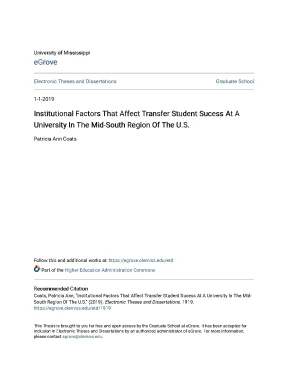
Tải xuống để đọc toàn bộUniversity of Mississippi eGrove Electronic Theses and Dissertations Graduate School 1-1-2019 Institutional Factors That Affect Transfer Student Sucess At A University In The Mid-South Region Of The U. Patricia Ann Coats Follow this and additional works at: https://egrove.edu/etd Part of the Higher Education Administration Commons Recommended Citation Coats, Patricia Ann, "Institutional Factors That Affect Transfer Student Sucess At A University In The Mid- South Region Of The U. Electronic Theses and Dissertations.edu/etd/1919 This Thesis is brought to you for free and open access by the Graduate School at eGrove. It has been accepted for inclusion in Electronic Theses and Dissertations by an authorized administrator of eGrove.
For more information, please contact egrove@olemiss. INSTITUTIONAL FACTORS THAT AFFECT TRANSFER STUDENT SUCCESS AT A UNIVERSITY IN THE MID-SOUTH REGION OF THE U. A Companion Dissertation in Practice presented in partial fulfillment of requirements for the degree of Doctor of Education in the Department of Higher Education The University of Mississippi by Patricia A. Coats December 2019 Copyright © 2019 Patricia A.Coats ALL RIGHTS RESERVED.
ABSTRACT At a four-year university located in the Mid-South region of the United States, students who transfer do so with the likelihood of spending more time and money completing a baccalaureate degree than non-transfer students. This is what research scholar Kevin Dougherty (1992) entitled the Baccalaureate Attainment Gap or the transfer gap. In this companion dissertation, using a multi-method approach, we use the quantitative data of transfer student graduation and retention rates along with qualitative data from interviews conducted with administrative staff about transfer student success. We consider these selected outcomes and administrative staff interviews to be institutional factors that help shape the transfer gap.
Framed using the student departure theory, enactment theory, and critical race theory, we contend that these institutional factors affect transfer student success. The overall summary of data confirms that the 4-year graduation rates examined in this Dissertation in Practice indicate that transfer students are graduating on average at a higher percentage of 64.4% on MSU regional campuses. There are fewer transfer student resources on the regional campuses than the Mid-South Central campus that graduates on average of 60. Regional campuses are showing the highest 4-year graduation rate of 70.
MSU central and regional campuses 4-year graduation rates are elevated to 64.0% when averages are combined. ii DEDICATION First, I dedicate this dissertation to our Heavenly Father and His Son, Jesus Christ, who made this aspiration a reality. I want to thank our Assistant Provost, who is the leader for Regional Education in Outreach, Dr. Rick Gregory, who was instrumental in inspiring and believing in me that I could complete this doctoral program.
Today his vision and my aspiration have been achieved. To my remarkable son, Mr. Doug Easterwood, whom I love to infinity, I finished this doctoral degree for you and I. Thank you for your prayers, love, and support during this season of my life.
There are numerous noteworthy people I want to thank, they are: my sister Mrs. Telisa Mabin-Davis, brother Mr. Kenneth Coats, Aunt Mildred Green, Dr. Mary Perkins-Jacobs, Ms.
Kail Adams, Ms. Dora Rivers, colleagues, friends, and family who consistently prayed and supported me during this time. Finally, I want to thank my inspiring noteworthy higher education mentors Dr. Charlotte Cone and Dr.
Fannye Love, for their loving support and prayers. Thank you all for being a part of my village. This dissertation is in honor of my deceased parents John Mabin and Lorene Coats- Mabin, who taught me to trust and have faith in God. They taught me to have a good work ethic, and they showed me through prayer and belief in God that I can persevere when life gets tough.
I utilized these skills through this entire process. Today, I know they both are smiling proudly concerning this achievement. iii ACKNOWLEDGMENTS I want to thank the dissertation chair Dr. Neal Hutchens and co-chair Dr.
Whitney Webb and committee members, Dr. Katie Busby and Dr. Amanda Windburn, for serving on the committee. Hutchens, without your guidance, intelligence, and support, this dissertation would not have been possible.
I appreciate you checking in on me when I grew weary and was missing in action. I will be forever grateful for your leadership from the beginning to the conclusion of this dissertation in practice. Webb, I cannot say enough about your knowledge and your sound advice and responses during the writing process of this dissertation. You kept my focus, and you were also instrumental and inspirational in guiding me through this finale.
Busby, thank you for your guidance from the beginning and the ending of this academic undertaking. You gave me clear guidelines on how to determine the type of data I needed to complete this research study. You also revealed to me how to disclose the data so that everyone reading this study could comprehend the outcomes. Again, thank you, Dr.
Winburn, for your support in serving on the final defense committee. Elizabeth Moore, my companion researcher, we honed in on some valuable skills throughout this journey, such as organization, persistence, achievement, time management, dependability, and how to encourage each other along the way. I thank you for your friendship and being a team player during the progressions of this Dissertation in Practice journey. As the higher education landscape evolves, I pray for your continued success as a life long learner.
iv TABLE OF CONTENTS ABSTRACT………………………………………………………………………………………ii DEDICATION……………………………………………………………………………………iii ACKNOWLEDGEMENTS………………………………………………………………………iv LIST OF FIGURES…………………………………………………………………………….viii LIST OF TABLES………………………………………………………………………………ix MANUSCRIPT ONE…………………………………………………………………………….…2 Context and Rationale………………………………………………………….4 Preliminary Research Questions………………………………………………….9 PRACTITIONER STATEMENTS………………………………………………………10 CPED STATEMENT………………………………………………………………….17 LIST OF REFERENCES………………………………………………………. 36 SUMMARY OF PROBLEM CHALLENGE TO TRANSFER……………………….43 v Transfer Student Graduation Rates…………………………………………….51 Summary of Data Interpretation……………………………………………….55 Limitations of the Data…….61 LIST OF REFERENCES………….66 METHODS………………………………………………………………………………67 PARTICIPANTS SURVEYS……………………………………………………………72 FINDINGS……………………………………………………………………………….90 MANUSCRIPT THREE…………………………………………………………………………93 CURRENT STUDY…………………………………………………………………….94 SUMMARY OF FINDINGS…………………………………………………………….95 LINKING STUDY FINDINGS TO THEORY AND RESEARCH……………….98 LIMITATIONS OF STUDY……………………………………………………….102 FUTURE RESEARCH AND RECOMMENDATIONS……………………………….103 CONCLUSION…………………………………………………………………………107 CPED REFLECTION………………………………………………………………….108 REFERENCES…………………………………………………………………………109 vi VITA……………………………………………………………………………………………112 vii LIST OF FIGURES 1. Connolly: Vincent Tinto original model Drop out from College (1975)…………. Connolly: Vincent Tinto Schema for Drop out from College (1993)……….
Administrative Staff Perceptions to Transfer Students…………………………….0 The Changing Face of U.………104 viii LIST OF TABLES 1. Full-time New Transfer Students Headcount Attending MSU Campuses…………………. Mid-South University Transfer Students 2-Year Graduation Rates on Central Campus…. 4-Year Graduation Rate of Full-Time Transfers who attended MSU Central Campus…….
Rate of Full-Time Transfers who attended MSU REGIONAL Campus…. 4-Year Graduation Rates of Full-Time Transfers who attended MSU Reg. 2-Year Grad Rate of Full-Time Transfers who attended MSU Central and Reg. 4-Year Grad Rate of Full-Time Transfers who attended MSU Central and Reg.
1st semester Retention Rates for Full-Time New Transfer Students (Retain to spring)……51 6. Second-Year Retention Rates for Full-Time New Transfer Students (Retained to Year 2). Third-Year Retention Rates for Full-Time New Transfer Students (Retained to Year 3). 4-Year Graduation Rate of Full-Time Freshman who attended MSU Central Campus….
6-Year Graduation Rate of Full-Time Freshman who attended MSU Central Campus. Rate of Full-Time Transfer who attended the MSU Central Campuses……. Rate of Full-Time Transfer who attended the MSU Regional Campuses……55 11. Interview methods table.
The six-phase framework for thematic analysis……………………………………………. MSU 2-Year Grad. Rates Averages for Transfer Student Cohorts of 2010 to 2016………. MSU 4-Year Graduation Rates for Transfer Student Cohorts of 2008- to 2014 ……….
MSU 6-Year Graduation Rates…………………………………………………………. MSU Transfer Student Retention Rates…………………………………………………. MSU Resources for First-Year Students…………………………………………………. MSU Resource Offices…………………………………………………………………….106 x MANUSCRIPT ONE 1 INTRODUCTION Institutional factors in higher education are the characteristics, traditions, and policies within an organization that influence administrators, staff, students, finances, campus events, etc.
Transfers are defined as students who have earned credits at one institution or more, but for a variety of reasons decide to go to a different institution and transfer those earned credits. For many transfer students, the decision to transfer can result in higher costs, and additional time spent earning a bachelor’s degree than those who entered a four-year institution after completion of high school (Dougherty, 1992). This dilemma – the transfer gap, is what Kevin Dougherty (1992) addressed in his work on the Baccalaureate Attainment Gap. In this companion dissertation, we triangulate the insights gained from data related to community college and university selected outcomes for transfer students with the insights of administrative staff perceptions of transfer students.
We frame our research using the enactment theory (Weick, 1995) coupled with critical race theory (Crenshaw, 1995; Hiraldo, 2010) to help explain the relationship between institutional factors and their impact on transfer student success. We selected a four-year institution and one of its regional campuses, which are both located in the Mid-South region of the United States, to conduct our research. From here forward, we will refer to the university as Mid-South University (MSU) and its regional campus as the Mid-South Regional Campus. We will focus on transfers’ classic route to earning a bachelor degree called the vertical transfer (Baker, 2016).
2 A vertical transfer student is one who attends a two-year institution before moving to attend a four-year institution. The context and rationale for the study are explained. A reflective statement from each author is provided to allow insight into the standpoints that inform this study. Followed is a review of literature that focuses on the institutional factors of higher education and the effects upon transfer student success.
Our reliance on multiple data sources and analytical methods is described. Next, we present findings and ethical considerations before concluding. CONTEXT AND RATIONALE The United States has historically deep roots in school segregation. In 1865, the Thirteenth Amendment to the United States Constitution was enacted to abolish slavery and involuntary servitude, with an exception to punishment for a crime.
The Fourteenth Amendment was enacted in 1868 that defined all people born in the U. as citizens required due process of law, and required equal protection to all people (Wells, 2001). The Fifteenth Amendment, enacted in 1870, gave citizens voting rights irrespective of their race, color, or previous condition of servitude. Southern and border states of the United States enacted Jim Crow laws and enforced them between 1876 and 1965 to subvert the goals of the Reconstruction Amendments.
Jim Crow laws mandated racial segregation in the American South between the end of Reconstruction in 1877 and the beginning of the civil rights movement in the 1960s. These laws continue to affect Mid-South University today (Wells, 2001). Mid- South University is a predominately White institution (PWI) where transfer students made up 24% of the total student body in Fall 2014 (Mid-South Transfer Task Force report, 2015). Of the total transfer student population; Mid-South University reported that the majority of transfer students were predominantly White (71%) and male.
3 Mid-South University Regional locations enrolled more transfers who were older, female, Black and residents of the state (Mid-South Transfer Task Force report, 2015). Well established are theories (e.,Lazarowicz, 2015) that attribute the transfer gap to the fact that transfer students are women, older, poorer, more often non-White, less academically prepared, and less likely to attend college full-time due to work or family commitments than their counterparts. However, when compared to four-year entrants with the same traits and characteristics, the College Board (2011) found that transfer students were still less likely to attain a bachelor degree. Dougherty (1992) explains that while the traits and characteristics of transfer students are essential factors in the transfer gap, they do not provide a complete picture.
We should also consider institutional factors such as the loss of earned credit and administrative staff perceptions. There are many studies on loss of earned credit and perceptions from a transfer student perspective., Giani, 2019, Tobolowsky & Bers, 2019, Hodara, Martinez-Wenzl, Stevens & Mazzeo, 2017, Jason, 1992). However, few studies (e., McGowan & Gawley, 2006) have conducted interviews gathering the perspective of administrative staff. Today, most students in the United States attend more than one institution in pursuit of a baccalaureate degree.
Nearly 50% of the entire U. undergraduate population in 2014 enrolled in a two-year college initially (National Center for Education Statistics, 2017). Eighty percent of those students expressed a desire to transfer and earn a bachelor’s degree.
Nội dung được bảo vệ bản quyền — Tải xuống đầy đủ
Trích dẫn luận án này
Patricia Ann Coats (2019). Institutional factors that affect transfer student sucess at [Luận án tiến sĩ, University of Mississippi]. LuanAn.net. https://luanan.net/giao-duc-hoc/institutional-factors-that-affect-transfer-student-sucess-at-a-un
Câu hỏi thường gặp
Luận án "Institutional factors that affect transfer student sucess at" nghiên cứu về vấn đề gì?
Phân tích các yếu tố tổ chức ảnh hưởng đến thành công của sinh viên chuyển trường tại các trường đại học.
Luận án "Institutional factors that affect transfer student sucess at" được bảo vệ tại trường nào?
Luận án này được bảo vệ tại University of Mississippi. Năm bảo vệ: 2019.
Luận án "Institutional factors that affect transfer student sucess at" thuộc chuyên ngành gì?
Luận án "Institutional factors that affect transfer student sucess at" thuộc chuyên ngành Higher Education. Danh mục: Giáo Dục Học.
Luận án "Institutional factors that affect transfer student sucess at" có bao nhiêu trang?
Luận án "Institutional factors that affect transfer student sucess at" có 125 trang. Bạn có thể xem trước một phần tài liệu ngay trên trang web trước khi tải về.
Cách tải luận án "Institutional factors that affect transfer student sucess at" về máy như thế nào?
Để tải luận án về máy, bạn nhấn nút "Tải xuống ngay" trên trang này, sau đó hoàn tất thanh toán phí lưu trữ. File sẽ được tải xuống ngay sau khi thanh toán thành công. Hỗ trợ qua Zalo: 0559 297 239.