Hao phuong phan final submission august 2018
Luận án Hao Phương Phan hoàn thành tháng 8 năm 2018. Nghiên cứu chuyên sâu mang lại đóng góp kiến thức mới cho lĩnh vực học thuật.
University of East Anglia
International Development
Luan An
Luận án tiến sĩ
Năm xuất bản
Số trang
261
Thời gian đọc
40 phút
Lượt xem
0
Lượt tải
0
Phí lưu trữ
50 Point
Tổng quan nhanh
- Chủ đề:
- 1. Giới Thiệu Về REDD+
- Số trang:
- 261 trang
- Trường:
- University of East Anglia
- Chuyên ngành:
- International Development
- Tác giả:
- Hao Phuong Phan
- Năm:
- 2018
Tóm tắt nội dung luận án
I. Giới Thiệu Về REDD
REDD+ là chương trình giảm thiểu phát thải khí nhà kính thông qua việc bảo tồn và quản lý rừng. Chương trình này có thể có tác động tích cực đến môi trường và xã hội, nhưng cũng có thể có những hạn chế và thách thức.
1.1. Khái Niệm Về REDD
REDD+ là chương trình giảm thiểu phát thải khí nhà kính thông qua việc bảo tồn và quản lý rừng.
1.2. Mục Tiêu Của REDD
Mục tiêu của REDD+ là giảm thiểu phát thải khí nhà kính và bảo tồn rừng.
II. Giới Thiệu Về Nghiên Cứu
Nghiên cứu này nhằm mục đích đánh giá tác động của chương trình REDD+ đến quyền truy cập tài nguyên của phụ nữ và nam giới tại Việt Nam.
2.1. Phương Pháp Nghiên Cứu
Nghiên cứu sử dụng phương pháp nghiên cứu định tính và định lượng để thu thập dữ liệu.
2.2. Đối Tượng Nghiên Cứu
Đối tượng nghiên cứu là phụ nữ và nam giới tại các cộng đồng địa phương ở Việt Nam.
III. Kết Quả Nghiên Cứu
Kết quả nghiên cứu cho thấy rằng chương trình REDD+ có thể có tác động tích cực đến quyền truy cập tài nguyên của phụ nữ và nam giới tại Việt Nam.
3.1. Tác Động Của REDD Đến Quyền Truy Cập Tài Nguyên
Chương trình REDD+ có thể giúp tăng cường quyền truy cập tài nguyên của phụ nữ và nam giới.
3.2. Thách Thức Và Hạn Chế Của REDD
Chương trình REDD+ cũng có thể có những thách thức và hạn chế, chẳng hạn như việc phân phối lợi ích không công bằng.
IV. Kết Luận
Kết luận của nghiên cứu này là chương trình REDD+ có thể có tác động tích cực đến quyền truy cập tài nguyên của phụ nữ và nam giới tại Việt Nam, nhưng cũng cần phải xem xét các thách thức và hạn chế của chương trình.
4.1. Đề Xuất Chính Sách
Nghiên cứu đề xuất các chính sách để tăng cường quyền truy cập tài nguyên của phụ nữ và nam giới.
4.2. Hướng Nghiên Cứu Tương Lai
Nghiên cứu cũng đề xuất các hướng nghiên cứu tương lai để tiếp tục đánh giá tác động của chương trình REDD+.
Mục lục chi tiết luận án
Tải xuống file đầy đủ để xem toàn bộ nội dung
Tải đầy đủ (261 trang)Trích đoạn nội dung luận án
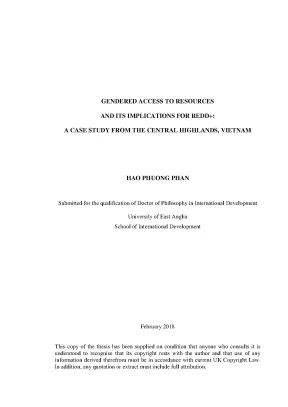
Tải xuống để đọc toàn bộGENDERED ACCESS TO RESOURCES AND ITS IMPLICATIONS FOR REDD+: A CASE STUDY FROM THE CENTRAL HIGHLANDS, VIETNAM HAO PHUONG PHAN Submitted for the qualification of Doctor of Philosophy in International Development University of East Anglia School of International Development February 2018 This copy of the thesis has been supplied on condition that anyone who consults it is understood to recognise that its copyright rests with the author and that use of any information derived therefrom must be in accordance with current UK Copyright Law. In addition, any quotation or extract must include full attribution. Contents Abstract i List of Tables, Figures and Boxes ii List of Abbreviation iv Acknowledgement vi Chapter 1. The context of REDD+ 3 1.
Scope and orientation of the research 7 1. Thesis structures 9 Chapter 2. Literature review and theoretical framework 11 2. REDD+ and gender: a research inquiry 12 2.
Land and forest access from a gender perspective 13 2. Upland transformation in Southeast Asia and Vietnam: setting the context 17 2. Ribot and Peluso’s (2003) theory of access 19 2. Feminist Political Ecology 21 2.
Locating the theory of access within Feminist Political Ecology 24 2. Research methodology and research contexts 29 3. Justification for using an ethnographic approach and a nested case study 29 3. Ethnographic research at the local level 30 3.
Research at the national and provincial levels 38 3. Positionality and ethical considerations 41 3. Data management, coding and analysis 48 3. Lam Dong Province (Provincial level) and Kala Tongu village (Local level) 52 3.
Global, national and local structures of REDD+: from a gender perspective 56 4. Gender and REDD+: a global perspective 56 4. Safeguards and gender in REDD+: A country approach 62 4. Overview of REDD+ in Vietnam 62 4.
Safeguards and gender considerations in REDD+ 64 4. Contextualising gender in forestry and REDD+ in Vietnam 67 4. Politics of decision-making around REDD+ at the national level 67 4. Local structures of forest governance and gendered implications 71 4.
Policies, Laws and Regulations for gender, forestry and REDD+ 76 4. Gendered implications of UN-REDD Vietnam Programme and other REDD+ pilot project 79 4. Rethinking gender, women’s participation and development in Vietnam 87 4. Introducing the village: socio-economic and cultural landscapes 91 5.
Under the forest’s canopy: Locating Kala Tongu village 91 5. Touching down in the village 91 5. History of resettlement after ‘Định canh định cư’ (Sendentarisation Policies) 95 5. Ethnic composition in Kala Tongu village 97 5.
Kala Tongu’s involvement in forest protection schemes 99 5. Other development projects in Kala Tongu village 101 5. Social structures of a matrilineal society 103 5. Matrilineal systems at a glance: previous research on the Central Highlands 103 5.
Matrilineal systems at work: the case of Kala Tongu village 104 5. Patterns of residence 106 5. Groom price in a matrilineal society 106 5. Control over children and kinship support in a matrilineal society 111 5.
Payments from forestry schemes 121 5. Non-timber forest products 123 5. Gendered access to resources: A Feminist Political Ecology approach 126 6. Gendered access to productive land 126 6.
Gendered rights and responsibilities of land and forest 132 6. Gender relations in agricultural activities 133 6. Gendered forest rights and responsibilities 135 6. Gendered meanings of the forest 141 6.
Clan forests and community forests 142 6. Emotional connection with the forest 147 6. Gendered knowledge of the forest 149 6. Gendered politics of everyday resistance and negotiation 152 6.
Claims of forest tenure rights 152 6. Fairness and transparency in benefit distribution 154 6. Gendered resistance and negotiation 157 6. Engendering national-local dynamics of resource access in the context of REDD+: reflections from the case study 162 7.
Who can access what? Articulating claims, interests and motivations in resource access 162 7. Ethnicity and access claims 163 7. Local women’s claims of their gendered rights and responsibilities and expectations of national actors 174 7. Matrilineal-based claims within a top-down patrilineal system of resource governance 179 7.
How to mobilise resources? Conflicting, negotiating and cooperating interactions among actors 182 7. Benefit distribution: a site of potential conflict 183 7. Forestland conversion: negotiating access claims 187 7. Constituting a successful model: when actors attempt to cooperate 191 7.
What does it mean for REDD+ and REDD+-like projects? Bringing REDD+ into the picture 194 7. Choosing a REDD+ pilot site: Convenience for implementing agencies or benefit for local communities 195 7. Gendered implications of REDD+ safeguards compliance for local gendered access to resources 199 7. Summary of findings 206 8.
Contribution to the existing literature 209 8. Future research agenda 221 References 222 Appendices 236 Abstract This thesis explores how gender influences local access to resources through a case study of an upland community in the Central Highlands of Vietnam. It also teases out the im- plications of these gender dynamics for the implementation of REDD+ (Reducing Emis- sions from Deforestation and Forest Degradation) in Vietnam. To address the complexity of the chosen topic and case study, I employ a theoretical framework that fuses both Ribot and Peluso’s (2003) theory of access and Feminist Political Ecology (Rocheleau et al.
The qualitative methods encompass interviews, participant observation, life histo- ries and photovoice. My findings show that gendered access to resources is shaped by various factors including gender, ethnicity, age, culture and social status. Gendered access to resources can also be negotiated through social relations including kinship, conjugal relationships and political connections to local authorities at the household and commu- nity levels. Resource access, however, is not only concerned with local actors.
When it comes to decision-making regarding resource access, both national and local actors are involved. Accordingly, the legal systems of resource management imposed by the Viet- namese state and the customary ways of resource use practised by local villagers in Kala Tongu are both brought to bear in decision-making in different ways at different levels. These national-local dynamics of resource access might take different forms. On the one hand, the politics of decision making at the national level often results in gender policies being less prioritised and being limited to women’s participation, which might contradict local understandings of gender.
On the other hand, everyday politics within the village also feed into the wider debates about what is actually happening around resource access and reflect local expectations of how these forestry policies should be implemented. i List of tables, figures and boxes List of tables Chapter 3 Table 1. Respondents at the local level (by ethnicity, gender and age group) Chapter 4 Table 2. International donors involved in REDD+ Readiness Stage in Vietnam Chapter 5 Table 3.
Income from forestry activities of Kala Tongu villagers in 2014 Chapter 6 Table 4. Summary of resource claimants and registrees on LUC(s) List of figures Chapter 4 Figure 1. Institutional arrangement of REDD+ in Vietnam Figure 2. Mapping forest tenure in Kala Tongu village Figure 3.
Local structures of REDD+ in Kala Tongu case (in theory) Figure 4. Local structures of REDD+ in Kala Tongu case (in practice) Chapter 5 Figure 5. Map of forest landscapes in Di Linh District Figure 6. Map of Kala Tongu Village Figure 7.
Gate to Kala Tongu Village Figure 8. The concrete road sponsored by the FLITCH project in Kala Tongu Figure 9. Kala Tongu Hydrodam Chapter 7 Figure 10. Terms and conditions for a Forestland Use Certificate (proposed by the Bao Thuan Forest Company) Figure 11.
Trees felled in the Community Forest (provided by ID24) Figure 12. Picture showing the boundary between the Bao Thuan Forest Company grown forest and local people’s garden (plantation) (provided by PV2) List of boxes Chapter 3 Box 1. Photovoice in qualitative research ii Chapter 4 Box 2. Key steps to achieve gender sensitive approach Chapter 5 Box 3.
List of most popular items needed for groom price (field work in 2015-2016) Chapter 6 Box 4. An excerpt from the interview with a senior man and his daughter/son as transla- tors Box 5. An excerpt from the interview with a young K’ho woman about her encounter with the Kinh forest officers Chapter 7 Box 6. Proposed options for improving gender integration within each component of the Lam Dong PRAP framework Box 7.
Reflection on the relationship between cooperation, conflicts and negotiation mechanisms iii List of abbreviations CAS: Country Approach to Safeguards CFMB: Community Forest Management Board CIFOR: Centre for International Forestry Research COP: Conference of Parties FAO: Food and Agriculture Organisation FCPF: Forest Carbon Partnership Facility FFI: Fauna and Floral International FLITCH: Forests for Livelihood Development in the Central Highlands FPE: Feminist Political Ecology FPIC: Free, Prior and Informed Consent FULRO: Front Uni de Lutte des Races Opprimées (United Front for the Liberation of Oppressed Races) GIZ: German Society for International Cooperation GoV: Government of Vietnam ICS: Institute of Cultural Studies JICA: Japan International Cooperation Agency LEAF: Lowering Emissions in Asia’s Forests LUC: Land Use Certificate MARD: Ministry of Agricultural and Rural Development NGO: Non-governmental Organisation NORAD: Norwegian Agency for Development Cooperation NRAP: National REDD+ Action Plan NTFP: Non-timber forest product PES: Payments for Ecosystem Services PFES: Payments for Forest Environmental Services PLRs: Policies, Laws and Regulations PRAP: Provincial REDD+ Action Plan RECOFTC: Regional Community Forest Training Centre REDD+: Reducing Emissions from Deforestation and Forest Degradation R-PP: Readiness Package Proposal SIS: Safeguards Information Systems SNV: Netherlands Development Organisation SOI: Summary of Information iv UNDP: United Nations Development Programme UNEP: United Nations Environment Programme UNFCCC: United Nations Framework Convention on Climate Change USAID: United States Agency for International Development VFD: Vietnam Forest and Delta VNFOREST: Vietnam Administration of Forestry VPF: Village Production Fund VRO: Vietnam REDD Office v Acknowledgements Firstly, I would like to thank my former supervisor, Prof. It was he that introduced me to UEA and supported me with my PhD application, and then my PhD upgrade. Although he cannot be here to see me getting to the finishing line, he was and has been one of the greatest mentors that I could possibly have. I am deeply indebted to my primary supervisor, Dr.
Catherine Locke for her detailed comments, intellectual open-mindedness and endless encouragement for the last four years. She not only provided me with academic support but also shared the ups and downs of my PhD life, without which I would not have been able to finish my thesis on time. I am also indebted to Prof. Roger Few who kindly agreed to act as my secondary supervisor when I was half way through my PhD study.
I have learnt a lot from his concise, critical and sharp comments. I am grateful for having received full support from my project leader, anh Cầm, and my senior colleagues at Institute of Cultural Studies (ICS) especially chú Lý and chị Châm, who enabled me to take study leave for my PhD in UEA, and facilitated my data collec- tion. My PhD study was funded by a collaborative project between ICS, UEA and Uni- versity of Copenhagen (KU). I also received financial support from Funds for Women Graduates and The Leche Trust during my writing stage.
I am thankful to the project members, and to the coordinators of the CoCooR and Forest Grabs projects, especially Ida and Christian. I specifically thank Prathiwi for keeping me company during my stay in KU. I would like to wholeheartedly thank local villagers in my field site who spent their free time with me and provided so many valuable insights for my thesis. I would also like to thank Cecilia, Jay, Rachel, Jonthon, Ruth, Jon, Carole and Simon for reading my thesis drafts.
Special thanks to Jess for proofreading the final version. As a saying goes, doing PhD is a lonely journey. It was, sometimes. Above all, I have had a tremendously fulfilling journey thanks to many friends in DEV and Norwich.
I cannot find enough words to express my gratitude to Ailie, Anni and Ines (three pieces of the vi ‘Fantastic Four’), who have laughed, cried and gone crazy with me during the last four years.
Nội dung được bảo vệ bản quyền — Tải xuống đầy đủ
Trích dẫn luận án này
Hao Phuong Phan (2018). Hao phuong phan final submission august 2018 [Luận án tiến sĩ, University of East Anglia]. LuanAn.net. https://luanan.net/giao-duc-hoc/hao-phuong-phan-final-submission-august-2018
Câu hỏi thường gặp
Luận án "Hao phuong phan final submission august 2018" nghiên cứu về vấn đề gì?
Luận án Hao Phương Phan hoàn thành tháng 8 năm 2018. Nghiên cứu chuyên sâu mang lại đóng góp kiến thức mới cho lĩnh vực học thuật.
Luận án "Hao phuong phan final submission august 2018" được bảo vệ tại trường nào?
Luận án này được bảo vệ tại University of East Anglia. Năm bảo vệ: 2018.
Luận án "Hao phuong phan final submission august 2018" thuộc chuyên ngành gì?
Luận án "Hao phuong phan final submission august 2018" thuộc chuyên ngành International Development. Danh mục: Giáo Dục Học.
Luận án "Hao phuong phan final submission august 2018" có bao nhiêu trang?
Luận án "Hao phuong phan final submission august 2018" có 261 trang. Bạn có thể xem trước một phần tài liệu ngay trên trang web trước khi tải về.
Cách tải luận án "Hao phuong phan final submission august 2018" về máy như thế nào?
Để tải luận án về máy, bạn nhấn nút "Tải xuống ngay" trên trang này, sau đó hoàn tất thanh toán phí lưu trữ. File sẽ được tải xuống ngay sau khi thanh toán thành công. Hỗ trợ qua Zalo: 0559 297 239.