Hage rita dissertation for etd 5 3 20
Luận văn Hage rita dissertation cho ETD 5 3 20: Nghiên cứu chuyên sâu, phân tích dữ liệu và đề xuất giải pháp đột phá. Khám phá ngay!
Antioch University New England
Luan An
Luận án tiến sĩ
Năm xuất bản
Số trang
51
Thời gian đọc
8 phút
Lượt xem
0
Lượt tải
0
Phí lưu trữ
40 Point
Tổng quan nhanh
- Chủ đề:
- Rita Hage Dissertation: Examining Societal Eating Pressures
- Số trang:
- 51 trang
- Trường:
- Antioch University New England
- Chuyên ngành:
- Clinical Psychology
- Tác giả:
- Rita Hage
- Năm:
- 2019
Tóm tắt nội dung luận án
I.Rita Hage Dissertation Examining Societal Eating Pressures
Rita Hage's dissertation represents a significant contribution to academic research. This doctoral thesis, titled "The Relationship of Societal Pressures and Disordered Eating Among Lebanese Women," explores critical issues within clinical psychology. Hage completed a Bachelor of Arts from the University of California, Los Angeles, in 2010. Subsequently, she earned a Master of Arts from the American University of Beirut in 2014. Her academic journey continued with a Master of Science from Antioch University New England in 2019. The culmination of her graduate studies is this comprehensive dissertation, submitted in partial fulfillment for the degree of Doctor of Psychology. This scholarly publication was accepted by Antioch University New England's Department of Clinical Psychology on December 19, 2019. The work reflects rigorous academic standards and represents a pivotal step in Hage's career. It contributes valuable insights into a complex public health issue.
1.1. Author and Academic Background
Rita Hage possesses an extensive academic background. She earned a Bachelor of Arts from the University of California, Los Angeles, in 2010, establishing a strong foundation. An MA followed from the American University of Beirut in 2014, broadening her international perspective in graduate studies. Her commitment to advanced academic research continued with a Master of Science from Antioch University New England in 2019. This multidisciplinary educational path prepared her for the rigorous demands of her doctoral thesis. The completion of her Doctor of Psychology degree marks a significant milestone in her scholarly journey. Hage's diverse academic experiences across multiple institutions are evident.
1.2. Doctoral Thesis Overview
This pivotal doctoral thesis, submitted by Rita Hage, carries the title "The Relationship of Societal Pressures and Disordered Eating Among Lebanese Women." The extensive academic research completed fulfills the rigorous requirements for a Doctor of Psychology degree. Submission occurred within the esteemed Department of Clinical Psychology at Antioch University New England. The dissertation was formally presented and accepted on December 19, 2019. This acceptance, certified by the department chairperson, underscores its significant scholarly merit. This comprehensive submission signifies the culmination of years of intensive graduate studies and dedicated academic research. The thesis stands as a foundational document for future investigations into this critical subject area.
II.Understanding Societal Pressures on Lebanese Women s Eating
Rita Hage's impactful dissertation meticulously examines a critical public health issue: the intricate relationship between societal pressures and disordered eating among Lebanese women. This comprehensive academic research investigates how various external influences, both direct and indirect, profoundly shape body image perceptions and dietary behaviors. The study highlights the pervasive "thin ideal" aggressively promoted within Lebanese society. This often leads to significant psychological distress and contributes directly to the development of eating disorders. Unrealistic standards for thinness are a central component of how glamour and female beauty are defined and reinforced in Lebanon. The research provides a deeper, nuanced understanding of these complex psychosocial dynamics. It underscores the urgent need for targeted interventions and further scholarly inquiry.
2.1. Core Research Problem Addressed
The core research problem addressed by this doctoral thesis focuses on the pervasive messages women receive from various societal sources. These messages frequently and aggressively promote a specific "female thin ideal." This ideal, often unattainable, contributes significantly to the development and perpetuation of disordered eating behaviors and clinical eating disorders. Specifically, in Lebanese society, unrealistic standards for thinness are deeply embedded and highly prevalent. This cultural emphasis is a central component of how glamour and female desirability are defined. The academic research rigorously scrutinizes this harmful connection. It seeks to quantify the measurable impact of such ingrained societal expectations. Understanding this intricate relationship is deemed crucial for the field of clinical psychology and public health.
2.2. Key Influencers Media Family Peers
The doctoral dissertation specifically investigates three primary, interconnected sources of societal pressure. These significant influencers include mass media, familial relationships, and peer groups. Each entity plays a distinct and measurable role in shaping women's perceptions of body image and driving unhealthy eating behaviors. Mass media frequently disseminates unattainable idealized body types through various platforms. Family members, both directly and inadvertently, may impose specific aesthetic expectations or comment on appearance. Peer groups contribute through intense social comparison and conformity pressures, particularly concerning physical attractiveness. The academic research meticulously examines the unique contribution of each identified factor. It also explores their combined and synergistic effect on the prevalence of disordered eating among Lebanese women.
III.Methodology of Rita Hage s Doctoral Research Study
The robust research methodology employed in Rita Hage's comprehensive PhD dissertation is primarily focused on the quantitative analysis of specific societal pressures. The entire study was meticulously designed to systematically examine predefined hypotheses regarding the development and prevalence of disordered eating. A clear and concise statement of purpose profoundly guided the entire investigation. The chosen research design specifically allowed for the thorough exploration of correlations between various identified societal pressures and observed eating behaviors. This empirical approach is a standard and respected practice for academic research within the field of clinical psychology. The findings derived from this methodology contribute significantly to the broader body of scholarly knowledge concerning women's health and psychological well-being.
3.1. Primary Research Questions Explored
The doctoral dissertation by Rita Hage meticulously posed several primary research questions designed to elucidate complex relationships. A broad initial inquiry explored the overall impact of societal pressures on the prevalence and manifestations of disordered eating behaviors. More specifically, a distinct research question focused intently on the influence of mass media and its correlation with disordered eating patterns. Another critical question investigated the role of family pressure and its direct link to the development of disordered eating. Finally, the significant contribution of peer pressure and its association with disordered eating was rigorously examined. These precisely formulated questions guided the entire research methodology, providing a clear and systematic framework for subsequent data collection and comprehensive analysis. Each question targeted a distinct and crucial aspect of multifaceted societal influence.
3.2. Data Collection Instruments Utilized
Data collection for this significant academic research involved the careful utilization of several key instruments. A comprehensive Demographic Data Questionnaire, detailed in Appendix A, was employed to gather essential background information about study participants. An Introductory Email for Recruiting Participants, presented in Appendix B, clearly outlined the study's objectives and criteria for involvement. Furthermore, robust Informed Consent procedures, fully documented in Appendix C, were meticulously followed to ensure complete ethical compliance and participant understanding. These instruments are fundamental to sound research methodology and uphold the highest standards of graduate studies. They collectively ensure participant awareness, voluntariness, and the ethical conduct of the study. The meticulous preparation and implementation of these data collection tools underscore the overall integrity and rigor of Rita Hage's dissertation.
IV.Scholarly Impact Rita Hage s Contribution to Graduate Studies
Rita Hage's comprehensive dissertation represents a vital scholarly publication. It contributes significantly to the evolving field of clinical psychology, particularly concerning women's health. This original work advances the collective understanding of complex societal issues influencing mental health. Its empirical findings will undoubtedly inform future academic research, theoretical development, and practical clinical interventions. The successful thesis submission ensures its inclusion in the institutional repository. This guarantees broad accessibility for scholars and researchers worldwide through Electronic Theses and Dissertations (ETD) platforms. The dissertation stands as a prime example of rigorous and impactful graduate studies. Its presence within the institutional repository enhances its visibility and long-term academic value.
4.1. Advancing Academic Research in Clinical Psychology
This compelling dissertation provides crucial, evidence-based insights directly applicable to the field of clinical psychology. It offers a deeper, nuanced understanding of the etiology and perpetuation of eating disorders, specifically within a unique cultural context. The empirical findings derived from this academic research can directly guide the development of more effective therapeutic approaches. Clinicians can leverage this knowledge to develop more culturally sensitive and context-specific interventions for Lebanese women. This scholarly publication effectively fills a recognized gap in existing literature, offering valuable, evidence-based information for practitioners. Ultimately, this directly enhances the quality and efficacy of mental health services for vulnerable populations.
4.2. Role in Electronic Theses and Dissertations ETD
The dissertation's formal submission into the Electronic Theses and Dissertations (ETD) system is a crucial step for maximizing its scholarly impact. This widely recognized digital platform ensures the broad and efficient dissemination of valuable academic work. It makes Rita Hage's comprehensive research readily accessible to a global audience of researchers, academics, and practitioners. Through the ETD system, scholars worldwide can easily discover, read, and cite this significant academic research. The ETD system actively facilitates open access to the outputs of graduate studies. It profoundly promotes knowledge sharing and interdisciplinary collaboration across diverse institutions. This mechanism significantly broadens the reach and long-term academic impact of individual thesis submissions like Hage's.
Mục lục chi tiết luận án
Tải xuống file đầy đủ để xem toàn bộ nội dung
Tải đầy đủ (51 trang)Trích đoạn nội dung luận án
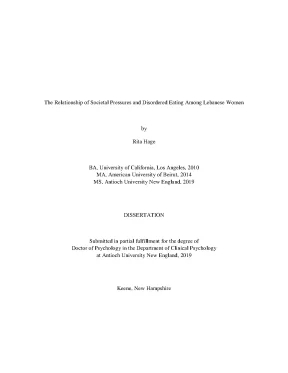
Tải xuống để đọc toàn bộThe Relationship of Societal Pressures and Disordered Eating Among Lebanese Women by Rita Hage BA, University of California, Los Angeles, 2010 MA, American University of Beirut, 2014 MS, Antioch University New England, 2019 DISSERTATION Submitted in partial fulfillment for the degree of Doctor of Psychology in the Department of Clinical Psychology at Antioch University New England, 2019 Keene, New Hampshire ii Department of Clinical Psychology DISSERTATION COMMITTEE PAGE The undersigned have examined the dissertation entitled: THE RELATIONSHIP OF SOCIETAL PRESSURES AND DISORDERED EATING AMONG LEBANESE WOMEN presented on December 19, 2019 by Rita Hage Candidate for the degree of Doctor of Psychology and hereby certify that it is accepted*. Dissertation Committee Chairperson: Kathi Borden, PhD Dissertation Committee members: Gina Pasquale, PsyD Katherine Russell, PsyD Accepted by the Department of Clinical Psychology Chairperson Vincent Pignatiello, PsyD 12/19/2019 *Signatures are on file with the Registrar’s Office at Antioch University New England. iii Dedication I dedicate this dissertation to my father, Dr. Joe Hage, who is the reason for my achievements and success in life.
I am grateful for his continuing and unwavering love, support, and sacrifices. Throughout my life, he continues to be my most important role model. I also dedicate this study to my mother, Myrna Hage. I am appreciative and thankful for her continuing love, encouragement, reassurance, and prayers in times of stress and difficulty.
Both my parents have provided me the catalyst to continue my doctoral degree and dissertation research. I owe my success in life to both my parents who taught me the value of leadership, education, and sacrifice in achieving greater goals. Without their continued love, patience, and support I would not have achieved what I have accomplished in my life. iv Acknowledgements This dissertation represents the completion of a long journey with obstacles that seemed challenging and insurmountable at times.
Completion of my dissertation would not have been achievable without the encouragement and support of my loving family and friends, as well as the collaboration and support from my colleagues and professors. I am truly grateful for all of them. I would like to acknowledge and thank Dr. Kathi Borden, my academic advisor, professor, and committee chairperson, for her guidance, mentoring, and support throughout my endeavor.
Her insight, understanding, and encouragement helped me stay focused on completing my long journey in the doctoral program and dissertation process successfully. I could not have done this difficult journey without her. I would like to thank Dr. Gina Pasquale and Dr.
Katherine Russell, my dissertation committee members, for their support and encouragement through the writing of this dissertation. I would like to thank my family. A special thank you to my father and mother, Dr. Joe Hage and Myrna Hage, and my sister, Karel Hage, for their unprecedented support, mentorship, and inspiration.
Without their unwavering encouragement and support, I could not have completed my doctoral degree, let alone this dissertation. It is impossible to overstate the value and worth of the presence my parents and sister have in my life. I would also like to express my heartfelt thanks and gratitude to my best friends, Aline Hachem and Nassab Ouainy. They never stopped praying, encouraging, and supporting me throughout my doctoral journey.
They both have always stood by my side, believed in me when things got tough, and gave me the extra push I needed. I am forever grateful and blessed to have them in my life. v Table of Contents Acknowledgements .iv List of Tables. 2 Women and Society.
2 Pressure from Family and Peers. 3 Pressure from Media. 6 Generational Standards of Beauty. 7 Beauty and Appearance are Greatly Emphasized in Lebanon.
8 Definition of Key Constructs. 11 Statement of Purpose. 19 Overall Societal Pressures on Disordered Eating. 20 Research Question 1: Mass Media and Disordered Eating.
20 Research Question 2: Family Pressure and Disordered Eating. 21 Research Question 3: Peer Pressure and Disordered Eating. 21 vi Exploratory Analysis. 26 Limitations and Directions for Future Research.
32 Appendix A: Demographic Data Questionnaire. 38 Appendix B: Introductory Email for Recruiting Participants. 39 Appendix C: Informed Consent. 42 vii List of Tables Table 1.
Correlations of Disordered Eating and Societal Pressures. Correlations of Disordered Eating and Societal Pressures by Age Group. 44 1 Abstract Messages that women receive from the media, family, and peers are often intended to promote the female thin ideal, and these messages may contribute to the development of eating disorders. In Lebanese society, unrealistic standards for thinness are a central component of how Lebanese society defines glamour.
The following paper examined the relationship of societal pressures on Lebanese women to meet these beauty expectations and how those pressures are related to disordered eating. Ninety Lebanese women between the ages of 18 and 39 responded to two questionnaires: (a) the Eating Attitudes Test-26 (EAT-26) and (b) the Sociocultural Attitudes Towards Appearance Questionnaire (SATAQ-4). A correlation analysis indicated that there was a positive relationship between problematic eating and exposure to social pressures of thin ideals and beauty conveyed by family, peers, and media. Given the limited research examining eating disorders in Lebanon and other parts of the Middle East, the results of this study can be useful to help facilitate awareness of social pressure and advocate for necessary treatment facilities and programs for women in Lebanon.
This dissertation is available in open access at AURA, http://aura.edu/ and Ohio Link ETD Center, https://etd.edu/ Keywords: disordered eating, societal pressure, Lebanon, women, thinness, peer, media 2 The Relationship of Societal Pressures and the Development of Problem Eating Among Lebanese Women Introduction The purpose of this quantitative correlational study was to examine the existence and extent of the relationship between disordered eating and societal pressures among Lebanese women. The following review of the scholarly literature includes the conceptual framework of the study, as well as information on eating disorders, pressure from family and peers, pressure from media, and generational standards of beauty. Key constructs related to eating disorders and societal pressures are discussed, and the literature review concludes with a discussion of the purpose of the study and the research questions. Literature Review Women and Society Women look to society’s ideals and norms for their personal perceptions of beauty.
Polivy, Garner, and Garfinkel (1986) found that societal preferences greatly dictate physical appearance and definitions of beauty. Beauty is defined as “a combination of qualities, such as shape, colour, or form that pleases the aesthetic senses, especially the sight” (Oxford Dictionary, 2013). Surrounded by images of celebrities who are painfully thin and photoshopped, women in many societies feel pressured to look like the images they see. Because of the focus of popular culture on beauty and thinness, many women are determined to achieve these unrealistic ideals, using any method available to them to lose weight, regardless of whether it is risky or safe (Pinhas, Toner, Ali, Garfinkel, & Stuckless, 1999).
Millions of women resort to food restriction, cosmetic surgery, and diet pills to enhance various parts of their bodies and minimize others (Saha & Saha, 2017). Pinhas et al. found that, as pressure increased on women to lose weight and 3 to change their looks so that they become more like the ideals society portrays, women felt more dissatisfaction about their bodies and looks. Research has shown that in Western society, the beauty ideals and messages that females receive from the media, family, and peers help promote the female thin ideal, leading to the development of eating disorders (Le Grange, Lock, Loeb, & Nicholls, 2010; Stice, Maxfield, & Wells, 2003; van den Berg, Thompson, Obremski-Brandon, & Coovert, 2002).
The Dove Self-Esteem Project featured a study to understand how women and girls across 13 countries felt about their appearance and body. Dove (2016) found that across the 13 countries, 87% of women will stop themselves from eating and put their health at risk to achieve a certain body weight. The study revealed that 69% of women and 65% of girls felt pressure from television and other media to reach these unrealistic standards. Moreover, the survey showed that 60% of women believed that they had to achieve the unrealistic beauty standards portrayed in their society and media to achieve a better and happier life.
The Dove study suggested that women can be affected negatively by exposure to beauty and thin ideals, resulting in poor mental and physical health, as well as failure to recognize their full natural beauty and worth (Dove, 2016). Pressure from Family and Peers Family and peers are important socializing agents serving as messengers of societal values to be thin, which could encourage disordered eating (Meyer & Gast, 2008; Stice, Maxfield, & Wells, 2003). Western studies have shown that women who lived in a critical family environment dominated by dialogues about thinness and weight were at increased risk for eating disorders (Haworth-Hoeppner, 2000). In addition to family environments, Western studies suggested that peers who placed pressure on others regarding beauty and thin ideals helped influence the presence of eating disorders (Stice et al.
Societal pressures to be thin 4 appeared to have a greater negative effect on women when messages originated from closer related people, such as family and peers, compared to messages from those with more distant relationships. Peers and family contribute to pressure on women regarding weight-loss attitudes and behaviors. Whale, Gillison, and Smith (2014) investigated the relationship of women’s attitudes and reason for losing weight to societal pressures surrounding weight loss and attitudes toward weight. The authors conducted semistructured qualitative interviews with women who were attending commercial weight-loss programs.
The researchers found that women believed their primary reason for losing weight was external pressure. Rather than having personal values motivate the participants, women tried to lose weight because of the pressures they faced from family and friends. Participants expressed that the comments and reactions they experienced from family and friends about weight and unrealistic thin ideals brought up negative emotions. Even when participants were successful in their weight loss regime, they still did not feel that the weight change was enough for their family and friends (Whale et al.
This study showed that women are influenced by their perception of family and peer pressure to partake in weight-loss behaviors. Studies have shown that sociocultural influences, such as peers and family, can contribute to the development of eating disorder attitudes and behaviors. Linville, Stice, Gau, and O’Neil (2011) examined whether maternal and peer attitudes about the importance of thinness might be associated with eating disorders in adolescent girls. A sample of 483 adolescent girls between the ages of 15–19 were given questionnaires that measured thin-ideal internalization, body dissatisfaction, social support, pressure to be thin, and bulimic symptoms.
The researchers found that maternal and peer views of thin ideals significantly predicted bulimic symptoms in 5 adolescent girls (Linville et al. These findings demonstrated that unhealthy attitudes and behaviors from family members and peers are associated with an increased risk for exhibiting eating disorder symptoms. Rhodes and Kroger (1992) found that young women who lived in a family where pressures for beauty and thinness were greatly emphasized were at risk for disordered eating. In particular, mother-daughter relationships have been shown to contribute to eating disorders in young women.
Studies have also found connections between the parents’ own dieting behaviors and concern about weight, and the parents’ encouragement of their children to lose weight (Krones, Stice, Batres, & Orjada, 2005). Further, parental judgments, remarks, and comments concerning weight and shape of their children have been shown to be associated with eating disorders. Feedback that young women receive from parents and family concerning their appearance exerted pressure to follow cultural ideals of thinness and beauty. Because young girls and women want to win parental and family approval, they internalize these pressures, and this may increase their risk of developing eating disorders (Krones et al.
Nội dung được bảo vệ bản quyền — Tải xuống đầy đủ
Trích dẫn luận án này
Rita Hage (2019). Hage rita dissertation for etd 5 3 20 [Luận án tiến sĩ, Antioch University New England]. LuanAn.net. https://luanan.net/giao-duc-hoc/hage-rita-dissertation-for-etd-5-3-20
Câu hỏi thường gặp
Luận án "Hage rita dissertation for etd 5 3 20" nghiên cứu về vấn đề gì?
Luận văn Hage rita dissertation cho ETD 5 3 20: Nghiên cứu chuyên sâu, phân tích dữ liệu và đề xuất giải pháp đột phá. Khám phá ngay!
Luận án "Hage rita dissertation for etd 5 3 20" được bảo vệ tại trường nào?
Luận án này được bảo vệ tại Antioch University New England. Năm bảo vệ: 2019.
Luận án "Hage rita dissertation for etd 5 3 20" thuộc chuyên ngành gì?
Luận án "Hage rita dissertation for etd 5 3 20" thuộc chuyên ngành Clinical Psychology. Danh mục: Giáo Dục Học.
Luận án "Hage rita dissertation for etd 5 3 20" có bao nhiêu trang?
Luận án "Hage rita dissertation for etd 5 3 20" có 51 trang. Bạn có thể xem trước một phần tài liệu ngay trên trang web trước khi tải về.
Cách tải luận án "Hage rita dissertation for etd 5 3 20" về máy như thế nào?
Để tải luận án về máy, bạn nhấn nút "Tải xuống ngay" trên trang này, sau đó hoàn tất thanh toán phí lưu trữ. File sẽ được tải xuống ngay sau khi thanh toán thành công. Hỗ trợ qua Zalo: 0559 297 239.