Giant steps toward a developmental trajectory of creative talent
Khám phá các bước nhảy vọt định hình quỹ đạo phát triển sáng tạo. Bài viết đào sâu các yếu tố thúc đẩy tư duy đột phá, đổi mới và tiềm năng con người.
The College of William and Mary in Virginia
Luan An
Luận án tiến sĩ
Năm xuất bản
Số trang
144
Thời gian đọc
22 phút
Lượt xem
0
Lượt tải
0
Phí lưu trữ
40 Point
Tổng quan nhanh
- Chủ đề:
- Quỹ Đạo Phát Triển Tài Năng Sáng Tạo Jazz
- Số trang:
- 144 trang
- Trường:
- The College of William and Mary in Virginia
- Chuyên ngành:
- Educational Leadership
- Tác giả:
- Anthony Michael Washington
- Năm:
- 2019
Tóm tắt nội dung luận án
I.Quỹ Đạo Phát Triển Tài Năng Sáng Tạo Jazz
Nghiên cứu khám phá quỹ đạo phát triển tài năng sáng tạo ở nghệ sĩ jazz ngẫu hứng. Lĩnh vực jazz xem sự sáng tạo là yếu tố cốt lõi trong biểu diễn. Vì vậy, việc phát triển khả năng này bao gồm các kỹ thuật cụ thể. Nghiên cứu này phân tích cách các chuyên gia jazz phát triển năng lực sáng tạo. Điều này liên quan đến việc xác định các trải nghiệm quan trọng, kỹ năng, tố chất. Các hoạt động liên quan đến việc phát triển tài năng ưu tú trong lĩnh vực này cũng được làm rõ. Mục tiêu là hiểu sâu sắc về tiến trình sáng tạo. Hiểu được cách tài năng sáng tạo được hình thành và phát triển. Đây là một đóng góp quan trọng cho tâm lý học phát triển và giáo dục nghệ thuật.
1.1. Hiểu Rõ Tiềm Năng Sáng Tạo
Tài liệu này tập trung vào việc làm rõ tiềm năng sáng tạo của các nghệ sĩ jazz. Nghiên cứu xem xét các kỹ năng bẩm sinh và những yếu tố được trau dồi. Sáng tạo trong jazz không chỉ là kỹ thuật. Đó là khả năng tạo ra cái mới, độc đáo trong thời gian thực. Khám phá các dấu hiệu sớm của tài năng sáng tạo là một mục tiêu. Xác định cách các dấu hiệu này được nhận biết và phát triển. Việc này cung cấp cái nhìn sâu sắc về bản chất của tài năng.
1.2. Mục Tiêu Nghiên Cứu Sáng Tạo
Mục tiêu chính là xây dựng một khung lý thuyết. Khung này mô tả quá trình phát triển sự sáng tạo. Phân tích các giai đoạn sáng tạo mà một nghệ sĩ jazz trải qua. Việc này giúp nhận diện các điểm uốn quan trọng. Các điểm này ảnh hưởng đến sự phát triển tài năng. Nghiên cứu nhằm cung cấp cái nhìn toàn diện. Từ đó giúp nuôi dưỡng sáng tạo một cách hiệu quả hơn. Đây là một bước tiến lớn trong tâm lý học phát triển tài năng.
1.3. Bản Chất Sáng Tạo Trong Jazz
Sáng tạo trong ngẫu hứng jazz là một quá trình phức tạp. Nó đòi hỏi sự kết hợp giữa kiến thức âm nhạc sâu rộng và khả năng tư duy nhanh. Sáng tạo không chỉ là việc chơi những nốt nhạc mới. Nó là cách nghệ sĩ diễn đạt cảm xúc, ý tưởng cá nhân. Nghiên cứu này mổ xẻ các khía cạnh này. Nó khám phá cách nghệ sĩ phát triển 'tiếng nói' riêng. Việc này liên quan đến việc hiểu rõ bản thân và công cụ của mình.
II.Tiến Trình Sáng Tạo Phương Pháp Nghiên Cứu
Nghiên cứu sử dụng phương pháp lý thuyết nền tảng (grounded theory). Phương pháp này cho phép phát triển một lý thuyết từ dữ liệu thực tế. Các cuộc phỏng vấn được thực hiện với các nghệ sĩ jazz chuyên gia. Họ cung cấp những câu chuyện hồi cứu về quá trình phát triển tài năng. Bên cạnh đó, các tài liệu tự truyện và tiểu sử cũng được phân tích. Các tài liệu này liên quan đến các nghệ sĩ jazz xuất chúng. Dữ liệu được thu thập và phân tích một cách có hệ thống. Mục tiêu là tạo ra một khung lý thuyết toàn diện. Khung này giúp xác định và phát triển tài năng sáng tạo.
2.1. Phương Pháp Luận Nền Tảng
Lý thuyết nền tảng là một phương pháp nghiên cứu định tính. Nó tập trung vào việc xây dựng lý thuyết từ dữ liệu. Phương pháp này phù hợp để khám phá các hiện tượng phức tạp. Sự phát triển tài năng sáng tạo là một hiện tượng như vậy. Các nhà nghiên cứu không bắt đầu với một giả thuyết định sẵn. Thay vào đó, lý thuyết nổi lên từ quá trình phân tích dữ liệu. Cách tiếp cận này đảm bảo sự phù hợp và chính xác của khung lý thuyết.
2.2. Phân Tích Dữ Liệu Phát Triển Tài Năng
Dữ liệu từ các cuộc phỏng vấn và tài liệu được mã hóa. Các chủ đề và mô hình lặp lại được xác định. Quá trình này bao gồm việc so sánh liên tục. Các khái niệm được liên kết để hình thành các danh mục. Cuối cùng, một khung lý thuyết được xây dựng. Khung này giải thích các mối quan hệ giữa các yếu tố phát triển. Nó minh họa rõ ràng các giai đoạn sáng tạo. Việc phân tích này giúp nhận diện các yếu tố cốt lõi của quỹ đạo phát triển tài năng.
III.Nuôi Dưỡng Sáng Tạo Vai Trò Thầy Kinh Nghiệm
Nghiên cứu chỉ ra vai trò thiết yếu của giáo viên và người cố vấn. Họ là những người định hình quá trình phát triển tài năng. Sự hướng dẫn của họ giúp định hướng tiến trình sáng tạo. Các trải nghiệm thực tế cũng đóng góp đáng kể. Chúng rèn luyện tư duy sáng tạo và kỹ năng ngẫu hứng. Việc nuôi dưỡng sáng tạo đòi hỏi một môi trường hỗ trợ. Nó cũng cần những cơ hội thực hành chuyên sâu. Quá trình này không chỉ là học kỹ thuật. Nó là sự phát triển toàn diện của một nghệ sĩ.
3.1. Thầy Cô và Người Hướng Dẫn
Giáo viên và người cố vấn đóng vai trò trung tâm. Họ cung cấp kiến thức, kỹ năng và định hướng. Họ truyền cảm hứng và giúp học viên vượt qua thử thách. Sự hiện diện của họ thúc đẩy sự phát triển cá nhân. Họ giúp học viên khám phá tài năng tiềm ẩn. Mối quan hệ này có ý nghĩa lớn trong việc hình thành tư duy sáng tạo. Nó là yếu tố then chốt trong các giai đoạn sáng tạo ban đầu.
3.2. Thực Hành Chuyên Sâu Tích Cực
Thực hành 'trong xưởng' (going to the woodshed) là cần thiết. Đây là quá trình tự học và luyện tập chuyên sâu. Nó bao gồm việc chép lại và phân tích các bản nhạc của bậc thầy. Việc này giúp xây dựng vốn từ vựng âm nhạc. Nó rèn luyện kỹ năng kỹ thuật trên nhạc cụ. Thực hành liên tục giúp củng cố kiến thức và phát triển phong cách cá nhân. Đây là nền tảng vững chắc cho tiến trình sáng tạo.
3.3. Trải Nghiệm Thực Tế Quan Trọng
Trải nghiệm biểu diễn trực tiếp là vô cùng quý giá. Nó cho phép nghệ sĩ thử nghiệm và phát triển 'tiếng nói' của mình. Việc 'tìm kiếm âm thanh riêng' là một phần của hành trình này. Nghệ sĩ học cách 'nói những gì mình muốn nói' qua âm nhạc. Có 'điều gì đó để nói' trở thành mục tiêu cuối cùng. Những trải nghiệm này cung cấp phản hồi thực tế. Nó thúc đẩy sự trưởng thành của tiềm năng sáng tạo.
IV.Khám Phá Tiềm Năng Sáng Tạo Qua Thực Hành
Nghiên cứu làm rõ các hoạt động cụ thể giúp phát triển tiềm năng sáng tạo. Việc hiểu rõ nhạc cụ là điều kiện tiên quyết. Các kỹ năng như phiên âm và mở rộng tiết mục rất quan trọng. Chúng xây dựng nền tảng vững chắc cho ngẫu hứng. Tư duy sáng tạo được mài giũa qua những buổi thực hành lặp đi lặp lại. Mục tiêu cuối cùng là phát triển một phong cách cá nhân độc đáo. Điều này thể hiện sự trưởng thành trong tiến trình sáng tạo của mỗi nghệ sĩ.
4.1. Kỹ Năng Nghe và Diễn Giải
Kỹ năng phiên âm (transcribing) là một trụ cột. Nó đòi hỏi lắng nghe kỹ lưỡng các bản ngẫu hứng của các nghệ sĩ vĩ đại. Sau đó, nó cần tái tạo chúng trên nhạc cụ. Quá trình này không chỉ là sao chép. Nó là sự hiểu biết sâu sắc về cấu trúc và ý đồ âm nhạc. Nó giúp nghệ sĩ hấp thụ các ngôn ngữ và ý tưởng khác nhau. Đây là một bước quan trọng để nuôi dưỡng sáng tạo.
4.2. Tư Duy Sáng Tạo Trong Ngẫu Hứng
Biết rõ nhạc cụ là điều kiện tiên quyết. Hiểu rõ giới hạn và khả năng của nó. Điều này giải phóng nghệ sĩ để tập trung vào tư duy sáng tạo. Ngẫu hứng không chỉ là chơi đúng nốt. Nó là khả năng tạo ra dòng chảy ý tưởng âm nhạc. Nó là việc phản ứng linh hoạt với môi trường âm nhạc. Việc này đòi hỏi sự kết hợp giữa kỹ thuật, lý thuyết và cảm xúc.
4.3. Phát Triển Phong Cách Cá Nhân
Việc tìm kiếm 'âm thanh của riêng mình' là một hành trình dài. Nó liên quan đến việc tổng hợp các ảnh hưởng. Nó đòi hỏi thử nghiệm và khám phá liên tục. Mục tiêu là phát triển một phong cách đặc trưng, dễ nhận biết. Khi nghệ sĩ có 'điều gì đó để nói', họ mới thực sự sáng tạo. Điều này là dấu hiệu của sự phát triển trưởng thành trong quỹ đạo phát triển tài năng.
V.Tâm Lý Học Phát Triển Sáng Tạo Khung Giant Steps
Nghiên cứu tạo ra khung 'Giant Steps Framework'. Khung này mô tả các thuộc tính và chiều kích của từng giai đoạn phát triển tài năng. Nó cung cấp một cái nhìn có cấu trúc. Từ đó giúp hiểu rõ cách tài năng sáng tạo phát triển. Khung này là một công cụ quan trọng. Nó dùng để nhận diện và nuôi dưỡng sáng tạo trong ngẫu hứng jazz. Đây là một đóng góp lớn cho tâm lý học phát triển tài năng. Nó cũng có ý nghĩa thực tiễn cho giáo dục âm nhạc.
5.1. Khung Phát Triển Tài Năng Giant Steps
Khung 'Giant Steps' là kết quả của việc áp dụng lý thuyết nền tảng. Khung này được xây dựng dựa trên dữ liệu từ các chuyên gia. Nó phác thảo các giai đoạn chính của sự phát triển sáng tạo. Mỗi giai đoạn có các đặc điểm, kỹ năng và thách thức riêng. Khung này cung cấp một bản đồ. Nó giúp người học và người dạy điều hướng quá trình phát triển tài năng. Đây là một công cụ hữu ích để khám phá tài năng.
5.2. Các Giai Đoạn Sáng Tạo Nổi Bật
Khung xác định các giai đoạn sáng tạo từ khởi đầu đến đỉnh cao. Nó mô tả sự chuyển đổi từ học hỏi đến làm chủ. Các giai đoạn này bao gồm từ việc bắt chước đến việc tạo ra phong cách độc đáo. Sự tiến bộ không chỉ là tuyến tính. Nó có thể bao gồm những bước lùi và những bước nhảy vọt. Việc hiểu rõ các giai đoạn này giúp cá nhân hóa quá trình học tập. Nó thúc đẩy sự phát triển sự sáng tạo một cách hiệu quả.
5.3. Hàm Ý cho Giáo Dục Thực Hành
Khung 'Giant Steps' có ý nghĩa quan trọng cho giáo dục âm nhạc. Nó giúp thiết kế các chương trình giảng dạy hiệu quả hơn. Các nhà giáo dục có thể sử dụng khung này. Từ đó xác định nhu cầu của học viên ở từng giai đoạn. Nó cung cấp một hướng dẫn để nuôi dưỡng sáng tạo. Nó thúc đẩy các phương pháp thực hành có ý nghĩa. Việc này giúp học viên đạt được tiềm năng sáng tạo cao nhất của họ. Nó cũng có giá trị cho nghiên cứu dọc về sáng tạo trong tương lai.
Mục lục chi tiết luận án
Tải xuống file đầy đủ để xem toàn bộ nội dung
Tải đầy đủ (144 trang)Trích đoạn nội dung luận án
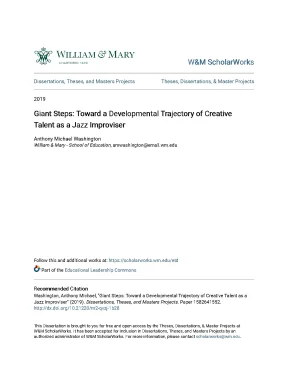
Tải xuống để đọc toàn bộW&M ScholarWorks Dissertations, Theses, and Masters Projects Theses, Dissertations, & Master Projects 2019 Giant Steps: Toward a Developmental Trajectory of Creative Talent as a Jazz Improviser Anthony Michael Washington William & Mary - School of Education, amwashington@email.edu Follow this and additional works at: https://scholarworks.edu/etd Part of the Educational Leadership Commons Recommended Citation Washington, Anthony Michael, "Giant Steps: Toward a Developmental Trajectory of Creative Talent as a Jazz Improviser" (2019). Dissertations, Theses, and Masters Projects.21220/m2-qvzj-1b28 This Dissertation is brought to you for free and open access by the Theses, Dissertations, & Master Projects at W&M ScholarWorks. It has been accepted for inclusion in Dissertations, Theses, and Masters Projects by an authorized administrator of W&M ScholarWorks. For more information, please contact scholarworks@wm.
GIANT STEPS: TOWARD A DEVELOPMENTAL TRAJECTORY OF CREATIVE TALENT IN JAZZ IMPROVISATION ____________________________________ A Dissertation Presented to The Faculty of the School of Education The College of William and Mary in Virginia _____________________________________ In Partial Fulfillment of the Requirements for the Degree Doctor of Philosophy _______________________________________ by Anthony Michael Washington June 2019 GIANT STEPS: CREATIVE TALENT IN JAZZ IMPROVISATION GIANT STEPS: TOWARD A DEVELOPMENTAL TRAJECTORY OF CREATIVE TALENT IN JAZZ IMPROVISATION by Anthony Michael Washington ____________________________________________ Approved June 2019 by Tracy L. Chairperson of Doctoral Committee Carol Tieso, Ph. Rena Subotnik, Ph. ii GIANT STEPS: CREATIVE TALENT IN JAZZ IMPROVISATION DEDICATION I write your name On my school desk In every sound I create On echoes of my childhood I write your name By the weight of the one word I was born to know you I write your name How is freedom? iii GIANT STEPS: CREATIVE TALENT IN JAZZ IMPROVISATION CHAPTER 1: INTRODUCTION.
2 STATEMENT OF PROBLEM. 16 CHAPTER 2: REVIEW OF LITERATURE. 26 TEACHERS AND MENTORS. 37 iv GIANT STEPS: CREATIVE TALENT IN JAZZ IMPROVISATION Maker.
54 MEMOS AND DIAGRAMS. 62 HEARD THIS SOUND. 62 MENTORS AND TEACHERS. 65 GOING TO THE WOODSHED.
66 Struggle with It. 68 Know Your Horn. 69 Transcribing and Repertoire. 74 v GIANT STEPS: CREATIVE TALENT IN JAZZ IMPROVISATION AUTHENTIC EXPERIENCE.
79 In search of their sound. 81 Saying what you want. 83 Having Something to Say. 90 GIANT STEPS: A GROUNDED THEORY OF TALENT DEVELOPMENT AMONG JAZZ IMPROVISERS.
92 CHAPTER 5: IMPLICATIONS AND DISCUSSION. 97 ASSOCIATIVE CREATIVE EXPRESSION. 121 vi GIANT STEPS: CREATIVE TALENT IN JAZZ IMPROVISATION REFERENCES. 124 vii GIANT STEPS: CREATIVE TALENT IN JAZZ IMPROVISATION Acknowledgements To every teacher who believed in me and helped me along my way, thank you.
Momma, I made it! Betty Jean Washington Charlene Rogers Dr. Clifford Watson Mrs. Christopher Rogers Dr. Benjamin Pruitt Bill Lucas Marcus Belgrave Charles Gabriel Dr.
Timmey Zachary Geraldine Boone Dr. Cross viii GIANT STEPS: CREATIVE TALENT IN JAZZ IMPROVISATION List of Figures Figure 1. Giant Steps Framework explaining the properties and dimensions of each phase of talent development for jazz improvisers in this study. Color coded depiction of brain areas.
101 Figure 3: TDMM/Giant Steps comparison chart. 102 ix GIANT STEPS: CREATIVE TALENT IN JAZZ IMPROVISATION Abstract Expert jazz improvisers follow a developmental trajectory that is useful to understanding creative ability. Because this domain uses creativity as a fundamental part of its performance, its development naturally includes techniques for developing one’s creativity. This study explored the development of expert and eminent jazz improvisers' creative abilities and delineated critical experiences, skills, dispositions, and activities associated with developing elite talent in this domain.
I conducted interviews with expert jazz improvisers to gain retrospective accounts of their talent development process in addition to exploring autobiographical and biographical accounts of developmental activities of selected eminent jazz improvisers. I employed grounded theory techniques to generate and analyze these data and ultimately create a framework for identifying and developing creative talent as a jazz improviser. x GIANT STEPS: TOWARD A DEVELOPMENTAL TRAJECTORY OF CREATIVE TALENT IN JAZZ IMPROVISATION GIANT STEPS: CREATIVE TALENT IN JAZZ IMPROVISATION Chapter 1: Introduction Expert jazz improvisers follow a developmental trajectory that is useful to understanding creative ability. Because this domain uses creativity as a fundamental part of its performance, its development naturally includes techniques for developing one’s creativity.
This study explored the development of expert and eminent jazz improvisers' creative abilities and delineated critical experiences, skills, dispositions, and activities associated with developing elite talent in this domain. I conducted interviews with expert jazz improvisers to gain retrospective accounts of their talent development process in addition to exploring autobiographical and biographical accounts of developmental activities of selected eminent jazz improvisers. I employed grounded theory techniques to generate and analyze these data and ultimately create a framework for identifying and developing creative talent as a jazz improviser. Some researchers espouse creativity to be a largely innate ability that existed in a binary fashion from birth with little ability for a person to change their creative output (Subotnik, Worrell, & Olszewski-Kubilius, 2011).
By looking retrospectively at the development process of expert jazz improvisers I examined this field’s approach to developing creativity and the learning experiences that comprised the trajectory. Understanding the properties and dimensions of development in this field may allow us to better understand the extent to which we can develop creative ability and the methods jazz improvisers use to achieve this goal. 2 GIANT STEPS: CREATIVE TALENT IN JAZZ IMPROVISATION Statement of Problem Too often, researchers posit creativity to be an innate ability that is only valued in arts related domains when, the impact of creativity is valued throughout many fields of study. Creativity also impacts the identification and selection process for gifted education programs as many high ability students may possess creative gifts that are not measure by IQ tests.
Researchers have endeavored to accurately find talent using psychometric assessments throughout the history of educational measurement. From the earliest attempts at discerning intellectual ability of soldiers using Alpha and Beta tests during World War 1 to present day ability and achievement tests, psyshometricians have tried to predict with certainty those with the potential for high levels of performance through predictive assessments (Bloom, 1985; Subotnik et al. Since those early days, there have been many studies of the lives of gifted children and adults in which IQ has been shown to be a strong predictor of reaching expert levels of performance. However, there is little evidence of a demonstrable increase in our ability to predict eminence using IQ (Bloom, 1985; Cross & Coleman, 2005; Subotnik et al.
This is largely due to the role of creative skills in making a Big-C contribution to a field which would result in the designation of eminence (Csikszentmihalyi, 1990). To be eminent refers to having achieved the highest level of performance within a domain which is frequently accompanied by a creative contribution to a domain that moves the field forward. Relying solely on IQ to determine which youth may reach eminent levels of performance as Terman (1926) ignores the role of creative skill development. In addition, there is an inconsistent correlation between IQ and creative domains which prevents these assessments from being useful for identification in a 3 GIANT STEPS: CREATIVE TALENT IN JAZZ IMPROVISATION domain like jazz improvisation.
I hoped to glean useful information from this study of creativity that may help us understanding the necessary components for reaching eminent levels of performance. In this study, I explored the developmental trajectory of expert jazz improvisers with a focus on the properties and dimensions of their learning experiences and the extent to which musicians systematically develop creativity this field. I did this through semi- structured interviews with expert improvisers and field observations of the talent development process in several settings to include expert improvisers’ jazz improvisers interacting with students. During this investigation I implemented a Grounded Theory approach as I looked to gain a deeper understanding of each participant’s developmental activities to uncover the common properties, dimensions, and critical experiences of their talent development process.
This study sought to gain a deeper understanding of creative development to potentially understand more about the extent to which jazz musicians intentionally address creative ability. While there is evidence to support the development of speed, strength, and complex routines through deliberate practice there is a need for research regarding the growth and development of the cognitive and psychosocial skills associated with eminence (Csikszentmihalyi, 1996; Ericsson, 2008; Subotnik, Jarvin, & Rayhack, 2007). The field could receive help from further exploration of the development of skills and dispositions among improvisers to inform the teaching practice. There is ample evidence to support the role of creativity, intrinsic motivation, willingness to take risks, and persistence through failure as essential personality traits of eminent individuals (Bloom, 1985; Leslie, 2000; Marsalis & Hinds, 2003; Subotnik et al., 2007; Terman, 1926) but 4 GIANT STEPS: CREATIVE TALENT IN JAZZ IMPROVISATION there is a paucity of research that focuses on the extent to which these dispositions have been developed so that practitioners can systematically provide high quality experiences to their students.
Within the literature there is often a disconnect between the skills needed to become and expert and the assessments used to identify giftedness in youth. This has played out in a lack of ability to identify which students will reach eminent levels of achievement as adults. There are several instances where researchers overlooked children who demonstrate gifted potential and reach eminence were overlooked during various gifted screening processes throughout their development. A notable example of this misidentification was Lewis Terman's (1926) Genetic Study of genius.
Terman sought out students that met stringent intellectual criteria (IQ above 140) in the hopes of generating a sample of those students with the highest potential for reaching eminence (Terman, 1926). Relying primarily on IQ as his selection criteria resulted in two students who he screened and did not select who went on to earn Nobel Prizes, which is exactly the sort of adult giftedness Terman sought to study. In addition, among those selected, those who ultimately reached the highest levels of achievement within their fields had comparatively low IQs for this high-powered group (Terman, 1926). There has been less effort devoted to the development of talent in those who do not demonstrate exceptional gifts early on in life.
Even though we have notable examples of individuals who did not demonstrate prodigious talent in their youth who went on to eminent levels of performance as adults, there remains a focus on the talent level demonstrated rather than the skills and dispositions exhibited that are known to be 5 GIANT STEPS: CREATIVE TALENT IN JAZZ IMPROVISATION common among eminent individuals as children. This study sought to control this error in identification by focusing on experts who have reached expertise which alleviates the necessity to predict later performance. The participants in this study, some of whom did not demonstrate exceptional ability in their youth, have all achieved expertise and have the potential for eminent recognition by virtue of their current level of performance and prior accomplishments. Understanding the talent development process from their perspective was rich with useful information about talent development.
Misidentification of giftedness could also be due to a lack of understanding of specific traits that lead to eminence (Subotnik et al., 2011; Waugh & Gronlund, 2013) and over-reliance on psychometric assessments that ignore factors known to be associated with gifted children (Terman, 1926). By increasing our ability to accurately identify students with eminent potential, we reduce the impact of selection bias against students who may not demonstrate their potential through these more traditional measures. In this regard, this study sought to deepen the fields’ understanding of the innate skills and dispositions that contribute to expertise in addition to understanding the educational and environmental factors that led the participants to expertise as jazz improvisers. Often, researchers who have sought to identify gifted youth in anticipation of eminence have chosen their samples based on only academic achievements rather than exploring the role of the psychosocial skills and dispositions that are associated with eminent individuals (Bloom, 1985; Subotnik, 1995; Terman, 1926).
Nội dung được bảo vệ bản quyền — Tải xuống đầy đủ
Trích dẫn luận án này
Anthony Michael Washington (2019). Giant steps toward a developmental trajectory of creative ta [Luận án tiến sĩ, The College of William and Mary in Virginia]. LuanAn.net. https://luanan.net/giao-duc-hoc/giant-steps-toward-a-developmental-trajectory-of-creative-talent
Câu hỏi thường gặp
Luận án "Giant steps toward a developmental trajectory of creative ta" nghiên cứu về vấn đề gì?
Khám phá các bước nhảy vọt định hình quỹ đạo phát triển sáng tạo. Bài viết đào sâu các yếu tố thúc đẩy tư duy đột phá, đổi mới và tiềm năng con người.
Luận án "Giant steps toward a developmental trajectory of creative ta" được bảo vệ tại trường nào?
Luận án này được bảo vệ tại The College of William and Mary in Virginia. Năm bảo vệ: 2019.
Luận án "Giant steps toward a developmental trajectory of creative ta" thuộc chuyên ngành gì?
Luận án "Giant steps toward a developmental trajectory of creative ta" thuộc chuyên ngành Educational Leadership. Danh mục: Giáo Dục Học.
Luận án "Giant steps toward a developmental trajectory of creative ta" có bao nhiêu trang?
Luận án "Giant steps toward a developmental trajectory of creative ta" có 144 trang. Bạn có thể xem trước một phần tài liệu ngay trên trang web trước khi tải về.
Cách tải luận án "Giant steps toward a developmental trajectory of creative ta" về máy như thế nào?
Để tải luận án về máy, bạn nhấn nút "Tải xuống ngay" trên trang này, sau đó hoàn tất thanh toán phí lưu trữ. File sẽ được tải xuống ngay sau khi thanh toán thành công. Hỗ trợ qua Zalo: 0559 297 239.