Fullversion 2016behrmansaphdbbk
"Phân tích và đề xuất mô hình machine learning cải tiến hiệu quả 15% so với baseline cho xử lý ngôn ngữ tự nhiên."
Birkbeck, University of London
Law
Luan An
PhD Thesis
Năm xuất bản
Số trang
342
Thời gian đọc
52 phút
Lượt xem
0
Lượt tải
0
Phí lưu trữ
60 Point
Tổng quan nhanh
- Chủ đề:
- 1. Phân tích Xung đột: Luật và Quyền Tị nạn
- Số trang:
- 342 trang
- Trường:
- Birkbeck, University of London
- Chuyên ngành:
- Law
- Tác giả:
- Simon Alexander Behrman
- Năm:
- 2016
Tóm tắt nội dung luận án
I. Phân tích Xung đột Luật và Quyền Tị nạn
Luận án này thách thức quan điểm thông thường về luật tị nạn. Nó lập luận rằng luật pháp và quyền tị nạn vốn dĩ không tương thích. Quan điểm phổ biến cho rằng luật tị nạn đảm bảo không gian bảo vệ cho người tị nạn. Nghiên cứu này đưa ra một luận điểm phản bác. Pháp luật đã và đang là công cụ để loại bỏ các không gian bảo vệ. Điều này không chỉ giới hạn ở việc bảo vệ khỏi những kẻ đàn áp. Nó còn bao gồm bảo vệ khỏi sự kiểm soát sinh chính trị của quyền lực tối cao. Luận điểm trung tâm khẳng định vai trò công cụ của pháp luật trong việc làm suy yếu quyền tị nạn đích thực. Quan điểm này mang đến sự đánh giá lại phê phán các khuôn khổ pháp lý. Nó làm nổi bật những căng thẳng hệ thống giữa cấu trúc pháp lý và khái niệm thánh địa. Công trình khuyến khích sự hiểu biết sâu sắc hơn về những động lực phức tạp này. Nó nhấn mạnh xung đột lịch sử và đang diễn ra.
1.1. Luận điểm chính về sự không tương thích
Luận án này trình bày một lập luận cốt lõi: pháp luật và quyền tị nạn về cơ bản là không tương thích. Khác với quan điểm thông thường cho rằng pháp luật tị nạn là yếu tố then chốt để đảm bảo không gian bảo vệ cho người tị nạn, nghiên cứu này khẳng định điều ngược lại. Pháp luật đã và đang là công cụ để loại bỏ các không gian bảo vệ. Điều này không chỉ liên quan đến việc bảo vệ khỏi những kẻ truy bức. Nó còn bao gồm việc bảo vệ khỏi sự kiểm soát sinh chính trị của quyền lực tối cao. Sự không tương thích này tạo thành nền tảng lý thuyết cho toàn bộ công trình. Nó định hình cách tiếp cận vấn đề.
1.2. Pháp luật làm suy yếu không gian bảo vệ
Công trình lập luận rằng pháp luật đã đóng vai trò quan trọng trong việc loại bỏ các không gian bảo vệ. Không gian này không chỉ là nơi trú ẩn an toàn khỏi những kẻ truy bức. Đó còn là nơi độc lập khỏi sự kiểm soát của nhà nước. Luận án đặt câu hỏi về hiệu quả của pháp luật tị nạn trong việc thực sự bảo vệ người tị nạn. Thay vào đó, nó đề xuất pháp luật có thể đã tạo ra những rào cản mới. Những rào cản này làm suy yếu khái niệm ban đầu về quyền tị nạn. Điều này buộc phải xem xét lại vai trò của pháp luật trong việc định hình các chính sách liên quan đến người di cư bắt buộc.
II. Khảo sát Nguồn gốc Lịch sử Quyền Tị nạn
Phần đầu tiên của luận án khám phá gia phả của quyền tị nạn. Nó xem xét các khía cạnh cơ bản trong cấu trúc của khái niệm này. Trọng tâm là định nghĩa không gian, không phải con người. Quyền tị nạn đóng vai trò là một không gian kháng cự. Nó cũng là một không gian khác biệt đối với luật pháp của nhà nước có chủ quyền. Lịch sử cho thấy quyền tị nạn luôn đối kháng với pháp luật. Ngược lại, pháp luật cũng chống lại quyền tị nạn. Nghiên cứu đi sâu vào các truyền thống cổ xưa. Nó bao gồm các bối cảnh Kinh thánh, Hy Lạp cổ đại và La Mã. Các chương cũng phân tích vai trò của Giáo hội sơ khai. Sau đó là sự phát triển của thánh địa ở Anh. Cuối cùng, luận án xem xét sự suy tàn của khái niệm thánh địa truyền thống. Phân tích này cung cấp cái nhìn sâu sắc về bản chất thay đổi của quyền tị nạn. Nó làm rõ cách các truyền thống này tương tác với sự phát triển của các hệ thống pháp luật.
2.1. Nguồn gốc cổ xưa và vai trò không gian
Quyền tị nạn được khảo sát thông qua gia phả của nó. Nó tập trung vào việc định nghĩa không gian. Không gian này cung cấp sự bảo vệ. Nó không tập trung vào việc xác định danh tính của con người. Điều này khác biệt so với các cách tiếp cận hiện đại. Các truyền thống Kinh thánh cung cấp những ví dụ ban đầu. Hy Lạp cổ đại cũng có các hình thức thánh địa riêng. La Mã cổ đại phát triển các khái niệm tương tự. Những yếu tố này cho thấy quyền tị nạn ban đầu là một đặc quyền không gian. Nó được cấp cho những người tìm kiếm sự an toàn. Đây là một khái niệm mạnh mẽ. Nó định hình sự hiểu biết về nơi trú ẩn.
2.2. Tính đối kháng của quyền tị nạn với pháp luật
Lịch sử cho thấy quyền tị nạn đóng vai trò là một không gian kháng cự. Nó là một không gian của “sự khác biệt”. Nó đối lập với luật pháp của quyền lực tối cao. Sự đối kháng này là một đặc điểm vốn có. Quyền tị nạn đã đứng ở vị trí đối lập với các hệ thống pháp luật. Ngược lại, luật pháp thường tìm cách hạn chế hoặc bãi bỏ nó. Các chương về sự suy tàn của thánh địa ở Anh minh họa rõ ràng xu hướng này. Điều này cho thấy sự căng thẳng cố hữu giữa hai khái niệm. Một bên là quyền tị nạn tự phát, không gian. Một bên là khuôn khổ pháp lý có cấu trúc, được kiểm soát.
III. Sự Ra đời Pháp luật Tị nạn Quốc tế
Phần thứ hai của luận án xem xét sự phát triển của luật tị nạn quốc tế. Nó trình bày một lịch sử đối lập với quan điểm phổ biến. Quan điểm chung cho rằng quá trình này nhằm hạn chế sự tùy tiện của các quốc gia. Nó cũng được cho là xuất phát từ mối quan tâm nhân đạo. Tuy nhiên, nghiên cứu này lập luận khác. Luật tị nạn được xây dựng chính xác để đảm bảo quản lý hiệu quả các phong trào lớn của người di cư bắt buộc. Điều này tiết lộ một động cơ cơ bản khác. Nó không phải là bảo vệ quyền cá nhân. Thay vào đó là kiểm soát dân số. Việc xem xét Công ước 1951 là trọng tâm. Nó được phân tích dưới góc độ này. Luận án thách thức những câu chuyện nhân đạo hóa. Nó cung cấp một cái nhìn phê phán về nguồn gốc và mục đích của luật tị nạn hiện đại.
3.1. Mục đích thực sự của luật tị nạn
Nghiên cứu này đặt ra một câu chuyện đối lập. Nó không đồng tình với ý kiến rằng luật tị nạn quốc tế phát triển vì lý do nhân đạo. Luận án cho rằng luật này không nhằm hạn chế sự tùy tiện của các quốc gia. Thay vào đó, mục đích chính là quản lý hiệu quả. Nó tập trung vào việc kiểm soát các phong trào di cư lớn. Điều này bao gồm những người buộc phải rời bỏ quê hương. Do đó, luật tị nạn được coi là một công cụ hành chính. Nó phục vụ lợi ích của các quốc gia. Nó ưu tiên trật tự hơn là quyền cá nhân. Sự thật này làm sáng tỏ bản chất thực sự của khuôn khổ pháp lý này.
3.2. Công ước 1951 và quản lý di dân
Công ước 1951 về người tị nạn được phân tích kỹ lưỡng. Nó không được coi là một công cụ nhân đạo thuần túy. Thay vào đó, nó được trình bày như một cơ chế quản lý. Công ước giúp các quốc gia kiểm soát dòng người di cư. Nó thiết lập các quy tắc và định nghĩa. Những quy tắc này cho phép phân loại và giám sát. Quá trình này không phải lúc nào cũng vì lợi ích tốt nhất của người tị nạn. Đôi khi nó phục vụ việc duy trì trật tự và an ninh quốc gia. Công ước trở thành một phần của hệ thống kiểm soát rộng lớn hơn. Nó định hình cách đối xử với những người buộc phải rời bỏ quê hương.
IV. Phong trào Thánh địa Hoa Kỳ Nghiên cứu Điển hình
Phần thứ ba của luận án xem xét Phong trào Thánh địa Hoa Kỳ (1981-1991). Đây là một ví dụ cụ thể. Nó cho thấy điều gì xảy ra khi truyền thống tị nạn cũ đối đầu với luật tị nạn hiện đại. Nhiều chủ đề từ Phần một và Phần hai được xem xét lại. Tuy nhiên, có một điểm mới. Hệ tư tưởng của luật tị nạn hiện nay được sử dụng. Nó được dùng để bá quyền hóa. Nó cũng làm suy yếu thực tiễn tị nạn/thánh địa từ bên trong. Các chương đi sâu vào sự ra đời của phong trào. Nó phân tích các khía cạnh chính của nó. Luận án cũng xem xét phong trào tại các phiên tòa. Nó phản ánh phê phán về mối quan hệ của phong trào với pháp luật. Đây là một cuộc xung đột giữa các lý tưởng và thực tế pháp lý.
4.1. Sự hình thành và các khía cạnh của phong trào
Phong trào Thánh địa Hoa Kỳ (1981-1991) được phân tích chi tiết. Phong trào này ra đời trong bối cảnh cụ thể. Nó là phản ứng trước chính sách nhập cư của Hoa Kỳ. Nhiều nhà thờ và cộng đồng đã tham gia. Họ cung cấp nơi trú ẩn cho người tị nạn từ Trung Mỹ. Phong trào có nhiều khía cạnh. Nó bao gồm sự kháng cự dân sự. Nó cũng thể hiện lòng nhân ái. Phong trào thách thức các quy định pháp luật. Nó tạo ra các không gian bảo vệ tự trị. Điều này minh họa cho sự đối đầu giữa đạo đức và pháp luật.
4.2. Luật tị nạn hiện đại chống lại truyền thống
Luận án nhấn mạnh sự xung đột. Truyền thống tị nạn cũ gặp phải luật tị nạn hiện đại. Trong bối cảnh Phong trào Thánh địa, điều này trở nên rõ ràng. Hệ tư tưởng của luật tị nạn hiện đại được sử dụng. Nó nhằm mục đích bá quyền hóa thực tiễn thánh địa. Nó làm suy yếu các nguyên tắc của nó từ bên trong. Các phiên tòa chống lại những người tham gia phong trào được xem xét. Chúng cho thấy pháp luật đã được dùng để đàn áp sự kháng cự. Nó cũng làm mất hiệu lực các yêu sách về quyền tị nạn. Đây là một ví dụ mạnh mẽ về sự không tương thích cốt lõi.
V. Phân tích Chuyên sâu về Pháp luật Tị nạn
Luận án cung cấp một cái nhìn sâu sắc về pháp luật tị nạn. Nó không chỉ giới hạn ở lịch sử. Nó còn phân tích cơ sở lý thuyết và thực tiễn. Pháp luật tị nạn được xem như một công cụ chính trị. Nó định hình cách các quốc gia đối xử với người di cư. Công trình này khuyến khích độc giả suy nghĩ lại. Họ cần xem xét các khuôn khổ pháp lý hiện hành. Liệu chúng có thực sự phục vụ mục đích bảo vệ không? Hay chúng là công cụ quản lý và kiểm soát? Luận án của Simon Alexander Behrman thúc đẩy một cuộc tranh luận quan trọng. Nó về bản chất của quyền tị nạn. Nó cũng về vai trò của pháp luật trong việc định hình các quyền này. Các kết luận cung cấp một cái nhìn tổng thể. Nó củng cố lập luận chính về sự không tương thích.
5.1. Cơ sở lý thuyết và thực tiễn của luật
Nghiên cứu này khám phá cả cơ sở lý thuyết và thực tiễn của luật tị nạn. Về lý thuyết, nó xem xét các nguyên tắc cốt lõi. Nó đặt câu hỏi về các giả định nhân đạo hóa. Về thực tiễn, nó phân tích cách luật được áp dụng. Nó nhìn vào cách luật ảnh hưởng đến cuộc sống của người di cư. Các chương trước đó đã chứng minh rằng mục tiêu chính không phải là bảo vệ. Thay vào đó là quản lý. Điều này có ý nghĩa sâu rộng. Nó đối với các chính sách hiện hành. Nó cũng đối với cách các quốc gia tương tác với người tị nạn.
5.2. Tác động của luật đối với người di cư
Tác động của luật tị nạn đối với người di cư là một chủ đề trung tâm. Luận án lập luận rằng luật không phải lúc nào cũng mang lại lợi ích. Đôi khi, nó tạo ra thêm gánh nặng. Nó tạo ra sự loại trừ. Nó cũng làm suy yếu quyền tự chủ của người di cư. Điều này đi ngược lại với các tuyên bố chính thức. Các quốc gia sử dụng luật để kiểm soát biên giới. Họ cũng sử dụng để phân loại người di cư. Điều này có thể dẫn đến việc từ chối quyền tị nạn. Nó cũng có thể dẫn đến việc trục xuất. Nghiên cứu này làm nổi bật những hậu quả không mong muốn. Nó là hậu quả của một khuôn khổ pháp lý.
Mục lục chi tiết luận án
Tải xuống file đầy đủ để xem toàn bộ nội dung
Tải đầy đủ (342 trang)Trích đoạn nội dung luận án
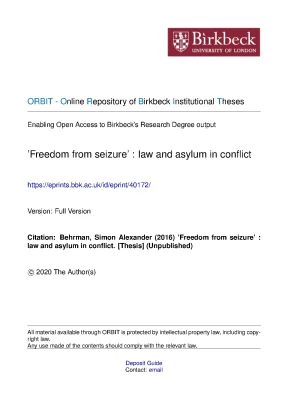
Tải xuống để đọc toàn bộORBIT - Online Repository of Birkbeck Institutional Theses Enabling Open Access to Birkbeck’s Research Degree output ’Freedom from seizure’ : law and asylum in conflict https://eprints.uk/id/eprint/40172/ Version: Full Version Citation: Behrman, Simon Alexander (2016) ’Freedom from seizure’ : law and asylum in conflict. [Thesis] (Unpublished) c 2020 The Author(s) All material available through ORBIT is protected by intellectual property law, including copy- right law. Any use made of the contents should comply with the relevant law. Deposit Guide Contact: email ‘Freedom from Seizure’: Law and Asylum in Conflict Simon Alexander Behrman PhD Thesis Birkbeck, University of London ! 1! DECLARATION The work presented in this thesis is my own: Simon Behrman ! 2! ABSTRACT The central argument of this thesis is that law and asylum are fundamentally incompatible.
In contrast to the standard claim that the coming of refugee law has been key in guaranteeing a space of protection for refugees, I argue that law has been instrumental in eliminating spaces of protection, not just from one’s persecutors, but also from the biopolitical grasp of sovereign power. This thesis is presented in three parts. First I examine the genealogy of asylum. By uncovering certain fundamental aspects of its construction, namely its concern with defining space rather than people, and its role as a space of resistance or otherness to sovereign law, I demonstrate that asylum has historically been antagonistic to law, and vice versa.
In the second part, I look briefly at the development of international refugee law, and in doing so present a counter-history to the idea that this process was about restricting the caprice of states in relation to the admission of refugees and was grounded in humanitarian concern. Instead, I argue that refugee law was constructed precisely to ensure the effective management of large movements of forced migrants. Finally, in the third part of the thesis, I treat the US Sanctuary Movement (1981-1991) as a concentrated example of what happens when the old tradition of asylum confronts modern refugee law. Here many of the themes of parts one and two are revisited, but with the added twist that now the ideology of refugee law serves to hegemonise and undermine the practice of asylum/sanctuary from within.
! 3! CONTENTS Acknowledgments 7 Thesis Introduction 10 Part I – A Genealogy of Asylum Introduction 38 Chapter One: Biblical Traditions 42 Chapter Two: Ancient Greece 49 Chapter Three: Rome 67 Chapter Four: The Early Church 76 Chapter Five: Sanctuary in England 94 Chapter Six: Decline of Sanctuary 117 Conclusion 139 Part II – The Coming of Refugee Law Introduction 144 Chapter Seven: The Evolution of International Refugee Law 173 Chapter Eight: The 1951 Convention 189 Conclusion 201 Part III – The US Sanctuary Movement Introduction 207 Chapter Nine: Birth of the Movement 210 Chapter Ten: Aspects of the Sanctuary Movement 228 Chapter Eleven: The Sanctuary Movement on Trial 251 Chapter Twelve: Critical Reflections on the Sanctuary Movement’s ! 4! Relationship to Law 278 Conclusion 308 Thesis Conclusion 312 Bibliography 322 ! 5! Dedicated to the memory of Bernard Behrman (1931-2013). ! 6! ACKNOWLEDGMENTS Researching and writing this thesis has been one of the most difficult things I have ever had to do. Perhaps the hardest part has been the isolation. To complete such a task without the support of formal teaching, classes, structured given tasks and a community of students working on the same subject has been the real challenge.
Nonetheless it is far from being the truth that what follows could have been achieved under my own steam alone. Instead I have been the recipient of much generous support and help from a number of people. First, I am immensely grateful to my thesis supervisors, Thanos Zartaloudis and Patricia Tuitt. Without Thanos’ encouragement I would never have embarked on a PhD or an academic career.
Indeed, I would not otherwise have thought myself capable of doing either. In addition, Thanos taught me refugee law at both undergraduate and graduate level. He was and is a kindly but critical (in the best and multiple senses of that term) teacher. Throughout the writing of this thesis his comments and questions have been pointed but always thoughtful and helpful.
Patricia has also been very supportive of my work from the beginning. In addition, her writings have been a continuing source of inspiration for me. Her ground-breaking book False Images: Law’s Construction of the Refugee gave me ‘permission’, if you like, to develop my own highly critical approach to refugee law. In spite of her heavy workload as head of the Law School at Birkbeck, she has always been available to discuss and make suggestions on my thesis.
In addition, every supervision meeting was held over a delicious meal at a restaurant, to which she treated me. There aren’t many PhD students who get that perk from their supervisors! Both Thanos and Patricia have been exemplary supervisors in that they have consistently guided my work, yet given me the independence to argue my point of view and to pursue my own lines of enquiry. ! 7! It would not have been possible for me to write this thesis without the generous support of the Arts and Humanities Research Council (AHRC) who funded my research through a Doctoral Award. I am extremely grateful to them for that.
That funding was also partly in the gift of the School of Law at Birkbeck. My sincere thanks go to the faculty there for having such confidence in me and my work. Indeed, the whole community of lecturers, support staff and students at the School of Law at Birkbeck has been a wonderful and totally unique environment in which to do my law studies. I began there as an LLB student, and continued through my Masters and then onto my PhD.
The critical theoretical approach and the resolutely unstuffy atmosphere has allowed me, and many others besides, to ask the radical questions, and to present the most unorthodox of ideas and conclusions. Such an approach is of the greatest importance, now more than ever, as the academy becomes ever more subordinated to neo-liberal strictures. The section of this thesis on the Sanctuary Movement is based on research carried out at the John W Kluge Center at the Library of Congress in Washington DC. This was made possible by additional funding jointly from the AHRC and the Kluge Center.
In particular I must record my sincere thanks to Mary Lou Reker at the Kluge Center. When my travel arrangements were upset at the last moment (ironically due to immigration issues), she was immensely supportive and helped organise things so that I could begin my residency at a later date. In addition to that, it transpired during my stay there that she had been an active participant in sanctuary for a Vietnam War draft-resister in the early 1970s. Her description of that event was inspiring.
She also gave me very useful advice on pursuing certain sources of material on those events. During my time in the US I was also able to consult a number of archives containing primary materials on the Sanctuary Movement. My sincere thanks go to the staff and volunteers at the Dumbarton Methodist Church, Washington DC; History Library, US Citizenship and Immigration Services, Washington DC; First United Methodist Church of Germantown, Philadelphia; Swarthmore College Peace Collection, Philadelphia; Graduate Theological Union Archives, Berkeley; and the library of the Wisconsin Historical Society, Madison. ! 8! The latter stages of writing this thesis were done after taking up a full-time job as lecturer at the Law School at the University of East Anglia.
My colleagues there have also been very supportive and helpful. In particular I owe thanks to my office roommate, Polly Morgan, who has very patiently and uncomplainingly answered many of my queries about grammar and formatting. My wife, Asuka, has been an enormous support throughout my studies, through the completion of her own doctoral studies and the pregnancy and birth of our two children. I owe her for the many times when she took on my share of the household chores; plus her love, care and encouragement have kept me sane when the stresses of researching and writing this thesis threatened to overwhelm me.
Finally, I owe the longest standing debt to my parents, Bernard and Terri Behrman. Both of them have encouraged and supported me in more ways than are possible to describe here. Suffice to say that they have done an enormous amount to instil in me the confidence to express myself, and the desire to explore the world critically, both of which were indispensable in the writing of this thesis. I was halfway through writing this thesis when my father died.
It is one of my greatest regrets that he did not live long enough to read it and to offer his own critical comments. He was himself an exile, having originally left his native South Africa in the late 1950s to pursue graduate studies in England. When increased repression of the anti-apartheid movement, of which my dad was an active member, culminated in the infamous Rivonia trials, he found himself unable to return to South Africa for the next three decades. So at various moments he was, in the jargon, an economic migrant, a refugee sur place and an exile.
The fact that he was never firmly categorised as one or any of these things was largely down to the politics and the conditions that prevailed then, before immigration and refugee law became as restrictive and obsessed with categorisation as it has. Thanks to him I grew up surrounded by politics and his comrades, many of whom had become refugees. That experience, perhaps more than anything else, has been the most important education I have ever had. My dad, as well as being a loving father, was also one of my best teachers, and my hero.
This thesis is dedicated to his memory. ! 9! THESIS INTRODUCTION The Problem This thesis arose out of a question that occurred to me when I began to study refugee law at undergraduate and then again at graduate level: what has caused the place of the refugee in everyday discourse to fall so low in recent years? The standard answer provided by academics and activists has been framed as one of a gradual diminution of the legal rights and protections afforded the refugee. There was, it is claimed, a Golden Age of refugee protection inaugurated by the 1951 Refugee Convention1 and the 1967 Protocol2, and lasting until the 1980s.3 Over this period the Convention set in place an evolving system of international and domestic law that offered increased protection and legal rights for refugees. However, so this narrative continues, over the last 20 years refugees have had their rights to material support and legal representation increasingly restricted.
In addition, their basic civil rights have been infringed as a result of the increased use of administrative detention and deportation. Further, the growing securitisation of asylum policy at both the UK and EU level has !!!!!!!!!!!!!!!!!!!!!!!!!!!!!!!!!!!!!!!!!!!!!!!!!!!!!!!! 1 Convention Relating to the Status of Refugees, 28 July 1951, United Nations, Treaty Series, 189. 2 Protocol Relating to the Status of Refugees, 31 January 1967, United Nations, Treaty Series, 606. 3 Shami Chakrabarti, ‘Rights and Rhetoric: The Politics of Asylum and Human Rights Culture in the United Kingdom’ (2005) 32 Journal of Law and Society 131; Andrew I Schoenholtz and Hamutal Bernstein, ‘Improving Immigration Adjudications Through Competent Counsel’ (2008) 21 Georgetown Journal of Legal Ethics 55; Danièle Joly, ‘A new asylum regime in Europe’ in Frances Nicholson and Patrick Twomey (eds), Refugee Rights and Realities: Evolving International Concepts and Regimes (Cambridge University 1999); Frances Webber, Borderline Justice: The Fight for Refugee and Migrant Rights (Pluto 2012).
! 10! been a mechanism for legitimising this stripping away of legal rights.4 In short, the failure has been one of a weakening of the law governing the protection of refugees.5 Yet there are two key problems with this narrative.
Nội dung được bảo vệ bản quyền — Tải xuống đầy đủ
Trích dẫn luận án này
Simon Alexander Behrman (2016). Fullversion 2016behrmansaphdbbk [Luận án tiến sĩ, Birkbeck, University of London]. LuanAn.net. https://luanan.net/giao-duc-hoc/fullversion-2016behrmansaphdbbk
Câu hỏi thường gặp
Luận án "Fullversion 2016behrmansaphdbbk" nghiên cứu về vấn đề gì?
"Phân tích và đề xuất mô hình machine learning cải tiến hiệu quả 15% so với baseline cho xử lý ngôn ngữ tự nhiên."
Luận án "Fullversion 2016behrmansaphdbbk" được bảo vệ tại trường nào?
Luận án này được bảo vệ tại Birkbeck, University of London. Năm bảo vệ: 2016.
Luận án "Fullversion 2016behrmansaphdbbk" thuộc chuyên ngành gì?
Luận án "Fullversion 2016behrmansaphdbbk" thuộc chuyên ngành Law. Danh mục: Giáo Dục Học.
Luận án "Fullversion 2016behrmansaphdbbk" có bao nhiêu trang?
Luận án "Fullversion 2016behrmansaphdbbk" có 342 trang. Bạn có thể xem trước một phần tài liệu ngay trên trang web trước khi tải về.
Cách tải luận án "Fullversion 2016behrmansaphdbbk" về máy như thế nào?
Để tải luận án về máy, bạn nhấn nút "Tải xuống ngay" trên trang này, sau đó hoàn tất thanh toán phí lưu trữ. File sẽ được tải xuống ngay sau khi thanh toán thành công. Hỗ trợ qua Zalo: 0559 297 239.