Final library copy doctoral dissertation robert egan
Bản sao thư viện cuối cùng: luận án tiến sĩ của Robert Egan. Khám phá nghiên cứu chuyên sâu và đóng góp học thuật của ông.
St Patrick’s College Maynooth
Luan An
Luận án tiến sĩ
Năm xuất bản
Số trang
286
Thời gian đọc
43 phút
Lượt xem
0
Lượt tải
0
Phí lưu trữ
50 Point
Tổng quan nhanh
- Chủ đề:
- Tổng quan Luận án Robert Egan: Phân tích Tội lỗi
- Số trang:
- 286 trang
- Trường:
- St Patrick’s College Maynooth
- Chuyên ngành:
- Theology
- Tác giả:
- Robert Egan
- Năm:
- 2013
Tóm tắt nội dung luận án
I.Tổng quan Luận án Robert Egan Phân tích Tội lỗi
Luận án tiến sĩ của Robert Egan khám phá một cách tiếp cận tổng hợp về tội lỗi. Công trình này kết hợp giáo huấn của Giáo hội với suy tư thần học. Nó cũng tích hợp các hiểu biết triết học của Bernard J. Lonergan. Mục tiêu là tạo ra một khung khái niệm toàn diện về tội lỗi. Luận án được đệ trình tại Khoa Thần học, St Patrick’s College Maynooth. Đây là yêu cầu để đạt bằng Tiến sĩ Thần học. Nghiên cứu này do Rev. Dr Pádraig Corkery hướng dẫn vào tháng 7 năm 2013. Luận án đặt nền móng cho việc hiểu sâu sắc hơn về bản chất phức tạp của tội lỗi. Nó bắc cầu giữa các truyền thống khác nhau. Công trình này là một đóng góp quan trọng cho thần học công giáo hiện đại. Nó cung cấp một cái nhìn sâu sắc về những thách thức đạo đức. Công trình này là tài liệu "Final library copy doctoral dissertation robert egan".
1.1. Mục đích Luận án và Phương pháp
Luận án tìm cách hợp nhất giáo huấn công giáo chính thống về tội lỗi. Nó cũng kết hợp các suy tư thần học hiện đại. Đặc biệt, nó sử dụng các quan điểm triết học của Bernard Lonergan. Phương pháp luận bao gồm phân tích so sánh. Nó đối chiếu các quan điểm khác nhau về tội lỗi. Mục tiêu là phát triển một tài khoản tổng hợp. Tài khoản này giải quyết những căng thẳng hiện có.
1.2. Cấu trúc và Phạm vi Nghiên cứu
Công trình chia thành ba phần chính. Phần I xem xét thần học tội lỗi đương đại. Phần II tập trung vào quan niệm tội lỗi của Bernard Lonergan. Phần III trình bày một cách tiếp cận biện chứng để tổng hợp. Phạm vi bao gồm tội lỗi mortal và venial. Nó cũng thảo luận về kiến thức về điều thiện và tự do của con người. Luận án kiểm tra các tài liệu quan trọng của Giáo hội và các nhà thần học.
1.3. Đóng góp Chính của Công trình
Đóng góp chính là tạo ra một lý thuyết tội lỗi gắn kết. Lý thuyết này kết hợp thần học và triết học. Nó cung cấp một nền tảng vững chắc hơn. Nền tảng này giúp hiểu các hành vi đạo đức. Nó cũng làm rõ trách nhiệm cá nhân. Công trình này cũng đưa ra những hiểu biết mới về sự liên quan của Lonergan đối với các cuộc tranh luận về tội lỗi.
II.Thần học Đương đại về Tội lỗi Giáo huấn Hội thánh
Phần đầu của luận án phân tích sâu sắc các quan điểm thần học đương đại về tội lỗi. Nó đặc biệt tập trung vào sự phân biệt giữa tội lỗi mortal và venial. Các định nghĩa về tội lỗi được xem xét cẩn thận. Nguồn gốc kinh thánh của sự phân biệt này cũng được khám phá. Công trình này đánh giá các tiêu chí để phân định tội lỗi. Nó tham khảo thần học của Thomas Aquinas. Luận án cũng khảo sát khái niệm tội lỗi mortal như một lựa chọn cơ bản tiêu cực. Quan điểm của Bernard Häring và Richard Gula được trình bày. Sau đó, công trình này phân tích quan điểm của Germain Grisez và William E. May. Họ nhấn mạnh tội lỗi mortal là một hành động có ý thức và tự do lựa chọn. Đây là một phần quan trọng của "doctoral dissertation robert egan" về contemporary theologies of sin và magisterial teaching.
2.1. Suy tư Thần học về Tội lỗi
Nghiên cứu khảo sát các định nghĩa và bản chất của tội lỗi. Nó đánh giá các tài liệu thần học về tội lỗi mortal và venial. Quan điểm của Thomas Aquinas cung cấp một khung sườn lịch sử. Häring và Gula giới thiệu khái niệm lựa chọn cơ bản. Grisez và May nhấn mạnh yếu tố có ý thức. Các cách tiếp cận này được phân tích chi tiết.
2.2. Giáo huấn Chính thức của Giáo hội
Luận án cũng xem xét giáo huấn của Giáo hội. Sách Giáo lý của Hội thánh Công giáo là nguồn chính. Nó cung cấp các định nghĩa và khái niệm về tội lỗi. Giáo huấn của Đức Giáo hoàng Gioan Phaolô II được phân tích. Các văn kiện như "Reconciliatio et Paenitentia" và "Veritatis Splendor" rất quan trọng. Những tài liệu này làm rõ quan điểm chính thức của Giáo hội về tội lỗi. Nó cũng giải thích vai trò của tự do và kiến thức.
2.3. Tự do và Kiến thức trong Tội lỗi
Một chủ đề xuyên suốt là vai trò của kiến thức về điều thiện. Nó cũng là vai trò của tự do con người. Các nhà thần học được phân tích có những hiểu biết khác nhau. Häring, Gula, Grisez, May trình bày các quan điểm khác nhau về kiến thức và ý chí tự do. Các quan điểm này hình thành sự hiểu biết về mức độ nghiêm trọng của tội lỗi. Giáo huấn của Giáo hội cũng cung cấp hướng dẫn về các yếu tố này.
III.Quan điểm Lonergan về Tội lỗi Kiến thức Tự do Con người
Phần thứ hai của luận án đào sâu vào quan niệm tội lỗi của Bernard Lonergan. Nghiên cứu khám phá hai tác phẩm lớn của Lonergan. Đó là "Insight" và "Method in Theology". Trong "Insight", khái niệm tội lỗi được phân tích thông qua các ý tưởng của Lonergan. Các ý tưởng như hành động đạo đức bắt buộc và cái "hầu như vô điều kiện" được thảo luận. Công trình này xem xét cách Lonergan liên hệ việc nắm bắt và khẳng định sự tồn tại với việc nắm bắt và khẳng định điều thiện. Sự thất bại của ý chí tự do là một yếu tố trung tâm. Các khái niệm như tự do thiết yếu và tự do hiệu quả được làm rõ. "Method in Theology" mở rộng những hiểu biết này. Nó nhấn mạnh tính chân thực và tự siêu việt của con người. Luận án kiểm tra cách Lonergan xem xét sự khách quan của các phán đoán giá trị. Nó cũng xem xét vai trò của các hình thức chuyển đổi. "Robert Egan's doctoral dissertation" chi tiết về philosophical insights of Bernard Lonergan về sin, knowledge of good, và human freedom.
3.1. Khái niệm Tội lỗi trong Insight
Lonergan trong "Insight" định nghĩa tội lỗi như một sự thất bại của ý chí tự do. Ông phân tích cấu trúc của điều thiện. Điều này bao gồm thiện tiềm năng, hình thức và thực tế. Tội lỗi phát sinh khi ý chí không nắm bắt và khẳng định điều thiện. Đặc biệt là cái điều thiện nội tại có thể hiểu được. Sự bất khả kháng của hành động ý chí là một khía cạnh quan trọng.
3.2. Tự do và Kiến thức trong Method in Theology
“Method in Theology” phát triển hơn nữa quan niệm về tội lỗi. Nó đặt nó trong bối cảnh tính chân thực và tự siêu việt. Lonergan khám phá cách kiến thức và tự do con người liên hệ với tội lỗi. Ông tập trung vào tính khách quan của các phán đoán giá trị. Các khái niệm về chuyển đổi tri thức, đạo đức và tôn giáo rất quan trọng. Chúng đóng vai trò là tiêu chí cho chân lý của các phán đoán giá trị.
3.3. Đối tượng Hóa các Phán đoán Giá trị
Vấn đề khách quan của các phán đoán giá trị được Lonergan giải quyết. Ông đề xuất rằng các loại chuyển đổi khác nhau xác định chân lý của các phán đoán này. Chuyển đổi tri thức củng cố nền tảng nhận thức. Chuyển đổi đạo đức liên quan đến sự nhất quán của hành động. Chuyển đổi tôn giáo cung cấp một chiều kích siêu việt. Những yếu tố này cùng nhau thiết lập tính khách quan.
IV.Tổng hợp Thần học Triết học về Tội lỗi Cách tiếp cận
Phần cuối cùng của luận án trình bày một cách tiếp cận biện chứng để tổng hợp. Nó hợp nhất các suy tư thần học với các hiểu biết của Lonergan. Công trình này giải quyết các câu hỏi cốt lõi. Đó là liệu có một trật tự đạo đức khách quan mà con người có thể phân định được không. Nó đối mặt với chủ nghĩa hoài nghi đạo đức. Các lý thuyết như 'lý thuyết sai lầm' của Mackie và 'chủ nghĩa cảm xúc' của A.J. Ayer được xem xét. Luận án sử dụng Lonergan để phản bác những phản đối này. Nó viện dẫn lập luận về 'khả năng hiểu nội tại' của Lonergan. Nó cũng sử dụng khái niệm 'hầu như vô điều kiện'. Sau đó, công trình này giải quyết câu hỏi về tự do hành động đạo đức của con người. Nó đối mặt với lập luận định mệnh của Ted Honderich. Luận án khẳng định giáo huấn của Giáo hội về tự do con người. Luận án chứng minh sự liên quan của Lonergan. Lonergan cung cấp một công cụ mạnh mẽ. Nó chống lại các lập luận định mệnh. Đây là một synthesis of sin quan trọng.
4.1. Đối thoại giữa Thần học và Lonergan
Phần này tạo ra một cuộc đối thoại giữa thần học truyền thống và Lonergan. Mục đích là để làm giàu thêm sự hiểu biết về tội lỗi. Các khái niệm thần học được phân tích lại. Chúng được xem xét dưới ánh sáng của triết học Lonergan. Điều này dẫn đến một sự tổng hợp sâu sắc hơn. Nó cung cấp một cái nhìn toàn diện về bản chất phức tạp của tội lỗi.
4.2. Khắc phục Chủ nghĩa Hoài nghi Đạo đức
Luận án sử dụng Lonergan để chống lại chủ nghĩa hoài nghi đạo đức. Lonergan lập luận về một trật tự đạo đức khách quan. Điều này trái ngược với quan điểm của Mackie. Lonergan cũng phản bác lại chủ nghĩa cảm xúc. Ông khẳng định khả năng nhận thức giá trị đạo đức khách quan. Điều này củng cố nền tảng cho việc phân định tội lỗi.
4.3. Giải quyết vấn đề Chủ nghĩa Định mệnh
Vấn đề tự do con người là trọng tâm. Luận án đối mặt với các lập luận định mệnh. Đặc biệt là những lập luận của Ted Honderich. Lonergan cung cấp một phản bác mạnh mẽ. Ông khẳng định ý chí tự do và trách nhiệm cá nhân. Điều này phù hợp với giáo huấn của Giáo hội. Nó bảo vệ nền tảng đạo đức của trách nhiệm cá nhân đối với tội lỗi.
V.Khái niệm Tự do Kiến thức trong Các Thuyết Tội lỗi
Luận án liên tục khảo sát vai trò của tự do và kiến thức. Đây là hai yếu tố thiết yếu trong việc hiểu tội lỗi. Các cuộc thảo luận thần học đương đại đặt ra những câu hỏi quan trọng. Làm thế nào con người nhận thức được điều thiện? Mức độ tự do của họ trong việc lựa chọn hành động đạo đức là gì? Các nhà thần học như Häring, Gula, Grisez, và May có những diễn giải khác nhau. Häring và Gula nhấn mạnh ý chí tự do như một lựa chọn cơ bản. Grisez và May tập trung vào hành động có ý thức và lựa chọn tự do. Giáo huấn của Giáo hội, đặc biệt là dưới thời Gioan Phaolô II, cũng làm rõ những khái niệm này. Lonergan đưa ra một khuôn khổ triết học sâu sắc. Ông phân tích bản chất của kiến thức và ý chí. Ông làm rõ mối liên hệ giữa chúng. Mối liên hệ này xác định trách nhiệm cá nhân đối với tội lỗi. Luận án làm nổi bật sự phức tạp của việc đánh giá culpability đạo đức. Nó nhấn mạnh tầm quan trọng của việc hiểu các yếu tố bên trong. Đây là trọng tâm của doctoral dissertation robert egan về human freedom và knowledge of good.
5.1. Kiến thức về Điều Thiện Quan điểm Khác nhau
Các nhà thần học trình bày các quan điểm khác nhau về kiến thức. Đặc biệt là kiến thức cần thiết cho tội lỗi mortal. Häring và Gula khảo sát kiến thức về điều thiện trong bối cảnh lựa chọn cơ bản. Grisez và May phân tích kiến thức trong hành động có ý thức. Luận án đánh giá các cách hiểu này. Nó so sánh chúng với giáo huấn của Giáo hội. Lonergan cung cấp một phân tích nhận thức luận. Phân tích này làm rõ quá trình nắm bắt và khẳng định điều thiện.
5.2. Tự do Con người Từ Thần học đến Triết học
Tự do là một chủ đề trung tâm. Các thảo luận thần học nhấn mạnh ý chí tự do như nền tảng của trách nhiệm. Lonergan cung cấp một phân tích triết học về tự do. Ông phân biệt giữa tự do thiết yếu và tự do hiệu quả. Ông xem xét sự bất khả kháng của hành động ý chí. Luận án kết nối những hiểu biết này. Nó liên kết chúng với các cuộc tranh luận về tính định mệnh. Nó khẳng định rằng con người có khả năng hành động tự do. Điều này trái ngược với các lập luận định mệnh.
5.3. Trách nhiệm Đạo đức và Các Yếu tố Cá nhân
Việc hiểu kiến thức và tự do là rất quan trọng. Nó giúp xác định trách nhiệm đạo đức. Luận án khám phá các yếu tố làm giảm hoặc tăng trách nhiệm. Nó nhấn mạnh rằng tội lỗi không chỉ là hành động bên ngoài. Tội lỗi còn liên quan đến ý định bên trong và sự lựa chọn của ý chí. Công trình này làm rõ các điều kiện cần thiết. Điều kiện này để một hành vi được coi là tội lỗi nghiêm trọng.
Tải xuống file đầy đủ để xem toàn bộ nội dung
Tải đầy đủ (286 trang)Trích đoạn nội dung luận án
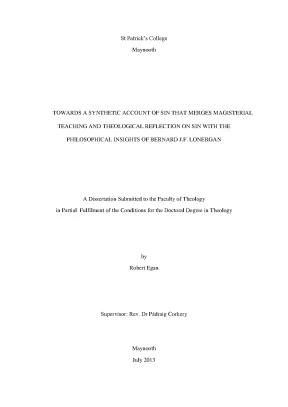
Tải xuống để đọc toàn bộSt Patrick’s College Maynooth TOWARDS A SYNTHETIC ACCOUNT OF SIN THAT MERGES MAGISTERIAL TEACHING AND THEOLOGICAL REFLECTION ON SIN WITH THE PHILOSOPHICAL INSIGHTS OF BERNARD J. LONERGAN A Dissertation Submitted to the Faculty of Theology in Partial Fulfilment of the Conditions for the Doctoral Degree in Theology by Robert Egan Supervisor: Rev. Dr Pádraig Corkery Maynooth July 2013 In loving memory of Frances Neville CONTENTS ACKNOWLEDGEMENTS. 1 PART I: CONTEMPORARY THEOLOGIES OF SIN CHAPTER ONE: THEOLOGICAL REFLECTION ON SIN.
Mortal and Venial Sin. Definitions of Sin. Definitions of Mortal and Venial Sin. Scriptural Roots of the Distinction between Mortal and Venial Sin.
Criteria for Discerning Whether a Sin is Mortal or Venial: Thomas Aquinas Summa Theologica. Mortal Sin as Negative Fundamental Option: Bernard Häring and Richard Gula. Häring’s Notion of Mortal Sin as Negative Fundamental Option. Gula’s Notion of Mortal Sin as Negative Fundamental Option.
Summary and Analysis. Knowledge of the Good. Knowledge of the Good in Häring: Exposition and Critique. Knowledge of the Good in Gula: Exposition and Critique.
Häring’s Notion of Human Freedom: Exposition and Critique. Gula’s Notion of Human Freedom: Exposition and Critique. Mortal Sin as Conscious and Freely Chosen Act: Germain Grisez and William E. Grisez’s Notion of Mortal Sin.
May’s Notion of Mortal Sin. Summary and Analysis. Knowledge of the Good. Knowledge of the Good in Grisez: Exposition and Critique.
Knowledge of the Good in May: Exposition and Critique. Grisez’s Notion of Human Freedom: Exposition and Critique. May’s Notion of Human Freedom: Exposition and Critique. 76 CHAPTER TWO: MAGISTERIAL TEACHING ON SIN.
The Theology of Sin in the Catechism of the Catholic Church. Notions and Definitions of Sin. Knowledge of the Good. Knowledge of the Good.
Pope John Paul II’s Theology of Sin. The Notion of Sin in Reconciliatio et Paenitentia and Veritatis Splendor. Reconciliatio et Paenitentia. Knowledge of the Good.
Sin and Freedom. Conclusion to Section. 124 Conclusion to Chapter. 125 PART II: BERNARD LONERGAN’S CONCEPTION OF SIN CHAPTER THREE: KNOWLEDGE AND HUMAN FREEDOM IN INSIGHT’S CONCEPTION OF SIN.
The Notion of Sin. The Morally Obligatory Course of Action. The Virtually Unconditioned. Grasping and Affirming Being.
Grasping and Affirming the Good. The Failure of Free Will. Essential and Effective Freedom. The Intrinsic Intelligibility of the Good.
Background and Method. The Structure of the Good in Insight. Potential, Formal, and Actual Good. Byrne’s Critique of Lonergan’s Argument.
Lonergan’s Argument Compared to Contemporary Theological Discourse on the Good. Lonergan’s Notion of Human Freedom in Insight. The Contingence of the Act of Will. The Contingence of Actuality.
The Spiritual Nature of the Act of Will. Lonergan on Willing the End and Choosing the Means. Lonergan’s Argument Compared to Contemporary Theological Discourse on Freedom. 175 CHAPTER FOUR: KNOWLEDGE AND HUMAN FREEDOM IN METHOD IN THEOLOGY’S ACCOUNT OF SIN.
The Notion of Sin. Authenticity and Self-transcendence. Knowledge and Human Freedom in Method in Theology’s Conception of Sin. The Objectivity of Judgements of Value.
The Notion of Value. Judgments of Value. The Problem of Objectivity. Conversion as Criterion of the Truth of Judgements of Value.
Intellectual, Moral, and Religious Conversion. Conversion and Value Judgements. Intellectual Conversion as Criterion of the Truth of Value Judgements. Moral Conversion as Criterion of the Truth of Value Judgements.
Religious Conversion as Criterion of the Truth of Value Judgements 204 2. The Notion of Human Freedom. Human Freedom and Authenticity. Conclusion to Section.
214 Conclusion to Chapter. 215 PART III: SYNTHESIS CHAPTER FIVE: A DIALECTICAL APPROACH TO SIN. Knowledge and Human Freedom in Theological Reflection on Sin. Is there an Objective Moral Order which is Discernible by Human Beings?.
Propositum: Moral Scepticism. Mackie’s ‘Error Theory’. The ‘Emotivism’ of A. Sed Contra: The Theological Tradition’s Affirmation of the Possibility of Moral Discernment.
Responsio: Drawing on Lonergan to Answer the Objections of Moral Sceptics. Lonergan’s ‘Intrinsic Intelligibility’ Argument vs. Mackie’s Denial of viii Objective Values. Lonergan’s ‘Virtually Unconditioned’ vs.
Ayer’s Unverifiability Theory. Are Human Beings Free to Act Morally?. Ted Honderich’s Deterministic Argument from Common Experience. Implications of Determinism for Ethics and Sin.
Sed Contra: Magisterial Teaching on Human Freedom as a Contrary Thesis to Hard Determinism. Responsio: Drawing on Lonergan to Answer Honderich. Lonergan in Response to Honderich. 269 ix ACKNOWLEDGEMENTS I first of all wish to express my gratitude to the supervisor of this thesis, Fr.
Pádraig Corkery, whose advice, enthusiasm, and encouragement helped greatly to make the writing of this thesis a rewarding and enjoyable process. I wish also to thank the Scholarship Board here in Maynooth for the numerous bursaries I have received since embarking on my postgraduate studies. This financial assistance helped greatly in relieving my financial burden, thus helping me to focus on completing my studies. Thanks are due also to Fr.
Raymond Maloney of the Milltown Institute of Philosophy and Theology, for his generous assistance in allowing me to access the Lonergan archives. I also wish to thank Fr. Michael Conway with whom I began my work on Lonergan before deciding to move this study into the area of moral theology. I learned a great deal from Fr.
Conway’s careful scrutiny and honest appraisal of my work. Finally, and above all, my profound gratitude is due to my wife, Angela, who has supported me both financially and emotionally during the completion of this work. x INTRODUCTION Contemporary hamartological treatises usually begin by pointing out that the concept of sin has lost its meaning in the modern world.1 While the causes of this situation are many and varied,2 part of the problem lies in the fact that the basic notions that underlie the concept of sin are themselves problematic. The concept of sin presupposes the existence of an objective moral order, as well as humanity’s ability to apprehend this order.
It also presupposes freedom to choose to act or not to act in accordance with what we have judged to be either morally justifiable or morally reprehensible. These presuppositions, however, are not easily demonstrated, as they involve concepts that require in-depth empirical analysis. Furthermore, the notion of an objective moral order that can be known, and the notion of human freedom are challenged by the counter-notions of moral scepticism and certain forms of determinism. Because of these challenges, it is crucial that a study in the theology of sin demonstrates the rational plausibility of the concept of sin.
Such a study must attempt to establish the possibility of both ethical knowledge and human freedom. The importance of understanding ourselves as beings who are capable of knowing good from evil, and who are capable of freely choosing to do either the former or the latter, is reflected in the teachings of Pope Benedict XVI and his predecessor, Pope John Paul II. Pope Benedict, in his World Youth Day address of 2008, speaks of one form of moral scepticism that has for a long time been denounced in Christian circles, namely, moral relativism.3 In his address, he speaks of the loss of genuine freedom and of self-respect that comes from moral 1 See for example the introductions to the following books: Josef Pieper, The Concept of Sin, trans. 2 Pope Benedict XVI, for example, suggests that the ‘eclipse of God necessarily brings the eclipse of sin.’ See ‘Pope Benedict XVI: The Eclipse of God Leads to a Loss of the Sense of Sin,’ 15 March 2011 [article on-line]; available from www.org/clife/lent/story.php?id=40691; Internet; accessed 17 May 2013.
3 See for example, C. Lewis, ‘The Poison of Subjectivism,’ in Christian Reflections (London: Geoffrey Bles, 1967), 72-81, and C. Lewis, The Abolition of Man (London: Harper Collins, 1999); first published in 1943 by the Oxford University Press. 1 relativism: ‘Relativism, by indiscriminately giving value to practically everything, has made “experience” all important.
Yet experiences, detached from any consideration of what is good or true, can lead, not to a genuine freedom, but to moral or intellectual confusion, to a lowering of standards, to a loss of self-respect, and even to despair.’4 Similarly, in his discussion of personal and social sin in his Reconciliatio et Paenitentia, Pope John Paul II speaks of the denial of a person’s dignity and freedom that comes from a belief in determinism: ‘This truth [that the human person is free] cannot be disregarded, in order to place the blame for individuals’ sins on external factors such as structures, systems or other people. Above all, this would be to deny the person’s dignity and freedom, which are manifested – even though in a negative and disastrous way – also in this responsibility for sin committed.’5 Magisterial teaching and contemporary theologies of sin reflect on the necessity of human knowledge and freedom if a wrongful act is to be considered a sin. Neither, however, has engaged sufficiently with the rational possibility of either objective moral knowledge or the freedom to choose between alternative courses of action. Magisterial documents and contemporary treatises in fundamental moral theology, while dealing in some detail with the issues of ethical knowledge and human freedom before formulating a conception of sin, contain many presuppositions regarding knowledge and freedom.
These presuppositions are based on scripture, and the arguments presented in these works rely heavily on biblical sources and the Church’s theological tradition. In my dissertation I shall develop a synthetic account of sin that examines and takes seriously the theological anthropology provided by the magisterium and contemporary theologians. I shall also attempt to make this account of sin accessible to the more sceptical 4 ‘Benedict XVI on Moral Relativism in His World Youth Day Address,’ July 17 2008 [article on-line]; available from berkleycenter.edu/recourses/quotes/benedict-xvi-on-moral-relativism-in-his-world- youth-day-address; Internet; accessed 17 May 2013. 5 Pope John Paul II, Reconciliatio et Paenitentia (London: Catholic Truth Society, 1984), sec.
2 reader by drawing on the work of the Canadian philosopher and theologian Bernard Lonergan (1904-84). In his works, especially Insight (1957), Lonergan provides solid foundations for the possibility of sin, ethical knowledge, and human freedom. While recent works have dealt with Lonergan’s notion of sin, they have not engaged with the philosophical question of the possibility of sin, or the related questions of the possibility of ethical knowledge and human freedom. For example, Cynthia S.
Crysdale develops a theology of sin using Lonerganian categories, in order to demonstrate the necessity of conversion for authentic moral development in both individuals and communities.6 Eamonn Mulcahy examines aspects of Lonergan’s soteriology. He explores Lonergan’s notion of sin as alienation and dehumanisation, as failure to achieve authentic humanness. He goes on to explore how this evil is transformed into good through what Lonergan terms ‘the law of the cross.’7 My focus, however, is on Lonergan’s demonstration of the possibility of sin, his grounding of the notion of sin in his rationally developed notions of ethical knowledge and human freedom. My dissertation will be divided into three sections.
In the first section I shall offer an exposition and critique of contemporary theologies of sin. This section will be divided into two chapters. In the first chapter I shall examine the work of four theologians who have contributed significantly to the theology of sin: Bernard Häring, Richard Gula, Germain Grisez, and William E. My selection of these particular theologians is designed to indicate the broad spectrum of approaches to moral theology in general.
Häring and Gula represent a primarily inductive approach to moral theology that draws general conclusions about the moral life by observing human experience in its concrete historical contexts. Grisez and May, 6 Cynthia S. Crysdale, ‘Heritage and Discovery: A Framework for Moral Theology,’ Theological Studies 63, no.
Nội dung được bảo vệ bản quyền — Tải xuống đầy đủ
Trích dẫn luận án này
Robert Egan (2013). Final library copy doctoral dissertation robert egan [Luận án tiến sĩ, St Patrick’s College Maynooth]. LuanAn.net. https://luanan.net/giao-duc-hoc/final-library-copy-doctoral-dissertation-robert-egan
Câu hỏi thường gặp
Luận án "Final library copy doctoral dissertation robert egan" nghiên cứu về vấn đề gì?
Bản sao thư viện cuối cùng: luận án tiến sĩ của Robert Egan. Khám phá nghiên cứu chuyên sâu và đóng góp học thuật của ông.
Luận án "Final library copy doctoral dissertation robert egan" được bảo vệ tại trường nào?
Luận án này được bảo vệ tại St Patrick’s College Maynooth. Năm bảo vệ: 2013.
Luận án "Final library copy doctoral dissertation robert egan" thuộc chuyên ngành gì?
Luận án "Final library copy doctoral dissertation robert egan" thuộc chuyên ngành Theology. Danh mục: Giáo Dục Học.
Luận án "Final library copy doctoral dissertation robert egan" có bao nhiêu trang?
Luận án "Final library copy doctoral dissertation robert egan" có 286 trang. Bạn có thể xem trước một phần tài liệu ngay trên trang web trước khi tải về.
Cách tải luận án "Final library copy doctoral dissertation robert egan" về máy như thế nào?
Để tải luận án về máy, bạn nhấn nút "Tải xuống ngay" trên trang này, sau đó hoàn tất thanh toán phí lưu trữ. File sẽ được tải xuống ngay sau khi thanh toán thành công. Hỗ trợ qua Zalo: 0559 297 239.