Factors contributing to the success of first generation college s
Khám phá các yếu tố dẫn đến thành công của sinh viên đại học thế hệ đầu. Hiểu rõ hành trình và bí quyết để đạt được thành tựu trong giáo dục bậc cao.
Năm xuất bản
Số trang
114
Thời gian đọc
18 phút
Lượt xem
0
Lượt tải
0
Phí lưu trữ
40 Point
Tổng quan nhanh
- Chủ đề:
- 1. Understanding First-Generation Student Success Factors
- Số trang:
- 114 trang
- Trường:
- University of Arkansas
- Chuyên ngành:
- Higher Education
- Tác giả:
- Mary Margaret Hui
- Năm:
- 2017
Tóm tắt nội dung luận án
I. Understanding First Generation Student Success Factors
First-generation college students, whose parents lack a bachelor's degree, encounter distinct challenges within higher education. Understanding the elements contributing to their success is paramount for educational institutions. This study investigates these pivotal factors at a research university. It provides essential insights for enhancing first-generation student success and closing the achievement gap. Analyzing these success drivers enables better support systems.
1.1. Defining First Generation College Students
First-generation college students are individuals whose parents did not obtain a four-year college degree. This specific demographic navigates college environments without direct parental experience in higher education. This definition forms the foundation for targeted research and the development of effective student support services. Recognizing this status helps institutions tailor appropriate interventions.
1.2. Importance of First Generation Student Success
The success of first-generation students carries significant societal implications. Educational attainment correlates with increased income, improved quality of life, and enhanced social mobility. This achievement is particularly crucial in regions facing low educational attainment and high poverty rates. Supporting their academic persistence contributes to broader economic and social development. It empowers individuals and communities.
1.3. Researching Factors for First Gen Persistence
Limited knowledge exists regarding effective strategies to close the achievement gap for this student group. Identifying specific factors that foster first-generation student success offers valuable insights. Higher education administrators, faculty, and staff can utilize these findings. The goal is to implement targeted programs that boost academic persistence and improve retention rates for first-gen students. This research helps build evidence-based support structures.
II. Barriers to First Generation College Student Success
First-generation college students frequently confront numerous obstacles throughout their academic journey. These barriers can impact their preparedness, financial stability, and social integration. Addressing these challenges is critical for improving first-generation student success. Institutions must develop comprehensive strategies to mitigate these hurdles, ensuring greater academic persistence and better retention rates for first-gen students.
2.1. Academic Unpreparedness Challenges
Many first-generation students face academic unpreparedness for the rigors of university life. This can create initial difficulties in coursework and adaptation to higher education standards. Recognizing these gaps allows for the implementation of targeted academic advising and preparatory programs. Early intervention strategies are vital to bolster their academic skills and confidence, fostering stronger self-efficacy first-gen students.
2.2. Financial Burdens and Obligations
Significant financial obligations often burden first-generation students. These can include personal expenses or family support responsibilities, impacting their ability to focus on studies. The effectiveness of financial aid is paramount for their continuous enrollment. Comprehensive financial literacy resources and robust aid packages are essential. Addressing financial aid impact directly supports academic persistence and reduces stress.
2.3. Social and Family Relationship Impacts
Navigating college can strain relationships with family members who lack similar experiences. This can lead to feelings of isolation or misunderstanding. Balancing family expectations with academic demands presents a common challenge. Providing strong student support services and opportunities for peer mentorship programs can help students manage these social dynamics, promoting resilience college students.
III. Motivation for First Generation Student Persistence
Despite significant barriers, many first-generation college students exhibit remarkable motivation and resilience. Their determination is a powerful driver for academic persistence. Understanding these motivational factors is key to reinforcing their commitment and improving first-generation student success. This intrinsic drive helps them overcome adversity and achieve their educational goals.
3.1. Belief in a Better Future with a Degree
A primary motivator for first-generation students is the firm conviction that a college degree leads to a better life. This belief provides the impetus for their sustained academic persistence. The degree signifies access to improved opportunities and enhanced quality of life. Institutions can highlight this aspirational value to maintain student engagement and commitment, reinforcing their self-efficacy first-gen students.
3.2. Driving Social Mobility and Quality of Life
Education serves as a clear pathway to upward social mobility. First-generation students often aspire to elevate their socioeconomic status and achieve a higher quality of life. This ambition is particularly strong in communities with low educational attainment. Recognizing this drive allows educators to frame academic goals within broader life aspirations, boosting their commitment to first-generation student success.
3.3. Internal Motivation and Self Efficacy
Beyond external factors, internal motivation, including strong self-efficacy, plays a critical role. First-generation students often possess remarkable resilience college students. They believe in their capacity to overcome academic and personal challenges. Fostering and strengthening this internal belief through mentorship programs and positive reinforcement is vital for their sustained academic persistence and overall success.
IV. Strategies for First Generation College Student Success
Successful first-generation students employ various strategies to navigate college effectively. These include proactive academic planning and leveraging institutional resources. Promoting these proven approaches can significantly enhance academic persistence and retention rates for first-gen students. Institutions should focus on disseminating these strategies widely to support student success.
4.1. Active Involvement in Academic Planning
Successful first-generation students actively engage in planning their course of study. They prioritize efficiency to maximize their academic journey. This proactive approach includes strategic course selection and understanding degree requirements. Robust academic advising is essential in equipping students with these planning skills, guiding them towards timely graduation and strong academic persistence.
4.2. Utilizing Student Support Services
Accessing and effectively utilizing available student support services proves critical for first-generation student success. These services, such as tutoring, writing centers, and counseling, provide essential resources. They help address academic and personal challenges, bolstering student resilience college students. Promoting awareness and accessibility of these programs enhances student persistence and overall well-being.
4.3. Developing Resilience in College
Facing numerous barriers, first-generation students develop significant resilience. This capacity to adapt and persevere through adversity is a key factor in their success. Institutions can cultivate this quality through workshops, peer support groups, and a culture of encouragement. Supporting mental and emotional well-being directly contributes to improved retention rates first-gen students.
V. Demographic Influences on First Generation Student Success
Specific demographic factors demonstrate a significant relationship with first-generation student success. These elements provide valuable context for understanding student populations and tailoring support. Identifying these influences helps institutions develop more targeted interventions and enhance academic advising strategies. Other factors, however, show no direct correlation.
5.1. Impact of Age and Residency Status
Demographic characteristics such as age and residency status significantly influence a first-generation student's success trajectory. Older students or those with specific residency statuses may possess unique needs or varied levels of preparedness. These factors are crucial for developing personalized support systems. Understanding these nuances helps institutions refine outreach and student support services.
5.2. ACT Scores and Academic Preparedness
ACT scores represent another significant demographic factor. Higher scores often indicate stronger academic preparedness, facilitating a smoother transition to college-level work. While not the only indicator, scores can highlight areas where additional academic support or preparatory programs are beneficial. This information aids in providing targeted academic advising to enhance first-generation student success.
5.3. Irrelevance of Ethnicity or Major Change
Research indicates that ethnicity does not directly correlate with a first-generation student's likelihood of graduating on track. Similarly, changing one's major college program does not significantly impact their overall academic persistence. This finding suggests that institutional efforts should focus on universal support systems and other identified influential factors rather than these specific demographic traits.
VI. Boosting First Generation Retention Rates in Higher Ed
Enhancing first-generation student success requires deliberate institutional efforts and continuous research. Practical recommendations focus on strengthening support systems and fostering an inclusive environment. A multi-faceted approach addressing academic, financial, and social needs is crucial. This proactive stance aims to improve retention rates for first-gen students significantly.
6.1. Recommendations for Institutional Practice
The study provides actionable recommendations for higher education institutions. These include implementing robust student support services and refining academic advising strategies. Proactive engagement regarding financial aid impact is also beneficial. Creating an inclusive and welcoming environment is paramount. These practices aim to significantly improve first-generation student success and overall academic persistence.
6.2. Future Research for Enhanced Support
Continued research is essential to deepen understanding of first-generation student success. Exploring long-term outcomes and the efficacy of specific mentorship programs could yield valuable insights. Further investigation into the interplay of socioeconomic status and education will inform policy development. Longitudinal studies can track academic persistence and identify emerging trends.
6.3. Enhancing Academic Advising and Mentorship
Robust academic advising offers critical guidance for course planning and career pathways. Mentorship programs connect students with experienced individuals, fostering self-efficacy first-gen students and resilience college students. These initiatives build strong support networks. They empower first-generation students to navigate academic complexities and personal challenges, ultimately contributing to higher retention rates first-gen students.
Mục lục chi tiết luận án
Tải xuống file đầy đủ để xem toàn bộ nội dung
Tải đầy đủ (114 trang)Trích đoạn nội dung luận án
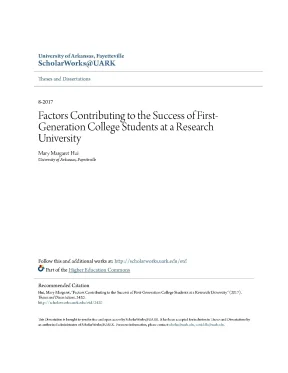
Tải xuống để đọc toàn bộUniversity of Arkansas, Fayetteville ScholarWorks@UARK Theses and Dissertations 8-2017 Factors Contributing to the Success of First- Generation College Students at a Research University Mary Margaret Hui University of Arkansas, Fayetteville Follow this and additional works at: http://scholarworks.edu/etd Part of the Higher Education Commons Recommended Citation Hui, Mary Margaret, "Factors Contributing to the Success of First-Generation College Students at a Research University" (2017). Theses and Dissertations.edu/etd/2420 This Dissertation is brought to you for free and open access by ScholarWorks@UARK. It has been accepted for inclusion in Theses and Dissertations by an authorized administrator of ScholarWorks@UARK. For more information, please contact scholar@uark.edu, ccmiddle@uark.
Factors Contributing to the Success of First-Generation College Students at a Research University A dissertation submitted in partial fulfillment of the requirements for the degree of Doctor of Education in Higher Education by Mary Margaret Hui University of Arkansas Bachelor of Arts in Drama and History, 2009 University of Arkansas Master of Arts in History, 2011 August 2017 University of Arkansas This dissertation is approved for recommendation to the Graduate Council. Miller Dissertation Director Dr. Robinson II Committee Member Committee Member Abstract First-generation college students are students whose parents do not have a college degree, and they face numerous barriers in college. Yet, several first-generation college students (FGCS) are successful and are on-track to graduate with a bachelor’s degree in four years.
Their success is important because education is associated with increased income, quality of life, and social mobility, making educational attainment even more significant in Arkansas, which has both low educational attainment and high poverty. Little is known about what can be done to close the achievement gap. It is important to analyze what helped FGCS succeed so that higher education administrators, faculty, and staff can help other FGCS succeed. The study used explanatory sequential mixed methodology to analyze the factors first- generation college students identified as contributing toward being on-track to graduate in four years.
Data for the study were collected at the University of Arkansas, an Arkansas land-grant institution. Descriptive statistics and Pearson’s chi-square of independence test were used to analyze first-generation students. Focus groups of FGCS were conducted to understand the factors that contributed to being on-track and strategies for success. The study’s results indicated that ethnicity and changing the major college of degree program are not related to being on-track to graduate, but other demographic factors like age, residency, and ACT score are significant.
FGCS faced multiple barriers like unpreparedness, financial obligations, and relating to their family members, but they were motivated to succeed by many factors, primarily believing that a college degree was necessary for a better life. They used a few strategies to succeed, such as active involvement in planning their course of study to maximize efficiency. Recommendations for both future research and future practice were made to help first-generation college students succeed. Acknowledgements I could not have completed this project without the love and support of my family and want to thank them beginning with my paternal grandparents, Mr.
Tung-Sing Hui. Although they passed before my birth, I have known and loved them through my father’s character and values. Thank you to my maternal grandparents, Mr. My Poppy and Grandmom always supported my education and I hope that as they watch over me they are still proud of their “spunky girl.” I want to acknowledge my parents, Dr.
Anthony and Susan Hui. They offered immense support throughout my time in my doctoral program from “buck-up” speeches to the fellowship of our many Saturday night dinners. Thank you to my aunt, Sandra “Sissy,” who broadened my view of the public education sector and is my best travel buddy. I also want to thank my three sisters: Jennifer, Alexandra, and Victoria.
They made me laugh when I needed to most and never questioned my dreams. Thank you to my two brothers- in-law, Micah and Joseph, and soon-to-be brother-in-law, Thomas. I also want to thank my niece, Mary-Micah, and my nephew, Joseph, Jr., for adding so much joy to my life. I was inspired to work on this project as I imagined them as the next generation of college students.
A special thank you to the man closest to my heart, Trase Cunningham. He cheered me on throughout every step of this journey. Thank you for never doubting my potential and always believing in me. I am also grateful for the companionship of my chihuahua, Miley Ray Chihuahua.
She offered unconditional love throughout my graduate education and sat by my side as I typed every page of this work. I am grateful for many others, especially Dr. Calvin White, Jr. He mentored me throughout my time at the U of A, guiding me through multiple degrees and providing invaluable life lessons (and multiple cups of coffee) along the way.
I would not be who I am today without him and could not have achieved this work without his support. I was inspired to pursue a career in higher education because of the impact he had on my life. I also want to thank Dr. James Gigantino II for his mentorship throughout my graduate studies.
A special thank you to the community of St. Paul’s Episcopal Church and the St. Paul’s Choir for providing a spiritual community throughout my studies. I want to thank all of those who have made this project possible, beginning with my dissertation advisor, Dr.
I am so grateful for his guidance on this work. Thank you to my committee members, Dr. Charles Robinson II and Dr. They supported me throughout the research process and offered mentorship throughout my time as a graduate student.
A special thanks to the University of Arkansas Office of Graduation and Retention for sponsoring pizzas for the focus groups. Thank you to Quinn Ramsey who selflessly helped me with the statistics portion of this project. Finally, I want to thank the project’s participants. Without their success and willingness to participate, this project would not be complete.
Dedication This project is dedicated to a set of successful first-generation students: my parents, Dr. Anthony and Susan Hui. Your love and support enabled me to achieve my dreams. Table of Contents INTRODUCTION.
1 Context of the Problem. 1 Statement of the Problem. 2 Purpose of the Study. 3 Definition of Terms.
3 Limitations and Delimitations of the Study. 5 Current Literature Gaps. 7 Significance of Study. 11 Literature Review Search Process.
11 Education and Social Mobility. 12 Student Success in College. 14 First-Generation College Students. 21 Persistence and Attrition.
25 Lack of Support. 35 Selection of the Research Design. 37 Research Question 1: What was the profile of first-generation students on-track to graduate in four years?. 37 Research Question 2: To what extent was there a relationship between the following factors and being on-track to graduate in first-generation students: ACT score, ethnicity, gender, the number of AP tests taken, age at enrollment, in-state residency, and initial college of enrollment?.
37 Research Question 3: What factors did first-generation students on-track to graduate in four years perceive as barriers to their success?. 38 Research Question 4: What factors did first-generation students on-track to graduate in four years perceive as impetuses to their success?. 41 Research Question 5: What did first-generation students on-track to graduate in four years identify as strategies for success?. 41 Role of the Researcher.
44 Summary of the Study. 49 Research Question 1: What was the profile of first-generation students on-track to graduate in four years?. 49 Research Question 2: To what extent was there a relationship between the following factors and being on-track to graduate in first-generation students: ACT score, ethnicity, gender, the number of AP tests taken, age at enrollment, in-state residency, and initial college of enrollment?. 51 Research Question 3: What factors did first-generation students on-track to graduate in four years perceive as barriers to their success?.
52 Research Question 4: What factors did first-generation students on-track to graduate in four years perceive as impetuses to their success?. 59 Research Question 5: What did first-generation students on-track to graduate in four years identify as strategies for success?. 65 CONCLUSIONS, RECOMMENDATIONS, AND DISCUSSION. 67 Introduction to the Chapter.
67 Summary of the Study. 70 Recommendations for Further Research. 73 Recommendations for Practice. 75 Recommendations for Higher Education Institution Administrators and Faculty.
75 Recommendations for First-Generation College Students. 85 Appendix A Institutional Review Board Approval Letter. 92 Appendix B Emails to Target Population. 93 Appendix C Focus Group Protocol and Guided Questions.
98 Appendix D Consent Form. 101 Appendix E Original IRB Approval. 103 List of Tables 1. Enrollment Report Summary by Percentage of Total, Fall Semesters 2010-2014.
Fulbright College of Arts and Sciences Undergraduate Enrollment. Profile of First-Generation Students On-Track to Graduate in Four-Years from the College of Arts and Sciences. Results of Pearson’s Chi-Square Test of Independence to Being On-Track to Graduate 52 5. Profile of Focus Group Participants.
53 CHAPTER 1 INTRODUCTION Context of the Problem In the United States, higher education is the traditional gateway to a career and contributing to society. A college degree benefits graduates and their families in many ways, primarily through increased job opportunities; most jobs that offer a comfortable salary require a at least a bachelor’s degree. Bachelor’s degree recipients earn an average of 66% more for full- time, year-round workers in lifetime earnings than those with only a high school diploma (Perna & Finney, 2014). The children of college graduates benefit from their parents’ education because they often grow up with the expectation that they will also graduate from college.
Furthermore, they receive advice on how to succeed in college and, with higher average incomes, their families are more prepared to handle the financial burden of college tuition. But what about those students whose parents did not go to college? How do they prepare for the uncharted territory of college without a family member to guide them? Students whose parents do not have a college degree are commonly referred to as first- generation college students (FGCS), indicating their position as the first person in their family to earn a college degree. First-generation students comprise roughly 15-20% of students in American universities (Harackiewicz et al. These students face numerous barriers to their success, as one of the biggest predictors of college success is whether a student’s parent attained a college degree.
First-generation students lack the social capital, and often the economic capital, of their continuing-generation peers. And yet, several first-generation students succeed, breaking the lack of educational attainment cycle in their family. When first-generation students graduate from college, they have the potential to change the trajectory of their life and future generations, 1 exponentially increasing degree attainment. Since educational attainment and income levels are strongly related, reducing achievement gaps can also reduce income gaps.
Therefore, it is important to understand what factors contribute to first-generation students’ success so that educational attainment can be increased. Statement of the Problem Higher education administrators and staff are familiar with several factors that prohibit student success; it is easy to identify the many barriers first-generation students face. There is a greater number who fail than succeed and it is seemingly easier to question why those who did not make it failed, rather than examine those who succeeded. Without existing research on how first-generation students succeed, higher education administrators, faculty, and staff cannot duplicate this success.
For a state with both low education attainment and high poverty, such as Arkansas, it is imperative to understand what can be done to close the achievement gap by examining first-generation students who graduate from a four-year institution. Therefore, the question “What helps first-generation students to succeed and how can we duplicate this success?” propelled this research.
Nội dung được bảo vệ bản quyền — Tải xuống đầy đủ
Trích dẫn luận án này
Mary Margaret Hui (2017). Factors contributing to the success of first generation coll [Luận án tiến sĩ, University of Arkansas]. LuanAn.net. https://luanan.net/giao-duc-hoc/factors-contributing-to-the-success-of-first-generation-college-s
Câu hỏi thường gặp
Luận án "Factors contributing to the success of first generation coll" nghiên cứu về vấn đề gì?
Khám phá các yếu tố dẫn đến thành công của sinh viên đại học thế hệ đầu. Hiểu rõ hành trình và bí quyết để đạt được thành tựu trong giáo dục bậc cao.
Luận án "Factors contributing to the success of first generation coll" được bảo vệ tại trường nào?
Luận án này được bảo vệ tại University of Arkansas. Năm bảo vệ: 2017.
Luận án "Factors contributing to the success of first generation coll" thuộc chuyên ngành gì?
Luận án "Factors contributing to the success of first generation coll" thuộc chuyên ngành Higher Education. Danh mục: Giáo Dục Học.
Luận án "Factors contributing to the success of first generation coll" có bao nhiêu trang?
Luận án "Factors contributing to the success of first generation coll" có 114 trang. Bạn có thể xem trước một phần tài liệu ngay trên trang web trước khi tải về.
Cách tải luận án "Factors contributing to the success of first generation coll" về máy như thế nào?
Để tải luận án về máy, bạn nhấn nút "Tải xuống ngay" trên trang này, sau đó hoàn tất thanh toán phí lưu trữ. File sẽ được tải xuống ngay sau khi thanh toán thành công. Hỗ trợ qua Zalo: 0559 297 239.