University of Louisville Dissertation: Exploring Explicit Genre Instruction and Antecedent Genres' Impact on Student Engagement
Nghiên cứu tương tác giữa hướng dẫn thể loại rõ ràng, thể loại tiền nhiệm và sự tham gia của người học, khám phá các yếu tố ảnh hưởng đến hiệu quả học tập.
University of Louisville
Department of English / College of Arts and Sciences
Luan An
Luận án tiến sĩ
Năm xuất bản
Số trang
255
Thời gian đọc
39 phút
Lượt xem
0
Lượt tải
0
Phí lưu trữ
50 Point
Tổng quan nhanh
- Chủ đề:
- Explicit Genre Instruction: Enhancing Literacy Education
- Số trang:
- 255 trang
- Trường:
- University of Louisville
- Chuyên ngành:
- Department of English / College of Arts and Sciences
- Tác giả:
- Jason Charles Dietz
- Năm:
- 2013
Tóm tắt nội dung luận án
I.Explicit Genre Instruction Enhancing Literacy Education
The field of literacy education actively discusses explicit genre instruction. Educators debate its utility in the classroom. This dissertation joins that conversation. It provides an overview of genre theory. The study specifically focuses on explicit genre instruction and genre context. Research explores how instructors can best enable students. The argument supports linking classroom instruction to an individual’s genre context. This differs from solely focusing on a social genre context. This pedagogical shift aims to improve genre learning. It helps students navigate complex writing tasks. The approach leverages students' existing cognitive frameworks. It builds a foundation for successful academic writing. This method promises enhanced engagement and deeper understanding. It addresses core challenges in writing instruction.
1.1. Debate on Explicit Genre Teaching
Explicit genre instruction remains a central topic. Educators discuss its value in the classroom. Some question if genres can or should be taught directly. This dissertation enters that ongoing discussion. It explores the benefits of direct genre teaching. It considers how such instruction impacts student learning. The focus is on practical applications for writing instruction.
1.2. The Role of Individual Genre Context
Effective genre pedagogy connects classroom teaching to individual student experience. The study argues for linking instruction not to abstract social genre context, but to a student’s personal genre context. This approach personalizes the learning process. It acknowledges a student's existing knowledge. This individual focus aims to improve comprehension and application. It facilitates academic writing development.
1.3. Foundations of Genre Pedagogy
The research builds on genre theory. It reviews existing scholarship on explicit genre instruction. It examines the question of genre context deeply. Understanding the theoretical foundations is crucial. This provides a framework for instructional strategies. The goal is to develop more effective approaches to teaching writing. Better genre pedagogy benefits all students.
II.Antecedent Genres Leveraging Prior Genre Knowledge
Students possess a wealth of prior genre knowledge. This knowledge, termed antecedent genres, plays a critical role in new learning. The dissertation explores how students repurpose this existing knowledge. It investigates their ability to cross genre boundaries. Instructors can leverage this pre-existing understanding. Connecting new genre tasks to familiar ones enhances learning. This strategy improves the effectiveness of writing instruction. It helps students recognize patterns across different writing situations. Acknowledging antecedent genres validates student experience. It provides a bridge for acquiring new academic writing skills. This approach supports a more dynamic learning environment.
2.1. Defining Antecedent Genre Knowledge
Antecedent genres represent prior knowledge. Students bring this knowledge from past writing experiences. It includes genres encountered in various contexts. Understanding these pre-existing frameworks is key. This knowledge forms a basis for future learning. It influences how students approach new writing tasks.
2.2. Repurposing Existing Genre Skills
The study examines how students repurpose their antecedent genre knowledge. They apply familiar rhetorical strategies to new situations. This repurposing is a form of genre transfer. It shows cognitive flexibility. Effective instructional strategies encourage this adaptation. Students learn to see connections, not just differences.
2.3. Bridging Past and Present Writing
Connecting past writing experiences with present assignments is crucial. Antecedent genres act as a bridge. They provide a scaffold for developing new genre competencies. This integration fosters a deeper understanding of writing. It supports students in navigating diverse academic writing demands. This approach maximizes the value of prior genre knowledge.
III.Student Engagement Boosting Academic Writing Success
Student engagement is a critical factor in academic success. This dissertation specifically examines its link to writing assignments. It explores how explicit genre instruction influences engagement. Higher engagement correlates with deeper learning outcomes. The study evaluates individual students' propensity to engage. It connects engagement to the successful repurposing of antecedent genres. Effective instructional strategies can foster this engagement. When students feel connected to the writing task, performance improves. This enhances overall literacy education. Creating relevant connections makes academic writing more accessible and meaningful. It addresses student motivation directly.
3.1. Fostering Deeper Engagement
The research investigates methods for fostering deeper student engagement. It highlights the importance of instructional strategies that resonate with students. Connecting content to individual genre context boosts interest. This personalized approach can increase motivation. Engaged students show greater persistence in complex tasks. This leads to better academic writing outcomes.
3.2. Connection to Writing Assignments
A direct link exists between engagement and writing assignments. Students who understand the genre's purpose show more commitment. Clarity in explicit genre instruction enhances this understanding. This helps students see relevance in their work. It encourages them to invest more effort. Strong connections improve both process and product in writing.
3.3. Impact on Creative Output
Student engagement also impacts creative output. When students feel engaged, they are more willing to experiment. They cross genre boundaries with greater confidence. This leads to more innovative solutions in writing tasks. The study ties engagement to creativity. It suggests that a supportive genre pedagogy can unlock student potential. This benefits the quality of academic writing.
IV.Genre Transfer Crossing Boundaries in Writing Instruction
Genre transfer is a key concept in effective writing instruction. This dissertation investigates students' ability to transfer knowledge. It focuses on crossing genre boundaries. This involves applying understanding from one genre to another. The study evaluates how explicit genre instruction aids this process. It examines the repurposing of antecedent genres. Successful transfer allows students to adapt their writing skills. They apply these skills across diverse academic and professional contexts. This capability is vital for overall literacy education. Instructional strategies should actively promote genre transfer. It prepares students for varied writing challenges.
4.1. Navigating Genre Boundaries
Students often encounter new genre boundaries. These boundaries define different writing expectations. The research explores how students navigate these transitions. It examines their ability to adapt rhetorical choices. Understanding boundary crossing is essential for writing development. Explicit instruction can guide students effectively.
4.2. Mechanisms of Genre Repurposing
The study identifies mechanisms by which students repurpose genres. It analyzes how prior genre knowledge is modified for new contexts. This repurposing is not just imitation. It involves active adaptation and transformation. Genre pedagogy should teach these adaptive strategies. This empowers students to be flexible writers.
4.3. Facilitating Effective Genre Transfer
Facilitating effective genre transfer is a primary goal. The dissertation offers insights into instructional strategies for this purpose. Linking new genres to antecedent genres proves beneficial. Providing opportunities for cross-genre application is important. This practice strengthens students' ability to move between writing tasks. It builds confidence in academic writing.
V.Research Insights Genre Pedagogy Strategies Examined
The dissertation presents empirical research findings. It systematically examines genre pedagogy strategies. The study evaluates the interaction of explicit genre instruction. It considers antecedent genres and student engagement. Research provides a detailed analysis across six chapters. Chapter one offers a comprehensive literature review. It discusses the project's developed framework. Concepts of boundary crossing, antecedent genres, student engagement, and creativity are overviewed. Chapter two details data collection procedures. It describes coding and analysis methods. Data sources include student interviews. This rigorous approach validates the study's conclusions. The findings inform future instructional strategies in writing.
5.1. Empirical Study Overview
The research presents an empirical study. It explores a pedagogical possibility. The study examines individual students' tendencies. It focuses on crossing genre boundaries. It investigates repurposing antecedent genre knowledge. It also assesses engagement with writing assignments. This forms the core of the dissertation's contribution.
5.2. Data Collection and Analysis
Procedures for data collection, coding, and analysis are reported. The study uses interviews with students. These interviews provide rich qualitative data. This data helps understand student thought processes. Rigorous analysis supports robust conclusions. The methodology ensures validity of findings.
5.3. Key Findings on Genre Interaction
Key findings reveal important interactions. Explicit genre instruction, antecedent genres, and engagement are linked. The research shows the value of individual genre context. It impacts how students learn and apply genres. These insights contribute significantly to literacy education. They suggest new directions for teaching academic writing.
VI.Actionable Strategies Improving Writing Instruction Outcomes
The dissertation offers actionable strategies for educators. It provides clear guidance for improving writing instruction outcomes. The research argues for linking explicit genre instruction to individual student context. This approach personalizes learning experiences. It enhances the application of prior genre knowledge. The findings suggest practical instructional strategies. These strategies can boost student engagement. They can also facilitate genre transfer effectively. Implementing these recommendations can lead to better academic writing. It helps students become more adaptable and confident writers. This work contributes to the ongoing evolution of literacy education practices.
6.1. Pedagogical Recommendations
Specific pedagogical recommendations emerge from the study. These advise instructors on explicit genre instruction. They emphasize tailoring teaching to student needs. The recommendations aim to maximize learning efficiency. They promote a more student-centered approach to writing. These strategies support diverse learning environments.
6.2. Emphasizing Individual Genre Context
A key recommendation is emphasizing individual genre context. Instructors should recognize and utilize students' prior genre knowledge. This helps students make meaningful connections. It strengthens their ability to understand new genres. This focus improves student engagement. It makes writing instruction more relevant.
6.3. Future Directions for Genre Research
The dissertation also points to future research directions. Further investigation into genre transfer mechanisms is needed. Continued study of student engagement strategies is beneficial. Research on long-term impacts of explicit genre instruction is important. These areas will further refine genre pedagogy. They will advance literacy education.
Mục lục chi tiết luận án
Tải xuống file đầy đủ để xem toàn bộ nội dung
Tải đầy đủ (255 trang)Trích đoạn nội dung luận án
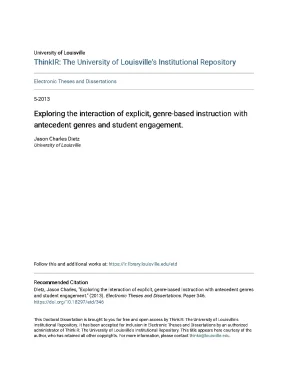
Tải xuống để đọc toàn bộUniversity of Louisville ThinkIR: The University of Louisville's Institutional Repository Electronic Theses and Dissertations 5-2013 Exploring the interaction of explicit, genre-based instruction with antecedent genres and student engagement. Jason Charles Dietz University of Louisville Follow this and additional works at: https://ir.edu/etd Recommended Citation Dietz, Jason Charles, "Exploring the interaction of explicit, genre-based instruction with antecedent genres and student engagement. Electronic Theses and Dissertations.18297/etd/346 This Doctoral Dissertation is brought to you for free and open access by ThinkIR: The University of Louisville's Institutional Repository. It has been accepted for inclusion in Electronic Theses and Dissertations by an authorized administrator of ThinkIR: The University of Louisville's Institutional Repository.
This title appears here courtesy of the author, who has retained all other copyrights. For more information, please contact thinkir@louisville. EXPLORING THE INTERACTION OF EXPLICIT, GENRE-BASED INSTRUCTION WITH ANTECEDENT GENRES AND STUDENT ENGAGEMENT By Jason Charles Dietz B., Brigham Young University-Idaho, 2006 M., Idaho State University, 2009 A Dissertation Submitted to the Faculty of the College of Arts and Sciences of the University of Louisville In Partial Fulfillment of the Requirements for the Degree of Doctor of Philosophy Department of English University of Louisville Louisville, KY May 2013 Copyright 2013 by Jason Charles Dietz All rights reserved EXPLORING THE INTERACTION OF EXPLICIT, GENRE-BASED INSTRUCTION WITH ANTECEDENT GENRES AND STUDENT ENGAGEMENT By Jason Charles Dietz B., Brigham Young University-Idaho, 2006 M., Idaho State University, 2009 A Dissertation Approved on April 8, 2013 by the following Dissertation Committee: __________________________________________________ Debra Journet, Dissertation Director __________________________________________________ Joanna Wolfe __________________________________________________ Bronwyn Williams __________________________________________________ Andrew Rabin __________________________________________________ Ann Larson ii DEDICATION This dissertation is dedicated to my wife Mae Loraine Dietz and to my children Faith Anne Dietz Peter Ammon Dietz Rebekah Mary Dietz Joseph Michael Dietz Elijah Samuel Dietz Stephen Amulek Dietz who have patiently endured and fully supported me over many years of schooling. iii ACKNOWLEDGEMENTS Foremost, I would like to thank my Heavenly Father for His continual guidance, support, and inspiration.
I would also like to express thanks both to Dr. Debra Journet, who graciously assumed directorship of my dissertation after data collection had been complete, and Dr. Joanna Wolfe, who guided my dissertation through the prospectus and data collection phase. Both have given invaluable guidance and displayed exemplary patience.
I would also like to thank the other committee members, Dr. Bronwyn Williams, Dr. Andrew Rabin, and Dr. Ann Larson, for their guidance, assistance, and encouragement both before and during the dissertation process.
I would especially like to thank my wife, Mae, for her patience, understanding, unflagging support, and unconditional love throughout our schooling and especially during our dissertation. My children also deserve my special thanks for enduring my absences and sequestering throughout these schooling years. My parents have continually encouraged my ongoing education, as I have pursued my dream. Finally, I would like to thank Dr.
Carolyn Rhodes-Shenton, who provided the encouragement that inspired my wife and me to begin this road. iv ABSTRACT EXPLORING THE INTERACTION OF EXPLICIT, GENRE-BASED INSTRUCTION WITH ANTECEDENT GENRES AND STUDENT ENGAGEMENT Jason C. Dietz April 8, 2013 This dissertation enters the ongoing discussion regarding whether or not genre can and/or should be explicitly taught in the classroom. It begins with an overview of genre theory, specifically centering on explicit genre instruction and the question of genre context.
It uses genre, transfer, student engagement, and creativity scholarship, as well as my own empirical research, to argue that instructors might best enable students to learn genres by linking classroom instruction not the social genre context, but to the individual’s genre context. I sought to evaluate such a pedagogical possibility by examining individual students’ propensity to cross genre boundaries, to repurpose their antecedent genre knowledge, and to engage with their writing assignments. The dissertation reports the results of my analysis in six chapters. Chapter one provides a comprehensive literature review and discusses the framework I developed for my project, over-viewing the concepts of boundary crossing, antecedent genres, student engagement, and creativity.
Chapter two reports my procedures for data collection, coding, and analysis, and describes the data sources for this project: interviews with four instructors and fifteen students, as well as pre- and post-writing surveys gathered from students in six first year composition courses. v Chapters three through six report the results of my research. In chapter three I examine the presence of a powerful, direct, pervasive, and at times, obstructive influence that I termed the “antecedent effect,” or students’ tendency to default to antecedent genre knowledge in a rhetorical situation. Chapter four reports the potentially mitigating impact of explicit instruction on the antecedent effect, specifically suggesting that explicit instruction may enable more students to cross genre boundaries than otherwise would.
Chapter five suggests that student engagement with writing prompts may be nearly universal, but also argues that such engagement may not always be positive for learning. This chapter also reveals an extensive overlap between boundary crossing, student engagement, and creativity. Finally, chapter six synthesizes the theoretical and pedagogical implications of my findings, recognizes the limitations of the research I have performed, and suggests areas for future research, including suggestions on ways that such research might be conducted based on my findings. vi TABLE OF CONTENTS DEDICATION…………………………………………………….v LIST OF TABLES…………………………………………………………………………………….ix LIST OF FIGURES…………………………………………………………………………….
1 CHAPTER 1: LITERATURE REVIEW .1 Explicit Instruction: Socially-Centered Approaches to Genre. Concerns about Explicit Instruction: The New Rhetoric School and Transfer Studies 22 1. Context: The Substance of Genre. Research Examining the Importance of Context.
Transfer Research: Findings and Difficulties. Using the Individual to Evaluate the Social. Examining Antecedent Genres. Examining Private Motive.
Data Sources and Analysis. Ethics and Representation. 61 CHAPTER 3: DEFINING BOUNDARY CROSSING AND EXPLORING THE ANTECEDENT EFFECT. In Pursuit of Boundary Crossing and Boundary Guarding.
Viewing the Concepts Broadly. Nuancing: Boundary Crossing as a Meta-Ability. Nuancing: Boundary Guarding as Multi-Faceted. Combined Antecedent and Current Influences.
Linking Antecedent and Classroom-Originating Abilities and Genres. Explanations for Authorial Choices. Linking Academic and Non-Academic Writing. Antecedent Influence on Writing Choices.
Rhetorical Awareness and Facility. Antecedent Experiences with Writing. Voice and Creativity. Elements that Appear Unconnected to Boundary Crossing and Guarding.
107 CHAPTER 4: PROPOSING EXPLICIT INSTRUCTION’S CONTRIBUTION TO BOUNDARY CROSSING. Overviewing the Instructors. The Power and Importance of the Writing Prompt. Students’ Focus: The Assignment within the Classroom.
Assignment Clarity and Stability. Assignment Achievability: Challenge vs. Pre-Grading Feedback. Organization and the Role of Templates.
Summary Synthesis and Implications. 169 CHAPTER 5: EXPLORING THE LINKS BETWEEN BOUNDARY CROSSING, STUDENT ENGAGEMENT, AND CREATIVITY. Synthesizing Student Engagement and Explicit Instruction. Theorizing Student Engagement.
Exploring Student Engagement. Student Engagement and Explicit Instruction. Synthesizing Student Engagement and Boundary Crossing/Guarding. Student Engagement and Boundary Crossing.
Student Engagement and Boundary Guarding. Synthesizing Boundary Crossing/Guarding, Student Engagement,. The Engaging, Creative, Boundary Crossing Task. The Engaging, Creative, Boundary Crossing Environment.
The Engaging, Creative, Boundary Crossing Instructor. Summary Synthesis and Implications. Dissertation Summary, Implications, and Synthesis of Findings. The Antecedent Effect.
Explicit Instruction as a Contributor to Boundary Crossing. Student Engagement and Creativity as Related to Boundary Crossing. Additional Theoretical Implications. Calls for Future Research.
238 viii LIST OF TABLES 3. Identification of boundary crossing interviewees with quotes illustrating classification …………. Identification of boundary crossing/guarding interviewees with quotes illustrating classification. Identification of boundary guarding interviewees with quotes illustrating classification ….
Similarities and differences noted between academic and non-academic writing by boundary crossers and boundary guarders………………………………………. Comparison of average number of antecedent rhetorical strategies mentioned……………………. Comparison of average number of current instructional elements mentioned ……………………. Sources of writing guidance students found most influential …….
Explanation for responses in Table ………………………………………………. Attitudes regarding templates ………………………………………………………. Visual representation of chapter 4 data …………………………………. Survey responses regarding flow during assignment given during research ………………….
Summary representation of overlapping criteria between boundary crossing, student engagement, and creativity ………………….…189 ix LIST OF FIGURES 1. Illustration of Csikszentmihalyi’s theory of optimal engagement………………………. Visual representation of nuance with the boundary guarding concept…………………….81 x INTRODUCTION Genres order nearly every aspect of our lives, affecting how we interpret reality. Genres appear on the side of our cereal boxes, in the warnings on our medicine containers, in our perusal of movies or books, in the academic research which influences policy and pedagogy, and in classroom writing assignments.
Genres surround us and enable us to make sense of the world we live in by helping us anticipate the information we will find or not find in a piece of writing, as well as the order, the diction, and myriad other elements crucial to our ability to accurately interpret written language. In recent decades, facets of composition studies have focused on genres as an academic study, seeking to discern meaning, but also hoping to refine pedagogy to better enable our students to navigate the world of genres. My dissertation enters this drive toward pedagogical refinement by adding to our understanding of how individual students interact with explicit, genre-based classroom instruction. Specifically, I argue that students’ antecedent experience with writing powerfully affects how they repurpose and reshape that experience, subsequently influencing how well they are able to merge their prior knowledge with new classroom knowledge, how successfully they can participate in classroom genres, how well they transfer knowledge to future genre performances, and how fully they engage with their writing assignments.
In addition, based on my research and analysis, I contend that a number of elements of explicit genre-based instruction appear to positively impact the 1 student experience in each of these areas. Therefore, my project suggests that learning and engagement occurs most often when we approach our students’ antecedent writing experience from an explicit instructional frame. For this empirical research project, I created a theoretical framework to examine the effects of explicit instruction on antecedent genres, student engagement, and creativity. This framework incorporates genre theory, engagement theory, and research into both explicit instruction and transfer.
More specifically, I relied heavily on Reiff and Bawarshi’s genre-based concepts of genre boundary crossers and genre boundary guarders and Csikszentmihalyi’s theory of full engagement, most commonly known as “flow.” In the introduction that follows, I will explain how this framework, and these two theories specifically, enabled me to provide insight into issues of transfer and genre performance, as well as answer Reiff and Bawarshi’s call to “study prior genre knowledge in its fuller complexity” (334), as I sought to address the following sets of questions: 1. In what ways are students who are taught through explicit (template) genre- based instruction able to articulate: a. Their antecedent experience with genres? b. Their rhetorical awareness of their antecedent and current writing experience? c.
Their awareness of how templates and their antecedent genres connect? 2. In what ways are students in an explicit (template) genre-based curriculum drawing on and/or adapting antecedent genres and/or rhetorical abilities? 2 3. Are students in an explicit (template) genre-based curriculum where the genre is new able to fully engage a flow experience, as explained in the preceding chapter? 4. What factors distinguish students who merge their antecedent abilities with current instruction (boundary crossers) from students who write exclusively using their antecedent abilities (boundary guarders)? 5.
What factors distinguish students who use or disregard templates from those who don’t? Are those factors related to boundary guarding and/or boundary crossing? 6. What factors distinguish students who fully engage with the writing prompt from students who don’t engage at all? Finally, the over-arching question about which I sought insight was: 7. Does explicit instruction appear to lead to boundary guarding? Crossing? Have no effect? To address these questions, I turned first to genre theory. Since its inception, the school of genre studies has examined genre performances as an intersection between social exigency and individual motive (Miller).
Nội dung được bảo vệ bản quyền — Tải xuống đầy đủ
Trích dẫn luận án này
Jason Charles Dietz (2013). Interaction of Explicit Genre Instruction with Antecedent Genres and Engagement [Luận án tiến sĩ, University of Louisville]. LuanAn.net. https://luanan.net/giao-duc-hoc/explicit-genre-instruction-antecedent-genres-student-engagement
Câu hỏi thường gặp
Luận án "Interaction of Explicit Genre Instruction with Antecedent Genres and Engagement" nghiên cứu về vấn đề gì?
Nghiên cứu tương tác giữa hướng dẫn thể loại rõ ràng, thể loại tiền nhiệm và sự tham gia của người học, khám phá các yếu tố ảnh hưởng đến hiệu quả học tập.
Luận án "Interaction of Explicit Genre Instruction with Antecedent Genres and Engagement" được bảo vệ tại trường nào?
Luận án này được bảo vệ tại University of Louisville. Năm bảo vệ: 2013.
Luận án "Interaction of Explicit Genre Instruction with Antecedent Genres and Engagement" thuộc chuyên ngành gì?
Luận án "Interaction of Explicit Genre Instruction with Antecedent Genres and Engagement" thuộc chuyên ngành Department of English / College of Arts and Sciences. Danh mục: Giáo Dục Học.
Luận án "Interaction of Explicit Genre Instruction with Antecedent Genres and Engagement" có bao nhiêu trang?
Luận án "Interaction of Explicit Genre Instruction with Antecedent Genres and Engagement" có 255 trang. Bạn có thể xem trước một phần tài liệu ngay trên trang web trước khi tải về.
Cách tải luận án "Interaction of Explicit Genre Instruction with Antecedent Genres and Engagement" về máy như thế nào?
Để tải luận án về máy, bạn nhấn nút "Tải xuống ngay" trên trang này, sau đó hoàn tất thanh toán phí lưu trữ. File sẽ được tải xuống ngay sau khi thanh toán thành công. Hỗ trợ qua Zalo: 0559 297 239.