Dissertation submission draft title page pd copy3 augmented
"Phân tích và đề xuất cải tiến hiệu suất của mô hình xử lý ngôn ngữ tự nhiên bằng phương pháp machine learning"
Năm xuất bản
Số trang
184
Thời gian đọc
28 phút
Lượt xem
0
Lượt tải
0
Phí lưu trữ
50 Point
Tổng quan nhanh
- Chủ đề:
- 1. Tổng quan luận văn tốt nghiệp Stanford
- Số trang:
- 184 trang
- Trường:
- stanford university
- Chuyên ngành:
- Education
- Tác giả:
- Michael Dunson
- Năm:
- 2010
Tóm tắt nội dung luận án
I. Tổng quan luận văn tốt nghiệp Stanford
1.1. Mục đích và phạm vi luận văn tốt nghiệp.
Luận văn khám phá chính trị ra quyết định. Nó tập trung vào các trường công lập San Francisco. Nghiên cứu sâu sắc hai chính sách giáo dục cụ thể. Các chính sách này đã bùng phát thành tranh cãi công khai. Bối cảnh là sự khởi đầu của một cuộc khủng hoảng lớn. Đây là bản nháp luận văn cuối cùng trước khi nộp. Tài liệu này đại diện cho "bản nháp luận văn" đã được tăng cường. Nó sẵn sàng cho quy trình nộp luận văn chính thức. Sinh viên tốt nghiệp cần chú ý đến quy trình nộp luận văn này. Việc chuẩn bị kỹ lưỡng là cần thiết cho hạn chót nộp luận văn.
1.2. Thông tin tác giả và cơ sở cấp bằng.
Tác giả của luận văn tốt nghiệp này là Michael Dunson. Luận văn được nộp cho Trường Giáo dục. Đồng thời, nó được trình lên Ủy ban Nghiên cứu Sau đại học. Mục tiêu là hoàn thành các yêu cầu cho bằng Tiến sĩ Triết học. Luận văn được hoàn thành vào tháng 5 năm 2010. Các cố vấn đã xác nhận chất lượng. Joy Williamson là cố vấn chính. David Labaree là đồng cố vấn. Samuel Wineburg cũng chứng nhận chất lượng luận văn. Việc này đảm bảo tiêu chuẩn học thuật cao của tài liệu. Luận văn là thành quả của quá trình nghiên cứu và viết lách kỹ lưỡng.
1.3. Bản quyền và quyền truy cập luận văn.
Bản quyền của luận văn thuộc về Michael Leon Dunson. Năm bản quyền được ghi nhận là 2010. Luận văn được phân phối lại bởi Đại học Stanford. Việc phân phối này tuân theo một giấy phép cụ thể. Giấy phép đó là Creative Commons Attribution-Noncommercial 3.0 United States License. Điều này cho phép sử dụng phi thương mại. Luận văn có sẵn trực tuyến. Một địa chỉ URL cụ thể được cung cấp để truy cập. Người quan tâm có thể tìm thấy bản sửa đổi luận văn tại đây. Nó hỗ trợ khả năng tiếp cận và chia sẻ kiến thức. Các hướng dẫn nộp luận văn thường bao gồm thông tin bản quyền này.
II. Phân tích chính sách giáo dục San Francisco
2.1. Bối cảnh lịch sử của chính sách giáo dục.
Luận văn theo dõi lịch sử chính sách giáo dục. Nó khám phá hai chính sách cụ thể tại San Francisco. Cả hai chính sách đều bùng phát thành tranh cãi công khai. Điều này xảy ra trong bối cảnh các cuộc khủng hoảng lớn. Tranh cãi đầu tiên diễn ra sau trận động đất năm 1906. Vấn đề xoay quanh nỗ lực của Hội đồng Giáo dục San Francisco. Họ tìm cách phân biệt chủng tộc học sinh Nhật Bản. Tranh cãi thứ hai tập trung vào việc xây dựng trường học. Nó xảy ra trong thời kỳ Đại suy thoái. Các sự kiện này là trọng tâm của nghiên cứu. Bản nháp luận văn này cung cấp phân tích chi tiết.
2.2. Xây dựng trường học trong thời kỳ suy thoái.
Trong thời kỳ Đại suy thoái, việc xây dựng trường học trở thành một vấn đề cấp bách. Các quan chức trường học và các tác nhân chính trị khác vẫn kiên cường. Họ theo đuổi chương trình nghị sự của mình một cách bền bỉ. Điều này diễn ra ngay cả khi phải đối mặt với sự hỗn loạn nghiêm trọng. Sự hỗn loạn này do các cuộc khủng hoảng gây ra. Chính trị không hề lắng xuống hay suy yếu đi. Ngược lại, chính trị đã mang lại ý nghĩa cho sự hỗn loạn. Điều này cho thấy vai trò trung tâm của chính trị. Ngay cả trong những thời điểm khó khăn nhất. Đây là một điểm nhấn quan trọng của luận văn tốt nghiệp này.
2.3. Vai trò của các nhà chính trị trong khủng hoảng.
Nghiên cứu cho thấy các nhà chính trị tìm kiếm cơ hội. Họ tìm kiếm cơ hội trong các cuộc khủng hoảng. Khi khủng hoảng làm thay đổi cơ sở hạ tầng vật chất và vật chất. Của sở học đường một cách triệt để. Các nhà chính trị đã nhanh chóng nắm bắt các nguồn lực. Họ sử dụng những nguồn lực đó để đạt được mục tiêu. Ngoài ra, khủng hoảng buộc các tác nhân chính trị phải điều chỉnh hùng biện. Họ thích nghi ngôn ngữ của mình. Để phù hợp với hoàn cảnh mới. Điều này thể hiện sự linh hoạt và khả năng thích ứng. Bản sửa đổi luận văn này nêu bật những chiến lược này.
III. Khám phá chính trị ra quyết định trong khủng hoảng
3.1. Các phản ứng chính trị trước sự thay đổi cơ cấu.
Các cuộc khủng hoảng đã thay đổi cơ sở hạ tầng vật chất. Đồng thời, nó thay đổi cơ sở hạ tầng vật chất của sở học đường. Sự thay đổi này diễn ra một cách triệt để. Trong bối cảnh đó, các tác nhân chính trị đã tìm kiếm cơ hội. Họ nắm bắt mọi nguồn lực có sẵn. Mục tiêu là đạt được các mục tiêu của mình. Điều này thể hiện khả năng thích ứng. Nó cũng cho thấy sự kiên cường trong ra quyết định. Phân tích này là một điểm nhấn của luận văn. Bản nháp luận văn này trình bày chi tiết các trường hợp cụ thể. Các bản sửa đổi luận văn đã làm rõ điểm này.
3.2. Điều chỉnh hùng biện và giá trị trong thời kỳ khủng hoảng.
Trước các cuộc khủng hoảng như động đất và suy thoái. Các tác nhân chính trị đã cố gắng tác động công chúng. Họ định nghĩa các giá trị cốt lõi. Những giá trị này liên quan đến phân biệt chủng tộc. Chúng cũng liên quan đến việc xây dựng trường học. Tuy nhiên, các cuộc khủng hoảng đã tạo ra một bộ giá trị mới. Những giá trị này xuất hiện từ hoàn cảnh mới. Do đó, các tác nhân chính trị đã điều chỉnh hùng biện của họ. Họ tích hợp các giá trị mới vào diễn ngôn chính trị cũ. Đây là một cơ chế quan trọng trong chính trị ra quyết định. Nó phản ánh sự thay đổi ưu tiên và nhận thức.
3.3. Các phát hiện chính về động lực chính trị.
Nghiên cứu này rút ra hai tổng quát hóa chính. Thứ nhất, chính trị không lắng xuống trong khủng hoảng. Ngược lại, chính trị mang lại ý nghĩa cho sự hỗn loạn. Thứ hai, các tác nhân chính trị chủ động tìm kiếm cơ hội. Họ cũng điều chỉnh chiến lược truyền đạt của mình. Việc này là để phù hợp với bối cảnh thay đổi. Những phát hiện này cung cấp cái nhìn sâu sắc. Chúng giúp hiểu về chính sách giáo dục trong điều kiện bất ổn. Luận văn này đóng góp vào lý thuyết ra quyết định. Hạn chót nộp luận văn đã thúc đẩy việc hoàn thiện các phát hiện này.
IV. Cấu trúc trang bìa luận văn thông tin tác giả
4.1. Bố cục trang tiêu đề luận văn chuẩn Stanford.
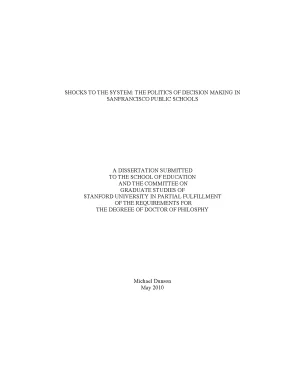
Trang tiêu đề luận văn này tuân thủ nghiêm ngặt bố cục chuẩn. Nó trình bày tên đầy đủ của luận văn: "SHOCKS TO THE SYSTEM: THE POLITICS OF DECISION MAKING IN SAN FRANCISCO PUBLIC SCHOOLS". Trang này cũng nêu rõ nơi nộp. Đó là Trường Giáo dục và Ủy ban Nghiên cứu Sau đại học của Đại học Stanford. Mục đích là để hoàn thành các yêu cầu cho bằng Tiến sĩ Triết học. Các quy định định dạng luận văn đòi hỏi chi tiết này. Nó đảm bảo tính minh bạch và học thuật của tài liệu. Trang bìa luận văn là phần đầu tiên người đọc thấy.
4.2. Chi tiết tác giả và thông tin liên hệ.
Tác giả của luận văn tốt nghiệp này là Michael Dunson. Ngày hoàn thành và nộp tài liệu là tháng 5 năm 2010. Thông tin bản quyền rõ ràng được ghi trên trang. "© 2010 by Michael Leon Dunson. All Rights Reserved." Luận văn được phân phối lại bởi Đại học Stanford. Việc này tuân theo giấy phép đã thỏa thuận với tác giả. Điều này bảo vệ quyền sở hữu trí tuệ của tác giả. Nó cũng đảm bảo khả năng tiếp cận học thuật. Trang bìa luận văn cung cấp tất cả các thông tin cơ bản này.
4.3. Các phê duyệt và xác nhận của ủy ban.
Luận văn đã nhận được nhiều chứng nhận quan trọng. Joy Williamson, cố vấn chính, đã xác nhận chất lượng. David Labaree, đồng cố vấn, cũng đã chứng nhận. Samuel Wineburg cũng khẳng định luận văn đáp ứng tiêu chuẩn. Phó Hiệu trưởng Giáo dục Sau đại học đã phê duyệt luận văn. Trang chữ ký được tạo điện tử khi nộp. Tuy nhiên, bản sao cứng có chữ ký gốc được lưu trữ. Nó nằm trong Kho lưu trữ của Đại học. Các phê duyệt này là yêu cầu bắt buộc. Đây là một phần của hướng dẫn nộp luận văn.
V. Hướng dẫn nộp luận văn và quy định định dạng
5.1. Quy trình nộp luận văn điện tử tại Stanford.
Quá trình nộp luận văn tại Stanford có các bước cụ thể. Trang chữ ký cho luận văn này được tạo điện tử. Điều này xảy ra ngay sau khi nộp luận văn ở định dạng điện tử. Tuy nhiên, một bản sao cứng có chữ ký gốc vẫn được yêu cầu. Bản sao cứng này được lưu trữ trong Kho lưu trữ của Đại học. Đây là một phần của hướng dẫn nộp luận văn. Sinh viên cần tuân thủ cả hai hình thức nộp. Việc quản lý phiên bản tài liệu là cần thiết. Đặc biệt khi xử lý các bản sửa đổi luận văn trước khi nộp.
5.2. Các quy định định dạng luận văn chuẩn mực.
Các cố vấn đã đọc và chứng nhận luận văn. Họ xác nhận luận văn "hoàn toàn đầy đủ về phạm vi và chất lượng". Điều này áp dụng cho bằng Tiến sĩ Triết học. Việc này ngụ ý rằng tài liệu tuân thủ các quy định định dạng luận văn. Các quy định này bao gồm cấu trúc, trích dẫn, và bố cục. Tuân thủ định dạng là một yếu tố quan trọng. Nó quyết định việc chấp nhận luận văn. Sinh viên cần xem xét kỹ các yêu cầu này. Chúng thường được nêu chi tiết trong hướng dẫn nộp luận văn.
5.3. Yêu cầu chứng nhận chất lượng và phạm vi.
Mỗi cố vấn đã cung cấp một xác nhận riêng. Họ chứng nhận rằng luận văn đáp ứng tiêu chuẩn cao. Tiêu chuẩn này cần thiết cho bằng Tiến sĩ Triết học. Các xác nhận này nhấn mạnh sự kỹ lưỡng của nghiên cứu. Nó cũng đảm bảo chất lượng học thuật của luận văn. Việc này là một bước bắt buộc trong quy trình nộp luận văn. Các sinh viên phải làm việc chặt chẽ với cố vấn. Mục đích là để đảm bảo rằng bản nháp luận văn đạt yêu cầu. Các yêu cầu này thường được kiểm tra trước hạn chót nộp luận văn.
VI. Quản lý phiên bản tài liệu luận văn và bản sửa đổi
6.1. Tầm quan trọng của việc quản lý phiên bản tài liệu.
Tên tài liệu "Dissertation submission draft title page pd copy3 augmented" rất quan trọng. Nó gợi ý rằng đây là một bản nháp luận văn cụ thể. Cụ thể hơn, nó là "bản sao 3 đã được tăng cường". Điều này nhấn mạnh tầm quan trọng của việc quản lý phiên bản tài liệu. Tác giả cần theo dõi các thay đổi. Việc này giúp kiểm soát các bản sửa đổi luận văn. Trong quá trình dài viết luận văn, nhiều phiên bản được tạo ra. Quản lý cẩn thận giúp tránh nhầm lẫn. Nó cũng đảm bảo sử dụng bản tài liệu mới nhất.
6.2. Quy trình làm việc với bản sửa đổi luận văn.
Quá trình hoàn thành luận văn bao gồm nhiều bản sửa đổi. Tác giả đã làm việc qua nhiều bản nháp luận văn. Các cố vấn đã xem xét tài liệu định kỳ. Họ cung cấp phản hồi quan trọng. Các bản sửa đổi luận văn là kết quả của quá trình này. Việc này đảm bảo rằng luận văn đạt tiêu chuẩn học thuật cao. Nó cũng giúp cải thiện chất lượng nghiên cứu và văn phong. Hướng dẫn nộp luận văn thường nêu rõ tầm quan trọng của các vòng sửa đổi. Các sinh viên phải sẵn sàng thực hiện những thay đổi cần thiết.
6.3. Sẵn có trực tuyến và quyền truy cập vào tài liệu.
Luận văn này có sẵn trực tuyến. Một URL cụ thể được cung cấp: http://purl.edu/cj379jt8818. Điều này cho phép quyền truy cập rộng rãi. Người đọc có thể dễ dàng tìm thấy và tham khảo bản sửa đổi luận văn này. Việc phân phối lại bởi Đại học Stanford cũng là một điểm cộng. Giấy phép Creative Commons Attribution-Noncommercial 3.0 cho phép sử dụng. Nó cho phép sử dụng phi thương mại với sự ghi nhận. Điều này hỗ trợ việc phổ biến kiến thức học thuật. Nó cũng tuân thủ các quy tắc về nộp luận văn điện tử.
Mục lục chi tiết luận án
Tải xuống file đầy đủ để xem toàn bộ nội dung
Tải đầy đủ (184 trang)Trích đoạn nội dung luận án
Tải xuống để đọc toàn bộSHOCKS TO THE SYSTEM: THE POLITICS OF DECISION MAKING IN SANFRANCISCO PUBLIC SCHOOLS A DISSERTATION SUBMITTED TO THE SCHOOL OF EDUCATION AND THE COMMITTEE ON GRADUATE STUDIES OF STANFORD UNIVERSITY IN PARTIAL FULFILLMENT OF THE REQUIREMENTS FOR THE DEGREEE OF DOCTOR OF PHILOSPHY Michael Dunson May 2010 © 2010 by Michael Leon Dunson. All Rights Reserved. Re-distributed by Stanford University under license with the author. This work is licensed under a Creative Commons Attribution- Noncommercial 3.0 United States License.org/licenses/by-nc/3.0/us/ This dissertation is online at: http://purl.edu/cj379jt8818 ii I certify that I have read this dissertation and that, in my opinion, it is fully adequate in scope and quality as a dissertation for the degree of Doctor of Philosophy.
Joy Williamson, Primary Adviser I certify that I have read this dissertation and that, in my opinion, it is fully adequate in scope and quality as a dissertation for the degree of Doctor of Philosophy. David Labaree, Co-Adviser I certify that I have read this dissertation and that, in my opinion, it is fully adequate in scope and quality as a dissertation for the degree of Doctor of Philosophy. Samuel Wineburg Approved for the Stanford University Committee on Graduate Studies. Gumport, Vice Provost Graduate Education This signature page was generated electronically upon submission of this dissertation in electronic format.
An original signed hard copy of the signature page is on file in University Archives. iii ABSTRACT I trace the history of two education policies in San Francisco that flared into public controversy during the onset of a major crisis. The first controversy, which transpired in the wake of the 1906 Earthquake, involved the San Francisco Board of Education’s attempt to segregate Japanese students. The second was the drive for school construction during the Great Depression.
School officials and other political actors resiliently pursued their agendas even when faced with the turmoil caused by the crises. Politics did not subside; in fact, politics gave meaning to chaos. Two generalizations help to explain this finding. First, political actors searched for opportunities in crisis.
When crises radically altered the physical and material infrastructure of the school department, people seized whatever resources they could to achieve their goals. Second, crises forced political actors to adjust their rhetoric by adapting their language to fit the circumstances. Prior to the earthquake and depression, political actors attempted to sway the public in their favor by defining the core values involved in segregation and school construction. The crises generated a new set of values.
Political actors adjusted their rhetoric by integrating new values into the old political discourse. iv ACKNOWLEDGMENTS Earning a Ph. brings many personal accolades, but this accomplishment was a true community effort. Without the help and support of numerous people, I would not have completed the degree.
I begin with special thanks to the Stanford University Teacher Education Program (STEP). From the beginning, STEP supported me financially, intellectually, and emotionally. In particular Ruth Ann Costanzo, your support and understanding helped me work through some difficult times. And Rachel, I’m not going to try to summarize in one sentence all you’ve done for me.
You’re amazing. The history of education family is an amazing collection of brilliant scholars and genuinely wonderful people. Larry Cuban, Leah Gordon, Jack Schneider, thank you for all your support. Lori, we came in together and that’s how we’re leaving.
It was great to have you as a partner. To David Tyack and Elisabeth Hansot, thank you so much for your mentorship and friendship. I cherish our lunches and conversations. One reason I’m excited to stay in the Bay Area is that we will be able to spend more time together.
I want to send a special thank you to the Stanford IT staff, Debbie, Chris, Paul, and Tom. You four are awesome. To Tami Suzuki and the archivists at the San Francisco Public Library History Room, you helped make research a pleasant experience. You all do a great job.
Most graduate students are lucky to have an amazing advisor; I was blessed with two, David Labaree and Joy Williamson. David, you never gave up on me. You v trained me and patiently let me grow into a better writer and researcher. Joy, you brought me to Stanford and encouraged me every step of the way.
I am so thankful to have you as a mentor and as a friend. And Sam Wineburg, you pretty much adopted me as an advisee. When my aunt passed away and I wanted to quit the program, I called and you answered. Thank you all.
I’m a better scholar, teacher, and person because of you. I am blessed with an amazing collection of friends and family. My first reading group: Django, Laurie, and Heather. We’ve all made it through.
Nathalie, Ross, and Jeanette, you adopted me into the family and helped make the Bay Area feel like home. To the Ashby crew: You opened your doors to me. Thank you so much. Heather, you’re a spark of life.
Cullen and Jay, I would not have survived the first four years without you. The support, jokes, and encouragement gave me a way to escape the stress. Adrian and Carl, my guys. I can’t wait to come home and watch a game (graduate school stress free) with y’all.
Wes, Simone, Camden, and Jacobi. You have no idea how much I relied on you. On many occasions, I entered your home stress out and depressed, but each time, I left with my spirits up and recharged. Thank you so much.
You practically raised me. I love you both so much. Dave and Mike, we’re at 30 years together. That’s crazy when you think about it.
We’ve been through it all. You two are my brothers. Coach you helped me become a man. Todd thanks for the constant check-ins and support.
You made sure I stayed connected to home. Allen Temple: Ralph and Kathi, Reg, Willie, Mike and Judy. From the first time we met, you embraced me and you haven’t let go yet. To class 5, vi your spirit, faith and fellowship guided me through the final stretch.
To my 2003- 2007 BGSA crew, most especially Faruq, Christen, Jide, and Erica. You stayed with me through the craziness and long silences. Salina, you’ve seen me at my best and worst; you have the full picture. I thank you and IS for keeping me stable and giving me something to believe in beyond the research.
I love you dearly. To my aunts, uncles, and cousins, “It’s good to be a Johnson.” My sister, Joy D., we’ve been through a lot over the last few years and we’re still here. Love you so much. To my ladies, Carol, Shacole, and Sennice, you are my heart.
On my saddest days, thinking of you made me smile. Dad, thank you for all your support and help. You keep pressing forward. Reg, my big brother, my mentor, my role model.
When I see you, I see mom: her strength, her spirit. Love you with all my heart. Over the course of this journey, much as changed. Many wonderful people have entered my life; many I hold dear are no longer with me.
Steve and Spankie, even in spirit, I know you’re still fixing cars and painting graffiti. Joe, I still see your smile and hear your laugh. Weiner, a survivor in every sense of the word (Karen you are a beautiful person and you embody the spirit and strength of your father). Buckley, thanks for the great times at Jones Beach.
Aunt Gloria, the perfect Godmother. You believed in me more than I believed in myself. Mom, you and Aunt Gloria wanted to see me walk across the stage to accept the degree. I know you are looking down on me.
I’m fighting to be the man that you raised, and even though I often fall short, I keep going because of you. I miss you so much. vii CONTENTS Introduction 1 The Politics of Segregation: Japanese Segregation and the “Great Calamity” 19 Politics of School Construction: Progressive Reform and the Great Depression 76 Conclusion 154 Bibliography 170 viii Introduction Education and politics have historically made a volatile mixture. At the end of the 19th century, politics were branded as the scourge of education.
Americans criticized school officials for letting politics corrupt their decision making. Decisions ranging from school construction to hiring personnel were viewed as tainted by the twin evils of politics and patronage. In response, educational reformers proclaimed their intent to exorcize politics from the public schools. They vowed to create school systems that rejected self-interested politicians and embraced rational experts.
Nationwide, reformers erected bureaucracies to shield education from the vagaries of politics. Hierarchical systems of governance became the standard model for decision making in urban school districts. Bureaucracies were designed to establish boundaries and place constraints on participation. By restricting access, reformers hoped to streamline the decision making process by putting experts in charge and shunning laypersons.
With experts making the decisions, reformers presumed that research and science would replace politics as the mechanism for deciding educational policy. Reformers were certain that a corporate model of governance would transform urban school systems into rational, efficient, well- managed enterprises.1 The reformers were widely successful. By the middle of the twentieth century, they upheld bureaucracy as the preeminent model for urban school governance. Political scientists Michael Kirst and Frederick Wirt explain that educational bureaucracies established a uniform pattern of school governance across the country, a 1 David Tyack and Elisabeth Hansot, Managers of Virtue: Public School Leadership in America, 1820- 1980, (New York: Basic Books, 1982).
1 pattern so prevalent that it resulted in the establishment of a separate system of government. “Although few Americans realize it” state Kirst and Wirt, “the nation long has maintained one government for schools—comprised mainly of local and state boards of education and superintendents—and another for everything else.”2 The reformers, however, failed in one important aspect: while the rules of the game changed, the politics continued. Although formal structures were supposed to limit access to the decision making process, American citizens never relented their right to participate. Schools remained the site of contentious battles, as interest groups of various social classes, races, and religions continued to fight to control educational policy.
School boards and superintendents, the formal decision makers within the bureaucracy, were responsible for converting demands into policy. Their decisions were contingent on numerous factors that included the formal rules of the system, the power and influence of various interest groups, the availability of resources, and in general, the communities political will toward a particular policy. These were the components of educational decision making. The contours of school politics were shaped by the fluid interaction between the formal bureaucracy and interest groups, as well as the fluctuating availability of resources.
Under normal conditions, decision making is messy. Educational leaders struggle to function within a system that contains an array of divergent and conflicting groups, each insisting their needs, more than anyone other group, are most urgent. Superintendents and school boards face a steady stream of dilemmas requiring them to make trade-offs in how resources are distributed. The range and variety of issues are 2 Mike Kirst and Frederick Wirt, The Political Dynamics of American Education, 3rd ed.
Problems can be limited to a specific classroom, or they can be systemic, involving the entire teaching force or several schools across the district. But regardless of the variety and scope of the issues, they can be classified as part of the normal state of affairs; they are events that rightfully fall within the purview of the superintendent and school board.3 My study examines the educational system, but with a twist. The focus of the study is when the normal abruptly becomes abnormal, when educational policies are altered by the onset of a major crisis. The study is guided by three questions.
Nội dung được bảo vệ bản quyền — Tải xuống đầy đủ
Trích dẫn luận án này
Michael Dunson (2010). Dissertation submission draft title page pd copy3 augmented [Luận án tiến sĩ, Stanford University]. LuanAn.net. https://luanan.net/giao-duc-hoc/dissertation-submission-draft-title-page-pd-copy3-augmented
Câu hỏi thường gặp
Luận án "Dissertation submission draft title page pd copy3 augmented" nghiên cứu về vấn đề gì?
"Phân tích và đề xuất cải tiến hiệu suất của mô hình xử lý ngôn ngữ tự nhiên bằng phương pháp machine learning"
Luận án "Dissertation submission draft title page pd copy3 augmented" được bảo vệ tại trường nào?
Luận án này được bảo vệ tại Stanford University. Năm bảo vệ: 2010.
Luận án "Dissertation submission draft title page pd copy3 augmented" thuộc chuyên ngành gì?
Luận án "Dissertation submission draft title page pd copy3 augmented" thuộc chuyên ngành Education. Danh mục: Giáo Dục Học.
Luận án "Dissertation submission draft title page pd copy3 augmented" có bao nhiêu trang?
Luận án "Dissertation submission draft title page pd copy3 augmented" có 184 trang. Bạn có thể xem trước một phần tài liệu ngay trên trang web trước khi tải về.
Cách tải luận án "Dissertation submission draft title page pd copy3 augmented" về máy như thế nào?
Để tải luận án về máy, bạn nhấn nút "Tải xuống ngay" trên trang này, sau đó hoàn tất thanh toán phí lưu trữ. File sẽ được tải xuống ngay sau khi thanh toán thành công. Hỗ trợ qua Zalo: 0559 297 239.