Dissertation final
Luận án: Dissertation final. Xem tóm tắt và tải về tại LuanAn.net
Cornell University
Medieval Studies / English
Luan An
Luận án tiến sĩ
Năm xuất bản
Số trang
235
Thời gian đọc
36 phút
Lượt xem
0
Lượt tải
0
Phí lưu trữ
50 Point
Tổng quan nhanh
- Chủ đề:
- 1. Late Medieval Spirituality: A Dissertation Insight
- Số trang:
- 235 trang
- Trường:
- Cornell University
- Chuyên ngành:
- Medieval Studies / English
- Tác giả:
- John Thomas Sebastian
- Năm:
- 2004
Tóm tắt nội dung luận án
I. Late Medieval Spirituality A Dissertation Insight
Luận án này khám phá khát vọng tâm linh của giới giáo sĩ và giáo dân vào cuối thời Trung Cổ ở Anh. Nghiên cứu sâu sắc này phân tích các nhu cầu giáo dục và học hỏi tâm linh. Những khát vọng này, bề ngoài mang tính chiêm niệm, thực chất ẩn chứa những hàm ý quan trọng về giáo hội học, chính trị và văn học. Trọng tâm của nghiên cứu là hình ảnh người giáo dân chưa học thức, một hình tượng có lịch sử riêng. Theo dõi hình ảnh này hé lộ nhiều diễn ngôn và bản sắc cấu trúc xã hội cuối thời Trung Cổ. Người giáo dân mang tính biểu tượng được hình dung là một sinh vật của trí tưởng tượng, cảm xúc và khát khao. Họ không khao khát các mệnh đề thần học hay tranh luận, mà mong muốn một mối quan hệ hữu hình với Chúa. Giải quyết khát vọng này đã dẫn đến sự gia tăng đáng kinh ngạc trong nhận thức của giới giáo sĩ về nhu cầu tâm linh của giáo dân. Sự tích cực của giáo sĩ trong việc giải quyết những nhu cầu này cũng tăng lên rõ rệt. Đây là một điểm nhấn quan trọng trong dissertation abstract này, phản ánh sự thay đổi trong cách tiếp cận giáo lý. Công việc academic editing kỹ lưỡng đã đảm bảo tính chính xác của các phân tích.
1.1. Khám phá Nhu cầu Tâm linh Giáo dân
Giới giáo sĩ cuối thời Trung Cổ nhận thức rõ hơn về nhu cầu tâm linh của giáo dân. Sự nhận thức này thúc đẩy các hoạt động nhằm đáp ứng những khát vọng đó. Giáo dân tìm kiếm một mối quan hệ gần gũi, hữu hình với Chúa, không phải sự tranh luận thần học phức tạp. Luận án nhấn mạnh sự phát triển của các phương pháp giảng dạy phù hợp với đối tượng này. Điều này định hình lại mối quan hệ giữa giáo sĩ và giáo dân.
1.2. Hoạt động của Giáo sĩ và Giảng dạy
Giới học giả đã tạo ra một diễn ngôn về "lewdness" (từ ngữ kỹ thuật chỉ giáo dân trung cổ không biết chữ). Theo đó, giáo dân sùng đạo được cho là học hỏi bằng cách đọc hình ảnh. Điều này tương phản với giới học giả đọc sách. Giả định này duy trì quyền lực trong suốt thời Trung Cổ. Nó tái xuất hiện thường xuyên trong nhiều bối cảnh khác nhau. Sự tích cực của giáo sĩ trong việc định hình giáo lý cho giáo dân là một yếu tố cốt lõi của nghiên cứu này.
II. Diễn Ngôn Lewdness Thesis Key Concepts
Diễn ngôn "lewdness" bắt nguồn từ lời quở trách của một giáo hoàng ban đầu đối với một giám mục bài trừ tượng thánh. Giả định này duy trì uy quyền của nó trong suốt thời Trung Cổ. Nó thường xuyên tái xuất hiện dưới nhiều hình thức khác nhau, không phải lúc nào cũng dễ nhận biết ngay lập tức. Quyền lực lan tỏa của giáo huấn này đã khiến các nhà thần học cuối thời Trung Cổ giải thích một hệ thống thiền định có sự tham gia. Hệ thống này tập trung vào các sự kiện từ cuộc đời Chúa Kitô, đặc biệt phù hợp cho giáo dân vì các phương pháp giàu trí tưởng tượng của nó. Việc chuẩn bị cho thesis defense đã yêu cầu một sự hiểu biết sâu sắc về những khái niệm phức tạp này. Quá trình proofreading dissertation đảm bảo rằng mọi sắc thái của diễn ngôn "lewdness" được truyền đạt chính xác và rõ ràng. Việc xem xét cẩn thận các văn bản gốc là điều cần thiết để nắm bắt nguồn gốc và sự phát triển của khái niệm này.
2.1. Định nghĩa Giáo dân Không học thức
Thuật ngữ "lewdness" không chỉ đơn thuần là sự thiếu học thức. Nó mô tả một cách thức tiếp cận tâm linh đặc trưng. Giáo dân được hướng dẫn học hỏi thông qua các hình ảnh, biểu tượng trực quan. Phương pháp này khác biệt đáng kể so với việc đọc và phân tích văn bản của giới học giả. Nghiên cứu này phân tích cách định nghĩa và vai trò của giáo dân không học thức đã được xây dựng và duy trì trong xã hội.
2.2. Học bằng Hình ảnh so với Học bằng Sách
Các nhà văn học giả đã thiết lập một phương pháp sư phạm tâm linh. Theo đó, giáo dân được khuyến khích tương tác với các hình ảnh tôn giáo như một phương tiện học hỏi. Cách tiếp cận này giúp tạo ra một mối quan hệ cá nhân với thần linh. Nó là một sự thích nghi đáng chú ý từ các truyền thống học thuật và tu viện. Sự tương phản này làm nổi bật chiến lược giảng dạy sáng tạo nhằm đáp ứng nhu cầu của một đối tượng cụ thể.
III. Khu vực Đông Anglia Dissertation Formatting
Diễn ngôn "lewdness" này có một sức mạnh đặc biệt trong khu vực Đông Anglia. Khu vực này bao gồm các hạt Norfolk và Suffolk, cùng với một phần của Cambridgeshire và Kent. Điều này được chứng minh qua sự khúc xạ của nó trong tiểu sử tâm linh của một phụ nữ giáo dân đáng chú ý từ Bishops Lynn, Margery Kempe. Nó cũng biểu hiện như nền tảng kịch nghệ chung cho một bộ sưu tập các vở kịch. Những vở kịch này nổi bật vì sự khác biệt về hình thức và thể loại. Cuối cùng, diễn ngôn này lại kết hợp một cách trớ trêu với các mục tiêu của những nhà cải cách sau này. Việc hoàn thành dissertation formatting cho phần này đòi hỏi sự chú ý đến từng chi tiết, đảm bảo rằng các ví dụ lịch sử được trình bày rõ ràng. Một bibliography check cẩn thận cũng rất quan trọng để xác minh tất cả các nguồn tham khảo liên quan đến các nghiên cứu khu vực này.
3.1. Tiểu sử Tâm linh Margery Kempe
Câu chuyện của Margery Kempe cung cấp một minh chứng sống động về cách diễn ngôn "lewdness" ảnh hưởng đến đời sống tâm linh cá nhân. Tiểu sử của bà cho thấy một cách tiếp cận chiêm niệm sâu sắc. Cách tiếp cận này được định hình bởi các phương pháp giảng dạy dành cho giáo dân không biết chữ. Nghiên cứu này phân tích những trải nghiệm độc đáo của Kempe như một ví dụ điển hình.
3.2. Nền tảng Kịch nghệ Chung trong Các Vở kịch
Diễn ngôn "lewdness" cũng đóng vai trò là nền tảng kịch nghệ chung cho một số vở kịch cuối thời Trung Cổ ở Đông Anglia. Mặc dù các vở kịch này có sự khác biệt lớn về hình thức và thể loại, chúng đều chia sẻ một cách tiếp cận sư phạm tương tự. Điều này nhấn mạnh sự phổ biến và ảnh hưởng của phương pháp giảng dạy bằng hình ảnh và sự tham gia đối với giáo dân.
IV. Đóng góp Học thuật Final Thesis Phân tích
Các yếu tố của "lewdness" đã che khuất nguồn gốc giáo sĩ rộng lớn hơn của những thực hành thần bí như vậy. Những thực hành này bắt nguồn từ các truyền thống tu viện và các truyền thống học thuật khác. Chúng được điều chỉnh một cách nghịch lý theo cách mà giáo dân "lewd" được hướng dẫn để theo đuổi kiểu chiêm niệm thân mật độc đáo của riêng họ. Luận án này cung cấp một cái nhìn mới mẻ về sự phức tạp của giáo dục và tín ngưỡng cuối thời Trung Cổ. Nghiên cứu này là một đóng góp quan trọng cho các lĩnh vực nghiên cứu Trung Cổ, thần học và văn học. Final thesis này không chỉ làm rõ các khía cạnh lịch sử mà còn đưa ra những gợi ý cho các cuộc thảo luận học thuật hiện tại. Các dissertation defense tips tập trung vào việc nhấn mạnh những đóng góp độc đáo của nghiên cứu này. Chuẩn bị viva voce preparation cẩn thận là cần thiết để bảo vệ các phát hiện và ý nghĩa của chúng một cách hiệu quả cho dissertation submission.
4.1. Hé lộ Nguồn gốc Thực hành Thần bí
Nghiên cứu làm sáng tỏ nguồn gốc thực sự của nhiều thực hành thần bí. Những thực hành này thường được coi là dành riêng cho giáo dân nhưng thực chất có nguồn gốc từ giới giáo sĩ và tu viện. Việc thích nghi những truyền thống này cho giáo dân là một khía cạnh quan trọng của sư phạm cuối thời Trung Cổ. Điều này cho thấy sự linh hoạt trong việc truyền bá giáo lý.
4.2. Hàm ý Học thuật Rộng lớn
Phân tích này có những hàm ý rộng lớn cho các nghiên cứu về xã hội, giáo dục và tôn giáo thời Trung Cổ. Luận án thách thức những giả định hiện có về sự phân chia giữa giáo sĩ và giáo dân. Nó cung cấp một mô hình mới để hiểu sự tương tác giữa tín ngưỡng, văn hóa và quyền lực. Nghiên cứu này góp phần vào việc định hình lại các cuộc thảo luận trong lĩnh vực học thuật.
Tải xuống file đầy đủ để xem toàn bộ nội dung
Tải đầy đủ (235 trang)Trích đoạn nội dung luận án
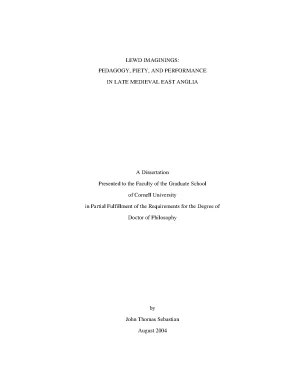
Tải xuống để đọc toàn bộLEWD IMAGININGS: PEDAGOGY, PIETY, AND PERFORMANCE IN LATE MEDIEVAL EAST ANGLIA A Dissertation Presented to the Faculty of the Graduate School of Cornell University in Partial Fulfillment of the Requirements for the Degree of Doctor of Philosophy by John Thomas Sebastian August 2004 © 2004 John Thomas Sebastian LEWD IMAGININGS: PEDAGOGY, PIETY, AND PERFORMANCE IN LATE MEDIEVAL EAST ANGLIA John Thomas Sebastian, Ph. Cornell University 2004 This dissertation explores clerical and lay desires for spiritual teaching and learning at the end of the Middle Ages in England, desires that, while ostensibly contemplative, carried crucial ecclesiological, political, and literary implications. Where these desires met stood the image of the unlearned lay person. This image has a history of its own; tracing it reveals many of the discourses and identities structuring late medieval society.
The iconic lay person was a creature of imagination, feeling, and desire, not desire for theological proposition and dispute, but for a palpable relationship to God. Addressing that desire led in late medieval England to an astonishing increase in clerical awareness of the laity’s spiritual needs and clerical activism in addressing those. Learned writers invented a discourse of “lewdness” (after the technical term for the unlettered medieval laity) according to which the pious laity were supposed to learn by reading images as the learned did by reading books. Derived from an early pope’s rebuke of an iconoclastic bishop, this assumption maintained its authority throughout the Middle Ages, regularly resurfacing in a variety of contexts, although not always in immediately recognizable forms.
The pervasive authority of this dictum led late medieval theologians to expound a system of participatory meditation on events from the life of Christ as particularly suitable for the laity on account of its imaginative methods. These trappings of “lewdness” obscured, however, the much broader clerical origins of such mystical practice, from monastic and other learned traditions, that paradoxically were adapted to how the “lewd” laity were instructed to pursue their own uniquely intimate kind of contemplation. This discourse of “lewdness” assumed peculiar force within the region of East Anglia (the counties of Norfolk and Suffolk along with parts of Cambridgeshire and Kent), as evidenced by its refraction in the spiritual biography of a remarkable lay woman from Bishops Lynn, Margery Kempe, and its manifestation as the common dramaturgical foundation for a collection of plays otherwise notable for their formal and generic differences. Ultimately it coalesced, ironically, with the goals of later Reformers.
BIOGRAPHICAL SKETCH John T. Sebastian grew up in Nutley, New Jersey, where he attended Nutley High School and was the valedictorian of his graduating class. John received his A. magna cum laude in 1998 from Georgetown University having completed a double major in Interdisciplinary Studies, with a concentration in Medieval Studies, and in English.
He also earned a master’s degree from Georgetown’s Department of English in medieval and Renaissance literature in 1999, after which he began further graduate work in the Medieval Studies Program at Cornell University. He received his second M. in 2002 and was awarded the Stephen and Margery Russell Award for Distinguished Teaching in 2003 by the College of Arts and Sciences. During the 2003-2004 academic year, he was an inaugural Mellon Graduate Fellow at Cornell’s Society for the Humanities.
John completed his Ph. in the summer of 2004, and has been appointed assistant professor of medieval literature in the Department of English at Loyola University, New Orleans. iii To my leue dere moder for þe grete godenesse þat I haue recyued þorow þe of oure Lord Ihesus Crist iv ACKNOWLEDGMENTS Of the many formalities attendant upon the completion of a dissertation, few are discharged as eagerly as the performance of acknowledging the many debts of gratitude that one has accumulated. The lifestyle that is graduate study cannot, I suspect, be pursued successfully in the absence of a substantial network of cheerleaders.
And so it is with tremendous enthusiasm that I finally extend my sincere thanks to the community of intellectual, psychological, and emotional supporters whose generosity of many kinds not only facilitated the completion of this project but created the conditions necessary for its inception and continuation at so many different stages of its life and my own. Most immediately, I must thank my Cornell family whose enthusiasm for my academic pursuits has never flagged, even when my own has. Andy Galloway, my Special Committee Chair and advisor since my arrival at Cornell, has been a constant source of inspiration. He has pointed out many a forest that I would otherwise have missed in my sometimes overly narrow quest for trees.
My Special Committee members, Tom Hill, Judith Peraino, and Masha Raskolnikov, have extended much advice and encouragement without which I would be a much less sensitive student of literature, music, and Buffy the Vampire Slayer. I have also benefited from the visionary leadership of Danuta Shanzer and the abiding friendship of Paul Hyams, the directors of the Medieval Studies Program during my time at Cornell. Dianne Ferriss, our graduate field assistant, has been a boundless repository of information and good cheer. I would also be hard pressed to ask for a more nearly perfect community of graduate student colleagues than those friends I have found here.
Three in particular stand out: Ross Leasure, Curtis Jirsa, and especially Johanna Kramer, who has been v my steadfast companion throughout graduate school, and for whose husband I was often mistaken during our early years on campus. I would be severely remiss if I did not also acknowledge the generous financial support that enabled me to conduct research in Europe for this project. The Mellon Foundation in conjunction with the Institute of Historical Research at the University of London provided a dissertation research fellowship to England during the summer of 2003 that allowed me to consult numerous manuscripts at the British Library and the University Library at Cambridge and to explore the physical and cultural spaces once inhabited by Margery Kempe in King’s Lynn and Norwich. I owe a special debt of gratitude to Professor Miri Rubin, who kindly acted as my mentor in England, and to Dr.
Michelle Brown, Curator of the Department of Western Manuscripts at the British Library, who, with what I came to recognize as characteristic and genuine enthusiasm, expended far more of her sought-after time with an unknown graduate student form the States—both during and following my visit—than was ever necessary. My research in England was further enhanced by a William B. Schallek Memorial Graduate Fellowship Award granted by the Richard III Society in 2002. At Cornell, the Mellon Foundation continued to sustain my work during the spring of 2004 with a Graduate Fellowship to Cornell’s Society for the Humanities.
The Society Fellows offered invaluable suggestions and wonderful friendship during a year-long intellectual conversation about the secular and the sacred, punctuated with a healthy dose of levity. I must also acknowledge the support of the Cornell University Graduate School, which provided funds for travel to professional conferences as well as a research travel grant to Dublin so that I could examine the sole surviving manuscript of the Croxton Play of the Sacrament in the spring of 2004. I would have no one to thank at Cornell if the truly outstanding medievalists at Georgetown University had not made me realize (thankfully) that Medieval Studies vi was something one could actually do for a living. Of the many superb teachers who generously gave of themselves during my time in DC, two deserve special mention.
Jo Ann Moran Cruz has helped me ground my forays into imaginative literature in an appreciation and respect for history, most recently through her trenchant response to material from the first three chapters of this dissertation presented at the 79th Annual Meeting of the Medieval Academy of America in Seattle. Penn Szittya has been so many things to me at some many times and in so many places, that I can only hope to be half the teacher and friend to my students that he as been to me during the last decade. Finally, these pages would never have been written without the unconditional support of my parents and my fiancée, nor without their patience with what must have seemed a quirky preoccupation with really old stuff. Without them and their love, I could never have written the words that fill the pages to come.
Mom, Dad, and Christy: I thank you and I love you. vii TABLE OF CONTENTS BIOGRAPHICAL SKETCH iii DEDICATION iv ACKNOWLEDGMENTS v TABLE OF CONTENTS viii INTRODUCTION 1 PART I CHAPTER ONE 9 “A book to þe lewyd peple”: Redefining the Gregorian Illitterati at the End of the Middle Ages CHAPTER TWO 44 Inventing Lay Meditation: Walter Hilton, Nicholas Love, and John Wyclif CHAPTER THREE 73 Learning to be Lewd: Ghostly Readings and Collaborative Visions viii PART II CHAPTER FOUR 100 Embodying Pedagogy: The Book of Margery Kempe CHAPTER FIVE 127 Performing Pedagogy: The Book of Margery Kempe PART III CHAPTER SIX 151 Staging Pedagogy EPILOGUE 206 BIBLIOGRAPHY 209 ix INTRODUCTION This dissertation explores clerical and lay desires as these intersected within peculiar forms of teaching and learning that emerged at the end of the Middle Ages, desires ostensibly spiritual but which nevertheless had implications ecclesiological, political, literary, and dramatic. At the point where these desires meet stands the image of the unlearned English lay person. This image, and the desires it speaks to, has a history of its own, and tracing that history reveals an unfolding of the discourses and identities that structured late-medieval society and its most basic foundations.
The lay person of late-medieval England was a creature of imagination, feeling, and desire, not desire for theological proposition and dispute, but for a palpable relationship to his or her God. Addressing that desire led in the Late Middle Ages in England to an astonishing increase in clerical awareness of the spiritual needs of the laity and activism on the part of priests in addressing these perceived needs. The proximate historical causes of this heightened clerical-lay interaction were as political as they were theological, as social as they were ecclesiological, beginning at least as early as the thirteenth-century reform program initiated by the bishops assembled at the Fourth Lateran Council during the papacy of Innocent III. The constitutions promulgated during the final session of the Council in 1215 hint at Innocent’s active, reformer’s zeal, but also at the preexistence of pressures both internal and external that propelled that reform.
These decrees commence with a restatement of the major tenets of the faith followed immediately by the anathematizing of the millennialist Joachim of Fiore and all heresies and all heretics in general, “whatever names they may go under.”1 If reform were to be undertaken, it 1 “. quibuscumque nominibus censeantur. Decrees of the Ecumenical Councils, vol. All translations of the constitutions are Tanner’s.
1 2 was to be initiated at the institutional level, not on the ground by people like Peter Waldo, the Albigensians, and other heterodox reformers against whom Innocent regularly contended.1 The Fourth Lateran constitutions then turn to specific instructions for reform of the Church, many of which no doubt had serious implications, or at least the intention thereof, for the practice of Christianity at all levels of society throughout Western Europe. Thus, constitution fifty-one, “de poena contrabentium clandestina matrimonia,” forbids participation in illicit clandestine marriages by lay men and women seeking to be united outside the bounds of normal procedure, as well as by the clergy who performed the secretive rituals, and prescribed punishments for both groups. Other constitutions focus on reforming individual social estates, such as the fifteenth, “de arcenda ebrietate clericorum,” on the inadvisability of clerical drunkenness, or, of perhaps greater relevance to the present study, the sixteenth, “de indumentis clericorum,” which, in addition to prohibiting the clergy from dressing in a manner unbefitting their religious calling, states that priests “should not watch mimes, entertainers and actors.
Nội dung được bảo vệ bản quyền — Tải xuống đầy đủ
Trích dẫn luận án này
John Thomas Sebastian (2004). Dissertation final [Luận án tiến sĩ, Cornell University]. LuanAn.net. https://luanan.net/giao-duc-hoc/dissertation-final
Câu hỏi thường gặp
Luận án "Dissertation final" nghiên cứu về vấn đề gì?
Luận án: Dissertation final. Xem tóm tắt và tải về tại LuanAn.net
Luận án "Dissertation final" được bảo vệ tại trường nào?
Luận án này được bảo vệ tại Cornell University. Năm bảo vệ: 2004.
Luận án "Dissertation final" thuộc chuyên ngành gì?
Luận án "Dissertation final" thuộc chuyên ngành Medieval Studies / English. Danh mục: Giáo Dục Học.
Luận án "Dissertation final" có bao nhiêu trang?
Luận án "Dissertation final" có 235 trang. Bạn có thể xem trước một phần tài liệu ngay trên trang web trước khi tải về.
Cách tải luận án "Dissertation final" về máy như thế nào?
Để tải luận án về máy, bạn nhấn nút "Tải xuống ngay" trên trang này, sau đó hoàn tất thanh toán phí lưu trữ. File sẽ được tải xuống ngay sau khi thanh toán thành công. Hỗ trợ qua Zalo: 0559 297 239.