Corrected dissertation 2 21 08
Luận văn đã chỉnh sửa ngày 21 tháng 2 năm 2008. Khám phá các phát hiện và cập nhật quan trọng trong tài liệu này.
Department of History (Lịch sử)
Luan An
Luận án tiến sĩ (Doctoral Dissertation)
Năm xuất bản
Số trang
235
Thời gian đọc
36 phút
Lượt xem
0
Lượt tải
0
Phí lưu trữ
50 Point
Tổng quan nhanh
- Chủ đề:
- 1. Lịch Sử Tự Do Đen
- Số trang:
- 235 trang
- Trường:
- University of North Carolina at Chapel Hill
- Chuyên ngành:
- Department of History (Lịch sử)
- Tác giả:
- John K. (Yonni) Chapman
- Năm:
- 2006
Tóm tắt nội dung luận án
I. Lịch Sử Tự Do Đen
Lịch sử tự do đen tại Đại học Bắc Carolina từ năm 1793 đến 1960 là một chủ đề quan trọng. Đại học này đã đóng vai trò trong việc thúc đẩy chế độ nô lệ và phân biệt chủng tộc. Các phong trào tự do đen đã thách thức trường đại học trở nên công bằng và bao gồm hơn.
1.1. Thời Kỳ Nô Lệ
Trước năm 1865, giới quý tộc sử dụng đại học để thúc đẩy sự phát triển của chế độ nô lệ.
1.2. Thời Kỳ Tái Xây Dựng
Sau khi giải phóng nô lệ, các nhà quản lý trường đại học đã dẫn đầu chiến dịch trắng để kìm hãm tự do đen và Tái Xây Dựng Cực đoan.
II. Phong Trào Tự Do Đen
Phong trào tự do đen đã đóng vai trò quan trọng trong việc thách thức trường đại học trở nên công bằng và bao gồm hơn. Các phong trào này đã thúc đẩy các chuẩn mực công dân dân chủ và trách nhiệm thể chế.
2.1. Phong Trào Tự Do Đen Những Năm 1860
Phong trào tự do đen trong những năm 1860 đã thúc đẩy các chuẩn mực công dân dân chủ và trách nhiệm thể chế.
2.2. Phong Trào Tự Do Đen Những Năm 1960
Phong trào tự do đen trong những năm 1960 đã tiếp tục thách thức trường đại học trở nên công bằng và bao gồm hơn.
III. Trường Đại Học Và Phân Biệt Chủng Tộc
Trường đại học đã thực hiện các chính sách phân biệt chủng tộc trong việc làm và quan hệ với thị trấn Chapel Hill. Các công nhân da đen đã là lực lượng chính thách thức chủ nghĩa phân biệt chủng tộc thể chế của trường đại học.
3.1. Chính Sách Phân Biệt Chủng Tộc
Trường đại học đã thực hiện các chính sách phân biệt chủng tộc trong việc làm và quan hệ với thị trấn Chapel Hill.
3.2. Thách Thức Chủ Nghĩa Phân Biệt Chủng Tộc
Các công nhân da đen đã là lực lượng chính thách thức chủ nghĩa phân biệt chủng tộc thể chế của trường đại học.
IV. Kết Luận
Tóm lại, lịch sử tự do đen tại Đại học Bắc Carolina từ năm 1793 đến 1960 là một chủ đề quan trọng. Trường đại học đã đóng vai trò trong việc thúc đẩy chế độ nô lệ và phân biệt chủng tộc, nhưng các phong trào tự do đen đã thách thức trường đại học trở nên công bằng và bao gồm hơn.
4.1. Di Sản Của Lịch Sử
Di sản của lịch sử tự do đen tại Đại học Bắc Carolina vẫn còn tồn tại ngày nay.
4.2. Hướng Tiếp Cận Mới
Cần có hướng tiếp cận mới để hiểu và giải quyết các vấn đề phân biệt chủng tộc và bất công tại trường đại học.
Tải xuống file đầy đủ để xem toàn bộ nội dung
Tải đầy đủ (235 trang)Trích đoạn nội dung luận án
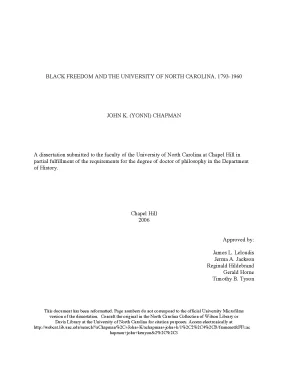
Tải xuống để đọc toàn bộBLACK FREEDOM AND THE UNIVERSITY OF NORTH CAROLINA, 1793-1960 JOHN K. (YONNI) CHAPMAN A dissertation submitted to the faculty of the University of North Carolina at Chapel Hill in partial fulfillment of the requirements for the degree of doctor of philosophy in the Department of History. Chapel Hill 2006 Approved by: James L. Jackson Reginald Hildebrand Gerald Horne Timothy B.
Tyson This document has been reformatted. Page numbers do not correspond to the official University Microfilms version of the dissertation. Consult the original in the North Carolina Collection of Wilson Library or Davis Library at the University of North Carolina for citation purposes. Access electronically at http://webcat.edu/search?/aChapman%2C+John+K/achapman+john+k/1%2C2%2C4%2CB/frameset&FF=ac hapman+john+kenyon&2%2C%2C3 ! 2006 JOHN K.
(YONNI) CHAPMAN ALL RIGHTS RESERVED john.com ii ABSTRACT JOHN K. CHAPMAN: Black Freedom and the University of North Carolina, 1793-1960 (Under the direction of James L. Leloudis) Recent histories of the University of North Carolina trivialize the institution’s support for white supremacy during slavery, Reconstruction, and Jim Crow, while denying that this unjust past affects the university today. The celebratory lens also filters out African American contributions to the university.
In fact, most credit for UNC’s increased diversity is due to the struggles of African Americans and other traditionally disenfranchised groups for equal rights. During both the 1860s and the1960s, black freedom movements promoted norms of democratic citizenship and institutional responsibility that challenged the university to become more honest, more inclusive, and more just. By censoring this historical viewpoint, previous scholarship has contributed to a culture of denial and racial historical amnesia that heralds UNC as the “University of the People,” without seriously engaging questions of justice in the past or the present. This dissertation demonstrates that before 1865, the gentry used the university to promote the growth of slavery.
Following Emancipation, university trustees led the white supremacy campaign to suppress black freedom and Radical Reconstruction. At the turn of the century, university leaders organized the movement for black disfranchisement and segregation that led to Jim Crow. Until the 1960s, the university enforced Jim Crow in its employment practices and its relations with the Town of Chapel Hill. Throughout its history, black workers were the main force challenging UNC’s institutional racism on campus, in Chapel Hill, and throughout the state.
An extended Epilogue examines how the university’s institutional culture changed during the 1960s from an open defense of Jim Crow to acceptance of non-discrimination. Although the university accepted formal equality in admissions, employment, and its relations with the larger community, it did not acknowledge or attempt to dismantle the institutional structures of white supremacy that it had helped to create throughout its history. In this way, UNC established a paradigm of diversity without justice to replace Jim Crow, replacing the open celebration of white supremacy with new forms of subtle, “colorblind” institutional racism that persist today. iii To friends and comrades Mary Smith and Elizabeth Brooks, leaders of the 1969 UNC cafeteria workers struggle Barbara Prear and Marcia Tinnen, leaders of the UNC Housekeepers Movement and UE Local 150 Fred Battle, Nate Davis, Eugene Farrar, Bill Thorpe, Al McSurely, Hank Anderson and James Brittian, leaders of the Hank Anderson Breakfast Club iv INTRODUCTION History is the fruit of power, but power itself is never so transparent that its analysis becomes superfluous.
The ultimate mark of power may be its invisibility; the ultimate challenge, the exposition of its roots. Michel-Rolph Trouillot, Silencing the Past When a people have been robbed of the knowledge of their past struggles they become passive. The suppression of working-class history, and of the history of conflict, has been a powerful tool in keeping poor people, ethnic minorities, and women, confused, deluded, and quiet. Campbell, Education for a Democratic Society In 1922, the University of North Carolina named a building for one of its most illustrious trustees, Col.
In the late 1860s, Saunders led the North Carolina Ku Klux Klan in a violent white supremacy campaign to overthrow biracial Republican politics during Radical Reconstruction. From 1874 to his death in 1891, Saunders served on the Executive Committee of the university’s Board of Trustees. I became interested in the names of university buildings during the 1990s when I was helping the UNC Housekeepers Association research the history of black workers at the university. The housekeepers were gathering evidence for a class action lawsuit against persistent racist employment practices.
One morning, I asked a well known liberal professor whose office was in Saunders Hall, “How do you feel about coming to work every day in a building named for the leader of the Ku Klux Klan?” He smiled at me and said, “I feel fine. That was then. That’s not my university now.” I told him, “I don’t think the housekeepers would agree with you.” Some people at Carolina have no inkling that Saunders Hall was named for a KKK leader. When Kristi Booker, a black student from Charlotte, found out, she organized a campus group called Students Seeking Historical Truth to publicize the issue.
In October 1999, the outraged students draped Saunders Hall with KKK banners and posters explaining Saunders’ history.1 Yet many, like the professor who worked in Saunders Hall, know the history of William L. Saunders, but do not believe it has anything to do with the university today. In a sense, they are in denial concerning ways that the unjust past continues to shape the present. They have bought into the celebratory progressive mythology promoted by institutional histories, university administrators, and much of the state’s media that acts as a fog shrouding the university against critical examination.
Most historical studies of the University of North Carolina have been written from a celebratory viewpoint that trivializes the university’s historical support for slavery and Jim Crow, while denying that this unjust past is an active force in the present.2 Such accounts help to shape an ideological lens, or frame, that bends our minds in ways that conform to the persistent norms of white supremacy that still permeate our culture. We are taught not to see black workers, not to be sensitive to racial injustice, and not to think critically about the past and its connection 1 Jenny Fowler, “Group Objects to KKK Leader’s Name on Hall,” Daily Tar Heel, April 4, 2001. 2 Battle, History, 2 vols.; Connor, Documentary History, 2 vols.; Henderson, Campus; Lockmiller, Consolidation; Spencer, “Sketches of the University”; Wagstaff, Impressions; Wilson, University of North Carolina. v to the present.
That’s just the way it was. If we acquiesce in looking at the world through such a lens, we succumb to colorblindness and historical racial amnesia. We cannot really examine the question of black freedom and the university. Yet it would be difficult for any sympathetic person with a real understanding of the hardships endured by low-wage workers of color at UNC to believe that the civil rights movement put an end to institutional racism.
It is the fact that many people have neither insight into the lives of black campus workers nor any realistic understanding of the university’s history of racial injustice that allows the celebratory narrative to dominate. The progressive mythology that has been fundamental to the university’s telling of its own story encourages students, professors, and others to make the choice to remain ignorant of the lives and struggles of black workers, as well as the institution’s real history. In this dissertation, I present some of the history that this mythmaking has censored and suppressed. Celebratory accounts of UNC’s history have two major failings with respect to racial justice and a realistic understanding of black freedom and the university today.
First, such histories have suppressed the story of the university’s leading role in promoting slavery and white supremacy since its founding in 1793 to the 1960s. The major studies written since the civil rights movement have not critically assessed the more subtle forms of institutional racism that have persisted at UNC since the overthrow of Jim Crow.3 Whether this censorship is intentional or not, the affect is to suppress critical thinking concerning the university’s unjust past. Such scholarship contributes to a widespread culture of denial that celebrates UNC as “the University of the People,” without seriously engaging questions of justice in the past or the present. Since the university funded many of these flawed studies, its failure to fund studies that honestly engage the question of racial justice constitutes a form of ongoing institutional racism.
The second major flaw of historical accounts that view the development of UNC through a celebratory lens is the failure to examine African American contributions to the university and the impact of black freedom struggle. Most UNC institutional histories credit a pantheon of white, male leaders for guiding the university to become an ever more inclusive and progressive institution. In fact, much of that credit is due the freedom struggles of African Americans and the democratic social movements organized by other traditionally disenfranchised groups. From slavery to the present, the university built itself upon the backs of a low-wage black laboring caste that it did a great deal to create and maintain.
It was the struggle of black workers and African Americans from slavery to the 1960s that overthrew Jim Crow. In the wake of these black freedom victories, every disenfranchised group built upon the breakthroughs of the civil rights movement. Women, Indians, Latinos/as, Asians, homosexuals, and others demanded that the university live up to its stated mission of being “the University of the People.” Without these struggles, there would have been no democratic progress at UNC. Yet these facts are ignored or trivialized in celebratory histories of the university.
Moreover, such accounts gloss over ongoing injustice at UNC, including more subtle forms of institutional racism and the persistent exploitation of low-wage workers of color.4 3 King, Multi-Campus University; Powell, First State University; Snider, Light on the Hill. 4 My use of the terms “racism,” “white supremacy,” and “institutional racism” all are founded on the understanding that race is a mechanism for implementing power relations. “Race relations,” or how people of different races “get along,” is a narrow and insufficient way of understanding the function of race in America. What I call the “race relations paradigm” obscures the most important aspects of race as a mechanism of power.
In general, I agree with the definition of racism advanced by Lani Guinier and Gerrald Torres: “We define racism, therefore, as acquiescence in and accommodation to racialized hierarchies governing resource distribution and resource generation.” Guinier and Torres, The Miner’s Canery, 292. vi My approach has been to look at the relationship of African Americans and the University of North Carolina from the viewpoint of black freedom, particularly from the viewpoint of black workers. My aim has been to reveal how UNC wielded its institutional power in relationship to black freedom by examining the historical roots of that dialectic from 1793 to 1960. At the same time, I have tried to retrieve the freedom legacy of African Americans, who have been systematically “robbed of the knowledge of their past struggles.” Every historian writes from a particular viewpoint, whether or not it is conscious or acknowledged.
Over the years, many white conservatives inside and outside of North Carolina have seen the university as far too liberal on race and most other matters. White liberals, on the other hand, have seen the university as a “light on the hill,” bringing enlightenment to a backward and bigoted state and region. The viewpoint of African Americans, however, has little in common with either of these frameworks. While Chapel Hill is known far and wide as “the Southern Part of Heaven,” black campus workers and community residents commonly see the university as “the Southern Part of Hell” or “the plantation.” This has to do with the university’s long history of white supremacy and its role as the dominant institution and main employer in Chapel Hill.
Nội dung được bảo vệ bản quyền — Tải xuống đầy đủ
Trích dẫn luận án này
John K. (Yonni) Chapman (2006). Corrected dissertation 2 21 08 [Luận án tiến sĩ, University of North Carolina at Chapel Hill]. LuanAn.net. https://luanan.net/giao-duc-hoc/corrected-dissertation-2-21-08
Câu hỏi thường gặp
Luận án "Corrected dissertation 2 21 08" nghiên cứu về vấn đề gì?
Luận văn đã chỉnh sửa ngày 21 tháng 2 năm 2008. Khám phá các phát hiện và cập nhật quan trọng trong tài liệu này.
Luận án "Corrected dissertation 2 21 08" được bảo vệ tại trường nào?
Luận án này được bảo vệ tại University of North Carolina at Chapel Hill. Năm bảo vệ: 2006.
Luận án "Corrected dissertation 2 21 08" thuộc chuyên ngành gì?
Luận án "Corrected dissertation 2 21 08" thuộc chuyên ngành Department of History (Lịch sử). Danh mục: Giáo Dục Học.
Luận án "Corrected dissertation 2 21 08" có bao nhiêu trang?
Luận án "Corrected dissertation 2 21 08" có 235 trang. Bạn có thể xem trước một phần tài liệu ngay trên trang web trước khi tải về.
Cách tải luận án "Corrected dissertation 2 21 08" về máy như thế nào?
Để tải luận án về máy, bạn nhấn nút "Tải xuống ngay" trên trang này, sau đó hoàn tất thanh toán phí lưu trữ. File sẽ được tải xuống ngay sau khi thanh toán thành công. Hỗ trợ qua Zalo: 0559 297 239.