Nhu cầu tâm lý - xã hội của trẻ mồ côi tuổi vị thành niên trong bối cảnh HIV/AIDS: Nghiên cứu tại Bulawayo, Zimbabwe
Hoàn thành luận văn cho mục đích nộp bài. Nghiên cứu chuyên sâu, đảm bảo chất lượng cao nhất cho công trình của bạn.
University of South Africa
Social Behaviour Studies in HIV/AIDS
Luan An
luận văn
Năm xuất bản
Số trang
102
Thời gian đọc
16 phút
Lượt xem
0
Lượt tải
0
Phí lưu trữ
40 Point
Tổng quan nhanh
- Chủ đề:
- Mastering Dissertation Submission: A Comprehensive Guide
- Số trang:
- 102 trang
- Trường:
- University of South Africa
- Chuyên ngành:
- Social Behaviour Studies in HIV/AIDS
- Tác giả:
- Kesiwe Phuthi
- Năm:
- 2014
Tóm tắt nội dung luận án
I.Mastering Dissertation Submission A Comprehensive Guide
A significant academic milestone, this complete dissertation represents the culmination of extensive research. The document details a comprehensive investigation into the psycho-social needs of orphaned adolescent learners within the context of HIV and AIDS. Its successful thesis completion reflects rigorous adherence to academic standards and a meticulous research process. The work serves as a valuable resource for understanding vulnerable populations and the complexities of support systems. The journey from initial concept to final dissertation draft involved dedicated effort, critical analysis, and careful structuring of findings. This ensures the study's insights are presented clearly and effectively, contributing meaningfully to the field. Achieving this standard requires thorough dissertation editing and thesis proofreading to ensure academic integrity and readability.
1.1. Navigating the Thesis Completion Journey
The journey of thesis completion demands sustained intellectual rigor and methodological precision. This involves defining a clear research problem, developing appropriate methodologies, and diligently collecting and analyzing data. The dissertation outlines a focused inquiry, moving from broad literature review to specific case study analysis. Every stage, from conceptualization to writing the final dissertation draft, is meticulously documented. This systematic approach ensures the study's validity and reliability, reflecting a high standard of academic endeavor. The meticulous process ultimately contributes to a robust and defensible piece of scholarly work ready for examination.
1.2. Adhering to Academic Submission Guidelines
Meeting academic submission guidelines is a critical final step for any dissertation. This process encompasses specific formatting requirements, citation styles, and departmental regulations. Strict adherence ensures the document conforms to university standards for presentation and scholarly integrity. The complete dissertation demonstrates exemplary compliance with these guidelines, crucial for formal acceptance. This includes precise referencing and consistent structural elements, a testament to careful dissertation formatting. The attention to detail required at this stage ensures the work is not only intellectually sound but also professionally presented, ready for the university submission portal.
II.Investigating Orphan Psycho Social Needs in HIV AIDS
This study delves into the critical area of psycho-social needs among orphaned adolescent learners affected by HIV and AIDS. It highlights the unique challenges faced by these vulnerable young individuals, often overlooked by generic support mechanisms. The research underscores the profound impact of parental loss due to AIDS-related illnesses on adolescents' emotional and social development. Understanding these specific needs is paramount for developing effective, targeted interventions. The dissertation identifies significant disparities in support provision, depending on whether orphans reside in child care institutions or extended families. This focus offers crucial insights for educators and support providers, helping them tailor assistance effectively and avoid further marginalization or stigmatization.
2.1. Unpacking Psycho Social Gaps for Adolescents
Psycho-social gaps for orphaned adolescents, especially those impacted by HIV and AIDS, require focused attention. These young learners often carry the trauma of witnessing parental illness and death, leading to complex emotional and psychological needs. The study reveals that general psycho-social support often fails to address these specific, profound needs. There is a clear distinction between the support required by orphans and non-orphans, emphasizing the necessity for specialized programs. Recognition of these gaps is the first step toward effective intervention strategies and better support systems within schools and communities. Addressing these unique needs enhances overall well-being and academic potential.
2.2. The Study s Focus Bulawayo High School Context
The research specifically concentrated on a high school in Bulawayo, Zimbabwe, providing a localized case study. This geographical focus allows for an in-depth understanding of the challenges and existing support structures within a specific cultural and socio-economic context. The environment of Bulawayo, like many regions in Southern Africa, has been significantly impacted by the HIV and AIDS epidemic, creating a large population of orphans. Investigating this particular setting provides concrete evidence and real-world observations, making the findings highly relevant for local policy and practice. The study contributes directly to the understanding of community-level interventions and support mechanisms.
III.Rigorous Research Methodology for Dissertation Success
The integrity of this complete dissertation rests upon its robust and transparent research methodology. A qualitative approach was strategically chosen to deeply explore the nuanced psycho-social experiences of orphaned adolescents. This design enabled researchers to capture rich, descriptive data directly from the participants, offering profound insights into their lived realities. Such methodology is essential for understanding complex human phenomena where numerical data alone cannot convey the full picture. The meticulous planning and execution of the research design are fundamental to the study's credibility. This ensures the findings are grounded in direct experiences, critical for a successful dissertation defense preparation.
3.1. Qualitative Approach In depth Interviews Conducted
An in-depth interview approach formed the cornerstone of this qualitative study. Eight orphaned learners, four from child care institutions and four from extended families, participated. Open-ended questions facilitated rich, unconstrained responses, allowing participants to express their unique experiences and perspectives on psycho-social needs. This method provided direct access to their perceptions and feelings, critical for understanding their complex situations. The careful selection of participants ensured diverse representation, capturing a range of experiences from different care environments. This thorough interview process yielded detailed narratives, invaluable for subsequent thematic analysis.
3.2. Data Analysis Thematic Exploration of Needs
Thematic analysis was employed to systematically interpret the qualitative data gathered from the interviews. This method involved identifying recurring patterns, ideas, and issues within the participants' responses. Key themes emerged relating to emotional support, social integration, educational challenges, and coping mechanisms. This rigorous analytical process allowed for the extraction of significant insights into the specific psycho-social needs of the orphaned adolescents. Thematic analysis provides a structured way to make sense of complex textual data, ensuring findings are grounded in participant voices. This analytical rigor is a hallmark of strong thesis completion.
IV.Key Findings Orphan Support Academic Performance
The study's findings offer crucial insights into the psycho-social support received by orphaned adolescent learners and its relationship to their academic performance. One significant discovery highlights differential support mechanisms based on care placement. This contributes to a broader understanding of how various environments impact vulnerable youth. Furthermore, the research addresses the often-assumed link between orphan status and academic struggles, presenting nuanced evidence. These findings are vital for policymakers and practitioners aiming to refine existing support programs and implement more effective strategies. The careful documentation of these results strengthens the final dissertation draft and its contributions.
4.1. Varied Support Family vs. Institution Care
A key finding revealed that psycho-social needs of AIDS-affected orphans in extended families were met more effectively by relatives than those in child care institutions. Family environments often provide a sense of belonging and individualized attention that institutions may struggle to replicate. This suggests that while institutions offer essential provisions, emotional and social support can be more deeply integrated within familial structures. Understanding this disparity is critical for enhancing welfare policies and support programs for all orphaned adolescents. It highlights the unique strengths and weaknesses of different care settings, informing targeted interventions.
4.2. Academic Outcomes Performance Parity Noted
Surprisingly, the study found no significant difference in school performance between HIV- and AIDS-affected orphans from extended families and those from child care institutions. This challenges assumptions that one care setting universally leads to better academic outcomes for orphans. It suggests that while psycho-social support levels may vary, other factors could influence academic resilience or that the measured support differences do not directly translate to performance disparities in this context. This finding encourages further investigation into the myriad factors affecting academic success among vulnerable youth. It provides valuable data for discussions during a viva voce examination.
V.Implications Future Research for Thesis Completion
This dissertation provides significant contributions to sociological and behavioral literature concerning HIV and AIDS, particularly regarding vulnerable groups like orphans. The findings challenge current generalized approaches to psycho-social support in schools, advocating for more tailored interventions. The study's implications extend beyond academia, offering practical guidance for policy-makers and educators in resource-constrained settings. Recognizing the fear of stigmatization in schools is crucial for designing future programs that effectively reach those in need without causing further marginalization. The work lays a solid foundation for future studies, paving the way for continued thesis completion in this vital research area.
5.1. Sociological Contributions to Vulnerable Groups
The study significantly enriches sociological and behavioral literature, specifically within the realm of HIV and AIDS. It offers new insights into the lived experiences of orphaned adolescents, a group frequently underrepresented in research. By detailing their specific psycho-social needs, the dissertation contributes to a deeper understanding of social behavior in challenging contexts. This robust academic contribution enhances the theoretical frameworks for supporting vulnerable populations. It provides essential data for researchers and practitioners working to mitigate the long-term impacts of the HIV and AIDS epidemic on younger generations. This valuable contribution aids future thesis completion efforts.
5.2. Informing Policy Stigma and Support Programs
The dissertation's findings hold crucial implications for informing policy and shaping future support programs. The observation that schools offer mass psycho-social support, fearing orphan stigmatization, highlights a significant barrier to effective help. Policies need to address stigma directly, fostering environments where targeted support can be provided without fear of discrimination. This research advocates for the development of specialized, stigma-free programs that genuinely meet the distinct needs of orphaned learners. Effective policy implementation, informed by such studies, can lead to more inclusive and supportive educational systems for all vulnerable students. The work is a critical resource for academic submission guidelines impacting policy.
VI.Ensuring Quality Dissertation Proofreading Formatting
The successful submission of this complete dissertation underscores the paramount importance of quality assurance in academic writing. Meticulous dissertation editing and thesis proofreading are non-negotiable steps to ensure clarity, accuracy, and adherence to scholarly conventions. This final stage eliminates errors, enhances readability, and strengthens the overall impact of the research. Ensuring the document meets all academic submission guidelines is also critical, from correct citation styles to consistent formatting. The dedication to producing a flawless final dissertation draft reflects the author's commitment to academic excellence and prepares the work for critical review, including a viva voce examination.
6.1. Critical Role of Dissertation Editing Proofreading
Dissertation editing and thesis proofreading represent crucial final quality control steps. These processes involve reviewing the document for grammatical errors, punctuation mistakes, spelling inconsistencies, and stylistic issues. Beyond superficial corrections, editing ensures logical flow, coherence, and precision in language, enhancing the arguments presented. Professional proofreading guarantees the eradication of even minor errors that could detract from the work's professionalism. This meticulous attention to detail is essential for a polished final dissertation draft, reflecting the high standards expected for academic submission. It confirms the work is ready for external scrutiny.
6.2. Finalizing the Draft Formatting and Plagiarism Check
Finalizing the final dissertation draft involves precise dissertation formatting according to university specifications. This includes consistent headings, page numbering, margins, and bibliography styles. Incorrect formatting can lead to rejection or delays in the submission process. Additionally, a rigorous plagiarism check dissertation is indispensable to confirm the originality of the work and proper attribution of all sources. This step upholds academic integrity, ensuring the research is entirely the author's own, with all borrowed ideas correctly referenced. These meticulous final checks are imperative before uploading the document to the university submission portal and preparing for any dissertation defense preparation.
Mục lục chi tiết luận án
Tải xuống file đầy đủ để xem toàn bộ nội dung
Tải đầy đủ (102 trang)Trích đoạn nội dung luận án
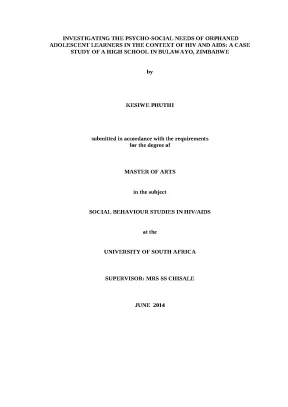
Tải xuống để đọc toàn bộINVESTIGATING THE PSYCHO-SOCIAL NEEDS OF ORPHANED ADOLESCENT LEARNERS IN THE CONTEXT OF HIV AND AIDS: A CASE STUDY OF A HIGH SCHOOL IN BULAWAYO, ZIMBABWE by KESIWE PHUTHI submitted in accordance with the requirements for the degree of MASTER OF ARTS in the subject SOCIAL BEHAVIOUR STUDIES IN HIV/AIDS at the UNIVERSITY OF SOUTH AFRICA SUPERVISOR: MRS SS CHISALE JUNE 2014 I Declaration I declare that the research project titled: Investigating the psycho-social needs of orphaned adolescent learners in the context of HIV and AIDS: A case of a high school in Bulawayo, Zimbabwe is my original work and all sources I have used or quoted have been acknowledged through references. I also declare that raw data that builds up to the conclusions herewith is available on request from the author. Kesiwe Phuthi II ABSTRACT Orphans from child care institutions and from extended families attend the same schools as non-orphans. They are often given the same psycho-social support yet it is clear that they have different psycho-social needs.
Their backgrounds are usually different from those of other adolescent learners because, often, they would have observed or nursed sick parents who eventually died from AIDS-related illnesses. This qualitative study aimed at investigating the psycho-social needs of orphaned adolescent learners in child care institutions and those in extended families in the context of HIV and AIDS. The study further sought to find out how the psycho-social needs affected the HIV- and AIDS-affected orphans’ school performance and social behaviour. In-depth interviews were conducted with four orphaned learners from child care institutions and four from extended families using open-ended questions.
Thematic analysis was used to analyse the data. Findings of the study were that the psycho-social needs of AIDS-affected orphans in families were met by relatives more than those of AIDS-affected orphans in child care institutions. The results of the study also revealed that there was not much difference in school performance between HIV- and AIDS-affected orphans from extended families and those from child care institutions. Thus this study contributes to Sociological and Behavioural literature in the area of HIV and AIDS as well as the education literature of the vulnerable groups like orphans.
The school offered psycho-social support en masse with no special programme for orphans affected by HIV and AIDS for fear of stigmatising the orphans. Key Terms psycho-social, orphan, adolescent, extended family, child care institution, school attendance III ACKNOWLEDGEMENTS I would like to thank God Almighty for giving me life, good health and the strength to work and complete this project. I would like to thank the following people heartily as well: My tireless supervisor, Sinenhlanhla Chisale, who guided me every step in compiling this project. Her attention to detail and informative guidance was invaluable.
May the good Lord increase her knowledge and wisdom My dear husband, Dr Nduduzo Phuthi, whose encouragement, support and patience during the stressful times of my being a student, wife, mother and teacher have been beyond measure My children, Nokubekezela, Thabisani and Mgcini who kept reminding me that all started projects MUST be completed. I thank Mgcini even more for coming in handy when I was stuck with typing and other computer technical matters. My mother, Anna, who sacrificed so much single handedly through prayer and hard work to get me started and complete my education up to becoming the person I am today My mother-in-law, Olive, for her fervent, continuous prayers and belief in me IV Dedication I dedicate this study to all orphans who have lost their parents to the AIDS epidemic and are striving towards reaching the highest educational attainment in both primary and secondary school. V Acronyms AIDS Acquired Immune Deficiency Syndrome BEAM Basic Education Assistance Module DEO District Education Officer GoZ Government of Zimbabwe HIV Human Immunodeficiency Virus NAC National AIDS Council NPA National Programme of Action PED Provincial Education Director UNAIDS United Nations Global Programme on HIV and AIDS UNICEF United Nations Children’s Fund ZNASP Zimbabwe National Strategic AIDS Plan VI CONTENTS ABSTRACT II ACKNOWLEDGEMENTS III Dedication IV Acronyms V CHAPTER 1 1 INTRODUCING THE STUDY 2 1.1 Background of Study 2 1.2 The Research Problem 5 1.3 Rationale of the Study 6 1.8 Research Methodology and Design 8 1.9 Chapter Outline 8 CHAPTER 2 9 LITERATURE REVIEW 9 2.2 An Overview of the Situation on Orphans in Zimbabwe 9 2.3 Orphans Absorbed in Extended Families: Challenges and Advantages 10 2.4 Orphans Absorbed into Child Care Institutions: Challenges and Advantages 13 2.7 Current forms of Psycho-Social Support for Orphans in Zimbabwean Schools 22 VII 2.8 Theoretical frameworks: Maslow’s Hierarchy of Needs and Bowlby’s Attachment Theory 23 2.9 Conclusion 26 CHAPTER 3 27 RESEARCH METHODOLOGY AND DESIGN 27 3.2 Qualitative Research Approach 27 3.3 The Study Design 28 3.5 Data Collection Technique 30 3.1 In-depth Interviews 30 3.6 Reliability and Trustworthiness 32 3.7 Data Analysis-thematic Analysis 34 3.1 Privacy and confidentiality 35 3.4 Conclusion 36 CHAPTER 4 37 RESEARCH FINDINGS AND DISCUSSIONS 37 4.1 Introduction 37 From child care institutions 37 4.2 Education and the Extended Families 39 4.1 Loss of childhood attachment and school performance 39 4.3 Disrupted education and age of orphans in school 42 4.4 The role of grandmothers in orphans’ education 44 4.3 Feelings of Abandonment 46 4.1 Orphans with known relatives but live in child care institutions 46 4.2 Orphans with no known relatives in child care institutions 47 VIII 4.3 Effects of changing caregivers frequently on orphans’ emotional development 47 4.4 Child care institutions and material support 47 4.1 Supervision of schoolwork in child care institutions 48 4.2 Regularity and punctuality regarding school 49 4.3 School as a social link for orphans’ socialisation 50 4.1 Sources of motivation to achieve high grades 50 4.6 Socialisation and the Child Care Institution 52 4.1 Bullying and abuse 52 4.2 Loss of parental love and care 53 4.7 Socialisation and the Extended Families 55 4.1 Bullying and abuse in extended families 55 4.1 Worry about tertiary education fees 57 4.2 Loss of hope for the future 58 4.9 Forms of Psycho-social Support Offered in the School 58 4.1 The role of guidance and counselling in schools 58 4.10 Conclusion 60 CHAPTER 5 61 CONCLUSION 61 5.2 Summary of Key Findings 61 5.3 Implications of the Results 67 5.4 Recommendations for Future Research 69 5.5 Limitations of the Study 70 IX LIST OF REFERENCES 71 Appendix I: Ethical Clearance 79 Appendix II: Letter to the Gatekeepers-Ministry of Education (province) 80 Appendix III: Letter for Permission to Carry out a Study at…High School 82 Appendix IV: Letter to the Gatekeeper – School 83 Appendix V: Informed Consent – Headmaster 85 Appendix VI: Informed Consent Form (Participant 15 - 18 years) 86 Appendix VII: Interview Guide for Learners 87 Appendix VIII: Interview Guide for the Senior Teacher 89 Appendix IX: Interview Guide for the Guidance and counselling Teachers 90 1 Key terms and operational definitions Adolescent a young person who is developing from childhood to an adult, between the ages of 13 and 18 years.
Oxford Dictionary Sv adolescent Orphan a child below the age of 18 years who has lost one or both parents (Subbarao and Coury 2004:76; UNICEF 2004; ZNSP 2011-2015) Psycho-social defined by Foster et al (2005) as interaction of psychological, emotional and social behaviour Extended family a family comprising of parents and children living with relatives like aunts, uncles, cousins and grandparents (De Witt & Lessing 2005) School attendance presence at school (Bennet & McNamara 1979) HIV refers to human immunodeficiency virus, and is a virus that causes AIDS (Van Dyke 2008:492) AIDS refers to acquired immune-deficiency syndrome. The disease is acquired and is caused by a virus that invades the body. The virus then attacks the immune system and the body becomes susceptible to infectious diseases (Van Dyke 2008:489) Child care institution a boarding place where orphans and other vulnerable children live under the guidance of adults 2 CHAPTER 1 INTRODUCING THE STUDY The purpose of this study was to investigate and compare the psycho-social needs of orphaned adolescent learners from extended families with those whose parents may have died of AIDS-related illnesses and have been placed in residential child care institutions. The study further examined forms of psycho-social support provided by the school to orphans, how orphans adjust to school learning and how they behave while at school.
After their parents’ death, orphans may have been affected psychologically and emotionally during their parents’ long illness. Some adolescents orphaned by AIDS may actually have nursed their sick parents (Adejuwon & Oki 2011:2). Adolescent orphans remain traumatised by the sickness and death of their parents as a result of HIV and AIDS and this affects their psycho- social well-being. It is even worse when both parents are dead and the orphaned adolescents are absorbed by extended families or are placed in residential child care institutions (Adejuwon & Oki 2011:4; Goldberg & Short 2012:72).
In-depth interviews were conducted with four orphaned adolescent learners from extended families and four from child care institutions through open-ended questions. The senior master and two guidance and counselling teachers at the school were also interviewed. Bowlby’s attachment and Maslow’s hierarchy of needs theories were used to guide and inform the study. The study revealed that relatives were concerned about the education of orphans beyond high school level.
Extended family members assisted orphans with homework, supervised study and encouraged them to pass even if it meant that the orphans repeat forms until they pass. On the other hand, orphans in child care institutions had no one to motivate them to proceed to tertiary institutions of learning. The orphaned learners in child care institutions seemed to have a bleak future and education was about completing high school only and there was no concern about tertiary education. Orphans in child care institutions seemed to lack love whereas most of those in extended families had support and love from relatives.
The school offers psycho-social support through guidance and counselling to all learners with no special programmes for orphans affected by HIV and AIDS due to the fear of increasing their vulnerability to stigma and discrimination by other learners. However, individual orphans who approach the guidance and counselling department get assistance from the teachers. The findings of this study are significant to Sociology and Education literature particularly to those entrusted with 3 educating Orphans and Vulnerable Children (OVC) from both child care institutions and extended families.1 Background of the Study Globally, there is an increase in the number of orphans owing to natural disasters and wars. This increase has worsened as a result of HIV and AIDS (Dalen, Nakitende & Musisi 2009:2; Miller 2007:3).
UNAIDS Global Report (2012) states that there are 17.3 million orphans in the world, most of whom live in sub-Saharan Africa (Adejuwon & Oki 2011:2). According to the Zimbabwe HIV and AIDS country report (2012: 2), there were 946 547 orphans affected by AIDS by December 2011 but only a small percentage of these were in child care institutions because Zimbabwe advocates for the integration of orphans into families to promote a sense of belonging and continuity in the family (Foster, Mukufa, Drew & Kralovec 1997:157; Foster 2000:2; Foster, Levine & Williamson 2005:33; Phiri & Webb 2002:10; ZNASP 2011-2015: 42). Adejuwon & Oki (2011:1) state that in almost all previously HIV high prevalence countries the number of orphans is on the increase because of the ‘time lag between infection and death’. While most of the countries are experiencing a decline in HIV infection, the aftermath of the disease is being felt now in the form of orphans and single parent families (Adejuwon & Oki 2011:2).
The majority of orphans still remain in unsupported extended families causing a lot of strain in families, with the poor families being hardest hit and failing to send orphans to school. There is a need for the government to support such families financially to ease the plight of orphans.
Nội dung được bảo vệ bản quyền — Tải xuống đầy đủ
Trích dẫn luận án này
Kesiwe Phuthi (2014). Nhu cầu tâm lý - xã hội của trẻ mồ côi HIV/AIDS [Luận án tiến sĩ, University of South Africa]. LuanAn.net. https://luanan.net/giao-duc-hoc/complete-dissertation-for-submission45099995
Câu hỏi thường gặp
Luận án "Nhu cầu tâm lý - xã hội của trẻ mồ côi HIV/AIDS" nghiên cứu về vấn đề gì?
Hoàn thành luận văn cho mục đích nộp bài. Nghiên cứu chuyên sâu, đảm bảo chất lượng cao nhất cho công trình của bạn.
Luận án "Nhu cầu tâm lý - xã hội của trẻ mồ côi HIV/AIDS" được bảo vệ tại trường nào?
Luận án này được bảo vệ tại University of South Africa. Năm bảo vệ: 2014.
Luận án "Nhu cầu tâm lý - xã hội của trẻ mồ côi HIV/AIDS" thuộc chuyên ngành gì?
Luận án "Nhu cầu tâm lý - xã hội của trẻ mồ côi HIV/AIDS" thuộc chuyên ngành Social Behaviour Studies in HIV/AIDS. Danh mục: Giáo Dục Học.
Luận án "Nhu cầu tâm lý - xã hội của trẻ mồ côi HIV/AIDS" có bao nhiêu trang?
Luận án "Nhu cầu tâm lý - xã hội của trẻ mồ côi HIV/AIDS" có 102 trang. Bạn có thể xem trước một phần tài liệu ngay trên trang web trước khi tải về.
Cách tải luận án "Nhu cầu tâm lý - xã hội của trẻ mồ côi HIV/AIDS" về máy như thế nào?
Để tải luận án về máy, bạn nhấn nút "Tải xuống ngay" trên trang này, sau đó hoàn tất thanh toán phí lưu trữ. File sẽ được tải xuống ngay sau khi thanh toán thành công. Hỗ trợ qua Zalo: 0559 297 239.