Andrews standafer elizabeth 2018 dissertation
Luận văn của Andrews Standafer (2018) về Elizabeth, nghiên cứu chuyên sâu, phân tích chi tiết, mang đến góc nhìn mới.
Appalachian State University
Luan An
Luận án tiến sĩ
Năm xuất bản
Số trang
189
Thời gian đọc
29 phút
Lượt xem
0
Lượt tải
0
Phí lưu trữ
50 Point
Tổng quan nhanh
- Chủ đề:
- Luận văn Tiến sĩ 2018 Elizabeth Andrews Standafer
- Số trang:
- 189 trang
- Trường:
- Appalachian State University
- Chuyên ngành:
- Educational Leadership
- Tác giả:
- Elizabeth K. Andrews-Standafer
- Năm:
- 2018
Tóm tắt nội dung luận án
I.Luận văn Tiến sĩ 2018 Elizabeth Andrews Standafer
Luận văn Tiến sĩ 2018 của Elizabeth K. Andrews-Standafer khám phá sâu sắc. Công trình học thuật này phân tích kinh nghiệm sống. Đối tượng là thanh niên nam da đen. Họ tham gia chương trình học nghề. Các chương trình này thuộc giáo dục kỹ thuật và nghề nghiệp (CTE). Nghiên cứu tiến sĩ này mang ý nghĩa lớn. Nó góp phần vào sự hiểu biết về tuyển dụng, duy trì nhóm đối tượng này. Elizabeth Andrews Standafer hoàn thành luận văn này vào tháng 5 năm 2018. Bà nhận bằng Doctor of Education (Ed.D.). Đây là một đóng góp quan trọng cho lĩnh vực giáo dục. Tóm tắt luận văn này cung cấp cái nhìn tổng quan. Nó chỉ ra những điểm nổi bật của công trình.
1.1. Mục tiêu công trình học thuật quan trọng.
Mục tiêu chính của luận văn. Nó nhằm tường thuật kinh nghiệm sống. Ba học viên da đen, nam giới ở Bắc Carolina. Nghiên cứu này diễn ra trong các chương trình học nghề CTE. Luận văn 2018 tìm hiểu động lực tham gia. Nó cũng khám phá các yếu tố giúp họ duy trì. Công trình học thuật này nhấn mạnh tầm quan trọng của việc lắng nghe. Nó hiểu rõ tiếng nói của những người tham gia. Nghiên cứu tiến sĩ này mang lại giá trị thực tiễn.
1.2. Giới thiệu tổng quan nghiên cứu tiến sĩ.
Nghiên cứu tiến sĩ này được trình bày tại Đại học Appalachian State. Nó đáp ứng yêu cầu bằng cấp Doctor of Education. Đề tài luận văn được Jerianne Taylor, Ed.D. chủ trì. Nhiều giáo sư khác cũng tham gia ủy ban. Đây là một phân tích toàn diện. Nó bao gồm nhiều yếu tố ảnh hưởng đến học viên. Tóm tắt luận văn nêu bật những điểm chính. Nó cung cấp một cái nhìn tổng thể về nội dung.
II.Phương pháp Nghiên cứu Luận văn 2018 Cụ Thể
Nghiên cứu tiến sĩ của Elizabeth K. Andrews-Standafer áp dụng phương pháp định tính. Đây là một nghiên cứu đa trường hợp. Phương pháp này phù hợp để khám phá kinh nghiệm sống. Nó cung cấp sự hiểu biết sâu sắc. Nó không chỉ là số liệu thống kê. Luận văn 2018 này tập trung vào câu chuyện cá nhân. Nó đi sâu vào các khía cạnh trải nghiệm. Các phương pháp nghiên cứu được trình bày rõ ràng. Nó đảm bảo tính toàn vẹn, độ tin cậy. Đánh giá tài liệu nền tảng đã được thực hiện kỹ lưỡng. Nó xây dựng cơ sở lý thuyết vững chắc cho đề tài luận văn này.
2.1. Thiết kế định tính nghiên cứu đa trường hợp.
Thiết kế nghiên cứu là một nghiên cứu đa trường hợp định tính. Ba học viên nam da đen được chọn. Họ tham gia các chương trình học nghề ở Bắc Carolina. Mỗi trường hợp được phân tích chi tiết. Điều này giúp nắm bắt sự phức tạp. Nó phản ánh bối cảnh cá nhân của mỗi học viên. Phương pháp này cho phép khám phá sâu sắc. Nó giúp hiểu rõ các yếu tố định hình kinh nghiệm. Đây là một phần quan trọng của công trình học thuật.
2.2. Đối tượng bối cảnh phân tích sâu sắc.
Các học viên được tuyển dụng từ thời trung học. Họ tham gia trải nghiệm tiền học nghề. Sau đó, họ được tuyển dụng chính thức. Các học viên trải qua hoạt động nhận thức nghề nghiệp. Hoạt động này kết nối họ với thế giới thực. Nó giúp họ khám phá con đường sự nghiệp. Bối cảnh nghiên cứu là các chương trình học nghề CTE. Luận văn của Elizabeth Andrews Standafer làm nổi bật tầm quan trọng. Nó chỉ ra trải nghiệm thực tế. Tóm tắt luận văn nhấn mạnh vai trò của bối cảnh.
III.Kết quả Nghiên cứu Kinh nghiệm Thanh niên Nam Da Đen
Các phát hiện từ luận văn 2018 rất phong phú. Ba chủ đề chính xuất hiện. Chúng hỗ trợ tuyển dụng, duy trì học viên. Các kết quả nghiên cứu chỉ ra yếu tố thành công. Chúng là cơ sở để phát triển chương trình. Đề tài luận văn này mang lại cái nhìn sâu sắc. Nó cung cấp kiến thức giá trị cho giáo dục nghề nghiệp. Tóm tắt luận văn nhấn mạnh các điểm này. Nó đặc biệt quan tâm đến thanh niên nam da đen trong chương trình học nghề.
3.1. Tăng cường nhận thức nghề nghiệp hiệu quả.
Các học viên đã tiếp xúc với nhận thức nghề nghiệp. Hoạt động này liên kết khả năng và sở thích. Nó kết nối họ với cơ hội nghề nghiệp khả thi. Điều này giúp họ định hướng tương lai. Nó cung cấp ý nghĩa cho việc học. Elizabeth Andrews Standafer chỉ ra tầm quan trọng. Nó là việc cung cấp trải nghiệm thực tế. Nó dẫn đến sự lựa chọn nghề nghiệp thông minh. Các chương trình học nghề cần chú trọng điều này.
3.2. Cơ hội di chuyển kinh tế lợi ích rõ ràng.
Học nghề mang lại sự di chuyển kinh tế. Các học viên trải nghiệm lợi ích tài chính. Họ có thu nhập ổn định hơn. Điều này giúp họ cải thiện cuộc sống. Nó cũng đóng góp vào cộng đồng. Luận văn của Elizabeth K. Andrews-Standafer khẳng định giá trị. Nó nhấn mạnh con đường học nghề. Đây là một con đường dẫn đến thành công kinh tế. Nghiên cứu tiến sĩ này củng cố quan điểm này.
3.3. Dịch vụ hỗ trợ toàn diện nhiều bên liên quan.
Dịch vụ hỗ trợ toàn diện đóng vai trò then chốt. Sự hỗ trợ đến từ phụ huynh, trường học, nơi làm việc. Các học viên khác cũng đóng góp. Chính bản thân học viên cũng tự hỗ trợ. Các dịch vụ này duy trì sự kiên trì. Nó dẫn đến sự bền bỉ của các học viên. Nghiên cứu tiến sĩ này nhấn mạnh. Nó là tầm quan trọng của hệ thống hỗ trợ đa chiều. Đây là yếu tố sống còn để giữ chân người học.
IV.Tóm tắt Luận văn 2018 Chủ đề và Phát hiện
Tóm tắt luận văn này nêu bật những phát hiện chính. Công trình học thuật của Elizabeth K. Andrews-Standafer cung cấp bằng chứng rõ ràng. Nó chứng minh các yếu tố quan trọng. Những yếu tố này ảnh hưởng đến sự thành công của học viên. Cụ thể là thanh niên nam da đen. Các kết quả nghiên cứu góp phần vào kho kiến thức. Nó liên quan đến giáo dục kỹ thuật và nghề nghiệp. Nghiên cứu tiến sĩ này tạo nền tảng cho các nghiên cứu tương lai. Đề tài luận văn có giá trị thực tiễn.
4.1. Ba chủ đề chính hỗ trợ tuyển dụng và giữ chân.
Ba chủ đề nổi bật là: tiếp xúc với nhận thức nghề nghiệp. Nó liên kết khả năng, sở thích học sinh. Nó hướng tới cơ hội nghề nghiệp khả thi. Tiếp theo là lợi ích di chuyển kinh tế. Cuối cùng là dịch vụ hỗ trợ toàn diện. Dịch vụ này liên quan đến nhiều bên liên quan. Các chủ đề này cung cấp khuôn khổ. Nó giúp cải thiện chương trình học nghề. Luận văn tiến sĩ này chi tiết hóa chúng. Công trình học thuật này cung cấp hướng đi.
4.2. Hàm ý thực tiễn cho chương trình giáo dục.
Các phát hiện có hàm ý thực tiễn sâu rộng. Chúng dành cho các nhà giáo dục, hoạch định chính sách. Chúng cũng dành cho doanh nghiệp. Cần tăng cường hoạt động nhận thức nghề nghiệp. Cần nhấn mạnh lợi ích kinh tế. Cần xây dựng hệ thống hỗ trợ mạnh mẽ. Điều này giúp tăng cường sự tham gia, thành công. Nó đặc biệt đối với thanh niên nam da đen. Nghiên cứu tiến sĩ này là tài liệu tham khảo giá trị. Tóm tắt luận văn chỉ rõ các bước hành động.
V.Đánh giá Luận văn Elizabeth Andrews Standafer
Luận văn tiến sĩ của Elizabeth Andrews Standafer đóng góp đáng kể. Nó mở rộng hiểu biết về giáo dục kỹ thuật. Nó đặc biệt tập trung vào nhóm học viên đặc thù. Đánh giá tài liệu nền tảng đã cung cấp bối cảnh vững chắc. Công trình học thuật này là nguồn tài nguyên quý giá. Nó dành cho các nhà nghiên cứu, nhà thực hành. Nó giúp họ trong lĩnh vực học nghề, CTE. Đề tài luận văn này có ý nghĩa khoa học lớn. Tóm tắt luận văn này hy vọng truyền tải giá trị đó.
5.1. Bối cảnh lịch sử và hiện tại của CTE.
Chương II của luận văn trình bày tổng quan. Nó về giáo dục kỹ thuật và nghề nghiệp ở Hoa Kỳ. Nó khám phá bối cảnh học tập dựa trên công việc. Lịch sử học nghề CTE cũng được xem xét. Đánh giá tài liệu này cung cấp nền tảng. Nó hiểu sự phát triển của các chương trình này. Nó cũng giúp hiểu vai trò của chúng ngày nay. Nghiên cứu tiến sĩ đặt vấn đề trong một bối cảnh rộng lớn.
5.2. Sự tham gia của nhóm thiểu số trong học nghề.
Luận văn 2018 đặc biệt chú ý. Nó quan tâm đến sự tham gia của nhóm thiểu số. Nó tập trung vào nam giới da đen. Các xu hướng chính và phát hiện được thảo luận. Các rào cản đối với học tập dựa trên công việc được phân tích. Công trình học thuật này góp phần giải quyết vấn đề công bằng. Nó mở ra cơ hội tiếp cận trong các chương trình học nghề. Nghiên cứu tiến sĩ này là một bước tiến quan trọng.
Mục lục chi tiết luận án
Tải xuống file đầy đủ để xem toàn bộ nội dung
Tải đầy đủ (189 trang)Trích đoạn nội dung luận án
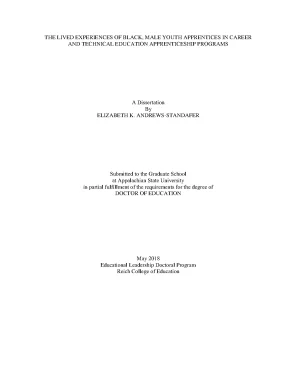
Tải xuống để đọc toàn bộTHE LIVED EXPERIENCES OF BLACK, MALE YOUTH APPRENTICES IN CAREER AND TECHNICAL EDUCATION APPRENTICESHIP PROGRAMS A Dissertation By ELIZABETH K. ANDREWS-STANDAFER Submitted to the Graduate School at Appalachian State University in partial fulfillment of the requirements for the degree of DOCTOR OF EDUCATION May 2018 Educational Leadership Doctoral Program Reich College of Education THE LIVED EXPERIENCES OF BLACK, MALE YOUTH APPRENTICES IN CAREER AND TECHNICAL EDUCATION APPRENTICESHIP PROGRAMS A Dissertation by ELIZABETH K. ANDREWS-STANDAFER May 2018 APPROVED BY: _____________________________________ Jerianne Taylor, Ed. Chair, Dissertation Committee _____________________________________ James Bartlett, Ph.
Member, Dissertation Committee _____________________________________ Herb Brown, Ph. Member, Dissertation Committee _____________________________________ Audrey Dentith, Ph. Director, Educational Leadership Doctoral Program _____________________________________ Max C. Williams School of Graduate Studies Copyright by Elizabeth K.
Andrews-Standafer 2018 All Rights Reserved Abstract THE LIVED EXPERIENCES OF BLACK, MALE YOUTH APPRENTICES IN CAREER AND TECHNICAL EDUCATION APPRENTICESHIP PROGRAMS Elizabeth K., Appalachian State University M., University of North Carolina at Charlotte Ed., Appalachian State University Dissertation Committee Chairperson: Jerianne Taylor, Ed. The lived experiences of three Black, male youth apprentices in North Carolina were told through a qualitative multi-case study. The participants in each case began recruitment for apprenticeship as a high school student though a pre-apprenticeship experience and were hired as full-time apprentices upon completing their program. All of the apprentices were exposed to career awareness activities that connected them to real-world experiences and career pathways before, during and after their recruitment.
They also experienced economic mobility by choosing an apprenticeship pathway. Wrap-around services that included support from parents, school, work, other apprentices and the apprentices themselves sustained the apprentices and led to their persistence. Three themes emerged in the findings that support the recruitment and retention of Black, male youth apprentices: exposure to career awareness experiences that link students’ abilities and interests to viable career opportunities, the benefits of economic mobility and wrap-around supportive services that involve multiple stakeholders. iv Acknowledgements I could not have done this without my family.
Thank you to my husband, Greg, for taking care of things at home when I was at class or working on my papers. You have been amazing. I could not have done this without your love and support. Thank you also to my children, Leah, Logan and Jenna for eating a lot of take-out pizza and Chinese food over the years.
Greg, Jacob, Erin, Leah, Logan, Jenna and Hudson each of you are the reason behind this. Thank you to my parents Amelia and Larry and Tom and Anne for supporting me financially and emotionally to achieve this dream. I could not have done it without your help. Mom, everything that I do and everything that I am I owe to you.
You have given everything to me, and I love you so much for your selflessness. You are an amazing mother. To my friends Susan, Charlene, Kirsten and Teresa you have been a wonderful support system. Charity, thank you for being there for me in every way.
I am blessed by your friendship. Thank you for sharing in my special day! Cary, you are the APA King! Thank you for your help and encouragement! Pam, you have been an amazing mentor and friend. Thank you for a quiet place to write and wonderful support throughout the process. Jana, thank you for encouraging me and being my voice of reason over these long years of papers, projects and classes.
I would not have wanted to be on this journey with anyone else. To my committee, Dr. Brown and Dr. Bartlett, thank you for your commitment to me and your belief in this work.
v Dedication In memory of Dr. You always made me feel smart. vi Table of Contents Abstract. vi List of Tables.
xi Chapter I: Introduction .1 Statement of the Problem. 5 Methodology and Research Questions. 6 Significance of the Issue. 7 Definition of Terms.
10 Organization of the Study. 12 Chapter II: Literature Review .15 Career and Technical Education in the United States. 16 Work-based Learning Contexts. 20 The History of CTE Apprenticeship.
22 Minority and Black, Male Participation in Apprenticeship. 27 Major Trends and Findings. 29 The Four-Year College Norm. 31 Wage Potential for Apprentices.
31 Economic Mobility and Apprenticeship. 32 Businesses’ Return on Investment. 33 Benefit-to-Cost Comparison for Businesses. 34 Equity and Access in Apprenticeship Programs.
36 Black Males and Apprenticeship Participation. 36 Societal Factors and Work-based Learning Completion. 37 Work-based Learning Barriers. 37 vii Work-based Learning as a Pathway to Prosperity.
38 The Apprenticeship Pathway. 39 Apprenticeship Through Social Constructionist and Transformative Learning Theories. 40 Trends and Findings in the Literature. 41 The Social Constructionist Perspective: Policy and Institutional Contexts.
42 Critique and Evaluation of Transformative Learning Theory. 43 Chapter III: Methodology. 48 Methods and Sources. 49 Role of the Researcher.
53 Participants and Participant Selection. 54 Sampling in a Collective Case Study. 55 Criterion and Purposeful Maximal Variation Sampling. 59 Chapter IV: Presentation of the Data.
64 Apprentice 1 (Phineas): Individual Description. 69 Apprentice 1: Individual Textural Description. 70 viii Apprentice 2 (Jerry): Individual Description. 82 CDC 2 and 3 (Mr.
85 Apprentice 2 Individual Textural Description:. 86 Apprentice 3 (Mark): Individual Description. 96 CDC 2 and 3 (Mr. 98 Apprentice 3: Individual Textural Description.
99 Results of the Study. 111 Theme 1: Career Awareness. 111 Theme 2: Economic Mobility. 113 Theme 3: Wrap-Around Supportive Services.
127 Analysis and Links to the Literature. 127 Theme 1: Career Awareness. 127 Theme 2: Economic Mobility. 132 Theme 3: Wrap-Around Supportive Services.
134 Addressing the Gaps. 141 Macro and Micro Theories in the Research. 143 Revisiting Social Constructionist Theory. 147 Revisiting Transformative Learning Theory.
150 ix Critical Reflection of Assumptions. 151 Validation of the Meaning of The Experience. 157 Recommendations for Future Research. 158 Personal Statement and Closing Remarks.
178 x List of Tables Table 1. Emerging Themes with Social Constructionist Supporting Data. Emerging Themes with Transformative Learning Theory Supporting Data. 153 xi 1 Chapter I: Introduction Chapter One addresses the historical and current reality of work-based learning access and completion for marginalized students in Career and Technical Education (CTE) programs.
Black, male students, the focus of this study, fall behind their peers in participating in work-based learning programs like apprenticeships. As a result, they experience significant inequalities in economic mobility compared to students in other demographic groups who profit from a free education and a salary with benefits including health insurance and a 401K. In this chapter, the statement of the problem, the research questions, an overview of the methodology and the significance of the study are introduced. This section concludes with the definitions of the research terms and an explanation of the organization of the chapters to follow.
Despite the dwindling numbers in the current workforce, there is a long history of Black participation in CTE training programs, particularly in apprenticeship. From 1619- 1846 there were many apprenticeship and manual labor programs available to slaves along with opportunities in private industrial institutions like Tuskegee and Hampton (Gordon, 2014). After the Civil War period, Booker T. Washington and Frederick Douglass spoke strongly about expanding vocational training for African Americans and from 1910-1930 public secondary programs began offering manual training for Black students (Gordon, 2014).
The manual training movement offered an educational response to the massive influx of rural, poor and uneducated African Americans in the South and the high attrition rate in high school that left them uneducated. But in the 1930’s, industrial advancements demanded more skilled workers and White schools began emphasizing industrial training to claim access to higher paying jobs. Black students were offered more academic education and less 2 vocational training during the recession leaving Black schools underfunded with low skill, low wage programs. The underrepresentation of Blacks in skilled industrial and business programs likely led to lower participation in these careers and greater economic disparity (Gordon, 2014).
Today, however, Black students across the nation have high enrollment in vocational coursework resulting in new questions about their overrepresentation along with an attached stigma of CTE as a program for low achievers (Gordon, 2014). Many Black youth tend to view vocational education as inferior to academic education resulting from past issues of access to training meant for lower-paying jobs (Nall, 1997). In accordance with Nall (1997), this view is likely to persist until Black students are prepared for and gain access to high-quality training that provides the skills for successful entry into the 21st Century workforce. Marginalized groups commonly experience problems effectively accessing and completing work-based learning opportunities (Bennett, 2007).
Whether in a rural or urban setting, the body of Work-Based Learning (WBL) research indicates their experiences have been plagued with issues of disconnectedness to related coursework, lack of support, inappropriate modification for their unique circumstances, and feelings of isolation from peers and family. Re-emerging CTE programs, like apprenticeship, require the active involvement of industry partners, Local Education Agencies (LEA), community college programs and community resources to mitigate these issues and provide WBL opportunities that afford all students the work experience and preparation they need to assume the jobs of the future (Symonds, Schwartz, & Ferguson, 2011). United States Department of Labor (USDOL) statistics indicate that the group most likely impacted by access and issues of completion of a CTE apprenticeship are Black males, 3 who are enrolled in apprenticeship at lower rates than Hispanic males and both Hispanic and Black females (Reed et al. Gordon (2014) cited Oakes (1990) who found Black students from low-income, inner-city backgrounds, or who are enrolled in low-ability classes, have historically had fewer opportunities than traditional students to participate in demanding academic programs.
Since the 1960’s and 70’s, legislation has been aimed at improving access into high-quality CTE programs for marginalized groups. The Vocational Education Act of 1963 expanded federal funding to include work-study programs and the nation began to take seriously the disenfranchisement of students due to economics, race, and disability through the authorization of the Elementary and Secondary Education Act (ESEA) (Richard, Clark, & Welch, 2011). Near the end of the 20th Century, the term “global competition” began to appear in reports like A Nation at Risk which highlighted the plight of disenfranchised youth. With the Carl D.
Perkins Vocational Act of 1984 to soon follow, federal funding under Perkins authorized $125 million to states for work-based learning programs through cooperative education (Richard, Clark, & Welch, 2011). The Secretary’s Commission on Attaining Necessary Skills (SCANS) report in 1991 further connected schools and industry as the skills and competencies needed for successful employment were defined, leading to the National Skills Standards Act of 1994. This act identified the 16 nationally recognized career clusters that have become integral in current work-based learning sector strategies and career pathways. Also in that year, the School-to-Work Opportunities Act allowed the use of federal funds for a school-to-work transition system in which all students were to be provided the opportunity to participate in work-based learning (Richard, Clark, & Welch, 2011).
4 As the 21st Century approached, The Workforce Investment Act of 1998 spawned a new age in job-training. The law required national job training frameworks, “one-stop” training centers, and state and local workforce boards comprised of both industry and education partners. Perkins legislation was reauthorized twice after its initial implementation, deepening the reach of the Federal Government in monitoring the states’ ability to prepare students and adult job seekers for careers in the 21st Century (Richard, Clark, & Welch, 2011). Even with decades of top-level reporting that led to federal legislation, the success of states to prepare students to graduate work-ready has remained unchanged since the1960’s, and the skills gap has continued to widen, leaving marginalized students with missed opportunities, fewer options, and lower wages (Symonds, 2012).
Nội dung được bảo vệ bản quyền — Tải xuống đầy đủ
Trích dẫn luận án này
Elizabeth K. Andrews-Standafer (2018). Andrews standafer elizabeth 2018 dissertation [Luận án tiến sĩ, Appalachian State University]. LuanAn.net. https://luanan.net/giao-duc-hoc/andrews-standafer-elizabeth-2018-dissertation
Câu hỏi thường gặp
Luận án "Andrews standafer elizabeth 2018 dissertation" nghiên cứu về vấn đề gì?
Luận văn của Andrews Standafer (2018) về Elizabeth, nghiên cứu chuyên sâu, phân tích chi tiết, mang đến góc nhìn mới.
Luận án "Andrews standafer elizabeth 2018 dissertation" được bảo vệ tại trường nào?
Luận án này được bảo vệ tại Appalachian State University. Năm bảo vệ: 2018.
Luận án "Andrews standafer elizabeth 2018 dissertation" thuộc chuyên ngành gì?
Luận án "Andrews standafer elizabeth 2018 dissertation" thuộc chuyên ngành Educational Leadership. Danh mục: Giáo Dục Học.
Luận án "Andrews standafer elizabeth 2018 dissertation" có bao nhiêu trang?
Luận án "Andrews standafer elizabeth 2018 dissertation" có 189 trang. Bạn có thể xem trước một phần tài liệu ngay trên trang web trước khi tải về.
Cách tải luận án "Andrews standafer elizabeth 2018 dissertation" về máy như thế nào?
Để tải luận án về máy, bạn nhấn nút "Tải xuống ngay" trên trang này, sau đó hoàn tất thanh toán phí lưu trữ. File sẽ được tải xuống ngay sau khi thanh toán thành công. Hỗ trợ qua Zalo: 0559 297 239.