Đánh giá tác động của phát triển chuyên môn đến khả năng tiếp cận khóa học trực tuyến cho sinh viên đặc biệt
Phân tích tác động của phát triển chuyên môn đến khả năng tiếp cận và hiệu quả học tập trên các nền tảng khóa học trực tuyến.
Abilene Christian University
Organizational Leadership
Luan An
Luận án
Năm xuất bản
Số trang
112
Thời gian đọc
17 phút
Lượt xem
0
Lượt tải
0
Phí lưu trữ
40 Point
Tổng quan nhanh
- Chủ đề:
- Phát triển chuyên môn: Nâng cao khả năng tiếp cận e-learning
- Số trang:
- 112 trang
- Trường:
- Abilene Christian University
- Chuyên ngành:
- Organizational Leadership
- Tác giả:
- Dallas Anne Swafford
- Năm:
- 2020
Tóm tắt nội dung luận án
I.Phát triển chuyên môn Nâng cao khả năng tiếp cận e learning
Phát triển chuyên môn đóng vai trò then chốt trong việc cải thiện khả năng tiếp cận các khóa học trực tuyến. Việc nâng cao năng lực chuyên môn cho giảng viên giúp thiết kế môi trường e-learning hòa nhập hơn. Nghiên cứu này đánh giá tác động của các chương trình phát triển nghề nghiệp đến sinh viên có nhu cầu đặc biệt. Mục tiêu là đảm bảo mọi sinh viên đều có cơ hội học tập bình đẳng. Đào tạo liên tục trang bị cho nhà giáo những kỹ năng cần thiết. Kỹ năng này bao gồm việc tạo ra tài liệu và phương pháp giảng dạy phù hợp. Điều này giảm thiểu rào cản, thúc đẩy học tập suốt đời cho tất cả mọi người. Các khóa bồi dưỡng nghiệp vụ chuyên sâu mang lại lợi ích lâu dài. Chúng góp phần xây dựng một hệ thống giáo dục từ xa công bằng.
1.1. Tầm quan trọng phát triển nghề nghiệp cho giảng viên
Việc phát triển nghề nghiệp liên tục là thiết yếu đối với giảng viên. Chương trình đào tạo giúp giảng viên cập nhật các phương pháp giảng dạy tốt nhất. Giảng viên được trang bị kiến thức về thiết kế phổ quát cho việc học. Điều này đảm bảo nội dung khóa học trực tuyến dễ tiếp cận. Khả năng nâng cao năng lực chuyên môn của họ trực tiếp ảnh hưởng đến chất lượng giảng dạy. Nâng cao kỹ năng giúp hỗ trợ hiệu quả hơn cho sinh viên có nhu cầu đặc biệt. Giảng viên trở thành cầu nối quan trọng. Họ giúp sinh viên tiếp cận thành công các nền tảng học trực tuyến. Quá trình bồi dưỡng nghiệp vụ tạo ra sự khác biệt lớn. Nó mang lại môi trường học tập công bằng cho mọi đối tượng.
1.2. Mối liên hệ phát triển chuyên môn và thiết kế khóa học
Phát triển chuyên môn ảnh hưởng trực tiếp đến cách thiết kế khóa học. Giảng viên được đào tạo sẽ áp dụng nguyên tắc thiết kế phổ quát. Các khóa học trở nên linh hoạt hơn, đáp ứng nhiều phong cách học. Điều này bao gồm việc sử dụng phụ đề, mô tả hình ảnh, và tài liệu định dạng đa dạng. Việc nâng cao năng lực chuyên môn giúp giảng viên nhận diện và loại bỏ rào cản. Các rào cản thường gặp trong các khóa học trực tuyến được giải quyết. Quá trình bồi dưỡng nghiệp vụ cải thiện khả năng của giảng viên. Họ có thể tạo ra môi trường e-learning thực sự hòa nhập. Mục tiêu là đảm bảo mọi sinh viên có thể tương tác hiệu quả với nội dung. Khả năng tiếp cận giáo dục được tăng cường đáng kể.
II.Khóa học trực tuyến và tiếp cận giáo dục đặc biệt
Khóa học trực tuyến mở ra nhiều cơ hội giáo dục. Tuy nhiên, sinh viên có nhu cầu đặc biệt đối mặt với nhiều rào cản. Việc hiểu rõ những thách thức này là bước đầu tiên. Tiếp theo là triển khai các giải pháp hiệu quả. Giáo dục từ xa cần đảm bảo sự công bằng. Điều này đòi hỏi các nền tảng học trực tuyến phải được thiết kế chu đáo. Khả năng tiếp cận giáo dục cho mọi sinh viên là ưu tiên hàng đầu. Nghiên cứu này khám phá cách khắc phục các vấn đề hiện có. Mục tiêu là tạo ra một môi trường e-learning hòa nhập hơn. Sự phát triển nghề nghiệp của giảng viên đóng góp trực tiếp vào mục tiêu này. Nó giúp họ nhận thức và hành động để cải thiện. Bồi dưỡng nghiệp vụ liên tục là yếu tố không thể thiếu.
2.1. Thách thức tiếp cận nền tảng học trực tuyến
Sinh viên có nhu cầu đặc biệt thường gặp khó khăn. Họ đối mặt với giao diện phức tạp và thiếu hỗ trợ công nghệ. Các nền tảng học trực tuyến đôi khi không tương thích với công cụ hỗ trợ. Ví dụ bao gồm trình đọc màn hình hoặc thiết bị nhập liệu thay thế. Tài liệu khóa học thiếu phụ đề, mô tả âm thanh là vấn đề phổ biến. Nội dung định dạng không đồng nhất cũng gây trở ngại. Điều này cản trở khả năng tiếp cận thông tin. Các rào cản này làm giảm sự tham gia của sinh viên. Nó ảnh hưởng đến hiệu quả học tập. Việc khắc phục yêu cầu một sự hiểu biết sâu sắc. Nó cũng cần cam kết từ phía các nhà giáo dục và nhà phát triển nền tảng.
2.2. Giải pháp cải thiện khả năng tiếp cận giáo dục từ xa
Cải thiện khả năng tiếp cận giáo dục từ xa đòi hỏi nhiều giải pháp. Việc áp dụng tiêu chuẩn thiết kế web W3C là một bước quan trọng. Các nền tảng học trực tuyến cần hỗ trợ đa dạng công cụ trợ giúp. Cung cấp tài liệu học tập ở nhiều định dạng khác nhau là cần thiết. Video nên có phụ đề và bản ghi chép. Hình ảnh cần mô tả văn bản thay thế. Giảng viên cần được đào tạo về phương pháp giảng dạy hòa nhập. Họ học cách tạo nội dung dễ tiếp cận. Đào tạo liên tục giúp họ cập nhật kiến thức. Mục tiêu là loại bỏ rào cản. Điều này đảm bảo mọi sinh viên đều có thể học tập hiệu quả. Việc bồi dưỡng nghiệp vụ là yếu tố then chốt.
III.Đào tạo liên tục Cải thiện chất lượng nền tảng học trực tuyến
Đào tạo liên tục đóng vai trò trọng yếu trong việc nâng cao chất lượng. Nó tác động đến khả năng tiếp cận các nền tảng học trực tuyến. Các chương trình bồi dưỡng nghiệp vụ giúp giảng viên và quản trị viên. Họ cập nhật kiến thức và kỹ năng mới. Những kỹ năng này bao gồm thiết kế khóa học hòa nhập và sử dụng công nghệ trợ giúp. Việc nâng cao năng lực chuyên môn đảm bảo các khóa học e-learning đáp ứng tiêu chuẩn. Tiêu chuẩn này liên quan đến khả năng tiếp cận và trải nghiệm người dùng. Mục tiêu cuối cùng là tạo ra một môi trường giáo dục từ xa hiệu quả. Môi trường đó phải phục vụ tốt nhất mọi đối tượng sinh viên. Học tập suốt đời được khuyến khích qua việc cung cấp nền tảng tốt hơn.
3.1. Vai trò bồi dưỡng nghiệp vụ trong giáo dục số
Bồi dưỡng nghiệp vụ là cần thiết trong bối cảnh giáo dục số phát triển nhanh chóng. Giảng viên cần nắm vững công nghệ mới. Họ cần hiểu rõ các phương pháp sư phạm phù hợp với môi trường trực tuyến. Các chương trình đào tạo liên tục tập trung vào thiết kế khóa học thân thiện. Nó giúp đảm bảo tính tương tác cao và khả năng tiếp cận. Nâng cao năng lực chuyên môn giúp giảng viên giải quyết các thách thức kỹ thuật. Họ có thể hỗ trợ sinh viên một cách hiệu quả hơn. Điều này đóng góp vào sự thành công chung của các khóa học e-learning. Nó cũng thúc đẩy việc học tập suốt đời cho cả người dạy và người học.
3.2. Tiêu chuẩn chất lượng khóa học và nền tảng trực tuyến
Để đảm bảo khả năng tiếp cận, các nền tảng học trực tuyến cần tuân thủ tiêu chuẩn. Tiêu chuẩn quốc tế như WCAG (Web Content Accessibility Guidelines) là ví dụ. Đào tạo liên tục giúp giảng viên hiểu và áp dụng các tiêu chuẩn này. Điều này bao gồm việc thiết kế giao diện thân thiện. Nó cũng bao gồm việc cung cấp các tùy chọn cá nhân hóa. Bồi dưỡng nghiệp vụ giúp đội ngũ phát triển xây dựng nền tảng vững chắc. Nền tảng này hỗ trợ các công nghệ trợ giúp. Mục tiêu là giảm thiểu rào cản cho sinh viên có nhu cầu đặc biệt. Việc nâng cao năng lực chuyên môn của toàn bộ đội ngũ là then chốt. Nó đảm bảo chất lượng và tính hòa nhập của giáo dục từ xa.
IV.Bồi dưỡng nghiệp vụ Giảm rào cản học tập suốt đời
Bồi dưỡng nghiệp vụ có khả năng giảm đáng kể rào cản học tập suốt đời. Đặc biệt đối với những người gặp khó khăn trong giáo dục truyền thống. Các chương trình đào tạo liên tục trang bị cho nhà giáo kỹ năng. Họ có thể tạo ra môi trường học tập linh hoạt. Môi trường này đáp ứng nhu cầu đa dạng. Việc nâng cao năng lực chuyên môn giúp giáo viên nhận diện và hỗ trợ học sinh hiệu quả. Khả năng tiếp cận giáo dục được cải thiện toàn diện. Điều này khuyến khích cá nhân tiếp tục học hỏi. Nó thúc đẩy sự phát triển cá nhân và nghề nghiệp không ngừng. Mục tiêu là xây dựng một xã hội học tập. Trong đó, mọi người đều có cơ hội phát triển tối đa tiềm năng của mình. E-learning đóng vai trò quan trọng trong việc hiện thực hóa điều này.
4.1. Khuyến khích học tập suốt đời qua đào tạo chuyên môn
Đào tạo chuyên môn không chỉ nâng cao kỹ năng giảng dạy. Nó còn truyền cảm hứng cho giáo viên về học tập suốt đời. Giảng viên học cách sử dụng các nền tảng học trực tuyến hiệu quả. Họ trở thành những người học gương mẫu. Điều này khuyến khích sinh viên tiếp tục phát triển. Khả năng tiếp cận giáo dục được tăng cường. Sinh viên nhận thấy giá trị của việc học liên tục. Bồi dưỡng nghiệp vụ giúp giảng viên tạo ra các khóa học hấp dẫn. Các khóa học này giữ chân người học. Nó tạo điều kiện cho họ tham gia các chương trình MOOCs (Khóa học trực tuyến mở đại chúng). Mục tiêu là xây dựng một văn hóa học tập năng động. Văn hóa này hỗ trợ sự phát triển liên tục của mỗi cá nhân.
4.2. Hỗ trợ sự đa dạng và hòa nhập trong giáo dục
Bồi dưỡng nghiệp vụ là công cụ mạnh mẽ để thúc đẩy sự đa dạng và hòa nhập. Giảng viên được đào tạo để hiểu rõ hơn về các nhu cầu đặc biệt. Họ học cách tạo ra môi trường học tập không phân biệt đối xử. Nâng cao năng lực chuyên môn giúp họ thiết kế các hoạt động phù hợp. Các hoạt động này tôn trọng sự khác biệt của từng sinh viên. Khả năng tiếp cận giáo dục là trọng tâm của mọi nỗ lực. Điều này bao gồm việc sử dụng các công cụ e-learning linh hoạt. Nó cũng đòi hỏi sự nhạy cảm văn hóa. Đào tạo liên tục giúp các tổ chức giáo dục xây dựng chính sách hòa nhập. Chính sách này đảm bảo mọi sinh viên đều có cơ hội thành công.
V.Nâng cao năng lực chuyên môn Hỗ trợ sinh viên khuyết tật
Nâng cao năng lực chuyên môn của đội ngũ giảng viên là yếu tố then chốt. Nó quyết định mức độ hỗ trợ dành cho sinh viên khuyết tật. Các chương trình phát triển nghề nghiệp tập trung vào việc hiểu các loại khuyết tật. Nó cũng bao gồm cách điều chỉnh phương pháp giảng dạy. Điều này đảm bảo rằng các khóa học trực tuyến trở nên dễ tiếp cận hơn. Khả năng tiếp cận giáo dục cho sinh viên khuyết tật là một quyền. Nó cần được đảm bảo thông qua đào tạo liên tục và bồi dưỡng nghiệp vụ. E-learning và nền tảng học trực tuyến có tiềm năng rất lớn. Tiềm năng này được khai thác khi giảng viên có đủ kiến thức và kỹ năng. Việc này tạo ra một môi trường học tập công bằng và hiệu quả cho tất cả.
5.1. Kỹ năng giảng dạy thích ứng với nhu cầu đặc biệt
Giảng viên cần phát triển các kỹ năng giảng dạy đặc biệt. Kỹ năng này giúp họ đáp ứng nhu cầu của sinh viên khuyết tật. Bao gồm việc sử dụng ngôn ngữ rõ ràng, cung cấp phản hồi đa dạng. Việc tạo ra các bài tập linh hoạt là cần thiết. Nâng cao năng lực chuyên môn giúp giảng viên thành thạo các công cụ e-learning. Họ có thể cá nhân hóa trải nghiệm học tập. Đào tạo liên tục cung cấp kiến thức về công nghệ hỗ trợ. Giảng viên học cách tích hợp chúng vào khóa học. Mục tiêu là đảm bảo mọi sinh viên có thể tham gia đầy đủ. Khả năng tiếp cận giáo dục được tối ưu hóa. Điều này hỗ trợ quá trình học tập suốt đời của sinh viên.
5.2. Đánh giá hiệu quả các chương trình phát triển nghề nghiệp
Việc đánh giá hiệu quả chương trình phát triển nghề nghiệp là rất quan trọng. Nó giúp xác định liệu các khóa bồi dưỡng nghiệp vụ có đạt được mục tiêu. Mục tiêu là cải thiện khả năng tiếp cận các khóa học trực tuyến. Các chỉ số đánh giá có thể bao gồm sự hài lòng của sinh viên. Nó cũng bao gồm thành tích học tập và mức độ tham gia. Phân tích dữ liệu từ các nền tảng học trực tuyến là cần thiết. Điều này cho thấy sự cải thiện về khả năng tiếp cận giáo dục. Việc nâng cao năng lực chuyên môn cần được đo lường cụ thể. Đánh giá cung cấp thông tin phản hồi. Thông tin này giúp điều chỉnh và cải thiện các chương trình đào tạo liên tục trong tương lai.
Mục lục chi tiết luận án
Tải xuống file đầy đủ để xem toàn bộ nội dung
Tải đầy đủ (112 trang)Trích đoạn nội dung luận án
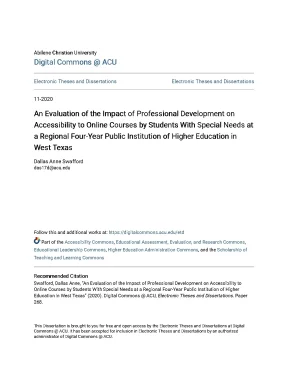
Tải xuống để đọc toàn bộAbilene Christian University Digital Commons @ ACU Electronic Theses and Dissertations Electronic Theses and Dissertations 11-2020 An Evaluation of the Impact of Professional Development on Accessibility to Online Courses by Students With Special Needs at a Regional Four-Year Public Institution of Higher Education in West Texas Dallas Anne Swafford das17d@acu.edu Follow this and additional works at: https://digitalcommons.edu/etd Part of the Accessibility Commons, Educational Assessment, Evaluation, and Research Commons, Educational Leadership Commons, Higher Education Administration Commons, and the Scholarship of Teaching and Learning Commons Recommended Citation Swafford, Dallas Anne, "An Evaluation of the Impact of Professional Development on Accessibility to Online Courses by Students With Special Needs at a Regional Four-Year Public Institution of Higher Education in West Texas" (2020). Digital Commons @ ACU, Electronic Theses and Dissertations. This Dissertation is brought to you for free and open access by the Electronic Theses and Dissertations at Digital Commons @ ACU. It has been accepted for inclusion in Electronic Theses and Dissertations by an authorized administrator of Digital Commons @ ACU.
This dissertation, directed and approved by the candidate’s committee, has been accepted by the College of Graduate and Professional Studies of Abilene Christian University in partial fulfillment of the requirements for the degree Doctor of Education in Organizational Leadership Dr. Joey Cope, Dean of the College of Graduate and Professional Studies October 22, 2020 Dissertation Committee: Dr. Antonina Lukenchuk, Chair Dr. Scott Self Dr.
Timothy Stafford Abilene Christian University School of Educational Leadership An Evaluation of the Impact of Professional Development on Accessibility to Online Courses by Students With Special Needs at a Regional Four-Year Public Institution of Higher Education in West Texas A dissertation submitted in partial satisfaction of the requirements for the degree of Doctor of Education in Organizational Leadership by Dallas Anne Swafford November 2020 i Dedication Several people have provided support, love, and motivation during this final educational journey as I worked to obtain my doctoral degree. First and foremost, this is a God thing! I am blessed to have you all in my life and dedicate this step of my educational journey to you all. To my husband, Carroll. I cannot express how much I appreciate your unconditional love, unwavering support, and the never-ending encouragement you provide to me always, but particularly when I was struggling with classes or homework, wanted to take a break, or quit.
You listen to me rant, rave, and yes, continuously talk about school or homework over the last couple of years or so. I love you more than I can ever express. To my mother, Reba. I would not be who I am or where I am today without the selfless love, guidance, and ever-present support you and Dad provided to me.
Because of your dedication to raising a hard-headed daughter, I have been able to achieve this goal. I know Daddy would be just as excited as we both are now. I love you and could not have done this without you two! To my Aunt Rita. Thank you for always loving me, being there for me, listening and providing feedback upon request, and reminding me that it is OK to take a break and work on crafts now and then.
Now we can perfect the mallet smash! (Mom, consider yourself warned. We promise to protect the cars!) I love you more, AMM! To Linda. Thank you for being a prayer warrior and friend. Although I have not known you long, I appreciate your friendship with my family and being a tireless prayer warrior with my mom and aunt! I have no doubt that you have played a considerable role in my success as well.
It’s time for another lunch and shopping trip! Thank you so much for your support. ii To the lunch bunch – Marsha, Paula, Elisa, Debbie, and while she was with us, Suzanne. You girls are the best friends a girl could ever ask for! Our relationships have stood the test of time, and I am blessed by your friendship every minute of every day. There are not many people who are lucky enough to have friends like you girls.
If we ever get through this pandemic…GIRL TRIP!! It has been entirely too long! Last and certainly not least – Thanks to my coworkers and colleagues: Bradley, Randall, Nancy, Russ, Wrennah, Lesley, Dara, Rebecca, Carey, Kristen, Audrey, Tara, and Alaric. All of you provided so much support and encouragement even before this journey began, and certainly throughout the entire journey, from the candid conversations, office coverage, and time off, experiences we share working together, and, most importantly, to the friendships we have. I cherish the time we spend together. I am lucky to call you all not only colleagues but friends.
Tara, as you would say, “This is just one big happy panda situation!” iii Acknowledgments I would like to take time to express my appreciation to several individuals who provided vital support, direction, and patience while helping me obtain my doctoral degree. Antonina Lukenchuk, my dissertation chair, pushed me to consider every aspect of research and expand my thinking to finally decide to complete evaluation research. Scott Self supported me from early in my journey when we connected as a professor and student and realized that we both have experiences in the same field. I have never been more excited to learn that I snuck in right under his limit of spaces available for him to serve as a committee member! While I did not know Dr.
Timothy Stafford until he became a committee member, I appreciate the knowledge and feedback he provided to make my study complete and thorough. Dana McMichael not only served on my committee but kept me on track and motivated throughout the program. I appreciate you all. The feedback and direction you all provided played an important role in helping me through the dissertation process and making my study one that I’m very proud of.
Thanks, also, to all of the faculty members who I completed classes with. You all make the process of learning fun, and I am glad I had the opportunity to learn from you. Finally, a special shout out to Courtney Hernandez. We met during the first phone call I received from an admission’s counselor on a Saturday afternoon because “she just happened to be in the office.” I am lucky that you were able to follow me through to the end of my journey when you moved to Student Services.
You are next, my friend, and I hope to be there to celebrate with you when you get to this same spot! iv © Copyright by Dallas Swafford (2020) All Rights Reserved v Abstract Evaluation research, including qualitative and quantitative data, was used in this study to determine the impact of professional development on online courses’ accessibility by students with disabilities. The study focused on online courses and course content. Data collection took place in phases and included self-paced, online professional development and one-on-one support sessions, a pre- and postsurvey, and a focus group interview. The study took place at a regional 4-year public institution of higher education in West Texas.
Change theory emerged as the primary theoretical lens guiding the research as the study unfolded. Keywords: Evaluation research, qualitative, quantitative, professional development, online, focus group, higher education, change theory vi Table of Contents Dedication. v List of Tables. viii List of Figures.
ix Chapter 1: Introduction. 1 Statement of the Problem. 2 Research Purposes and Questions. 4 Chapter 2: Literature Review.
7 Universal Design for Learning. 8 Best Practices Regarding Accessibility and Course Design. 9 Leadership Theories and Professional Development. 11 Adult Learning Theory.
12 Summary of Literature Review. 16 Site and Participants. 17 Sources of Data and Strategies of Data Collection. 19 Professional Development and Evaluation: Implementation and Analysis.
21 Chapter 4: Data Analysis. 23 The Role of the Student Disability Services Office in Accessibility. 24 Staffing and Budgetary Resources. 26 Standards of Evaluation Research.
32 Data Analysis Process. 33 Participants’ Initial Knowledge of Accessibility. 35 Training: Required or Nonexistent?. 36 Online Learning for Students with Disabilities: How Accessible Is It?.
37 Initial Perceptions of Existing Courses. 37 Access to Information and Learning. 38 Training: “If You Build It, They Will Come!”. 39 Self-Paced, Online Training Modules.
40 One-on-One Accessibility Support Sessions – One Step Further. 41 Using Ally to Review Course Content Accessibility. 43 Individual Responses Through Focus Group Interview. 43 Responses to Ally Through Surveys.
45 Professional Development: Does It Work?. 51 Initial Perceptions of Course Content and Accessibility. 52 Perceptions After Professional Development. 55 Overall Experiences With the Training.
59 Summary of the Findings. 63 Chapter 5: Discussion, Conclusions, and Reflections. 66 Best Practices in Online Education. 67 Accessibility of Online Course Content.
73 Recommendations for a Campus Community. 75 Recommendations for Practice and Future Research. 77 Limitations of the Study. 83 Appendix A: Pretest Accessibility Awareness Survey for Faculty.
94 Appendix B: Posttest Accessibility Awareness Survey for Faculty. 97 Appendix C: IRB Approval Letter. 100 viii List of Tables Table 1. Confidence Level With Content Remediation .58 ix List of Figures Figure 1.
Snapshot of Institutional Organization Chart. Participant Representation by Academic Category. Years of Teaching Experience at the College Level. Snapshot of the One-on-One Accessibility Support Session Agenda.
Source of Ally Instruction .47 1 Chapter 1: Introduction Over the last several years, while I have been a disability services provider for students enrolling in higher education classes, it has become evident that all courses the university offers should be accessible to all students, including those with disabilities. Ideally, course content, particularly in the online environment, should be accessible at the point of course creation. Two years ago, a student with a hearing impairment submitted an application for disability accommodations. She was pursuing an online program and was completing a course with the requirement to view multiple videos and participate in discussions about the video content, among other tasks.
The semester was well underway, and the student had been “managing” to hear the video content with the assistance of family members. She needed to view closed captions for the videos, but none were available at the time. The student registered with Student Disability Services approximately halfway through the semester because she needed immediate assistance to complete the course requirements and remain on track for the remainder of the term. Staff members in Student Disability Services and the Department of eLearning immediately began listening to the videos and typing transcripts to meet minimum accessibility requirements and to allow the student to remain on track and complete the current semester with no problems.
The task was time-consuming, but necessary in order to meet the requirements for institutions of higher education mandated by the Americans with Disabilities Act and the consequent Amendment Act. Staff members worked to fulfill the student’s immediate needs for access to the course material and to address her request for accommodations. After accomplishing this task, the team worked with the student’s academic advisor to begin reviewing future courses in which the student needed to enroll and complete to make progress toward her 2 degree completion. The employees began working to ensure the courses were accessible from the beginning of the term.
Because of the experiences and results of working with this particular student, the faculty in the College of Education requested to continue working with Student Disability Services to examine other online courses in other programs offered through the college. The two areas worked together to review the course content in all the online classes in their college to ensure an accessible format for all students. The updates first included closed captioning all videos, and transcripts for audio recordings.
Nội dung được bảo vệ bản quyền — Tải xuống đầy đủ
Trích dẫn luận án này
Dallas Anne Swafford (2020). Tác động phát triển chuyên môn đến khả năng tiếp cận khóa học trực tuyến [Luận án tiến sĩ, Abilene Christian University]. LuanAn.net. https://luanan.net/giao-duc-hoc/an-evaluation-of-the-impact-of-professional-development-on-access
Câu hỏi thường gặp
Luận án "Tác động phát triển chuyên môn đến khả năng tiếp cận khóa học trực tuyến" nghiên cứu về vấn đề gì?
Phân tích tác động của phát triển chuyên môn đến khả năng tiếp cận và hiệu quả học tập trên các nền tảng khóa học trực tuyến.
Luận án "Tác động phát triển chuyên môn đến khả năng tiếp cận khóa học trực tuyến" được bảo vệ tại trường nào?
Luận án này được bảo vệ tại Abilene Christian University. Năm bảo vệ: 2020.
Luận án "Tác động phát triển chuyên môn đến khả năng tiếp cận khóa học trực tuyến" thuộc chuyên ngành gì?
Luận án "Tác động phát triển chuyên môn đến khả năng tiếp cận khóa học trực tuyến" thuộc chuyên ngành Organizational Leadership. Danh mục: Giáo Dục Học.
Luận án "Tác động phát triển chuyên môn đến khả năng tiếp cận khóa học trực tuyến" có bao nhiêu trang?
Luận án "Tác động phát triển chuyên môn đến khả năng tiếp cận khóa học trực tuyến" có 112 trang. Bạn có thể xem trước một phần tài liệu ngay trên trang web trước khi tải về.
Cách tải luận án "Tác động phát triển chuyên môn đến khả năng tiếp cận khóa học trực tuyến" về máy như thế nào?
Để tải luận án về máy, bạn nhấn nút "Tải xuống ngay" trên trang này, sau đó hoàn tất thanh toán phí lưu trữ. File sẽ được tải xuống ngay sau khi thanh toán thành công. Hỗ trợ qua Zalo: 0559 297 239.