Alpert dissertation 2013
Luận án: Alpert dissertation 2013. Xem tóm tắt và tải về tại LuanAn.net
Texas A&M University
Luan An
Luận án tiến sĩ
Năm xuất bản
Số trang
119
Thời gian đọc
18 phút
Lượt xem
0
Lượt tải
0
Phí lưu trữ
40 Point
Tổng quan nhanh
- Chủ đề:
- Giới thiệu Luận văn Alpert 2013: Thành công Toán học Đại học
- Số trang:
- 119 trang
- Trường:
- Texas A&M University
- Chuyên ngành:
- Curriculum and Instruction
- Tác giả:
- Anna Pat Lucas Alpert
- Năm:
- 2013
Tóm tắt nội dung luận án
I.Giới thiệu Luận văn Alpert 2013 Thành công Toán học Đại học
Luận văn tiến sĩ này do Anna Pat Lucas Alpert hoàn thành năm 2013 tại Đại học Texas A&M. Đề tài nghiên cứu chính tập trung vào các yếu tố hỗ trợ thành công môn toán học ở cấp độ đại học. Luận văn khám phá ba khía cạnh. Thứ nhất, xem xét ảnh hưởng của định hướng công nghệ toán học cho bài kiểm tra xếp lớp đại học. Thứ hai, ghi nhận tiếng nói của các sinh viên tham gia định hướng này. Cuối cùng, dữ liệu định hướng được sử dụng để phát triển kiến thức sư phạm công nghệ nội dung (TPCK) cho các giảng viên.
1.1. Mục tiêu Nghiên cứu Chính và Bối cảnh
Mục tiêu nghiên cứu là xác định các yếu tố ảnh hưởng đến thành công môn toán đại học. Nhiều sinh viên mới nhập học bị xếp vào lớp toán phát triển. Điều này dựa trên điểm số từ các bài kiểm tra xếp lớp. Các bài kiểm tra này thường hạn chế sử dụng công nghệ tính toán và có các ràng buộc về thời gian. Nghiên cứu học thuật này nhằm mục đích giải quyết những thách thức đó, cung cấp cái nhìn sâu sắc cho giáo dục. Tác giả Alpert trình bày một giải pháp tiềm năng.
1.2. Phạm vi và Đối tượng Nghiên cứu Ban đầu
Nghiên cứu tập trung vào học sinh trung học phổ thông. Đối tượng là học sinh lớp Algebra II tại một trường trung học 3A ở vùng nông thôn miền trung Texas. Các em được làm bài kiểm tra trước và sau định hướng. Luận văn tiến sĩ này đặc biệt nhấn mạnh tầm quan trọng của sự chuẩn bị. Nghiên cứu cũng chú trọng việc áp dụng công nghệ trong môi trường học đường.
II.Phương pháp Luận Nghiên cứu Kiểm định Phân tích Dữ liệu
Luận văn của tác giả Alpert sử dụng phương pháp luận kết hợp. Nghiên cứu thực hiện cả phân tích định lượng và định tính. Thiết kế nghiên cứu bao gồm các bài kiểm tra trước và sau can thiệp. Một nghiên cứu điển hình cũng được tiến hành để thu thập dữ liệu định tính. Các kỹ thuật thống kê nâng cao được áp dụng để phân tích dữ liệu hiệu quả. Cách tiếp cận toàn diện này đảm bảo độ tin cậy của kết quả nghiên cứu.
2.1. Thiết kế Thực nghiệm và Công cụ Đánh giá
Học sinh được làm bài kiểm tra trước và sau bao gồm số học và đại số. Mỗi bài kiểm tra kéo dài 20 phút, có 15 câu hỏi nội dung toán học và một câu hỏi định tính. Giữa hai bài kiểm tra, học sinh được cung cấp tài liệu ôn tập. Họ sử dụng bút chì, giấy cho số học và máy tính bốn phép tính cho đại số. Đây là phần quan trọng của đề tài nghiên cứu, kiểm tra tác động của định hướng.
2.2. Phân tích Dữ liệu Định lượng và Định tính
Ảnh hưởng của định hướng được phân tích bằng nhiều phương pháp. Chúng bao gồm điểm trung bình, khoảng tin cậy, cỡ hiệu ứng và mô hình tuyến tính tổng quát (GLM). Phép kiểm t-test mẫu cặp đôi cũng được tính toán. Đối với phần định tính, 12 người tham gia định hướng được phỏng vấn sau khi vào đại học. Năm chủ đề chính đã nổi lên từ các cuộc phỏng vấn này. Đây là một phần quan trọng của phương pháp luận, giúp hiểu sâu sắc hơn về trải nghiệm của sinh viên.
III.Khám phá Yếu tố Thành công Toán Học Tiếng nói Sinh viên
Nghiên cứu học thuật này đã làm sáng tỏ nhiều yếu tố quan trọng. Các yếu tố này ảnh hưởng đến thành công môn toán học ở cấp đại học. Nó đặc biệt tập trung vào vai trò của công nghệ và sự chuẩn bị. Các cuộc phỏng vấn sâu với sinh viên đã cung cấp một góc nhìn độc đáo. Tiếng nói của họ là bằng chứng trực tiếp về những thách thức và kỳ vọng. Kết quả nghiên cứu có giá trị thực tiễn cao.
3.1. Phân tích Ảnh hưởng của Định hướng Công nghệ
Phân tích định lượng đã đánh giá hiệu quả của định hướng công nghệ. Định hướng này nhằm chuẩn bị cho sinh viên đối phó với các bài kiểm tra xếp lớp đại học. Kết quả cho thấy những thay đổi đáng kể trong điểm số. Điều này chứng tỏ tầm quan trọng của việc làm quen với công nghệ. Sự khác biệt có ý nghĩa thống kê giữa điểm kiểm tra trước và sau là một phát hiện chính. Tác giả Alpert cung cấp bằng chứng rõ ràng.
3.2. Tiếng nói Sinh viên và Chủ đề Nổi bật từ Phỏng vấn
Nghiên cứu điển hình đã thu thập thông tin quý giá từ sinh viên. Năm chủ đề chính xuất hiện từ các cuộc phỏng vấn. Các chủ đề này bao gồm: Kiến thức Toán học Đại học, Công nghệ và Toán học, Kiểm tra/Đánh giá Toán học, Dạy và Học Toán học, Kinh nghiệm, Hy vọng và Ước mơ Toán học. Những chủ đề này cung cấp một cái nhìn sâu sắc về nhận thức và kinh nghiệm của sinh viên. Chúng phản ánh trực tiếp tiếng nói của người tham gia.
IV.Phát triển TPCK Giảng viên Ứng dụng Bootstrapping
Một phần quan trọng của luận văn tiến sĩ này là phát triển TPCK cho giảng viên. Dữ liệu từ định hướng được sử dụng để minh họa kỹ thuật bootstrapping. Kỹ thuật này được trình bày cho các giảng viên khóa thống kê nhập môn năm thứ nhất. Mục tiêu là hỗ trợ sự thành công của sinh viên bằng cách nâng cao kiến thức sư phạm công nghệ nội dung của giảng viên. Đây là một đóng góp thiết thực của nghiên cứu học thuật.
4.1. Trình bày Ứng dụng Bootstrapping trong Đào tạo
Sử dụng Microsoft Excel, kỹ thuật bootstrapping được trình bày. Nó dùng để phát triển và trình diễn ứng dụng công nghệ tính toán. Cụ thể, bootstrapping được sử dụng để ước tính khoảng tin cậy ở mức 95%. Dữ liệu từ định hướng được phân tích thêm trong dự án bootstrapping này. Số lượng mẫu lặp lại là 250 ở ba mức: lấy mẫu quá mức, lấy mẫu đúng mức và lấy mẫu dưới mức.
4.2. Ý nghĩa của TPCK cho Giảng viên Thống kê
Việc phát triển TPCK của giảng viên là rất quan trọng. Nó giúp giảng viên tích cực thu hút sinh viên đạt được thành công môn toán đại học. Dự án bootstrapping này cung cấp một giàn giáo hữu ích. Nó giúp giảng viên nâng cao khả năng sử dụng công nghệ trong giảng dạy. Hội đồng khoa học của trường đại học sẽ đánh giá cao đóng góp này. Đây là một hướng đi mới cho việc đào tạo giảng viên.
V.Kết quả Đóng góp Chính Thành công Toán học TPCK
Luận văn tiến sĩ của Anna Pat Lucas Alpert cung cấp nhiều kết quả quan trọng. Những kết quả này có ý nghĩa cho giáo dục toán học đại học. Nghiên cứu xác nhận hiệu quả của định hướng công nghệ. Nó cũng làm nổi bật tiếng nói của sinh viên. Đồng thời, nó đề xuất một phương pháp cải thiện kỹ năng giảng dạy của giáo viên. Các đóng góp này mở ra hướng đi mới cho nghiên cứu học thuật và thực tiễn giáo dục.
5.1. Phát hiện Định lượng Quan trọng từ Dữ liệu
Biểu đồ khoảng tin cậy bootstrapping đã cho thấy sự khác biệt có ý nghĩa thống kê. Sự khác biệt này tồn tại giữa điểm kiểm tra trước và sau định hướng. Điều này đúng cho tất cả các cặp tập dữ liệu. Khoảng tin cậy được tính toán thực nghiệm từ các mẫu lặp lại trung bình. Phát hiện này củng cố tầm quan trọng của định hướng công nghệ. Đây là một trong những kết quả nghiên cứu nổi bật nhất.
5.2. Hàm ý Thực tiễn cho Giáo dục Toán học
Nghiên cứu này có những hàm ý thực tiễn sâu rộng. Nó gợi ý rằng định hướng sớm về công nghệ có thể cải thiện kết quả của sinh viên. Nó cũng nhấn mạnh sự cần thiết phải lắng nghe tiếng nói của sinh viên. Đồng thời, cần hỗ trợ phát triển TPCK cho giáo viên. Thư mục tham khảo của luận văn sẽ cung cấp thêm các nghiên cứu liên quan. Điều này góp phần vào thành công môn toán đại học. Trường đại học và các nhà giáo dục có thể ứng dụng các phát hiện này.
Tải xuống file đầy đủ để xem toàn bộ nội dung
Tải đầy đủ (119 trang)Trích đoạn nội dung luận án
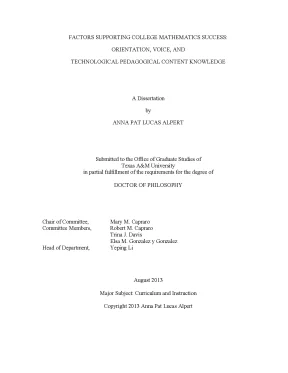
Tải xuống để đọc toàn bộFACTORS SUPPORTING COLLEGE MATHEMATICS SUCCESS: ORIENTATION, VOICE, AND TECHNOLOGICAL PEDAGOGICAL CONTENT KNOWLEDGE A Dissertation by ANNA PAT LUCAS ALPERT Submitted to the Office of Graduate Studies of Texas A&M University in partial fulfillment of the requirements for the degree of DOCTOR OF PHILOSOPHY Chair of Committee, Mary M. Capraro Committee Members, Robert M. Gonzalez y Gonzalez Head of Department, Yeping Li August 2013 Major Subject: Curriculum and Instruction Copyright 2013 Anna Pat Lucas Alpert ABSTRACT The purpose of this study was to examine factors supporting college mathematics success. First, effect of a brief high school orientation to mathematical technologies used for college placement testing was examined.
Secondly, the voice of participants in this orientation was heard. Finally, bootstrapped orientation data were presented to teachers and instructors of introductory statistics courses as a scaffold to their technological pedagogical content knowledge (TPCK) as these teachers and instructors strive to actively engage students to achieve college mathematics success. Many entering college students are placed into developmental mathematics classes based on scores from college placement assessments that allow extremely limited use of calculating technology and have various time constraints. Students in a rural central Texas 3A high school that were enrolled in Algebra II course were given pre- and post- tests in Arithmetic and Algebra.
Each 20-minute test contained 15 mathematical content questions and one qualitative question. The post-test was given approximately a week after the pre- test. During the week, students were provided time to explore review material using only pencil and paper for the arithmetic review, and a four-function calculator on the algebra review questions. Effects of the orientation were analyzed using mean scores, confidence intervals, effect size, and GLM for whole-group and sub-groups.
A paired samples t-test was calculated. These effects were discussed. A case study involving participants of the orientation was conducted. Twelve participants were interviewed after each had entered college.
Five themes emerged from these interviews: (1) Knowledge of College Mathematics, (2) Technology and Mathematics, ii (3) Mathematics Tests/Assessments, (4) Teaching and Learning Mathematics, and (5) Mathematical Experiences, Hopes and Dreams. Each theme is discussed. Using Microsoft Excel, bootstrapping is presented to instructors of first year introductory statistics courses in support of student success as instructors’ technological pedagogical content knowledge is developed. A course project demonstrating and developing application of computational technology by bootstrapping confidence intervals at the 95 % level using Microsoft Excel is presented.
Data from the orientation were further analyzed in the bootstrapping project. Confidence intervals were empirically calculated from bootstrapped resamples of the mean. The number of resamples used was 250 at each of three levels: Over-sampling, at-sampling, and under-sampling. Graphs of bootstrapped confidence intervals, using the Rule of Eye 4, showed statistically significant differences between pre-test and post-test scores for all pairs of data sets.
iii DEDICATIONS ~~~~~~~ To my Lord and Saviour, Jesus Christ. Who gives me all good things and the strength to have met requirements for this degree. To my loving husband, Ken. Whose love, encouragement, support, and late-night driving made this journey a success.
To my beloved children, David, Benjie, Seth, Samantha, and Hannah. Who encouraged me to become an Aggie “Dr. To my dear grandchildren, Trevor, Emily, Cason, Olivia, Abigail, Breck, and Sarah. Who provided incentive to enjoy my life while pursuing this degree and battling BC.
To my strong parents, Benny & Nell Lucas. Whose examples of educational service have inspired me to also serve educationally. To my encouraging Delta Kappa Gamma International Sorority sisters. Whose scholarship dollars, love and encouragement helped this dream to become reality.
To my dear friend and colleague, Dr. Who encouraged and inspired me with words and food. iv ACKNOWLEDGEMENTS A plethora of praise and thanks goes to my awesome committee, who guided my research and writing, each making unique contributions to my mathematical and research education. Thank you Dr.
Mary Margaret Capraro for encouraging me to keep moving in a forward direction, even if only a bit at a time, providing me with benchmark deadlines and proofreading my writing for content integrity and APA compliance. My special appreciation extends to Dr. Capraro for never accepting any excuse whatsoever, always holding me to the highest standard of excellence, and providing my husband words of perseverance and encouragement. Davis, thank you for your illumination of a world of new and wonderful educational technologies along with the concept of TPCK.
For illustrating qualitative research to be real and about real people, thank you Dr. Heartfelt appreciation goes to Dr. Richard Sanchez and the board of trustees of Navarro College for their belief in, and support of, NC faculty. Appreciation and gratitude to Natasha Brown for the encouragement and support you have kindly given during this past very difficult year.
Last, but not least, thank you, Dr. Gerren, for paving the way, and Chris Murphy for driving that pavement during all sorts of weather to get me to class on time! v TABLE OF CONTENTS Page ABSTRACT ……………………………………………………………. ii ii DEDICATIONS……………………………………………………. v TABLE OF CONTENTS ………………………………………………….
vi LIST OF TABLES ………………………………………………………. viii LIST OF FIGURES ……………………………………………………………….…… ix CHAPTER I INTRODUCTION ……………………………………………. 1 Student Success Quest …………………………………………………….…… 10 CHAPTER II SUPPORTING COLLEGE MATHEMATICS SUCCESS: HIGH SCHOOL ORIENTATION TO COLLEGE PLACEMENT ASSESSMENT ……………………………. 29 Conclusions ……………………………………………………………………… 31 CHAPTER III SUCCESS IN COLLEGE MATHEAMTICS?! STUDENT VOICE IDENTIFIES SUPPORTING FACTORS …………………………….
59 Discussion and Recommendations ……………………………………………. 63 vi Page CHAPTER IV TPCK FOR STATISTICS: SUPPORTING STUDENT SUCCESS THROUGH MICROSOFT EXCEL BOOTSTRAPPING ………………….……… 86 … Recommendations for Future Research in Statistics TPCK …………….……… 86 CHAPTER V SUMMARY AND DISCUSSION ………………………………. 87 Orientation to Mathematics Placement Assessments …………………………… 87 Factors Supporting College Mathematics Success ……………………. 109 vii LIST OF TABLES TABLE Page 1 Demographics of Participants ………………….
17 2 Results of Paired Samples t-test ………………. 24 3 Results of Arithmetic Assessments: Difference of Post-test and Pre-test ………………………………….…………… 25 4 Results of Arithmetic Self-Confidence: Difference of Post-test & Pre-test ……………………….…… 26 5 Results of Algebra Assessments: Difference of Post-test and Pre-test ………………………………………….… 27 6 Results of Algebra Self-Confidence: Difference of Post-test and Pre-test ……………………………….………………28 7 Results of GLM Analysis: Difference of Post-test and Pre-test…………………………………………….… 29 8 Demographics of Participants .……………………………………………… 38 9 Description of Eight Data Sets………………. 79 viii LIST OF FIGURES FIGURE Page 1 Race/ethnicity of participants……………………………………………………. 18 2 Race/ethnicity partitioned by academic level ……………………………….
19 3 Academic level partitioned by race/ethnicity……………………………. 19 4 Microsoft Excel syntax for producing an element in a bootstrap re-sample ……………………….…… 81 5 Microsoft Excel syntax for computing the mean of the 250 means of the bootstrap re-samples ………. 81 6 Microsoft Excel syntax for computing 2.5 percentile value of the 250 means ……………………….… 82 7 Microsoft Excel syntax for computing the 97.5 percentile value of the 250 means ………………….… 82 8 Bootstrapped 95 % CIs of Pre/Post Arithmetic Test by Re-Sample Factor ……………….… 83 9 Bootstrapped 95 % CIs of Pre/Post Arithmetic Question by Re-Sample Factor…………………. 84 10 Bootstrapped 95 % CIs of Pre/Post Algebra Test by Re-Sample Factor………………………….
84 11 Bootstrapped 95 % CIs of Pre/Post Algebra Question by Re-Sample Factor…………………………….… 85 ix INTRODUCTION Student Success Quest President Obama (2009) issued a challenge for the United States to regain the lead in having the highest proportion of college graduates in the world by the 2020. Organizations offering their support for similar goals include The Bill and Melinda Gates Foundation, pledging millions of dollars to support doubling the number of low-income students earning degrees by 2025 and Lumina Foundation for Education, aiming to increase the percentage of people with high-quality degrees by the time frame of 2025 (Parker, Bustillos, & Behringer, 2010). America, needing to develop the necessary workforce of the 21st century in order to hold on to its global prominence, is looking to harness the strengths of its citizenry (Parker et al. The President has urged every American to enroll in at least one year of postsecondary education in order to help increase America’s global competitiveness (Obama, 2009).
State policy makers have been similarly urged to support workforce development by empowering and embracing universities and community colleges to develop mechanisms to support postsecondary mathematics success: Mathematics is THE bridge to high paying jobs in STEM (Science, Technology, Engineering and Mathematics) fields (Capraro, 2011). This national focus on college completion has shifted the debate concerning remedial or developmental education from the philosophical view of access vs. excellence to a more evidence-based view of benefits vs. cost (Parker et al.
History of Developmental Education Academically underprepared students have been of concern to American higher education since the 1630s when Harvard College provided Latin tutors for incoming students (Breneman & Haarlow, 1998). The first remedial education program that included courses in 1 reading, writing, and arithmetic was offered at the University of Wisconsin in 1849 (Breneman & Haarlow, 1998). In the twentieth century, junior colleges and community colleges began to assume the front role in remedial education (Breneman & Haarlow, 1998). The Serviceman’s Readjustment Act or G.
Bill of 1944 provided financial aid for education to veterans returning from World War II, thus providing community colleges a financially prepared population of academically underprepared students (Mellow, 2000). Financial aid provided by The Higher Education Act of 1965 removed the cost barrier for all students, thus opening the doors to higher education, effectively making community colleges the Ellis Island of American Higher Education (Breneman & Haarlow, 1998; Mellow, 2000). This influx of students, most of whom were underprepared for higher education experiences, led to the need for assessment testing in the areas of mathematics, reading and writing as a way for proper placement at an appropriate academic level. By the mid 1970s, institutions of higher education such as Navarro Community College of Corsicana, Texas were voluntarily using assessment testing, sometimes with volatile results (T.
Stringer, personal communication, May 4, 2012). Assessment testing was federally mandated in the 1980s (Breneman & Haarlow, 1998). Placement Assessment The Texas Academic Skills Program (TASP), established in 1987, served as a diagnostic tool and placement device in the areas of mathematics, reading and writing (Breneman & Haarlow, 1998). More recently, the College Board’s ACCUPLACER test battery was employed for placement and diagnosis (Mattern & Packman, 2009).
However, many students take placement tests without realizing their purpose or the high-stakes nature 2 of the assessment such as placement into developmental studies increasing the cost and time for degree completion (Bailey, 2009; Bailey, Jeong, & Cho, 2010; Safron & Visher, 2010). Placement assessment testing is poorly understood by high school students, and not well aligned with entry-level courses, only assessing one dimension of college readiness – basic content knowledge (Conley, 2007). As Conley (2010) so aptly states in his address to the National Center for Postsecondary Research (NCPR) Developmental Education Conference, in which he gave comparisons of several college readiness assessment tests including the Computer-Adaptive Placement Assessment and Support System (COMPASS) developed by the American College Test (ACT), ACT, Assessment of Skills for Successful Entry and Transfer (ASSET), ACCUPLACER which was developed by the College Board, and the Scholastic Aptitude Test (SAT): The exam score is not designed to provide insight into the specific nature of and reason for any deficiency. It is not clear if the student simply has forgotten material learned previously and needs only to refresh his or her memory, or if he or she has never been exposed to the material in the first place.
The test cannot determine if a student needs a small amount of focused review or re-teaching of the material from scratch. It may not be clear if the problem is lack of content knowledge or lack of study skills. In short, while tests may identify deficiencies, they are not particularly useful in helping to identify how to remedy any particular deficiency. 6) The assessment-placement policy of states can result in developmental education placement when supports and enrollment in college-level classes would better serve some students (Collins, 2009).
Nội dung được bảo vệ bản quyền — Tải xuống đầy đủ
Trích dẫn luận án này
Anna Pat Lucas Alpert (2013). Alpert dissertation 2013 [Luận án tiến sĩ, Texas A&M University]. LuanAn.net. https://luanan.net/giao-duc-hoc/alpert-dissertation-2013
Câu hỏi thường gặp
Luận án "Alpert dissertation 2013" nghiên cứu về vấn đề gì?
Luận án: Alpert dissertation 2013. Xem tóm tắt và tải về tại LuanAn.net
Luận án "Alpert dissertation 2013" được bảo vệ tại trường nào?
Luận án này được bảo vệ tại Texas A&M University. Năm bảo vệ: 2013.
Luận án "Alpert dissertation 2013" thuộc chuyên ngành gì?
Luận án "Alpert dissertation 2013" thuộc chuyên ngành Curriculum and Instruction. Danh mục: Giáo Dục Học.
Luận án "Alpert dissertation 2013" có bao nhiêu trang?
Luận án "Alpert dissertation 2013" có 119 trang. Bạn có thể xem trước một phần tài liệu ngay trên trang web trước khi tải về.
Cách tải luận án "Alpert dissertation 2013" về máy như thế nào?
Để tải luận án về máy, bạn nhấn nút "Tải xuống ngay" trên trang này, sau đó hoàn tất thanh toán phí lưu trữ. File sẽ được tải xuống ngay sau khi thanh toán thành công. Hỗ trợ qua Zalo: 0559 297 239.