Academic support experiences and perceptions of postsecondary stu
Tìm hiểu trải nghiệm và nhận thức về hỗ trợ học thuật của sinh viên sau trung học. Nâng cao chất lượng giáo dục đại học.
Claremont Graduate University
Special Education
Luan An
Luận án
Năm xuất bản
Số trang
150
Thời gian đọc
23 phút
Lượt xem
0
Lượt tải
0
Phí lưu trữ
40 Point
Tổng quan nhanh
- Chủ đề:
- 1. Nâng cao Hỗ trợ Học tập sau Trung học cho Sinh viên
- Số trang:
- 150 trang
- Trường:
- Claremont Graduate University
- Chuyên ngành:
- Special Education
- Tác giả:
- Heather Taylor Wizikowski
- Năm:
- 2013
Tóm tắt nội dung luận án
I. Nâng cao Hỗ trợ Học tập sau Trung học cho Sinh viên
Sinh viên khuyết tật ngày càng có nhiều cơ hội tiếp cận giáo dục sau trung học. Những tiến bộ trong luật pháp, nhận thức xã hội, công nghệ hỗ trợ đã mở rộng cánh cửa. Kế hoạch hòa nhập, chuyển tiếp ở trường phổ thông cũng góp phần vào thành công này. Hiện nay, 15% sinh viên khuyết tật theo học các trường đại học bốn năm. Dữ liệu liên bang cho thấy 88% trường tư thục và 99% trường công lập có sinh viên khuyết tật. Nghiên cứu hiện tại thường tập trung vào thực tiễn thể chế. Nhu cầu và trải nghiệm thực tế của sinh viên ít được khám phá. Cần nghiên cứu sâu hơn về trải nghiệm cá nhân của sinh viên. Điều này giúp hiểu rõ hơn về cách cải thiện các dịch vụ hỗ trợ sinh viên. Hỗ trợ học tập sau trung học hiệu quả là chìa khóa cho thành công của sinh viên.
1.1. Bối cảnh hỗ trợ học tập cho sinh viên khuyết tật
Luật pháp và công nghệ đã tạo ra cơ hội đáng kể cho sinh viên khuyết tật. Các trường trung học đã tăng cường kế hoạch hòa nhập và chuyển tiếp. Điều này giúp sinh viên khuyết tật đạt được thành tích cao hơn. Số lượng sinh viên khuyết tật nhập học đại học tiếp tục tăng. Các tổ chức giáo dục phải đáp ứng nhu cầu đa dạng này. Cung cấp dịch vụ hỗ trợ sinh viên phù hợp là ưu tiên hàng đầu. Mục tiêu là đảm bảo mọi sinh viên đều có cơ hội thành công trong môi trường học thuật.
1.2. Khoảng trống nghiên cứu về nhu cầu sinh viên
Nghiên cứu hiện có chủ yếu tập trung vào các chính sách của tổ chức. Ít nghiên cứu khai thác trực tiếp nhu cầu và trải nghiệm của sinh viên. Điều này tạo ra một khoảng trống kiến thức. Cần có góc nhìn từ sinh viên để hiểu rõ hơn về dịch vụ hỗ trợ học tập. Nghiên cứu này phân tích mối quan hệ giữa nhận thức của sinh viên, kỹ năng tự vận động. Đồng thời, nghiên cứu cũng xem xét các chỗ ở dành cho người khuyết tật. Kết quả cung cấp thông tin quan trọng để lấp đầy khoảng trống này.
II. Trải nghiệm Hỗ trợ Học tập của Sinh viên Khuyết tật
Nghiên cứu định lượng này phân tích các mối quan hệ quan trọng. Mối quan hệ giữa nhận thức của sinh viên, mức độ tự tin vào kỹ năng tự vận động, và các điều chỉnh dành cho người khuyết tật được khảo sát. Hai cơ sở giáo dục đại học, một công lập và một tư thục, đã được so sánh. 113 sinh viên đại học khuyết tật hoàn thành một cuộc khảo sát trực tuyến. 34 người từ đại học tư thục, 79 người từ đại học công lập. Dữ liệu mô tả và liên kết được phân tích. Mục tiêu là so sánh kinh nghiệm giữa hai môi trường. Kiến thức và sự tự tin về kỹ năng tự vận động cũng được đánh giá. Mối quan hệ giữa các biến này và các mô hình tiết lộ thông tin cũng được xem xét. Nhìn chung, sinh viên có trải nghiệm tương tự nhau bất kể loại trường. Trải nghiệm hỗ trợ học tập của sinh viên khuyết tật được đánh giá thông qua nhiều khía cạnh. Điều này bao gồm cả sự hài lòng và hiệu quả của các dịch vụ nhận được.
2.1. Phương pháp nghiên cứu định lượng
Nghiên cứu sử dụng phương pháp định lượng. Một cuộc khảo sát trực tuyến đã được thực hiện với sinh viên khuyết tật. Mục đích là thu thập dữ liệu về trải nghiệm và nhận thức của họ. Dữ liệu được phân tích bằng thống kê mô tả và liên kết. Điều này cho phép so sánh kinh nghiệm giữa các trường công lập và tư thục. Phân tích này cũng giúp hiểu rõ hơn về kỹ năng tự vận động. Sự tự tin và kiến thức về tự vận động được đánh giá kỹ lưỡng.
2.2. Sự tương đồng trong trải nghiệm hỗ trợ học tập
Kết quả cho thấy sinh viên khuyết tật có những trải nghiệm tương tự. Điều này đúng cho cả trường công lập và tư thục. Các mô hình nhận dạng khuyết tật giống nhau. Trải nghiệm về các điều chỉnh và hỗ trợ cũng tương đồng. Sinh viên ở cả hai môi trường đều hài lòng với văn phòng hỗ trợ học tập và nhân viên. Sự hài lòng này cho thấy các dịch vụ hỗ trợ sinh viên đang đáp ứng một phần nhu cầu cơ bản. Các dịch vụ hỗ trợ người khuyết tật đóng vai trò quan trọng. Dù có sự khác biệt về loại hình trường, trải nghiệm cơ bản vẫn giữ tính nhất quán.
III. Phân tích Dịch vụ Hỗ trợ Sinh viên Công lập và Tư thục
Sinh viên khuyết tật ở cả trường công lập và tư thục đều bày tỏ sự hài lòng với các dịch vụ hỗ trợ sinh viên. Văn phòng hỗ trợ học tập và đội ngũ nhân viên nhận được đánh giá tích cực. Các điều chỉnh được sinh viên đánh giá là hữu ích bao gồm nhiều định dạng bài thi thay thế. Việc gửi tài liệu cho giảng viên cũng được coi trọng. Hỗ trợ đăng ký học phần cũng là một dịch vụ quan trọng. Những dịch vụ này giúp giảm bớt rào cản học thuật. Điều này góp phần cải thiện hiệu suất học tập của sinh viên. Các dịch vụ gia sư, trung tâm viết và tư vấn học tập cũng có thể được cung cấp thông qua các văn phòng này. Sự hài lòng là một yếu tố quan trọng trong việc đánh giá hiệu quả của các dịch vụ. Nó phản ánh khả năng của các tổ chức trong việc đáp ứng nhu cầu cụ thể của sinh viên khuyết tật.
3.1. Mức độ hài lòng với dịch vụ hỗ trợ sinh viên
Sinh viên bày tỏ sự hài lòng cao với văn phòng hỗ trợ học tập. Nhân viên hỗ trợ cũng được đánh giá tích cực. Điều này cho thấy các dịch vụ hiện có đang đáp ứng một số mong đợi. Mức độ hài lòng này rất quan trọng. Nó ảnh hưởng trực tiếp đến kết quả học tập và tinh thần của sinh viên. Cần duy trì và phát triển các dịch vụ này. Đảm bảo chất lượng của dịch vụ hỗ trợ sinh viên là cần thiết.
3.2. Các dịch vụ hỗ trợ người khuyết tật hiệu quả
Một số điều chỉnh được sinh viên coi là đặc biệt hữu ích. Chúng bao gồm các định dạng bài kiểm tra thay thế. Việc chuyển tài liệu về tình trạng khuyết tật cho giảng viên cũng rất quan trọng. Hỗ trợ trong quá trình đăng ký khóa học giúp sinh viên dễ dàng hơn. Những dịch vụ này trực tiếp hỗ trợ sinh viên trong học tập. Các dịch vụ này giúp giảm bớt gánh nặng hành chính. Đồng thời, chúng tạo ra một môi trường học tập công bằng hơn. Điều này có thể bao gồm cả các dịch vụ tư vấn học tập và dịch vụ hỗ trợ người khuyết tật chuyên biệt.
IV. Tác động của Kỹ năng Tự Vận động đến Hiệu suất Học tập
Sinh viên có nhận thức và sự tự tin trong việc sử dụng kỹ năng tự vận động. Tuy nhiên, họ lại ít hoặc không được đào tạo về các kỹ năng này. Sự thiếu hụt đào tạo này là một vấn đề đáng chú ý. Sinh viên cũng báo cáo sự hiểu biết yếu về quyền pháp lý của mình. Kiến thức về tình trạng khuyết tật cá nhân và các điều chỉnh cũng hạn chế. Sự thiếu hiểu biết này có thể ảnh hưởng tiêu cực. Nó tác động đến khả năng tiếp cận và sử dụng hiệu quả các dịch vụ hỗ trợ. Kỹ năng tự vận động là yếu tố then chốt cho sự độc lập. Việc thiếu đào tạo có thể cản trở hiệu suất học tập. Nó cũng ảnh hưởng đến sự thành công tổng thể trong giáo dục sau trung học. Cần có các chương trình đào tạo kỹ năng tự vận động cụ thể. Điều này giúp sinh viên tự tin và hiệu quả hơn.
4.1. Nhận thức và sự tự tin về tự vận động
Sinh viên thể hiện nhận thức và sự tự tin về kỹ năng tự vận động. Họ biết tầm quan trọng của việc nói lên nhu cầu của mình. Tuy nhiên, nhận thức này không đi kèm với đào tạo thực tế. Khoảng cách này cần được giải quyết. Kỹ năng tự vận động mạnh mẽ giúp sinh viên tiếp cận các dịch vụ hỗ trợ học tập. Nó cũng giúp họ yêu cầu các điều chỉnh cần thiết. Điều này cuối cùng cải thiện kết quả học tập.
4.2. Khoảng trống trong đào tạo kỹ năng tự vận động
Mặc dù có nhận thức, sinh viên nhận được rất ít hoặc không có đào tạo về tự vận động. Sinh viên cũng thiếu hiểu biết về quyền pháp lý. Kiến thức về khuyết tật và các điều chỉnh cũng hạn chế. Điều này tạo ra rào cản đáng kể. Nó cản trở khả năng tự hỗ trợ của sinh viên. Cần có các chương trình đào tạo chuyên biệt. Những chương trình này giúp sinh viên phát triển kỹ năng tự vận động cần thiết. Việc này hỗ trợ họ trong môi trường giáo dục sau trung học.
V. Cải thiện Tỷ lệ Duy trì Sinh viên qua Hỗ trợ Chuyển tiếp
Sinh viên báo cáo trải nghiệm chuyển tiếp kém từ giáo dục trung học lên sau trung học. Phát hiện này phù hợp với các nghiên cứu hiện tại. Việc lập kế hoạch chuyển tiếp ở cấp trung học phải có mục đích rõ ràng. Cần chuẩn bị kỹ lưỡng cho sinh viên vào môi trường đại học bốn năm. Sinh viên cần được trang bị kỹ năng tự vận động. Đào tạo nhận thức về khuyết tật cũng rất quan trọng. Điều này cần thực hiện trước khi chuyển sang các cơ sở sau trung học. Các mô hình chuyển tiếp hiệu quả cần được nghiên cứu thêm. Mối quan hệ giữa mức độ tự tin tự vận động và tỷ lệ duy trì sinh viên cần được xem xét. Cải thiện quy trình chuyển tiếp sẽ nâng cao tỷ lệ duy trì sinh viên. Nó cũng góp phần vào tỷ lệ tốt nghiệp cao hơn. Hỗ trợ chuyển tiếp mạnh mẽ là yếu tố then chốt cho thành công lâu dài.
5.1. Thách thức chuyển tiếp từ trung học lên cao đẳng
Sinh viên thường gặp khó khăn trong quá trình chuyển tiếp. Việc chuyển từ giáo dục trung học lên sau trung học thường không suôn sẻ. Nhiều sinh viên không được chuẩn bị đầy đủ. Họ thiếu kỹ năng và thông tin cần thiết. Việc lập kế hoạch chuyển tiếp ở cấp trung học cần được cải thiện. Kế hoạch này phải tập trung vào việc chuẩn bị cho sinh viên. Mục tiêu là giúp họ thích nghi với môi trường đại học. Đặc biệt là những sinh viên có nhu cầu hỗ trợ học tập.
5.2. Đề xuất cải thiện tỷ lệ duy trì sinh viên
Tương lai nghiên cứu cần xem xét lại tính hữu ích của các điều chỉnh hiện có. Nghiên cứu cũng nên tập trung vào các mô hình chuyển tiếp hiệu quả. Cần khám phá mối quan hệ giữa sự tự tin tự vận động và tỷ lệ duy trì sinh viên. Tỷ lệ tốt nghiệp cũng là một yếu tố quan trọng. Đào tạo kỹ năng tự vận động và nhận thức về khuyết tật là cần thiết. Sinh viên cần nhận được đào tạo này trước khi vào đại học. Điều này giúp nâng cao kết quả học tập và sự thành công lâu dài của họ.
Mục lục chi tiết luận án
Tải xuống file đầy đủ để xem toàn bộ nội dung
Tải đầy đủ (150 trang)Trích đoạn nội dung luận án
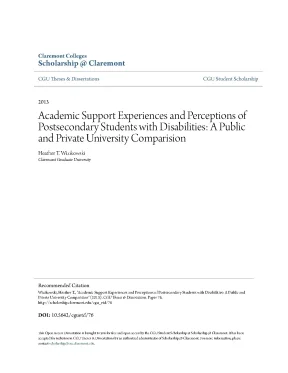
Tải xuống để đọc toàn bộClaremont Colleges Scholarship @ Claremont CGU Theses & Dissertations CGU Student Scholarship 2013 Academic Support Experiences and Perceptions of Postsecondary Students with Disabilities: A Public and Private University Comparision Heather T. Wizikowski Claremont Graduate University Recommended Citation Wizikowski, Heather T., "Academic Support Experiences and Perceptions of Postsecondary Students with Disabilities: A Public and Private University Comparision" (2013). CGU Theses & Dissertations.edu/cgu_etd/76 DOI: 10.5642/cguetd/76 This Open Access Dissertation is brought to you for free and open access by the CGU Student Scholarship at Scholarship @ Claremont. It has been accepted for inclusion in CGU Theses & Dissertations by an authorized administrator of Scholarship @ Claremont.
For more information, please contact scholarship@cuc. Academic Support Experiences and Perceptions of Postsecondary Students with Disabilities: A Public and Private University Comparison by Heather Taylor Wizikowski A final project submitted to the Faculty of Claremont Graduate University in partial fulfillment of the requirements for the degree of Doctor of Philosophy in Special Education. Claremont Graduate University 2013 © Copyright Heather Taylor Wizikowski, 2013 All rights reserved. APPROVAL OF THE REVIEW COMMITTEE This dissertation has been duly read, reviewed, and critiqued by the Committee listed below, which hereby approves the manuscript of Heather Taylor Wizikowski as fulfilling the scope and quality requirements for meriting the degree of Doctor of Philosophy in Special Education.
Deborah Deutsch Smith, Chair Claremont Graduate University Professor Sue Mortorff Robb Claremont Graduate University Professor Scott Thomas Claremont Graduate University Dean Bianca Montrosse Moorhead Western Carolina University Assistant Professor Abstract Academic Support Experiences and Perceptions of Postsecondary Students with Disabilities: A Public and Private University Comparison by Heather Taylor Wizikowski Claremont Graduate University: 2013 Legislation, social awareness, and advancements in medicine and assistive technology have created meaningful postsecondary opportunities for students with disabilities over the past 30 years. Mainstreaming, inclusion, and transition planning in elementary and secondary schools also greatly contributed to the increased achievement of students with disabilities. Today, 15% of students with disabilities attend four-year colleges. Current federal data show 88% of private and 99% of public universities report students with disabilities enrolled at their institutions.
Much of the current research focuses on institutional practice and need. There is a gap in the research when looking at student needs and experiences. This quantitative dissertation study analyzed the relationships between student perceptions, self-advocacy awareness and confidence levels, and available disability accommodations at two institutions of higher learning, one public and one private. One hundred and thirteen undergraduate students with disabilities completed an online survey.
Thirty-four respondents attend the private university, and 79 respondents attend the public university. Descriptive and associative statistics were analyzed for comparative experiences between the two settings, knowledge and confidence of self-advocacy skills, and relationships between these variables and disclosure patterns. The sample population of undergraduate students with disabilities appears to have similar experiences. In both settings, public and private, students have similar identification patterns, accommodation experiences, and support experiences.
Students in both settings are satisfied with their academic support office and staff. The accommodations students find useful are alternative exam formats, documentation sent to faculty, and registration assistance. Students report having an awareness of and confidence using self-advocacy skills, but have had little to no training in these skills. Students report weak understanding of their legal rights, disability, and accommodations.
Students also report poor transition experiences from secondary to postsecondary education, a finding that matches current research. Transition planning at the secondary level must be purposeful in preparing students for four-year college settings when appropriate. Students need self-advocacy skills and disability awareness training before transitioning to postsecondary settings. Future research should also include revisiting the usefulness of accommodations offered in postsecondary settings, studying effective transition models, and looking at the relationship between self-advocacy confidence levels and postsecondary retention rates.
Dedication To my girls, Paloma and Vivian, may you always grow in love and strength. Acknowledgements I would like to first acknowledge my dissertation committee. I appreciate your individual strengths and talents and how they have been integral to my own growth as an academic. Thank you Deb, for teaching me about being strong in my beliefs and in being meticulous in my work.
Thank you also for the immeasurable opportunity I received during my time at IRIS. Thank you, Sue, for always having a kind ear and reminding me about the importance of balance. Thank you, Scott, for saving the day when I suddenly needed a new committee member and doing so with such enthusiasm and engaging commentary. Bianca, I will be eternally grateful for your patience and guidance through statistical analysis, you truly have a gift.
I would like to acknowledge my wonderful family. Mom and Dad, thank you for instilling in me a love of learning and for teaching me that I should better myself through education for the benefit of the greater good. Thank you also for the priceless and selfless gift of being there whenever your granddaughters or I need you. You made all this possible in so many, many ways.
To my sister, Tori, even though the miles separate us, you are always there when I needed to talk something through and I couldn’t be more grateful. To my husband, Paul, I appreciate all the sacrifices you have made to get me to this point. Thank you for being both flexible and strong in the right doses, just when I needed each. Paloma and Vivian, you have made so many small sacrifices because of my work.
I hope that through the sacrifice I have asked of you, I have taught you a bit about reaching for the stars and being your own women. vi Thank you to my IRIS family. Jackie and Jen, you became such wonderful friends and such an amazing support system for me at a time when I really needed it. Thank you, Michael, for being so understanding through this process.
I would also like to acknowledge Dawn Hunter. Thank you for believing in my potential long before I could see it. You are a wonderfully compassionate academic whom I have learned so much from over the years. Thank you also to all the men and women who helped make this study possible.
Thank you to the disability offices at both colleges for being so supportive of my research. And a huge thank you to the students who participated in the survey. I only hope that I did your responses justice. vii Table of Contents Chapter One: Statement of the Problem ………………………………………………… 12 Background ……………………………………………………………………….… 22 Chapter Two: Review of the Literature ……………………………………………….… 24 Impact of IDEA and Other Legislation on Postsecondary Education …………….… 25 Campus Climate: Faculty, Disability Support Services, and Professional Development Considerations …………………………………………………………………….… 27 Accommodations and Services at the Four-Year Postsecondary Level ……….
33 Self-Advocacy: Necessary Skills and Adolescent Development Considerations …. 37 Chapter Three: Methodology ……………………………………………………….… 44 Data Collection Procedures ………………………………………………………. 51 Chapter Four: Results ……………………………………………………………………. 53 viii Chapter Five: Background, Discussion, and Recommendations ………………….
97 Recommendations for Secondary Settings …………………………………. 98 Recommendations for Postsecondary Settings ………………………………….… 99 Recommendations for Future Research ………………………………………. 100 References ………………………………………………………………………………… 102 Appendix A: Definition of Terms ………………………………………………………. 112 Appendix B: AHEAD Disability Support Program Standards and Performance Indicators ………………………………………………………………………………….
115 Appendix C: Online Survey …………………………………………………….……… 129 Appendix D: Participant Recruitment Email ………………………………….……… 149 ix List of Tables Table 1. Percentage of Disabilities Reported by Four-year Degree Granting Postsecondary Institutions that Enrolled Students with Disabilities, by Disability Category and College of Attendance, 2008-2009 ………………………………………………. Percentage of Four-year Degree Granting Institutions Enrolling Students with Disabilities That Provided Various Services or Accommodations to Students with Disabilities, by College of Attendance, 2008-2009 ………………………………. Undergraduate Student Population Characteristics from Sampled Universities; 2011………………………………………………………………….
Descriptive Analyses of Demographic Characteristics of Undergraduate Respondents ……………………………………………………………………. Descriptive Analyses of Reported Disability Categories by College of Attendance …………………………………………………………………………. Descriptive Analyses of Current Major by College of Attendance ……………. Descriptive and Associative Analyses of Whom Students Have Identified to at Their College by College of Attendance ………………………………………….
Descriptive Analyses of Precipitating Event That Led Students to Identify to Their College by College of Attendance ……………………………………. Descriptive Analyses of When Student Chose to Identify to Their College by College of Attendance ……………………………………………………. Descriptive and Associative Analyses of Accommodation Services Students Have Used by College of Attendance ……………………………………………. Descriptive and Associative Analyses of Student Perceived Usefulness of Accommodations ……………………………………………………………….
Descriptive and Associative Analysis of Student Satisfaction with Academic Support Office by College of Attendance …………………………………………………. Descriptive Analyses of Student Reported Services Currently Offered Through the Academic Support Office at Their College; Services Students Would Like to See Offered …………………………………………………………………. Associative Analyses of Student Reported Services Currently Offered Through the Academic Support Office at Their College; Services Students Would Like to See Offered ……………………………………………………………………………… 71 Table 15. Descriptive Analyses of Past Legal and Transition Education ……………….
Descriptive and Associative Analyses of Student Awareness of Self-Advocacy Skills Rating and Whom Students Have Identified to at Their College …………………… 85 Table 17. Descriptive and Associative Analyses of Student Confidence Using Self-Advocacy Skills Rating and Whom Students Have Identified to at Their College ………….… 86 xi Chapter One: Statement of the Problem Background of Problem1 Civil rights legislation and social equity awareness, as well as advancements in assistive and informational technology, education and medicine have resulted in better outcomes for students with disabilities. The implementation of mainstreaming in elementary and secondary schools, placement in the least restrictive learning environment, and inclusion along with formal transition planning have helped foster greater high school completion rates and expectations for postsecondary education for students with disabilities (Brinckerhoff, McGuire, & Shaw, 2002). More than 60% of students receiving special education services spend more than 80% of their school day in general education classrooms (United States Department of Education [USDOE], 2012).
Increases in reading proficiency, more students with disabilities graduating with a high school diploma, and decreases in dropouts rates also account for increased opportunities for postsecondary enrollment for students with disabilities (USDOE, 2010). These positive outcomes create opportunities for better preparation for college and greater numbers of students with disabilities pursuing higher education (Burgstahler & Moore, 2009). Approximately 15% of all students with disabilities pursued four-year postsecondary education in 2010, compared to 37% of their typical peers (Sanford, et al. This percentage is up from 15% of students with disabilities pursuing any postsecondary education in 1987 (vocational or career training, two-year college, and four- year college combined) (USDOE, 2010).
The American with Disabilities Act (ADA) in 1990, along with the reauthorized Individuals with Disabilities Education Act (IDEA) Amendments 1 See Appendix A for a complete list of terms. 1 of 1997, increased the accessibility of postsecondary education for many students with disabilities (Crank & Deshler, 2001; National Center for the Study of Postsecondary Educational Supports [NCSPES], 2005). Within two decades, the percentage of full-time college freshmen with disabilities increased from 2. Current federal data place the number attending college at 11% (United States Government Accountability Office [GAO], 2009).
Ninety-eight percent of four-year colleges in 2003 reported having at least one student with a disability (Johnson, Zascavage, & Gerber, 2008). Current federal data show 88% of private universities and 99% of public universities report students with verified disabilities enrolled at their institutions (Raue & Lewis, 2011). While the increase in the numbers of students with disabilities enrolling in postsecondary education is encouraging, the graduation rates are not (Shepler & Woosley, 2012). Federal data show that 29% of students with disabilities who enroll in four- year colleges receive a degree compared with 42% of their typical peers (Sanford, et al.
Nội dung được bảo vệ bản quyền — Tải xuống đầy đủ
Trích dẫn luận án này
Heather Taylor Wizikowski (2013). Academic support experiences and perceptions of postsecondar [Luận án tiến sĩ, Claremont Graduate University]. LuanAn.net. https://luanan.net/giao-duc-hoc/academic-support-experiences-and-perceptions-of-postsecondary-stu
Câu hỏi thường gặp
Luận án "Academic support experiences and perceptions of postsecondar" nghiên cứu về vấn đề gì?
Tìm hiểu trải nghiệm và nhận thức về hỗ trợ học thuật của sinh viên sau trung học. Nâng cao chất lượng giáo dục đại học.
Luận án "Academic support experiences and perceptions of postsecondar" được bảo vệ tại trường nào?
Luận án này được bảo vệ tại Claremont Graduate University. Năm bảo vệ: 2013.
Luận án "Academic support experiences and perceptions of postsecondar" thuộc chuyên ngành gì?
Luận án "Academic support experiences and perceptions of postsecondar" thuộc chuyên ngành Special Education. Danh mục: Giáo Dục Học.
Luận án "Academic support experiences and perceptions of postsecondar" có bao nhiêu trang?
Luận án "Academic support experiences and perceptions of postsecondar" có 150 trang. Bạn có thể xem trước một phần tài liệu ngay trên trang web trước khi tải về.
Cách tải luận án "Academic support experiences and perceptions of postsecondar" về máy như thế nào?
Để tải luận án về máy, bạn nhấn nút "Tải xuống ngay" trên trang này, sau đó hoàn tất thanh toán phí lưu trữ. File sẽ được tải xuống ngay sau khi thanh toán thành công. Hỗ trợ qua Zalo: 0559 297 239.