Phát triển Đổi mới Sáng tạo trong Giáo dục Đại học Hoa Kỳ: Nghiên cứu điển hình về Giáo dục Dựa trên Năng lực
Luận văn "hansen sew" được chỉnh sửa ngày 16/12/2016. Khám phá các khía cạnh quan trọng và kết quả nghiên cứu.
University of Pittsburgh (School of Education)
Administrative and Policy Studies / Education
Luan An
Luận án tiến sĩ (Dissertation)
Năm xuất bản
Số trang
167
Thời gian đọc
26 phút
Lượt xem
0
Lượt tải
0
Phí lưu trữ
50 Point
Tổng quan nhanh
- Chủ đề:
- Hansen's Doctoral Dissertation: Academic Research Overview
- Số trang:
- 167 trang
- Trường:
- University of Pittsburgh (School of Education)
- Chuyên ngành:
- Administrative and Policy Studies / Education
- Tác giả:
- Sarah Elizabeth Wilson Hansen
- Năm:
- 2016
Tóm tắt nội dung luận án
I.Hansen s Doctoral Dissertation Academic Research Overview
This academic research presents Sarah E. Hansen's doctoral thesis. The dissertation explores disruptive innovation within U.S. higher education. It specifically focuses on competency-based education (CBE) and its development. The study is presented as a case study. College for America serves as the primary subject. The core concept investigates how CBE challenges traditional educational models. This thesis contributes significantly to the understanding of educational transformation. It offers valuable insights for institutions considering new pedagogical approaches. The research was completed for a Doctor of Philosophy degree.
The author of this extensive work is Sarah E. Hansen. She submitted this dissertation to the Graduate Faculty of the School of Education. The University of Pittsburgh awarded her the Doctor of Philosophy degree in 2016. The defense occurred on November 17, 2016. Several distinguished professors approved the dissertation. Dr. Sutin served as the dissertation advisor. This rigorous doctoral study reflects deep engagement with the topic. It signifies a major contribution to academic writing.
The dissertation underwent a thorough review process. Dr. William Bickel, Dr. James Jacob, Dr. Kristin Jones, and Dr. Olson served on the approval committee. Their expertise ensured the quality and rigor of this academic research. The committee members represented diverse fields. This multidisciplinary approach strengthened the thesis's foundations. The manuscript revision process was meticulous. This ensures high standards for scholarly output.
1.1. Thesis on Disruptive Innovation in Higher Education
This dissertation details Sarah E. Hansen's extensive academic research. It specifically examines disruptive innovation within the U.S. higher education sector. The primary focus lies on competency-based education (CBE). This study provides a comprehensive case analysis of CBE's development. College for America serves as the central subject. This thesis offers critical insights into transforming educational models. It contributes to understanding modern academic trends.
1.2. Author and University Affiliation
Sarah E. Hansen authored this impactful doctoral study. She pursued her Doctor of Philosophy degree at the University of Pittsburgh. The School of Education's Graduate Faculty received her dissertation submission in 2016. This academic achievement culminates years of dedicated research. Dr. Sutin acted as the primary dissertation advisor. This work stands as a testament to diligent academic writing and scholarly pursuit.
1.3. Acknowledging the Academic Review Board
The dissertation's approval followed a rigorous review process. A distinguished panel of scholars assessed the work. Dr. William Bickel, Dr. James Jacob, Dr. Kristin Jones, and Dr. Olson comprised the committee. Their collective expertise ensured the research's academic integrity. The final manuscript revision reflects their valuable feedback. This commitment to quality upholds the standards of doctoral study.
II.Competency Based Education A Disruptive Innovation
Direct assessment competency-based education (CBE) represents a significant shift. It is an online, self-directed learning innovation. This model emphasizes demonstration of competencies. Students advance upon mastering specific skills and knowledge. Time in a classroom becomes less relevant. This approach directly challenges traditional credit-hour systems. It focuses on measurable learning outcomes. The model fosters flexibility for learners. It provides an alternative pathway to academic credentials. This dissertation provides a detailed analysis of its implementation.
CBE acts as a disruptive innovation in higher education. It reshapes how institutions deliver education. This model offers increased accessibility and affordability. It caters to diverse student populations. These populations often include working adults. The focus is on practical, applicable skills. This aligns with workforce demands. The research investigates its early diffusion. It examines its potential to transform the educational landscape. The study identifies factors influencing its adoption. It also explores its long-term impact on the industry.
The research features a specific case study. It examines College for America (CfA). CfA is part of Southern New Hampshire University (SNHU). This institution pioneered direct assessment CBE. The study analyzes CfA's development and early implementation. It reveals challenges and successes. The findings provide concrete examples. These examples illustrate the practical application of CBE principles. This contributes to the broader understanding of CBE's operational aspects.
2.1. Defining Direct Assessment CBE
Direct assessment competency-based education (CBE) signifies a novel approach. It promotes online, self-directed learning pathways. This innovation centers on skill and knowledge mastery. Learners progress by demonstrating specific competencies. Traditional time-based learning is superseded by outcomes. This model offers flexibility for diverse student needs. Its disruptive nature redefines academic credentialing standards.
2.2. CBE s Role in Modern Higher Education
CBE functions as a disruptive innovation within higher education. It challenges established educational delivery methods. This model enhances accessibility and often reduces costs. It serves a broad range of learners, including non-traditional students. The focus on practical competencies aligns with contemporary workforce demands. The dissertation meticulously explores its early diffusion and market impact.
2.3. Case Study at College for America
The study conducts a detailed case analysis of College for America (CfA). This institution, part of Southern New Hampshire University, implemented direct assessment CBE. The research scrutinizes CfA's developmental trajectory and initial deployment. It uncovers key insights into practical CBE application. This specific examination enriches the broader understanding of this educational innovation.
III.Research Methodology and Case Study Examination
The study's primary purpose was clear. It aimed to investigate organizational factors. These factors affect the planning, development, quality assurance, and delivery of direct assessment CBE. The research also sought to understand their influence. Specific research questions guided the inquiry. These questions explored the intricacies of CfA's operational model. This robust framework supports a comprehensive understanding. The methodology ensures thorough data collection.
Data collection involved in-depth interviews. Ten executive leaders and administrators from CfA participated. The interview guide was meticulously designed. It elicited perceptions on various aspects. These included CfA's mission, vision, and external stakeholder involvement. Strategies, challenges, and organizational structure were also covered. Participants discussed resource dissemination and critical success factors. Quality assurance practices were a key focus. Success measurement and evaluation methods were also explored. This qualitative approach yielded rich, contextual data. It offered deep insights into the subject.
College for America (CfA) served as the unit of analysis. This private, nonprofit university division provided a fertile ground for study. Its pioneering work in direct assessment CBE made it an ideal subject. Examining a real-world implementation offers practical insights. The case study approach allows for detailed exploration. It uncovers nuances often missed in broader surveys. This specific focus strengthens the dissertation's empirical foundation.
3.1. Purpose and Research Questions
The dissertation's research methodology establishes its core purpose. It investigates organizational factors influencing direct assessment CBE. This includes planning, development, and quality assurance. Specific research questions guide this inquiry. These questions probe the operational nuances of College for America's model. This structure ensures a focused and comprehensive academic research endeavor.
3.2. Data Collection through Executive Interviews
Data acquisition involved qualitative methods. Ten executive leaders and administrators at CfA were interviewed. The interview guide was carefully structured. It aimed to capture perceptions on CfA's mission, structure, and challenges. Critical success factors and quality assurance practices were key topics. This approach yielded rich, firsthand accounts. It provided deep contextual understanding for the thesis.
3.3. Unit of Analysis College for America
College for America (CfA) functions as the central unit of analysis. This specific institution provides a practical context for the study. Its role as a pioneer in direct assessment CBE makes it highly relevant. The case study approach allows for in-depth examination. This focus ensures the dissertation provides empirically grounded findings. It strengthens the applicability of the research methodology.
IV.Organizational Factors Driving Innovation Success
The research identified strong mission alignment. SNHU and CfA shared a common goal. Student success and innovative learning models were central. CfA's culture embraced these mission-oriented values. It also fostered appreciation for emergent, iterative improvement. An ongoing cycle of effort and feedback was evident. This promoted organizational learning among employees. Such cultural foundations are crucial for sustaining innovation. The findings highlight the importance of internal coherence.
Several factors proved critical to CfA's development. A balance between employee autonomy and leadership support was vital. Organizational decentralization also played a key role. Dedicated resources were essential. These resources came from both university and divisional levels. These elements collectively facilitated the innovation process. They ensured flexibility and responsiveness. These critical success factors offer valuable lessons. They apply to other institutions undertaking similar projects. This deepens academic research on innovation management.
CfA's strategic vision and implementation process were evident. They closely followed steps from Clayton Christensen’s disruptive innovation theory. This theoretical framework explained CfA's trajectory. It validated the disruptive nature of direct assessment CBE. The study provides empirical evidence for the theory's application in higher education. This aspect of the dissertation reinforces its theoretical contributions. It connects practical implementation to established academic models.
4.1. Alignment of Mission and Culture
Strong mission alignment was a key finding. Southern New Hampshire University and College for America shared core values. Student success and innovative learning drove their endeavors. CfA's culture fostered continuous, iterative improvement. This emphasis on feedback cycles enhanced organizational learning. Such cultural synergy proved vital for sustainable innovation. It underpins the success of the CBE model.
4.2. Critical Success Factors Identified
The study identified several critical success factors. Employee autonomy balanced with strong leadership support was crucial. Organizational decentralization also proved beneficial. Dedicated resources, both university-wide and divisional, were essential. These factors collectively propelled CfA's development. They offer insights for managing innovative projects within higher education. This supports effective academic research into institutional change.
4.3. Adherence to Disruptive Innovation Theory
CfA's development mirrored Clayton Christensen’s disruptive innovation theory. Its strategic vision aligned with theoretical principles. This validates the disruptive potential of direct assessment CBE. The dissertation provides empirical data supporting this framework. It demonstrates how theoretical models apply to real-world educational transformation. This strengthens the academic foundation of the study.
V.Key Implications and Future Research Directions
The findings offer significant implications for practice. Leaders planning innovative projects must consider several elements. Organizational culture is paramount. The organization's structure also matters greatly. Available resources play a critical role. The extent of departure for project staff roles from traditional roles requires thought. Autonomy and leadership support for individuals in these new roles are crucial. These insights provide actionable guidance. They help ensure successful innovation adoption.
This academic research has broader implications. It informs the higher education industry. It provides a blueprint for developing disruptive innovations. Policy makers can leverage these findings. They can craft policies supporting flexible learning models. The study encourages a reevaluation of traditional educational paradigms. It advocates for systems that foster student success. This directly influences the evolution of educational practices. The dissertation contributes to ongoing discussions on educational reform.
The study concludes with limitations and recommendations. Future academic research can build upon this foundation. Further exploration of long-term impacts of CBE is warranted. Investigations into diverse institutional contexts are needed. Comparative studies across different CBE models would be beneficial. Examining scalability challenges offers another avenue. This ongoing research ensures continued advancement. It deepens the understanding of disruptive innovations.
5.1. Practical Guidance for Innovative Projects
The dissertation yields practical implications for institutional leaders. Those planning innovative projects should prioritize organizational culture and structure. Resource allocation is another key consideration. Understanding how new project roles deviate from traditional ones is essential. Providing adequate autonomy and leadership support becomes critical. These insights offer a roadmap for successful innovation implementation.
5.2. Impact on Higher Education Policy and Practice
This academic research holds significant implications for higher education. It guides the development of future disruptive innovations. Policymakers can utilize these findings for informed decision-making. The study encourages a reevaluation of existing educational paradigms. It promotes systems that enhance student success. This directly influences policy formulation and educational practices.
5.3. Recommendations for Further Academic Research
The study concludes with specific recommendations. Future academic research should explore the long-term effects of CBE. Investigation into varied institutional settings is encouraged. Comparative analyses of different CBE models would enrich understanding. Addressing scalability challenges presents another important research avenue. This ensures continuous advancement in the field of educational innovation.
Mục lục chi tiết luận án
Tải xuống file đầy đủ để xem toàn bộ nội dung
Tải đầy đủ (167 trang)Trích đoạn nội dung luận án
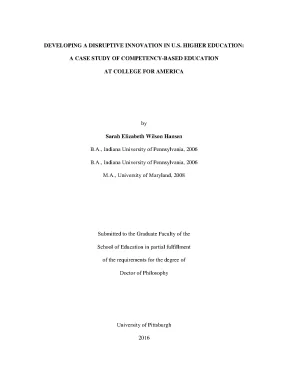
Tải xuống để đọc toàn bộDEVELOPING A DISRUPTIVE INNOVATION IN U. HIGHER EDUCATION: A CASE STUDY OF COMPETENCY-BASED EDUCATION AT COLLEGE FOR AMERICA by Sarah Elizabeth Wilson Hansen B., Indiana University of Pennsylvania, 2006 B., Indiana University of Pennsylvania, 2006 M., University of Maryland, 2008 Submitted to the Graduate Faculty of the School of Education in partial fulfillment of the requirements for the degree of Doctor of Philosophy University of Pittsburgh 2016 UNIVERSITY OF PITTSBURGH SCHOOL OF EDUCATION This dissertation was presented by Sarah E. Hansen It was defended on November 17, 2016 and approved by Dr. William Bickel, Associate Professor, Administrative and Policy Studies Dr.
James Jacob, Associate Professor, Administrative and Policy Studies Dr. Kristin Jones, Instructional Design Program Management Director/Academic Excellence, University of Washington Dr. Olson, Professor of Business Administration, Katz Graduate School of Business Dissertation Advisor: Dr. Sutin, Clinical Professor, Administrative and Policy Studies ii Copyright © by Sarah E.
Hansen 2016 iii DEVELOPING A DISRUPTIVE INNOVATION IN U. HIGHER EDUCATION: A CASE STUDY OF COMPETENCY-BASED EDUCATION AT COLLEGE FOR AMERICA Sarah Hansen, PhD University of Pittsburgh, 2016 Direct assessment competency-based education (CBE) is an online, self-directed learning innovation that is disrupting higher education. This study examined the development and early diffusion of direct assessment CBE at a private, nonprofit university. The purpose of this case study was to investigate the presence of organizational factors and the ways in which they affect planning, development, quality assurance, and delivery of the direct assessment CBE learning model.
This study was conducted at Southern New Hampshire University’s College for America (CfA). Ten executive leaders and CfA administrators were interviewed during this study. The interview guide was designed to elicit participants’ perceptions of the mission and vision of CfA, the involvement of external stakeholders in CfA’s development, strategies and challenges considered during CfA’s planning and implementation, the organizational structure and dissemination of resources between CfA and the university, critical success factors affecting CfA’s development, practices to ensure that quality learning and demonstration of learning occur, and how success is measured and evaluated. The researcher found that the missions of SNHU and CfA seem strongly aligned in support of student success and innovative learning models.
CfA’s culture incorporates these iv mission-oriented values as well as an appreciation for emergent, iterative improvement within an ongoing cycle of effort and feedback. This cycle is evident in CfA’s direct assessment learning model and promotes organizational learning across its employees. A strategic vision and implementation process for CfA were evident, following steps from Clayton Christensen’s disruptive innovation theory. Moreover, a balance between employee autonomy, leadership support, organizational decentralization, and dedicated resources (at the university and divisional level) were among the factors respondents consider critical to CfA’s development.
The findings suggest that organizational factors did influence the adoption and development of direct assessment CBE at College for America. Accordingly, leaders who are in the planning stages of an innovative project should contemplate their organization’s culture, how the organization is structured, the resources available to support the project, the extent to which project staff roles will depart from traditional employee roles within the institution, and how much autonomy and leadership support will be given to individuals in these roles. v TABLE OF CONTENTS PREFACE .1 PURPOSE OF THIS STUDY .3 DEFINITION OF TERMS .4 SIGNIFICANCE OF THE STUDY .5 OVERVIEW OF THE STUDY .0 REVIEW OF LITERATURE .1 DIRECT ASSESSMENT CBE AS DISRUPTIVE INNOVATION .1 History of Competency-Based Education in the United States .2 The Emergence of Direct Assessment CBE .3 Direct Assessment CBE as a Disruptive Innovation.2 DIFFUSION OF CBE RESEARCH MODEL .1 Diffusion of Innovation Theory .2 Developing a Research Model for Direct Assessment CBE .1 PURPOSE OF THE STUDY .2 RESEARCH QUESTIONS & PROPOSITIONS .3 UNIT OF ANALYSIS.4 LINKING DATA TO THE PROPOSITIONS .5 CRITERIA FOR INTERPRETING FINDINGS .2 PROCESSES OF IMPLEMENTATION .3 LOCUS OF CONTROL .1 ANSWERING THE RESEARCH QUESTIONS .2 IMPLICATIONS AND FUTURE RESEARCH .1 Implications for Practice .2 Implications for the Higher Education Industry .3 Implications for Policy .4 Limitations and Recommendations for Future Research. 157 viii LIST OF TABLES Table 1.
Task Complexity Factors Affecting the Acceptance of Direct Assessment CBE. Organizational Factors Affecting Perceptions of Direct Assessment CBE. Individual Factors Affecting Perceptions of Direct Assessment CBE. Organic Growth Factors Affecting Perceptions of Direct Assessment CBE.
Perceived Usefulness of Direct Assessment CBE. Perceived User Friendliness of Direct Assessment CBE. Perceived Voluntariness of Direct Assessment CBE. Subject Norms Surrounding Direct Assessment CBE.
Matrix of Study Propositions and Sources of Information. Functional Areas of College for America. Summary of Findings. 134 ix LIST OF FIGURES Figure 1.
Organizational Factors Affecting the Diffusion of Direct Assessment CBE. Model of Pattern Matching Process. CfA Curriculum and Assessment Development Process. Competency Areas in CfA Degrees.
CfA Sample Project Instructions for a BA in Healthcare Management. CfA Sample Project Rubric for a BA in Healthcare Management. (De)Centralization of Functions at SNHU. Cloud of Interviewees’ Most Frequently Stated Words.
Interviewees’ Most Commonly Linked Words. 127 x PREFACE Thank you to my family for your love and support, and especially to Sean for always being there no matter what the request or time of day. Sincere thanks to my doctoral committee members, who prompted me to balance solid academic research with the understanding, as Dr. Bickel constantly reminded me, that this is my first big study, not my last! Thanks as well to President Paul LeBlanc and the folks at SNHU and College for America for welcoming me and sharing insightful perspectives.
A special thanks to the professors throughout my higher education experience who motivated, challenged, and inspired me, including but not limited to: Barb Blackledge, Lynn Botehlo, Faedra Carpenter, Wendy Carse, Janet Goebel, Barbara Kraszewski, Laurie Frederick Meer, Charles Moseley, and Stu Sutin.0 INTRODUCTION I think we’re at a moment of time where the meaning and quality of a credential is in question. The exclusivity of the institution in having control over credentials is under challenge, if not direct assault. There are a lot of entities that are selling credentials. They are saying that there are all kinds of learning that are not degree-based and not necessarily academic institution-based.
Therefore, the next five to ten years will be about defining what credentials [academic institutions] are best suited for and what we are most credible at certifying. 31) Commonly referred to as the Information Age, the 21st century has been defined largely through the Digital Revolution, in which rapid technological advances have led to a global, knowledge economy. These advances have directly influenced the content, delivery, and value of higher education. Hawkins (2007) argues that a dominant educational paradigm persists in which economic development has become the primary function of higher education.
Moravec (2008) incorporates this economic imperative into his paradigm of knowledge production, asserting that the common mode of exchange in higher education is now the design, customization, and co- construction of goods and services. Moreover, educational stakeholders engaged in this exchange expect value-added features and returns on their investments. Such technological and cultural changes might seem challenging enough for higher education institutions (HEIs), but they are also occurring within an environment of economic crisis. As state and national budgets continue to decrease their educational spending, and students are made to bear more of the tuition costs, stakeholders on all sides of the equation consistently demand that institutions increase access, affordability, and quality (Immerwahr, Johnson, and Gasbarra, 2008).
12 Several scholars (Marshall, 2011; McFarlane 2011; Norris et al., 2013) posit that technology will remain a central driver of organizational change as higher education leadership seeks to address these issues. Indeed, digital technologies have driven disruptive change in higher education—and in organizations throughout the globe—since the turn of the 21st century. In particular, online learning has become a common element of higher education during this time.5% of higher education institutions offer some form of online coursework, online enrollment accounts for one-third of all higher education enrollments, and 70% of chief academic officers agree online education must be incorporated into their long-term institutional strategy (Allen and Seaman, 2013). Moreover, the percentage of institutions offering fully-online degree programs has doubled over the past 10 years (from 34.
In other words, within two decades, online education has evolved from an entirely new learning tool to a common and integral component of higher education. However, some technological changes have been more ephemeral or fad-like, temporarily disrupting higher education practices but then fading to the background. Massively Open Online Courses (MOOCs) stand as one such fad. While it surged into the higher education scene with vigor in 2008, it has since dwindled, as Allen and Seaman (2015) report, only 8% of institutions have MOOCs, and an overwhelming 87% are either undecided or unwilling to adopt this model.
Still, technological innovations in higher education abound, and online competency- based education (CBE) marks the latest in this line of disruptive technologies. Unlike MOOCs, CBE is gaining in prominence, most notably visible in the U. Department of Education’s approval—on an experimental basis—of federal financial aid for direct assessment (Bergeron, 2013) and the current funding streams from the U. government and foundations like Lumina and Bill and Melinda Gates specifically earmarked for CBE experimentation in higher education.
13 Cavanaugh (2013) suggests that historic emphasis on credits earned has overshadowed authentic assessment of learning outcomes, perpetuating subjective letter-grading that fails to accurately reflect levels of student learning. In contrast, online CBE—in particular, the direct assessment approach—favors education and assessment that is self-paced, asynchronous, industry-driven, and proficiency-based. To contemporary stakeholders, competency-based education is thus a tantalizing alternative to the traditional, arguably archaic model of higher education. Direct assessment CBE could be a fad that quickly dissipates, or it could be a lasting innovation with serious implications for higher education.
Accordingly, this dissertation investigates the defining features of direct assessment CBE, with focus on direct assessment as a distinct departure from traditional modes of higher education. I review available literature to understand direct assessment’s diffusion into higher education and why it is having such an influence in the field, particularly from the lens of educational access, affordability, and quality. Finally, this dissertation uses a case study to explore the successful implementation of a direct assessment model at an institution of higher education.1 PURPOSE OF THIS STUDY If one accepts that the direct assessment approach to CBE may be a lasting disruptive innovation, then it is important to learn about the organizational factors and change management practices that will aid in its adoption at other institutions. The purpose of this study, therefore, is to identify such factors and attempt to discern the ways in which they affect the planning, development, quality assurance, and delivery of direct assessment in higher education.2 RESEARCH QUESTIONS To answer the overarching question of why certain nonprofit institutions of higher education are experiencing success in diffusing online competency-based education, I will consider the following research questions in this study: 1.
When examining the implementation of a direct assessment CBE program at an institution of higher education, what organizational factors are present? 2. How do these organizational factors influence the diffusion of the direct assessment program? These questions constitute the broad scope of this research study, and they are described in further detail with corresponding study propositions in Chapter 3. Largely, I hypothesize that the presence of select organizational factors, such as leadership support, strategic vision, and processes for implementation, positively affect the successful adoption of direct assessment.3 DEFINITION OF TERMS The following terms are defined as they apply to this study. Competency-based Education (CBE): There are many different types of CBE that are being developed and implemented across the United States.
A review of literature suggests most CBE programs share the following common principles: • Competencies defined through multiple stakeholder input (e.
Nội dung được bảo vệ bản quyền — Tải xuống đầy đủ
Trích dẫn luận án này
Sarah Elizabeth Wilson Hansen (2016). Đổi mới giáo dục đại học: Nghiên cứu giáo dục dựa trên năng lực [Luận án tiến sĩ, University of Pittsburgh (School of Education)]. LuanAn.net. https://luanan.net/giao-duc-hoc/2016-12-16-hansen-sew-dissertation-mne-edits-12-16-20161
Câu hỏi thường gặp
Luận án "Đổi mới giáo dục đại học: Nghiên cứu giáo dục dựa trên năng lực" nghiên cứu về vấn đề gì?
Luận văn "hansen sew" được chỉnh sửa ngày 16/12/2016. Khám phá các khía cạnh quan trọng và kết quả nghiên cứu.
Luận án "Đổi mới giáo dục đại học: Nghiên cứu giáo dục dựa trên năng lực" được bảo vệ tại trường nào?
Luận án này được bảo vệ tại University of Pittsburgh (School of Education). Năm bảo vệ: 2016.
Luận án "Đổi mới giáo dục đại học: Nghiên cứu giáo dục dựa trên năng lực" thuộc chuyên ngành gì?
Luận án "Đổi mới giáo dục đại học: Nghiên cứu giáo dục dựa trên năng lực" thuộc chuyên ngành Administrative and Policy Studies / Education. Danh mục: Giáo Dục Học.
Luận án "Đổi mới giáo dục đại học: Nghiên cứu giáo dục dựa trên năng lực" có bao nhiêu trang?
Luận án "Đổi mới giáo dục đại học: Nghiên cứu giáo dục dựa trên năng lực" có 167 trang. Bạn có thể xem trước một phần tài liệu ngay trên trang web trước khi tải về.
Cách tải luận án "Đổi mới giáo dục đại học: Nghiên cứu giáo dục dựa trên năng lực" về máy như thế nào?
Để tải luận án về máy, bạn nhấn nút "Tải xuống ngay" trên trang này, sau đó hoàn tất thanh toán phí lưu trữ. File sẽ được tải xuống ngay sau khi thanh toán thành công. Hỗ trợ qua Zalo: 0559 297 239.