Quan điểm của giáo viên giáo dục thay thế về giảng dạy lớp học đa cấp và phát triển xã hội của học sinh
Luận văn tiến sĩ "jones dissertation final" ngày 16/06/2017. Khám phá sâu sắc về chủ đề nghiên cứu cốt lõi.
California State University, Fullerton
Educational Leadership P-12 Leadership
Luan An
Luận án tiến sĩ
Năm xuất bản
Số trang
105
Thời gian đọc
16 phút
Lượt xem
0
Lượt tải
0
Phí lưu trữ
40 Point
Tổng quan nhanh
- Chủ đề:
- 1. Jones Dissertation: Alternative Educators' Perceptions Studied
- Số trang:
- 105 trang
- Trường:
- California State University, Fullerton
- Chuyên ngành:
- Educational Leadership P-12 Leadership
- Tác giả:
- Gabriella Jones
- Năm:
- 2016
Tóm tắt nội dung luận án
I. Jones Dissertation Alternative Educators Perceptions Studied
This academic research explores alternative educators' perceptions. The focus is teaching multigrade classes. Views on student social development are also examined. Juveniles in the U.S. who commit offenses may attend alternative correctional schools. Research on general educators' perceptions of multigrade classes shows mixed findings. However, studies on alternative educators' perceptions remain scarce. This doctoral study by Gabriella Jones addresses this critical gap. It provides crucial insights into a specialized educational context. The final version of this thesis presents a comprehensive analysis.
1.1. Purpose of Doctoral Study on Educator Perceptions
The study's primary purpose is to capture alternative educators’ perceptions. These perceptions relate to multigrade teaching in alternative and correctional educational programs. The research specifically targets Southern California. A transformative worldview grounds the researcher. This approach advocates for marginalized groups. It also champions needed change within educational systems. This academic writing offers a unique contribution.
1.2. Scope and Significance of Jones s Academic Research
The scope covers educators in specific alternative settings. It includes correctional facilities. The significance lies in understanding challenges and opportunities. Multigrade classrooms present unique dynamics. This dissertation contributes to educational leadership knowledge. It informs policy and practice for vulnerable student populations. The Jones dissertation offers a foundational text.
1.3. Jones s Dissertation Foundational Context
This comprehensive doctoral study is submitted in partial fulfillment of requirements. It fulfills requirements for the Doctor of Education degree. The area is Educational Leadership P-12 Leadership. California State University, Fullerton, granted the degree. The final version represents extensive graduate research.
II. Researching Multigrade Teaching in Alternative Settings
Data collection for this significant academic research employed a quantitative method. An online survey served as the primary instrument. Sixty full-time alternative educators participated in the study. Their responses formed the basis of this thesis. This methodology ensures robust data for analysis. It provides measurable insights into educator perceptions. The approach aligns with rigorous doctoral study standards.
2.1. Methodology Quantitative Approach of Jones s Thesis
The quantitative method enabled systematic data gathering. This approach allowed for statistical analysis of perceptions. The survey instrument captured educators' views efficiently. It targeted specific demographic information. This robust methodology strengthens the findings of Jones's dissertation.
2.2. Data Collection from Alternative Educators
Educators from alternative and correctional programs participated. They worked across Southern California. The survey gathered information on their experiences. It focused on multigrade teaching environments. This direct input is crucial for understanding real-world scenarios. The data collection process was carefully managed.
2.3. Defining Perceptions Multigrade Teaching Focus
The study clearly defined 'alternative educators' perceptions.' These perceptions relate specifically to teaching multigrade classes. Understanding these focused views is paramount. It allows for targeted recommendations. This clear definition enhances the validity of this graduate research.
III. Key Findings Educator Views on Multigrade Teaching Impact
Overall findings indicate positive perceptions among educators. They focus strongly on academic performance. Their views on multigrade teaching are generally favorable. These insights are critical for educational practice and policy. The Jones dissertation offers detailed statistical results. It highlights specific trends and correlations. These findings contribute significantly to academic research in education.
3.1. General Perceptions of Multigrade Teaching
Educators largely expressed positive views. This positive outlook persisted despite the unique challenges. Multigrade settings in alternative schools present distinct circumstances. The focus on academic achievement remained central. This demonstrates a commitment to student success. The thesis details these broad positive sentiments.
3.2. Age Related Differences in Educator Views
Findings also revealed demographic variations. Educators 50 years of age and older held less positive perceptions. Counterparts aged 49 and under showed more favorable views. This age-related disparity warrants further investigation. It suggests potential differences in experience or training needs. Jones's academic writing highlights this nuance.
3.3. Social Development and Educator Perception Correlation
A significant correlation was identified. Educator perceptions of multigrade teaching connect with views on student social development. Safety and security are major concerns in these schools. Nevertheless, educators reported positive views related to cooperation. They also noted other forms of prosocial behavior. The helpfulness and leadership skills of older students were viewed as assets. This strengthens the argument for multigrade benefits. This PhD research deepens understanding of social dynamics.
IV. Jones s Dissertation Recommendations for Education Policy
The Jones dissertation provides concrete recommendations. These aim to improve alternative education systems. They address credential programs, support staff, and future academic research. These recommendations stem directly from the study's findings. They offer practical pathways for system enhancement. The final version emphasizes actionable changes for policy makers and practitioners.
4.1. Proposed Changes for Credential Programs
A key recommendation targets credential programs. These programs should incorporate training for teaching multigrade classes. Such training would better prepare educators for these specific environments. It addresses a current gap in educator preparation. This ensures future educators possess necessary skills for complex settings.
4.2. Enhancing Support for Multigrade Classrooms
Additional support staff is recommended. Classes with more than two grade levels would particularly benefit. This support alleviates educator workload. It also enhances the learning experience for students. Such resources are crucial for effective multigrade instruction. This strengthens the educational environment.
4.3. Future Directions for Academic Research and Doctoral Study
Further research is encouraged. Additional districts should be included in similar studies. A balanced sample, regarding age and gender, is crucial. Obtaining perceptions from correctional administrators offers a more holistic system view. These suggestions guide future PhD candidates. They ensure continued progress in graduate research. Jones's dissertation lays vital groundwork.
V. Academic Research Perceptions of Multigrade Classrooms
This doctoral study systematically reviews existing academic research. It provides a comprehensive literature review. Chapter 2 details scholarly empirical findings. This review establishes context for Jones's specific investigation. It highlights the importance of understanding educator perceptions. The broader academic writing landscape informs this specific thesis. It underscores the originality of Jones's contribution.
5.1. Literature Review Prior Studies on Multigrade Views
The review covers prior studies on educators’ perceptions. These studies focused on multigrade classrooms. The existing body of knowledge is synthesized. This includes diverse perspectives on teaching challenges and benefits. It sets the stage for understanding the scarcity of research in alternative settings.
5.2. Administrator and Educator Views A Synthesis
The literature also explores administrators' views. Their perspectives on multigrade classrooms are analyzed. This synthesis reveals areas of agreement and divergence. It demonstrates the multi-faceted nature of multigrade education. This helps frame Jones's focus on alternative educators.
5.3. Academic Performance and Social Growth in Multigrade Settings
Key literature discussing academic performance is reviewed. Social development in multigrade classrooms also receives attention. Research indicates various outcomes for students. This foundational knowledge is essential. It provides a benchmark for evaluating Jones's specific findings on alternative education contexts. This supports the significance of this PhD study.
Tải xuống file đầy đủ để xem toàn bộ nội dung
Tải đầy đủ (105 trang)Trích đoạn nội dung luận án
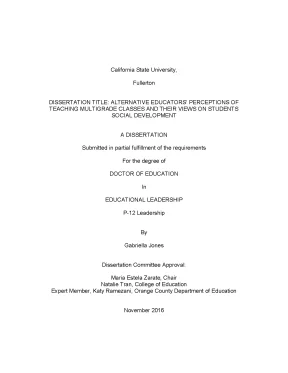
Tải xuống để đọc toàn bộCalifornia State University, Fullerton DISSERTATION TITLE: ALTERNATIVE EDUCATORS’ PERCEPTIONS OF TEACHING MULTIGRADE CLASSES AND THEIR VIEWS ON STUDENTS SOCIAL DEVELOPMENT A DISSERTATION Submitted in partial fulfillment of the requirements For the degree of DOCTOR OF EDUCATION In EDUCATIONAL LEADERSHIP P-12 Leadership By Gabriella Jones Dissertation Committee Approval: Maria Estela Zarate, Chair Natalie Tran, College of Education Expert Member, Katy Ramezani, Orange County Department of Education November 2016 Copyright 2016 © Gabriella Jones ALL RIGHTS RESERVED ii ABSTRACT Juveniles who commit offences in the U. may be mandated to attend school in alternative correctional facilities. Although there are mixed findings in research focusing on general educators’ perceptions of teaching multigrade classes, research on alternative educators’ perceptions is scarce. This dissertation captured alternative educators’ perceptions of multigrade teaching in alternative and correctional educational programs in Southern California.
The researcher is grounded in the transformative worldview advocating for the marginalized and for change as needed. An online survey was the quantitative method used to collect data from 60 full-time, alternative educators. Overall, the findings indicate that educators are focused on academic performance and have positive perceptions of multigrade teaching. However, the findings demonstrate that educators 50 years of age and older have less positive perceptions than their counterparts who are 49 and under.
The findings also indicate that there is a correlation between the educators’ perceptions of multigrade teaching and their views of student social development. Although safety and security is a major concern in alternative schools, educators have positive views related to cooperation and other forms of prosocial behavior. The educators view older students’ helpfulness and leadership skills as an asset in multigrade classrooms. It is recommended that additional districts be included in a similar study and that the sample be evenly iii distributed with regard to age and gender.
Obtaining the perceptions of correctional administers should also be included to gain a more holistic view of the system. It is also recommended that a change be made in credential programs to include training in teaching multigrade classes and that additional support staff be provided in classes with more than two grade levels. iv TABLE OF CONTENTS ABSTRACT. iii LIST OF TABLES.
ix CHAPTER 1: INTRODUCTION. 1 Background of the Problem. 9 Significance of the Study. 10 Scope of the Study.
11 Assumptions of the Study. 12 Definitions of Key Terms. 13 Organization of the Dissertation. 15 CHAPTER 2: REVIEW OF THE LITERATURE.
17 Review of the Scholarly Empirical Literature. 20 Educators’ Perceptions of Multigrade Classrooms. 21 Administrators’ Views on Multigrade Classrooms. 26 Academic Performance and Social Development in Multigrade Classrooms.
29 CHAPTER 3: RESEARCH METHODOLOGY. 41 Data Collection and Management. 42 Data Analysis and Interpretation. 54 Defining Alternative Educators’ Perceptions of Multigrade Teaching.
55 Educator’s Perceptions of Multigrade Teaching Vary. 57 Independent Samples of t-Test. 58 One-Way ANOVA. 61 Relationship of Educators’ Perceptions and Social Development.
62 Competition with Others. 63 Invites Cooperation and Others Forms of Prosocial Behavior. 64 Helpfulness and Leadership. 65 Competence with Themselves.
69 Interpretations and Implications. 73 Limitations of this Study. 74 Recommendations for Future Research. 75 Summary of the Dissertation.
PARTICIPANT INVITATION EMAIL. PARTICIPANT SURVEY FIRST REMINDER. PARTICIPANT SURVEY FINAL REMINDER. 96 vi LIST OF TABLES Table Page 1.
Differences in Educators’ Perceptions of Multigrade Teaching by Demographic Variables. Inter-item Correlations for Assessing Alternative Educators’ Perceptions. Results of t-test and Descriptive Statistics for Alternative Educators’ Perceptions by Gender. Results of t-test and Descriptive Statistics for Alternative Educators’ Perceptions by Type of Credential.
Results of t-test and Descriptive Statistics for Alternative Educators’ Perceptions by Years of Teaching Experience. Results of t-test and Descriptive Statistics for Alternative Educators’ Perceptions by Age Group. ANOVA of Alternative Educators’ Perceptions by Teaching Assignment. Correlations Between Educators’ Perceptions of Multigrade Teaching and Perceptions of Student Social Development.
67 vii To my wonderful daughter, Shannon, the truly insightful one, and To my amazing husband, Terry, for his infinite patience and support. viii ACKNOWLEDGMENTS This dissertation would not have been possible without the thirst for knowledge that was instilled in the foundation of my education at Ohio’s Bowling Green State University; California State University, Long Beach; and California State University, Dominguez Hills. These institutions enhanced my learning experience through well-developed programs, outstanding faculty and staff, high expectations and rigorous coursework, all of which inspired me to pursue a degree of Doctor of Education in Educational Leadership. There wasn’t a one-step guide or manual to prepare for the experiences encountered during this very worthwhile adventure.
Being dedicated to the task and having the support of those who knew and believed in my abilities was the driving force to completing this doctoral program. I would like to express my gratitude to the educators in the alternative and correctional education programs in Southern California for providing the input needed to complete my research. I would also like to thank the entire California State University, Fullerton, community for their assistance, the members in the cohort for being great learning partners, and my family and friends for their support. ix 1 CHAPTER 1 INTRODUCTION U.
federal policy and the California Constitution guarantee all students the right to a free public education (Cal. Several choices are available to parents and guardians when selecting a school at which to enroll their children. However, those choices are taken away when youths are mandated to receive their education at an institution that is operated by the Office of Juvenile Justice and Delinquency Prevention. These students are often placed in multigrade classrooms that serve grade levels that are significantly below and/or above their grade level.
Additionally, educators may be assigned to teach these classes with minimal to no experience and without concern for educators’ perceptions of teaching multigrade classes. This study will examine alternative educators’ perceptions of teaching multigrade classrooms in alternative correctional facilities. It will also explore how the educators’ perceptions vary and the impact of their perceptions on their views of student’s social development. Students who are mandated or court ordered to attend schools under the Juvenile Justice and Delinquency Prevention Act of 1974 temporarily or permanently lose their right to enroll in a school of their choice and therefore must attend school at an alternative correctional facility.
Nonetheless, every student in the United States, including those who are on probation, must be educated according to the same standards and expectations. Therefore, 2 educators, administrators, and parents or guardians of students attending schools within the juvenile justice system must ensure students are receiving a proper education. In addition, the education being provided must prove to be beneficial to the success of the student, as well as to the community and society at large. Juvenile justice institutions have a mission that includes an academic program that meets the competencies needed for students to be successful in K- 12 education and beyond.
The program provides a comprehensive education through engaging and rigorous coursework. Academic success is demonstrated when students attain proficiency level literacy skills and can accurately interpret and synthesize information. Students who do not obtain these skills may find themselves at greater risk of falling short of meeting their educational goals, which can negatively impact their future. These skills, along with the support and guidance of educators and other stakeholders, can provide the means for students to transition from making poor choices to making responsible decisions.
Educators who are properly trained can have a positive influence on their students’ decisions. Therefore, all educators should be provided with meaningful training, support, and guidance when teaching in multigrade classrooms. This is especially important for alternative educators who make decisions regarding teaching multigrade classes. According to Miller (1991) and Bandy and Gleadow (1980), educators in multigrade classrooms should not be ill-prepared, untrained, or inexperienced.
Educators must teach to the individual differences in multigrade classrooms. 3 When teachers are not prepared to teach varying ages and abilities, their instruction, and thus the students’ education, suffers. Furthermore, during the 1980 conference of the United Nations Education Science and Culture Organization (UNESCO), it was determined that several countries were experiencing problems with inadequately trained teachers in the multigrade classroom (UNESCO, 1981). Therefore, research suggests that educators who are properly trained, as well as those who acknowledge and prepare for the developmental differences in students’ needs (Miller, 1991), are best positioned to experience educational success with their students.
The three stakeholders that directly contribute to the success of student learning are teachers, students, and parents. Teachers are charged with providing an education that prepares students for college and career readiness, students are expected to successfully complete coursework to graduate with a high school diploma and become productive citizens, while parents are responsible for supporting their child’s academic and developmental needs. Although the three stakeholder groups (teachers, students, and parents) must work independently and collaboratively to ensure the greatest chance of educational success for all students, it is expected that teachers will effectively guide the students’ educational process. Background of the Problem Students whose delinquent behavior has led to a referral to the judicial system are enrolled in alternative education facilities throughout the United States.
This study will focus on educators’ perceptions from one of the alternative 4 education programs in California. The James County Department of Education (JCDE) is a public education organization located in Southern California. 1 The mission of JCDE is to inspire all students to discover their potential, develop their character, and maximize their learning so that they may become successful contributors to society. The JCDE has multiple divisions and prides itself in successfully graduating thousands of students each year.
This research will focus on one of the divisions: the Alternative and Correctional Education (ACE) programs. A Western Association of School and Colleges accredited program, ACE offers year-round educational options and services to students in over 50 programs located throughout James County, California. The ACE programs consist of juvenile justice institutions, student resource centers, group homes and James County-operated student service institutions, as well as James County community schools and community day schools. Students whose delinquent behavior has led to a referral to the judicial system are assigned to one of the correctional education components of ACE.
Generally, these students are delinquent, at risk of becoming repeat offenders, and/or have been placed on probation or sentenced to incarceration. ACE’s juvenile justice institutions comprise the following four residential, detention, and treatment facilities: James County Juvenile Hall, Student Guidance Center, Salea Institute, and the Marble Leadership Academy. The facilities operate under the Juvenile Justice and Delinquency Prevention Act of 1974. Although all four institutions have many variables in common, each 1 For the purpose of confidentiality, the county, cities, facilities, and titles of programs referred to in this study are pseudonyms.
5 institution has its own culture and programs that address the specific needs of the students at that particular site. Some examples of how the programs differ include ● the minimum length of time a student is required to be sentenced at one of the sites is six months, whereas at another site the timeframe may be as short as one day; ● the caliber of crimes committed by the students may range from a misdemeanor (e., probation violation) to a felony (e., murder); ● the student population could be all male or both genders; ● immediate medical attention is available at one site on a daily basis while at another site it may range from several hours to a couple days per week; ● varying elective courses are offered; and ● access to off-site activities, such as community service opportunities, educational fieldtrips, and sporting events varies.
Nội dung được bảo vệ bản quyền — Tải xuống đầy đủ
Trích dẫn luận án này
Gabriella Jones (2016). Giáo viên giáo dục thay thế: góc nhìn về lớp học đa cấp [Luận án tiến sĩ, California State University, Fullerton]. LuanAn.net. https://luanan.net/giao-duc-hoc/11-2017-06-16-jones-dissertation-final
Câu hỏi thường gặp
Luận án "Giáo viên giáo dục thay thế: góc nhìn về lớp học đa cấp" nghiên cứu về vấn đề gì?
Luận văn tiến sĩ "jones dissertation final" ngày 16/06/2017. Khám phá sâu sắc về chủ đề nghiên cứu cốt lõi.
Luận án "Giáo viên giáo dục thay thế: góc nhìn về lớp học đa cấp" được bảo vệ tại trường nào?
Luận án này được bảo vệ tại California State University, Fullerton. Năm bảo vệ: 2016.
Luận án "Giáo viên giáo dục thay thế: góc nhìn về lớp học đa cấp" thuộc chuyên ngành gì?
Luận án "Giáo viên giáo dục thay thế: góc nhìn về lớp học đa cấp" thuộc chuyên ngành Educational Leadership P-12 Leadership. Danh mục: Giáo Dục Học.
Luận án "Giáo viên giáo dục thay thế: góc nhìn về lớp học đa cấp" có bao nhiêu trang?
Luận án "Giáo viên giáo dục thay thế: góc nhìn về lớp học đa cấp" có 105 trang. Bạn có thể xem trước một phần tài liệu ngay trên trang web trước khi tải về.
Cách tải luận án "Giáo viên giáo dục thay thế: góc nhìn về lớp học đa cấp" về máy như thế nào?
Để tải luận án về máy, bạn nhấn nút "Tải xuống ngay" trên trang này, sau đó hoàn tất thanh toán phí lưu trữ. File sẽ được tải xuống ngay sau khi thanh toán thành công. Hỗ trợ qua Zalo: 0559 297 239.