Luận án tiến sĩ: Tác dụng synergic của sắn, bã bia, biochar lên sản xuất methane và hiệu suất vật nuôi nhai lại - Đại học Nông Lâm Huế 2020
Nghiên cứu ảnh hưởng phối hợp lá sắn, bã bia và biochar lên sản xuất methane và hiệu suất động vật nhai lại.
Luan An
Luận án
Năm xuất bản
Số trang
154
Thời gian đọc
24 phút
Lượt xem
0
Lượt tải
0
Phí lưu trữ
50 Point
Tổng quan nhanh
- Chủ đề:
- 1. Giải pháp giảm khí methane đường ruột từ sắn và biochar
- Số trang:
- 154 trang
- Trường:
- Trường Đại học Nông Lâm, Đại học Huế
- Chuyên ngành:
- Chăn nuôi
- Tác giả:
- Lê Thụy Bình Phương
- Năm:
- 2020
Tóm tắt nội dung luận án
I. Giải pháp giảm khí methane đường ruột từ sắn và biochar
Khí phát thải methane đường ruột từ gia súc nhai lại là nguyên nhân gây ô nhiễm môi trường. Khí này sinh ra từ quá trình lên men dạ cỏ. Methane thất thoát làm giảm 2-12% tổng năng lượng khẩu phần ăn của vật nuôi. Nhiều nghiên cứu tìm kiếm giải pháp thức ăn bổ sung sinh học để giảm thiểu khí thải. Việc kết hợp lá sắn, bã bia và than sinh học biochar chăn nuôi mang lại hiệu quả vượt trội. Nghiên cứu của Lê Thụy Bình Phương (2020) mở ra hướng đi bền vững. Khẩu phần phối hợp giúp cân bằng hệ vi sinh vật đường tiêu hóa. Năng lượng thất thoát qua khí thải được tận dụng cho tăng trọng. Giải pháp này phù hợp điều kiện chăn nuôi quy mô nông hộ và trang trại. Nguồn nguyên liệu sẵn có, giá thành thấp và dễ áp dụng vào thực tế sản xuất.
1.1. Thực trạng khí phát thải methane đường ruột trong chăn nuôi
Gia súc nhai lại như bò và dê tạo ra lượng lớn khí phát thải methane đường ruột. Hoạt động tiêu hóa chất xơ tại dạ cỏ tạo ra khí hydro tự do. Khí hydro kết hợp với cacbonic dưới tác động của vi sinh vật để tạo khí methane. Quá trình này gây lãng phí năng lượng thức ăn của gia súc. Biến đổi khí hậu toàn cầu đòi hỏi các biện pháp can thiệp dinh dưỡng cấp bách. Các hóa chất ức chế methane công nghiệp thường đắt đỏ và để lại tồn dư. Do đó, xu hướng quốc tế tập trung vào các nguồn thực vật giàu hoạt chất sinh học. Nghiên cứu tận dụng phụ phẩm nông nghiệp địa phương là mục tiêu trọng tâm hiện nay.
1.2. Xu hướng sử dụng thức ăn bổ sung tự nhiên giảm phát thải
Nguồn thức ăn tự nhiên giàu hợp chất thứ cấp đang được ưu tiên ứng dụng. Lá sắn chứa nhiều protein và các hợp chất chuyển hóa đặc thù. Phụ phẩm bã bia cung cấp dưỡng chất lên men và men vi sinh tự nhiên. Than sinh học biochar chăn nuôi hỗ trợ hấp phụ khí và cải thiện bề mặt tiêu hóa. Sự kết hợp ba thành phần tạo nên cơ chế bổ trợ lẫn nhau. Dinh dưỡng vật nuôi được cải thiện mà không gây tổn hại hệ vi sinh có lợi. Tỷ lệ khí phát thải methane đường ruột giảm rõ rệt qua các thử nghiệm. Xu hướng này đem lại lợi ích kép về kinh tế và môi trường sinh thái.
II. Tác động của lá sắn và tannin đến quá trình lên men dạ cỏ
Lá sắn là nguồn đạm thô dồi dào cho gia súc nhai lại tại vùng nhiệt đới. Hàm lượng protein thô trong lá sắn có thể đạt từ 20-25% vật chất khô. Sự hiện diện của tannin lá sắn tạo ra liên kết bền vững với protein. Phức hợp này bảo vệ protein không bị phân giải quá mức tại dạ cỏ. Nhờ đó, protein thoát qua dạ cỏ và đi xuống ruột non hấp thu hiệu quả hơn. Các giống sắn đắng như KM94 và KM140 chứa hàm lượng cyanogenic glucosides cao. Độc chất tiền thân cyanide trong lá sắn đắng có khả năng ức chế sinh khí mạnh mẽ. Quá trình lên men dạ cỏ được tái cấu trúc theo hướng có lợi cho vật nuôi.
2.1. Vai trò của tannin lá sắn và protein thoát qua dạ cỏ
Tannin lá sắn là hợp chất polyphenol có hoạt tính sinh học mạnh. Tannin tạo phức hợp tannin-protein bất hoạt tạm thời trong môi trường pH dạ cỏ. Điều này ngăn chặn sự phân hủy protein thành amoniac dư thừa. Lượng đạm quý giá được bảo toàn để chuyển xuống dạ múi khế và ruột non. Tại môi trường axit của ruột non, liên kết bị bẻ gãy giải phóng axit amin. Hiện tượng protein thoát qua dạ cỏ làm tăng tỷ lệ tiêu hóa axit amin thực tế. Động vật nhai lại nhận được nhiều dưỡng chất thiết yếu cho quá trình tổng hợp thịt. Hiện tượng này còn hạn chế lượng nitơ đào thải ra môi trường qua nước tiểu.
2.2. Ức chế vi khuẩn sinh methane methanogens bằng lá sắn đắng
Các giống sắn đắng chứa hàm lượng hợp chất cyanogenic glucosides rất cao. Khi vào dạ cỏ, các enzym thủy phân giải phóng một lượng hydro cyanide (HCN) nhỏ có kiểm soát. Nồng độ này ức chế trực tiếp quần thể vi khuẩn sinh methane methanogens. Nhóm vi sinh vật này chịu trách nhiệm chính trong việc hình thành khí thải. Thử nghiệm in vitro cho thấy lá sắn đắng giảm sản lượng methane nhiều hơn giống sắn ngọt Gon. Mật độ tế bào methanogens suy giảm làm gián đoạn chu trình chuyển đổi khí hydro. Lượng khí phát thải methane đường ruột giảm xuống mức tối ưu mà không làm xáo trộn hệ tiêu hóa.
2.3. Điều hòa tỷ lệ acetate trên propionate và axit béo bay hơi VFA
Quá trình lên men carbohydrate tại dạ cỏ sản sinh ra các axit béo bay hơi VFA. Ba axit chính gồm acetate, propionate và butyrate cung cấp năng lượng cho vật nuôi. Sự hiện diện của lá sắn điều chỉnh tỷ lệ acetate trên propionate theo hướng giảm dần. Con đường tạo propionate tiêu thụ hydro tự do, cạnh tranh trực tiếp với vi khuẩn sinh methane methanogens. Nồng độ propionate tăng đồng nghĩa với việc giữ lại nhiều năng lượng chuyển hóa hơn. Axit béo bay hơi VFA tổng số duy trì ở mức cao đảm bảo nhu cầu năng lượng. Cấu trúc lên men dạ cỏ trở nên tối ưu cho quá trình tích lũy mô cơ.
III. Phối hợp phụ phẩm bã bia ủ chua và sắn tối ưu tiêu hóa
Bã bia và bột củ sắn là những phụ phẩm nông công nghiệp giá trị cao. Bổ sung phụ phẩm bã bia ủ chua tạo điều kiện thuận lợi cho hệ vi sinh vật dạ cỏ phát triển. Bã bia chứa các peptide hòa tan, axit amin và thành phần prebiotic. Tinh bột sắn dễ tiêu cung cấp nguồn năng lượng phân giải nhanh. Năng lượng này hỗ trợ vi khuẩn phân giải chất xơ và cố định amoniac tự do. Sự phối hợp giữa bã bia và sắn giúp hóa giải độc tính cyanide từ lá sắn đắng. Vật nuôi dung nạp tốt khẩu phần chứa tỷ lệ lá sắn cao mà không gặp rối loạn chuyển hóa.
3.1. Giá trị dinh dưỡng của phụ phẩm bã bia ủ chua cho dạ cỏ
Phụ phẩm bã bia ủ chua rất giàu protein thô và xơ tiêu hóa chất lượng cao. Bã bia trải qua quá trình lên men chứa nhiều hợp chất nấm men và vitamin nhóm B. Các chất này đóng vai trò như chất kích thích sinh trưởng tự nhiên cho vi sinh vật dạ cỏ. Khả năng đệm của bã bia giúp ổn định độ pH dạ cỏ, ngăn ngừa nguy cơ toan hóa. Vi khuẩn phân giải cellulose hoạt động mạnh mẽ hơn khi có sự hiện diện của bã bia. Nhờ đó, tốc độ tiêu hóa xơ thô tăng cao, thúc đẩy lượng ăn vào của gia súc.
3.2. Cung cấp tinh bột sắn dễ tiêu tối ưu hóa năng lượng vi sinh
Tinh bột sắn dễ tiêu là nguồn carbohydrate hòa tan nhanh chóng trong dạ cỏ. Tinh bột cung cấp chuỗi khung cacbon cần thiết cho quá trình tổng hợp protein vi sinh vật. Khi kết hợp với nguồn nitơ vô cơ như urê, tinh bột sắn giúp đồng hóa amoniac triệt để. Tình trạng ngộ độc khí amoniac trong máu được loại trừ hoàn toàn. Hệ vi sinh vật phân giải được cung cấp đủ năng lượng để nhân đôi sinh khối. Hiệu suất chuyển hóa thức ăn tại dạ cỏ đạt mức cao nhất. Gia súc nhai lại duy trì trạng thái trao đổi chất cân bằng và liên tục.
3.3. Tác dụng prebiotic trung hòa độc lực cyanide trong dạ cỏ
Hệ men vi sinh trong bã bia ủ chua thể hiện đặc tính prebiotic vượt trội. Các chủng vi sinh vật kích thích hoạt tính enzyme rhodanese nội sinh. Enzyme này chuyển hóa cyanide độc hại thành thiocyanate không độc và đào thải dễ dàng. Nhờ cơ chế prebiotic, độc tố cyanide từ lá sắn đắng bị vô hiệu hóa nhanh chóng. Gia súc có thể tiêu thụ khẩu phần chứa tới 50% lá sắn đắng mà không bị ngộ độc. Khả năng ăn vào, sự thèm ăn và sức khỏe tổng thể của bò và dê được bảo toàn. Quá trình tiêu hóa dinh dưỡng diễn ra an toàn và ổn định.
IV. Ứng dụng than sinh học biochar chăn nuôi gia súc nhai lại
Than sinh học biochar chăn nuôi là vật liệu carbon xốp được sản xuất qua nhiệt phân sinh khối. Cấu trúc vi mô của biochar sở hữu diện tích bề mặt tiếp xúc cực lớn. Khi bổ sung vào khẩu phần thức ăn, than sinh học đóng vai trò như giá thể cố định vi sinh vật. Các vi khuẩn có lợi bám dính trên bề mặt biochar và hình thành màng sinh học bền vững. Than sinh học còn có khả năng hấp phụ chọn lọc các khí độc và chất ức chế tiêu hóa. Sự hiện diện của biochar cải thiện môi trường lên men dạ cỏ và giảm thiểu khí phát thải methane đường ruột.
4.1. Cơ chế hấp phụ và điều hòa sinh khí của than sinh học biochar
Than sinh học biochar chăn nuôi có cấu trúc xốp với hàng triệu vi mao quản dẫn khí. Bề mặt biochar mang điện tích giúp hấp phụ khí hydro dư thừa trong dạ cỏ. Khi hydro tự do bị giữ lại, nguồn nguyên liệu của vi khuẩn sinh methane methanogens bị cắt giảm. Quá trình sản sinh khí methane do đó bị ức chế mạnh mẽ. Biochar cũng đóng vai trò như chất dẫn truyền điện tử ngoại bào giữa các vi sinh vật. Dòng electron được chuyển hướng sang con đường tạo propionate giàu năng lượng. Kết quả là thể tích khí methane sinh ra giảm sâu mà không ảnh hưởng tới sự phân giải thức ăn.
4.2. Tăng cường lưu giữ nitơ và hiệu quả tiêu hóa ở gia súc nhai lại
Biochar có khả năng lưu giữ các ion amoni (NH4+) hòa tan trong dịch dạ cỏ. Sự phóng thích chậm nitơ giúp vi sinh vật hấp thụ tối đa để tạo protein tế bào. Thử nghiệm trên dê cho thấy khẩu phần có biochar làm tăng đáng kể lượng nitơ lưu giữ trong cơ thể. Tỷ lệ tiêu hóa dưỡng chất khô và hữu cơ đều có xu hướng tăng cao. Vật nuôi hấp thụ trọn vẹn các thành phần protein thoát qua dạ cỏ từ thức ăn thô xanh. Hiện tượng tiêu chảy và rối loạn tiêu hóa ở vật nuôi non giảm đi rõ rệt. Năng suất vật nuôi được cải thiện đồng thời giảm thiểu ô nhiễm phân bón.
V. Hiệu ứng synergic sắn bã bia biochar giảm khí methane
Sự kết hợp đồng vận (synergic effect) giữa sắn, bã bia và biochar tạo ra giải pháp đột phá. Mỗi thành phần đảm nhận một mắt xích quan trọng trong hệ tiêu hóa động vật nhai lại. Lá sắn đắng cung cấp đạm và ức chế vi khuẩn sinh methane methanogens. Phụ phẩm bã bia ủ chua đóng vai trò prebiotic bảo vệ niêm mạc và giải độc cyanide. Than sinh học biochar chăn nuôi hấp phụ khí và tối ưu hóa hệ vi sinh vật bám dính. Ba thành phần bổ trợ cho nhau tạo nên tác động cộng hưởng mạnh mẽ. Tỷ lệ phát thải khí nhà kính giảm sâu trong khi tốc độ tăng trọng vật nuôi tăng vượt bậc.
5.1. Hiệu ứng cộng hưởng giảm thiểu khí methane in vitro và in vivo
Các thí nghiệm ủ in vitro và thử nghiệm trực tiếp in vivo trên gia súc xác nhận hiệu ứng synergic. Sản lượng khí phát thải methane đường ruột giảm mạnh nhất khi kết hợp đủ cả ba yếu tố. Tác dụng cộng hưởng vượt trội hơn hẳn so với việc sử dụng từng thành phần đơn lẻ. Quá trình lên men chuyển dịch mạnh mẽ theo hướng giảm tỷ lệ acetate trên propionate. Lượng axit béo bay hơi VFA có lợi cho tích lũy năng lượng tăng cao. Tannin lá sắn và biochar cùng phối hợp ngăn chặn quá trình sinh hydro tự do. Methane giảm giúp giảm thiểu dấu chân carbon trong ngành chăn nuôi gia súc nhai lại.
5.2. Nâng cao năng suất thịt và cải thiện sức khỏe vật nuôi bền vững
Khẩu phần kết hợp tối ưu giúp gia súc tăng trọng nhanh và nâng cao tỷ lệ chuyển hóa thức ăn. Bò và dê duy trì sức khỏe tốt, lông mượt và tăng khả năng kháng bệnh đường ruột. Việc tận dụng tinh bột sắn dễ tiêu và nguồn đạm từ phụ phẩm giúp giảm giá thành chăn nuôi. Người nông dân có thể tự phối trộn thức ăn từ các nguyên liệu sẵn có tại địa phương. Mô hình này mở ra giải pháp chăn nuôi xanh, thích ứng với biến đổi khí hậu toàn cầu. Hiệu quả kinh tế của trang trại tăng lên song hành với mục tiêu bảo vệ môi trường bền vững.
Mục lục chi tiết luận án
Tải xuống file đầy đủ để xem toàn bộ nội dung
Tải đầy đủ (154 trang)Trích đoạn nội dung luận án
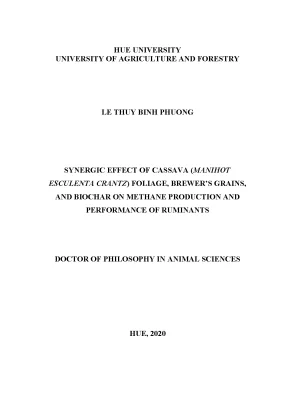
Tải xuống để đọc toàn bộHUE UNIVERSITY UNIVERSITY OF AGRICULTURE AND FORESTRY LE THUY BINH PHUONG SYNERGIC EFFECT OF CASSAVA (MANIHOT ESCULENTA CRANTZ) FOLIAGE, BREWER’S GRAINS, AND BIOCHAR ON METHANE PRODUCTION AND PERFORMANCE OF RUMINANTS DOCTOR OF PHILOSOPHY IN ANIMAL SCIENCES HUE, 2020 luan an HUE UNIVERSITY UNIVERSITY OF AGRICULTURE AND FORESTRY LE THUY BINH PHUONG SYNERGIC EFFECT OF CASSAVA (MANIHOT ESCULENTA CRANTZ) FOLIAGE, BREWER’S GRAINS, AND BIOCHAR ON METHANE PRODUCTION AND PERFORMANCE OF RUMINANTS SPECIALIZATION: ANIMAL SCIENCES CODE: 9620105 DOCTOR OF PHILOSOPHY IN ANIMAL SCIENCES SUPERVISOR 1: ASSOC. NGUYEN HUU VAN SUPERVISOR 2: DR. DINH VAN DUNG HUE, 2020 luan an Declaration I declare that this dissertation is the result of my work and that it has not been presented previously as a dissertation at this university or elsewhere. To the best of my knowledge, it does not breach copyright law, and has not been taken from other sources except where such work has been cited and acknowledged within the text.
All results have been published at Journal of Livestock Research for Rural Development (LRRD) http://www.org/ Hue University, 2020 Le Thuy Binh Phuong i luan an Dedication To my parent who spends their immense loves to me. To my husband, Than Van Dang, and my two daughters, Than Ngoc Kim Nguyen and Than Ngoc Hai An, who encouraged me to pursue my dreams. Acknowledgements ii luan an My Ph. has been an amazing experience with Professor Thomas Reginal Preston.
He has been teaching me how good experiment is done and how to be real researcher. I have been grown up like that, thus, I would like to thank with all my heart to his guidance. I am thankful to Professor Ron A. Leng who gave me the background knowledge in biochemistry for stimulating the ideas in research.
I would like to thanks to Assoc. Nguyen Huu Van and Dr. Dinh Van Dung who gave me the most helpful advice and instructed me to complete the dissertation. I gratefully acknowledge financial support from the SIDA-financed project, MEKARN II for 3 years that made my Ph.
My classmate in Ph. course, the group is source of friendship as well as good collaboration. Lastly, I would like to thank my family for all their love and encouragement. For my parents who take care of my children during course time and support me to participate in learning and research activities.
Most of all for my loving, supportive, encouraging, and patient husband Dang who faithful support during the final stages of this Ph. is so appreciated. iii luan an Abstract This dissertation was aimed to develop a greater understanding of both the constraints in the presence of cyanide toxin and benefits of using cassava foliage as bypass protein in order to improve its utilization in ruminant feeding systems. The study comprised two in vitro rumen incubations, one feeding trial on cattle and a digestibility/N retention experiment on goats, in each case involving comparisons of varieties of cassava known to be rich (KM94) or poor (Gon) in cyanogenic glucosides.
In the first experiment (Chapter 2), cassava foliage varieties (Japan, KM94, KM140 and Gon) with different level of cyanide concentration were considered their effect on methane production in ruminal in vitro incubation. The second experiment (Chapter 3) examined the relative responses of cattle fed cassava root pulp and urea as basal diet with foliage from “sweet” (Gon) or “bitter” (KM140) cassava foliage as protein source. The third experiment (Chapter 4) determined methane production in an in vitro rumen incubation of cassava pulp - urea with additives of brewers’ grain, rice wine yearst culture, yeast-fermented cassava pulp and leaves of sweet or bitter cassava variety. The fourth experiment (Chapter 5) measured effect of additives (brewer’s grain and biochar) on the nitrogen retention and rumen methane production when goats had access to mixed sweet and bitter varieties of cassava foliage compared with the sweet variety alone.
The results of these experiments indicated that bitter cassava foliage containing high levels of cyanogenic glucosides greatly reduces methane production, compared with sweet varieties, in the rumen in vitro incubations. However, the toxicity of cyanide in vivo in ruminants (cattle and goats) can be reduced by “prebiotic” properties provided by either brewers’ grains or biochar. In the presence of these “prebiotics”, HCN-linked challenges from feeding bitter cassava leaves at up to 50% of the diet of goats did not negatively impact to feed intake, growth and animal health. On the contrary, the HCN precursors present in bitter cassava leaves may lead to a partial shift in digestion of nutrients from the rumen to the lower parts of the ruminant digestive tract leading to improvement in productivity.
Key words: Prebiotic, cyanide, bitter cassava, rumen fermentation, in vitro. iv luan an Table of Contents List of Figures.ix List of Tables. Aim and objective of the study.1 Aims of the study.2 Objective of the study. Significant/Innovation of study.1 Rumen fermentation and methane production.2 Volatile fatty acid pattern.9 Pathway of methane production.5 Effect of feeding system on rumen fermentation.2 Understanding ruminal microorganism.1 The self-detoxify mechanism of ruminal microbes.2 Interaction of ruminal microorganism in biofilm formation.3 Using agro-industrial by-products for ruminant feeding system.19 Effect of tannin content in cassava leaves on the ruminant feeding system.21 Cyanogenic glucosides in cassava leaf.25 v luan an New potentially application on mitigation of HCN effect.30 Using brewers grain in ruminant feeding.3 Potential using cassava root pulp as energy source or protein enrichment source .4 Biochar: application as an additive.4 Supplementary Saccharomyces cerevisiae: concept on detoxification.
METHANE PRODUCTION IN AN IN VITRO FERMENTATION OF CASSAVA PULP WITH UREA WAS REDUCED BY SUPPLEMENTATION WITH LEAVES FROM BITTER, AS OPPOSED TO SWEET, VARIETIES OF CASSAVA.2 Materials and methods.64 Location and duration.3 Results and discussion.4 Conclusions and recommendation. A LOW CONCENTRATION (4% IN DIET DRY MATTER) OF BREWERS’ GRAINS IMPROVES THE GROWTH RATE AND REDUCES THIOCYANATE EXCRETION OF CATTLE FED CASSAVA PULP-UREA AND “BITTER” CASSAVA FOLIAGE.75 vi luan an 3.2 Materials and methods.78 Location and duration.78 Treatments and experimental design.78 Animals and housing.79 Feeding and management.79 Data collection and measurements.3 Results and discussion.4 Conclusions and recommendation. METHANE PRODUCTION IN AN IN VITRO RUMEN INCUBATION OF CASSAVA PULP-UREA WITH ADDITIVES OF BREWERS’ GRAIN, RICE WINE YEAST CULTURE, YEAST-FERMENTED CASSAVA PULP AND LEAVES OF SWEET OR BITTER CASSAVA VARIETY.2 Materials and methods.97 Location and duration.97 Treatments and design.97 In vitro incubation.3 Results and discussion.4 Conclusions and recommendation. EFFECT OF ADDITIVES (BREWER’S GRAIN AND BIOCHAR) AND CASSAVA VARIETY (SWEET VERSUS BITTER) ON NITROGEN vii luan an RETENTION, THIOCYANATE EXCRETION AND METHANE PRODUCTION BY BACH THAO GOATS.2 Materials and Methods.111 Location and duration.111 Feeds and feeding.112 Animals and feeding system.3 Results and discussion.4 Conclusions and recommendation.
GENERAL DISCUSSION AND CONCLUSIONS.3 Implication and further research. PROTOCOL D1- DETERMINATION OF THIOCYANATE IN URINE. 139 List of Figures Figure 1.1 Pathway of VFA in metabolism.2 The reaction of methane generation.10 viii luan an Figure 1.3 The pathway of hexose conversation to end-products.4 A sulfurtransferase reaction catalyzed by rhodanese.5 The porous structure of biochar invites microbial colonization- pine saw dust-derived biochar.1 Relationship between methane in the gas and HCN content in treatments.2 Effect of HCN content in treatment on ammonia production is expressed as all data in each treatment during the in vitro fermentation.3 Effect of HCN content in treatment on ammonia production is expressed as average in each treament.1 The negligible growth rate of Laisind cattle fed bitter cassava foliage as protein source in Period 1 was dramatically increased by adding 4% of brewers’ grains to the diet in Period 2.2 Growth curves of Laisind cattle showing the change in live weight gain after introduction of 4% brewers’ grains (as % of diet DM) to those fed bitter cassava foliage.3 Mean values for VFA proportions in rumen fluid from cattle in Period 2.1 Effect of additives, and source of cassava leaf (bitter or sweet variety) on gas production after 24h fermentation.2 Effect of stage of the fermentation on the methane content of the gas.3 Effect of additives, and source of cassava leaf on methane content of the gas after 24h fermentation.4 Interaction between source of cassava leaf and additive with brewers’ grains on methane content in the gas.5 Viable Saccharomyces cells in brewers’ grain and in cassava pulp fermented only with yeast (YFCP) or with yeast and urea (YFCP-U-DAP) after 07 days of fermentation.6 Lactobacilli in brewers’ grain and in cassava pulp fermented only with yeast (YFCP) or with yeast and urea (YFCP-U-DAP) after 07 days of fermentation.1 Condensed tannin in petiole and leaf from cassava foliage.2 HCN equivalent in petiole and leaf from cassava foliage.116 ix luan an Figure 5.3 DM intake of leaf and petiole of sweet and bitter cassava varieties when the goats had free access to both (sweet+ bitter foliage) in Square 2.4 Individual and combined effects of additives and source of cassava foliage on N retention; (SW as Sweet; SW-BIT as Sweet and Bitter).5 Bach Thao goat from Latin Square 2.6 Methane: carbon dioxide ratios in mixed eructed gas and air in goats.7a Relationship between methane: carbon dioxide ratio in mixed eructed gas and air and nitrogen retention (includes all 8 goats).7b Relationship between methane: carbon dioxide ratio and nitrogen retention (excluding the outlier result).121 x luan an List of Tables Table 1.1 Nutrient composition of fresh cassava leaf.2 Essential amino acid profile of cassava leaf.3 Chemical composition of brewers’ grain.1 Composition of the substrates.2 Ingredients in buffer solution.3 Chemical composition of the ingredients in the substrate.4 Mean values for gas production in 24 hours, methane in the gas and per unit DM mineralized in an in vitro rumen fermentation.5 Mean values for content of condensed tannin and HCN in the leaves of sweet and bitter varieties of cassava leaves, ammonia concentration and methane production per DM mineralized after 24h incubation.1 The chemical composition of ingredients.2a Mean values for feed intake, change in live weight and feed conversion of Laisind cattle in Period 1. Mean values for feed intake, change in live weight and feed conversion of Laisind cattle (in Period 2).3 Mean values for thiocyanate in the urine of cattle.4 Mean values for VFA proportions in rumen fluid of cattle (in Period 2).5 Mean values of methane: carbon dioxide ratios in mixed eructed gas/air of cattle.1 Chemical composition of substrates.2a Effect of source of cassava variety on gas production and methane percentage in the gas.2b Effect of additive on gas production and methane percentage in the gas.1 Layout of each Latin Square.2 Dry matter (DM) and crude protein (CP) of ingredients.112 xi luan an Table 5.3 Mean values for effects of cassava foliage (sweet or bitter) on % DM, tannin and HCN equivalent in leaves and petioles.4 Mean intakes of leaf and petiole for the goats in Square 2 that had free access to foliage of both sweet and bitter varieties.5 Mean values (g/d) for effects of cassava foliage (bitter or sweet) and of additives on DM intake (DMI), apparent digestibility of DM and crude protein (CP) and N balance.6 Mean values for effects of additives on N retention.7 Mean values for VFA proportions (mol %), acetic: propionic ratio, rumen ammonia, daily urine volume, daily excretion of thiocyanate (SCN) in urine and CH4:CO2 ratio in mixed eructed gas and air.119 xii luan an Abbreviation ADG Average daily gain ATP Adenosine tri-phosphate ADF Acid detergent fiber BG Brewers’ grain CP Crude protein CF Crude fiber CFU Colony-forming unit DM Dry matter DMI Dry matter intake EPS Extracellular polymeric substances EE Ether extract HCN Hydrocyanic acid GE Gross energy xiii luan an LW Live weight MOS Manna-oligosaccharide N Nitrogen NADH Nicotinamide adenine dinucleotide hydride NDF Neutral detergent fiber NPN Non-protein nitrogen RDP Rumen degradable protein Phosphoenolpyruvate PEP Standard error mean SEM UDP Un-degradable protein VFA Volatile fatty acid xiv luan an INTRODUCTION 1.
Problem statement Cassava is perspective plant to climate change adaptation; its pests and its diseases resistance and greater drought tolerance is a major factor in ranking cassava in the food security of the world (Jarvis et al.
Nội dung được bảo vệ bản quyền — Tải xuống đầy đủ
Trích dẫn luận án này
Lê Thụy Bình Phương (2020). Tác dụng synergic của sắn, bã bia, biochar giảm khí methane trong chăn nuôi [Luận án tiến sĩ, Trường Đại học Nông Lâm, Đại học Huế]. LuanAn.net. https://luanan.net/chan-nuoi-thu-y/dinh-duong-dong-vat/ruminants
Câu hỏi thường gặp
Luận án "Tác dụng synergic của sắn, bã bia, biochar giảm khí methane trong chăn nuôi" nghiên cứu về vấn đề gì?
Nghiên cứu ảnh hưởng phối hợp lá sắn, bã bia và biochar lên sản xuất methane và hiệu suất động vật nhai lại.
Luận án "Tác dụng synergic của sắn, bã bia, biochar giảm khí methane trong chăn nuôi" được bảo vệ tại trường nào?
Luận án này được bảo vệ tại Trường Đại học Nông Lâm, Đại học Huế. Năm bảo vệ: 2020.
Luận án "Tác dụng synergic của sắn, bã bia, biochar giảm khí methane trong chăn nuôi" thuộc chuyên ngành gì?
Luận án "Tác dụng synergic của sắn, bã bia, biochar giảm khí methane trong chăn nuôi" thuộc chuyên ngành Chăn nuôi. Danh mục: Dinh Dưỡng Động Vật.
Luận án "Tác dụng synergic của sắn, bã bia, biochar giảm khí methane trong chăn nuôi" có bao nhiêu trang?
Luận án "Tác dụng synergic của sắn, bã bia, biochar giảm khí methane trong chăn nuôi" có 154 trang. Bạn có thể xem trước một phần tài liệu ngay trên trang web trước khi tải về.
Cách tải luận án "Tác dụng synergic của sắn, bã bia, biochar giảm khí methane trong chăn nuôi" về máy như thế nào?
Để tải luận án về máy, bạn nhấn nút "Tải xuống ngay" trên trang này, sau đó hoàn tất thanh toán phí lưu trữ. File sẽ được tải xuống ngay sau khi thanh toán thành công. Hỗ trợ qua Zalo: 0559 297 239.