The role of sox4 in regulating choroid fissure closure and retina
Vai trò của Sox4 trong điều hòa đóng khe màng mạch và phát triển võng mạc. Khám phá cơ chế phân tử và ý nghĩa sinh học.
Luan An
Doctoral Dissertation
Năm xuất bản
Số trang
210
Thời gian đọc
32 phút
Lượt xem
0
Lượt tải
0
Phí lưu trữ
50 Point
Tổng quan nhanh
- Chủ đề:
- SOX4 Gene's Critical Role in Vertebrate Ocular Development
- Số trang:
- 210 trang
- Trường:
- University of Kentucky
- Chuyên ngành:
- Biology
- Tác giả:
- Wen Wen
- Năm:
- 2016
Tóm tắt nội dung luận án
I.SOX4 Gene s Critical Role in Vertebrate Ocular Development
Sự phát triển mắt ở động vật có xương sống được kiểm soát chặt chẽ bởi các quy định di truyền chính xác. Từ một mầm mắt duy nhất đến đôi mắt song phương với cấu trúc và loại tế bào phức tạp, quá trình này đòi hỏi sự tăng sinh và di chuyển mạnh mẽ của các tế bào. Các tế bào ở cả ngoại bì và trung bì tham gia vào quá trình hình thái học mắt. Trong quá trình này, sự biệt hóa và tương tác tế bào diễn ra để thiết lập thành phần phức tạp của các loại tế bào mắt và các kết nối tế bào. Các khiếm khuyết di truyền có thể dẫn đến những bất thường nghiêm trọng trong hình thái học mắt và sự biệt hóa tế bào trong quá trình phát triển mắt. Đã có rất nhiều công việc được thực hiện để xác định cả các yếu tố nội tại và ngoại tại điều chỉnh sự phát triển mắt. Tuy nhiên, cần nhiều công việc hơn để hiểu đầy đủ quá trình phức tạp này. SOX4 được biết đến là một chất hoạt hóa phiên mã điều chỉnh sự sống sót và biệt hóa tế bào trong nhiều mô phôi trong quá trình phát triển. Bằng chứng về yêu cầu của nó trong quá trình phát triển mắt gần đây đã xuất hiện, nhưng cơ chế mà SOX4 điều chỉnh sự phát triển mắt còn xa mới được làm rõ.
1.1. Sự phức tạp của hình thái học mắt ở động vật có xương sống
Hình thái học mắt là một quá trình phát triển sinh học vô cùng phức tạp. Nó bao gồm nhiều giai đoạn liên tiếp, mỗi giai đoạn được điều hòa bởi các tương tác di truyền cụ thể. Từ sự hình thành túi thị giác ban đầu đến sự biệt hóa thành các cấu trúc tinh vi như võng mạc và thủy tinh thể, mọi bước đều rất quan trọng. Những sai sót trong quá trình này có thể dẫn đến các dị tật bẩm sinh nghiêm trọng. Các yếu tố nội tại và ngoại tại điều chỉnh chặt chẽ từng giai đoạn của quá trình phát triển mắt. Nắm vững những tương tác này là chìa khóa để hiểu về sự hình thành mắt khỏe mạnh.
1.2. Vai trò rộng lớn của yếu tố phiên mã SOX4 trong biệt hóa tế bào
SOX4 là một yếu tố phiên mã quan trọng, được biết đến với khả năng điều hòa sự sống sót và biệt hóa tế bào. SOX4 hoạt động trong nhiều mô phôi khác nhau trong quá trình phát triển. Các yếu tố phiên mã SOX có vai trò đa dạng trong quá trình sinh phôi. Mặc dù vai trò của SOX4 trong phát triển mắt mới được công nhận, tầm quan trọng của nó ngày càng rõ nét. Tuy nhiên, cơ chế phân tử chính xác mà SOX4 điều chỉnh các khía cạnh cụ thể của ocular development vẫn chưa được hiểu rõ hoàn toàn. Nghiên cứu sâu hơn là cần thiết để làm sáng tỏ các con đường này.
II.SOX4 Điều hòa Đóng khe hở màng mạch trong quá trình phát triển mắt
Nghiên cứu này tập trung vào vai trò của SOX4 trong việc điều hòa quá trình đóng khe hở màng mạch. Đây là một bước quan trọng trong sự phát triển mắt. Việc đóng khe hở không thành công có thể dẫn đến các dị tật mắt bẩm sinh nghiêm trọng. Cơ chế chính xác SOX4 tác động lên quá trình này vẫn còn là một lĩnh vực nghiên cứu tích cực. Các phát hiện cung cấp bằng chứng cụ thể về ảnh hưởng của SOX4. Nó là một yếu tố quan trọng đối với eye morphogenesis bình thường.
2.1. Quá trình quan trọng của sự hợp nhất khe hở màng mạch
Đóng khe hở màng mạch (choroid fissure closure) là một giai đoạn thiết yếu của quá trình phát triển mắt. Khe hở màng mạch là một cấu trúc tạm thời trong quá trình hình thành mắt. Sự hợp nhất thành công của khe hở này là bắt buộc. Nó đảm bảo sự toàn vẹn của cuống thị giác và võng mạc. Thất bại trong quá trình optic fissure fusion dẫn đến một tình trạng gọi là coloboma. Coloboma là một dị tật bẩm sinh nghiêm trọng, ảnh hưởng đến các cấu trúc mắt khác nhau. Hiểu biết về các yếu tố điều hòa quá trình này là rất quan trọng.
2.2. Sự thiếu hụt SOX4 làm suy yếu đóng khe hở thị giác
Các dữ liệu nghiên cứu chỉ ra rằng sự thiếu hụt SOX4 gây ra các khuyết tật trong việc đóng khe hở màng mạch. Thực nghiệm cho thấy việc giảm biểu hiện SOX4 dẫn đến sự thất bại của optic fissure fusion. Điều này ảnh hưởng trực tiếp đến eye morphogenesis. Phát hiện này củng cố vai trò trung tâm của SOX4 gene. Nó là cần thiết cho sự phát triển mắt bình thường. Sự suy yếu này làm tăng nguy cơ coloboma. Hiểu rõ cơ chế này là bước tiến trong developmental biology.
III.Con đường tín hiệu Hedgehog và sự hợp nhất khe hở thị giác
Nghiên cứu sâu hơn đã làm sáng tỏ cơ chế phân tử mà SOX4 điều hòa quá trình đóng khe hở màng mạch. Một con đường tín hiệu quan trọng đã được xác định. Con đường tín hiệu Hedgehog (Hh) đóng vai trò trung gian trong tác động của SOX4. Sự điều hòa không chính xác của con đường này là nguyên nhân chính gây ra các khuyết tật. Việc hiểu rõ mối liên hệ này là rất quan trọng. Nó cung cấp cái nhìn sâu sắc về các cơ chế cơ bản của ocular development.
3.1. Tín hiệu Hedgehog tăng cao và các khuyết tật khe hở
Sự thiếu hụt SOX4 dẫn đến sự tăng cao trong con đường tín hiệu Hedgehog. Sự điều hòa tăng cường của Hh signaling pathway này là nguyên nhân trực tiếp gây ra các khuyết tật. Nó làm thay đổi ranh giới gần-xa của túi thị giác. Cuối cùng, tín hiệu Hh tăng cao ức chế choroid fissure closure. Phát hiện này cung cấp một liên kết cơ học rõ ràng. Nó giải thích cách SOX4 điều chỉnh optic fissure fusion. Điều này rất quan trọng đối với retinal development khỏe mạnh.
3.2. Vai trò của Indian hedgehog b trong ranh giới cốc thị giác
Cụ thể, việc giảm biểu hiện SOX4 gây ra sự điều hòa tăng lên của ligand Indian hedgehog b (ihhb). ihhb là một yếu tố tín hiệu Hedgehog quan trọng. Sự tăng cường biểu hiện ihhb làm thay đổi ranh giới gần-xa của túi thị giác. Thay đổi này trực tiếp ức chế quá trình đóng khe hở màng mạch. Do đó, SOX4 điều chỉnh choroid fissure closure thông qua việc kiểm soát biểu hiện của ihhb. Sự mất cân bằng này có thể dẫn đến coloboma và các congenital eye defects khác.
IV.Mô hình cá ngựa vằn để nghiên cứu SOX4 trong phát triển võng mạc
Cá ngựa vằn là một mô hình sinh vật tuyệt vời cho các nghiên cứu phát triển. Phôi cá ngựa vằn trong suốt, cho phép quan sát trực tiếp quá trình ocular development. Hơn nữa, khả năng thao tác di truyền ở cá ngựa vằn rất hiệu quả. Nghiên cứu này đã sử dụng rộng rãi mô hình cá ngựa vằn để khám phá chức năng của SOX4 gene. Việc sử dụng các công cụ di truyền tiên tiến đã cung cấp những hiểu biết sâu sắc về vai trò của SOX4 trong retinal development và eye morphogenesis.
4.1. Hồ sơ biểu hiện của các đồng bản SOX4 ở cá ngựa vằn
Nghiên cứu đã đặc trưng hóa hồ sơ biểu hiện của các đồng bản sox4 của cá ngựa vằn, sox4a và sox4b. Sự phân bố biểu hiện của chúng trong mắt đang phát triển đã được lập bản đồ. Việc hiểu các kiểu biểu hiện không gian và thời gian này là rất quan trọng. Nó xác định các khu vực và giai đoạn mà SOX4 hoạt động mạnh mẽ. Thông tin này là nền tảng. Nó giúp làm rõ vai trò cụ thể của SOX4 trong retinal development. Nó cũng cho thấy cách SOX transcription factors điều hòa sự phát triển mắt.
4.2. Chỉnh sửa bộ gen tiên tiến cho dòng đột biến SOX4
Ban đầu, các thí nghiệm giảm biểu hiện bằng morpholino đã cung cấp những hiểu biết quan trọng. Để củng cố những phát hiện này, các dòng cá ngựa vằn đột biến sox4 đã được tạo ra. Hệ thống chỉnh sửa bộ gen CRISPR/Cas9 đã được sử dụng. Công cụ chính xác này cho phép tạo ra các đột biến ổn định, có thể di truyền. Đặc điểm của các dòng đột biến này cung cấp bằng chứng quyết định. Nó xác nhận vai trò của SOX4 trong choroid fissure closure. Nó cũng làm sáng tỏ vai trò của SOX4 trong ocular development và các congenital eye defects.
V.Ý nghĩa đối với Coloboma và các dị tật mắt bẩm sinh
Những phát hiện từ nghiên cứu này có ý nghĩa lâm sàng sâu sắc. Chúng góp phần đáng kể vào sự hiểu biết về coloboma và các dị tật mắt bẩm sinh khác. Việc xác định SOX4 và con đường tín hiệu Hedgehog cung cấp mục tiêu tiềm năng cho chẩn đoán và điều trị. Sự hiểu biết sâu sắc hơn về cơ chế phân tử có thể dẫn đến các chiến lược can thiệp mới. Điều này cuối cùng cải thiện kết quả cho những cá nhân bị ảnh hưởng bởi congenital eye defects.
5.1. Hiểu rõ các bất thường mắt bẩm sinh
Các khuyết tật trong quá trình đóng khe hở màng mạch là nguyên nhân chính của coloboma. Coloboma là một dị tật mắt bẩm sinh nghiêm trọng. Nghiên cứu này làm sáng tỏ cơ sở di truyền và phân tử của các tình trạng như vậy. Việc xác định con đường SOX4-Hedgehog cung cấp một mục tiêu tiềm năng để can thiệp. Kiến thức được cải thiện góp phần chẩn đoán sớm và tư vấn cho những cá nhân bị ảnh hưởng. Điều này thúc đẩy sự tiến bộ trong developmental biology và y học lâm sàng.
5.2. Hướng đi tương lai trong nghiên cứu sinh học phát triển
Nghiên cứu này thiết lập một vai trò quan trọng cho SOX4 trong ocular development. Nó cũng khám phá một cơ chế điều hòa mới liên quan đến con đường Hedgehog. Nghiên cứu trong tương lai có thể khám phá các yếu tố phiên mã SOX khác. Điều tra các mục tiêu hạ nguồn của ihhb trong việc đóng khe hở là cần thiết. Công việc tiếp theo có thể xác định các biến thể di truyền ở người trong các con đường SOX4 hoặc Hh liên quan đến coloboma. Kiến thức này mở rộng lĩnh vực developmental biology và cung cấp cơ sở cho các liệu pháp tiềm năng.
Mục lục chi tiết luận án
Tải xuống file đầy đủ để xem toàn bộ nội dung
Tải đầy đủ (210 trang)Trích đoạn nội dung luận án
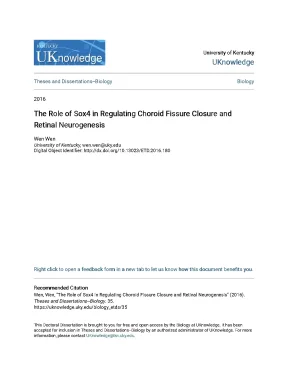
Tải xuống để đọc toàn bộUniversity of Kentucky UKnowledge Theses and Dissertations--Biology Biology 2016 The Role of Sox4 in Regulating Choroid Fissure Closure and Retinal Neurogenesis Wen Wen University of Kentucky, wen.edu Digital Object Identifier: http://dx.180 Right click to open a feedback form in a new tab to let us know how this document benefits you. Recommended Citation Wen, Wen, "The Role of Sox4 in Regulating Choroid Fissure Closure and Retinal Neurogenesis" (2016). Theses and Dissertations--Biology.edu/biology_etds/35 This Doctoral Dissertation is brought to you for free and open access by the Biology at UKnowledge. It has been accepted for inclusion in Theses and Dissertations--Biology by an authorized administrator of UKnowledge.
For more information, please contact UKnowledge@lsv. STUDENT AGREEMENT: I represent that my thesis or dissertation and abstract are my original work. Proper attribution has been given to all outside sources. I understand that I am solely responsible for obtaining any needed copyright permissions.
I have obtained needed written permission statement(s) from the owner(s) of each third-party copyrighted matter to be included in my work, allowing electronic distribution (if such use is not permitted by the fair use doctrine) which will be submitted to UKnowledge as Additional File. I hereby grant to The University of Kentucky and its agents the irrevocable, non-exclusive, and royalty-free license to archive and make accessible my work in whole or in part in all forms of media, now or hereafter known. I agree that the document mentioned above may be made available immediately for worldwide access unless an embargo applies. I retain all other ownership rights to the copyright of my work.
I also retain the right to use in future works (such as articles or books) all or part of my work. I understand that I am free to register the copyright to my work. REVIEW, APPROVAL AND ACCEPTANCE The document mentioned above has been reviewed and accepted by the student’s advisor, on behalf of the advisory committee, and by the Director of Graduate Studies (DGS), on behalf of the program; we verify that this is the final, approved version of the student’s thesis including all changes required by the advisory committee. The undersigned agree to abide by the statements above.
Wen Wen, Student Dr. Morris, Major Professor Dr. Westneat, Director of Graduate Studies THE ROLE OF SOX4 IN REGULATING CHOROID FISSURE CLOSURE AND RETINAL NEUROGENESIS __________________________ DISSERTATION __________________________ A dissertation submitted in partial fulfillment of the requirements for the degree of Doctor of Philosophy in the College of Arts and Sciences at the University of Kentucky By Wen Wen Lexington, Kentucky Director: Ann C. Morris, Associate Professor of Biology Lexington, Kentucky 2016 Copyright © Wen Wen 2016 ABSTRACT OF DISSERTATION THE ROLE OF SOX4 IN REGULATING CHOROID FISSURE CLOSURE AND RETINAL NEUROGENESIS The development of the vertebrate eye is tightly controlled by precise genetic regulations.
From a single ocular primordium to bilateral eyes with complex structures and cell types, it requires intensive proliferation and migration for cells in both the ectoderm and mesoderm to accomplish ocular morphogenesis, and during this process cell differentiation and interaction takes place to establish the complex composition of ocular cell types and cellular connections. Genetic defects can lead to severe abnormalities in eye morphogenesis and cell differentiation during ocular development. A tremendous amount of work has been done to identify both intrinsic and extrinsic factors that regulate ocular development. However, much more work is needed to fully understand this complex process.
Sox4 is known as a transcription activator that regulates cell survival and differentiation in multiple embryonic tissues during development. Evidence of its requirement during ocular development has recently emerged, but the mechanism by which Sox4 regulates ocular development is far from elucidated. Chapter 1 of this dissertation provides an overview of different stages in embryonic eye development and known genetic interactions during each stage. It also reviews recent knowledge about SoxC proteins and their roles in ocular development.
Chapter 2 presents data characterizing the expression profile of the zebrafish sox4 co-orthologs, sox4a and sox4b, in the developing eye. Additionally, it presents data from morpholino-mediated sox4 knockdown in zebrafish, which indicate that Sox4 deficiency leads to defects in choroid fissure closure through elevation in the Hedgehog (Hh) signaling pathway. Sox4 knockdown causes upregulation of the Hh ligand indian hedgehog b (ihhb), which alters the proximal-distal boundary of the optic vesicle and inhibits choroid fissure closure. Chapter 3 presents data reporting the generation of sox4 mutant zebrafish lines using the CRISPR/Cas9 genome editing system.
Characterization of one sox4a maternal zygotic (MZ) mutant line confirms Sox4’s role in negative regulation of Hh signaling and reveals new evidence that maternal and zygotic sox4 are both critical for ocular development. Chapter 4 presents data demonstrating that sox4 is required for rod photoreceptor neurogenesis. Rod photoreceptor terminal differentiation is delayed in both sox4 morphants and sox4 CRISPR mutants, while rod progenitor and precursor cells are properly specified. In Chapter 5, the roles of Sox4 in regulating ocular development are summarized based on the results, and implications of the results are discussed to expand our understanding of the genetic regulation of ocular morphogenesis and retinal neurogenesis.
KEYWORDS: Sox4, Eye development, Coloboma, Hedgehog signaling, Rod photoreceptor, CRISPR/Cas9 Wen Wen Student’s Signature April 26, 2016 Date THE ROLE OF SOX4 IN REGULATING CHOROID FISSURE CLOSURE AND RETINAL NEUROGENESIS By Wen Wen Ann C. Morris Director of Dissertation David F. Westneat Director of Graduate Studies April 26, 2016 Date To Mama, Baba, and Qi ACKNOWLEDGEMENTS My six years of graduate study was like an adventure in the science ocean that was full of excitement and challenge. I would like to give my sincere thanks to many who were like the lighthouse that guided my direction and gave me tremendous amount of supports throughout my voyage.
First and foremost I would like to convey my deepest gratitude to my doctoral advisor Dr. She is my role model in any aspects of science and life. She sets an incredible example as an excellent scientist, mentor and friend that influences me every day. Ann, thank you for leading me into the fascinating world of zebrafish eye development, thank you for teaching me how to do science, talk science, write science and enjoy science, thank you for encouraging me to explore science freely with your endless supports and guidance, and thank you for walking me through the ups and downs during both my graduate study and personal life.
Your enthusiastic attitude towards life and science is also deeply rooted in my heart that made me believe that one day I can also become a great scientist like you. No word can express my appreciations to you; all in all I would like to say that you are the one true Queen in the seven kingdoms of my scientific world. I would also like to express my gratitude to my doctoral committee members. Vinnie, thank you for sharing your wisdom and broad knowledge with me and thanks for all the things you have done for us from writing great recommendation letters, raising our stipend to holding annual Christmas parties at your house.
Thanks for holding everybody from Biology together as a big family. Bruce, thank you very much for encouraging me and give me insightful suggestions throughout my graduate training. Pete, thank you very much not only for teaching me how to do critical thinking, but also how to pass my passion to science and research to the younger generation through teaching. I will carry your philosophy of learning and teaching for the rest of my scientific career.
JJ, thank you very much for providing me so much priceless advices toward my graduate study and career development. I would also like to thank all the faculties from Biology. I am so grateful for your patience with my millions of questions and generosity for sharing your lab equipment whenever I need to use. Also, I want to thank Dr.
Downie, my outside defense committee member. Thank you so much for editing my dissertation and giving me valuable suggestions to make it better. I would like to thank all past and present Morris lab students. Lakshmi, Marie, Stephen, Hannah, CC, and Becky, thank you all for your friendship and support.
You made my daily life in iii the lab full of joyful memories! You are like my sisters and brothers in the lab. I cannot forget all the ‘crazy’ things and all the good science we have done together. Thanks very much for sharing your scientific ideas and encouragement with me. Sara, thank you so much for taking care of our fishroom and lab business.
You are the most important core of our daily lab business. None of our research will be done smoothly without your hard work and great support! The same appreciation to Tony, our previous ‘fish man’. Also, thanks to my wonderful undergraduate trainee Joanna and Abi. I am so proud of you two.
Your bright and hardworking minds will bring you success whatever future careers you choose. I also offer my sincere gratitude to the members of the academic staff for their support and help. Jacqueline Burke, Jaclyn Gibson, Jacqueline Lee, Michael Adams, Seth Taylor, George White, Beverly Taulbee, Monica Decker, Cheryl Edwards, thank you so much for keeping our department running smoothly so that we students could only focus on our study and research. You make our department a warm family to everyone.
The degree will benefit me for my career, but the friendship I earn will be with me for my entire life. I would like to thank all my friends who I will always love and remember. Qian, Min, Ye, Lina, Lingfeng, Ting, Wenhui, Houfu, Gang, Zheng, Hui, Yuechen, Qingchao, Yuting, Weikai, Dangdang, Shang, Diao, Yifeng, Bingwei, Chanung, Swagata, Deep, thank you for being there for me whenever I need you. I also want to give special thanks to the Nannan family.
They gave me tremendous amount of love and support. They made it home for me ever since the first night I landed in Lexington. Thank you for all the things you have done for me! Finally, I would like to thank my family: mom, dad and my husband Qi. My dissertation is dedicated for them.
Even the most beautiful word cannot express my love to them. Their love and encouragement always accompany with me and make me who I am today. iv TABLE OF CONTENTS ACKNOWLEDGEMENTS. iii TABLE OF CONTENTS.
v LIST OF TABLES. ix LIST OF FIGURES. x CHAPTER 1: KEEPING AN EYE ON SOXC PROTEINS: VERTEBRATE EYE DEVELOPMENT AND SOXC TRANSCRIPTION FACTORS .3 Origin and morphogenesis of the vertebrate eye.1 Optic primordium specification .2 Eye field segregation.3 Optic cup and optic stalk formation .4 Cellular differentiation of the vertebrate eye .1 The anterior segment.2 The retina and the retinal pigmented epithelium (RPE).6 Hedgehog (Hh) signaling and vertebrate eye development .1 Vertebrate Hh signaling transduction .2 The role of Hh in vertebrate optic vesicle patterning .3 The role of Hh during the cellular differentiation of vertebrate eye .7 Zebrafish as a model for studying eye development.8 SoxC and eye development .1 Sox Subfamilies in vertebrates.2 SoxC proteins and their known target genes .3 SoxC expression in the developing vertebrate eye .4 Functional studies of SoxC proteins in animal models during eye development .9 SoxC and human ocular defects .10 Conclusions and perspective .11 Rationale, Hypothesis and Specific Aims. 37 v CHAPTER 2: SOX4 REGULATES CHOROID FISSURE CLOSURE BY LIMITING HEDGEHOG SIGNALING DURING OCULAR MORPHOGENESIS .1 Sox4a and sox4b are expressed in periocular tissues and the developing retina .2 Knockdown of sox4 causes ocular coloboma .3 Proximo-distal patterning of the optic vesicle is altered in Sox4-deficient zebrafish.4 Sox4-deficient retinas display ectopic cell proliferation.5 Hh signaling is elevated in Sox4-deficient zebrafish .6 Sox4 negatively regulates expression of Indian Hedgehog b (ihhb).7 Bmp7 is a potential intermediate between sox4 and ihhb .8 Sox4 and sox11 have overlapping functions in regulating choroid fissure closure .5 Materials and methods .1 Zebrafish strains and maintenance .
Nội dung được bảo vệ bản quyền — Tải xuống đầy đủ
Trích dẫn luận án này
Wen Wen (2016). The role of sox4 in regulating choroid fissure closure and r [Luận án tiến sĩ, University of Kentucky]. LuanAn.net. https://luanan.net/y-hoc/ngoai-khoa/the-role-of-sox4-in-regulating-choroid-fissure-closure-and-retina
Câu hỏi thường gặp
Luận án "The role of sox4 in regulating choroid fissure closure and r" nghiên cứu về vấn đề gì?
Vai trò của Sox4 trong điều hòa đóng khe màng mạch và phát triển võng mạc. Khám phá cơ chế phân tử và ý nghĩa sinh học.
Luận án "The role of sox4 in regulating choroid fissure closure and r" được bảo vệ tại trường nào?
Luận án này được bảo vệ tại University of Kentucky. Năm bảo vệ: 2016.
Luận án "The role of sox4 in regulating choroid fissure closure and r" thuộc chuyên ngành gì?
Luận án "The role of sox4 in regulating choroid fissure closure and r" thuộc chuyên ngành Biology. Danh mục: Ngoại Khoa.
Luận án "The role of sox4 in regulating choroid fissure closure and r" có bao nhiêu trang?
Luận án "The role of sox4 in regulating choroid fissure closure and r" có 210 trang. Bạn có thể xem trước một phần tài liệu ngay trên trang web trước khi tải về.
Cách tải luận án "The role of sox4 in regulating choroid fissure closure and r" về máy như thế nào?
Để tải luận án về máy, bạn nhấn nút "Tải xuống ngay" trên trang này, sau đó hoàn tất thanh toán phí lưu trữ. File sẽ được tải xuống ngay sau khi thanh toán thành công. Hỗ trợ qua Zalo: 0559 297 239.