Navigating the career pipeline experiences of female community c
Phân tích trải nghiệm đường ống sự nghiệp của phụ nữ trong lĩnh vực cộng đồng, đánh giá các yếu tố ảnh hưởng đến sự phát triển và thành công của họ.
Education Science
Luan An
Doctoral Dissertation
Năm xuất bản
Số trang
233
Thời gian đọc
35 phút
Lượt xem
0
Lượt tải
0
Phí lưu trữ
50 Point
Tổng quan nhanh
- Chủ đề:
- Female Leadership in Higher Ed: Career Pipeline Insights
- Số trang:
- 233 trang
- Trường:
- University of Kentucky
- Chuyên ngành:
- Education Science
- Tác giả:
- Andrea Allen Deal
- Năm:
- 2019
Tóm tắt nội dung luận án
I.Female Leadership in Higher Ed Career Pipeline Insights
This research explores female leadership in higher education. It investigates the career pipeline for women seeking community college presidencies. Despite holding many mid-level management roles, women occupy only one-third of these top positions. The study sheds light on this gendered phenomenon. It examines the journey to the presidential office. Understanding these pathways is crucial for female leadership development. The approach involved a qualitative phenomenological study. Data collection used semi-structured interviews, reflection logs, and document analysis. A modified van Kaam method analyzed participant data. This identified recurring themes. Individual descriptions were synthesized into a composite overview. This provides a clear picture of female leaders' experiences. Insights reveal key aspects of professional growth pathways in academia. The study contributes to understanding career advancement strategies for women.
1.1. Educational Backgrounds of Female Presidents
The study meticulously examined the educational backgrounds of recently-appointed female community college presidents. Understanding their academic journeys provides foundational insights. It highlights specific degrees, institutions, and areas of study that prepared them for leadership. These educational experiences often shape their initial professional growth pathways. The research identifies common threads in their academic preparation. It also notes unique aspects of their intellectual development. These backgrounds are critical for analyzing subsequent career advancement strategies. Identifying successful educational patterns can inform future female leadership development programs. This allows aspiring leaders to strategically plan their academic pursuits.
1.2. Career Trajectories for Women in Academia
An in-depth analysis of career trajectories for women in academia was conducted. This included mapping their progression through various roles within higher education institutions. The study identified the stepping stones and critical junctures leading to the presidency. It highlights the diverse paths taken by these successful leaders. Some moved through academic affairs, others through student services or administrative roles. Understanding these varied professional growth pathways is essential. It provides models for aspiring women in higher education leadership. The research identifies common experiences and unique deviations. This helps delineate effective career advancement strategies. It also underscores the importance of diverse experiences for leadership development.
1.3. Phenomenological Study Approach Utilized
A phenomenological approach guided this qualitative study. This method focused on understanding the lived experiences of female presidents. Semi-structured interviews formed the primary data collection method. These allowed for deep exploration of personal narratives. Reflection logs, memos, and document analysis supplemented interview data. This triangulation strengthened the findings. The modified van Kaam method provided a robust framework for data analysis. It helped code participant responses. Recurring thematic elements emerged from this process. These themes formed the basis for individual and composite descriptions. The approach ensured a rich, detailed account of female leadership development experiences. It captured the nuances of their journey.
II.Overcoming Barriers for Women in Higher Education Leadership
Women in higher education leadership frequently encounter significant barriers. This study identified three primary types of obstacles. These barriers hinder progress along the career pipeline. Understanding these challenges is vital for gender equality in higher education. The research provides critical insights into the difficulties faced by aspiring female presidents. These obstacles prevent the realization of professional growth pathways. They impact career advancement strategies. The findings demonstrate the systemic and subtle nature of these impediments. Addressing these barriers is key for fostering female leadership development.
2.1. Institutional Challenges for Aspiring Leaders
Study participants faced various institutional barriers. These included systemic issues within higher education structures. These challenges often created obstacles to career advancement strategies. Examples include biased promotion practices or lack of clear pathways for women. Institutional cultures sometimes lack support for female leadership development. Such environments can contribute to a glass ceiling in higher education leadership. Overcoming these challenges requires strategic institutional change. Policies promoting gender equality in higher education are crucial. Addressing these systemic issues directly impacts professional growth pathways for women.
2.2. Birdcage Barriers in Professional Growth Pathways
The term "birdcage barriers" emerged from this research. It describes a unique set of challenges. Aspiring female leaders could identify professional growth opportunities. Yet, situational boundaries prevented access to these opportunities. These boundaries were often subtle or indirect. They were not always explicit prohibitions. They created a sense of being trapped, unable to reach visible goals. This phenomenon significantly impacts professional growth pathways. It highlights insidious forms of gender bias in higher education administration. Recognizing these "birdcage barriers" is crucial for effective female leadership development. It requires deeper scrutiny of access and inclusion.
2.3. Internal Obstacles for Female Leadership Development
Participants also reported encountering internal barriers. These obstacles originated from within the individuals themselves or their perceptions. Self-doubt, imposter syndrome, or a reluctance to assert ambition were noted. These internal factors can impede career advancement strategies. They contribute to a slower progression along professional growth pathways. While external support is vital, addressing internal obstacles is equally important. Female leadership development programs must consider these psychological aspects. Fostering self-confidence and assertive communication skills becomes essential. This empowers women to overcome internal limitations.
III.Support Systems for Female Community College Presidents
Navigating the career pipeline successfully requires robust support systems. This study identified three key sources of support for female community college presidents. These supports enabled them to overcome challenges. They facilitated their career advancement strategies. These systems proved invaluable in reaching top leadership roles. Understanding these supportive elements is critical for female leadership development. It offers models for building environments where women can thrive. These resources empower women along their professional growth pathways.
3.1. Institutional Support for Professional Growth
Participants benefited from institutional support. This included formal programs and informal encouragement from their organizations. Institutions provided development opportunities, training, and resources. These supports were instrumental in fostering professional growth pathways. Mentorship programs sponsored by institutions were valuable. Supportive supervisors and administrative teams made a difference. Such environments promote gender equality in higher education. They help dismantle elements of the glass ceiling in higher education leadership. Strong institutional backing is a cornerstone for career advancement strategies.
3.2. Personal Networks and Mentorship for Women
Personal support networks played a significant role. Friends, family, and colleagues offered emotional and practical assistance. Mentorship for women was frequently cited as crucial. Experienced leaders provided guidance, advice, and advocacy. These relationships offered invaluable insights into career advancement strategies. They helped navigate complex political landscapes. Sponsorship opportunities from influential mentors opened doors. These connections fostered a sense of belonging and encouragement. They are vital for sustained female leadership development and resilience.
3.3. Individual Traits and Strategies for Success
Individual traits and personal strategies also emerged as key support elements. Resilience, determination, and strong communication skills were frequently mentioned. Participants employed proactive career advancement strategies. These included strategic networking and continuous learning. Their ability to adapt and persevere was paramount. Effective work-life integration strategies helped manage demands. These personal attributes served as internal resources. They complemented external support. These individual strengths are integral to female leadership development. They facilitate navigation of challenging professional growth pathways.
IV.Advancing Women in Academia Strategies for Growth
Advancing women in academia requires targeted strategies. The study's findings offer actionable insights for promoting female leadership development. These strategies aim to bolster professional growth pathways for women. They address both systemic issues and individual needs. Effective approaches enhance career advancement strategies. Such initiatives contribute to greater gender equality in higher education. These strategies ensure a more inclusive and equitable environment. Focus remains on empowering women to reach their full potential.
4.1. Identifying Professional Growth Pathways
A clear understanding of professional growth pathways is essential. Institutions must articulate these paths more effectively for women. This includes transparent criteria for promotion and leadership roles. Identifying and communicating specific skill development opportunities is key. Providing access to relevant training programs supports career advancement strategies. Women need to see a clear route to higher positions. This transparency helps demystify the leadership journey. It empowers them to plan their female leadership development proactively.
4.2. Sponsorship Opportunities for Female Leaders
Sponsorship opportunities are critical for female leaders. Sponsors advocate for women in leadership positions. They actively promote their protégés for advanced roles. This differs from mentorship, which often provides guidance. Sponsorship offers active championing and opening doors. Identifying and cultivating potential sponsors is a powerful career advancement strategy. Organizations should foster cultures where sponsorship thrives. This directly addresses the glass ceiling in higher education leadership. It creates concrete avenues for female leadership development.
4.3. Fostering Work Life Integration for Women
Effective work-life integration is paramount for women in leadership. The demands of senior roles often conflict with personal responsibilities. Institutions must implement policies that support this balance. Flexible work arrangements, family leave, and on-site childcare are examples. These measures reduce burnout and enhance retention. They ensure that family responsibilities do not derail professional growth pathways. Supporting work-life integration is a key component of female leadership development. It enables women to sustain their career advancement strategies long-term.
V.Addressing Gender Bias Female Higher Education Leaders
Addressing gender bias in higher education administration is fundamental. This study highlights the subtle yet pervasive nature of such bias. It impacts female leadership development and career progression. Uncovering and confronting these biases is crucial. This fosters greater gender equality in higher education. The findings offer insights into how bias manifests. They underscore the need for proactive measures. Eliminating bias strengthens professional growth pathways for women.
5.1. Uncovering Second Generation Institutional Bias
Most institutional bias encountered by participants was second-generation. This form of bias is often subtle and unconscious. It is embedded in organizational practices and norms. It is not overt discrimination but systemic disadvantages. Examples include informal networks that exclude women. Or, performance evaluations that subtly penalize female leadership styles. Recognizing this nuanced gender bias in higher education administration is critical. It requires careful analysis of institutional culture. Addressing it is essential for true gender equality in higher education.
5.2. Reluctance to Label Gender as a Barrier
Participants often showed reluctance to label gender as a direct barrier. This indicates the subtle nature of gender bias in higher education administration. Women may internalize challenges or attribute them to other factors. This reluctance makes addressing the issue more complex. It highlights the need for external validation of experiences. Discussions around female leadership development must acknowledge this phenomenon. Creating safe spaces for discussing gender equality in higher education is vital. This helps women recognize and articulate gender-related obstacles.
5.3. Promoting Gender Equality in Higher Education
Promoting gender equality in higher education requires concerted effort. This includes active policies to increase representation of women in leadership. It involves training to identify and mitigate unconscious bias. Creating inclusive cultures where diverse leadership styles are valued is key. Transparency in hiring and promotion processes builds trust. These efforts are crucial for dismantling the glass ceiling in higher education leadership. They ensure that all professional growth pathways are equally accessible. This proactive approach supports robust female leadership development.
Mục lục chi tiết luận án
Tải xuống file đầy đủ để xem toàn bộ nội dung
Tải đầy đủ (233 trang)Trích đoạn nội dung luận án
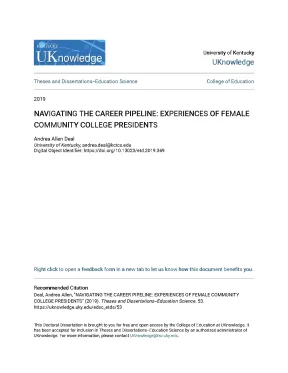
Tải xuống để đọc toàn bộUniversity of Kentucky UKnowledge Theses and Dissertations--Education Science College of Education 2019 NAVIGATING THE CAREER PIPELINE: EXPERIENCES OF FEMALE COMMUNITY COLLEGE PRESIDENTS Andrea Allen Deal University of Kentucky, andrea.edu Digital Object Identifier: https://doi.369 Right click to open a feedback form in a new tab to let us know how this document benefits you. Recommended Citation Deal, Andrea Allen, "NAVIGATING THE CAREER PIPELINE: EXPERIENCES OF FEMALE COMMUNITY COLLEGE PRESIDENTS" (2019). Theses and Dissertations--Education Science.edu/edsc_etds/53 This Doctoral Dissertation is brought to you for free and open access by the College of Education at UKnowledge. It has been accepted for inclusion in Theses and Dissertations--Education Science by an authorized administrator of UKnowledge.
For more information, please contact UKnowledge@lsv. STUDENT AGREEMENT: I represent that my thesis or dissertation and abstract are my original work. Proper attribution has been given to all outside sources. I understand that I am solely responsible for obtaining any needed copyright permissions.
I have obtained needed written permission statement(s) from the owner(s) of each third-party copyrighted matter to be included in my work, allowing electronic distribution (if such use is not permitted by the fair use doctrine) which will be submitted to UKnowledge as Additional File. I hereby grant to The University of Kentucky and its agents the irrevocable, non-exclusive, and royalty-free license to archive and make accessible my work in whole or in part in all forms of media, now or hereafter known. I agree that the document mentioned above may be made available immediately for worldwide access unless an embargo applies. I retain all other ownership rights to the copyright of my work.
I also retain the right to use in future works (such as articles or books) all or part of my work. I understand that I am free to register the copyright to my work. REVIEW, APPROVAL AND ACCEPTANCE The document mentioned above has been reviewed and accepted by the student’s advisor, on behalf of the advisory committee, and by the Director of Graduate Studies (DGS), on behalf of the program; we verify that this is the final, approved version of the student’s thesis including all changes required by the advisory committee. The undersigned agree to abide by the statements above.
Andrea Allen Deal, Student Dr. Lewis, Major Professor Dr. Margaret Bausch, Director of Graduate Studies NAVIGATING THE CAREER PIPELINE: EXPERIENCES OF FEMALE COMMUNITY COLLEGE PRESIDENTS ________________________________________ DISSERTATION ________________________________________ A dissertation submitted in partial fulfillment of the requirements for the degree of Doctor of Philosophy in the College of Education at the University of Kentucky By Andrea Allen Deal Lexington, Kentucky Director: Dr. Lewis, Professor of Educational Leadership Studies Lexington, Kentucky 2019 Copyright © Andrea Allen Deal 2019 ABSTRACT OF DISSERTATION NAVIGATING THE CAREER PIPELINE: EXPERIENCES OF FEMALE COMMUNITY COLLEGE PRESIDENTS Despite holding a majority of lower and middle management positions in public two-year institutions, women still hold only one-third of current community college presidencies.
This study explored the gendered phenomenon of navigating the career pipeline in higher education to reach the office of community college president. The purpose of the study was to examine the educational backgrounds and career paths of recently-appointed female community college presidents, as well as the barriers and sources of support they encountered while navigating the career pipeline. A phenomenological approach was utilized for this qualitative study. Data was primarily collected using semi-structured interviews.
Additional sources for data collection include reflection logs, memos, and document analysis. A modified van Kaam method of data analysis was used to code participant data and identify recurring thematic elements. These recurring thematic elements provided the foundation for individual descriptions of the phenomenon, which were later synthesized to create a composite description. Results suggest that study participants encountered three types of barriers while navigating the career pipeline in higher education: institutional, birdcage, and internal.
The term “birdcage barriers” was coined here to describe scenarios in which aspiring female leaders could identify opportunities for professional growth or advancement, but were unable to access these opportunities because of situational boundaries. Findings also suggest study participants benefited from three sources of support: institutional, personal, and individual traits/strategies. Additional findings include: participants were reluctant to label gender a barrier; most of the institutional bias encountered by participants was second-generation; and, as aspiring leaders in higher education, participants required intrusive recruitment. KEYWORDS: Community College, Higher Education, Educational Leadership, Women in Leadership, Female College President.
Andrea Allen Deal 08/27/2019 Date NAVIGATING THE CAREER PIPELINE: EXPERIENCES OF FEMALE COMMUNITY COLLEGE PRESIDENTS By Andrea Allen Deal Wayne D. Director of Dissertation Margaret Bausch, Ed. Director of Graduate Studies 08/27/2019 Date DEDICATION I dedicate this dissertation to my mother, Sharon Allen, who passed away in February 2011. She did not complete her college degree, but she possessed incredible wisdom.
Her passion for learning instilled a natural curiosity in me. Most importantly, she taught me that wisdom is meaningless without a kind heart. She passed away before I started the doctoral program, but I hope this completed work honors her memory. ACKNOWLEDGMENTS To my committee chair, Dr.
Wayne Lewis, thank you for your leadership and guidance. Without your support, this dissertation may not exist. From the first semester of the program, you demonstrated your belief in my work and my goals. You had an uncanny ability to discern when I needed to be challenged and when I needed to be shored up.
For your instruction, advice, and friendship, I will be forever grateful. Thank you to my dissertation committee: Dr. Lars Bjork (thank you for helping me reframe my conception of leadership), Dr. John Thelin (thank you for pushing me to consider the past as I examined the present), and Dr.
Thank you also to my outside examiner, Dr. Jeannette Sutton, who paid me the highest compliment by saying my dissertation was enjoyable to read. Additionally, thank you to my cohort colleagues for creating a sense of community and for celebrating each member’s success. #Upgrade4point0 To my husband, Mike Deal, thank you for insisting I persist when I was overwhelmed, and thank you for sharing the load at home to make the task a little less daunting.
Your ongoing love and support spurred me forward. You believe in me more than I believe in myself, and my gratitude knows no bounds. Thank you to my grandson, Cy, for providing much-needed play breaks and for giving me incentive to ‘hang in there.’ I hope you are proud of Nons. Thank you to my dad, who always believed I could achieve any goal, and my grandmother, who spent countless hours of my childhood reading with me and playing ‘teacher’ in my pretend schoolhouse.
Finally, I wish to thank the respondents of my study (who remain anonymous for confidentiality purposes). iii TABLE OF CONTENTS ACKNOWLEDGMENTS. iii LIST OF TABLES .1 Purpose of the Study. 3 Significance of the Study .5 Design of the Study.
7 Limitations of the Study.8 Chapter 2: Review of the Literature.9 Critical Feminist Framework. 10 Four-Frames Model as a Theoretical Framework. 13 Human resource frame. 19 Four-Frames as a Research Paradigm.
21 Do Male and Female Leaders Differ? .21 Perceptions of Gender Differences in Leadership .23 Gender in Dominant Leadership Theories .25 Trait-Based Theories. 26 Contingency-Based Theories. 27 iv Transactional versus Transformational Leadership. 30 Integrative Theories: Servant and Synergistic Leadership.
31 Impact of Leadership Theories. 33 Female Representation in Various Employment Sectors. 34 Public Education and District Superintendents. 36 Barriers and Sources of Support.
38 Organizational culture and climate. 39 Behavioral expectations and the ‘double bind. 40 Sources of Support. 41 Mentors and role models.
41 Proactive workplace policies .53 Research Sample and Data Sources .53 Instruments and Procedures. 59 Recording and transcription. 61 Documents and Memos. 67 Thick, rich descriptions.
68 Role of the Researcher .68 Researcher Reflexivity Statement. 86 Supervisors as barriers. 90 Gender norms and the ‘double bind. 92 Sexism and sexual harassment.
101 vi Place-bound. 110 Feeling the need to be perfectly qualified. 112 Needing external validation. 114 Sources of Support .117 Institutional Sources of Support.
118 Supervisors as sources of support. 127 Interviews as confidence builders. 130 Personal Sources of Support. 132 Family of origin.
137 Individual Traits and Strategies. 139 Thick skin and adaptability. 140 Proactive and open to experiences. 146 Finding one’s own leadership persona .152 Chapter 5: Discussion and Recommendations .153 Summary of the Study .153 Research Question 1: How do female community college presidents describe their educational background?.
154 Research Question 2: How do female community college presidents describe their career pathway from initial employment to presidential appointment?. 155 Research Question 3: What barriers, gender-related or non-gender-related, do female community college presidents perceive as they navigate the career pipeline from initial employment to presidential appointment?. 156 vii Research Question 4: What resources and sources of support, gender-related or non- gender-related, do female community college presidents perceive while navigating the career pipeline from initial employment to presidential appointment?. 157 Discussion of Findings.
168 Sources of Support. 169 Institutional sources of support. 169 Personal sources of support. 174 Internal traits and strategies.
175 Other Significant Findings. 179 Gender as a factor, not a barrier. 179 Aspiring female leaders may need intrusive recruitment. 180 Today’s institutional gender bias is second-generation.
181 No children or significant help with childcare. 182 Short-term organizational climates may affect the presidential search process .184 Recommendations for Institutions of Higher Learning. 185 Proactively seek out prospective female leaders. 186 Provide mentors to scaffold female leaders to higher levels of leadership.
186 Sponsor aspiring female leaders’ participation in formal leadership programs. 187 Support aspiring female leaders’ ability to integrate work-home life roles. 187 Recommendations for Aspiring Female Leaders. 188 Expand your view of leadership.
188 Anticipate role conflict and competing demands. 189 Expect to encounter second-generation bias. 189 Recommendations for Future Research .191 APPENDIX A: EMAIL INVITATION TO PARTICIPATE IN STUDY .193 viii APPENDIX B: INTERVIEW PROTOCOL AND GUIDE.218 ix LIST OF TABLES Table 1 Moustakas’ Modified van Kaam Method of Qualitative Data Analysis. 64 Table 2 Demographic Characteristics and Educational Backgrounds of Participants.
82 Table 3 Barriers Reported by Female Community College Presidents. 116 Table 4 Participants’ Experiences with Barriers (by subthemes). 117 Table 5 Sources of Support Reported by Female Community College Presidents. 150 Table 6 Participants’ Experiences with Sources of Support (by subthemes).
150 x Chapter 1: Introduction With the impending retirement of many community college presidents (Philippe, 2016) and the increasing enrollment of females in postsecondary education (Doherty, Willoughby, & Wilde, 2016), the time is ripe for females who aspire to leadership positions within higher education. Many women who aspire to leadership roles in higher education do so in community colleges where the environment has historically been more open to women (Townsend & Twombly, 2006). Community colleges have less defined pathways to the presidency, which provides greater access for women. When compared with four-year colleges and universities, community colleges employ a larger percentage of women in both faculty and senior administrative positions.
This places more women in the career pipeline on the pathway to the presidency and provides institutions with a greater number of potential female leaders. However, despite holding almost two-thirds of the lower and middle management positions in public two-year institutions (King & Gomez, 2008), women still hold only one-third of current community college presidencies. The clustering of women in lower and middle management positions supports Ward and Eddy’s (2013) assertion that women may be reluctant to pursue leadership positions in higher education organizations if the organization appears closed to aspiring female leaders. In such traditional institutions, dominant leadership theories advance a masculine paradigm that excludes female voices from the leadership dialogue and hinders women’s ability to incorporate leadership into their personal identity (Ibarra, Ely, & Kolb, 2013).
Nội dung được bảo vệ bản quyền — Tải xuống đầy đủ
Trích dẫn luận án này
Andrea Allen Deal (2019). Navigating the career pipeline experiences of female communi [Luận án tiến sĩ, University of Kentucky]. LuanAn.net. https://luanan.net/tam-ly-hoc/navigating-the-career-pipeline-experiences-of-female-community-c
Câu hỏi thường gặp
Luận án "Navigating the career pipeline experiences of female communi" nghiên cứu về vấn đề gì?
Phân tích trải nghiệm đường ống sự nghiệp của phụ nữ trong lĩnh vực cộng đồng, đánh giá các yếu tố ảnh hưởng đến sự phát triển và thành công của họ.
Luận án "Navigating the career pipeline experiences of female communi" được bảo vệ tại trường nào?
Luận án này được bảo vệ tại University of Kentucky. Năm bảo vệ: 2019.
Luận án "Navigating the career pipeline experiences of female communi" thuộc chuyên ngành gì?
Luận án "Navigating the career pipeline experiences of female communi" thuộc chuyên ngành Education Science. Danh mục: Tâm Lý Học.
Luận án "Navigating the career pipeline experiences of female communi" có bao nhiêu trang?
Luận án "Navigating the career pipeline experiences of female communi" có 233 trang. Bạn có thể xem trước một phần tài liệu ngay trên trang web trước khi tải về.
Cách tải luận án "Navigating the career pipeline experiences of female communi" về máy như thế nào?
Để tải luận án về máy, bạn nhấn nút "Tải xuống ngay" trên trang này, sau đó hoàn tất thanh toán phí lưu trữ. File sẽ được tải xuống ngay sau khi thanh toán thành công. Hỗ trợ qua Zalo: 0559 297 239.