The design and synthesis of novel chelates for the precipitation
Phân tích và thiết kế các hợp chất chelat mới cho quá trình kết tủa. Nghiên cứu thiết kế và tổng hợp các hợp chất chelat có khả năng kết tủa hiệu quả.
Luan An
Doctoral Dissertation
Năm xuất bản
Số trang
170
Thời gian đọc
26 phút
Lượt xem
0
Lượt tải
0
Phí lưu trữ
50 Point
Tổng quan nhanh
- Chủ đề:
- Global Mercury Contamination & Urgent Remediation Needs
- Số trang:
- 170 trang
- Trường:
- University of Kentucky
- Chuyên ngành:
- Chemistry
- Tác giả:
- Aaron Robert Hutchison
- Năm:
- 2007
Tóm tắt nội dung luận án
I.Global Mercury Contamination Urgent Remediation Needs
Mercury poses a significant global threat. Its widespread industrial utilization has led to pervasive environmental contamination across continents and ecosystems. Due to mercury's extremely high toxicity, its presence in the environment is a matter of profound concern for both ecological health and human well-being. Effective and sustainable mercury removal strategies are critically needed to mitigate these pervasive risks. The persistent nature of mercury metal ions requires robust and long-term solutions.
1.1. Toxicity and Environmental Presence of Mercury
Mercury has been an element of great industrial importance since early times. This wide utilization has led to pervasive mercury contamination in the global environment. Its high toxicity is a matter of great concern. Mercury contamination impacts various ecosystems, necessitating effective removal. Understanding the widespread presence of metal ions is crucial for environmental protection.
1.2. Challenges in Existing Mercury Remediation Methods
A number of methods, including phytoremediation, filtration, and precipitation/chelation, have been investigated. Unfortunately, these existing methods are not entirely satisfactory. They present limitations for in-situ remediation of mercury from aqueous environments. Novel and more efficient solutions are required. Current approaches often lack the necessary efficacy for comprehensive metal separation.
II.Novel Chelate Design for Effective Mercury Precipitation
The central hypothesis guiding this research posited an improved method for mercury removal. This involves the strategic addition of a large, highly flexible, sulfur-based chelate to mercury-contaminated waters. This specific molecular design aimed to facilitate binding mercury metal ions in a precise tetracoordinate, presumably tetrahedral, environment. This approach promised to optimize chelation, leading to superior precipitation reactions and efficient contaminant removal. The thoughtful design of these coordination compounds is key.
2.1. Hypothesis for Enhanced Mercury Binding
This dissertation hypothesized optimal mercury removal. This involves adding a large, flexible, sulfur-based chelate to contaminated waters. The chelate would bind mercury in a tetracoordinate environment, likely tetrahedral. This molecular design aimed for efficient and stable binding. Effective chelation is central to the proposed solution.
2.2. Principles of Chelates for Metal Ion Interactions
Chelates are crucial for complexing specific metal ions. Their molecular design dictates binding strength and selectivity. Sulfur-based ligands exhibit strong affinity for mercury. Understanding chelation principles guides the synthesis of effective precipitants. This approach targets stable coordination compounds for remediation.
III.Synthesis of Sulfur Based Ligands for Hg2 Binding
The chemical synthesis of the target ligands proved challenging. Sulfur-based chelation compounds, while highly effective, often exhibit a tendency to decompose. They can cyclize into smaller, less reactive, sulfur-containing rings during the synthesis process. Despite these inherent difficulties, persistent effort led to the successful synthesis and thorough characterization of the desired novel chelates. This achievement represents a significant step in molecular design for mercury remediation.
3.1. Overcoming Synthetic Difficulties of Chelates
The synthesis of these chelates proved difficult. Ligands tended to decompose into smaller, sulfur-containing rings. Extensive chemical synthesis efforts were required to overcome these challenges. The successful synthesis and characterization of the target chelate was ultimately achieved. This breakthrough allowed for further investigation into their binding properties.
3.2. Developing Potential Mercury Binding Ligands
Several potential mercury-binding ligands were eventually synthesized. These were produced in significant amounts. The focus was on tetradentate chelates. Such ligands are specifically designed to form strong coordination compounds with Hg2+. This systematic chemical synthesis approach yielded promising new agents for metal separation.
IV.Achieving High Mercury Removal with Stable Chelates
The newly synthesized chelates demonstrated remarkable efficiency in actual mercury removal. They successfully precipitated 91-100% of mercury metal ions from contaminated aqueous solutions. These highly effective precipitation reactions led to significant reductions in mercury levels. In one notable instance, the mercury concentration in the treated water was lowered to below the detection limits of Cold Vapor Atomic Fluorescence (CVAF). This confirms the chelates' strong capability for metal separation.
4.1. Efficient Mercury Precipitation from Aqueous Solutions
The synthesized chelates exhibited high efficiency. They precipitated 91-100% of mercury from contaminated solutions. Mercury levels in water were, in one case, lowered below CVAF detection limits. This demonstrates effective metal separation through robust precipitation reactions. These novel chelates provide a powerful tool for environmental cleanup.
4.2. Stability of Mercury Ligand Precipitates
The resulting solid precipitates showed remarkable stability. Leaching studies revealed minimal mercury loss, less than 15 ppb. This confirms the formation of stable mercury-ligand coordination compounds. The work demonstrates the use of tetradentate chelates to produce stable Hg2+ precipitates. This stability is critical for long-term remediation and safe disposal after gravimetric analysis.
V.Molecular Geometry Quantification in Coordination Compounds
A significant outcome of this research included the development of a novel calculation. This advanced tool precisely quantifies the geometry of four-coordinate compounds. It provides a robust and objective method for structural analysis, offering deeper insights into the coordination environments around various metal ions. Such computational tools are invaluable in the field of molecular design, enhancing the understanding of complex chemical structures and their properties.
5.1. New Calculation for Four Coordinate Geometry
A novel calculation was developed. This quantifies the geometry of four-coordinate compounds. It provides a precise method for structural analysis. This enhances understanding of coordination environments around metal ions. Such tools are crucial for advanced molecular design studies.
5.2. Application to Aluminum Gallium and Mercury Compounds
The new calculation was applied to aluminum, gallium, and mercury compounds. This offers a standardized way to assess geometry. Once X-ray structures are available, the calculation can be applied to the mercury compounds in this thesis. This facilitates comprehensive characterization of new coordination compounds and validates their molecular design for potential gravimetric analysis.
Mục lục chi tiết luận án
Tải xuống file đầy đủ để xem toàn bộ nội dung
Tải đầy đủ (170 trang)Trích đoạn nội dung luận án
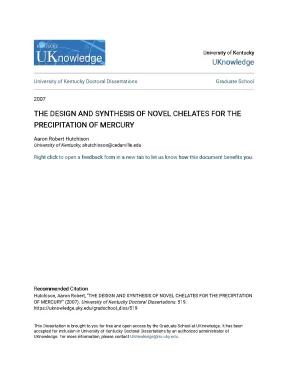
Tải xuống để đọc toàn bộUniversity of Kentucky UKnowledge University of Kentucky Doctoral Dissertations Graduate School 2007 THE DESIGN AND SYNTHESIS OF NOVEL CHELATES FOR THE PRECIPITATION OF MERCURY Aaron Robert Hutchison University of Kentucky, ahutchinson@cedarville.edu Right click to open a feedback form in a new tab to let us know how this document benefits you. Recommended Citation Hutchison, Aaron Robert, "THE DESIGN AND SYNTHESIS OF NOVEL CHELATES FOR THE PRECIPITATION OF MERCURY" (2007). University of Kentucky Doctoral Dissertations.edu/gradschool_diss/519 This Dissertation is brought to you for free and open access by the Graduate School at UKnowledge. It has been accepted for inclusion in University of Kentucky Doctoral Dissertations by an authorized administrator of UKnowledge.
For more information, please contact UKnowledge@lsv. ABSTRACT OF DISSERTATION Aaron Robert Hutchison The Graduate School University of Kentucky 2007 THE DESIGN AND SYNTHESIS OF NOVEL CHELATES FOR THE PRECIPITATION OF MERCURY _______________________________ ABSTRACT OF DISSERTATION ________________________________ A dissertation submitted in partial fulfillment of the requirements for the degree of Doctor of Philosophy in the College of Arts and Sciences at the University of Kentucky By Aaron Robert Hutchison Lexington, Kentucky Director: Dr. David Atwood, Associate Professor of Chemistry Lexington, Kentucky 2007 Copyright © Aaron Robert Hutchison 2007 ABSTRACT OF DISSERTATION THE DESIGN AND SYNTHESIS OF NOVEL CHELATES FOR THE PRECIPITATION OF MERCURY Mercury has been an element of great industrial importance since early times. This wide utilization of the element has led to pervasive mercury contamination in the global environment.
Due to mercury’s high toxicity, this is a matter of great concern. A number of methods, includ ing phytoremediation, filtration, and precipitation/chelation, have been investigated to remove mercury from the environment. Unfortunately, these methods are not entirely satisfactory for the in-situ remediation of mercury from aqueous environments. The hypothesis of this dissertation is that this can best be accomplished by the addition of a large and flexible sulfur-based chelate, that will bind mercury in a tetracoordinate and presumably tetrahedral environment, to mercury-contaminated waters.
Although this proved difficult due to the tendency of these ligands to decompose into smaller, sulfur-containing rings, the synthesis and characterization of such a chelate was achieved. Several potential mercury-binding ligands were eventually synthesized significant amounts of mercury (91-100%) from the contaminated solutions, in one case lowering the mercury levels in the water to below the CVAF detection limits. The resulting solids lost little (<15 ppb) of their mercury during leaching studies. This work demonstrates the use of tetradentate chelates in precipating Hg2+ from water to produce stable mercury- ligand precipitates.
A calculation for the quantification of the geometry of a four-coordinate compound was also developed and applied to aluminum, gallium, and mercury compounds. This calculation could also be applied to the mercury compounds described in this thesis once X-ray structures become available KEYWORDS: Mercury, Remediation, Thiols, Chelation, Precipitation Aaron Hutchison February 26, 2007 THE DESIGN AND SYNTHESIS OF NOVEL CHELATES FOR THE PRECIPITATION OF MERCURY By Aaron Robert Hutchison Dr. David Atwood Director of Dissertation Dr. Robert Grossman Director of Graduate Studies February 26, 2007 RULES FOR THE USE OF DISSERTATIONS Unpublished dissertations submitted for the Doctor's degree and deposited in the University of Kentucky Library are as a rule open for inspection, but are to be used only with due regard to the rights of the authors.
Bibliographical references may be noted, but quotations or summaries of parts may be published only with the permission of the author, and with the usual scholarly acknowledgments. Extensive copying or publication of the dissertation in whole or in part also requires the consent of the Dean of the Graduate School of the University of Kentucky. A library that borrows this dissertation for use by its patrons is expected to secure the signature of each user. DISSERTATION Aaron Robert Hutchison The Graduate School University of Kentucky 2007 THE DESIGN AND SYNTHESIS OF NOVEL CHELATES FOR THE PRECIPITATION OF MERCURY ___________________________________ DISSERTATION ___________________________________ A dissertation submitted in partial fulfillment of the requirements for the degree of Doctor of Philosophy in the College of Arts and Sciences at the University of Kentucky By Aaron Robert Hutchison South Charleston, Ohio Director: Dr.
David Atwood, Associate Professor of Chemistry Lexington, Kentucky 2007 Copyright © Aaron Robert Hutchison 2007 This work is dedicated to my parents and friends for all their support during my research. It is also dedicated to God, from Whom all human originality and success originate. ACKNOWLEDGEMENTS The following dissertation, while representing my individual work, has been strengthened by the input of several individuals. First, I would like to thank my advisor, Dr.
David Atwood, for his encouragement and support during my graduate career. I would also like to thank several other past and present members of the Atwood research group, including Dr. Sonali Bhandari, Dr. Burl Yearwood, Dr.
Tim Keizer, Mr. Niladri Gupta, Mr. Taimur Shaikh, Mr. John Twyman, and Mr.
Eduardo Santillion, for their advice and assistance during various stages of this work. Next, I would to thank my Dissertation Committee and outside examiner, Dr. John Selegue, Dr. Folami Ladipo, Dr.
Robert Grossman, Dr. Chris Matocha, and Dr. Dibakar Bhattacharyya for their help at every stage of this process. In addition to the professional assistance given by those listed above, throughout my work I received personal support from a network of friends too numerous to list individually.
Specifically, I would like to acknowledge my many friends at Porter Memorial Baptist Church, Highlands Baptist Church, and Zion Baptist Church for their care for me during this process. I would also like to thank my mother and father, John and Teresa Hutchison, witho ut whose help I never could have completed this project. iii TABLE OF CONTENTS Acknowledgements………………………………………………………………………iii List of Tables…………………………………………………………………………….vi List of Figures……………………………………………………………………………vii List of Files…………………………………………………………………………….viii Chapter One: Mercury Pollution and Remediation………………………………………1 1.2 Methylmercury and Human Mercury Poisoning ………………………….3 Industrial Uses of Mercury………………………………………………….4 Environmental Mercury Pollution………………………………………….1 Remediation of Mercury from the Gas Phase……………………26 1.2 Remediation of Mercury from Water and Soil……………….1 Excavation and Capping….3 Phytoremediation and Bioremediation………………….5 Complexation and Ultrafiltration……………………….6 Precipitation and Extraction…………………………….8 Mercury Precipitation Research in the Atwood Group…………………….9 The Design of an Ideal Mercury Precipitation Agent……….52 Chapter Two: Non-Thiol Ligand Byproducts of the Project…………………………….1 An Introduction to Sulfur…………………………………………………….4 Alkyl Sulfide Ligands…………………………………………………….79 Chapter Three: Synthesis and Application of the Thiol Ligands……………………….1 The Synthesis of 3S4SH and 4S4SH………………………………….2 The Use of the New Thiol Ligands in Mercury Precipitation…………….102 iv Chapter Four: A Quantification of Geometry for Four-Coordinate Aluminum and Gallium……………………………………………………………………………….1 The Four-Coordinate Geometric Parameter………….2 Application of the Parameter to Group 13 Structures…………………….3 Application of the Parameter to Mercury Structures……………………….133 Chapter Five: Conclusions and Further Work…………………………………………134 5.1 Conclus ions and Further Work…………………………………………….153 v LIST OF TABLES Table 3.1 The removal of mercury from water by the new thiols………………….2 Results of the leaching study.1 Geometric data for all examples……………………………….116 vi LIST OF FIGURES Figure 1.3 Chelation therapy ligands……………………………………………………10 Figure 1.4 The geochemical mercury cycle………………………………………….5 Mercury deposition as recorded by the Upper Fremont Glacier since 1750.6 Commercial remediation agents…….7 Representative TMT titration curve…………………………………………47 Figure 1.8 Fractional composit ion of TMT by pH…………………………………….9 Target ligands for the ideal mercury precipitation chelate….1 Rosen and Busch’s synthesis of 3S2SH …………………………………….2 Some new dithioether diols…………………….3 Proposed structure for 4S2-tert-OAlCH3 ……………………………………63 Figure 2.4 The diene route………………………………………….5 Some new dithioether dienes……………………………………………….6 The reaction of 2O2S3diene and tin chloride ……………………………….7 The tin dithioether diene dimer…………….8 The cyclization of an “arm”…………………………………….9 The tert-butyl route…………………………………………….1 Direct halide substitution plan …….2 Summary of direct substitution reactions attempted……………………….3 Results of Ochrymowycz’s study of crown thioether synthesis …………….4 Possible mechanism for the failure of the sodium salt SN2 reactions …….5 The cesium route………………………………………………………….6 Ligands analyzed for mercury removal…………………………………….1 One face of a tetrahedron……………………………………….2 The Four Coordinate Geometric Parameter…………………………….7 Ko and Kang’s structure………………………………………………….130 vii LIST OF FILES ARHdissertation.04 MB viii Chapter One: Mercury Pollution and Remediation 1.1 Mercury Mercury is an unusual element, noteworthy both for its liquid state (m.9°C) and high vapor pressure at room temperature (1.1 It also has the property of dissolving some metals to form amalgams. Due to this property, mercury is believed to have been used to extract gold, silver, and other metals from ore through amalgamation since as early as 2700 BC,2 a practice that continues into the present.
In nature, mercury is most often found as the reddish mineral cinnabar (HgS). Large deposits of cinnabar have been located and mined in Spain, the former Soviet Union, Yugoslavia, Mexico, Italy, North Africa, and California, with by far the largest deposit being at Almaden, Spain. Elemental mercury can be easily isolated from cinnabar by roasting. 1 Mercury has an electron configuration of [Xe]4f14 5d10 6s2.
It is unique in that it is the only element outside of the noble gases to give off a monatomic vapor. It also has a high electrical resistivity. 1 Some of its unusual properties are due to the high relativistic effects experienced for mercury; the speed of its 1s electrons is greater than half the speed of light, leading to a contraction of the s and p orbitals and, due to greater shielding by the contracted orbitals, an expansion of the d and f orbitals.3 This results in a net contraction of the overall atom and is largely responsible for the greater electronegativity seen in such large elements. Mercury exists in three forms, elemental Hg0 , monovalent HgI-HgI (Hg2 II), and divalent HgII.
Of these, it is interesting to note that the monovalent oxidation state is only found as bimetallic HgI-HgI, never as the monatomic HgI ion. Furthermore, this oxidation state is significantly less common than the elemental and divalent states. Mercury also shows a distinct tendency to form strong 1 bonds with sulfur, to the extent that thiol compounds are sometimes known as mercaptans, from the Latin mercurium captans “mercury seizing”.4 This can at least partially be explained by the hard soft acid base (HSAB) concept. Sulfur is a quintessential soft base and HgII is one of the best examples of a soft acid.
It has even been argued that the methylmercury ion serves as the “soft” equivalent of the “hard” proton. 5 Therefore, it is expected that combinations of mercury and sulfur-containing species would form stable compounds. Due to its soft nature, mercury is usually considered to more readily form covalent bonds with ligands than many metals. 1 Mercury has long fascinated chemists due to its unusual properties.
Mercury and sulfur (another element central to this study, which will be discussed in greater length later) were key reagents for the early alchemists and were utilized in pursuit of the transmutation of base materials to gold as early as 100 AD. In ancient China, mercury was used medicinally to kill lice and fleas. It was also given to patients in supposedly health-promoting elixirs, a practice which led to the death of at least three Chinese emperors.6 Even though the emperors died, the Chinese alchemists considered the experiments at least partial successes, since decomposition was delayed in these victims. In reality, the highly toxic mercury compounds had killed all the microbial organisms in the body, along with the patient, thus delaying the onset of decay.
The early European doctor Paracelsus used mercury to treat syphilis, a dubious practice that was continued until the twentieth century. 6 More positively, Lavoisier utilized mercuric oxide as his oxygen source dur ing his groundbreaking study of the element.7 Mercury has remained an element of interest for chemists on into modern times. In the mid-1990’s, a pair of structural reviews were published covering the coordination8 and organometallic compounds9 of mercury. Virtually all of the compounds found in both studies involved the divalent oxidation state.
Among the coordination compounds, the most common coordination number was four and the most common geometry tetrahedral, with varying degrees 2 of distortion. This was usually achieved by using four monodentate ligands or two bidentate ligands, rather than a single tetradentate ligand such as is the focus of the present study. For the organomercury compounds, however, a two-coordinate linear arrangement was overwhelmingly the most commom motif.
Nội dung được bảo vệ bản quyền — Tải xuống đầy đủ
Trích dẫn luận án này
Aaron Robert Hutchison (2007). The design and synthesis of novel chelates for the precipita [Luận án tiến sĩ, University of Kentucky]. LuanAn.net. https://luanan.net/hoa-hoc/the-design-and-synthesis-of-novel-chelates-for-the-precipitation
Câu hỏi thường gặp
Luận án "The design and synthesis of novel chelates for the precipita" nghiên cứu về vấn đề gì?
Phân tích và thiết kế các hợp chất chelat mới cho quá trình kết tủa. Nghiên cứu thiết kế và tổng hợp các hợp chất chelat có khả năng kết tủa hiệu quả.
Luận án "The design and synthesis of novel chelates for the precipita" được bảo vệ tại trường nào?
Luận án này được bảo vệ tại University of Kentucky. Năm bảo vệ: 2007.
Luận án "The design and synthesis of novel chelates for the precipita" thuộc chuyên ngành gì?
Luận án "The design and synthesis of novel chelates for the precipita" thuộc chuyên ngành Chemistry. Danh mục: Hóa Học.
Luận án "The design and synthesis of novel chelates for the precipita" có bao nhiêu trang?
Luận án "The design and synthesis of novel chelates for the precipita" có 170 trang. Bạn có thể xem trước một phần tài liệu ngay trên trang web trước khi tải về.
Cách tải luận án "The design and synthesis of novel chelates for the precipita" về máy như thế nào?
Để tải luận án về máy, bạn nhấn nút "Tải xuống ngay" trên trang này, sau đó hoàn tất thanh toán phí lưu trữ. File sẽ được tải xuống ngay sau khi thanh toán thành công. Hỗ trợ qua Zalo: 0559 297 239.