Regulators Gene lin-11 và let-711: Điều chỉnh tỷ lệ lão hóa và tuổi thọ ở C. elegans
Khám phá vai trò của các gene lin-11 và let-711 trong việc điều hòa tuổi thọ và quá trình lão hóa. Hiểu rõ cơ chế phân tử ảnh hưởng đến sự già đi.
Năm xuất bản
Số trang
105
Thời gian đọc
16 phút
Lượt xem
0
Lượt tải
0
Phí lưu trữ
40 Point
Tổng quan nhanh
- Chủ đề:
- Tổng quan Nghiên cứu Lão hóa và Tuổi thọ C. elegans
- Số trang:
- 105 trang
- Trường:
- University of Kentucky
- Chuyên ngành:
- Biology
- Tác giả:
- Tseten Yeshi Jamling
- Năm:
- 2011
Tóm tắt nội dung luận án
I. elegans
Nghiên cứu tập trung vào hai yếu tố điều hòa biểu hiện gen: lin-11 và let-711. Các gen này có vai trò quan trọng trong việc điều chỉnh tốc độ lão hóa và tuổi thọ. C. elegans (Caenorhabditis elegans) được sử dụng làm mô hình sinh học. Loài giun này cung cấp cái nhìn sâu sắc về các cơ chế di truyền học lão hóa. Trước đây, lin-11 và let-711 chưa được biết đến với vai trò trong quá trình lão hóa. Tuy nhiên, chúng cho thấy các hồ sơ biểu hiện gen liên quan chặt chẽ đến tuổi tác. Nghiên cứu này khám phá cách thức lin-11 và let-711 tác động đến tuổi thọ. Phát hiện giúp mở rộng hiểu biết về sinh học lão hóa và các con đường tín hiệu lão hóa.
1.1. Mục tiêu Nghiên cứu và Phương pháp tiếp cận
Mục tiêu chính là xác định vai trò của gen lin-11 và let-711 trong điều hòa tuổi thọ. Nghiên cứu cũng nhằm khám phá các cơ chế phân tử liên quan. Các nhà khoa học đã thực hiện nghiên cứu microarray toàn bộ gen. Phương pháp này giúp nhận diện các gen mục tiêu của lin-11 và let-711. Sau đó, các gen mục tiêu được phân tích di truyền để đánh giá tác động đến tuổi thọ. Kết quả cung cấp bằng chứng mạnh mẽ về sự tham gia của các gen điều hòa này trong sinh học lão hóa.
1.2. C. elegans Mô hình Sinh học Lão hóa lý tưởng
C. elegans là mô hình quan trọng trong nghiên cứu di truyền học lão hóa. Kích thước nhỏ, vòng đời ngắn và bộ gen được biết đến hoàn chỉnh là những ưu điểm. Các đặc tính này cho phép theo dõi dễ dàng các thay đổi liên quan đến tuổi tác. C. elegans giúp khám phá các cơ chế điều hòa tuổi thọ ở cấp độ gen. Nhiều con đường tín hiệu lão hóa được bảo tồn giữa C. elegans và các loài phức tạp hơn. Việc nghiên cứu trên C. elegans mang lại thông tin giá trị cho kéo dài tuổi thọ.
II.Gen lin 11 và let 711 Điều hòa Biểu hiện Gen
lin-11 và let-711 là các yếu tố điều hòa biểu hiện gen. Chúng đóng vai trò trong quá trình phát triển sớm. Nghiên cứu cho thấy chúng có hồ sơ biểu hiện gen thay đổi theo tuổi. lin-11 tăng mạnh ở quần thể giun già. Ngược lại, let-711 giảm dần theo tuổi của quần thể. Những thay đổi này gợi ý vai trò quan trọng của chúng trong sinh học lão hóa. Việc xác định các gen mục tiêu của chúng là chìa khóa. Các gen mục tiêu đó giúp hiểu rõ hơn về cách chúng ảnh hưởng đến tuổi thọ.
2.1. Hồ sơ Biểu hiện Gen trong Quá trình Lão hóa
Biểu hiện của lin-11 và let-711 biến đổi đáng kể khi C. elegans già đi. lin-11 thể hiện sự tăng cường biểu hiện rõ rệt ở những con giun rất già. Điều này có thể là phản ứng thích nghi hoặc yếu tố thúc đẩy quá trình lão hóa. Ngược lại, let-711 cho thấy sự giảm biểu hiện liên tục. Sự giảm này diễn ra trong suốt quá trình lão hóa của quần thể giun. Hồ sơ biểu hiện đối lập này nhấn mạnh vai trò điều hòa phức tạp của chúng. Các thay đổi này liên quan trực tiếp đến các con đường tín hiệu lão hóa.
2.2. Xác định Gen mục tiêu và Vai trò trong Lão hóa
Các nghiên cứu microarray đã được thực hiện để xác định gen mục tiêu. Việc này cho phép lập bản đồ toàn bộ gen mà lin-11 và let-711 điều hòa. Kết quả cho thấy các gen mục tiêu này phong phú gen lão hóa. Một số lượng đáng kể các gen mục tiêu đã được thử nghiệm và cho thấy khả năng kéo dài tuổi thọ. Điều này cung cấp bằng chứng mạnh mẽ. lin-11 và let-711 thực sự điều hòa biểu hiện của các gen lão hóa ở C. elegans trưởng thành. Chúng là các cơ chế điều hòa tuổi thọ quan trọng.
III.Cơ chế Điều hòa Tuổi thọ qua Insulin IGF 1
Nghiên cứu chỉ ra rằng lin-11 và let-711 điều hòa tuổi thọ thông qua con đường tín hiệu insulin/IGF-1. Đây là một con đường đã biết có liên quan đến sinh học lão hóa. Tăng biểu hiện lin-11 và giảm biểu hiện let-711 có thể thúc đẩy kéo dài tuổi thọ. Điều này xảy ra bằng cách giảm hoạt động của con đường insulin/IGF-1. Phát hiện này cung cấp một cơ chế phân tử rõ ràng. Nó giải thích cách các yếu tố điều hòa biểu hiện gen này ảnh hưởng đến lão hóa.
3.1. lin 11 và Con đường Tín hiệu Insulin IGF 1
Tăng biểu hiện lin-11 có liên quan đến việc giảm biểu hiện của ins-3. ins-3 là một gen quan trọng trong con đường insulin/IGF-1. Sự giảm biểu hiện của ins-3 khi lin-11 bị ức chế gợi ý sự tham gia của lin-11. Gen này có thể điều hòa con đường insulin/IGF-1. Đây là một cơ chế điều hòa tuổi thọ tiềm năng. Mặc dù cấu trúc RNAi cho ins-3 không có sẵn, mối liên hệ này vẫn đáng chú ý. Nó mở ra hướng nghiên cứu mới về di truyền học lão hóa.
3.2. let 711 và Tương tác với Insulin IGF 1
Ức chế let-711 dẫn đến giảm gần bốn lần biểu hiện của pdk-1. pdk-1 là một thành phần thiết yếu của con đường insulin/IGF-1. Việc ức chế pdk-1 bằng RNAi đã được chứng minh là kéo dài tuổi thọ. Điều này củng cố bằng chứng. Giảm biểu hiện let-711 góp phần vào kéo dài tuổi thọ thông qua con đường insulin/IGF-1. Cơ chế này cung cấp một ví dụ cụ thể về cách điều hòa biểu hiện gen ảnh hưởng đến tuổi thọ. Đây là một điểm sáng trong nghiên cứu sinh học lão hóa.
IV.Tín hiệu Dòng mầm và Kéo dài Tuổi thọ
Ngoài con đường insulin/IGF-1, let-711 còn điều hòa tuổi thọ thông qua tín hiệu dòng mầm. Giảm biểu hiện let-711 có thể góp phần vào kéo dài tuổi thọ. Điều này xảy ra bằng cách điều chỉnh con đường tín hiệu dòng mầm. Các gen mục tiêu của let-711 với chức năng cụ thể trong dòng mầm đã được xác định. Các gen này khi bị ức chế đã dẫn đến tăng tuổi thọ. Điều này khẳng định mối liên hệ mạnh mẽ. Tín hiệu dòng mầm là một con đường tín hiệu lão hóa quan trọng, chịu sự điều hòa của let-711.
4.1. let 711 Điều hòa Con đường Tín hiệu Dòng mầm
Bốn gen mục tiêu của let-711 đã được xác định: cdc-25.1, gna-2, meg-1 và ooc-3. Tất cả các gen này đều có chức năng đặc hiệu trong dòng mầm. Việc ức chế các gen này đã cho thấy sự kéo dài tuổi thọ đáng kể. Kết quả này nhất quán với các cơ chế điều hòa lão hóa của dòng mầm đã được thiết lập trước đây. Điều này cho thấy let-711 tham gia vào việc điều hòa con đường tín hiệu dòng mầm. Đây là một khía cạnh quan trọng của cơ chế điều hòa tuổi thọ.
4.2. Phụ thuộc DAF 16 trong kéo dài Tuổi thọ
Việc kéo dài tuổi thọ do các gen dòng mầm gây ra hoàn toàn phụ thuộc vào DAF-16. DAF-16 là một yếu tố phiên mã quan trọng trong con đường insulin/IGF-1 và lão hóa. Đối với gna-2, meg-1 hoặc ooc-3, sự kéo dài tuổi thọ độc lập với DAF-2. Các kết quả này phù hợp với các cơ chế đã biết về điều hòa lão hóa của dòng mầm. Chúng cung cấp bằng chứng thêm về di truyền học lão hóa. Đặc biệt, chúng làm nổi bật vai trò của DAF-16 trong con đường tín hiệu lão hóa này.
V.Kết quả Nghiên cứu và Ý nghĩa Sinh học Lão hóa
Nghiên cứu đã cung cấp bằng chứng thuyết phục. Các yếu tố điều hòa biểu hiện gen lin-11 và let-711 đóng vai trò then chốt trong điều hòa tuổi thọ và lão hóa. Chúng thực hiện chức năng này thông qua các con đường tín hiệu quan trọng. Đặc biệt là con đường insulin/IGF-1 và tín hiệu dòng mầm. Việc xác định các gen mục tiêu liên quan đến lão hóa củng cố vai trò này. Những phát hiện này mở ra hướng đi mới. Chúng giúp hiểu sâu hơn về sinh học lão hóa ở cấp độ phân tử.
5.1. Bằng chứng về Vai trò điều hòa của lin 11 và let 711
Các dữ liệu tổng thể cho thấy lin-11 và let-711 là các yếu tố điều hòa quan trọng. Chúng tác động đến tuổi thọ của C. elegans. Hồ sơ biểu hiện gen theo tuổi và sự phong phú của gen lão hóa trong các gen mục tiêu là bằng chứng. Mối liên hệ với các con đường tín hiệu đã biết về lão hóa càng củng cố điều này. Nghiên cứu xác nhận lin-11 và let-711 là một phần của mạng lưới điều hòa tuổi thọ phức tạp. Chúng góp phần vào sự hiểu biết về di truyền học lão hóa.
5.2. Tiềm năng Ứng dụng trong Kéo dài Tuổi thọ
Việc khám phá các cơ chế điều hòa tuổi thọ bởi lin-11 và let-711 có ý nghĩa lớn. Nó mở ra tiềm năng cho các chiến lược kéo dài tuổi thọ. Hiểu rõ cách các gen này tác động đến lão hóa có thể dẫn đến các phương pháp can thiệp mới. Điều này đặc biệt đúng với các con đường như insulin/IGF-1 và tín hiệu dòng mầm. Nghiên cứu này đặt nền tảng cho việc phát triển các liệu pháp chống lão hóa trong tương lai. Nó thúc đẩy sự tiến bộ trong sinh học lão hóa.
Mục lục chi tiết luận án
Tải xuống file đầy đủ để xem toàn bộ nội dung
Tải đầy đủ (105 trang)Trích đoạn nội dung luận án
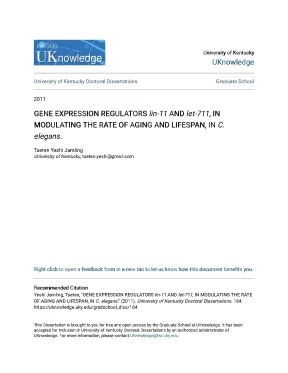
Tải xuống để đọc toàn bộUniversity of Kentucky UKnowledge University of Kentucky Doctoral Dissertations Graduate School 2011 GENE EXPRESSION REGULATORS lin-11 AND let-711, IN MODULATING THE RATE OF AGING AND LIFESPAN, IN C. Tseten Yeshi Jamling University of Kentucky, tseten.com Right click to open a feedback form in a new tab to let us know how this document benefits you. Recommended Citation Yeshi Jamling, Tseten, "GENE EXPRESSION REGULATORS lin-11 AND let-711, IN MODULATING THE RATE OF AGING AND LIFESPAN, IN C. University of Kentucky Doctoral Dissertations.edu/gradschool_diss/164 This Dissertation is brought to you for free and open access by the Graduate School at UKnowledge.
It has been accepted for inclusion in University of Kentucky Doctoral Dissertations by an authorized administrator of UKnowledge. For more information, please contact UKnowledge@lsv. ABSTRACT OF DISSERTATION Tseten Yeshi Jamling The Graduate School University of Kentucky 2011 GENE EXPRESSION REGULATORS lin-11 AND let-711, IN MODULATING THE RATE OF AGING AND LIFESPAN, IN C. ________________________________________________________________________ ABSTRACT OF DISSERTATION ________________________________________________________________________ A dissertation submitted in partial fulfillment of the requirements for the degree of Doctor of Philosophy in the College of Arts and Sciences at the University of Kentucky.
By Tseten Yeshi Jamling Lexington, Kentucky Director: Dr. Jim Lund, Assistant Professor of Biology Lexington, Kentucky 2011 Copyright Tseten Yeshi Jamling 2011 ABSTRACT OF DISSERTATION GENE EXPRESSION REGULATORS lin-11 AND let-711, IN MODULATING THE RATE OF AGING AND LIFESPAN, IN C. lin-11 and let-711 are early-developmental gene expression regulators with no previously known roles in aging regulation. Yet, they show strong aging-correlated expression profiles (Lund, Tedesco et al.
lin-11 is strongly upregulated in very old worm populations, and let-711 is progressively downregulated in aging worm populations. Microarray studies were performed to identify their genome-wide targets, which were then subjected to further lifespan and genetic analysis to investigate their role in C. The results indicate that the target pools of both lin-11 and let-711 are enriched for aging genes, since a significant number of tested genes increased lifespan. This enrichment of aging genes in their target pools provides strong evidence that lin-11 and let-711 are indeed regulating the expression of aging genes in adult C.
The data suggests that increased lin-11 expression as well as reduced let-711 expression may be promoting longevity by downregulating the insulin/IGF-1 pathway. Decreasing let-711 may also be contributing to longevity by downregulating the germline signaling pathway.5 are four genes from the lin-11 target pool, whose knockdown produced increases inlifespan. These are unannotated genes, and the details of their roles in aging regulation are not known at this point. ins-3 expression was downregulated two-fold upon knockdown of lin-11, suggesting the possible involvement of lin-11 in regulation of the insulin/IGF-1 pathway.
An RNAi construct for ins-3 was not available and it is not known whether loss of ins-3 leads to lifespan extension. let-711 knockdown resulted in an almost four-fold reduction in pdk-1 expression. pdk-1 is an integral part of the insulin/IGF-1 pathway and its knockdown by RNAi extended lifespan. Four other genes from the let-711 target pool that increased lifespan, cdc-25.1, gna-2, meg-1 and ooc-3, all have germline specific functions.
The extensions in lifespan generated by these genes were completely dependent on DAF-16. Furthermore, for gna-2, meg-1 or ooc-3, they were independent of DAF-2. These results agree with previously established mechanisms for germline regulation of aging, suggesting the involvement of let-711 in regulating the germline-signaling pathway. elegans, aging, lin-11, let-711,germline signaling.
Tseten Yeshi Jamling 25 Febuary 2011 GENE EXPRESSION REGULATORS lin-11 AND let-711, IN MODULATING THE RATE OF AGING AND LIFESPAN, IN C. By Tseten Yeshi Jamling Jim Lund Director of Dissertation Rebecca Kellum Co-director of Dissertation Brian Rymond Director of Graduate Studies 25 Febuary 2011 RULES FOR THE USE OF DISSERTATIONS Unpublished dissertations submitted for the Doctor’s degree and deposited in the University of Kentucky Library are as a rule open for inspections, but are able to be used only with due regard to the rights of the authors.Bibliographiccal references may be noted, but quatations or summaries of parts may be published only with the permission of the author, and with the usual scholarly acknowledgements. Extensive copying or publication of the dissertation in whole or in part also requires the consent of the Dean of the Graduate School of the University of Kentucky. A Library that borrows this dissertation for use by its patrons is expected to secure the signature of each user.
NAMEDATE ________________________________________________________________________ ________________________________________________________________________ ________________________________________________________________________ ________________________________________________________________________ _______________________________________________________________________ ________________________________________________________________________ ________________________________________________________________________ ________________________________________________________________________ ________________________________________________________________________ ________________________________________________________________________ DISSERTATION Tseten Yeshi Jamling The Graduate School University of Kentucky 2011 GENE EXPRESSION REGULATORS lin-11 AND let-711, IN MODULATING THE RATE OF AGING AND LIFESPAN, IN C. ________________________________________________________________________ DISSERTATION ________________________________________________________________________ A dissertation submitted in partial fulfillment of the requirements for the degree of Doctor of Philosophy in the College of Arts and Sciences at the University of Kentucky. By Tseten Yeshi Jamling Lexington, Kentucky Director: Dr. Jim Lund, Assistant Professor of Biology Lexington, Kentucky 2011 Copyright Tseten Yeshi Jamling 2011 FOR MY SON, TO BE BORN JUNE 29th 2011, MY WIFE, PHUNTSOK DOLMA, AND MY PARENTS, BUMO TSERING AND TSEWANG YESHI JAMLING.
THIS ACHEIVEMENT IS AS MUCH YOURS AS IT IS MINE. ACKNOWLEDGMENTS The followitng dissertation would never have been, were it not for the contributions of numerous people in numerous different ways.I begin by thanking my advisor, Dr. Jim Lund, for introducing me to the fascinating field of aging biology and C. elegans genetics, for his patience and guidancethoughout my graduate career.
I thank my committee members, Drs. Rebecca Kellum, Peter Mirabito and Brett Spear, for valuable insight and feedback towards my improvement as a scientist. I would also like to thank all my lab members, Scott Frasure, Dustin Perry, David Keesling, Daipayan Banerjee, Lin Xue, Suchita Desai and especially George Chaffins (late) for being comrades through the trials and tribulations of graduate school. George, you are always in my thoughts and prayers.
I have had a wonderful graduate school experience and would like to thank all graduate students, staff and faculty of the Biology department, for contributing towards my amazing experience. I thank Beverly Taulbee for her help with all the administrative details, and to Dr. John Seabolt for his genuine care and concern. The completion of my doctoral degree would not have been possible also, without the continuous support of my loved ones.
My beautiful wife, Phuntsok Dolma, never ceases to amaze me with her unwavering conviction in my capabilities, even when I am in doubt myself. Your love and support has been the single greatest contribution towards my completion of graduate school. Likewise, my parents BumoTsering and Tsewang Yeshi, along with my sisters Tenzin Nangkyi and Lhakpa Dolma, have provided incredible support and understanding throughout this entire process iii Table of Contents ACKNOWLEDGMENTS. iii LIST OF TABLES.
vi LIST OF FIGURES. vii CHAPTER 1: Background and Significance .1 Cellular pathways that regulate aging .3 The DAF-2 Insulin/IGF-1 Pathway. 3 Role of the reproductive system in aging regulation. 5 Other pathways that regulate aging.
8 Gene Expression Regulators lin-11 and let-711 .12 Expression profiles of lin-11 and let-711 are aging co-regulated. 12 lin-11, an early-developmental transcription factor. 13 let-711, an early-developmental gene expression regulator .21 CHAPTER 2: Characterization of early developmental transcription factors lin-11 and let-711 as aging regulators.24 Results and Discussion .26 Individual knockdown of lin-11 and let-711 in adult worms shortens lifespan. 26 Genome-wide target identification of lin-11 and let-711 in adult worms utilizing microarray analysis.
28 lin-11 knockdown increased expression of an insulin-related peptide. 29 lin-11 target pool is enriched for aging genes. 30 let-711 interaction with the Insulin-like signaling pathway. 32 let-711 target pool is enriched for aging genes that may be contributing to lifespan extension by downregulating germline signaling.
33 lin-11 and let-711 coregulated genes .2, a common target in both microarray experiments, extends lifespan .36 lin-11 regulates aging genes in C. 36 let-711 is an aging regulator in C. 36 Materials and Methods. 38 CHAPTER 3: let-711 Regulates Aging Through the Germline Signaling Pathway .58 iv Regulation of lifespan by the germline.
58 The germline regulates lifespan by inhibiting DAF-16 activity, independent of the daf- 2/insulin-like signaling pathway. 59 let-711 regulated genes that influence germline survival and proliferation. 60 Results and Discussion .64 daf-16 mutation suppresses lifespan extensions produced by RNAi of germline-related let- 711-regulated genes. 64 meg-1, ooc-3 and gna-2 regulate lifespan independently of daf-2.
65 Lifespan extension by cdc-25.1 is dependent on daf-2 .67 let-711 regulates lifespan through the germline signaling pathway. 67 let-711 regulates aging through daf-2 dependent check-point signaling mechanisms. 67 Model for let-711 regulation of lifespan in adult C. 68 Materials and Methods .69 Strains and maintenance.
69 CHAPTER 4: Conclusions and Future Directions. 77 lin-11 regulation of aging. 77 let-711 regulation of aging. 88 v LIST OF TABLES Table 2.
Seven genes showed significant changes in expression in both lin-11 and let- 711 microarray experiments. Sixteen genes were differentially expressed by at least two-fold when lin-11 is knocked down…………………………………. Sixty genes showed at least two-fold change in expression in response to let- 711 RNAi………………………………………………………………………54 Table 3. Summary of lifespan assays……….……85 vi LIST OF FIGURES Figure 1.
The Insulin/IGF-1 signaling pathway……. The early embryonic lineage and summary of the asymmetric distribution of various cell-fate determinants in 4-cell embryos……. Development of the reproductive system in C. Effects of germline and whole gonad ablation on C.
A genetic working model for the effects of the reproductive system on Aging.lin-11 RNAi and let-711 RNAi effects on lifespan………………………. M vs A plots show good agreement among replicate GeneChips…. Venn Diagram summarizing the results of the microarray analyses………. Expression profiles of the genes that were differentially expressed in the microarray experiments….2 RNAi extended lifespan……………….
RNAi of pdk-1 extended lifespan………………….grsp-4 RNAi and meg-1 RNAi extended lifespan…………………………. RNAi of cdc-25.1, ooc-3 or gna-2 individually extended lifespan. The daf-16 gene is required for the longevity induced bycdc-25.1, meg-1, ooc-3 or gna-2RNAi…. Loss of daf-2 supressed the lifespan extension of cdc-25.
Lifespan extensionsdue to knockdown of meg-1, ooc-3 and gna-2were independent of daf-2……………………………………………………………83 Figure 3. A model for let-711 regulation of lifespan in adult C.84 vii CHAPTER 1: Background and Significance Introduction Aging and death are something we are very familiar with, and accept as universal biological phenomena that cannot be avoided. Nonetheless, human life expectancy has increased by decades due to modern medicine and technology over the last century. Infant mortality rates have declined, cures for deadly diseases have been discovered, and our cars and buildings have become safer, allowing us to live longer.
As such, the elderly population is growing at a rapid rate and diseases associated with aging, including Alzheimer’s disease and cancer, are gaining notoriety. The US Department of Health and Human Services estimates that 20% of Americans, more than 70 million individuals, will be over the age of 65, by the year 2030. With ever-greater numbers living to grow old, there is strong interest in understanding the aging process at a fundamental level. But what do we really know about the biology of aging? The increased lifespan expectancy of the modern man is due to a reduction in risks or external factors and not due to an intimate understanding of the biology of aging.
All organisms age, and the similar vulnerability to deleterious effects of aging across phyla is remarkable, hinting at a conserved mechanism that regulates the aging process. Aging exponentially increases the mortality rate, producing a characteristic population survival curve observed in aging populations of a wide range of animals with lifespans ranging from days to years. Physiological changes such as organ function decline, loss of muscle mass, and weakened stress resistance are common aging phenotypes. The similarities are even more remarkable at the cellular level.
Accumulation of DNA damage, lipofuscin deposits, and accumulation of misfolded and damaged proteins are common cellular changes observed with aging in all living organisms.
Nội dung được bảo vệ bản quyền — Tải xuống đầy đủ
Trích dẫn luận án này
Tseten Yeshi Jamling (2011). Regulators Gene lin-11, let-711: Tuổi thọ và lão hóa [Luận án tiến sĩ, University of Kentucky]. LuanAn.net. https://luanan.net/sinh-hoc/regulators-gene-lin-11-let-711-tuoi-tho-lao-hoa-c-elegans
Câu hỏi thường gặp
Luận án "Regulators Gene lin-11, let-711: Tuổi thọ và lão hóa" nghiên cứu về vấn đề gì?
Khám phá vai trò của các gene lin-11 và let-711 trong việc điều hòa tuổi thọ và quá trình lão hóa. Hiểu rõ cơ chế phân tử ảnh hưởng đến sự già đi.
Luận án "Regulators Gene lin-11, let-711: Tuổi thọ và lão hóa" được bảo vệ tại trường nào?
Luận án này được bảo vệ tại University of Kentucky. Năm bảo vệ: 2011.
Luận án "Regulators Gene lin-11, let-711: Tuổi thọ và lão hóa" thuộc chuyên ngành gì?
Luận án "Regulators Gene lin-11, let-711: Tuổi thọ và lão hóa" thuộc chuyên ngành Biology. Danh mục: Sinh Học.
Luận án "Regulators Gene lin-11, let-711: Tuổi thọ và lão hóa" có bao nhiêu trang?
Luận án "Regulators Gene lin-11, let-711: Tuổi thọ và lão hóa" có 105 trang. Bạn có thể xem trước một phần tài liệu ngay trên trang web trước khi tải về.
Cách tải luận án "Regulators Gene lin-11, let-711: Tuổi thọ và lão hóa" về máy như thế nào?
Để tải luận án về máy, bạn nhấn nút "Tải xuống ngay" trên trang này, sau đó hoàn tất thanh toán phí lưu trữ. File sẽ được tải xuống ngay sau khi thanh toán thành công. Hỗ trợ qua Zalo: 0559 297 239.