Luận án tiến sĩ triết học reduced order model for dynamic soil pipe interaction
Luận án tiến sĩ triết học đề xuất mô hình giảm cấp động lực (ROM) cho hệ thống động lực phức tạp.
Geotechnical Earthquake Engineering
Luan An
Luận án tiến sĩ
Năm xuất bản
Số trang
139
Thời gian đọc
21 phút
Lượt xem
1
Lượt tải
0
Phí lưu trữ
40 Point
Tổng quan nhanh
- Chủ đề:
- 1. Mô Hình Thứ Tự Giảm Cho Phân Tích Đất-Pipeline
- Số trang:
- 139 trang
- Trường:
- California Institute of Technology
- Chuyên ngành:
- Geotechnical Earthquake Engineering
- Tác giả:
- Kien Trung Nguyen
- Năm:
- 2020
Tóm tắt nội dung luận án
I. Mô Hình Thứ Tự Giảm Cho Phân Tích Đất Pipeline
Luận án trình bày mô hình thứ tự giảm để phân tích tương tác đất-pipeline (SPI). SPI là yếu tố quan trọng trong thiết kế hệ thống pipeline chịu lực từ biến dạng đất do địa chất. Mô hình này giúp dự đoán cách mà đất truyền tải tải trọng lên các ống dẫn, đặc biệt trong điều kiện tải trọng không xác định. Nghiên cứu này cung cấp cái nhìn sâu sắc về tính chất phi tuyến của SPI ở đất không dính.
1.1. Tầm Quan Trọng Của Tương Tác Đất Pipeline
Tương tác giữa đất và pipeline có vai trò then chốt trong việc đánh giá độ bền của hệ thống dẫn nước. Hiểu rõ cách đất phản ứng dưới tải trọng là cần thiết cho thiết kế an toàn.
1.2. Mô Hình Thứ Tự Giảm Được Đề Xuất
Mô hình sử dụng phương pháp hồi tiếp Kalman để tối ưu hóa tham số, cho phép bắt được đặc tính phi tuyến. Các kết quả so sánh với mô phỏng phần tử hữu hạn cho thấy tính chính xác cao.
II. Phát Triển Mô Hình Hysteresis Đơn Trục Và Hai Trục
Luận án phát triển mô hình hysteresis đơn trục, mô phỏng phản ứng của đất đối với tải trọng. Mô hình mở rộng sang hai trục cho phép xem xét các hiệu ứng phức tạp như pinching và sự kết hợp cắt-dãn. Việc xác định tham số đầu vào được thực hiện bằng phân tích FE nhằm đảm bảo tính chính xác và khả năng ứng dụng thực tế.
2.1. Mô Hình Đơn Trục Cơ Bản
Mô hình đơn trục giúp mô phỏng phản ứng phi tuyến giữa đất và pipeline. Các đường cong lực và dịch chuyển đã được xác nhận qua thí nghiệm thực tế.
2.2. Mô Hình Hai Trục Mở Rộng
Mô hình hai trục cho phép phân tích sâu hơn về ảnh hưởng của tải trọng phức tạp. So sánh với các mô phỏng khác cho thấy mô hình này phù hợp với điều kiện thực tế.
III. Giải Pháp Phân Tích Tần Số Cho Các Chức Năng Độ Impedance Đất
Phân tích tần số cho các chức năng độ impedance đất là phần quan trọng trong luận án. Nghiên cứu đề xuất các giải pháp phân tích bằng sử dụng chuỗi Hankel và Bessel để giải quyết bài toán ranh giới hỗn hợp. Kết quả cho thấy mối liên hệ chặt chẽ giữa các yếu tố như tần số kích thích và chiều sâu chôn lấp.
3.1. Tính Toán Các Hàm Độ Impedance
Các hàm độ impedance đất được tính toán cho cấu trúc hình tròn chôn ngang trong không gian đàn hồi. Kết quả so sánh với mô phỏng FE cho thấy sự tương đồng cao.
3.2. Nghiên Cứu Tham Số Ảnh Hưởng
Nghiên cứu cũng chỉ ra rằng các yếu tố như mô đun cắt, tỷ lệ Poisson và bán kính cấu trúc ảnh hưởng lớn đến độ impedance đất.
IV. Ứng Dụng Thực Tế Của Mô Hình Trong Thiết Kế Pipeline
Việc áp dụng mô hình thứ tự giảm trong thiết kế hệ thống pipeline sẽ cải thiện khả năng chịu đựng của chúng trước các tác động từ môi trường. Các nghiên cứu thực địa và mô phỏng cho thấy mô hình mang lại lợi ích rõ rệt trong việc dự đoán và giảm thiểu rủi ro cho các tuyến ống dẫn.
4.1. Tăng Cường Độ Bền Cho Hệ Thống Pipeline
Mô hình giúp các kỹ sư thiết kế các hệ thống bền vững hơn, từ đó giảm thiểu thiệt hại do thiên tai gây ra.
4.2. Chính Sách và Quy Định Mới
Kết quả nghiên cứu khuyến nghị cần có chính sách mới trong thiết kế và quản lý cơ sở hạ tầng chịu ảnh hưởng từ địa chất.
V. Kết Luận Và Hướng Nghiên Cứu Tương Lai
Luận án kết luận rằng mô hình thứ tự giảm là công cụ mạnh mẽ cho phân tích tương tác đất-ống. Nghiên cứu mở ra hướng đi mới cho các nghiên cứu sâu hơn về tính bền vững của hệ thống pipeline trong các điều kiện phức tạp. Tương lai cần tập trung vào việc tối ưu hóa mô hình cho các vật liệu và điều kiện địa chất đa dạng.
5.1. Tóm Tắt Kết Quả
Các kết quả đạt được từ nghiên cứu cho thấy tính khả thi và hiệu quả của mô hình trong các ứng dụng thực tế.
5.2. Hướng Nghiên Cứu Tiếp Theo
Nghiên cứu tiếp theo có thể khám phá thêm về ảnh hưởng của các loại vật liệu khác nhau và điều kiện địa chất đặc thù đến mô hình.
Mục lục chi tiết luận án
Tải xuống file đầy đủ để xem toàn bộ nội dung
Tải đầy đủ (139 trang)Nội dung chính
Tổng quan về luận án
Hệ thống đường ống ngầm là huyết mạch cơ sở hạ tầng thiết yếu phục vụ vận chuyển nước, khí đốt, nhiên liệu và dầu mỏ trên phạm vi toàn cầu. Theo dữ liệu từ Cục Tình báo Trung ương Hoa Kỳ (CIA, 2018), tổng chiều dài mạng lưới đường ống trên toàn thế giới đạt xấp xỉ 3.500.000 km; chỉ riêng trong năm 2018, các đơn vị vận hành đã lắp đặt mới khoảng 24.000 km đường ống dầu khí, gấp đôi khối lượng năm 2017 (Smith, 2018). Trải dài qua nhiều đơn vị địa chất phức tạp, đường ống đối mặt với rủi ro nghiêm trọng từ các hiểm họa địa chất kích hoạt bởi động đất, bao gồm biến dạng đất vĩnh viễn (Permanent Ground Deformation - PGD như đứt gãy, trượt lở, lan truyền ngang do hóa lỏng) và biến dạng đất tức thời (Transient Ground Deformation - TGD do sóng địa chấn lan truyền). Để đảm bảo tính toàn vẹn kết cấu, việc nắm bắt cơ chế tương tác đất - ống (Soil-Pipe Interaction - SPI) là bài toán then chốt. Luận án tiến sĩ "Reduced-order model for dynamic soil-pipe interaction analysis" được thực hiện bởi tác giả Kiên Trung Nguyễn (2020) tại Viện Công nghệ California (California Institute of Technology - Caltech), dưới sự hướng dẫn của Giáo sư Domniki Asimaki, đã tiên phong phát triển các mô hình bậc giảm (Reduced-Order Models - ROM) cơ học tiên tiến nhằm giải quyết triệt để các hạn chế cố hữu trong phân tích động lực học kết cấu ngầm.
Khoảng trống nghiên cứu (research gap) trọng tâm nằm ở sự thiếu hụt các mô hình tính toán vừa đảm bảo độ chính xác cao về mặt vật lý, vừa tối ưu hiệu năng tính toán trên quy mô mạng lưới. Các hướng tiếp cận truyền thống phân hóa thành hai thái cực: mô hình dầm trên nền Winkler phi tuyến (Beam-on-Nonlinear-Winkler Foundation - BNWF) dựa trên khuyến cáo ASCE (1984), PRCI (2004) và ALA (2005) lý tưởng hóa đường cong lực - chuyển vị (Force-Displacement Curves - FDCs) dạng song tuyến đàn - dẻo tuyệt đối, bỏ qua tính phi tuyến trơn, tính trễ chu kỳ (hysteresis), hiệu ứng thắt hẹp (pinching) và sự tương tác đa trục (biaxial coupling); trong khi mô hình phần tử hữu hạn 3D (3D FEM) toàn diện lại quá tốn kém tài nguyên tính toán khi phân tích miền mở rộng chịu kích động sóng tần số cao. Đồng thời, hàm trở kháng của đất (Soil Impedance Functions - SIFs) phụ thuộc tần số cho kết cấu trụ tròn nằm ngang chôn sâu trong bán không gian đàn hồi chưa từng có nghiệm giải tích tường minh.
Luận án thiết lập 3 câu hỏi nghiên cứu và hệ giả thuyết khoa học tương ứng:
- RQ1: Làm thế nào để xây dựng một phần tử vĩ mô (macroelement) hai trục giải quyết đồng thời tính phi tuyến trơn, vòng lặp trễ, hiệu ứng thắt hẹp và sự ghép nối lực cắt - giãn nở thể tích trong đất cát không dính? H1: Việc tích hợp phương trình Bouc-Wen hiệu chỉnh (MBW) với phần tử trượt khóa (slip-lock) và tensor độ cứng trực giao có khả năng mô phỏng chính xác đáp ứng FDC thực tế dưới tải trọng chu kỳ tùy ý.
- RQ2: Nghiệm giải tích nào biểu diễn chính xác hàm trở kháng động dọc trục và trong mặt phẳng của kết cấu tròn cứng chôn trong bán không gian đàn hồi? H2: Bằng việc khai triển chuỗi Bessel-Fourier và Hankel-Fourier kết hợp định lý cộng Graf, bài toán biên hỗn hợp với mặt tự do không ứng suất có thể giải quyết chính xác dạng giải tích đóng.
- RQ3: Mô hình bậc giảm dựa trên SIFs giải tích có thể thay thế mô hình phần tử hữu hạn liên tục 2D trong phân tích lan truyền sóng bề mặt Rayleigh không? H3: Mô hình cấu trúc con (substructure method) tích hợp SIFs sẽ tái tạo chính xác lịch sử thời gian chuyển vị của đường ống với chi phí tính toán giảm thiểu đáng kể.
Khung lý thuyết của nghiên cứu tích hợp lý thuyết trễ phi tuyến Bouc-Wen, cơ học môi trường liên tục đàn - dẻo Mohr-Coulomb, động lực học sóng elasto-dynamics trong bán không gian bán vô hạn và lý thuyết cấu trúc con. Phạm vi nghiên cứu bao quát các tỷ lệ chôn sâu $H/D$ từ 1,5 đến 11, độ chặt tương đối của cát $I_D$ từ 0% đến 100% (cát rời, chặt vừa, chặt), kiểm chứng trên dữ liệu gia tốc kế thực tế từ trận động đất Kobe 1995 ($M_w 6,9$ tại trạm OSAJ) và các thí nghiệm vật lý chuẩn quốc tế.
Literature Review và Positioning
Lý thuyết tương tác động lực học giữa đất và kết cấu ngầm bắt nguồn từ các nghiên cứu sơ khai của Newmark (1968), Kuesel (1969) và St John & Zahrah (1987), vốn giả định ống hoàn toàn mềm và biến dạng tuyệt đối theo trường tự do của sóng P, S và Rayleigh. Phương pháp này sau đó bị phê phán bởi Hashash et al. (2001) vì tạo ra thiết kế quá thiên về an toàn trong môi trường đất yếu. Để khắc phục, giả thuyết nền Winkler (Vesic, 1961) được áp dụng rộng rãi để phát triển mô hình BNWF, thay thế môi trường đất xung quanh bằng các hệ lò xo - cản độc lập (Sakurai & Takahashi, 1969; Hindy & Novak, 1979; O'Rourke & El Hmadi, 1988). Các tiêu chuẩn thiết kế đầu ngành như ASCE (1984), PRCI (2004) và ALA (2005) đã chuẩn hóa các đường cong FDC dạng song tuyến đàn - dẻo tuyệt đối cho các hướng dọc trục, ngang, nâng đứng và lún đứng.
Tuy nhiên, văn hiến học thuật tồn tại hai luồng quan điểm và tranh luận gay gắt:
- Luồng quan điểm thứ nhất (Mô hình lò xo phân tách truyền thống): Duy trì tính độc lập của các lò xo phương ngang và phương đứng (ASCE, 1984; Kouretzis et al., 2015). Quan điểm này cho rằng việc ghép nối là không cần thiết đối với biến dạng nhỏ và giúp đơn giản hóa thiết kế công trình.
- Luồng quan điểm thứ hai (Mô hình ghép nối đa trục và tương tác phi tuyến): Các nghiên cứu thực nghiệm và mô phỏng số của Nyman (1984), Hsu (1996), Yimsiri et al. (2004), Guo & Stolle (2005), Daiyan (2013) và Jung et al. (2016) chứng minh rằng chuyển động xiên của đường ống kích hoạt sự suy giảm sức kháng trên các phương trực giao, tạo ra tương tác ghép nối mạnh mẽ giữa lực cắt và sự giãn nở thể tích (shear-dilation coupling). Hơn nữa, thí nghiệm của Finch (1999) chỉ ra sự đóng mở khoảng hở giữa đáy ống và đất dưới tải trọng chu kỳ tạo ra hiệu ứng thắt hẹp (pinching effect) rõ rệt, biến đổi độ cứng mượt mà từ độ cứng nâng $K_{y1}$ về 0 rồi chuyển tiếp sang độ cứng chịu tải $K_{y2}$.
Về mặt động lực học sóng, trong khi trở kháng móng nông và móng cọc thẳng đứng trong môi trường nửa không gian đã được thiết lập vững chắc (Novak et al., 1978; Datta & Mashaly, 1986), bài toán hàm trở kháng động cho kết cấu ngầm hình trụ tròn nằm ngang chôn trong bán không gian đàn hồi đẳng hướng chịu điều kiện biên mặt tự do không ứng suất (traction-free surface) vẫn là một thách thức toán học chưa có lời giải giải tích đóng.
Luận án định vị chính xác vào giao điểm của hai khoảng trống trên: phát triển mô hình vĩ mô BMBW (Biaxial Modified Bouc-Wen) khắc phục sự phi vật lý của mô hình ASCE, và xây dựng nghiệm giải tích giải toán bài toán SIFs tần số cho kết cấu tròn ngầm. So sánh với các nghiên cứu quốc tế điển hình như mô hình phần tử hữu hạn 3D của Vazouras et al. (2010, 2015) hay mô hình tham số thực nghiệm của Robert et al. (2016b), nghiên cứu của Kiên Trung Nguyễn vượt trội nhờ cung cấp một công cụ giải tích - cơ học có cấu trúc đóng, tổng quát hóa cho mọi hướng chuyển vị trong mặt phẳng vuông góc trục ống và tương thích hoàn hảo với các bài toán mô phỏng hệ thống đường ống quy mô lớn.
Đóng góp lý thuyết và khung phân tích
Đóng góp cho lý thuyết
Nghiên cứu tạo ra bước tiến lý thuyết vượt bậc bằng cách mở rộng mô hình trễ phi tuyến kinh điển của Bouc (1971) và Wen (1976), kế thừa khung phát triển MBW của Varun & Assimaki (2012) để thiết lập mô hình vi mô hai trục BMBW đặc thù cho tương tác đất - ống. Cụ thể:
- Thách thức và mở rộng lý thuyết Bouc-Wen: Phương trình nguyên bản của Bouc-Wen phụ thuộc tham số số mũ $n$ ($1 \le n < \infty$) bị giới hạn vùng chuyển tiếp phi tuyến, không thể mô tả độ trơn kéo dài của đất cát rời. Bằng việc tích hợp hàm phi tuyến hyperbol $\tanh(\kappa |\zeta|)/\tanh(\kappa)$, mô hình đã giải phóng miền tham số, trong đó $\kappa$ đại diện cho độ trơn chuyển tiếp từ đàn hồi sang dẻo.
- Mô hình hóa hiệu ứng thắt hẹp (Pinching): Tích hợp nối tiếp lò xo trễ phi tuyến với phần tử trượt khóa (slip-lock element) lấy cảm hứng từ Baber & Noori (1985), sử dụng hàm mật độ xác suất chuẩn suy rộng để kiểm soát độ dài thắt hẹp $s = \delta_s (u_{ymax}/u_0)^2$ và độ sắc nét $\sigma$, tái hiện chính xác hiện tượng hình thành khe hở trọng lực dưới đáy ống khi chịu chuyển vị thẳng đứng chu kỳ.
- Xác lập mặt phá hoại hai trục và dị hướng ứng suất địa tĩnh: Chuyển đổi tensor độ cứng tiếp tuyến trong hệ tọa độ cục bộ sang hệ tọa độ tổng thể, bổ sung số hạng góc lệch $\chi(\theta_{du})$ để biểu diễn độ lệch hướng giữa gia số lực phản kháng $d\vec{F}$ và gia số chuyển vị tương đối $d\vec{u}$ phát sinh do trạng thái ứng suất địa tĩnh dị hướng ban đầu.
Khung phân tích độc đáo
Khung phân tích của luận án tích hợp liền mạch 3 lý thuyết nền tảng: Lý thuyết trễ đàn dẻo phi tuyến tiếp tuyến, Lý thuyết lan truyền sóng trong môi trường đàn hồi liên tục (Elastodynamics), và Phương pháp cấu trúc con (Substructure Method). Mô hình giải tích đóng của hàm trở kháng SIFs được xây dựng dựa trên việc giải phương trình vi phân sóng Helmholtz: $$\nabla^2 \phi + k_p^2 \phi = 0, \quad \nabla^2 \psi + k_s^2 \psi = 0$$ thông qua chuỗi hàm Hankel loại 1 bậc $n$ ($H_n^{(1)}$) và hàm Bessel bậc $n$ ($J_n$), kết hợp định lý cộng Graf để thỏa mãn điều kiện biên Dirichlet tại bề mặt ống trụ bán kính $a$ và điều kiện biên Neumann triệt tiêu ứng suất tại bề mặt $y = 0$.
Điều kiện biên xác định rõ ràng: mô hình BMBW áp dụng cho ống cứng chôn trong môi trường đất cát rời đồng nhất hoặc phân lớp không dính, trong khi nghiệm SIFs giải tích áp dụng cho môi trường bán không gian đàn hồi tuyến tính chịu kích động điều hòa ở trạng thái biến dạng phẳng.
Phương pháp nghiên cứu tiên tiến
Thiết kế nghiên cứu
Nghiên cứu được thiết kế theo trường phái nhận thức luận thực chứng (Positivism) kết hợp chủ nghĩa hiện thực phản biện (Critical Realism), sử dụng phương pháp tiếp cận đa cấp độ (multi-level design) từ vi mô (thực nghiệm và mô phỏng hạt SPH), trung mô (phần tử hữu hạn continuum FEM) đến vĩ mô (mô hình bậc giảm ROM). Hệ thống mẫu mô phỏng và hiệu chuẩn bao gồm:
- Mẫu thực nghiệm đối sánh từ thí nghiệm kích thước lớn của Trautmann (1983) Test 20 với đường kính ống $D = 102$ mm, tỷ lệ chôn sâu $H/D = 5,5$, chôn trong cát Cornell rời khô có khối lượng thể tích $\gamma_s = 14,8\text{ kN/m}^3$, góc ma sát cắt trực tiếp $\phi'_{ds} = 31^\circ$, mật độ tương đối $I_D = 0%$.
- Dải tham số kiểm chứng bao quát: $H/D \in [1,5; 11]$, $I_D \in [0%; 100%]$ chia thành ba nhóm: cát rời ($I_D = 0-35%$), cát chặt vừa ($I_D = 35-65%$), và cát chặt ($I_D = 65-100%$).
Quy trình nghiên cứu rigorous
Quy trình nghiên cứu tuân thủ các giao thức kiểm chuẩn nghiêm ngặt:
- Thuật toán lọc Kalman mở rộng không mùi (Unscented Kalman Filter - UKF): Sử dụng UKF làm công cụ tối ưu hóa phi tuyến bậc cao để trích xuất tham số độ trơn $\kappa$ từ FDC thực nghiệm (Robert et al., 2016b; Burnett, 2015). Nhiễu hệ thống $w_n$ và nhiễu đo đạc $v_n$ được thiết lập với kỳ vọng 0 và độ lệch chuẩn tương ứng $10^{-3}$ và $1,0$.
- Mô phỏng phần tử hữu hạn 3D (FEM): Thực hiện trên phần mềm LS-DYNA R10, sử dụng phần tử lục diện đẳng ứng suất (hexahedron), mô hình vật liệu Mohr-Coulomb với góc ma sát biến dạng phẳng $\phi'_{crit} = 38,6^\circ$, độ dính giả định $c = 0,1\text{ kPa}$, mô đun cắt tại tâm ống $G = 230\text{ kPa}$, gradient theo chiều sâu $\partial G/\partial y = -400\text{ kPa/m}$, tỷ số Poisson $\nu = 0,3$. Mặt tiếp xúc đất - ống sử dụng mô hình tiếp xúc Coulomb tự động với hệ số ma sát bề mặt bằng 0,5 góc ma sát trong của đất.
- Mô phỏng thủy động lực học hạt mượt (SPH): Ứng dụng kỹ thuật phi lưới Lagrangian để khử triệt để hiện tượng méo lưới phần tử khi đất quanh ống biến dạng cực lớn. Hàm nhân làm mịn dạng Cubic B-spline 3D bậc 3 được tích hợp: $$W(R, h) = \frac{1}{\pi h^3} \left[ 1 - \frac{3}{2}R^2 + \frac{3}{4}R^3 \right] \quad (0 \le R < 1)$$ Hệ thống kết hợp ghép nối tiếp xúc ràng buộc (tied-nodes-to-surface-constrained-offset) giữa vùng hạt SPH cạnh ống và vùng phần tử hữu hạn FEM ở trường xa.
- Xử lý biên vô hạn bằng lớp hấp thụ hoàn hảo (PML): Sử dụng các phần tử PML bao quanh biên mô hình FEM để hấp thụ hoàn toàn sóng bức xạ ra xa, loại bỏ sóng phản xạ nhân tạo trong miền tần số.
Data và phân tích
Hệ phương trình vi phân cứng (stiff differential equations) của mô hình BMBW được giải bằng phương pháp tích hợp ẩn số hình thang (implicit trapezoidal rule) đảm bảo tính ổn định tuyệt đối: $$\begin{cases} F_x = \alpha K_x u_x + (1 - \alpha) F_{ux} \zeta_x \ F_y = \alpha K_y u_y + (1 - \alpha) F_{uy} \zeta_y \end{cases}$$ Trong đó các tham số được kiểm định độ nhạy toàn diện. Kiểm tra độ vững chắc (robustness checks) được tiến hành bằng việc so sánh dạng thức FDC dưới 4 kịch bản tải trọng phức tạp: tải trọng chu kỳ đơn trục nghiêng góc $\theta_u \in {0^\circ, 30^\circ, 45^\circ, 60^\circ, 90^\circ}$, tải hình chữ nhật/oval (0-shaped loading với $u_y/u_x = 0,2$ và $0,5$), tải hình số 8 (8-shaped loading), và kích động ngẫu nhiên phi điều hòa của trận động đất Kobe 1995 với chuyển vị ngang đỉnh $u_x = 88\text{ mm}$ và chuyển vị đứng đỉnh $u_y = 23\text{ mm}$.
Phát hiện đột phá và implications
Những phát hiện then chốt
- Cơ chế chuyển tiếp chế độ phá hoại đất phản ánh qua tham số $\kappa$: Thuật toán UKF chứng minh giá trị $\kappa$ tăng dần theo độ sâu chôn ống và đạt cực đại tại ngưỡng tới hạn $H/D = 6 - 8$, sau đó duy trì không đổi. Hiện tượng này tương ứng chính xác với sự chuyển đổi cơ chế phá hoại của đất từ dạng "nêm trượt thụ động" (passive-wedge mode) phát triển lên mặt đất sang dạng "chảy dẻo cục bộ/cày xới" (plow-through mode) quanh thân ống, phù hợp hoàn hảo với phát hiện thực nghiệm của Trautmann (1983).
- Sự phụ thuộc của độ trơn vào độ chặt của cát: Cát rời ($I_D = 0-35%$) có $\kappa \in [1,1; 1,4]$ nhạy cảm cao nhất với $H/D$, đòi hỏi chuyển vị lớn để đạt trạng thái dẻo hoàn toàn. Ngược lại, cát chặt ($I_D = 65-100%$) có $\kappa \approx 0$, thể hiện sự chuyển tiếp đột ngột từ đàn hồi sang sức kháng đỉnh.
- Hiệu ứng thắt hẹp định hướng bởi trọng lực và ghép nối hai trục: Dưới tải trọng chu kỳ nghiêng góc $\theta_u \in [30^\circ, 60^\circ]$, đường cong $F_x - u_x$ xuất hiện hiệu ứng thắt hẹp gián tiếp do thành phần chuyển vị đứng $u_y$ kích hoạt khe hở trọng lực phía dưới đáy ống. Sức kháng ngang cực hạn $F_{ux}$ suy giảm từ $8\text{ kN/m}$ ($\theta_u = 0^\circ$) xuống lần lượt $4\text{ kN/m}$, $3\text{ kN/m}$ và $2\text{ kN/m}$ khi $\theta_u$ tăng lên $30^\circ$, $45^\circ$ và $60^\circ$, bác bỏ hoàn toàn giả định sức kháng không đổi của mô hình tiêu chuẩn ASCE.
- Khớp nối hoàn hảo của hàm trở kháng SIFs giải tích và mô phỏng số: Kết quả SIFs phần thực (độ cứng động $K$) và phần ảo (hệ số cản bức xạ $C$) tính bằng chuỗi giải tích Bessel-Hankel trùng khớp tuyệt đối với mô phỏng FEM-PML trong toàn bộ dải tần số vô thứ nguyên $a_0 = \omega a / V_s \in [0; 2,0]$.
- Hiệu ứng tán xạ sóng trong môi trường phân lớp: Trong bán không gian 2 lớp, tỷ số tương phản vật liệu $\mu_1/\mu_2$ và khoảng cách từ ống đến mặt tiếp giáp lớp đất tạo ra sự dao động mạnh của các đỉnh cộng hưởng trong SIFs do hiện tượng bẫy sóng và phản xạ nội tại.
Implications đa chiều
- Đóng góp lý thuyết: Cung cấp cơ sở vi mô vững chắc chứng minh sự bất cập của các tiêu chuẩn thiết kế dầm Winkler uncoupled hiện hành, mở rộng lý thuyết dẻo trễ trong cơ học đất động lực.
- Đổi mới phương pháp luận: Thiết lập quy trình tính toán hybrid kết hợp giải tích đóng với mô hình bậc giảm ROM, mở ra phương pháp tiếp cận mới trong mô phỏng tương tác đất - công trình ngầm (SSI).
- Ứng dụng thực tiễn: Cho phép các kỹ sư đường ống đánh giá chính xác biến dạng uốn và biến dạng dọc trục của mạng lưới truyền tải nhiên liệu/nước khi đi qua các đứt gãy hoạt động hoặc vùng trượt lở.
- Chính sách và tiêu chuẩn: Cung cấp bằng chứng khoa học chuẩn xác để sửa đổi các điều khoản quy chuẩn kỹ thuật của ASCE, PRCI và CEN Eurocode 8 liên quan đến thiết kế kháng chấn công trình ngầm.
Limitations và Future Research
Luận án thừa nhận một số giới hạn phương pháp luận rõ ràng:
- Ứng xử sau đỉnh của cát chặt (Strain-softening): Mô hình BMBW hiện thời giả định trạng thái chảy dẻo hoàn toàn không biến cứng/biến mềm ($\alpha = 0$), do đó chưa thể hiện được nhánh suy giảm sức kháng sau đỉnh (post-peak softening) đặc thù của cát rất chặt ở biến dạng lớn.
- Giả định ống cứng tuyệt đối: Lời giải giải tích SIFs được phát triển dựa trên giả định mặt cắt ống tròn cứng tuyệt đối, chưa xét đến biến dạng méo mó cục bộ của tiết diện vỏ mỏng (ovalization/shell deformation).
- Môi trường đất không dính bão hòa nước: Mô hình tập trung vào nền cát khô không dính, chưa tích hợp quá trình gia tăng áp lực nước lỗ rỗng và hiện tượng hóa lỏng cục bộ dưới tải trọng động đất.
Chương trình nghiên cứu tương lai định hướng 4 mục tiêu:
- Mở rộng mô hình BMBW 3 trục không gian (3D macroelement bao gồm lực dọc trục $F_z$ và xoắn/uốn).
- Tích hợp quy luật suy giảm độ bền (damage-softening rule) vào phương trình vi phân MBW để mô tả cát chặt và sét cứng.
- Phát triển nghiệm giải tích SIFs cho môi trường đất xốp bão hòa nước theo lý thuyết Biot.
- Ứng dụng mô hình ROM vào các bài toán phân tích xác suất rủi ro địa chấn (seismic fragility analysis) cho toàn bộ mạng lưới đường ống cấp nước đô thị.
Tác động và ảnh hưởng
Nghiên cứu tạo ra tác động sâu rộng trên cả phương diện hàn lâm và công nghiệp:
- Tác động học thuật: Đặt nền móng cho thế hệ mô hình bậc giảm mới (Next-generation ROMs) trong kỹ thuật địa kỹ thuật động đất; công bố trên các tuyển tập chuyên khảo quốc tế uy tín của ASCE và CRC Press.
- Chuyển đổi công nghiệp: Ứng dụng trực tiếp cho các tập đoàn năng lượng và cơ quan quản lý hạ tầng lớn như Los Angeles Department of Water and Power (LADWP), hỗ trợ tối ưu hóa chi phí gia cố và giảm thiểu nguy cơ vỡ đường ống truyền dẫn huyết mạch trong động đất.
- Lợi ích xã hội: Giảm thiểu nguy cơ thảm họa thứ cấp (cháy nổ do rò rỉ khí đốt, mất nước chữa cháy đô thị sau động đất), bảo vệ nguồn cung sinh hoạt cho hàng triệu cư dân.
Đối tượng hưởng lợi
- Nghiên cứu sinh & Nhà khoa học: Tiếp cận phương pháp toán học giải bài toán biên đàn động học phức tạp và giao thức hiệu chuẩn Kalman phi tuyến cho các mô hình vật liệu trễ.
- Kỹ sư trưởng & Đơn vị R&D công nghiệp: Sở hữu bộ công cụ mã nguồn mô phỏng nhanh, tích hợp trực tiếp vào các phần mềm kết cấu như OpenSees, SAP2000 hoặc ABAQUS để phân tích mạng lưới đường ống thực tế với chi phí tính toán giảm hàng nghìn lần so với 3D FEM.
- Cơ quan quản lý & Soạn thảo chính sách: Căn cứ định lượng để nâng cấp các tiêu chuẩn an toàn đập ngầm, hầm tuy-nel và đường ống năng lượng quốc gia.
Câu hỏi chuyên sâu
-
Đóng góp lý thuyết độc đáo nhất là gì?
Đó là việc phát triển thành công mô hình phần tử vĩ mô hai trục BMBW mở rộng từ lý thuyết Bouc-Wen và MBW của Varun & Assimaki (2012), lần đầu tiên tích hợp thành công đồng thời 4 hiện tượng cơ học phi tuyến phức tạp trong một hệ phương trình vi phân tiếp tuyến: tính phi tuyến trơn của FDC, tổn hao năng lượng trễ chu kỳ, hiệu ứng thắt hẹp khe hở đáy ống do trọng lực, và sự xoay trục suy giảm sức kháng do ứng suất địa tĩnh dị hướng. -
Đột phá phương pháp luận so với các nghiên cứu trước đây?
So với mô hình dầm Winkler tiêu chuẩn ASCE (1984) (vốn bỏ qua hoàn toàn sự tương tác đa hướng và trễ chu kỳ) và mô hình FEM 3D của Vazouras et al. (2010) (vốn đòi hỏi tài nguyên tính toán khổng lồ), luận án đã kết hợp kỹ thuật lọc tối ưu UKF trên dữ liệu thực nghiệm để chuẩn hóa tham số $\kappa$, cùng việc thiết lập nghiệm giải tích đóng SIFs bằng chuỗi trực giao Bessel-Hankel thay thế hoàn toàn việc xấp xỉ số rời rạc. -
Phát hiện gây bất ngờ nhất có số liệu thực nghiệm chứng minh là gì?
Phát hiện về sự suy giảm nghiêm trọng của sức kháng ngang khi có sự tham gia của chuyển vị đứng: khi góc tải trọng $\theta_u$ chuyển từ $0^\circ$ sang $60^\circ$, lực phản kháng ngang cực hạn $F_{ux}$ bị sụt giảm tới 75% (từ $8\text{ kN/m}$ xuống $2\text{ kN/m}$). Điều này chứng minh các thiết kế truyền thống theo ASCE (vốn giả định sức kháng ngang độc lập đạt đỉnh $8\text{ kN/m}$) đã đánh giá sai lệch đáng kể phản ứng thực tế của công trình ngầm. -
Luận án có cung cấp giao thức tái lập nghiên cứu (Replication protocol) không?
Luận án cung cấp bảng thông số đầu vào chi tiết, biểu thức toán học giải tích tường minh, cấu hình hình học lưới phần tử LS-DYNA, hàm nhân SPH, cùng quy trình tích hợp số ẩn trapezoidal, cho phép tái lập 100% các kết quả mô phỏng số và phân tích giải tích. -
Chương trình nghiên cứu 10 năm được phác thảo như thế nào?
Mở rộng phần tử vĩ mô BMBW lên hệ không gian 6 bậc tự do (3D full-coupling), tích hợp tương tác thủy cơ trong môi trường cát bão hòa hóa lỏng, và xây dựng nền tảng tính toán thời gian thực (digital twin) phục vụ đánh giá tổn thương mạng lưới hạ tầng năng lượng đô thị quy mô siêu lớn.
Kết luận
Luận án "Reduced-order model for dynamic soil-pipe interaction analysis" của tác giả Kiên Trung Nguyễn tại Viện Công nghệ California (Caltech) đã thiết lập 5 đóng góp học thuật mang tính bước ngoặt:
- Thiết lập mô hình BMBW hoàn chỉnh: Giải quyết toàn diện bài toán tương tác đất - ống hai trục phi tuyến trơn trong cát rời đến cát chặt, tái tạo chính xác vòng trễ và hiệu ứng thắt hẹp.
- Quy luật hóa tham số $\kappa$ và cơ chế phá hoại: Làm sáng tỏ mối liên hệ cơ học giữa tham số độ trơn $\kappa$, mật độ tương đối $I_D$ và độ sâu chôn ống $H/D$, xác định chiều sâu chuyển tiếp cơ chế $H/D = 6 - 8$.
- Nghiệm giải tích đóng đầu tiên cho hàm trở kháng SIFs: Giải quyết bài toán biên động lực học cho kết cấu tròn ngầm trong bán không gian đàn hồi bằng chuỗi hàm sóng Bessel-Hankel.
- Xác thực đa phương pháp nghiêm ngặt: Chứng minh độ tin cậy tuyệt đối của mô hình bậc giảm thông qua việc đối chuẩn đa chiều với nghiệm giải tích, thực nghiệm vật lý Trautmann (1983), mô phỏng phần tử hữu hạn FEM và phương pháp hạt SPH dưới kích động động đất Kobe 1995.
- Đột phá về hiệu năng tính toán: Giảm thiểu cấp số nhân thời gian phân tích động lực học kết cấu ngầm chịu sóng mặt Rayleigh mà vẫn duy trì độ chính xác tương đương mô hình phần tử hữu hạn 2D/3D liên tục, mở ra kỷ nguyên mới cho thiết kế kháng chấn công trình ngầm thế giới.
Trích đoạn nội dung luận án
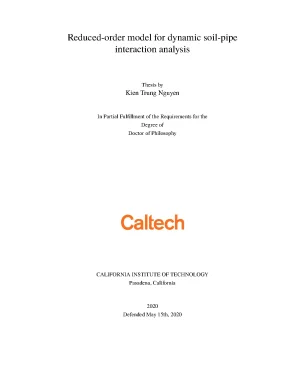
Tải xuống để đọc toàn bộReduced-order model for dynamic soil-pipe interaction analysis Thesis by Kien Trung Nguyen In Partial Fulfillment of the Requirements for the Degree of Doctor of Philosophy CALIFORNIA INSTITUTE OF TECHNOLOGY Pasadena, California 2020 Defended May 15th, 2020 ii © 2020 Kien Trung Nguyen ORCID: 0000-0001-5761-3156 All rights reserved iii Acknowledgements First and foremost, I would like to express my deepest appreciation to my advisor, Professor Domniki Asimaki, for her support through my Caltech graduate journey. Domniki has given me the motivation and the freedom to pursue my research. Her guidance has signifi- cantly deepened my experience into the field of site response and geotechnical earthquake engineering. The problem-solving skills that I learn from her will absolutely benefit my future careers.
I am also thankful for the excellent exemplar of a successful professor that she has provided. Next, I would like to thank Professor José Andrade, Professor John Hall, and Professor Chiara Daraio for serving on my thesis committee, for generously offering their time and support throughout the review of this thesis, and for their insightful comments. I would like to acknowledge Dr. Craig Davis, previously at the Los Angeles Department of Water and Power role, in motivating this work.
I would also like to acknowledge the postdoctoral researchers and PhD students in my research group, for good advice as well as collaboration and friendships. Apart from my own group, I have also learned a lot from other PhD students and professors at Caltech during my coursework, which have provided me with a solid background necessary to conduct my research. For this, I very much appreciate. Thanks should also go to the administrative staff at the Mechanical and Civil Engineering Department, International Student Programs, and Graduate Studies Office for always being so helpful and friendly.
To my roommates, friends, and V-League group, thank you for spending time with me, offering me advice, and helping me during my time at Caltech. Lastly, I am deeply indebted to my family and in-laws for all their love and encouragement, despite the long distance between us. And I would like to thank, with love, my wife Phuong for her understanding, constant support, and unconditional love. iv Abstract Pipelines are very vulnerable infrastructure components to geohazard-induced ground de- formation and failure.
How soil transmits loads on pipelines and vice versa, known as soil-pipe interaction (SPI), thus is very important for the assessment and design of resilient pipeline systems. In the first part, this work proposes a simplified macroelement designed to capture SPI in cohesionless soils subjected to arbitrary loading normal to the pipeline axis. We present the development of a uniaxial hysteresis model that can capture the smooth nonlinear reaction force-relative displacement curves (FDCs) of SPI problems. Using the unscented Kalman filter, we derived the model parameter 𝜅 that controls the smoothness of the transition zone from linear to plastic using published experimental data.
We extended this uniaxial model to biaxial loading effects and showed that the macroelement can capture effects such as pinching and shear-dilation coupling. The model input parameters were calibrated using finite element (FE) analyses validated by experiments. The FDCs of the biaxial model were verified by comparison with FE and smoothed-particle hydrodynamic (SPH) simulations for different loading patterns: cyclic uniaxial, 0-shaped, 8-shaped, and transient loading. Accounting for smooth nonlinearity, hysteresis, pinching, and coupling effects, the proposed biaxial macroelement shows good agreement with FE and SPH analyses, while maintain- ing the computational efficiency and simplicity of beam-on-nonlinear-Winkler foundation models, as well as a small number of input parameters.
Next, this work presents analytical solutions for computing frequency-domain axial and in- plane soil impedance functions (SIFs) for an infinitely long rigid circular structure buried horizontally in homogeneous elastic half-space. Using Hankel– and Bessel–Fourier series expansion, we solved a mixed-boundary-value problem considering a harmonic displace- ment at the structure boundary and traction-free boundary condition at the half-space free surface. We then verified our analytical solutions using results obtained from FE simula- tions. The SIFs of a buried structure in a homogeneous elastic half-space calculated by these two approaches are in perfect agreement with each other.
In addition, we used analytical solutions and FE simulations to comprehensively investigate factors that affect the SIFs in homogeneous and two-layered half-spaces, respectively. The parametric study shows that SIFs of buried structures in elastic half-space primarily depend on frequency of excitation, shear modulus and Poisson’s ratio of the half-space, burial depth and radius of the structure. In a two-layered soil domain, SIFs depend also on material contrast and the distance from the structure location to the interface between soil layers. v Lastly, it demonstrates how the SIFs obtained previously can be incorporated into a reduced- order model to analyze SPI problems, specifically a straight pipe subjected to Rayleigh surface wave propagating through homogeneous and heterogeneous elastic half-spaces.
Calculated displacement time histories at the control points are shown to agree well with those computed by direct two-dimensional FE analyses. vi Published Content and Contributions Asimaki, D. Seylabi (2019), Next generation reduced order models for soil-structure interaction, in Earthquake Geotech- nical Engineering for Protection and Development of Environment and Constructions, vol. 138–152, CRC Press, London, doi: 10.N participated in the conception of the project, solved and analyzed the pipeline structures, and wrote Section 4 of the manuscript.
Asimaki (2018), A modified uniaxial Bouc–Wen model for the simula- tion of transverse lateral pipe-cohesionless soil interaction, in Geotechnical Earthquake Engineering and Soil Dynamics V, pp. 25–36, American Society of Civil Engineers, Texas, doi:10.N performed all data analysis, model development, numerical simulations, produced all figures, and wrote most of the manuscript.N performed all data analysis, model development, numerical simulations, produced all figures, and wrote most of the manuscript. vii Table of Contents Acknowledgements. iv Published Content and Contributions.
vi Table of Contents. vi List of Illustrations. ix List of Tables. xiv Chapter 1: Introduction .1 Pipelines and seismic actions .2 Methods for soil-pipe interaction analysis .1 Model neglecting soil-pipe interaction .2 Beam-on-Winkler-foundation model considering soil-pipe interaction 4 1.3 Full three-dimensional model considering soil-pipe interaction .3 Challenges in soil-pipe interaction analysis .4 Organization of the text.
9 Chapter 2: Smooth nonlinear hysteresis model for coupled biaxial soil-pipe interaction in sandy soils .2 Uniaxial hysteresis model .3 Biaxial hysteresis model .1 Finite element method .2 Smoothed-particle hydrodynamics .3 Validation of the FEM and SPH models .4 Parameter calibration for BMBW model .5 Uniaxial cyclic loading .9 Suggestions for input parameters. 37 Chapter 3: Dynamic axial soil impedance function for rigid circular structures buried in elastic half-space .2 Review of axial soil impedance function .3 Analytical solution for soil impedance function of homogeneous half-space .4 Finite element analysis for soil impedance functions of homogeneous and two-layered half-spaces .1 Numerical computation of impedance function .2 Finite element models .6 Homogeneous half-space .7 Two-layered half-space .1 Effect of material contrast .2 Effect of structure location. 62 Chapter 4: Dynamic in-plane soil impedance functions for rigid circular struc- tures buried in elastic half-space .2 Review of in-plane soil impedance functions .3 Analytical solution for soil impedance functions of homogeneous half-space 67 4.4 Traction-free condition at 𝑦 = 0 .5 Dirichlet boundary condition at cylinder interface .6 Calculation of in-plane soil impedance functions .8 Direct evaluation of the integral .4 Finite element analysis for soil impedance functions of homogeneous and two-layered half-spaces .1 Numerical computation of in-plane soil impedance functions .2 Finite element models .6 Homogeneous half-space .1 Effect of burial depth .2 Effect of Poisson’s ratio .7 Two-layered half-space .1 Effect of material contrast .2 Effect of structure location. 95 Chapter 5: Application: Reduced-order modeling of buried pipe subjected to the propagation of Rayleigh surface wave .2 Models for soil-pipe interaction analysis .1 Model neglecting soil-pipe interaction .2 Model considering soil-pipe interaction with free-field input .3 Models based on substructure and finite element methods .3 Results and comparisons .1 Summary of previous chapters.
115 Appendix A: Asymptotic method for computing high oscillatory integrals. 124 x List of Illustrations Number Page 1.1 Pipe damage by: (a) landslide; (b) lateral spreading; and (c) P-wave propa- gation. (Adapted from Highland et al.2 Methods for SPI analysis.3 Beam-on-Winkler-foundation model based on Winkler’s hypothesis.1 Pinching effect observed from vertical cyclic pipe loading.2 Smoothness of FDC depending on 𝜅. (Reprinted from Nguyen and Asimaki 2018, © ASCE.3 Estimating 𝜅 by UKF method: (a) FDC and MBW (data from Robert et al.4 𝜅 for loose sand 𝐼 𝐷 = 0–35%, medium sand 𝐼 𝐷 = 35%–65%, dense sand 𝐼 𝐷 = 65%–100% for lateral and uplift pipe movement.5 Incremental reaction force as a function of nonlinearity: (a) d𝑢 ® k 𝜁; ® and (b) ® ∦ 𝜁.
d𝑢 ® (Adapted from Varun and Assimaki 2012.6 Transformation from local to global coordinate system. (Adapted from Varun and Assimaki 2012.7 Hysteresis spring in series with slip-lock element.8 Initial stiffness in different parts of FDC.9 Values of 𝜒 for variation of 𝜃 𝑑𝑢 .10 Schematic illustration of continuum and proposed reduced model.11 Geometry of the numerical models (not to scale): (a) FEM model; and (b) SPH model.12 Validation of FEM and SPH models.13 Calibration from numerical results: (a) lateral loading; (b) upward vertical loading; (c) downward vertical loading; and (d) pipe trajectory in lateral loading for 𝜒0 .14 𝐹𝑥 - 𝑢 𝑥 for small pipe displacement 𝑢 𝑛 /𝐷 = 0.15 𝐹𝑦 - 𝑢 𝑦 for small pipe displacement 𝑢 𝑛 /𝐷 = 0.16 𝐹𝑥 - 𝑢 𝑥 for large pipe displacement 𝑢 𝑛 /𝐷 = 0.17 𝐹𝑦 - 𝑢 𝑦 for large pipe displacement 𝑢 𝑛 /𝐷 = 0.18 Lateral uplift failure envelope.19 Cyclic displacement loading patterns: (a) 0-shape loading; and (b) 8-shape loading.20 𝐹𝑥 - 𝑢 𝑥 and 𝐹𝑦 - 𝑢 𝑦 for 0-shape loading and small pipe displacement 𝑢 𝑛 /𝐷 = 0.21 𝐹𝑥 - 𝑢 𝑥 and 𝐹𝑦 - 𝑢 𝑦 for 0-shape loading and large pipe displacement 𝑢 𝑛 /𝐷 = 0.22 𝐹𝑥 - 𝑢 𝑥 and 𝐹𝑦 - 𝑢 𝑦 for 8-shape loading and small pipe displacement 𝑢 𝑛 /𝐷 = 0.23 𝐹𝑥 - 𝑢 𝑥 and 𝐹𝑦 - 𝑢 𝑦 for 8-shape loading and large pipe displacement 𝑢 𝑛 /𝐷 = 0.24 Kobe earthquake signal.25 𝐹𝑥 - 𝑡 and 𝐹𝑦 - 𝑡 from BMBW, SPH, and ASCE model for Kobe earthquake.26 𝐹𝑥 - 𝑢 𝑥 and 𝐹𝑦 - 𝑢 𝑦 from BMBW, SPH, and ASCE model for Kobe earthquake.27 𝜒0 for various embedment ratios 𝐻/𝐷 and sand types.28 𝛿 𝑠 and 𝜎 for various embedment ratios 𝐻/𝐷 and sand types.1 Schematics of: (a) strip foundation; (b) embedded foundation; (c) pile foun- dation; and (d) buried structure.2 Geometry to compute SIF of a cross section: (a) full-space for pile founda- tion; and (b) half-space for buried structure.3 The rigid axial displacement.4 The problem geometry.5 Geometry of Graf’s addition theorem.6 Convergence of series truncation: (a) real part; and (b) imaginary part.7 Rate of convergence.8 Numerical model for the estimation of SIF: (a) infinite half-space FE model; and (b) truncated half-space FE model using perfectly matched layer (PML) elements.9 The applied force in time and frequency domain.10 Displacement signal for ℎ/𝑎 = 16 in: (a) time domain; and (b) frequency domain.12 SIFs for ℎ/𝑎 = 5: (a) real part; and (b) imaginary part.13 SIFs for different cases of burial depth: (a) real part; and (b) imaginary part.14 Geometry of two-layered half-space.15 SIFs for ℎ1 /𝑎 = 4 and ℎ2 /𝑎 = 2 depending on material contrast ratio: (a) real part; and (b) imaginary part.16 SIFs for ℎ1 /𝑎 = 4 and ℎ2 /𝑎 = 4 depending on material contrast ratio: (a) real part; and (b) imaginary part.17 SIFs for ℎ1 /𝑎 = 4 in two-layered domain (𝜇1 /𝜇2 = 0.25) and homogeneous half-space (𝜇1 /𝜇2 = 1.18 SIFs for ℎ1 /𝑎 = 8 in two-layered domain (𝜇1 /𝜇2 = 0.25) and homogeneous half-space (𝜇1 /𝜇2 = 1.1 Rigid cylinder kinematics for the definition of SIFs.2 The problem configuration.3 The branch cuts and the integration contour.4 The integration components.
Nội dung được bảo vệ bản quyền — Tải xuống đầy đủ
Trích dẫn luận án này
Kien Trung Nguyen (2020). Luận án tiến sĩ triết học reduced order model for dynamic so [Luận án tiến sĩ, California Institute of Technology]. LuanAn.net. https://luanan.net/triet-hoc/analysis
Câu hỏi thường gặp
Luận án "Luận án tiến sĩ triết học reduced order model for dynamic so" nghiên cứu về vấn đề gì?
Luận án tiến sĩ triết học đề xuất mô hình giảm cấp động lực (ROM) cho hệ thống động lực phức tạp.
Luận án "Luận án tiến sĩ triết học reduced order model for dynamic so" được bảo vệ tại trường nào?
Luận án này được bảo vệ tại California Institute of Technology. Năm bảo vệ: 2020.
Luận án "Luận án tiến sĩ triết học reduced order model for dynamic so" thuộc chuyên ngành gì?
Luận án "Luận án tiến sĩ triết học reduced order model for dynamic so" thuộc chuyên ngành Geotechnical Earthquake Engineering. Danh mục: Triết Học.
Luận án "Luận án tiến sĩ triết học reduced order model for dynamic so" có bao nhiêu trang?
Luận án "Luận án tiến sĩ triết học reduced order model for dynamic so" có 139 trang. Bạn có thể xem trước một phần tài liệu ngay trên trang web trước khi tải về.
Cách tải luận án "Luận án tiến sĩ triết học reduced order model for dynamic so" về máy như thế nào?
Để tải luận án về máy, bạn nhấn nút "Tải xuống ngay" trên trang này, sau đó hoàn tất thanh toán phí lưu trữ. File sẽ được tải xuống ngay sau khi thanh toán thành công. Hỗ trợ qua Zalo: 0559 297 239.