School aged sheltered homeless childrens stressors and coping st
Khám phá những áp lực và chiến lược đối phó của trẻ em vô gia cư trong độ tuổi đi học. Hiểu rõ tác động và cách hỗ trợ.
Cedarville University
Behavior and Behavior Mechanisms, Public Health and Community Nursing
Luan An
Dissertation
Năm xuất bản
Số trang
190
Thời gian đọc
29 phút
Lượt xem
0
Lượt tải
0
Phí lưu trữ
50 Point
Tổng quan nhanh
- Chủ đề:
- Stressors Facing School-Aged Homeless Children
- Số trang:
- 190 trang
- Trường:
- Cedarville University
- Chuyên ngành:
- Behavior and Behavior Mechanisms, Public Health and Community Nursing
- Tác giả:
- Chu-Yu Huang
- Năm:
- 2001
Tóm tắt nội dung luận án
I.Stressors Facing School Aged Homeless Children
The experiences of child homelessness present significant challenges for developing youth. Research identifies specific stressors of homeless children residing in shelters. Understanding these stressors is crucial for addressing the school-aged homelessness impact. This descriptive study examined the lived realities of children aged 8 to 12 years. A sample of 90 children participated, representing diverse backgrounds. Data collection involved direct interviews with children using a specialized schedule, complemented by maternal input. The conceptual framework, based on Lazarus' and Folkman's stress and coping paradigm and child development perspectives, guided the investigation. Stressors were categorized into five main areas, providing a comprehensive view of daily difficulties. These included family, shelter, school, friends, and self. The findings illuminate the pervasive nature of stress in the lives of sheltered children challenges. Recognizing these primary sources of distress helps in developing targeted interventions. The study provides a foundational understanding of the emotional landscape experienced by youth homelessness populations, highlighting the urgency for supportive measures.
1.1. Common Sources of Stress for Homeless Children
Children experiencing homelessness face a multitude of stressors daily. The study delineated five primary categories of stress affecting school-aged homelessness impact. Family-related issues represented the largest number of reported stressors, with 325 instances. These often involve instability, conflict, or separation, contributing significantly to family homelessness strain. The shelter environment itself posed another substantial source of stress, accounting for 235 reported instances. This includes lack of privacy, rigid rules, and potential fears for safety. School-related challenges were also prevalent, with 231 reported stressors, encompassing academic difficulties, social stigma, and transportation issues. Fewer stressors were linked to friends (90 instances) and individual self-perceptions (49 instances). This categorization provides a clear map of the diverse pressures contributing to adverse childhood experiences (ACEs) homelessness. Understanding these varied sources helps practitioners design holistic support programs for homeless children's well-being. The sheer volume of stressors highlights the complex nature of life for sheltered children challenges.
1.2. Family Stressors A Primary Concern
Family-related issues consistently emerged as the most significant source of stress for homeless children. With 325 identified stressors, family dynamics overshadow other categories. This underscores the profound impact of family homelessness on a child's psychological state. Children in shelters often witness parental distress, experience disruptions in family routines, or face separation from loved ones. The instability inherent in their living situation, combined with potential conflicts or anxieties within the family unit, creates a constant undercurrent of stress. These findings emphasize that interventions aimed at supporting youth homelessness must prioritize family stability and parental support. Addressing the root causes of family distress can significantly mitigate the overall burden of stressors of homeless children, fostering a more secure environment for their development and promoting homeless children's well-being.
1.3. Shelter and School Environments as Stress Factors
Beyond family concerns, the immediate environments of shelter and school contribute substantially to stressors of homeless children. Shelters, while providing refuge, introduce new challenges. These sheltered children challenges include lack of personal space, noise, strict regulations, and concerns about safety. The confined and communal living arrangements can erode a child’s sense of autonomy and privacy. Similarly, school, typically a place of learning and socialization, becomes another stressor (231 instances). Academic struggles, bullying, social isolation due to their housing status, and difficulty adjusting to new schools are common. The stigma associated with child homelessness can lead to feelings of shame or embarrassment, further impacting their homeless children's well-being. Addressing these environmental stressors requires specific strategies to make shelters more child-friendly and schools more inclusive and supportive for youth homelessness populations.
II.Coping Strategies Sheltered Homeless Youth
Understanding how sheltered homeless youth manage adversity is vital for effective support. The study categorized the coping strategies homeless youth employ, utilizing Ryan-Wenger's (1992) taxonomy. This framework provided a structured approach to analyze children's responses to stressors of homeless children. The investigation identified a range of coping mechanisms, from active problem-solving to more avoidant behaviors. The findings highlight both commonly used and less frequent strategies. Identifying these patterns offers critical insights into children's adaptive capacities amidst child homelessness. This knowledge informs the development of resilience-building programs and mental health interventions for homeless children's well-being. The coping strategies observed offer a window into the inner strength and resourcefulness of children facing profound adverse childhood experiences (ACEs) homelessness.
2.1. Frequent Coping Methods Used by Children
Children living in shelters frequently employ several key coping strategies homeless youth use to navigate their challenging circumstances. The most commonly reported strategies included endurance, a passive acceptance of difficult situations. Stressor modification, an attempt to actively change or resolve the stressful event, was also prominent. Social support, seeking comfort or help from others, proved a vital resource. Emotional expression, overtly communicating feelings, served as another frequent outlet. Behavioral avoidance, physically distancing oneself from a stressor, and behavioral distraction, engaging in activities to divert attention, were also widely used. These strategies reflect children's attempts to manage the pervasive stressors of homeless children across various domains. The reliance on these methods demonstrates an intuitive effort to maintain homeless children's well-being despite the considerable sheltered children challenges.
2.2. Less Utilized Coping Mechanisms
While certain coping strategies were prevalent, others were notably less frequently employed by sheltered homeless youth. Cognitive distraction, the mental diversion of thoughts away from the stressor, was used less often. Similarly, cognitive problem-solving, involving analytical thought to devise solutions, was among the least reported strategies. This observation suggests a potential gap in the development or application of more internal, cognitive-based coping skills among some homeless children. The findings indicate that children might lean more towards immediate behavioral or emotional responses rather than complex mental processing to address stressors of homeless children. Understanding these less utilized strategies can guide interventions, promoting the development of a broader repertoire of coping skills. This could enhance resilience and overall homeless children's well-being in the face of ongoing child homelessness.
2.3. Categorization of Coping for Youth Homelessness
The categorization of coping strategies homeless youth employ provided a structured understanding of their responses to adversity. Ryan-Wenger's (1992) coping strategy taxonomy served as the framework for this analysis. This systematic approach allowed for the classification of observed behaviors and self-reported methods. The taxonomy helped in distinguishing between various types of coping, such as problem-focused versus emotion-focused, or active versus avoidant strategies. This granular insight into how children navigate child homelessness is critical for tailoring effective support programs. The detailed categorization illuminated which strategies are naturally adopted by children and which might need explicit encouragement or teaching. This framework aids researchers and practitioners in developing interventions that build upon existing strengths and address areas where children may lack effective responses to stressors of homeless children.
III.Effectiveness of Coping for Homeless Children
Assessing the effectiveness of coping strategies homeless youth utilize is crucial for understanding homeless children's well-being. The study evaluated children's perceptions of how well their coping methods worked across different types of stressors. The findings indicate that a majority of strategies were perceived as effective, offering a positive outlook on children's resilience. However, effectiveness varied depending on the stressor source, revealing important distinctions. Identifying which strategies prove most beneficial, and which are less so, informs targeted interventions. This analysis helps professionals guide sheltered homeless youth towards more adaptive responses. Understanding coping effectiveness is a key component in supporting children facing school-aged homelessness impact and mitigating the long-term effects of adverse childhood experiences (ACEs) homelessness. This focus ensures interventions are practical and genuinely supportive.
3.1. Perceived Success of Coping Strategies
Children perceived the majority of their coping strategies as effective, with an overall success rate of 80%. This suggests a notable degree of adaptive capacity among homeless children in managing their difficult circumstances. The perceived effectiveness varied across stressor categories. Coping strategies for friend stressors demonstrated the highest success rate (85%). This was followed closely by strategies for shelter stressors (84%) and school stressors (81%). Coping with self-related stressors was effective 79% of the time, while family stressors had the lowest, though still substantial, effectiveness rate at 74%. These percentages highlight areas where children feel more empowered to manage their situations. The data offers valuable insights into where sheltered children challenges can be effectively addressed by existing coping mechanisms and where additional support for homeless children's well-being might be needed, particularly concerning complex family issues.
3.2. Most Effective Coping for Different Stressors
Stressor modification emerged as the most frequently used effective coping strategy. This indicates that children who actively try to change or resolve the source of their stress often find success. For instance, addressing a problem directly, seeking help to change a situation, or finding solutions within their environment were perceived as beneficial. The varied effectiveness across different stressor types suggests that specific approaches are better suited for particular challenges. High effectiveness for friend and shelter stressors might reflect situations where children feel more control or can more easily seek external support. Understanding these nuances helps in guiding youth homelessness support programs. Promoting active, solution-oriented coping strategies can significantly bolster homeless children's well-being and their capacity to navigate stressors of homeless children, moving beyond passive endurance.
3.3. Ineffective Coping Responses Identified
While many coping strategies were effective, the study also identified methods frequently perceived as ineffective. Aggressive activities and endurance were common examples of ineffective responses. Engaging in aggressive behaviors, while providing a temporary outlet, often exacerbates problems or creates new ones. Similarly, simply enduring or passively tolerating stressful situations, without active problem-solving, did not lead to perceived resolution for homeless children. These ineffective strategies can hinder homeless children's well-being and potentially contribute to cycles of distress. Identifying these less helpful coping patterns is crucial for interventions aimed at youth homelessness. Guiding children away from aggressive or purely passive responses and towards more constructive coping strategies homeless youth can learn is essential for long-term positive school-aged homelessness impact and reducing adverse childhood experiences (ACEs) homelessness.
IV.Impact of Child Homelessness on Well Being
The overall impact of child homelessness on well-being extends beyond immediate stressors, influencing behavioral states. The study utilized the Child Behavior Checklist (CBCL) to assess children's internalizing and externalizing behaviors. These scores provide objective measures of psychological distress and adjustment. While no significant gender differences were found in overall behavioral outcomes, specific coping patterns were linked to clinical ranges. This highlights that certain coping choices, particularly in response to core stressors of homeless children, may indicate underlying vulnerability. Understanding these connections is vital for identifying children at risk and providing timely mental health support. Addressing trauma in homeless children and the cumulative effects of adverse childhood experiences (ACEs) homelessness requires a comprehensive approach to enhance homeless children's well-being and resilience.
4.1. Behavioral States and Homeless Children s Well being
Assessment of behavioral states provides insight into homeless children's well-being. The Child Behavior Checklist (CBCL) measured total, internalizing, and externalizing scores. Internalizing behaviors include anxiety, depression, and withdrawal. Externalizing behaviors encompass aggression, defiance, and hyperactivity. The study found no significant gender differences in these total, internalizing, or externalizing scores. This suggests that despite differences in how stressors are perceived or coping strategies are utilized, the overall behavioral manifestation of distress is similar across genders for sheltered homeless youth. The general lack of significant differences does not diminish the presence of challenges. It indicates a shared burden of behavioral adjustment issues stemming from child homelessness. Therefore, interventions supporting school-aged homelessness impact should consider these broad behavioral patterns irrespective of gender, focusing on universal mental health support strategies.
4.2. Clinical Concerns for Youth Homelessness
Specific coping strategies demonstrated a concerning link to clinical range CBCL scores, indicating potential mental health vulnerabilities within youth homelessness. Children using information-seeking coping strategies for family stressors exhibited CBCL scores of 70, placing them in the clinical range. Similarly, children employing self-controlling activities coping strategies for self stressors had CBCL scores of 64, also within the clinical range. These findings are critical. They suggest that what might appear as adaptive coping—like seeking information or self-control—can sometimes be associated with elevated psychological distress when applied to specific types of profound stressors of homeless children. This underscores the need for careful assessment when working with sheltered children challenges. Interventions should not only teach coping skills but also evaluate their underlying psychological impact, recognizing potential trauma in homeless children even in seemingly constructive behaviors. The presence of clinical range scores demands focused mental health support.
4.3. Understanding Adverse Childhood Experiences ACEs
While the term 'ACEs' is not explicitly used in the abstract, the context of child homelessness inherently involves numerous adverse childhood experiences (ACEs) homelessness. These experiences, including housing instability, family conflict, and lack of safety, accumulate and contribute significantly to trauma in homeless children. The findings regarding high stressor counts and specific behavioral outcomes on the CBCL align with the broader understanding of ACEs' impact on development. Children in shelters face chronic stress, which can disrupt neurological development and emotional regulation. Recognizing sheltered children challenges through an ACEs lens emphasizes the need for trauma-informed care. This approach acknowledges the pervasive impact of trauma and integrates knowledge about trauma into policies and practices. Addressing these foundational stressors of homeless children is paramount for fostering resilience and long-term homeless children's well-being, moving beyond mere symptom management.
V.Gender Differences in Homeless Youth Experiences
The study revealed significant gender differences in how sheltered homeless youth perceive and respond to their circumstances. These variations are crucial for tailoring supportive interventions effectively. Females, for instance, reported a greater number of stressors overall, suggesting a potentially heightened awareness or susceptibility to the stressors of homeless children. Additionally, differences emerged in the types and frequency of coping strategies homeless youth employ, particularly concerning shelter-related challenges. Understanding these gender-specific patterns allows for more nuanced approaches to support homeless children's well-being. Recognizing these distinctions in school-aged homelessness impact is essential for developing programs that genuinely resonate with the unique experiences of boys and girls facing child homelessness. This targeted approach enhances the effectiveness of support for youth homelessness.
5.1. Variances in Stressor Identification by Gender
A notable gender difference emerged in the identification of stressors of homeless children. Females reported significantly more total stressors compared to males. This finding suggests that female sheltered homeless youth might be more attuned to or affected by the various difficulties inherent in child homelessness. The reasons for this difference could be complex, involving socialization patterns, emotional processing, or varying exposure to specific types of stress. Regardless of the underlying cause, this distinction is important for practitioners. It implies that interventions designed to address school-aged homelessness impact should be sensitive to these gender-specific perceptions. Acknowledging that girls may identify a wider range of sheltered children challenges can lead to more comprehensive support, fostering their homeless children's well-being more effectively.
5.2. Gender Specific Coping Strategy Usage
Gender also played a significant role in the use of coping strategies homeless youth employ. Females identified significantly more total coping strategies than males. Furthermore, females reported utilizing a greater number of coping strategies specifically for shelter stressors. This suggests that girls in shelters may have a broader repertoire of coping mechanisms or are more inclined to actively engage in managing their environment. The finding that females are more active in coping with sheltered children challenges highlights a potential strength that can be leveraged. Understanding these gender-specific patterns is crucial for developing targeted psychoeducational programs. These programs can enhance the coping skills of both boys and girls, particularly helping males develop a wider range of responses to stressors of homeless children and improving overall homeless children's well-being.
5.3. Behavioral Outcomes Across Genders
Despite observed gender differences in stressor identification and coping strategy usage, no significant gender differences were found for the total, internalizing, or externalizing CBCL scores. This indicates that while boys and girls may perceive stressors and cope with them differently, the overall behavioral and emotional impact, as measured by the CBCL, appears similar. Both male and female sheltered homeless youth experience comparable levels of distress, anxiety, aggression, and withdrawal. This finding suggests that the cumulative impact of child homelessness on well-being transcends gender-specific coping styles. Therefore, universal mental health support programs remain critical for all youth homelessness populations. While tailoring interventions to specific coping preferences is beneficial, core services addressing trauma in homeless children and adverse childhood experiences (ACEs) homelessness should be accessible to all, ensuring equitable support for homeless children's well-being.
Mục lục chi tiết luận án
Tải xuống file đầy đủ để xem toàn bộ nội dung
Tải đầy đủ (190 trang)Trích đoạn nội dung luận án
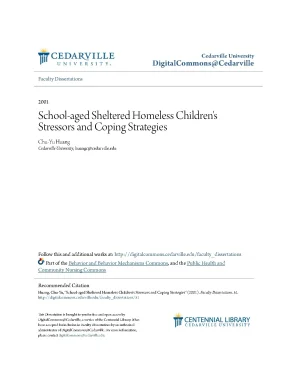
Tải xuống để đọc toàn bộCedarville University DigitalCommons@Cedarville Faculty Dissertations 2001 School-aged Sheltered Homeless Children's Stressors and Coping Strategies Chu-Yu Huang Cedarville University, huangc@cedarville.edu Follow this and additional works at: http://digitalcommons.edu/faculty_dissertations Part of the Behavior and Behavior Mechanisms Commons, and the Public Health and Community Nursing Commons Recommended Citation Huang, Chu-Yu, "School-aged Sheltered Homeless Children's Stressors and Coping Strategies" (2001).edu/faculty_dissertations/51 This Dissertation is brought to you for free and open access by DigitalCommons@Cedarville, a service of the Centennial Library. It has been accepted for inclusion in Faculty Dissertations by an authorized administrator of DigitalCommons@Cedarville. For more information, please contact digitalcommons@cedarville. ABSTRACT The purpose was to study the stressors, coping strategies, coping effectiveness behavioral states, and gender differences of school-aged homeless children.
The conceptual framework was Lazarus' and Folkman's (1984) stress and coping paradigm and child development perspectives. A cross-sectional descriptive design was used. The sample consisted of 90 children and their mothers residing in shelters. The children ranged in age form 8 to 12 years, 46 were females and 44 were males, 65 were African-American, 23 were Caucasian, and it was the first time homeless for 55 of the families.
Data were collected through interviews with the children using Homeless Sheltered Children Interview Schedule. The mothers completed the Child Behavior Checklist (Achenbach, 1991) and a background information sheet. Content analysis was used to delineate five categories of stressors and subcategories. The largest number of stressors was related to family (n=325), followed by shelter (n=235), and school (n=231).
Fewer stressors were related to the friend (n=90) and self (n=49) categories. Females identified significantly more total number of stressors compared to males. The children's coping strategies were categorized using Ryan-Wenger's (1992) coping strategy taxonomy. The most frequently used were endurance, stressor modification, social support, emotional expression, behavioral avoidance and behavioral ii distraction.
The least frequently used were cognitive distraction and cognitive problem- solving. Females identified significantly more total number of coping strategies and more number of coping strategies for the shelter stressors than males. The majority of the coping strategies (80%) were perceived as effective. The coping strategies for the friend stressors have the highest percentage (85%) of being effective, followed by shelter (84%), school (81%), self (79%) and family stressors (74%).
Stressor modification was the most frequently used effective coping strategies. The aggressive activities and endurance were frequently used ineffective categories. Females reported significantly more number of effective coping strategies than males. No significant gender differences were found for the Total, Internalizing and externalizing scores.
The children using information seeking coping strategies for the family stressors (CBCL scores = 70), and the children using self-controlling activities coping strategies for the self stressors (CBCL scores = 64) had clinical range CBCL scores.
Nội dung được bảo vệ bản quyền — Tải xuống đầy đủ
Trích dẫn luận án này
Chu-Yu Huang (2001). School aged sheltered homeless childrens stressors and copin [Luận án tiến sĩ, Cedarville University]. LuanAn.net. https://luanan.net/tam-ly-hoc/school-aged-sheltered-homeless-childrens-stressors-and-coping-st
Câu hỏi thường gặp
Luận án "School aged sheltered homeless childrens stressors and copin" nghiên cứu về vấn đề gì?
Khám phá những áp lực và chiến lược đối phó của trẻ em vô gia cư trong độ tuổi đi học. Hiểu rõ tác động và cách hỗ trợ.
Luận án "School aged sheltered homeless childrens stressors and copin" được bảo vệ tại trường nào?
Luận án này được bảo vệ tại Cedarville University. Năm bảo vệ: 2001.
Luận án "School aged sheltered homeless childrens stressors and copin" thuộc chuyên ngành gì?
Luận án "School aged sheltered homeless childrens stressors and copin" thuộc chuyên ngành Behavior and Behavior Mechanisms, Public Health and Community Nursing. Danh mục: Tâm Lý Học.
Luận án "School aged sheltered homeless childrens stressors and copin" có bao nhiêu trang?
Luận án "School aged sheltered homeless childrens stressors and copin" có 190 trang. Bạn có thể xem trước một phần tài liệu ngay trên trang web trước khi tải về.
Cách tải luận án "School aged sheltered homeless childrens stressors and copin" về máy như thế nào?
Để tải luận án về máy, bạn nhấn nút "Tải xuống ngay" trên trang này, sau đó hoàn tất thanh toán phí lưu trữ. File sẽ được tải xuống ngay sau khi thanh toán thành công. Hỗ trợ qua Zalo: 0559 297 239.