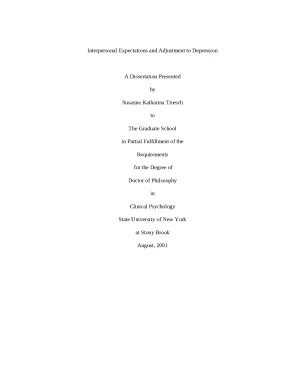
Interpersonal expectations and adjustment to depression a dissertation presented
Kỳ vọng giữa các cá nhân và khả năng thích ứng với trầm cảm: Phân tích mối liên hệ sâu sắc, giải pháp hỗ trợ hiệu quả.
State University of New York at Stony Brook
Luan An
Luận án tiến sĩ
Năm xuất bản
Số trang
84
Thời gian đọc
13 phút
Lượt xem
1
Lượt tải
0
Phí lưu trữ
40 Point
Tổng quan nhanh
- Chủ đề:
- Interpersonal Expectations & Depression Adjustment Impact
- Số trang:
- 84 trang
- Trường:
- State University of New York at Stony Brook
- Chuyên ngành:
- Clinical Psychology
- Tác giả:
- Susanne Katharina Triesch
- Năm:
- 2001
Tóm tắt nội dung luận án
I.Interpersonal Expectations Depression Adjustment Impact
Major depression places considerable burdens on patients. It also impacts their interpersonal relations with friends and family members. Research consistently shows depression leads to significant problems in social and family functioning. Depressed individuals often experience more friction and arguments within their households. They may also struggle with daily tasks and show decreased social activity. These difficulties highlight the profound effect of depression on relationship dynamics and psychological well-being. The study specifically explored how patients perceive their ability to meet the expectations of significant others. This perception significantly influences their mental health adjustment and coping with depression.
1.1. Burden of Depression on Interpersonal Relationships
Major depression creates significant difficulties for patients. It also places considerable burdens on their interpersonal relationships with friends and family members. Studies show depression leads to problems in social and family functioning. Depressed women experienced increased friction with spouses and children. They also had difficulty with household tasks. Social activity and contact with friends decreased compared to non-depressed individuals. Families of depressed patients face difficulties during the acute phase. Problems often persist even after depressive symptoms lessen. This highlights the long-term impact on relationship dynamics.
1.2. Impact of Relationship Dynamics on Mental Health
Problematic family relationship dynamics can contribute to depression onset. They also influence the illness's course. Interpersonal relationship stressors increase the risk of clinical depression. Marital discord can precede depression development. Conflict with friends and family negatively affects the illness course. Conversely, high levels of perceived social support have positive effects. The study suggests psychological well-being is closely tied to these dynamics. Coping with depression becomes harder without stable social connections.
1.3. Exploring Patient Perceptions of Expectations
The study investigated patient perceptions. It focused on the belief of being unable to meet expectations. These expectations came from significant others. Several domains related to depression were examined. The hypothesis tested if perceived inability to meet expectations leads to poorer mental health adjustment. The research also explored the source of these social expectations. It considered if they stemmed from unrealistic demands by others. Patient perfectionism was another potential source.
II.Understanding Social Expectations in Depression
The study delved into the nature of social expectations. It aimed to differentiate between external demands and internal patient characteristics. Socially prescribed perfectionism was a key concept. This refers to the belief that others hold unrealistically high standards. Understanding the origin of these perceptions is crucial. It informs strategies for mental health adjustment and coping with depression. The role of perceived social support was also considered as a comparative factor.
2.1. Defining Socially Prescribed Perfectionism
Socially prescribed perfectionism was a key variable. It refers to a belief that others hold unrealistic expectations. Patients may feel intense pressure to meet these high standards. This perception can contribute to feelings of inadequacy. The study assessed this trait in depressed patients. Its role in perceived inability to meet expectations was examined. Social expectations can drive this perfectionistic tendency.
2.2. Distinguishing Demands vs. Patient Perfectionism
The study sought to understand the origin of perceived expectations. It questioned whether these perceptions came from actual unrealistic demands from others. Another possibility was the patient's own perfectionistic tendencies. This distinction is crucial for interventions. Identifying the source informs treatment strategies. Social cognition plays a role in how patients interpret these demands. The research aimed to clarify this complex relationship dynamics.
2.3. Role of Perceived Social Support
Perceived social support was assessed as a control variable. This factor often influences mental health adjustment. High levels of support are typically beneficial. The study compared its predictive power. It measured support against perceived inability to meet expectations. The research aimed to determine which factor was a stronger predictor. Social support is widely recognized in coping with depression.
III.Depression Adjustment Research on Interpersonal Perceptions
The study utilized a prospective design with clinically depressed patients. It carefully assessed multiple factors contributing to depression adjustment. These included patient perceptions of expectations, perfectionism, and quality of life. Significant others also provided their perspective on expectations. Control variables ensured robust findings regarding the impact of interpersonal perceptions on depressive symptoms and overall psychological well-being. This comprehensive approach aimed to clarify complex relationship dynamics.
3.1. Study Methodology and Participant Assessment
Forty-five clinically depressed patients participated. They were assessed prospectively. The study measured perceptions of family and friends' expectations. Socially prescribed perfectionism was also evaluated. Assessments included depression levels and optimism. Quality of life was another metric. Significant others were also questioned about their expectations for patients. This provided a dual perspective on interpersonal relationships.
3.2. Assessing Key Variables Depression Optimism Quality of Life
Key outcome variables included depression, optimism, and quality of life. Patients were initially assessed on these measures. They were followed for three months. Changes in these variables were tracked over time. The goal was to see how perceived expectations influenced long-term depressive symptoms and overall psychological well-being. Optimism is a crucial factor in coping with depression.
3.3. Control Variables in Depression Research
Several control variables were included. These helped isolate the effect of perceived expectations. Patient neuroticism was assessed. Perceived criticism was also measured. Social support and social desirability completed the list. These controls ensured the findings were robust. They accounted for other known factors influencing mental health adjustment and relationship dynamics.
IV.Key Findings Expectations Depressive Symptoms
The research revealed crucial insights into depression adjustment. Patient perceptions of expectations proved to be a powerful predictor. These perceptions directly correlated with the severity of depressive symptoms. They also influenced optimism and quality of life. The findings underscored the profound impact of interpersonal relationships and social expectations on a patient's psychological well-being. Mediational analyses provided further clarity on these complex relationship dynamics.
4.1. Perceived Expectations Predict Poorer Adjustment
Results showed perceived expectations reflected actual family expectations. This perception was a strong predictor of mental health adjustment. It was more consistent than social support. Perceived criticism and socially prescribed perfectionism also yielded weaker predictions. Patients feeling unable to meet expectations were initially more depressed. They were less optimistic and reported lower quality of life. This indicates a clear link between interpersonal relationships and depressive symptoms.
4.2. Impact on Depression Severity and Optimism Over Time
Patients who perceived an inability to meet expectations continued to be more severely depressed. This pattern persisted three months later. Changes in perceived expectations over time correlated with changes in depression. They also associated with changes in quality of life and optimism. This suggests a dynamic relationship. Social expectations are not static; their evolution impacts patient well-being. The findings emphasize the chronicity of depressive symptoms when these perceptions are negative.
4.3. Mediational Analysis of Interpersonal Perceptions
Mediational analyses were conducted. They explored the pathway between perceived expectations and adjustment. Neither family expectations nor perfectionism fully explained this relationship. The direct source of these powerful interpersonal perceptions remains unclear. This opens avenues for further research. It suggests social cognition plays a complex role in mediating these outcomes. The relationship dynamics are more nuanced than initially hypothesized.
V.Improving Mental Health Adjustment Future Directions
The study concludes that interpersonal perceptions are vital for depression adjustment. However, the precise source of these perceptions warrants further investigation. This clarification is essential for developing effective interventions. Reducing miscommunication within interpersonal relationships could significantly improve patient outcomes. The findings offer practical implications for coping with depression. They highlight the need for a targeted approach to address social expectations and enhance psychological well-being.
5.1. Unclear Source of Interpersonal Perceptions
The study strongly suggests interpersonal perceptions predict adjustment in depression. However, the precise source of these perceptions remains a puzzle. Further investigation is required. Understanding this source could refine interventions. Is it internal patient bias? Or are external family dynamics the primary driver? Clarifying this is vital for effective mental health adjustment. Social cognition research could illuminate these origins.
5.2. Potential for Targeted Communication Interventions
The findings suggest a practical application. Developing interventions could prevent or reduce miscommunication. This includes communication between patients and family members. Such interventions might improve patient adjustment. Improved relationship dynamics can lead to better outcomes. This offers a tangible strategy for coping with depression. It emphasizes the importance of clear social expectations.
5.3. Implications for Coping with Depression
The research provides valuable insights for coping with depression. It highlights the critical role of how patients perceive their social world. Focusing solely on social support might not be enough. Addressing the perception of unmet expectations is crucial. Improving psychological well-being requires a holistic approach. This includes understanding the subtle elements of interpersonal relationships. Future studies should delve deeper into the interplay of social expectations and individual interpretation.
Mục lục chi tiết luận án
Tải xuống file đầy đủ để xem toàn bộ nội dung
Tải đầy đủ (84 trang)Trích đoạn nội dung luận án
Tải xuống để đọc toàn bộInterpersonal Expectations and Adjustment to Depression A Dissertation Presented by Susanne Katharina Triesch to The Graduate School in Partial Fulfillment of the Requirements for the Degree of Doctor of Philosophy in Clinical Psychology State University of New York at Stony Brook August, 2001 State University of New York at Stony Brook The Graduate School Susanne Katharina Triesch We, the dissertation committee for the above candidate for the Doctor of Philosophy degree, hereby recommend acceptance of this dissertation. ___________________________ Ronald Friend, Ph. Professor, Department of Psychology ___________________________ John Neale, Ph. Professor, Department of Psychology ___________________________ Susan O’Leary, Ph.
Professor, Department of Psychology ___________________________ Arnold Jaffe, Ph. Associate Professor, Department of Family Medicine Stony Brook University Hospital This dissertation is accepted by the Graduate School ___________________________ Dean of the Graduate School ii Abstract of the Dissertation Interpersonal Expectations and Adjustment to Depression by Susanne Katharina Triesch Doctor of Philosophy in Clinical Psychology State University of New York at Stony Brook 2001 Major depression places considerable burdens on patients and their interpersonal relations with friends and family members. This study explored patient perceptions of being unable to meet the expectations of significant others in several domains related to depression. It tested the hypothesis that perceived inability to meet expectations leads to poorer adjustment and examined whether perceived expectations are derived from unrealistic demands by others or from patient perfectionism.
Forty-five clinically depressed patients were assessed prospectively for perceptions of family and friends expectations, socially prescribed perfectionism, depression, optimism, and quality of life. Significant others were asked about their expectations for patients. Patient neuroticism, perceived criticism, social support, and social desirability were also assessed as control variables. Results showed that perceived expectations reflected the actual expectations reported by family members and were a stronger and more consistent predictor of adjustment than social support, perceived criticism, or socially prescribed perfectionism.
iii Patients who viewed themselves as unable to meet the expectations of others were initially more depressed and less optimistic and reported a lower quality of life. These patients continued to be more severely depressed three months later. Additionally, changes in perceived expectations over time were associated with changes in depression, quality of life, and optimism. Mediational analyses indicated that neither family expectations nor perfectionism explained the relationship between perceived expectations and adjustment.
The results of the study suggest that interpersonal perceptions are an important predictor of adjustment in depression. However, the source of these perceptions remains unclear and requires further study. Developing interventions to prevent or reduce miscommunication between patients and their family members may be effective in improving patient adjustment. iv Table of Contents List of Tables.78 v List of Tables Table 1.60 vi Introduction The study of interpersonal relationships has long been an important focus of research on the etiology and course of major depression.
Over the last several decades, a substantial number of studies have demonstrated that depression leads to significant problems in social and family functioning. For example, Weissman and Paykel (1974) reported that depressed women experienced more friction and arguments with their husbands and children, had difficulty performing housework and other tasks, and showed decreased social activity and contact with friends when compared with nondepressed control women. More recent studies using varied patient populations and assessment procedures have continued to find that families of depressed patients experience significant difficulties during the acute phase of the illness. Moreover, these families continue to experience more problems than nonclinical families even after the diminution of depressive symptomatology (see review by Keitner, Miller, Epstein, & Bishop, 1990).
Problematic family relationships have themselves been shown to contribute to the onset of depression and to influence the course of depressive illness. Interpersonal stressors significantly increase the risk of developing clinical depression (Paykel et al., 1969) and studies of depressed women in discordant marriages have shown that marital discord tends to precede the development of depression rather than vice versa (Beach & Cassidy, 1991). Among depressed patients, conflict with friends and family members has a detrimental effect on the course of the illness (Finch & Zautra, 1992). Conversely, patients who report high levels of social support have less severe symptoms (Lara, Leader, & Klein, 1997), are more likely to recover from a depressive episode (Goering, Lancee, & Freeman, 1992; Keitner et al., 1995; Keitner, Ryan, Miller, & Norman, 1992), 1 and have a lower rate of relapse compared to those with few supportive relationships (Keitner & Miller, 1990).
The evidence for a reciprocal relationship between depressive symptoms and interpersonal relations may best be explained by an interactive, mutually reinforcing process. While the emergence of major depression is facilitated by disturbed marriages and family environments, depressive illness itself creates significant problems for those living with a depressed patient. If friends and family members do not have an effective way of dealing with the problems of depression, then the illness can be significantly prolonged and worsened (Keitner, Miller, Epstein, & Bishop, 1990). Family members may be particularly likely to aggravate the situation with unsuccessful attempts to influence the behavior and feelings of the patient.
Although these attempts may be motivated by a sincere desire to alleviate the suffering of the patient, they are often carried out in ways that complicate and unwittingly worsen the depression (Coates & Wortman, 1988). At the same time, patients themselves may actively contribute to the escalation of interpersonal conflict and depressed mood by seeking support from their social environment with symptomatic behaviors that have the unintended effect of eliciting rejection from others and confirming negative beliefs about the self (Coyne, 1976). An interactional view of depression maintenance is consistent with calls for a situational perspective that does not place blame on either patients or relatives, but attempts to understand the problems that occur in the coordination of mutual needs and concerns among families with depressed patients (Coyne, Ellard, & Smith, 1990). From this perspective, it is particularly important to identify the nature of interpersonal 2 conflicts that reduce support from significant others and contribute to the escalation of depressive symptoms.
The present study focuses on the misunderstandings and misperceptions that may occur among patients and their families as the result of the depression itself. We hypothesize that adjustment to depression may be made more difficult when friends and family members fail to understand the magnitude of the illness and its effects. Family members who do not understand or lack information about the nature of depression are likely to develop expectations about the ability of patients to function and manage their illness that exceed the perceived capabilities of the patients themselves. As a result, patients may perceive that they are unable to meet the expectations of significant others in a number of important areas.
This perception may lead patients to believe that their families and friends do not understand how seriously ill they are (Eitel, Hatchett, Friend, Griffin, & Wadhwa, 1995; Hatchett, Friend, Symister, & Wadhwa, 1997). Over time, perceived inability to meet expectations from significant others and the related feeling of being misunderstood may increase subjective distress and contribute to the maintenance of the depressive episode. These hypotheses emerged from two recent studies that found a strong relationship between perceived expectations and adjustment in renal dialysis patients. Hatchett, Friend, Symister, and Wadhwa (1997) studied patient perceptions of family and medical staff expectations and found that perceived inability to meet the expectations of others predicted changes in depression, optimism, illness intrusiveness, and quality of life over a three month period.
Furthermore, perceived expectations were strongly correlated with patient reports of feeling misunderstood by family members. Although the study did not directly address the origin of the perceived inability to meet family expectations, two 3 alternative explanations were proposed for these results. First, family members may lack knowledge about the nature and course of renal disease and its physical and psychological consequences, resulting in unrealistic and fluctuating expectations for the patient. Alternatively, patients may experience a loss of self-esteem due to their inability to function at a level they of expect of themselves.
As they become frustrated at their own incapacity, they project this anger outward and come to believe that others also hold expectations that they cannot fulfill. These hypotheses were tested in a second study that measured patient self-esteem and also assessed family members regarding their expectations for the patient (Hatchett, 1997). Mediational analyses revealed that high levels of reported expectations on the part of family and friends led to patients perceiving that they were unable to meet these expectations, which in turn predicted patient adjustment. Self-esteem, on the other hand, did not explain the relationship between patient perceptions and adjustment.
Thus, the author concluded that patient perceptions accurately reflected excessive expectations from family members and friends. The theoretical perspective developed by Hatchett and colleagues (1997) and the present study is strongly influenced by the work of Solomon Asch, whose general theory of social psychology centered around the importance of shared psychosocial fields of perceptions, cognitions, and emotions (Friend, Rafferty, & Bramel, 1990). Asch (1952/1987) argued that a consensus of shared perceptions and expectations forms the basis of social relations and plays a central role in making intelligible social action possible. In this context, Asch emphasized the fundamental importance of the object of judgment, arguing that perceptions and attitudes are determined primarily by the specific qualities or properties of the object as they are perceived by the individual.
Shared 4 understanding is the rule because common perceptual processes generally lead to similar perceptions among persons in a given situation. When individual perspectives differ or conclusions are based on inaccurate or incomplete data, however, lack of consensus in perceptions or expectations may result. Given the importance of shared cognitions in regulating social interaction, such disagreements may lead to frustration and the experience of substantial distress (Asch 1952/1987). The present study incorporates the Aschian framework by emphasizing the role of the object of judgment, in this case depression and its symptoms, in characterizing the relationship between patients and their family members and friends.
We propose that interpersonal agreements and disagreements arise from the depression itself as understood or misunderstood by patients and their significant others. Thus, we examine several aspects of depression that may lead to conflicting interpersonal expectations among patients and their friends and family members. Depression is characterized primarily by negative symptoms that are largely continuous with normative behavior and may not be recognized as signs of mental illness by others who lack information about the nature of the disorder (Beck, 1967). These symptoms represent a considerable burden for friends and family members of persons with depression.
Coyne et al. (1987), for example, found that family members of depressed patients were significantly more distressed than those living with recovered patients. Their increased distress was almost completely accounted for by difficulties related to negative symptoms such as fatigue, hopelessness, and lack of energy. Similarly, Fadden, Bebbington, and Kuipers (1987) found that spouses of depressed patients reported substantial problems due to negative symptoms including underactivity, 5 dependence, self-neglect, and indecisiveness.
Unlike positive symptoms such as hallucinations or delusions, negative symptoms were not attributed to the depression by spouses who generally reported that they were unaware of what behavior to expect from patients as a result of the illness. The negative symptoms associated with depression may also make it difficult for patients to carry out the routine functions and activities of daily life. For example, Weissman and Paykel (1974) found that many depressed women in a community sample were unable to manage household or parenting tasks and severely decreased their involvement in social and leisure activities. They depended on their husbands to perform the majority of household chores and to assume responsibility for coordinating the social life of the family.
Although the husbands generally tried to be helpful, most soon became resentful and demanded that their wives resume their normal activities. Consistent with these findings, the family members surveyed by Coyne et al. (1987) also reported significant difficulties related to patient lack of interest in social life and leisure activities.
Nội dung được bảo vệ bản quyền — Tải xuống đầy đủ
Trích dẫn luận án này
Susanne Katharina Triesch (2001). Interpersonal expectations and adjustment to depression a di [Luận án tiến sĩ, State University of New York at Stony Brook]. LuanAn.net. https://luanan.net/tam-ly-hoc/interpersonal-expectations-and-adjustment-to-depression-a-dissertation-presented
Câu hỏi thường gặp
Luận án "Interpersonal expectations and adjustment to depression a di" nghiên cứu về vấn đề gì?
Kỳ vọng giữa các cá nhân và khả năng thích ứng với trầm cảm: Phân tích mối liên hệ sâu sắc, giải pháp hỗ trợ hiệu quả.
Luận án "Interpersonal expectations and adjustment to depression a di" được bảo vệ tại trường nào?
Luận án này được bảo vệ tại State University of New York at Stony Brook. Năm bảo vệ: 2001.
Luận án "Interpersonal expectations and adjustment to depression a di" thuộc chuyên ngành gì?
Luận án "Interpersonal expectations and adjustment to depression a di" thuộc chuyên ngành Clinical Psychology. Danh mục: Tâm Lý Học.
Luận án "Interpersonal expectations and adjustment to depression a di" có bao nhiêu trang?
Luận án "Interpersonal expectations and adjustment to depression a di" có 84 trang. Bạn có thể xem trước một phần tài liệu ngay trên trang web trước khi tải về.
Cách tải luận án "Interpersonal expectations and adjustment to depression a di" về máy như thế nào?
Để tải luận án về máy, bạn nhấn nút "Tải xuống ngay" trên trang này, sau đó hoàn tất thanh toán phí lưu trữ. File sẽ được tải xuống ngay sau khi thanh toán thành công. Hỗ trợ qua Zalo: 0559 297 239.