A drama based group intervention for adolescents to improve menta
Hội thảo can thiệp nhóm nhằm nâng cao nhận thức và kỹ năng đối với thanh thiếu niên thông qua các kịch bản drama đa dạng.
Antioch University New England
Luan An
Luận án tiến sĩ
Năm xuất bản
Số trang
78
Thời gian đọc
12 phút
Lượt xem
0
Lượt tải
0
Phí lưu trữ
40 Point
Tổng quan nhanh
- Chủ đề:
- Drama Group Intervention for Adolescent Mentalization
- Số trang:
- 78 trang
- Trường:
- Antioch University New England
- Chuyên ngành:
- Clinical Psychology
- Tác giả:
- Michael S. Goddard
- Năm:
- 2020
Tóm tắt nội dung luận án
I.Drama Group Intervention for Adolescent Mentalization
Một can thiệp nhóm sáng tạo sử dụng kịch liệu pháp được thiết kế để cải thiện năng lực tâm thần hóa ở thanh thiếu niên. Nghiên cứu này đề xuất một phương pháp tiếp cận mới trong việc hỗ trợ sức khỏe tinh thần cho giới trẻ. Can thiệp tập trung vào việc phát triển khả năng hiểu bản thân và người khác. Nó được thực hiện dưới hình thức nhóm, khai thác sức mạnh của tương tác xã hội. Các kỹ thuật kịch liệu pháp được áp dụng để tạo ra môi trường trị liệu an toàn và hiệu quả. Mục tiêu là giúp thanh thiếu niên nâng cao nhận thức về cảm xúc và suy nghĩ của mình. Đây là một group intervention youth có cấu trúc rõ ràng. Nó cung cấp một khung khổ để khám phá những thách thức tâm lý. Tài liệu này cung cấp một cái nhìn tổng quan về tâm thần hóa và kịch liệu pháp. Nó cũng thảo luận các khái niệm liên quan đến điều trị nhóm. Thiết kế can thiệp này là một bước tiến quan trọng. Nó sử dụng drama therapy adolescents như một phương tiện chính. Cách tiếp cận này giúp thanh thiếu niên xây dựng kỹ năng sống. Nó cũng góp phần cải thiện adolescent mental health drama nói chung. Mục tiêu cuối cùng là thúc đẩy sự phát triển toàn diện. Phương pháp này mang lại lợi ích cho sức khỏe tâm lý của thanh thiếu niên.
1.1. Innovative Group Approach for Youth
Luận văn này giới thiệu một thiết kế can thiệp độc đáo. Nó nhắm vào việc cải thiện tâm thần hóa ở thanh thiếu niên. Can thiệp diễn ra trong một định dạng nhóm. Nó sử dụng các kỹ thuật từ drama therapy adolescents. Phương pháp này được coi là phù hợp cho độ tuổi này. Thanh thiếu niên thường được coi là quá lớn cho đồ chơi trị liệu. Tuy nhiên, chúng chưa hoàn toàn sẵn sàng cho các cuộc trò chuyện sâu sắc. Kịch liệu pháp cung cấp một cầu nối. Nó cho phép thể hiện bản thân một cách sáng tạo. Điều này tạo ra một môi trường trị liệu hấp dẫn. Nó cũng thúc đẩy sự tham gia tích cực. Mục tiêu chính là phát triển khả năng tâm thần hóa. Đây là một yếu tố quan trọng trong sức khỏe tâm lý.
1.2. Improving Mentalization in Adolescents
Tâm thần hóa là khả năng hiểu hành vi dưới góc độ trạng thái tinh thần. Bao gồm suy nghĩ, cảm xúc, niềm tin và ý định. Can thiệp này được thiết kế để tăng cường khả năng đó. Nó giúp thanh thiếu niên nhận thức rõ hơn về thế giới nội tâm. Đồng thời, nó cải thiện sự hiểu biết về người khác. Group intervention youth mang lại cơ hội thực hành kỹ năng này. Môi trường nhóm tạo ra tương tác xã hội phong phú. Điều này hỗ trợ quá trình học hỏi và thích nghi. Nghiên cứu này cung cấp cơ sở lý luận vững chắc. Nó giải thích tại sao kịch liệu pháp lại phù hợp. Nó là công cụ hiệu quả để cải thiện tâm thần hóa ở lứa tuổi thanh thiếu niên. Can thiệp này có tiềm năng lớn. Nó giúp thanh thiếu niên phát triển kỹ năng tự điều chỉnh cảm xúc. Nó cũng tăng cường khả năng đối phó với căng thẳng.
II.Mentalization Theory Foundations for Youth Support
Nghiên cứu đi sâu vào lý thuyết tâm thần hóa. Nó cung cấp các khái niệm nền tảng cho can thiệp. Tâm thần hóa là khả năng hiểu hành vi dựa trên các trạng thái tinh thần. Điều này bao gồm suy nghĩ, cảm xúc, niềm tin và ý định. Nền tảng của tâm thần hóa liên quan đến sự phát triển bản ngã. Nó cũng gắn liền với sự gắn bó. Các khái niệm chính được trình bày chi tiết. Chúng bao gồm sự phát triển của bản ngã, mối quan hệ với sự gắn bó, chế độ tương đương tâm linh và giả vờ. Ngoài ra, còn có khái niệm phản chiếu cảm xúc được đánh dấu. Các khía cạnh khác nhau của tâm thần hóa được khám phá. Lý thuyết này cung cấp một khuôn khổ. Nó hiểu được cách thức thanh thiếu niên xử lý thông tin xã hội. Nó cũng giải thích cách chúng tương tác với thế giới. Việc cải thiện tâm thần hóa có thể nâng cao emotional regulation adolescents group và self-esteem building youth therapy. Nó cũng là một chiến lược quan trọng để tăng cường coping skills teens intervention.
2.1. Core Concepts of Mentalization Explained
Tâm thần hóa là một khả năng nhận thức và cảm xúc. Nó cho phép một người giải thích hành vi. Hành vi này được nhìn nhận thông qua các trạng thái tinh thần tiềm ẩn. Các khái niệm cốt lõi bao gồm sự phát triển của bản ngã. Bản ngã hình thành qua tương tác với người khác. Nó cũng bao gồm mối quan hệ với sự gắn bó. Kiểu gắn bó an toàn thúc đẩy tâm thần hóa lành mạnh. Chế độ tương đương tâm linh và giả vờ là các chế độ hoạt động ban đầu. Chúng cần được tích hợp để phát triển tâm thần hóa hoàn chỉnh. Phản chiếu cảm xúc được đánh dấu là điều cần thiết. Nó giúp trẻ em hiểu và điều chỉnh cảm xúc. Các khía cạnh này cung cấp một cái nhìn sâu sắc. Chúng giải thích quá trình thanh thiếu niên hiểu thế giới nội tâm và xã hội.
2.2. Mentalization s Role in Youth Development
Tâm thần hóa đóng vai trò trung tâm trong sự phát triển của thanh thiếu niên. Nó ảnh hưởng đến khả năng điều chỉnh cảm xúc. Nó cũng tác động đến việc hình thành các mối quan hệ lành mạnh. Thanh thiếu niên có kỹ năng tâm thần hóa tốt hơn. Chúng thường thể hiện khả năng emotional regulation adolescents group vượt trội. Chúng cũng có coping skills teens intervention hiệu quả hơn. Khả năng này giúp chúng xử lý căng thẳng. Nó cũng giúp chúng giải quyết xung đột xã hội. Việc can thiệp sớm để cải thiện tâm thần hóa có thể mang lại lợi ích lâu dài. Nó hỗ trợ sự phát triển cá nhân và xã hội. Nó cũng củng cố lòng tự trọng và sự tự tin. Điều này góp phần vào self-esteem building youth therapy.
2.3. Mentalization Based Treatment for Children
Lý thuyết tâm thần hóa đã được áp dụng trong điều trị cho trẻ em. Can thiệp này mở rộng các nguyên tắc đó. Nó áp dụng cho nhóm tuổi thanh thiếu niên. Điều trị dựa trên tâm thần hóa (MBT) giúp trẻ em phát triển khả năng này. Nó cải thiện sự hiểu biết về cảm xúc và ý định của bản thân và người khác. Các chiến lược MBT được điều chỉnh cho phù hợp. Chúng được tích hợp vào định dạng group intervention youth. Cách tiếp cận này tạo điều kiện cho sự phát triển. Nó hỗ trợ các kỹ năng tâm thần hóa. Điều này đặc biệt quan trọng trong môi trường nhóm. Tại đó, thanh thiếu niên có thể thực hành và nhận phản hồi. Mục tiêu là xây dựng nền tảng vững chắc cho sức khỏe tâm lý. Nó cũng cải thiện khả năng thích nghi xã hội.
III.Therapeutic Drama for Teens Core Principles Applied
Phần này khám phá các khái niệm từ kịch và trị liệu. Nó đặc biệt liên quan đến công việc với thanh thiếu niên. Kịch liệu pháp cung cấp một phương tiện độc đáo. Nó cho phép thanh thiếu niên thể hiện cảm xúc. Nó cũng giúp chúng khám phá các mối quan hệ. Điều này thường khó khăn trong các phương pháp trị liệu truyền thống. Trị liệu nhóm tâm động học được thảo luận. Nó cung cấp cái nhìn sâu sắc về cơ chế thay đổi trong điều trị nhóm. Cơ chế này được thông báo bởi góc độ thần kinh sinh học. Drama therapy adolescents được xem là một phương tiện phù hợp. Nó thu hút nhóm tuổi này một cách hiệu quả. Nó cung cấp một không gian an toàn cho sự thử nghiệm. Nó cũng giúp phát triển các kỹ năng xã hội và cảm xúc. Các phương pháp therapeutic drama teens bao gồm đóng vai, ứng biến và kể chuyện. Chúng cho phép người tham gia trải nghiệm và học hỏi. Psychodrama adolescents cũng là một kỹ thuật mạnh mẽ. Nó có thể được sử dụng để khám phá các xung đột nội tâm. Nó cũng giúp giải quyết các vấn đề liên cá nhân. Expressive arts therapy youth cung cấp một phương pháp đa diện. Nó hỗ trợ sự phát triển toàn diện.
3.1. Drama Therapy s Value for Adolescent Engagement
Drama therapy adolescents là một công cụ mạnh mẽ. Nó thu hút thanh thiếu niên trong quá trình trị liệu. Thanh thiếu niên thường cảm thấy khó khăn khi nói về cảm xúc trực tiếp. Kịch liệu pháp cung cấp một con đường gián tiếp. Nó cho phép thể hiện thông qua hành động và biểu tượng. Điều này tạo ra một môi trường ít đe dọa hơn. Nó khuyến khích sự tham gia tự nguyện. Nó cũng thúc đẩy sự sáng tạo. Việc sử dụng các kỹ thuật kịch giúp phát triển social skills training drama. Nó cho phép thanh thiếu niên thử nghiệm các vai trò khác nhau. Điều này giúp chúng hiểu rõ hơn về bản thân. Nó cũng giúp chúng hiểu người khác. Kịch liệu pháp là một phương tiện hiệu quả. Nó hỗ trợ sự phát triển cảm xúc và xã hội.
3.2. Psychodynamic Group Treatment Benefits
Điều trị nhóm tâm động học cung cấp bối cảnh. Nó giúp thanh thiếu niên hiểu các mẫu hình quan hệ của mình. Các cơ chế thay đổi trong điều trị nhóm rất đa dạng. Chúng bao gồm việc học hỏi từ phản hồi của bạn bè. Nó cũng bao gồm việc nhận ra kinh nghiệm chung. Góc độ thần kinh sinh học làm rõ. Nó cho thấy cách các tương tác nhóm ảnh hưởng đến não bộ. Nó thúc đẩy sự thay đổi. Điều này củng cố niềm tin. Nó cho rằng group intervention youth có thể là một phương tiện mạnh mẽ. Nó thúc đẩy sự phát triển tâm thần hóa. Nó cũng cải thiện sức khỏe tinh thần tổng thể. Môi trường nhóm tạo ra sự hỗ trợ lẫn nhau. Nó giúp cá nhân không cảm thấy cô đơn. Nó cũng cung cấp một không gian an toàn để khám phá các vấn đề.
3.3. Engaging Preadolescents Through Creative Arts
Expressive arts therapy youth cung cấp các phương pháp sáng tạo. Nó thu hút nhóm thanh thiếu niên. Kịch liệu pháp là một hình thức nghệ thuật biểu cảm. Nó đặc biệt hiệu quả với lứa tuổi này. Nó cung cấp một cách an toàn để khám phá các chủ đề phức tạp. Nó không cần lời nói trực tiếp. Kịch, đóng vai và kể chuyện là các kỹ thuật chính. Chúng cho phép thanh thiếu niên thử nghiệm các cảm xúc. Chúng cũng giúp thử nghiệm các tình huống xã hội. Điều này giúp phát triển sự đồng cảm. Nó cũng cải thiện khả năng giao tiếp. Nó xây dựng social skills training drama một cách tự nhiên. Mục tiêu là giúp thanh thiếu niên thể hiện bản thân. Nó cũng giúp chúng kết nối với người khác. Điều này thông qua các phương tiện sáng tạo và không đe dọa.
IV.Group Intervention Design for Adolescent Wellbeing
Can thiệp này được thiết kế cẩn thận. Nó dựa trên các khái niệm từ lý thuyết tâm thần hóa. Nó cũng sử dụng các nguyên tắc từ kịch liệu pháp. Cấu trúc của nhóm được phác thảo rõ ràng. Nó bao gồm cách tiếp cận của nhà trị liệu. Nhà trị liệu áp dụng 'thế không biết' (not-knowing stance). Điều này thúc đẩy sự tò mò. Nó cũng khuyến khích sự khám phá của người tham gia. Việc làm việc với cảm xúc là trọng tâm. Nó giúp thanh thiếu niên nhận diện và điều chỉnh chúng. Môi trường quan hệ trong nhóm cũng được nhấn mạnh. Nó được coi là chất xúc tác cho sự thay đổi. Định dạng của một phiên trị liệu được mô tả chi tiết. Nó bao gồm cách bắt đầu phiên. Điều này cung cấp một kế hoạch thực tế. Nó đảm bảo hiệu quả của group intervention youth. Thiết kế này nhằm mục đích nâng cao emotional regulation adolescents group và self-esteem building youth therapy. Nó cũng là một công cụ để phát triển coping skills teens intervention.
4.1. Structuring the Drama Based Group Sessions
Cấu trúc của các phiên nhóm kịch liệu pháp được trình bày rõ ràng. Nó đảm bảo sự liên tục và mục đích. Các hoạt động được thiết kế để khuyến khích sự tham gia. Nó cũng thúc đẩy việc khám phá các chủ đề. Các phiên thường bắt đầu với các bài tập khởi động. Chúng giúp người tham gia làm quen. Sau đó, các hoạt động chính diễn ra. Chúng có thể bao gồm đóng vai hoặc ứng biến. Các hoạt động này tập trung vào các tình huống thực tế. Chúng giúp thanh thiếu niên thực hành social skills training drama. Mỗi phiên kết thúc bằng phần chia sẻ và suy ngẫm. Điều này giúp củng cố việc học. Nó cũng tích hợp các kinh nghiệm trị liệu. Cấu trúc này hỗ trợ một môi trường an toàn. Nó cho phép thử nghiệm và học hỏi. Nó thúc đẩy sự phát triển cá nhân và nhóm.
4.2. Therapist Stance and Relational Work
Cách tiếp cận của nhà trị liệu là rất quan trọng. Nó định hình bầu không khí nhóm. 'Thế không biết' của nhà trị liệu khuyến khích sự khám phá. Nó giảm bớt áp lực phải 'biết câu trả lời'. Điều này tạo không gian cho sự tò mò. Nó cũng thúc đẩy sự tham gia tích cực. Làm việc với cảm xúc là trọng tâm. Nhà trị liệu giúp thanh thiếu niên nhận diện. Nó cũng giúp chúng hiểu và quản lý cảm xúc của mình. Môi trường quan hệ trong nhóm được chú ý. Nó là một yếu tố trị liệu mạnh mẽ. Các mối quan hệ đồng đẳng cung cấp cơ hội. Nó giúp thực hành các kỹ năng xã hội. Nó cũng giúp nhận phản hồi chân thật. Điều này góp phần vào việc xây dựng self-esteem building youth therapy và emotional regulation adolescents group.
4.3. Session Format for Effective Engagement
Định dạng của một phiên được mô tả chi tiết. Nó đảm bảo sự mạch lạc và hiệu quả. Các phiên bắt đầu bằng một 'check-in'. Điều này cho phép mọi người chia sẻ cảm xúc hiện tại. Sau đó là các hoạt động kịch. Chúng được thiết kế để kích thích tâm thần hóa. Chúng cũng khuyến khích tương tác. Việc chuyển tiếp giữa các hoạt động được quản lý cẩn thận. Nó duy trì sự gắn kết của nhóm. Các phiên kết thúc bằng một 'check-out'. Nó giúp người tham gia suy ngẫm về những gì đã học. Nó cũng giúp chúng kết nối với nhau. Định dạng này hỗ trợ một quá trình trị liệu có cấu trúc. Nó giúp thanh thiếu niên phát triển coping skills teens intervention. Nó cũng thúc đẩy sự hiểu biết sâu sắc hơn về bản thân. Nó là một therapeutic drama teens được thiết kế tốt.
V.Advancing Adolescent Mental Health with Drama Therapy
Luận văn này trình bày một can thiệp độc đáo. Nó kết hợp kịch liệu pháp với lý thuyết tâm thần hóa. Mục tiêu chính là cải thiện sức khỏe tâm thần của thanh thiếu niên. Kịch liệu pháp được chứng minh là một phương tiện hiệu quả. Nó thu hút nhóm tuổi này một cách sâu sắc. Nó cung cấp một không gian an toàn để thể hiện bản thân. Nó cũng giúp khám phá các mối quan hệ. Can thiệp này đóng góp vào lĩnh vực adolescent mental health drama. Nó cung cấp một mô hình thực tế và sáng tạo. Nó giúp phát triển các kỹ năng sống quan trọng. Điều này bao gồm khả năng điều chỉnh cảm xúc. Nó cũng bao gồm sự đồng cảm và kỹ năng xã hội. Các hạn chế và hướng đi trong tương lai cũng được thảo luận. Điều này mở ra con đường cho các nghiên cứu tiếp theo. Nó cũng giúp cải tiến các thực hành lâm sàng. Can thiệp này có tiềm năng lớn. Nó giúp cải thiện chất lượng cuộc sống cho thanh thiếu niên. Nó cũng xây dựng khả năng phục hồi của chúng.
5.1. Rationale for Drama Based Mentalization
Lý do cho việc sử dụng kịch liệu pháp để cải thiện tâm thần hóa là rất mạnh mẽ. Kịch cung cấp một phương tiện phi ngôn ngữ. Nó cho phép thanh thiếu niên khám phá cảm xúc và suy nghĩ. Điều này khó khăn bằng lời nói trực tiếp. Môi trường kịch an toàn. Nó cho phép thử nghiệm các vai trò và quan điểm khác nhau. Nó giúp phát triển sự đồng cảm. Nó cũng tăng cường khả năng tâm thần hóa. Drama therapy adolescents tạo ra một không gian vui tươi. Nó làm giảm sự kháng cự. Nó khuyến khích sự tham gia tích cực. Nó là một phương pháp therapeutic drama teens tự nhiên. Nó được xây dựng trên sự sáng tạo bẩm sinh của giới trẻ. Điều này giúp chúng phát triển social skills training drama và khả năng tự nhận thức.
5.2. Benefits for Youth Emotional Regulation
Cải thiện tâm thần hóa thông qua kịch liệu pháp mang lại nhiều lợi ích. Đặc biệt là trong việc điều chỉnh cảm xúc. Khi thanh thiếu niên hiểu rõ hơn về cảm xúc của mình. Chúng có thể quản lý chúng hiệu quả hơn. Emotional regulation adolescents group là một kết quả trực tiếp của can thiệp này. Kịch liệu pháp cung cấp các công cụ thực tế. Nó giúp nhận diện và xử lý cảm xúc. Nó cũng giúp chúng đối phó với những tình huống khó khăn. Điều này xây dựng coping skills teens intervention vững chắc. Nó cũng góp phần vào việc củng cố lòng tự trọng. Việc thực hành trong môi trường nhóm mang lại sự hỗ trợ. Nó cũng cung cấp phản hồi từ bạn bè. Điều này giúp phát triển bền vững các kỹ năng mới.
5.3. Future Directions in Adolescent Intervention
Luận văn này mở ra những hướng đi mới. Nó dành cho các can thiệp trong tương lai. Nghiên cứu sâu hơn có thể tập trung vào việc đánh giá hiệu quả. Nó có thể kiểm tra kết quả lâu dài của phương pháp này. Việc mở rộng can thiệp tới các nhóm thanh thiếu niên đa dạng hơn là cần thiết. Điều này bao gồm các bối cảnh văn hóa khác nhau. Nó cũng bao gồm các thách thức tâm lý cụ thể. Việc tích hợp các yếu tố khác của expressive arts therapy youth cũng có thể được khám phá. Nó có thể tăng cường tác động của can thiệp. Mục tiêu là tiếp tục phát triển các phương pháp sáng tạo. Nó giúp hỗ trợ adolescent mental health drama. Điều này đảm bảo rằng thanh thiếu niên có các công cụ. Nó giúp chúng phát triển mạnh mẽ về mặt cảm xúc và xã hội.
Mục lục chi tiết luận án
Tải xuống file đầy đủ để xem toàn bộ nội dung
Tải đầy đủ (78 trang)Trích đoạn nội dung luận án
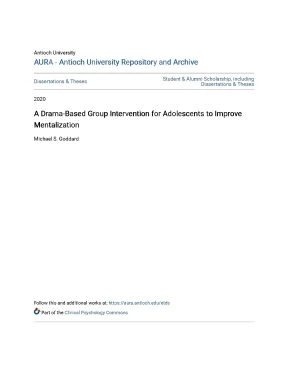
Tải xuống để đọc toàn bộAntioch University AURA - Antioch University Repository and Archive Student & Alumni Scholarship, including Dissertations & Theses Dissertations & Theses 2020 A Drama-Based Group Intervention for Adolescents to Improve Mentalization Michael S. Goddard Follow this and additional works at: https://aura.edu/etds Part of the Clinical Psychology Commons A Drama-Based Group Intervention for Adolescents to Improve Mentalization by Michael S. Antioch University New England, 2018 DISSERTATION Submitted in partial fulfillment for the degree of Doctor of Psychology in the Department of Clinical Psychology at Antioch University New England, 2020 Keene, New Hampshire ii Department of Clinical Psychology DISSERTATION COMMITTEE PAGE The undersigned have examined the dissertation entitled: A DRAMA-BASED GROUP INTERVENTION FOR ADOLESCENTS TO IMPROVE MENTALIZATION presented on July 15, 2020 by Michael S. Goddard Candidate for the degree of Doctor of Psychology and hereby certify that it is accepted*.
Dissertation Committee Chairperson: Theodore Ellenhorn, PhD, ABPP Dissertation Committee members: Vince Pignatiello, PsyD Megan Turchetti, PsyD Accepted by the Department of Clinical Psychology Chairperson Vincent Pignatiello, PsyD 7/15/2020 iii Dedication I dedicate this research project to my former students from Vladimirovtsi, Bulgaria. iv Acknowledgements The completion of this dissertation was made possible through the support of friends, family, and mentors who supported me with their curiosity, interest, and inspiration. To the friends I have made at Antioch, our Sunday night groups were without a doubt the most meaningful experiences of my graduate studies. You taught me the truest meaning of friendship I have known.
To my family, spread out across the globe, you have been a source of support when I needed you throughout my training. I would not have embarked on this journey without you. To Ted, my advisor, you have offered guidance and a willing ear when the stresses of being a doctoral student felt like too much. You have been one of the most impactful teachers I have had in my life.
You brought the complex world of psychoanalysis alive for me and stirred in me a life-long interest in the more ambiguous, complex, and ineffable aspects of what makes us psychological beings. In addition, a very special thank you to other mentors I have had the pleasure of working with. Vince, you put up with me for two years of ProSem, three years of supervision, and more classes than I can count. I have joked with my classmates on more than one occasion that I feel as though I am graduating from the University of Vince.
I would add that it has been an inspiring institution in which to learn. Megan, your dedication, compassion, and expertise have impacted me tremendously. Finally, to all the young people I have had the pleasure to work with in therapy. It is you who have made all of this worthwhile and have taught me the most about being an empathic and creative therapist.
v Table of Contents Dedication.3 Mentalization and the Self .3 Mentalization and Attachment .5 Psychic Equivalence and Pretend Mode .7 Marked-affect Mirroring .9 The Components of Mentalization.11 Mentalization-Based Treatment and Children .14 Why Mentalization: A Rationale .17 A Remark on Manualized Treatment Approaches .17 Mentalization as a Common Factor .21 Focusing on Group Treatment .22 Mentalization-Based Group Therapy .28 Drama and Therapy.29 Therapy with Preadolescents .40 Structure of the Group .45 Approach of the Therapist .49 The Not-Knowing Stance .51 Working with Emotions .52 Working with the Relational Environment .53 The Format of a Session .55 Starting the Session .61 Limitations and Future Directions .64 1 Abstract This dissertation is an innovative intervention design to improve mentalization in preadolescents. The intervention presented is conducted in a group format and using techniques drawn from drama-based therapy. I have provided a brief literature review on mentalization, and relevant topics in group treatment and drama therapy. I have outlined key concepts from mentalization theory including: (a) the development of the self, (b) its relationship to attachment, (c) psychic equivalence and pretend mode functioning, (d) marked-affect mirroring, (e) the various facets of mentalization, and (f) mentalization treatment with children.
After outlining these concepts, I discuss psychodynamic group treatment, mentalization-based group therapy, and the mechanism of change in group treatment from a neurobiologically informed perspective. From there I discuss concepts from play and drama therapy relevant to work with preadolescents. The topics covered in the literature review are used as a basis for an mentalization-based intervention appropriate for preadolescents. The argument is made that drama therapy is an appropriate vehicle through which this age group can be engaged as they are often regarded as too old for the typical toys of play therapy, but not yet ready for an adult approach to group treatment.
Following the literature review, an intervention design is proposed. The proposal offers guidance on the structure of the group intervention, approach taken by the therapist, and the format of a typical session. Finally, limitations, future directions, and reflections on conducting this research are discussed. This dissertation is available in open access at AURA, http://aura./ and Ohio Link ETD Center, https://etd.
Keywords: mentalization, group therapy, drama therapy, preadolescence 2 A Drama-Based Group Intervention for Adolescents to Improve Mentalization The aim of this dissertation was to propose an innovative group intervention for working with preadolescent children using the concept of mentalization as an organizing principle and dramatic play techniques as the primary vehicle of intervention. Mentalization, or reflective functioning, is the ability to reflect on one’s own and others’ emotional states. It is a capacity that is refined over the course of healthy development, in the context of attuned relationships, and is needed for effective self-regulation and social interaction (Fonagy et al. Deficits in mentalizing capacity underlie seemingly disparate interpersonal and intrapersonal difficulties.
For example, a middle schooler may be referred for psychological services because they are constantly disruptive in the classroom, while another child may be having frequent disagreements with classmates, and a third frequently becomes tearful and is difficult to soothe. Although the manifest symptoms in each case are quite different, each of the children in question are experiencing a deficit in their ability to mentalize effectively; they are limited in their ability to reflect on (a) their own behavior; (b) the impact their behavior is having on the people around them; and (c) the motivations, desires and intentions of the behaviors of others. As failures to mentalize at an age-appropriate level can be understood as a significant factor influencing a wide variety of challenging behaviors and psychopathologies, intentionally focusing on this capacity is a meaningful target for therapeutic intervention. While there exist effective treatment approaches using mentalization as a core concept (Allen & Fonagy, 2006), the intervention proposed here is unique in that it was designed to address the specific developmental concerns of middle school-aged children (approximately ages 10-13); and, the intervention is focused on work in groups to be implemented as a stand-alone 3 treatment or used in conjunction with individual and/or family therapy.
The rationale for focusing on an approach that is theoretically grounded in a concept that is therapeutically valuable to wide ranging symptom presentations, and already has an empirical support base as a group treatment (Karterud, 2016), is pragmatic. Many school, community mental health, and inpatient settings lack the financial and human resources to provide treatment focused on specific diagnostic categories, and many patients present with complex diagnostic pictures. Due to these factors, transdiagnostic treatment approaches are increasingly needed. The review of the literature to follow clarifies the theory and practice of mentalization as an approach to treatment and argues that improved mentalizing ability can be understood as a transdiagnostic and transtheoretical treatment goal.
The literature review then proceeds to discuss the benefits of group therapy and its role in treatment to improve mentalization. Finally, the review also explores the aims of arts-based therapies, including drama therapy, through the lens of mentalization, and discusses the particular therapeutic needs of preadolescent children. The aim of this review was to highlight the need and establish the theoretical foundation for a mentalization-based group treatment targeting preadolescent children. Mentalization Mentalization and the Self Mentalization is concerned with the development of both the representational self, the aspects of self inferred from the way our social environment reacts to us—the “me,” and the psychological, or agentive, self—the “I” (Fonagy et al.
According to Fonagy et al. (2002) the latter has received far less attention in both the fields of psychoanalytic and cognitive psychology due to the Cartesian assumption that we possess a reliable ability to accurately introspect on intentional states of mind. 4 The relative neglect by psychologists and psychoanalysts of the developmental processes that underpin the agentive self may be seen as a residue of the traditionally powerful Cartesian doctrine of first-person authority that claims direct and infallible introspective access to intentional mind states. (Fonagy et al.
3) The view from this Cartesian perspective has been that our ability to think and introspect is a given, is reliable, and is accurate. When Descartes wrote cogito, ergo sum, I think, therefore I am, it meant that the ability to doubt the existence of the self proves its existence. However, embedded in the phrase is an assumption that has had a great influence on many modern theories of mind and the development of the self—that consciousness of the self is an individual act that does not require the existence of other selves. Contemporary research from a wide range of fields, notably in neurobiology and infant development research (Beebe, 2006; Schore, 2003; Trevarthen et al., 2015), are pointing in quite a different direction; namely, we come into existence as psychological selves because early in life others envision us as selves with agency.
The roots of this view of self-development can be found in the perspectives of psychoanalysts such as Fairbairn (1952),Winnicott (1964), and Kohut (1977). In the Cartesian tradition, many developmental theorists have regarded mental agency as an innate modular capacity (Carruthers & Smith, 1996), in a similar vein to Chomsky’s language acquisition device (Chomsky, 1965; Palmer, 2000). Their argument is that the existence of certain human capabilities, such as language, can be explained as genetically endowed internal capacities that need only be activated by the environment. Mentalization challenges that notion and takes an alternate approach to the development of the psychological self.
According to Fonagy et al. (2002), the psychological self“ “is not a genetic given. It is a structure that evolves from infancy through childhood, and its development critically depends upon interaction with 5 more mature minds, who are both benign and reflective in their turn”“ (Fonagy et al. This insight, that the capacity to infer others’ and our own minds is a developmental process, beginning in infancy and continuing throughout the lifespan, has significant implications for the manner in which we approach therapy and its aims.
From the mentalization perspective, and the psychoanalytic theories from which it draws, the birth of the psychological self begins with the recognition and co-regulation of affective states, which occurs through interaction with primary object relationships. Children learn, from birth through 5 months, to represent affect through moment-by-moment nonverbal exchanges with caregivers (Beebe, 2006; Beebe & Lachmann, 2014; Fonagy et al. The development of self-representations is accompanied by object representations. Self and other representations are associated with feelings and different affective states (Kernberg, 1984) that provide the emotional coloring for the experience of self in interaction with significant others, which, in turn, informs the way we see ourselves in the world.
Interactions with caretakers and the environment become a part of the developing personality, long before autobiographical memory comes online. Preverbal experiences of self and other are remembered through bodily sensations, behaviors, and models of interaction (Ogden et al. The self comes into being through the interaction of neurophysiological processes and interpersonal experience (Fonagy, 1991; Fonagy et al. Mentalization and Attachment The theory of mentalization is closely related to and draws heavily from attachment theory (Bowlby, 1969, 1973, 1980, 1988).
Nội dung được bảo vệ bản quyền — Tải xuống đầy đủ
Trích dẫn luận án này
Michael S. Goddard (2020). A drama based group intervention for adolescents to improve [Luận án tiến sĩ, Antioch University New England]. LuanAn.net. https://luanan.net/tam-ly-hoc/a-drama-based-group-intervention-for-adolescents-to-improve-menta
Câu hỏi thường gặp
Luận án "A drama based group intervention for adolescents to improve" nghiên cứu về vấn đề gì?
Hội thảo can thiệp nhóm nhằm nâng cao nhận thức và kỹ năng đối với thanh thiếu niên thông qua các kịch bản drama đa dạng.
Luận án "A drama based group intervention for adolescents to improve" được bảo vệ tại trường nào?
Luận án này được bảo vệ tại Antioch University New England. Năm bảo vệ: 2020.
Luận án "A drama based group intervention for adolescents to improve" thuộc chuyên ngành gì?
Luận án "A drama based group intervention for adolescents to improve" thuộc chuyên ngành Clinical Psychology. Danh mục: Tâm Lý Học.
Luận án "A drama based group intervention for adolescents to improve" có bao nhiêu trang?
Luận án "A drama based group intervention for adolescents to improve" có 78 trang. Bạn có thể xem trước một phần tài liệu ngay trên trang web trước khi tải về.
Cách tải luận án "A drama based group intervention for adolescents to improve" về máy như thế nào?
Để tải luận án về máy, bạn nhấn nút "Tải xuống ngay" trên trang này, sau đó hoàn tất thanh toán phí lưu trữ. File sẽ được tải xuống ngay sau khi thanh toán thành công. Hỗ trợ qua Zalo: 0559 297 239.