Dissertation draft puja batra wells 2016
Bản nháp luận văn của Puja Batra Wells (2016) cung cấp cái nhìn sâu sắc về các phương pháp nghiên cứu và phân tích.
Comparative Studies
Luan An
Luận án tiến sĩ
Năm xuất bản
Số trang
215
Thời gian đọc
33 phút
Lượt xem
0
Lượt tải
0
Phí lưu trữ
50 Point
Tổng quan nhanh
- Chủ đề:
- Luận án Puja Batra Wells 2016: Định hình Bản sắc Nghệ sĩ
- Số trang:
- 215 trang
- Trường:
- The Ohio State University
- Chuyên ngành:
- Comparative Studies
- Tác giả:
- Puja Batra-Wells
- Năm:
- 2016
Tóm tắt nội dung luận án
I.Luận án Puja Batra Wells 2016 Định hình Bản sắc Nghệ sĩ
1.1. Bối cảnh Kinh tế và Thách thức Nghệ thuật Hiện đại.
Tài liệu "Dự thảo luận án 2016" này khám phá môi trường kinh tế khắc nghiệt. Neoliberal và hậu Fordist định hình lại mâu thuẫn nghệ thuật và thương mại. Môi trường kinh tế luôn bất ổn. Nó tạo ra các hình thức kiến thức đặc biệt. Các cách tồn tại này là nền tảng cho nghiên cứu dân tộc học. "Luận án Puja Batra" đi sâu vào các động lực này. Nó cung cấp một cái nhìn sâu sắc về các thách thức đương đại.
1.2. Khảo sát Danh tính Nghề nghiệp và Nơi chốn của Nghệ sĩ.
Nghiên cứu tập trung vào nghệ sĩ thị giác ở Columbus, Ohio. Công trình xem xét cách họ xây dựng quan niệm về lao động và giá trị. Quản lý tài nguyên và sự ngẫu nhiên cũng được phân tích. Nó thẩm vấn các thực hành không chính thức, tạm thời và tự tổ chức. Các nghệ sĩ dựa vào chúng trong các cuộc gặp gỡ hàng ngày với nền kinh tế. "Nghiên cứu học thuật Puja Batra" làm sáng tỏ bản sắc nghề nghiệp.
II.Nghiên cứu Học thuật Puja Batra Vượt qua Bấp bênh Kinh tế
2.1. Giải quyết Nỗi lo Bấp bênh Kinh tế và Bất an Vật chất.
"Luận văn tiến sĩ Batra" ghi lại các câu chuyện. Nó nói về cách nghệ sĩ đối mặt, vật lộn và thích nghi với lo lắng. Sự bấp bênh kinh tế và bất an vật chất được nhấn mạnh. Nghiên cứu điều tra cách danh tính nghề nghiệp của nghệ sĩ bị ảnh hưởng. Các chuyển đổi kinh tế và văn hóa đương đại tạo ra, sửa đổi danh tính này. "Công trình học thuật của Wells và Batra" cung cấp cái nhìn quan trọng.
2.2. Phân tích Sự phân biệt Nghệ thuật và Thương mại.
Nghiên cứu lập bản đồ các câu chuyện này. Nó đối chiếu với các phân biệt tranh chấp giữa nghệ thuật và thủ công. Sự độc đáo và tiêu chuẩn hóa cũng được xem xét. Nó so sánh giữa quà tặng và hàng hóa. Trọng tâm là cách nghệ sĩ liên hệ với sự cụ thể của địa điểm. Các trừu tượng của thị trường cũng như tính phù du của hiệu suất được phân tích.
III.Dự thảo Luận án 2016 Lao động Nghệ thuật trong Thời kỳ Neoliberal
3.1. Sự bất ổn của Danh mục Nghệ sĩ và Thị trường Nghệ thuật.
"Dự thảo luận án 2016" tiết lộ danh mục "nghệ sĩ" và "thị trường" không ổn định. Cách nghệ sĩ định vị bản thân trong các diễn ngôn này cũng biến đổi. Sự chú ý đến lĩnh vực bản địa cho thấy các thực hành không chính thức phức tạp. Chúng lộn xộn và đầy những vướng mắc nghịch lý. "Tài liệu nghiên cứu 2016" làm sáng tỏ sự năng động này.
3.2. Những mâu thuẫn trong Định nghĩa và Giá trị Lao động Nghệ thuật.
Nghiên cứu tiết lộ lợi ích của nghệ sĩ trong các cách cư trú diễn ngôn khác nhau. Các danh mục nghệ sĩ đề cao hoặc kỳ thị cũng được xem xét. Nó phân tích cách các cách cư trú danh mục nghịch lý được duy trì. Chúng bị tranh chấp hoặc bị từ chối. Học bổng này làm sáng tỏ khả năng phản ứng của các tiết mục mới nổi. "Viết luận án khoa học" đòi hỏi phân tích sâu sắc các mâu thuẫn này.
IV.Công trình Học thuật Wells và Batra Giá trị Nghệ thuật và Thị trường
4.1. Sự phụ thuộc vào Việc làm Thay thế và Khó khăn Thực hành Nghệ thuật.
Các nghệ sĩ không thể duy trì thực hành của mình nếu không có việc làm thay thế. Nghệ thuật như công việc thường được tạo thành từ nhiều loại công việc khác nhau. Hình thức "bricolage" này càng tăng cường dưới áp lực kinh tế. Nghệ sĩ trở thành doanh nhân, tự khách quan hóa bản thân trên thị trường. Họ thông qua việc tự xây dựng thương hiệu và tiếp thị. "Báo cáo nghiên cứu học thuật" xác định những thách thức này.
4.2. Chi phí Thời gian và Tính không ổn định của Kinh tế Neoliberal.
Nhu cầu sản xuất kinh tế và sáng tạo trong bối cảnh này có cái giá phải trả. Đó là chi phí thời gian. Hầu hết những người được phỏng vấn cần thời gian để duy trì thực hành chất lượng. Sự ổn định được nền kinh tế neoliberal cung cấp hóa ra gây bất ổn. Các can thiệp của doanh nhân tự thân lại trở thành yếu tố làm mất ổn định. "Hồ sơ xuất bản Puja Batra" thảo luận về những phát hiện này.
V.Luận Văn Tiến sĩ Batra Ảnh hưởng của Không gian và Màn trình diễn
5.1. Thiết lập Nghiên cứu Bối cảnh Phạm vi và Giới hạn.
Nghiên cứu này được đặt trong một bối cảnh lịch sử. Nó mô tả cấu tạo mẫu, phạm vi và giới hạn. Một tuyên bố về tính vị thế cũng được trình bày. Nghiên cứu xem xét thời gian và không gian. Các địa điểm cụ thể như "The Studio" và "The Little Pond" được đề cập. Các yếu tố này là nền tảng cho "Giáo trình nghiên cứu học thuật" về nghệ sĩ.
5.2. Lời cảm ơn và Đóng góp cho Công trình Nghiên cứu.
"Dự thảo luận án 2016" này ghi nhận sự hào phóng của những người cung cấp thông tin. Lòng biết ơn sâu sắc được gửi đến cố vấn, Tiến sĩ Amy Shuman. Dự án được phát triển, chỉ đạo và hoàn thành dưới sự hướng dẫn của cô. Các thành viên ủy ban cũng được cảm ơn vì sự tham gia nghiêm túc. Công trình nghiên cứu này không thể hoàn thành nếu thiếu sự hỗ trợ của gia đình.
Tải xuống file đầy đủ để xem toàn bộ nội dung
Tải đầy đủ (215 trang)Trích đoạn nội dung luận án
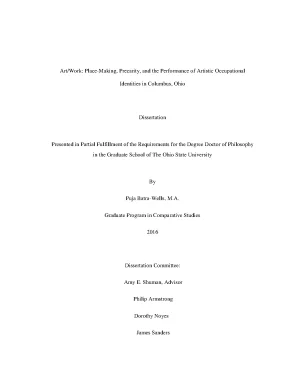
Tải xuống để đọc toàn bộArt/Work: Place-Making, Precarity, and the Performance of Artistic Occupational Identities in Columbus, Ohio Dissertation Presented in Partial Fulfillment of the Requirements for the Degree Doctor of Philosophy in the Graduate School of The Ohio State University By Puja Batra-Wells, M. Graduate Program in Comparative Studies 2016 Dissertation Committee: Amy E. Shuman, Advisor Philip Armstrong Dorothy Noyes James Sanders Copyright by Puja Batra-Wells 2016 Abstract Visual artists working today encounter a harsh and uncertain economic environment shaped by neoliberal and post-Fordist orientations that have reorganized the long- standing antagonisms between art and commerce. The conjunction of artistic and commercial logics, endured in a permanently uncertain economic environment has generated particular forms of knowledge and ways of being that are the basis of the ethnographic study that follows.
By attending to quotidian orders of sense-making through the use of a vernacular framework, my study examines how visual artists working in Columbus, Ohio partake in economic and aesthetic discourses, constructing notions of labor and value, resource management and contingency. I interrogate the informal, provisional, and self-organizing practices and discursivities that artists come to rely upon in their daily and lived encounters with the economy. Within this context, I am interested in documenting narratives of how artists conceive of, grapple with, and adjust to the anxieties of economic precarity and material insecurity. I investigate how artists’ occupational identities are implicated, generated, and modified by contemporary economic and cultural transformations.
I also map these narratives onto contestatory distinctions between art and craft, singularity and standardization, gift and commodity. To do this, I train my focus on how artists relate to the concreteness of place, the abstractions of the marketplace and the emphemeralities of performance. ii My dissertation reveals the ways in which the categories of artist and market are unstable. I show that artists’ ways of emplacing themselves within these discursivities are also variant and unstable.
That is, my attention to the vernacular sphere reveals artists’ informal practices to be complex, knotty and filled with paradoxical entanglements. I reveal artists’ stakes in varying discursive inhabitations; the categories artists’ valorize or alternatively stigmatize; and how paradoxical, categorical inhabitations are sustained, contested or rejected. My scholarship illuminates both the responsiveness of emergent repertoires and their delimiting attributes. I find that artists are unable to sustain their practices without alternative employment and thus art as work is often constituted by doing many different types of work.
This form of bricolage is further intensified under the economizing pressures of the artist as entrepreneur who objectifies herself in the marketplace through self-branding and marketing. The demands to be economically and creatively productive within this context come at the cost of time which most informants require to maintain a qualitative practice. Thus, the stabilities offered by the neoliberal economy in the form of entrepreneurial interventions are themselves revealed as destabilizing. iii Dedication For the women artists in my life… iv Acknowledgments This study would not be possible but for the generosity and candor of my informants to whom I am eternally grateful.
I am also deeply indebted to my wonderful and distinguished advisor, Dr. Amy Shuman, under whose consummate tutelage this project was developed, directed, and completed. I want to thank my brilliant committee members, Drs. Philip Armstrong, Dorothy Noyes, and James Sanders for their rigorous and considered engagement with my scholarship.
Finally, and on a personal note, my project owes everything to my family who have rallied around me and have accompanied me on this journey. v Vita May 1995…………………………………Loreto Convent School 2001………………………………………. Economics, Ohio State University 2010……………………………. Popular Culture; Certificate in Public History, Bowling Green State University 2011 to 2014………………………………Graduate Archivist, Center for Folklore Studies, Ohio State University Spring, 2015……………………………….Graduate Fellow, Center for Folklore Studies 2015- Present……………………………….Graduate Teaching Associate, Department of Comparative Studies, Ohio State University Publications “Pruning the Bio-Political Subject: The Obama Garden as Neo-Liberal Display.
Regina Bendix and Michaela Fenske. LIT Verlag Münster. 2014 Fields of Study Major Fields: Comparative Studies vi Table of Contents Abstract……………………………………………………………. Situating the Study: Some Historical Background………………………….
Sample Constitution, Scope and Limits…………………. Statement on Positionality…………………………………. Time and Space………………………………………………………………33 i. The Studio……………………………………………………………37 ii.
The Little Pond………………………………………………………43 iii. Professional Place-Making………………………………………………. The Economic Terrain………………………………………………………. The Uncertain Business of Art…………………………………………….
‘Making Do’ and the Economic Vernacular…. Recuperating [Economic] Value……………………………………102 ii. Alternative Exhibitionary Tactics…………………………………. The Artist as Creator…………………………………………………….
Engagements with (a very American) Mass Culture………………. The Auctorial Function and the Age of Entrepreneurial Individualism………………………………………………………. Myth and the Artist…………………………………………………………141 i. The Myth of Vocation………………………………………………146 ii.
The Myth of Individuality…………………………………………. The Myth of Privation (Disinterest) and Autonomy………………. The Art of Self Marketing…………………………………………………. The Retail Pitch…………………………………………………….
The Intimacy Pitch………………………………………………. The Detached Pitch………………………………………………. The Technician’s Pitch……………………………………………. The Identity Loaded Pitch………………………………………….
Place and Placelessness……………………………………. Precarity and Economic Stability…………………………. Immobile Myths and Ephemeral Performances…………….189 ix Introduction In every artist’s career there is a moment, when you ask yourself what is it that I do? Why am I compelled like a mad person to create things that are simultaneously of no value and of absolute value? This exercise feels utterly pointless and wasteful and at the same time it is the penultimate rendering of my skill and knowledge and is so precious. It’s just, in the end, you can’t eat your canvas… Olivia Parsons (Printmaker and Informant) Olivia Parsons is a working screen-printer and artist.
For eight years following art-school, she worked as a book store manager to sustain her practice and to make rent for her art studio. Three years ago after taking two loans out, she managed to emancipate herself from the manic world of retail only to replicate its freneticism in her new role as artist- entrepreneur. On a typical day she arrives at her studio at 10 am. The mornings begin with a perusal of the day’s schedule and email followed by floor cleaning, inspections of the washer booth, the cleaning of screens, and maintenance checks of the exposure units.
To keep her practice afloat, Olivia sublets her space and equipment to other artists. She also runs printing and design workshops to help pay down the cost of her capital assets and rent. The mornings are often spent as technical assistant to artists using the studio or as a teacher to those learning printing techniques. The afternoons are often spent with business operations like invoicing, purchasing and accounting.
Additionally, time is carved out for new business generation through marketing, website management, and 1 workshop development. It is generally only after and if the studio is vacated by other artists at the end of the day that she finds time for her own creative expression. Home between 7 and 8 each evening (including Saturdays), the work continues after dinner. Against the background of television programming shared with her spouse, the final hours before bed are distractedly spent on managing independent social media presences for the studio and her practice.
Twitter, Instagram, and Facebook are updated with photographs and videos taken through the course of the day. In this brief elaboration of a day in the life of an informant, a few things are made palpable. The first is that contemporary artists are increasingly business-minded in their efforts to sustain a living from their practices. The second is that between mastering branding and sales strategies, developing new forms of revenue and managing online enterprises, the ‘work’ never ends and seems to subsume the practice.
Thirdly, and perhaps most significantly, the imbuing of this business-minded stance or what I refer to as an entrepreneurial disposition, often comes at the cost and quality of an artists’ creative output. Framed by post-Fordist reorganizations in the economy, such ways of being have come to consolidate the distance between work and leisure, between art and commerce, and between creativity and capital. Artistic labor has long been romantically idealized for its self-actualizing potentiality and its autonomy from industrial forms of production. Creative articulations, unsullied by the alienating constraints of commerce, are registered as the “authentic” modality of the laboring artist subject.
This is the discursive sphere in which the formal practice of art resides. This formal practice, for artists, is configured as a pure zone; a zone of autonomous action that is unsullied and 2 unconcerned by the demands of the monetary economy. Yet the rise of the so-called “creative economy,” in convergence with the social transformation of the figure of the artist under late capitalism and neoliberal policy interventions, have papered over the historical antagonisms between art and commerce by ceding to market-driven solutions. Thus, artists today enroll the market into their creative practices through the inculcation of an entrepreneurial sensibility that simultaneously requires that they re-skill their labor in other sectors.
The conjunction of such artistic and commercial logics, endured in a permanently uncertain economic environment, has generated particular forms of knowledge and ways of being that are the basis of the study that follows. By attending to quotidian orders of sense-making through the use of a vernacular framework, this study examines how working visual artists partake in economic and aesthetic discourses, constructing notions of labor and value, resource management and contingency. That is, I am interested in interrogating the informal, provisional, and self-organizing practices and discursivities that artists come to rely upon in their daily and lived encounters with an economy undergirded by a neoliberal logic. I want to enunciate how these modalities and discourses are inhabited and embodied in field and how artists use resources/means at hand to structure and stabilize their occupational lives.
Within this context, I document narratives of how artists conceive of, grapple with, and adjust to the anxieties of economic precarity and material insecurity. What orders of sense and response are brought to bear when the practice of art, for example, fails to ensure financial sustenance? What modes of economic, material, and categorical 3 emplacements do artists use to reinforce themselves in such circumstances? In this frame, I interrogate how artists’ occupational identities are implicated, generated, and modified by contemporary economic and cultural transformations. I map these narratives onto contestatory distinctions between art and craft, singularity and standardization, gift and commodity. Additionally, I examine how these articulations come to be implicated by, resistant to, or complicit with contemporary modes of neoliberalism and the ideologies of an unregulated art market.
The constituency at the heart of my project are visual artists who identity as “independent.” The “visual arts” in my study are circumscribed by those working in the fields of painting, sculpture, ceramics, photography, video, drawing, and printmaking. I take the term “art” to mean the ascription of a status, in the vein of Howard Becker’s sociological reading of the term. For Becker, the usage of the word “art” is never impartial but instead reflects the interests of a social group whose position is augmented by its ascription (339). The claim to the status of art requires aspirants to distinguish and dissociate themselves from “crafts or commercial enterprises” while “constructing histories which tie the work their world produces to accepted arts, [emphasizing] those elements of their pasts that are clearly artistic while suppressing less desirable ancestors” (339).
Here, we may take “artistic” to mean cultural productions that have a “developed aesthetic apparatus and media” (339). While self-identifying as artists, my informants also ascribe to the status of “independents” indicating their freedom from the systems of brokerage, which requires them to bring their work to market directly. This constituency represents the majority of 4 artists practicing today— making a study about their place-making, their occupational folk-life, and their discursive repertoires a critical contribution. It ought to be noted here that whereas there exists a tradition of scholarly work on artists and their art, the emphasis of my dissertation is not on art-making but more on how art practices are sustained through engagements with the economy.1 That is, my research emphasizes the multifarious logics of art economies and not the procedures of production.
This study is set in Columbus, Ohio and relies on the ethnographic method. In the following pages, I will articulate the research legacy that I situate myself within so as to clarify the contribution and stakes of my project.
Nội dung được bảo vệ bản quyền — Tải xuống đầy đủ
Trích dẫn luận án này
Puja Batra-Wells (2016). Dissertation draft puja batra wells 2016 [Luận án tiến sĩ, The Ohio State University]. LuanAn.net. https://luanan.net/tai-lieu-khac/dissertation-draft-puja-batra-wells-2016
Câu hỏi thường gặp
Luận án "Dissertation draft puja batra wells 2016" nghiên cứu về vấn đề gì?
Bản nháp luận văn của Puja Batra Wells (2016) cung cấp cái nhìn sâu sắc về các phương pháp nghiên cứu và phân tích.
Luận án "Dissertation draft puja batra wells 2016" được bảo vệ tại trường nào?
Luận án này được bảo vệ tại The Ohio State University. Năm bảo vệ: 2016.
Luận án "Dissertation draft puja batra wells 2016" thuộc chuyên ngành gì?
Luận án "Dissertation draft puja batra wells 2016" thuộc chuyên ngành Comparative Studies. Danh mục: Tài liệu khác.
Luận án "Dissertation draft puja batra wells 2016" có bao nhiêu trang?
Luận án "Dissertation draft puja batra wells 2016" có 215 trang. Bạn có thể xem trước một phần tài liệu ngay trên trang web trước khi tải về.
Cách tải luận án "Dissertation draft puja batra wells 2016" về máy như thế nào?
Để tải luận án về máy, bạn nhấn nút "Tải xuống ngay" trên trang này, sau đó hoàn tất thanh toán phí lưu trữ. File sẽ được tải xuống ngay sau khi thanh toán thành công. Hỗ trợ qua Zalo: 0559 297 239.