Three essays on capital structure and product market interactions
Luận án: Three essays on capital structure and product market interactions. Xem tóm tắt và tải về tại LuanAn.net
Luan An
Luận án tiến sĩ
Năm xuất bản
Số trang
190
Thời gian đọc
29 phút
Lượt xem
0
Lượt tải
0
Phí lưu trữ
50 Point
Tổng quan nhanh
- Chủ đề:
- Tương tác cấu trúc vốn và thị trường sản phẩm
- Số trang:
- 190 trang
- Trường:
- University of South Carolina
- Chuyên ngành:
- Business Administration
- Tác giả:
- Ying Zheng
- Năm:
- 2017
Tóm tắt nội dung luận án
I.Tương tác cấu trúc vốn và thị trường sản phẩm
Tài liệu nghiên cứu sâu về sự tương tác phức tạp giữa cấu trúc vốn và thị trường sản phẩm. Cấu trúc vốn, bao gồm tỷ lệ nợ và vốn chủ sở hữu, là yếu tố cốt lõi trong tài chính doanh nghiệp. Nó định hình khả năng tài chính và rủi ro của công ty. Hiểu rõ mối liên hệ này giúp doanh nghiệp tối ưu hóa đòn bẩy tài chính. Nó cũng hỗ trợ xây dựng chiến lược cạnh tranh bền vững trên thị trường. Các quyết định về nợ và vốn chủ sở hữu không chỉ tác động nội bộ mà còn ảnh hưởng đến vị thế công ty so với đối thủ và khách hàng. Đây là lĩnh vực quan trọng để đánh giá hiệu suất công ty.
1.1. Tầm quan trọng của cấu trúc vốn trong tài chính doanh nghiệp
Cấu trúc vốn đóng vai trò trung tâm trong mọi quyết định tài chính. Nó xác định nguồn vốn dài hạn của doanh nghiệp. Nguồn vốn này bao gồm nợ dài hạn, vốn cổ phần ưu đãi và vốn cổ phần thông thường. Một cấu trúc vốn hiệu quả giúp tối thiểu hóa chi phí vốn. Nó tối đa hóa giá trị công ty. Cấu trúc vốn cũng ảnh hưởng đến khả năng tiếp cận vốn trong tương lai. Nó tác động đến sự linh hoạt tài chính để đáp ứng các cơ hội hoặc thách thức bất ngờ. Các nhà quản lý cần cân nhắc kỹ lưỡng giữa rủi ro tài chính và tiềm năng tăng trưởng. Quyết định về cấu trúc vốn là một yếu tố then chốt cho sự sống còn và phát triển của doanh nghiệp.
1.2. Ảnh hưởng của đòn bẩy tài chính đến công ty
Đòn bẩy tài chính là việc sử dụng vốn vay để tài trợ hoạt động. Nó có thể khuếch đại lợi nhuận cho các cổ đông. Tuy nhiên, nó cũng tăng nguy cơ tài chính. Mức độ đòn bẩy cao có thể gây ra gánh nặng lãi suất lớn. Nó làm giảm khả năng thanh toán của công ty khi doanh thu giảm. Trên thị trường sản phẩm, đòn bẩy tài chính ảnh hưởng đến nhận thức của khách hàng và đối thủ. Một công ty với đòn bẩy quá cao có thể bị coi là yếu thế. Điều này dẫn đến sự mất tin cậy từ khách hàng hoặc hành động cạnh tranh hung hãn hơn từ đối thủ. Do đó, việc quản lý đòn bẩy tài chính cần sự cân bằng tinh tế. Mục tiêu là tối ưu hóa giá trị mà không đẩy công ty vào rủi ro không cần thiết.
II.Chi phí đòn bẩy tài chính và rủi ro phá sản
Mặc dù đòn bẩy tài chính mang lại lợi ích tiềm năng, nó cũng tiềm ẩn chi phí đáng kể. Đặc biệt, đòn bẩy cao là nguyên nhân chính gây ra tình trạng khó khăn tài chính. Nó làm tăng xác suất phá sản của doanh nghiệp. Khi một công ty gặp vấn đề tài chính, các bên tham gia thị trường sản phẩm có thể phản ứng tiêu cực. Khách hàng có thể chuyển sang đối thủ. Đối thủ cạnh tranh có thể tận dụng điểm yếu để chiếm thị phần. Việc hiểu rõ các chi phí này là cần thiết. Nó giúp doanh nghiệp đưa ra các quyết định cấu trúc vốn thận trọng.
2.1. Đòn bẩy tài chính cao và nguy cơ phá sản doanh nghiệp
Đòn bẩy tài chính quá mức đẩy công ty vào rủi ro phá sản cao hơn. Các khoản nợ lớn đòi hỏi thanh toán lãi và gốc định kỳ. Trong bối cảnh kinh tế khó khăn hoặc doanh thu sụt giảm, khả năng chi trả của công ty bị suy yếu. Điều này có thể dẫn đến vỡ nợ. Vỡ nợ kéo theo các hành động pháp lý từ chủ nợ. Nó làm tổn hại nghiêm trọng đến danh tiếng và hoạt động kinh doanh. Nguy cơ phá sản không chỉ ảnh hưởng đến cổ đông và chủ nợ. Nó còn gây ra sự bất ổn cho nhân viên, nhà cung cấp và khách hàng. Một cấu trúc nợ không bền vững có thể phá hủy toàn bộ giá trị công ty tích lũy.
2.2. Phản ứng của đối thủ cạnh tranh và khách hàng
Sức khỏe tài chính của một công ty được theo dõi chặt chẽ bởi các đối thủ và khách hàng. Khi đòn bẩy tài chính của công ty tăng cao, đối thủ cạnh tranh có thể nhận thấy đây là dấu hiệu của sự yếu kém. Họ có thể phản ứng bằng cách hạ giá, tăng cường chiến dịch marketing, hoặc tăng cường đầu tư vào nghiên cứu và phát triển (R&D). Điều này nhằm chiếm thị phần hoặc thu hút khách hàng. Khách hàng cũng có thể lo ngại về khả năng cung cấp sản phẩm hoặc dịch vụ trong tương lai. Họ có thể chuyển sang các nhà cung cấp có tài chính ổn định hơn. Những phản ứng này có thể làm suy yếu vị thế cạnh tranh. Nó giảm hiệu suất công ty. Cấu trúc vốn cần được quản lý chiến lược.
III.Quyết định cấu trúc vốn và chiến lược cạnh tranh
Quyết định về cấu trúc vốn không chỉ là vấn đề tài chính đơn thuần. Nó là một phần không thể thiếu của chiến lược cạnh tranh tổng thể. Cách một công ty cân bằng giữa nợ và vốn chủ sở hữu ảnh hưởng đến khả năng đầu tư vào R&D, mở rộng thị trường, và phản ứng với các động thái của đối thủ. Một cấu trúc vốn tối ưu có thể cung cấp lợi thế chiến lược. Nó giúp công ty cạnh tranh mạnh mẽ hơn trên thị trường sản phẩm. Ngược lại, một cấu trúc vốn yếu kém có thể hạn chế các lựa chọn chiến lược. Nó làm suy yếu khả năng cạnh tranh của công ty.
3.1. Cấu trúc nợ và vốn chủ sở hữu ảnh hưởng chiến lược
Sự phân bổ giữa nợ và vốn chủ sở hữu có tác động sâu sắc đến các quyết định chiến lược. Tỷ lệ nợ cao có thể buộc công ty phải ưu tiên các khoản thanh toán lãi. Nó làm giảm nguồn lực cho các sáng kiến chiến lược dài hạn. Ví dụ, đầu tư vào R&D hoặc mở rộng thị trường mới có thể bị trì hoãn. Ngược lại, tỷ lệ vốn chủ sở hữu cao hơn mang lại sự linh hoạt tài chính. Nó cho phép công ty theo đuổi các chiến lược tăng trưởng tích cực. Nó cũng có thể chống lại các cuộc tấn công cạnh tranh. Doanh nghiệp cần lựa chọn cấu trúc vốn phù hợp với mục tiêu chiến lược.
3.2. Cấu trúc vốn tác động hiệu suất công ty
Hiệu suất công ty được liên kết chặt chẽ với cấu trúc vốn. Một cấu trúc vốn hợp lý có thể nâng cao hiệu suất tài chính và hoạt động. Nó giúp công ty duy trì khả năng cạnh tranh. Ví dụ, một cấu trúc vốn tối ưu có thể giảm chi phí vốn. Nó cải thiện lợi nhuận. Trên thị trường sản phẩm, công ty có tài chính vững mạnh có thể đầu tư nhiều hơn vào cải tiến sản phẩm. Nó xây dựng thương hiệu mạnh mẽ. Nó cũng có thể chịu được các áp lực cạnh tranh về giá. Điều này tạo ra lợi thế bền vững. Ngược lại, cấu trúc vốn không hiệu quả có thể gây ra khó khăn tài chính. Nó làm giảm hiệu suất tổng thể của công ty.
IV.Nghiên cứu tương tác Đòn bẩy và quyết định đầu tư
Nghiên cứu về tương tác giữa đòn bẩy tài chính và quyết định đầu tư là rất quan trọng. Nó làm rõ cách các lựa chọn tài trợ ảnh hưởng đến chiến lược phát triển sản phẩm. Các công ty thường phải đối mặt với sự đánh đổi giữa việc sử dụng nợ để tài trợ tăng trưởng và duy trì sự linh hoạt tài chính. Tài liệu này khám phá những cơ chế này. Nó chỉ ra cách cấu trúc vốn có thể thúc đẩy hoặc cản trở các quyết định đầu tư quan trọng. Đặc biệt, nó tập trung vào các lĩnh vực như R&D, nơi mà sự ổn định tài chính là yếu tố then chốt.
4.1. Liên kết đòn bẩy tài chính với các quyết định đầu tư
Đòn bẩy tài chính có liên quan trực tiếp đến các quyết định đầu tư của công ty. Các công ty với đòn bẩy cao có thể gặp khó khăn trong việc huy động vốn cho các dự án mới. Chủ nợ có thể ngần ngại cấp thêm tín dụng. Chi phí vay cũng có thể tăng lên. Điều này có thể buộc công ty phải cắt giảm các khoản đầu tư cần thiết. Ví dụ, cắt giảm chi tiêu vào nhà máy mới, thiết bị, hoặc mở rộng thị trường. Ngược lại, một cấu trúc vốn thận trọng có thể cung cấp nguồn lực ổn định hơn. Nó hỗ trợ các quyết định đầu tư dài hạn.
4.2. Vai trò của nghiên cứu và phát triển R D
Nghiên cứu và phát triển (R&D) là động lực chính của sự đổi mới và tăng trưởng. Tuy nhiên, các dự án R&D thường đòi hỏi đầu tư lớn và có rủi ro cao. Cấu trúc vốn của một công ty ảnh hưởng đến khả năng tài trợ cho R&D. Một công ty với đòn bẩy cao có thể miễn cưỡng đầu tư vào R&D. Điều này do áp lực trả nợ. Nó cũng do rủi ro tài chính gia tăng. Điều này có thể làm giảm khả năng đổi mới. Nó ảnh hưởng đến khả năng cạnh tranh lâu dài trên thị trường sản phẩm. Ngược lại, một cấu trúc vốn linh hoạt cho phép công ty đầu tư mạnh vào R&D. Nó tạo ra lợi thế công nghệ và sản phẩm.
Tải xuống file đầy đủ để xem toàn bộ nội dung
Tải đầy đủ (190 trang)Trích đoạn nội dung luận án
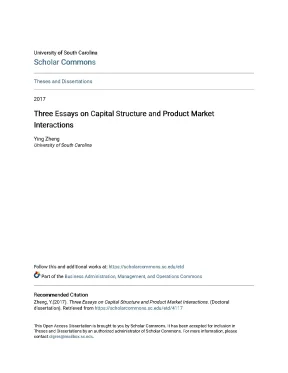
Tải xuống để đọc toàn bộUniversity of South Carolina Scholar Commons Theses and Dissertations 2017 Three Essays on Capital Structure and Product Market Interactions Ying Zheng University of South Carolina Follow this and additional works at: https://scholarcommons.edu/etd Part of the Business Administration, Management, and Operations Commons Recommended Citation Zheng, Y. Three Essays on Capital Structure and Product Market Interactions. Retrieved from https://scholarcommons.edu/etd/4117 This Open Access Dissertation is brought to you by Scholar Commons. It has been accepted for inclusion in Theses and Dissertations by an authorized administrator of Scholar Commons.
For more information, please contact digres@mailbox. THREE ESSAYS ON CAPITAL STRUCTURE AND PRODUCT MARKET INTERACTIONS by Ying Zheng Bachelor of Science East China University of Science and Technology, 2010 Master of Science Bentley University, 2012 Submitted in Partial Fulfillment of the Requirements For the Degree of Doctor of Philosophy in Business Administration Darla Moore School of Business University of South Carolina 2017 Accepted by: Omrane Guedhami, Major Professor Chuck C. Kwok, Major Professor Allen N. Berger, Committee Member Kee-Hong Bae, Committee Member Sadok El Ghoul, Committee Member Cheryl L.
Addy, Vice Provost and Dean of the Graduate School © Copyright by Ying Zheng, 2017 All Rights Reserved. ii DEDICATION This work is dedicated to: My husband, Yi Shen My parents, Dianzeng Zheng & Lingping Duan My parents-in-law, Jin Shen & Xiaomei Song I love you all iii ACKNOWLEDGEMENTS My journey at University of South Carolina is truly unforgettable, precious, and inspiring. During this journey, I have received generous support from many talented professors and friendship from bright individuals. Firstly, I would like to express my gratitude to my committee co-chairs.
Chuck Kwok gave me continuous support of my PhD study with great patience, motivation, and immense knowledge. His guidance helped me find a big picture of my research interests and get to learn the beauty of teaching. Omrane Guedhami provided me with many wise suggestions on my career and diligently worked on my dissertations. I especially want to thank his endless help during my down time.
His support led to a smooth transition of my career. Besides my advisors, I would like to thank the rest of my dissertation committee. Allen Berger is always willing to support the junior scholar. I thank him for his generous help of my dissertation and job market search.
Kee-Hong Bae is a truly insightful and knowledgeable scholar. I am impressed by his sharp mind and learn a lot after every conversation with him. Sadok El Ghoul has immense knowledge in both data analysis and finance theories. My dissertation would not be possible without his code guidance and theoretical inspiration.
My sincere thanks also go to Dr. Chao Jiang, for his advice on works as a junior professor, Dr. Jean Helwege, for her excellent explanation of corporate finance and her role model as a leading female scholar. I’m also thankful to all professors who have taught iv me.
The classes are undoubtedly the foundations of my future academic career. In addition, I extend my deep appreciation to my friends at University of South Carolina – Zhongyu Cao, Ruiyuan Chen, Chia-Chun Chiang, Ashleigh,Eldemire-Poindexter, Minjie Guo, Xinming Li, Kun Liu, Yuqi Peng, Helen Wang, Jiawei Wang, Herman Saheruddin, Pengxiang Zhang, Shenying Zhang, Yijia Zhao, Xiaoying Zheng, and Yaqin Zheng. I also thank my lovely cats, Madonna and Bubu, for their companionship. Finally, I would like to give my most special thanks to my family.
My parents, Dianzeng Zheng and Lingping Duan, give their unconditional love and support all the time. I often joke with them that they are not “wise” investors. They provide me with substantial supports in time, care and finance, but never ask for returns. My parents-in-law, Jin Shen and Xiaomei Song, shared a lot of extremely valuable suggestions on my PhD study.
They stand by me whenever I face difficulties in life. My husband, Yi Shen, is the best husband I can imagine. The luckiest thing in my life is to get to know him. He is talented, funny, and caring.
Our love is built after high school and since then he is the driver of my life and career. The journey with him is full of happiness as he always protects me from hardness or anything may negatively influence me. I cannot imagine a life without him. v ABSTRACT Capital structure can have important consequences for firm value.
High leverage increases firms’ probability of bankruptcy, and is shown to be the primary cause of financial distress. As suggested by a strand of literature on capital structure and product market interactions, high leverage is costly because financial weakness could induce unfavorable actions by product market participants such as customers and competitors. While the costs of high leverage are well documented in the extant literature, little is known on the factors that influence the costs of high leverage. This dissertation addresses this gap in the literature by examining how the costs of high leverage, measured by the sensitivity of firm sales growth to high leverage, are influenced by corporate social responsibility (CSR), creditor rights, and national culture.
The first essay examines the relation between CSR and the costs of high leverage. We find that CSR reduces losses in market share when firms are highly leveraged. Our main evidence persists when we use regression of discontinuity design (RDD) and difference-in-difference (DID) to address endogeneity. We also examine whether CSR separately mitigates the high leverage costs driven by customers and competitors.
We find that CSR helps high-leveraged firms retain customers and guard against rival predation. Our results support the stakeholder value maximization view of CSR. vi The second essay examines the impact of creditor rights on the costs of high leverage. We find that strong creditor rights increase the costs of high leverage.
This result lends support to the dark-side effects of strong creditor rights when a firm is highly leveraged. The negative impact of creditor rights on high leverage costs is more pronounced for the types of creditor protection that drive creditors’ hold-up incentives as well as for firms located in countries with developed banking system (rather than bond market system), and firms with higher liquidation costs. When we explore the dark-side effects of creditor rights on specific players, we find that strong creditor rights intensify the adverse responses of customers and competitors. In an additional analysis, we find that creditor rights intensify the adverse responses of employees.
Overall, our findings contribute to the debate on the role of creditor rights and shed light on the channels underlying the dark-side effects of creditor rights. The third essay examines how national culture (specifically collectivism) influences the costs of high leverage. We find that these costs are mitigated in collectivist countries through two potential channels of influence: tight group structures and mental conditioning. This relation is stronger where high leverage costs are more pronounced and where legal systems are less developed.
We extend our analysis to include employee and supplier stakeholder groups and find that collectivism helps highly leveraged firms retain employees and obtain trade credit from suppliers. Collectively, our findings suggest that national culture affects corporate financial outcomes by simultaneously influencing key stakeholders in the firm and its environment. vii TABLE OF CONTENTS DEDICATION. vi LIST OF TABLES .x CHAPTER 1 DOES CORPORATE SOCIAL RESPONSIBILITY REDUCE THE COSTS OF HIGH LEVERAGE? EVIDENCE FROM CAPITAL STRUCTURE AND PRODUCT MARKETS INTERACTIONS .2 SAMPLE, MAIN VARIABLES, AND EMPIRICAL DESIGN .34 CHAPTER 2 THE DARK-SIDE EFFECTS OF CREDITOR RIGHTS: EVIDENCE FROM CAPITAL STRUCTURE AND PRODUCT MARKETS INTERACTIONS .2 LITERATURE REVIEW AND HYPOTHESIS DEVELOPMENT .3 DATA AND VARIABLES .78 CHAPTER 3 COLLECTIVISM AND THE COSTS OF HIGH LEVERAGE .2 RELATED LITERATURE AND HYPOTHESIS .3 SAMPLE, VARIABLE, AND EMPIRICAL DESIGN .161 APPENDIX A – CHAPTER 1 MSCI ESG STATS .172 APPENDIX B – CHAPTER 1 VARIABLE DEFINITIONS .174 APPENDIX C – CHAPTER 2 SAMPLE CONSTRUCTION .176 APPENDIX D – CHAPTER 2 VARIABLE DEFINITIONS .177 ix LIST OF TABLES Table 1.1 Sample Distribution by Industry and Year .2 Descriptive Statistics and Correlation Matrix .3 CSR and the Costs of High Leverage .4 Endogeneity Tests: Regression of Discontinuity Design (RDD) .5 Endogeneity Tests: Exogenous Shock of Import Tariff Reduction .6 CSR and the Costs of High Leverage: Customer Channel .7 CSR and the Costs of High Leverage: Competitor Channel .3 The Dark-side Effect of Creditor Rights.4 Endogeneity Tests: Exogenous Shock of Financial Crisis .5 Endogeneity Tests: 2SLS and System GMM Approaches .6 Robustness Checks: Sample Composition .7 Robustness Checks: Alternative Definitions of Key Variables .9 Channels of The Dark-side Forces of Creditor Rights: Customer and Competitor .10 Additional Channels of the Dark-side Forces of Creditor Rights: Employee and Supplier .11 Alternative Explanation: Creditor Rights and Firm Performance .2 Collectivism and the Costs of High Leverage .3 Subsample Tests: the Costs of High Leverage .4 Subsample Tests: Legal Environment .5 Collectivism and Prevalence of Business Group .6 Collectivism and the costs of high leverage: drop countries according to the rank of business group prevalence .7 Collectivism and Value Traits .8 Collectivism and the costs of high leverage driven by employees and suppliers .10 Robustness Tests: Sample Composition and Alternative Measures .11 Robustness Tests: Firm Exit Bias .12 Robustness Tests: Market Structure Explanation .157 xi CHAPTER 1 DOES CORPORATE SOCIAL RESPONSIBILITY REDUCE THE COSTS OF HIGH LEVERAGE? EVIDENCE FROM CAPITAL STRUCTURE AND PRODUCT MARKETS INTERACTIONS 1.
INTRODUCTION Research on capital structure and product markets interactions documents significantly negative effects of high leverage on product market performances (e., Opler and Titman, 1994; Campello, 2003, 2006). However, very little attention is paid to the mechanisms that may mitigate high leverage costs. In this paper, we fill this gap in the literature. We argue that corporate social responsibility (CSR) can mitigate the negative impact of high leverage on product market performances.
Our study offers insights into the potentially important role of CSR in reducing the costs of high leverage due to a firm’s conflicts with its stakeholders such as customers and competitors. Stakeholders can impose significant costs on highly leveraged firms. For instance, high leverage leads to substantial losses in market share due to unfavorable actions by customers and competitors. Customers are reluctant to purchase from highly leveraged firms because these firms may renege on implicit contracts with customers by discontinuing product support or reducing product quality (Titman, 1984; Maksimovic and Titman, 1991; Matsa, 2011; Kini et al.
Competitors may undertake predatory 1 attacks such as capital-intensive promotion activities (e., negative advertising campaigns, deep price discounts) against highly leveraged firms. As highly leveraged firms have difficulty accessing capital and face high cost of capital, they have less ability to withstand predatory attacks from competitors and can be forced to surrender substantial market share (Telser, 1966; Bolton and Scharfstein, 1990; Chevalier, 1995).1 We hypothesize that CSR plays a risk management role by protecting firms from stakeholders’ unfavorable reactions in response to high leverage and thereby reduces the costs of high leverage. There are at least two reasons for this. First, CSR is associated with a halo effect (Hong and Liskovich, 2015; Lins et al., 2017) that increases trust between a firm and stakeholder groups such as customers.
The halo effect of CSR provides a highly leveraged firm with insurance-like protection that tempers negative actions from customers and reduces competitors’ incentives to exploit a highly leveraged firm’s weak financial position. Second, high-CSR firms are perceived to have lower levels of risk (e., lower litigation risk) and have a wider investor base (Waddock and Graves, 1997; Hong and Kacperczyk, 2009; El Ghoul et al. 2 These firms thus have better 1 In this paper, we follow Freeman (1984) and define stakeholders as “any group or individual who can affect or is affected by the achievement of the organization’s objectives” (Freeman, 1984, p. Accordingly, we classify both customers and competitors as stakeholders.
2 Waddock and Graves (1997) argue that firms attempting to shift costs to external stakeholders through socially irresponsible actions face a higher likelihood of future explicit claims. Hong and Kacperczyk (2009) document that “sin” firms (i.
Nội dung được bảo vệ bản quyền — Tải xuống đầy đủ
Trích dẫn luận án này
Ying Zheng (2017). Three essays on capital structure and product market interac [Luận án tiến sĩ, University of South Carolina]. LuanAn.net. https://luanan.net/quan-tri-kinh-doanh/three-essays-on-capital-structure-and-product-market-interactions
Câu hỏi thường gặp
Luận án "Three essays on capital structure and product market interac" nghiên cứu về vấn đề gì?
Luận án: Three essays on capital structure and product market interactions. Xem tóm tắt và tải về tại LuanAn.net
Luận án "Three essays on capital structure and product market interac" được bảo vệ tại trường nào?
Luận án này được bảo vệ tại University of South Carolina. Năm bảo vệ: 2017.
Luận án "Three essays on capital structure and product market interac" thuộc chuyên ngành gì?
Luận án "Three essays on capital structure and product market interac" thuộc chuyên ngành Business Administration. Danh mục: Quản Trị Kinh Doanh.
Luận án "Three essays on capital structure and product market interac" có bao nhiêu trang?
Luận án "Three essays on capital structure and product market interac" có 190 trang. Bạn có thể xem trước một phần tài liệu ngay trên trang web trước khi tải về.
Cách tải luận án "Three essays on capital structure and product market interac" về máy như thế nào?
Để tải luận án về máy, bạn nhấn nút "Tải xuống ngay" trên trang này, sau đó hoàn tất thanh toán phí lưu trữ. File sẽ được tải xuống ngay sau khi thanh toán thành công. Hỗ trợ qua Zalo: 0559 297 239.