Perceptions of innovations an examination of south carolina supe
Khám phá nhận thức về đổi mới tại South Carolina. Phân tích sâu sắc các yếu tố ảnh hưởng đến sự chấp nhận và triển khai công nghệ mới.
Educational Administration
Luan An
Luận án tiến sĩ
Năm xuất bản
Số trang
138
Thời gian đọc
21 phút
Lượt xem
0
Lượt tải
0
Phí lưu trữ
40 Point
Tổng quan nhanh
- Chủ đề:
- Perceptions of Innovation: SC Superintendents
- Số trang:
- 138 trang
- Trường:
- University of South Carolina
- Chuyên ngành:
- Educational Administration
- Tác giả:
- Alfred Lamont Williams
- Năm:
- 2013
Tóm tắt nội dung luận án
I.Perceptions of Innovation SC Superintendents
This study examines how South Carolina public school superintendents perceive innovations. It delves into their individual and organizational attitudes. Understanding these perspectives is crucial for educational reform. The research provides insight into leaders' readiness for change. It directly impacts student achievement outcomes. This foundational analysis helps shape future educational strategies. The document serves as a critical resource for educators and policymakers. It addresses core aspects of innovation adoption South Carolina within the educational system. Accurate perceptions drive successful implementation efforts. This research is vital for understanding public perception of technology SC among educational leaders.
1.1. Examining Superintendent Attitudes Toward Change
The study investigates how South Carolina public school superintendents view innovation. It explores their individual attitudes. Understanding these perceptions is crucial. This research provides insight into leaders' readiness for change. It directly impacts educational reform efforts. The document serves as a foundational analysis. Positive attitudes are a key driver of innovation in South Carolina.
1.2. Individual Orientations to Innovation
Superintendents possess unique orientations towards new ideas. This research analyzes these individual perspectives. Factors like age, gender, and years of experience play a role. These characteristics shape a leader's openness to innovation. The study seeks to connect personal attributes with innovation acceptance South Carolina. Understanding these individual differences is key.
1.3. Organizational Innovation Attitudes Analyzed
Beyond individual views, district-level attitudes are examined. The study looks at how school districts as organizations approach innovation. This includes factors like student enrollment and poverty levels. School report card grades also factor into this analysis. These organizational contexts influence the adoption of new practices. The findings can help improve regional innovation systems South Carolina.
II.Innovation Adoption South Carolina School Districts
This section details the dynamics of innovation adoption South Carolina within its school districts. It analyzes various district characteristics. These include enrollment figures, poverty levels, and school performance grades. Such factors significantly influence a district's capacity and willingness to embrace new educational practices. The research helps understand the complex interplay between district context and innovation success. It provides a clearer picture of diffusion of innovations SC across different educational environments. This understanding is essential for effective South Carolina innovation policy development.
2.1. District Characteristics and Innovation Readiness
The study assesses various characteristics of South Carolina public school districts. These include enrollment figures and socioeconomic indicators. Poverty levels within districts are analyzed. School report card grades provide performance metrics. These factors are critical in understanding innovation adoption South Carolina. They influence a district's capacity for change. Readiness varies significantly by district profile.
2.2. Enrollment Poverty and School Performance Links
Enrollment size can affect resource allocation for innovations. Higher poverty levels might present unique challenges. Strong school report card grades may indicate effective existing practices or a willingness to innovate. This study examines the relationships between these variables and innovation acceptance South Carolina. Understanding these links is vital for South Carolina innovation policy.
2.3. Diffusion of Innovations in SC Public Schools
The research explores the diffusion of innovations SC within educational settings. It investigates how new ideas and practices spread. Superintendents' perceptions are central to this process. Their leadership can either facilitate or hinder widespread adoption. Identifying effective diffusion pathways is a key goal. This knowledge supports technology acceptance South Carolina.
III.Factors Influencing SC Education Innovation Acceptance
This section explores specific factors shaping innovation acceptance South Carolina in education. It examines both superintendent demographics and district attributes. Understanding these influences helps identify key drivers of innovation in South Carolina. Conversely, it also sheds light on barriers to innovation adoption SC. The analysis covers individual experiences, district resources, and overall institutional readiness. This comprehensive view is essential for developing targeted interventions. It informs strategies to foster a more innovative educational environment throughout the state.
3.1. Superintendent Demographics Age Gender Experience
Superintendent age, gender, and years of experience are key variables. The study analyzes how these individual characteristics correlate with innovation perceptions. Younger superintendents might show greater openness. Experienced leaders bring a wealth of knowledge. Understanding these demographic influences is crucial. It helps identify drivers of innovation in South Carolina.
3.2. Drivers of Innovation in South Carolina Education
The study implicitly uncovers drivers of innovation in South Carolina education. Positive superintendent attitudes are a primary driver. A supportive district culture also promotes new ideas. The potential for improved student achievement acts as a strong motivator. This research seeks to illuminate what propels educational advancement. Policy support also plays a role.
3.3. Barriers to Innovation Adoption in SC Schools
Conversely, the study sheds light on barriers to innovation adoption SC. Negative perceptions or innovation resistance SC from leadership can impede progress. Lack of resources in certain districts may pose challenges. A focus on maintaining the status quo can also create obstacles. Identifying these barriers is the first step toward overcoming them. This informs better South Carolina innovation policy.
IV.Guiding SC School Reform Student Achievement
The findings of this study offer crucial guidance for South Carolina innovation policy and educational reform. It aims to better equip future superintendents. This preparation helps them meet challenges related to school improvement. The research also supports district and school-level staff. Their efforts in implementing reform and innovation plans are critical. Ultimately, improved student achievement is the goal. This contributes significantly to economic development SC and innovation. The study provides a roadmap for sustainable educational progress across the state.
4.1. Training Future South Carolina School Leaders
The study provides valuable insights for superintendent training programs. Future leaders need preparation for school reform challenges. Understanding innovation perceptions equips them better. This guidance can enhance their ability to lead change effectively. It prepares them to champion innovation adoption South Carolina. Early insights are beneficial.
4.2. Supporting District Level Innovation Implementation
Findings can inform district and school-level staff. It helps them support reform and innovation plans. Effective implementation requires aligned perspectives. The study contributes to a common understanding. This fosters a more cohesive approach to educational advancement. It strengthens regional innovation systems South Carolina by providing clear data.
4.3. Enhancing Economic Development SC Through Education
Educational innovation directly impacts economic development SC and innovation. A strong, adaptable education system prepares a skilled workforce. Embracing new technologies and methods improves student outcomes. These outcomes contribute to regional prosperity. The study's guidance supports this broader economic goal. It reinforces the importance of South Carolina innovation policy aligned with economic growth.
V.Understanding Innovation Resistance in SC Schools
This section addresses innovation resistance SC within South Carolina schools. It identifies factors contributing to reluctance regarding new practices and technologies. Superintendent perceptions play a significant role in fostering or hindering technology acceptance South Carolina. Understanding these dynamics is crucial for successful implementation. The study also implicitly touches upon public perception of technology SC by examining leadership attitudes. Developing effective strategies to overcome this resistance is paramount for educational progress and for shaping regional innovation systems South Carolina.
5.1. Identifying Obstacles to Technology Acceptance
The research implicitly identifies elements contributing to innovation resistance SC. Superintendent perceptions can either encourage or discourage technology acceptance South Carolina. A critical analysis of these views reveals potential friction points. Understanding these obstacles is vital for successful implementation of new tools. Resource limitations often exacerbate resistance.
5.2. Public Perception of Technology in SC Schools
While focused on superintendents, the study impacts public perception of technology SC. Leaders' attitudes often filter down to the community. Positive leadership fosters greater public trust in new educational tools. Conversely, resistance from leadership can create skepticism. Shaping leadership views influences broader acceptance. Communication strategies are essential here.
5.3. Strategies for Overcoming Innovation Challenges
The study's findings offer a basis for developing strategies. Addressing specific barriers to innovation adoption SC becomes possible. Tailored training and communication can mitigate innovation resistance SC. Fostering a culture of continuous improvement is essential. This proactive approach helps South Carolina schools embrace necessary change. Effective South Carolina innovation policy can then be formulated.
Mục lục chi tiết luận án
Tải xuống file đầy đủ để xem toàn bộ nội dung
Tải đầy đủ (138 trang)Trích đoạn nội dung luận án
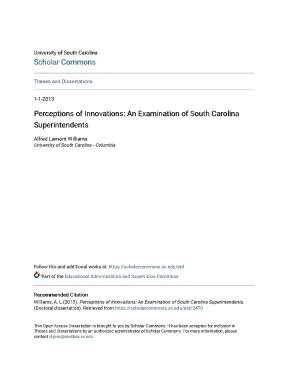
Tải xuống để đọc toàn bộUniversity of South Carolina Scholar Commons Theses and Dissertations 1-1-2013 Perceptions of Innovations: An Examination of South Carolina Superintendents Alfred Lamont Williams University of South Carolina - Columbia Follow this and additional works at: https://scholarcommons.edu/etd Part of the Educational Administration and Supervision Commons Recommended Citation Williams, A. Perceptions of Innovations: An Examination of South Carolina Superintendents. Retrieved from https://scholarcommons.edu/etd/2470 This Open Access Dissertation is brought to you by Scholar Commons. It has been accepted for inclusion in Theses and Dissertations by an authorized administrator of Scholar Commons.
For more information, please contact digres@mailbox. PERCEPTIONS OF INNOVATIONS: AN EXAMINATION OF SOUTH CAROLINA SUPERINTENDENTS By Alfred L. Williams Bachelor of Science Winthrop University, 1996 Master of Education University of South Carolina, 2007 Educational Specialist University of South Carolina, 2011 Submitted in Partial Fulfillment of the Requirements For the Degree of Doctor of Philosophy in Educational Administration College of Education University of South Carolina 2013 Accepted by: Edward Cox, Major Professor Sandra Lindsay, Committee Member Xiaofeng Steven Liu, Committee Member Peter Moyi, Committee Member Lacy Ford, Vice Provost and Dean of Graduate Studies © Copyright by Alfred L. Williams, 2013 All Rights Reserved.
ii DEDICATION The dissertation is dedicated to my family. Your love and support empowered me to embark on and ultimately survive this journey. I owe my success in this life to you all, and dedicate this, my greatest accomplishment thus far, to you. First, to my wife Sonya, whose love, patience, and encouragement has allowed me to finally reach this milestone.
Baby, you can finally have your living room and dining room back. To my children, Nya and Alfred, who have been anxiously waiting for me to complete my doctoral program so they can attend another graduation ceremony and play with the putty. You both have inspired me tremendously and I hope that I have inspired you to become life-long learners. Finally, to my parents, Joyce Williams and Daniel Cornwell, who taught me the value of hard work and perseverance.
They always believed that I could do anything that I set my mind to, so much so that I have come to believe it myself. My successes in academics, as a professional, and in life are forever linked to the lessons they taught and the example they set. Although they are not here to celebrate this accomplishment with me, I am sure that they are looking down on me with pride. iii ACKNOWLEDGEMENTS I would like to take this time to acknowledge and thank all of the people who have helped, encouraged, and supported me throughout my doctoral program.
Thank you to my committee Chair, Dr. Edward Cox, for your direction, insight, and encouragement during this process. Thank you to my committee members, Dr. Xiaofeng Steven Liu and Dr.
Peter Moyi for your guidance and patience. A heartfelt thank you goes out to Dr. Sandra Lindsay and Dr. Michael Fanning who both believed in and supported me throughout my masters, specialist, and doctoral programs.
Thanks to all of the professors in the Department of Educational Leadership and Policies, your high expectations and provocative exchange of ideas during this program made me journey outside my comfort zone and forced me to grow academically, professionally, and personally. I would also like to thank the superintendents who participated in this study. Your willingness and cooperation gave me the opportunity to conduct my research. Finally, I would like to thank the Olde English Consortium cohort, especially Blanche Bowles, for all the support, assistance, and collegiality that we shared throughout this endeavor.
I could not have done this without you. I will always remember the times we shared, the discussions we had, and both our challenges and successes. Thank God for making all of this possible. iv ABSTRACT The purpose of this study was to examine the perceptions of South Carolina public school superintendents regarding individual and organizational attitudes toward innovation.
Specific characteristics of South Carolina public school superintendents and public school districts, including enrollment, poverty level, school report card grades, age, gender, and years of experience, were analyzed to determine individual superintendents’ and their school districts’ orientations toward innovation. The findings have the potential to provide much-needed guidance to superintendents in training so that they may be better equipped to meet the challenge of school reform and innovation in relation to student achievement. In addition, the study may serve to provide guidance to district and school-level staff working to support the plans for implementation of reform and innovation. The findings that emerged from this study include the following: (1) The majority of South Carolina public school superintendents perceive themselves as highly innovative.
They also perceive their districts to be high in innovativeness yet they rate the districts lower than they rate themselves. (2) There exists a weak positive relationship between innovative public school district superintendents and innovative public school districts. (3) Superintendents of larger districts and districts with higher ESEA grades rated their districts higher in organizational innovation than smaller districts and those with lower ESEA scores. v TABLE OF CONTENTS DEDICATION……………………………………………………………………………iii ACKNOWLEDGEMENTS………………………………………………………………iv ABSTRACT……………………………………………………………………………….v LIST OF TABLES……………………………………………………………………….ix CHAPTER 1: INTRODUCTION.……………………1 Statement of the Problem……………………………………………………….…7 Purpose of the Study…………………….9 Significance of the Study……………………………………………………….10 Summary of Methodology……………………………………………………….………………………11 Definition of Terms………………………………………………………………12 CHAPTER 2: LITERATURE REVIEW.………29 Leadership and Managing Change………………………………………….……31 Diffusion of Innovations…………………………………………………………37 Summary……………………………….53 vi CHAPTER 3: METHODOLOGY…………………………………………………….…56 Research Questions………………………………………………………………56 Research Design……….…………………………………………………………57 Population and Sample………………………………………………………….62 Validity of Data Collection………………………………………………………64 Summary…….67 Research Questions………………………………………………………………67 Survey Instrument Response Rate……………………………………………….68 Perceptions of Individual and Organizational Innovativeness……….69 Relationship Between Individual and Organizational Innovativeness………….74 Perceptions Related to District Variables……………….………………………74 Perceptions Related to Demographic Variables…………………………………83 Summary…………………………………………………………………………88 CHAPTER 5: CONCLUSION, DISCUSSION, AND RECOMMENDATIONS………90 Purpose………………………………………………………………………….91 Summary of Findings…………………………………………………………….92 Conclusions………………………………………………………………………99 Discussion………………………………………………………………………100 viii Recommendations………………………………………………………………106 REFERENCES……………………………………………………….110 APPENDIX A - LETTER OF INVITATION AND CONSENT…………….119 APPENDIX B - SURVEY INSTRUMENT….………………………………………121 APPENDIX C – IRB APPROVAL DOCUMENT…………………………………….127 viii LIST OF TABLES Table 3.1 Perceptions of Individual Innovativeness…………………………………….2 Individual Innovativeness Adopter Categories…………………………….3 Perceptions of Organizational Innovativeness…………………………….4 Organizational Innovativeness Adopter Categories………………………….5 Relationship Between Perceptions of Individual and Organizational Innovativeness……………………………………………………………………………73 Table 4.7 Enrollment and Superintendents’ Perceptions of Innovation…………………77 Table 4.8 2012-2013 District Poverty Levels……………………………………………78 Table 4.9 Poverty Level and Superintendents’ Perceptions of Innovation………………80 Table 4.10 District ESEA Grades………………….11 District ESEA Grades and Perceptions of Innovation…………………….13 Superintendents’ Ages and Perceptions of Innovation………………….15 Superintendents’ Gender and Perceptions of Innovation……………………86 Table 4.16 Superintendents’ Years of Experience……………………………………….17 Superintendents’ Ages and Perceptions of Innovation………………………88 x CHAPTER ONE Introduction The first administrative task assigned to the first superintendent of education for the Buffalo, New York school district was to hire a horse and buggy, then go out into the city to find where the schools were located.
Although today’s superintendents would not have any trouble finding the schools, many of them would admit to feeling just as isolated from what is really going on in schools and classrooms as that first Buffalo, New York superintendent (Crowson, 1991). The position of school superintendent was created in response to the inability of urban school boards to manage the rapidly increasing enrollment in city schools. In the early stages of defining the superintendency, the duties and responsibilities assigned to a superintendent centered on finances, facilities, operations, and personnel. Because of these administrative responsibilities, superintendents were viewed primarily as managers of district resources.
However, close on the heels of these administrative responsibilities came the perceived need for the superintendent to be an instructional leader. The evolution of the role of superintendent was in response to increasing demand for reform and improved student achievement. More recently, the role of the superintendent has been defined by political mandates at the local, state, and federal levels. The demands and expectations placed on the position call for a superintendent to operate as an administrative chief, an instructional supervisor, and a 1 negotiator-statesman.
Balancing the competing demands produced by managerial imperatives, instructional requirements, and political considerations often leads to conflicting obligations. For decades, public education has faced mounting criticism for failing to serve the needs of all students. At the forefront of this issue is the persistent achievement gap that exists among students of different racial, ethnic, and socio-economic backgrounds and the low performance of American students compared to international students. Data gathered from recent research suggests that the performance of students in the United Stated trails that of students in other developed countries (Miller, Malley, & Owen, 2009).
This presents a problem because the United States commits more resources to education than any other nation; however, the country continues to produce mediocre academic results (Hanushek & Lindseth, 2009). Continuous unsatisfactory educational outcomes have the potential to place the United States’ national prosperity at-risk, as the nation could be ill prepared to meet the demands for human capital of the 21st century (Karoly & Panis, 2004). In relation to globalization, technological advances, and the development of the knowledge economy, the American public school system must transform and adapt to remain competitive (Freidman, 2007; Goldin, 2009). Innovation is crucial to creating and maintaining a competitive advantage (Dess & Picken, 2000).
In August 2009, President Obama said, “The United States led the world’s economies in the 20th century because we led the world in innovation. Today, the competition is keener; the challenge is tougher; and that is why innovation is more important than ever. It is the key to good, new jobs for the 21st century” (Executive Office of the President, 2009). 2 As the motivation for innovation within the private sector has intensified, so too has the demand for innovation in public and nonprofit sector organizations.
An explanation offered by institutional theory, proposes that the actions of organizations are socially entrenched and constrained (Rowan & Miskel, 1999), and tend to reflect the institutions around them (DiMaggio & Powell, 1983). Considering this paradigm, as the for-profit sector innovates, nonprofit and public organizations will be compelled to do so as well. Nonprofit and government organizations such as schools that rely on public resources are significantly influenced by their environments (Scott, 2003). They are subject to concerns put forward by a variety of stakeholders, including parents, policy makers, and business leaders (Dee, Henkin, & Pell, 2002).
As the call for change intensifies, public and nonprofit organizations, particularly those that depend on tax exemption, government funding, or charitable contributions, must make observable changes in order to survive, even if the demands are not realistic (Marion, 2002). To address these concerns, school districts are being forced to restructure and implement broad scale system reforms and innovation. Reform and innovation both require shifting personal and professional habits, changing attitudes and behavior, modifying programs and processes, adopting new curriculum and instructional practices, and providing ongoing staff development and technical assistance (Lunenburg, 2004). However, reform addresses improvement through the modification of existing programs and processes while innovation does so by introducing entirely new methods and practices.
Research substantiates the beneficial effects of innovation. In for-profit, nonprofit and government organizations, innovation can positively strengthen operational efficiency, improve performance, attract a skilled workforce, and cultivate knowledge 3 (Laforet, 2011). Innovation can bolster a competitive advantage in the marketplace and operate to boost performance (He & Nie, 2008). However, innovation on its own is not a source of competitive advantage, but rather a means of reaching the most important organizational goals.
The innovation process is guided by the objectives of the organization which determine the direction for all the efforts in the organization towards goal achievement (He & Nie, 2008). Compared to reform and innovation at the individual school level, system-wide changes are more difficult to implement because of the greater demand for coordination between the various schools and departments within a district. Successful whole district efforts improve teaching, learning, and administration through the identification of the best practices in individual schools, their application system-wide, and the realignment of the entire organization so that every component works toward achieving the same goal (Palandra, 2008). The majority of public school district superintendents are leading the largest and most sophisticated business in their communities.
Politically, they are responsible for balancing the petitions of all stakeholder groups, making them a lightning rod for controversy and conflict.
Nội dung được bảo vệ bản quyền — Tải xuống đầy đủ
Trích dẫn luận án này
Alfred Lamont Williams (2013). Perceptions of innovations an examination of south carolina [Luận án tiến sĩ, University of South Carolina]. LuanAn.net. https://luanan.net/giao-duc-hoc/perceptions-of-innovations-an-examination-of-south-carolina-supe
Câu hỏi thường gặp
Luận án "Perceptions of innovations an examination of south carolina" nghiên cứu về vấn đề gì?
Khám phá nhận thức về đổi mới tại South Carolina. Phân tích sâu sắc các yếu tố ảnh hưởng đến sự chấp nhận và triển khai công nghệ mới.
Luận án "Perceptions of innovations an examination of south carolina" được bảo vệ tại trường nào?
Luận án này được bảo vệ tại University of South Carolina. Năm bảo vệ: 2013.
Luận án "Perceptions of innovations an examination of south carolina" thuộc chuyên ngành gì?
Luận án "Perceptions of innovations an examination of south carolina" thuộc chuyên ngành Educational Administration. Danh mục: Giáo Dục Học.
Luận án "Perceptions of innovations an examination of south carolina" có bao nhiêu trang?
Luận án "Perceptions of innovations an examination of south carolina" có 138 trang. Bạn có thể xem trước một phần tài liệu ngay trên trang web trước khi tải về.
Cách tải luận án "Perceptions of innovations an examination of south carolina" về máy như thế nào?
Để tải luận án về máy, bạn nhấn nút "Tải xuống ngay" trên trang này, sau đó hoàn tất thanh toán phí lưu trữ. File sẽ được tải xuống ngay sau khi thanh toán thành công. Hỗ trợ qua Zalo: 0559 297 239.