Luận án: Trường phái Chế độ Nô lệ Charleston - Chủng tộc, Tôn giáo, Cộng đồng
Khám phá vai trò phức tạp của chủng tộc và tôn giáo trong hệ thống nô lệ Charleston. Phân tích lịch sử, xã hội.
Năm xuất bản
Số trang
390
Thời gian đọc
59 phút
Lượt xem
0
Lượt tải
0
Phí lưu trữ
60 Point
Tổng quan nhanh
- Chủ đề:
- Trường phái Charleston: Chủng tộc & Tôn giáo Miền Nam
- Số trang:
- 390 trang
- Trường:
- University of South Carolina
- Chuyên ngành:
- History
- Tác giả:
- Eric William Rose
- Năm:
- 2014
Tóm tắt nội dung luận án
I.Trường phái Charleston Chủng tộc Tôn giáo Miền Nam
Tài liệu khám phá các cộng đồng tôn giáo liên chủng tộc ở Nam Carolina thời tiền nội chiến. Phân tích các mô hình ý thức chủng tộc và xây dựng quốc gia. Luận điểm chỉ ra con đường hiện đại hóa miền Nam gần gũi với miền Bắc hơn nhận định trước đây. Hệ thống phân loại con người sẵn có trong chế độ nô lệ chủng tộc không cô lập người miền Nam khỏi các xung lực hiện đại. Những xung lực này đã làm biến đổi quan hệ chủng tộc miền Bắc. Người dân Carolinians, cả da trắng và da đen, tự do và nô lệ, đã tham gia vào một diễn ngôn hiện đại hóa tôn giáo. Điều này định hướng lại các tác động xã hội có khả năng gây bất ổn của chủ nghĩa phúc âm và sự tiến bộ. Nó tạo ra một cấu trúc cộng đồng lý tưởng hóa. Cấu trúc này phục vụ nhu cầu tinh thần của người Carolinians da đen. Đồng thời, nó củng cố chủ nghĩa da trắng thượng đẳng và tăng cường thể chế nô lệ.
1.1. Luận điểm cốt lõi về chế độ nô lệ
Luận án tập trung vào Trường phái Charleston. Luận án khám phá chủng tộc, tôn giáo và cộng đồng. Tài liệu cho thấy chế độ nô lệ chủng tộc không cách ly miền Nam khỏi sự hiện đại. Người Carolinians đã định hình lại phúc âm hóa. Họ tạo ra một cấu trúc cộng đồng mới. Cấu trúc này đáp ứng nhu cầu tôn giáo của người da đen. Nó cũng duy trì sự phân cấp chủng tộc. Mục tiêu là củng cố thể chế nô lệ.
1.2. Bối cảnh Nam Carolina thời tiền nội chiến
Nghiên cứu tập trung vào Nam Carolina. Đây là nơi tiên phong trong lập luận ủng hộ chế độ nô lệ và chủ nghĩa ly khai. Nghiên cứu chứng minh sự song song đáng kinh ngạc trong nhận thức chủng tộc. Những điều này phổ biến ở cả xã hội miền Bắc và miền Nam. Động lực chủng tộc của sự hình thành cộng đồng đóng vai trò định hình. Nó quan trọng trong sự phát triển ý thức phân chia vùng miền. Charleston không phải là một bối cảnh miền Nam điển hình nhất. Tuy nhiên, các quy trình hiện đại hóa chủng tộc đã diễn ra tại các nhà thờ của "Thành phố Thánh". Những quy trình này phổ biến ở nhiều thành phố của Mỹ. Trật tự xã hội lý tưởng hóa được mô hình hóa và phản ánh trong các không gian linh thiêng. Các nhà thờ lưỡng chủng tộc của thành phố mang lại sự xác nhận văn hóa tinh túy. Điều này dành cho chủ nghĩa quốc gia miền Nam.
II.Hệ tư tưởng ủng hộ chế độ nô lệ ở Charleston
Các nhà lãnh đạo da trắng ở Charleston đã đối mặt với những thách thức. Họ phải đối phó với thách thức bên ngoài từ phong trào phản đối chế độ nô lệ. Ngoài ra, thách thức nội bộ đến từ quyền tự chủ tôn giáo của người Mỹ gốc Phi. Để đáp lại, người Carolinians da trắng đã "phát minh ra" một truyền thống. Truyền thống này nói về sự phụ thuộc của người da đen. Họ đã biến truyền thuyết này thành một đạo đức cộng đồng hiện đại. Đó là "quốc gia miền Nam lưỡng chủng tộc". Hệ tư tưởng ủng hộ chế độ nô lệ này đã ăn sâu vào các cấu trúc xã hội. Nó định hình cách nhìn nhận chủng tộc. Nó cũng củng cố quyền lực của người da trắng.
2.1. Phát triển biện hộ nô lệ dựa trên sự phụ thuộc
Người da trắng Carolinians đã tạo ra một câu chuyện. Câu chuyện này nhấn mạnh sự phụ thuộc của người da đen. Luận điểm là người da đen cần sự hướng dẫn của người da trắng. Điều này được xem là cần thiết cho sự phát triển tinh thần và xã hội của họ. Việc này hợp pháp hóa chủ nghĩa gia trưởng miền Nam. Người chủ nô được xem là người giám hộ. Họ có trách nhiệm chăm sóc "gia đình" nô lệ. Đây là một phần của hệ thống phân cấp chủng tộc.
2.2. Củng cố chủ nghĩa da trắng thượng đẳng
Câu chuyện về sự phụ thuộc đã củng cố chủ nghĩa da trắng thượng đẳng. Người da trắng được đặt ở vị trí cao nhất. Người da đen ở vị trí thấp hơn trong hệ thống xã hội. Ý tưởng này được truyền bá rộng rãi. Các nhà thờ đóng vai trò quan trọng. Họ tạo ra một cộng đồng. Trong cộng đồng này, sự phân chia chủng tộc là điều tự nhiên. Điều này đảm bảo trật tự xã hội. Nó duy trì sự ổn định cho kinh tế đồn điền.
III.Cộng đồng tôn giáo liên chủng tộc Chủ nghĩa da trắng
Tài liệu phân tích các cộng đồng tôn giáo liên chủng tộc ở Nam Carolina thời tiền nội chiến. Nó làm nổi bật các mô hình ý thức chủng tộc và xây dựng quốc gia. Hệ thống phân loại con người sẵn có trong chế độ nô lệ chủng tộc không cô lập người miền Nam khỏi các xung lực hiện đại. Người Carolinians, cả da trắng và da đen, tự do và nô lệ, đã tham gia vào một diễn ngôn hiện đại hóa tôn giáo. Điều này định hướng lại các tác động xã hội có khả năng gây bất ổn của chủ nghĩa phúc âm và sự tiến bộ. Nó tạo ra một cấu trúc cộng đồng lý tưởng hóa. Cấu trúc này phục vụ nhu cầu tinh thần của người Carolinians da đen. Đồng thời, nó củng cố chủ nghĩa da trắng thượng đẳng. Nó cũng tăng cường thể chế nô lệ.
3.1. Sự thích nghi của phúc âm và tiến bộ
Chủ nghĩa phúc âm mang lại tiềm năng thay đổi xã hội. Tuy nhiên, ở Charleston, nó đã được điều chỉnh. Các nhà thờ da trắng đã kiểm soát thông điệp. Họ nhấn mạnh sự tuân thủ và trách nhiệm. Điều này áp dụng cho cả nô lệ. Sự tiến bộ không dẫn đến bình đẳng chủng tộc. Thay vào đó, nó hỗ trợ hệ thống phân cấp chủng tộc hiện có. Các bài giảng nhấn mạnh trật tự được Chúa định ra.
3.2. Cấu trúc cộng đồng lý tưởng hóa
Cấu trúc cộng đồng lý tưởng hóa được hình thành. Nó phục vụ nhu cầu tinh thần của người da đen. Tuy nhiên, nó vẫn nằm trong khuôn khổ của chế độ nô lệ. Người da đen được phép thờ phượng. Họ có các nghi lễ riêng. Nhưng sự kiểm soát vẫn thuộc về người da trắng. Điều này tạo ra một "quốc gia miền Nam" thống nhất về mặt tâm linh. Song, nó vẫn tách biệt về mặt chủng tộc. Nó là sự biện hộ nô lệ dựa trên Kinh Thánh.
IV.Hiện đại hóa chủng tộc Charleston và quốc gia miền Nam
Luận án trình bày sự song song đáng kinh ngạc trong nhận thức chủng tộc. Những điều này phổ biến ở cả xã hội miền Bắc và miền Nam. Động lực chủng tộc của sự hình thành cộng đồng đóng vai trò định hình. Nó quan trọng trong sự phát triển ý thức phân chia vùng miền. Charleston không phải là một bối cảnh miền Nam điển hình nhất. Tuy nhiên, các quy trình hiện đại hóa chủng tộc đã diễn ra tại các nhà thờ của "Thành phố Thánh". Những quy trình này phổ biến ở nhiều thành phố của Mỹ. Trật tự xã hội lý tưởng hóa được mô hình hóa và phản ánh trong các không gian linh thiêng. Các nhà thờ lưỡng chủng tộc của thành phố mang lại sự xác nhận văn hóa tinh túy. Điều này dành cho chủ nghĩa quốc gia miền Nam.
4.1. Sự tương đồng trong nhận thức chủng tộc
Các xã hội miền Bắc và miền Nam đều trải qua quá trình hiện đại hóa. Điều này bao gồm những thay đổi trong nhận thức chủng tộc. Miền Nam, đặc biệt là Nam Carolina, thể hiện các xu hướng tương tự. Mặc dù có chế độ nô lệ, nhưng sự phức tạp của quan hệ chủng tộc vẫn tồn tại. Quá trình hiện đại hóa không loại bỏ sự phân biệt. Nó chỉ định hình lại cách thức diễn ra sự phân biệt.
4.2. Cộng đồng lưỡng chủng tộc và bản sắc miền Nam
Các nhà thờ lưỡng chủng tộc ở Charleston là minh chứng. Chúng là nơi diễn ra sự tương tác chủng tộc. Đồng thời, chúng cũng là nơi duy trì sự phân cấp. Sự kết hợp này đã tạo ra một bản sắc miền Nam độc đáo. Đó là một bản sắc dựa trên sự phụ thuộc có kiểm soát. Nó tạo ra một nền tảng văn hóa. Nền tảng này cho phép chủ nghĩa ly khai và sự hình thành một "quốc gia miền Nam" riêng biệt.
V.Biện hộ nô lệ dựa trên Kinh Thánh tại Nam Carolina
Đối mặt với thách thức từ phong trào chống nô lệ và mong muốn tự chủ tôn giáo của người Mỹ gốc Phi, người Carolinians da trắng đã phản ứng. Họ "phát minh ra" một truyền thống về sự phụ thuộc của người da đen. Họ biến truyền thuyết này thành một đạo đức cộng đồng hiện đại: quốc gia miền Nam lưỡng chủng tộc. Sự biện hộ nô lệ dựa trên Kinh Thánh đóng vai trò trung tâm. Các nhà lãnh đạo tôn giáo đã diễn giải các đoạn Kinh Thánh. Họ khẳng định tính hợp pháp của chế độ nô lệ. Luận điểm thường xuyên là "lời nguyền của Ham". Điều này đặt người da đen vào một vị trí thấp kém đã được định sẵn. Nó duy trì hệ thống phân cấp chủng tộc.
5.1. Cơ sở tôn giáo cho hệ thống phân cấp chủng tộc
Tôn giáo được sử dụng làm công cụ. Nó cung cấp nền tảng đạo đức cho chế độ nô lệ. Các nhà thờ và giáo sĩ đã giảng dạy. Họ nói rằng chế độ nô lệ là một phần của trật tự thiêng liêng. Điều này tạo ra một hệ thống phân cấp chủng tộc. Nó được cho là do Chúa ban. Vị trí của mỗi chủng tộc được định rõ. Người da trắng là chủ nhân. Người da đen là nô lệ. Điều này củng cố quyền lực xã hội.
5.2. Vai trò của tôn giáo trong chủ nghĩa quốc gia miền Nam
Sự biện hộ nô lệ dựa trên Kinh Thánh không chỉ duy trì chế độ nô lệ. Nó còn giúp hình thành chủ nghĩa quốc gia miền Nam. Một bản sắc chung được tạo ra. Bản sắc này dựa trên đức tin và chế độ nô lệ. Các cộng đồng tôn giáo trở thành trung tâm. Chúng củng cố sự đoàn kết giữa người da trắng. Chúng đối phó với những chỉ trích từ miền Bắc. Cuối cùng, nó cung cấp sự xác nhận văn hóa. Điều này cần thiết cho sự tồn tại của một "quốc gia" tách biệt.
Tải xuống file đầy đủ để xem toàn bộ nội dung
Tải đầy đủ (390 trang)Trích đoạn nội dung luận án
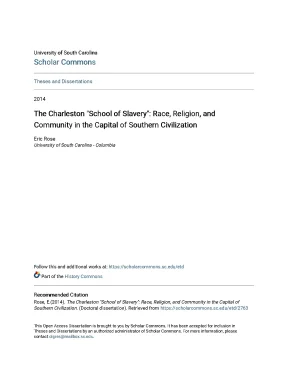
Tải xuống để đọc toàn bộUniversity of South Carolina Scholar Commons Theses and Dissertations 2014 The Charleston "School of Slavery": Race, Religion, and Community in the Capital of Southern Civilization Eric Rose University of South Carolina - Columbia Follow this and additional works at: https://scholarcommons.edu/etd Part of the History Commons Recommended Citation Rose, E. The Charleston "School of Slavery": Race, Religion, and Community in the Capital of Southern Civilization. Retrieved from https://scholarcommons.edu/etd/2763 This Open Access Dissertation is brought to you by Scholar Commons. It has been accepted for inclusion in Theses and Dissertations by an authorized administrator of Scholar Commons.
For more information, please contact digres@mailbox. THE CHARLESTON “SCHOOL OF SLAVERY”: Race, Religion, and Community in the Capital of Southern Civilization by Eric William Rose Bachelor of Arts College of Charleston, 1999 Master of Arts George Mason University, 2004 Submitted in Partial Fulfillment of the Requirements For the Degree of Doctor of Philosophy in History College of Arts and Sciences University of South Carolina 2014 Accepted by: Lacy K., Major Professor Don H. Doyle, Committee Member Mark M. Smith, Committee Member Shevaun Watson, Committee Member Lacy K., Vice Provost and Dean of Graduate Studies DEDICATION Dedicated to my Mom, Margaret Saville Rose, whose spirited support made this, and everything else, possible.
ii ACKNOWLEDGEMENTS This dissertation is a partial repayment for debts owed at archives all over the southeast. I am particularly indebted to the staff at the South Caroliniana Library, the South Carolina Historical Society, Avery Research Center, and the College of Charleston. Special thanks also go to R. Philip Stone at Wofford College Library, Erskine Clarke, and the archivists at Columbia Theological Seminary.
Insightful guidance and feedback from mentors, colleagues, and friends enriched the dissertation at each stage of its ten-year development. First credits go to the enduring support of the History Department at the University of South Carolina, particularly Lacy Ford, Don Doyle, Michael Scardaville, Carol Harrison, and Mark Smith. Jane Turner Censer and Mike O’Malley, my mentors at George Mason, deserve special credit for igniting the spark that became this great conflagration. Special thanks go to the gracious readers who helped to refine earlier drafts and related projects, particularly G.
Thomas Sheffer, Shevaun Watson, Jay Richardson, Edward Blum, Bob Elder, Christine Ames, David Prior, and Simons Tate. Behind every good dissertation are a number of good women. Whether or not this is a good dissertation, the women behind its author are great. I drew from a reservoir of inspiration filled by my grandmother Louise Pugh Saville, and her daughters Margaret Saville Rose, Mary Louise (Saville) DeSarran, and Elizabeth Saville Burns.
My mother- iii in-law, Roberta Sheffer, provided care, compassion, and cookies. The love, spice, and sacrifice contributed by my wife, Meredith Sheffer, make this dissertation hers as much as my own. iv ABSTRACT This dissertation explores the interracial religious communities of antebellum South Carolina to highlight patterns of racial consciousness and nation-building and demonstrate that the southern path to modernity was much closer to that of their northern contemporaries than previously recognized. The ready-made system of human classification inherent in racial slavery did not insulate southerners from the modern impulses that transfigured northern racial relations; instead, this dissertation argues that Carolinians white and black, free and slave, participated in a discourse of religious modernization that redirected the potentially destabilizing social implications of evangelicalism and progress into an idealized community structure that served the spiritual needs of black Carolinians, yet also reinforced white supremacy and strengthened the institution of slavery.
In response to the external challenge of antislavery and the internal challenge of African-American religious autonomy, white Carolinians invented a tradition of black dependence and parlayed this myth into a modern ethos of community: the bi-racial southern nation. By focusing this study of race and community formation on South Carolina, the vanguard of proslavery argument and separatism, this dissertation demonstrates striking parallels of racial consciousness common to both northern and southern societies, but also that the racial dynamics of community formation played a formative role in the v development of sectional consciousness. Charleston was not the most typical of southern scenes, but the processes of racial modernization that unfolded in the churches of the “Holy City” were common to many American cities, and the idealized social order modeled and reflected in the sacred spaces of her bi-racial churches provided the quintessential cultural validation for southern nationalism. The strong localized sense of community, modernized through the churches of Charleston over the course of a century, ultimately assumed a position of priority over the more distant imagined community of the United States and convinced most white Charlestonians to volunteer their lives, fortunes, and slaves to the cause of Civil War.
vi TABLE O F CONTENTS DEDICATION. Civilization and Conversion: Americanization in the Churches of Charleston. “The Tyranny of (Black) Majority”: Race, Space, and Ownership in the Churches of Charleston. The Invented Tradition of Black Dependence .“There is no Back Kitchen in Heaven”: Race and Community in the Late Antebellum Lowcountry.
The Charleston “School of Slavery”: The Separate Churches Movement. “A Nation within a Nation”. 368 APPENDIX A: Racial Demography. 377 APPENDIX B: Colored Church Membership in Charleston.
378 APPENDIX C: Circular Questionnaires. 379 vii CHAPTER ONE Civilization and Conversion: Americanization in the Churches of Charleston Finding a young Negro there, who seemed more sensible than the rest, I asked her how long she had been in Carolina. She said two or three years; but that she was born in Barbados, and had lived there in a minister’s family from a child. I asked whether she went to church there.
She said, “Yes, every Sunday – to carry the mistress’s children.” I asked what she had learned at church. She said, “Nothing: I heard a deal, but did not understand it.” “But what did your master teach you at home?” “Nothing.” “Nor your mistress?” “No.” - John Wesley, Journaling from Charleston, April 23, 1737 The surface of American society is covered with a layer of democratic paint, but from time to time one can see the old aristocratic colours breaking through. - Alexis de Tocqueville, Democracy in America, Vol. 1 In 1808, David Ramsay distilled a century of religious history in South Carolina into a synthetic narrative of tradition and adaptation.
Though the essence of “real religion” in South Carolina had (always) been constant, “fashions” and “modes” of religious expression varied according to “times and circumstances.” First transplanted to a frontier society, then “Awakened” during the mid-eighteenth century and transfigured through the formative struggles of independence and disestablishment, Carolina’s religious institutions were continuously enriched by the social and political challenges of their time. When the dynamic energy of modernization ran up against the cumulative weight of religious tradition, the result was a divergent array of religious experiences “worthy of historical notice.” In the same spirit as Ramsay’s evaluation, this chapter 1 tracks the balance of new and old through the variable “modes” of the revolutionary era to assemble the elements, influences, and experiences that framed religious consciousness for post-colonial Charlestonians. This chapter also augments Ramsay’s contemporary vantage by demonstrating the formative role that racial relations and racial discourse played in developing this framework.1 Ramsay’s religious attentions were disproportionately skewed to the tendencies of white Carolinians. He documented the spiritual patterns of Carolina Negroes as merely peripheral data, but in so doing reflected larger social trends at work in post- Revolutionary Charleston.
In his denominational summary of the city’s religious activity, most congregational figures did not merit racial breakdown, but the overwhelming black majority of the Methodist Church – 170 white members, 1520 black – earned special notice. Ramsay’s statistics attest to the dramatic extension of black involvement in local Christian institutions, a shift from an earlier period during which white individuals and white-run institutions generally neglected the spiritual needs of Carolina slaves. Ramsay noted the agitations of missionaries like John Wesley but did not conduct any more conclusive survey of slave Christianization. Wesley’s account in the epigraph documents his attempt to redress the Carolinian tradition of racial separation and spiritual neglect.
The contrast between this “before” picture of neglected black souls and the “after” picture of majority-black denominations indicates a measure of racial and religious dynamism that warrants examination. More recent historical work has filled in some of the gaps. As summarized by Robert Olwell, the findings of these historians describe a sequence in which the seeds of Christianity sown by Anglican missionaries and Methodist evangelicals in the first ‘Great Awakening’ of 1 David Ramsay, History of South Carolina (Newberry, SC: W. 2 the mid-eighteenth century fell upon stony ground, only to bear fruit in the conversion of the slave and the creation of a unique African Christianity in the second ‘awakening’ of the nineteenth century.2 Olwell’s summary presents a valid insight into the evolution of “African Christianity” in South Carolina: the punctuated increase in black church membership during the nineteenth century was in fact part of a longer, gradual, and continuous process of Christian sedimentation among African-American communities in South Carolina.
Olwell’s synthesis is the product of a series of articulated observations, drawn from two tracks of historical perspective – the black experience and the white experience. The following chapter adopts a similar interpretive framework, with two important distinctions. First, instead of organizing the narrative as a synthetic integration of two (a priori) separate stories, what follows is first and foremost an interracial and relational history, “an attempt to tell these two histories in a single narrative.” The second alteration provides the means to this end. This is not primarily a history of slave or slaveholder religion, but instead an institutional history, specifically a history of the interracial relationships, real and imagined, that emerged to dominate the course of institutional development in lowcountry South Carolina by the early decades of the nineteenth century.
This is not an attempt to bring together two separate histories, but rather to centralize one common history of interaction, and in so doing demonstrate how 2 Ibid., 19; Ramsay devoted a good deal of interpretive energy to the classist dimensions of Methodist appeal, and shifted his subjective weight on the controversy surrounding evangelical methods to suggest that Methodists did more good than evil, but did so in race-less terms. Reginald Ward, ed., The Works of John Wesley (Oxford: Clarendon Press, 1988), 18: 180; Robert Olwell, “The Long History of a Low Place: Slavery on the South Carolina Coast, 1670 – 1870,” in Slavery and the American South, ed. 3 these two histories – interracial and institutional – were inextricably linked. “Institutional” history here refers primarily to the development of religious institutions, but the impact of these interracial dynamics also extended to social and political institutions.
3 The most dynamic religious factor of institutional development in revolutionary era South Carolina was revivalism, a trend initiated during the mid-eighteenth century, and renewed to more substantial effect around the turn of the century. According to Ramsay, “some ascribed it to the real efficacy of the doctrines of Christ…others to the influence of the devil.” Those of the latter opinion represented another powerful factor of religious development – the established social and spiritual power of institutional tradition and orthodoxy. The consistent tension between tradition and progress generated a dynamic energy that flowed through the spiritual consciousness of most Carolinians to reconfigure not only their understanding of religious practice, but also of the modern political, social, and racial order. 4 The ripples of social destabilization created by the splash of the “Great Awakening” in other colonies did not register as prominently in the South Carolina lowcountry.
Revivalism stirred in various corners of the rural lowcountry, and large crowds attended the preachings of celebrity evangelists like George Whitefield, but these events did not significantly affect lowcountry denominational alignment or liturgical practices in the short-term. Whitefield’s most immediate effect was the storm of publicity that surrounded his southern tour and irritated the Anglican establishment.
Nội dung được bảo vệ bản quyền — Tải xuống đầy đủ
Trích dẫn luận án này
Eric William Rose (2014). Trường phái Chế độ Nô lệ Charleston: Chủng tộc, Tôn giáo [Luận án tiến sĩ, University of South Carolina]. LuanAn.net. https://luanan.net/nghien-cuu-van-hoa/ton-giao-hoc/truong-phai-che-do-no-le-charleston-chung-toc-ton-giao-cong-dong
Câu hỏi thường gặp
Luận án "Trường phái Chế độ Nô lệ Charleston: Chủng tộc, Tôn giáo" nghiên cứu về vấn đề gì?
Khám phá vai trò phức tạp của chủng tộc và tôn giáo trong hệ thống nô lệ Charleston. Phân tích lịch sử, xã hội.
Luận án "Trường phái Chế độ Nô lệ Charleston: Chủng tộc, Tôn giáo" được bảo vệ tại trường nào?
Luận án này được bảo vệ tại University of South Carolina. Năm bảo vệ: 2014.
Luận án "Trường phái Chế độ Nô lệ Charleston: Chủng tộc, Tôn giáo" thuộc chuyên ngành gì?
Luận án "Trường phái Chế độ Nô lệ Charleston: Chủng tộc, Tôn giáo" thuộc chuyên ngành History. Danh mục: Tôn Giáo Học.
Luận án "Trường phái Chế độ Nô lệ Charleston: Chủng tộc, Tôn giáo" có bao nhiêu trang?
Luận án "Trường phái Chế độ Nô lệ Charleston: Chủng tộc, Tôn giáo" có 390 trang. Bạn có thể xem trước một phần tài liệu ngay trên trang web trước khi tải về.
Cách tải luận án "Trường phái Chế độ Nô lệ Charleston: Chủng tộc, Tôn giáo" về máy như thế nào?
Để tải luận án về máy, bạn nhấn nút "Tải xuống ngay" trên trang này, sau đó hoàn tất thanh toán phí lưu trữ. File sẽ được tải xuống ngay sau khi thanh toán thành công. Hỗ trợ qua Zalo: 0559 297 239.