Unconditionally energy stable numerical schemes for hydrodynamics
Mô tả: Các phương pháp số ổn định năng lượng vô điều kiện cho thủy động lực học. Nghiên cứu các thuật toán mới đảm bảo tính chính xác và hiệu quả.
Luan An
Luận án tiến sĩ
Năm xuất bản
Số trang
69
Thời gian đọc
11 phút
Lượt xem
1
Lượt tải
0
Phí lưu trữ
40 Point
Tổng quan nhanh
- Chủ đề:
- Unconditionally Energy Stable Schemes for Hydrodynamics
- Số trang:
- 69 trang
- Trường:
- University of South Carolina
- Chuyên ngành:
- Mathematics
- Tác giả:
- Alexander Yuryevich Brylev
- Năm:
- 2017
Tóm tắt nội dung luận án
I.Unconditionally Energy Stable Schemes for Hydrodynamics
Developing robust numerical methods for complex fluid systems is a significant challenge in computational science. This research focuses on creating unconditionally energy stable numerical schemes for hydrodynamics. Such schemes guarantee stability regardless of the time step size. This property is critical for efficient and accurate simulations in Computational Fluid Dynamics (CFD). The work addresses the inherent difficulties of coupled fluid systems, where multiple physical phenomena interact. It provides advanced tools for simulating various hydrodynamic problems, enhancing the reliability and applicability of numerical models. The methodology ensures that computational results accurately reflect the physical principles of energy conservation and dissipation. This stability is paramount for long-term simulations and dynamic processes. The schemes offer a reliable foundation for complex scientific and engineering applications, improving predictive capabilities.
1.1. Foundations of Energy Stable Schemes
Energy stability is a cornerstone of reliable numerical analysis. It ensures that numerical solutions adhere to the fundamental physical energy dissipation laws. Without energy stability, numerical schemes can become unstable, leading to unphysical oscillations or divergence, especially when using larger time steps. This research emphasizes the construction of schemes that intrinsically preserve these energy properties. Traditional explicit numerical methods often suffer from restrictive time step limitations to maintain stability. Implicit methods, while more stable, can be computationally expensive. The focus here is on developing schemes that combine the benefits of stability with computational efficiency, by guaranteeing energy stability unconditionally. This ensures the physical realism and mathematical soundness of the simulations.
1.2. Addressing Coupled Fluid System Challenges
Coupled fluid systems present unique complexities for numerical modeling. These systems involve the interplay of different fluid dynamics equations or even distinct physical models. Ensuring numerical stability across these interacting components is a substantial hurdle. For instance, coupling flow equations with phase-field models or liquid crystal dynamics introduces highly nonlinear terms and intricate interdependencies. The proposed schemes specifically tackle these challenges by designing careful implicit-explicit treatments for nonlinear terms. This approach allows for stable integration of multiple physical phenomena, maintaining accuracy without sacrificing stability. The methodology provides a robust framework for simulating diverse coupled fluid problems, from multiphase flows to anisotropic fluids.
II.Phase Field Models Energy Stable Schemes for Two Phase Flow
The first part of this research makes significant contributions to two-phase incompressible flows. It focuses on developing advanced numerical schemes within the framework of the phase-field model. These schemes are second-order accurate in time, fully discrete, and applicable to both linear and nonlinear formulations. The methodology combines robust time discretization techniques with spatial discretization methods to accurately capture fluid interfaces and dynamics. The phase-field model offers a diffuse interface approach, naturally handling topological changes and complex interface dynamics without explicit tracking. The development of these schemes includes rigorous proofs of their energy stability, solvability, and uniqueness, providing strong theoretical guarantees for their performance and reliability in simulating complex fluid behaviors. This work advances the state-of-the-art for multiphase flow simulations.
2.1. Finite Element Method for Incompressible Flow
The Finite Element Method (FEM) forms the basis for spatial discretization in this work. FEM is particularly well-suited for solving partial differential equations on complex geometries. It allows for flexible meshing and accurate representation of curved boundaries and varying domains. For incompressible flow, FEM is employed to discretize the Navier-Stokes equations, which govern fluid motion. The accurate handling of incompressibility constraints is crucial. The formulation ensures mass conservation and momentum transport are correctly modeled. This choice of numerical method contributes to the high fidelity of the simulations, especially when dealing with intricate interface dynamics inherent in two-phase flows. The robust spatial discretization provided by FEM complements the temporal stability of the schemes.
2.2. Time Discretization via Crank Nicolson Projection
Temporal discretization employs a combination of established and innovative techniques. The second-order accurate Crank-Nicolson method is fundamental for time integration. It offers a balance between accuracy and stability, making it ideal for simulating dynamic processes. For the incompressible Navier-Stokes equations, a projection method is utilized. This method efficiently decouples the pressure and velocity fields, simplifying the solution procedure and enhancing computational efficiency. Furthermore, several implicit-explicit (IMEX) treatments are applied to the phase-field equations. These treatments carefully handle nonlinear terms explicitly while treating stiff terms implicitly, ensuring unconditional energy stability. This strategic decomposition of terms is key to achieving both accuracy and stability without excessive computational cost, crucial for complex Computational Fluid Dynamics (CFD) applications.
III.Smectic A Liquid Crystals Numerical Methods Stability
The second part of this research addresses numerical approximations for smectic-A liquid crystal flows. This model represents a highly nonlinear system, coupling the incompressible Navier-Stokes equations with two nonlinear coupled second-order elliptic equations. Such systems pose significant challenges for numerical stability and computational efficiency. This work successfully develops unconditionally energy stable, linear, and decoupled time discretization schemes for this complex model. The schemes are derived from a variational approach to the de Gennes energy, ensuring physical consistency. The rigorous mathematical proof confirms that the proposed scheme obeys the energy dissipation law. This advancement offers a powerful tool for simulating the intricate behaviors of smectic-A liquid crystals, critical for materials science and physics research, providing reliable solutions for a challenging class of fluid dynamics problems.
3.1. Nonlinear Systems Coupled Equation Challenges
Highly nonlinear systems are notoriously difficult to solve numerically. The smectic-A liquid crystal model exemplifies this complexity, involving strong coupling between fluid velocity, pressure, and the liquid crystal order parameters. The interaction between the incompressible Navier-Stokes equations and two additional nonlinear elliptic equations creates a system with many degrees of freedom and potential for numerical instability. Explicit schemes often require extremely small time steps, making simulations impractical. Implicit schemes can be computationally intensive due to the need to solve large nonlinear systems at each time step. The challenge lies in devising methods that can efficiently and stably handle these strong nonlinearities and couplings, preserving the physical integrity of the liquid crystal dynamics.
3.2. Decoupled Time Discretization for Smectic A
To overcome the challenges of the smectic-A liquid crystal model, innovative explicit-implicit treatments for nonlinear terms are introduced. These subtle treatments allow for the development of a linear and decoupled time discretization scheme. Decoupling the system means that instead of solving one large, coupled system, several smaller, simpler equations can be solved sequentially at each time step. This significantly reduces computational complexity and memory requirements. The linearity ensures that standard linear solvers can be applied, further boosting efficiency. Crucially, despite these simplifications, the scheme maintains unconditional energy stability. This combination of linearity, decoupling, and unconditional stability represents a major breakthrough for simulating smectic-A liquid crystal flows, making previously intractable problems accessible for Computational Fluid Dynamics (CFD).
IV.Advanced Numerical Techniques Stability Solvability Proofs
The research provides a comprehensive theoretical foundation for the developed numerical schemes. Beyond merely proposing new methods, it rigorously proves their fundamental mathematical properties. These proofs include unconditional energy stability, solvability, and uniqueness of the numerical solutions. Such theoretical guarantees are essential for the credibility and practical applicability of any numerical method in Computational Fluid Dynamics (CFD). They ensure that the schemes will behave predictably and reliably under various conditions, preventing common numerical artifacts like oscillations or divergence. This thorough mathematical validation distinguishes the work, offering users confidence in the accuracy and robustness of the proposed unconditionally energy stable numerical methods for hydrodynamics.
4.1. Proving Unconditional Energy Stability
A core achievement of this research is the rigorous proof of unconditional energy stability for all proposed schemes. This means the numerical methods remain stable irrespective of the time step size chosen for simulation. This property is invaluable for practical applications, as it eliminates the restrictive Courant-Friedrichs-Lewy (CFL) conditions often associated with explicit schemes. The proofs demonstrate that the discrete energy of the system remains bounded and adheres to the physical energy dissipation laws. This mathematical guarantee is critical for simulating long-term physical processes and for scenarios involving rapid changes, where large time steps are often desired for computational efficiency. Unconditional stability ensures the reliability and accuracy of the numerical solutions over extended simulation periods.
4.2. Solvability Uniqueness and Energy Dissipation
Beyond unconditional stability, the research also rigorously establishes other crucial properties of the numerical schemes. Proofs of solvability confirm that a solution to the discrete system always exists at each time step. This is vital for ensuring the computational process does not terminate due to an unsolvable system. Uniqueness proofs guarantee that only one solution exists for the given discrete equations, removing ambiguity and confirming the deterministic nature of the numerical model. Furthermore, for liquid crystal flows, the energy dissipation law is rigorously proven to hold for the numerical scheme. This directly demonstrates the physical consistency of the computational model, ensuring that the simulated system's energy evolves realistically. These combined proofs provide a complete theoretical validation for the developed numerical methods for hydrodynamics.
V.Computational Fluid Dynamics CFD Applications Validation
The theoretical developments are complemented by extensive numerical experiments. These experiments serve to validate the accuracy and efficiency of the proposed unconditionally energy stable numerical schemes. Ample simulations are performed for both the phase-field models of two-phase incompressible flows and the smectic-A liquid crystal flows. The results consistently demonstrate the high accuracy of the schemes in capturing complex fluid phenomena. Moreover, the experiments highlight the computational efficiency achieved, particularly due to the unconditional stability allowing for larger time steps without compromising solution quality. This practical validation reinforces the theoretical claims, showcasing the readiness of these advanced numerical methods for real-world Computational Fluid Dynamics (CFD) applications. The robust performance observed in various test cases confirms their utility for scientific and engineering research.
5.1. Validating Accuracy Efficiency of Schemes
Numerical experiments are essential for confirming the practical performance of any theoretical scheme. This research presents ample numerical simulations designed to validate both the accuracy and efficiency of the proposed methods. Accuracy is demonstrated through convergence tests and comparisons with known analytical solutions or benchmark problems. The second-order temporal accuracy of the schemes is consistently observed. Efficiency is showcased by the ability to use significantly larger time steps compared to conditionally stable schemes, without sacrificing the quality or stability of the solution. This allows for faster computations of complex hydrodynamic systems. These validations confirm that the developed Unconditionally Energy Stable Numerical Schemes for Hydrodynamics are not only theoretically sound but also practically superior for Computational Fluid Dynamics (CFD) applications.
5.2. Broader Impact on Hydrodynamic Simulations
The development of unconditionally energy stable numerical schemes has a broad and significant impact on hydrodynamic simulations. By providing methods that are inherently stable, robust, and accurate, this research advances the capabilities of Computational Fluid Dynamics (CFD) practitioners. Engineers and scientists can now simulate more complex physical phenomena, such as multiphase flows and liquid crystal dynamics, with greater confidence and efficiency. The ability to use larger time steps reduces computational time, making high-fidelity simulations more accessible. This work offers improved tools for a wide range of applications, from material science and engineering design to environmental modeling. The enhanced stability and accuracy contribute directly to better predictive models and deeper understanding of complex fluid behaviors.
Mục lục chi tiết luận án
Tải xuống file đầy đủ để xem toàn bộ nội dung
Tải đầy đủ (69 trang)Trích đoạn nội dung luận án
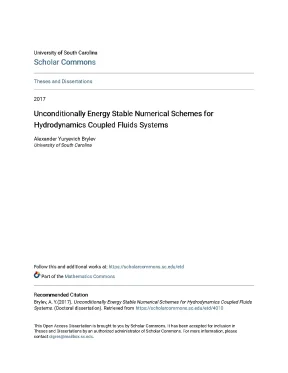
Tải xuống để đọc toàn bộUniversity of South Carolina Scholar Commons Theses and Dissertations 2017 Unconditionally Energy Stable Numerical Schemes for Hydrodynamics Coupled Fluids Systems Alexander Yuryevich Brylev University of South Carolina Follow this and additional works at: https://scholarcommons.edu/etd Part of the Mathematics Commons Recommended Citation Brylev, A. Unconditionally Energy Stable Numerical Schemes for Hydrodynamics Coupled Fluids Systems. Retrieved from https://scholarcommons.edu/etd/4010 This Open Access Dissertation is brought to you by Scholar Commons. It has been accepted for inclusion in Theses and Dissertations by an authorized administrator of Scholar Commons.
For more information, please contact digres@mailbox. Unconditionally Energy Stable Numerical Schemes for Hydrodynamics Coupled Fluids Systems by Alexander Yuryevich Brylev Bachelor of Arts Hamline University 2006 Master of Science New Mexico State University 2011 Submitted in Partial Fulfillment of the Requirements for the Degree of Doctor of Philosophy in Mathematics College of Arts and Sciences University of South Carolina 2017 Accepted by: Xiaofeng Yang, Major Professor Lili Ju, Committee Member Zhu Wang, Committee Member Xinfeng Liu, Committee Member Dewei Wang, Outside Committee Member Cheryl L. Addy, Vice Provost and Dean of the Graduate School Acknowledgments First of all, I would like to thank my thesis director, professor Xiaofeng Yang, for his support and guidance in writing this thesis. He held numerous office hours to work with me on it, was always prompt in answering e-mails and any questions I had about the research.
This work wouldn’t be possible without him. I also appreciate being funded by a research grant several times. Next, I thank all my professors during my first two years at the University of South Carolina for helping me build the foundations I needed to be able to succeed in my project. Courses in Computational Mathematics (MATH 708 and MATH 709), taught by professors Lili Ju and Xiaofeng Yang, as well as Numerical Differential Equations (MATH 726) and Applied Mathematics (MATH 720 and MATH 721), taught by professor Hong Wang, turned out to be particularly valuable.
Finally, I would like to thank the department of Mathematics at the University of South Carolina for accepting me on a PhD program and providing me financial support in the form of teaching assistanship. I really enjoyed my work experience and it was great to be a part of the Gamecock family! ii Abstract The thesis consists of two parts. In the first part we propose several second order in time, fully discrete, linear and nonlinear numerical schemes to solve the phase-field model of two-phase incompressible flows in the framework of finite ele- ment method. The schemes are based on the second order Crank-Nicolson method for time disretizations, projection method for Navier-Stokes equations, as well as several implicit-explicit treatments for phase-field equations.
The energy stability, solvability, and uniqueness for numerical solutions of proposed schemes are further proved. Ample numerical experiments are performed to validate the accuracy and efficiency of the proposed schemes thereafter. In the second part we consider the numerical approximations for the model of smectic-A liquid crystal flows. The model equation, that is derived from the varia- tional approach of the de Gennes energy, is a highly nonlinear system that couples the incompressible Navier-Stokes equations and two nonlinear coupled second-order elliptic equations.
Based on some subtle explicit-implicit treatments for nonlinear terms, we develop unconditionally energy stable, linear, decoupled time discretiza- tion scheme. We also rigorously prove that the proposed scheme obeys the energy dissipation law. Various numerical simulations are presented to demonstrate the ac- curacy and the stability thereafter. iii Table of Contents Acknowledgments.
iii List of Tables. v List of Figures. vi Chapter 1 Numerical analysis of certain schemes for phase field models of two-phase incompressible flows .2 The PDE System and Energy Law.3 Second Order, Semi-Discrete Schemes and Their Energy Stability.4 Fully Discrete Schemes and Energy Stability. 27 Chapter 2 Numerical approximations for smectic–A liquid crys- tal flows .2 The smectic-A liquid crystal fluid flow model and its energy law.
53 v List of Tables Table 1.1 Cauchy convergence test for the linear scheme (1.63) solv- ing ACNS system; errors are measured in L2 norm; 2k grid points in each direction for k from 4 to 8, δt = 0.2 Cauchy convergence test for the linear scheme (1.76) solv- ing CHNS system; errors are measured in L2 norm; 2k grid points in each direction for k from 4 to 8, δt = 0.3 Cauchy convergence test for the nonlinear convex-splitting scheme (1.81) solving ACNS system; errors are measured in L2 norm; 2k grid points in each direction for k from 4 to 8, δt = 0. 28 vi List of Figures Figure 1.1 Temporal evolution of a circular domain driven by mean cur- vature without hydrodynamic effects. The parameters are η = 1.2 The areas of the circle as a function of time. The slope of the line is −6.2842 and the theoretical slope is −2π.3 Snapshots of the relaxation of a square shape by the ACNS system.4 Zero contour plots of the merging and relaxation of two kissing circles by the CHNS system.
From left to right, t = 0.5 Filled contour plots in gray scale of the rising bubble by the CHNS system. From left to right, t = 0.1 The L2 errors of the layer funciton φ, the director field d = (d1 , d2 ), the velocity u = (u, v) and pressure p. The slopes show that the scheme is asymptotically first-order accurate in time.2 Snapshots of the layer function φ are taken at t = 0, 0.3 Snapshots of the director field d are taken at t = 0, 0.4 Time evolution of the free energy functional of Example 2.5 Snapshots of the layer function φ are taken at t = 0, 0.6 Snapshots of the director field d are taken at t = 0, 0.7 Snapshots of the profile for the first component u(y) of the velocity field u = (u, v) at the center (x = 2) and t = 0, 0. 52 viii Chapter 1 Numerical analysis of certain schemes for phase field models of two-phase incompressible flows 1.1 Introduction Interfacial problems have attracted much attention of scientists for over a century.
A classical approach to dealing with such problems was to introduce a mesh with grid points on the interfaces which deforms according to the motion of the boundary. This method, however, had a drawback that large displacement or deformation of internal domains could cause computational issues such as mesh entaglement. To overcome this, sophisticated remeshing schemes were often times used [57]. Other methods which proved to work well were the volume-of-fluid (VOF) [48, 49], the front-tracking [40, 41] and the level-set [61, 78] fixed-grid methods, where the interfacial tension is represented as a body-force or bulk-stress spreading over a narrow region covering the interface.
The VOF method is a numerical technique for tracking and locating the interface between the fluids using the marker function. The disadvatage of this method is in its difficulty maintaining the sharp interface between the fluids and the computation of the surface tension. The level-set method has improved the accuracy and, hence, the applicability of the VOF method. The problem with the level-set method occurs when one tries to use it in an advection field, for example, uniform or rotational velocity field.
In this case the shape and size of the level set must be conserved, however, the method does not guarantee this, so the level set may get significantly distorted and vanish over several time steps. This requires 1 the use of high-order finite difference schemes, such as high-order essentially non- oscillatory (ENO) schemes [47], and even then, the feasibility of long-time simulations is questionable. To overcome this difficulty, more sophisticated methods have been designed, such as combinations of the level set method with tracing marker particles advected by the velocity field [60]. In the front-tracking method a separate front marks the interface but a fixed grid, only modified near the front to make a grid line follow the interface, is used for the fuid within each phase.
Phase-field or diffuse-interface model is another mathematical model for solving various interfacial problems. In recent years it has been successfully used to simulate dynamical processes in many fields and has become one of the major tools to study various systems arising from the energy-based variational formalism. The method employs an order parameter, called the phase field, and substitutes boundary condi- tions at the interface by the partial differential equation involving this new variable. The phase field is assigned distinct values on each phase (for example, -1 and 1) and a thin smooth transition layer marking the interface is defined as the set of all points where the phase field takes a certain value (for example, 0).
Hence the dynamics of the interface can be simulated on a fixed grid without explicit interface tracking, which renders the diffuse interface method an attractive numerical approach to sim- ulate free moving/deforming interfacial problems. Based on variational approaches, the governing system can be derived from the total free energy, which usually leads to some well-posed nonlinear partial differential equations. This makes it possible to carry out mathematical analysis and design numerical schemes which preserve the thermo-dynamically consistent dissipation law (energy-stable) at the discrete level. The preservation of such laws is critical for numerical methods to capture the correct long time dynamics.
The dynamics of phase field models can be described by either the Allen-Cahn equation [4] or the Cahn-Hilliard equation [8, 9] based on choices of Sobolev spaces 2 of the variational approach. In details, the Allen-Cahn equation is a second-order equation, which is easier to solve numerically but does not conserve the volume frac- tion, while the Cahn-Hilliard equation is a fourth-order equation which conserves the volume fraction but is relatively harder to solve numerically. Basically, the coarse- graining (macroscopic) process described by these two equations may undergo rapid changes near the interface, so the noncompliance of energy dissipation laws may lead to spurious numerical solutions if the grid and time step sizes are not carefully controlled [52, 36]. Thus, from the numerical point of view, people are particularly in- terested in designing simple, efficient and energy stable numerical schemes satisfying discrete energy dissipations laws.
There are several challenges to construct the efficient numerical schemes to solve the hydrodynamics coupled phase field model numerically, namely, i) the small in- terfacial width introduces tremendous amount of stiffness into the system ii) the nonlinear coupling between the phase variable and velocity due to the nonlinear con- vections and stresses, iii) the coupling between the velocity and pressure in the fluid momentum equation. It is by no means an easy task, in particular, the development of any efficient and accurate numerical schemes while maintaining the dissipative energy law. It is remarkable that many attempts have been made in this direction recently (cf. a comprehensive summary in [65].
However, due to the complexity of the nonlinear convection terms and stresses in the system, most of developed schemes are either only first-order in time [44, 69, 67], or are nonlinear schemes which need some efficient iterative solvers [76, 15], or only focus on the no flow case [59, 77, 31], or unable to provide the stability analysis [17]. There are very few works with the focus on the development of the second order schemes for the hydrodynamics coupled phase field model. Recently, in [32], a second order, unconditionally stable, semi-discrete scheme for 3 the hydrodynamics coupled Cahn-Hilliard phase field model was developed, which could be regarded as one of the limited successful efforts in the development of second order schemes. However, in [32], first, the schemes for the computation of the phase field variable are nonlinear thanks to the application of the convex splitting approach, thus one in turn needs some efficient iterative solvers.
Second, the computation of the phase variable is always coupled with that of the velocity. Third, the proof of energy law is only for the time discretization case.
Nội dung được bảo vệ bản quyền — Tải xuống đầy đủ
Trích dẫn luận án này
Alexander Yuryevich Brylev (2017). Unconditionally energy stable numerical schemes for hydrodyn [Luận án tiến sĩ, University of South Carolina]. LuanAn.net. https://luanan.net/vat-ly/unconditionally-energy-stable-numerical-schemes-for-hydrodynamics
Câu hỏi thường gặp
Luận án "Unconditionally energy stable numerical schemes for hydrodyn" nghiên cứu về vấn đề gì?
Mô tả: Các phương pháp số ổn định năng lượng vô điều kiện cho thủy động lực học. Nghiên cứu các thuật toán mới đảm bảo tính chính xác và hiệu quả.
Luận án "Unconditionally energy stable numerical schemes for hydrodyn" được bảo vệ tại trường nào?
Luận án này được bảo vệ tại University of South Carolina. Năm bảo vệ: 2017.
Luận án "Unconditionally energy stable numerical schemes for hydrodyn" thuộc chuyên ngành gì?
Luận án "Unconditionally energy stable numerical schemes for hydrodyn" thuộc chuyên ngành Mathematics. Danh mục: Vật Lý.
Luận án "Unconditionally energy stable numerical schemes for hydrodyn" có bao nhiêu trang?
Luận án "Unconditionally energy stable numerical schemes for hydrodyn" có 69 trang. Bạn có thể xem trước một phần tài liệu ngay trên trang web trước khi tải về.
Cách tải luận án "Unconditionally energy stable numerical schemes for hydrodyn" về máy như thế nào?
Để tải luận án về máy, bạn nhấn nút "Tải xuống ngay" trên trang này, sau đó hoàn tất thanh toán phí lưu trữ. File sẽ được tải xuống ngay sau khi thanh toán thành công. Hỗ trợ qua Zalo: 0559 297 239.