Phân tích diễn ngôn phê phán: Kỳ thị giới qua hình ảnh trong sách giáo khoa Tiếng Anh tiểu học Việt Nam
Luận văn phân tích thiên kiến giới trong sách giáo khoa tiếng Anh tiểu học VN qua hình ảnh bằng phương pháp phân tích diễn ngôn phê phán.
Năm xuất bản
Số trang
114
Thời gian đọc
18 phút
Lượt xem
0
Lượt tải
0
Phí lưu trữ
40 Point
Tổng quan nhanh
- Chủ đề:
- Định kiến giới trong SGK Tiếng Anh tiểu học Việt Nam
- Số trang:
- 114 trang
- Trường:
- Trường Đại học Ngoại ngữ, Đại học Quốc gia Hà Nội
- Chuyên ngành:
- English Linguistics
- Tác giả:
- Nguyễn Thị Nhung
- Năm:
- 2019
Tóm tắt nội dung luận án
I.Định kiến giới trong SGK Tiếng Anh tiểu học Việt Nam
Nghiên cứu này tập trung vào định kiến giới. Nó xuất hiện qua hình ảnh trong sách giáo khoa Tiếng Anh tiểu học. Sách giáo khoa là công cụ giáo dục quan trọng. Chúng định hình nhận thức học sinh. Nhiều nghiên cứu trước đây đã xem xét ngôn ngữ. Nghiên cứu này khác biệt. Nó tập trung vào yếu tố phi ngôn ngữ. Hình ảnh truyền tải thông điệp mạnh mẽ. Chúng có thể củng cố hoặc thách thức định kiến. Việc hiểu rõ định kiến giới là cần thiết. Nó thúc đẩy bình đẳng giới trong giáo dục. Tài liệu này cung cấp cái nhìn sâu sắc. Nó giúp đánh giá hiện trạng giáo trình.
1.1. Bối cảnh nghiên cứu về kỳ thị giới tính
Cuộc chiến chống bất bình đẳng giới thu hút sự quan tâm. Nhiều nhà nghiên cứu đã tham gia. Tuy nhiên, trọng tâm thường là khía cạnh ngôn ngữ. Yếu tố hình ảnh ít được chú ý hơn. Các nhà giáo dục nhận ra vai trò của truyền thông thị giác. Hình ảnh, ảnh chụp mang ý nghĩa riêng. Chúng ảnh hưởng đến người học. Việc nghiên cứu này lấp đầy khoảng trống. Nó xem xét tác động của hình ảnh.
1.2. Trọng tâm phân tích diễn ngôn phê phán
Nghiên cứu áp dụng phân tích diễn ngôn phê phán đa phương thức. Phương pháp này xem xét hình ảnh. Nó đánh giá cách giới tính được thể hiện. Ba cuốn sách Tiếng Anh tiểu học mới được phân tích. Mục tiêu là phát hiện định kiến giới. Nó cũng xem xét mức độ biểu hiện. Nghiên cứu xác định các mẫu hình. Nó chỉ ra sự thiếu cân bằng.
II.Phân tích hình ảnh giới tính trong giáo trình Tiếng Anh
Phương pháp nghiên cứu rõ ràng. Nó kết hợp phân tích định tính và định lượng. Hơn 1.500 hình ảnh được kiểm tra. Mỗi hình ảnh có vai trò quan trọng. Chúng thể hiện nam và nữ. Việc phân tích diễn ngôn phê phán là cốt lõi. Nó giúp hiểu sâu sắc hơn. Các nhà nghiên cứu xem xét cách hình ảnh được xây dựng. Cách chúng truyền tải thông điệp giới. Mục tiêu là khám phá sự thiên vị. Đây là một phân tích toàn diện. Nó chỉ ra các khuôn mẫu ẩn giấu.
2.1. Phương pháp nghiên cứu định lượng và định tính
Phân tích nội dung được sử dụng. Cả định tính và định lượng đều cần thiết. Điều này đảm bảo sự chính xác. Nó mang lại cái nhìn tổng thể. Phương pháp định lượng đếm tần suất. Nó cho thấy sự hiện diện của giới tính. Phương pháp định tính giải thích ý nghĩa. Nó phân tích ngữ cảnh hình ảnh. Cách tiếp cận này rất hiệu quả. Nó khám phá các sắc thái của định kiến giới.
2.2. Dữ liệu và phạm vi phân tích hình ảnh
Ba cuốn sách giáo khoa Tiếng Anh là nguồn dữ liệu. Chúng là giáo trình Tiếng Anh bậc tiểu học mới. Tổng cộng 1.534 hình ảnh được phân tích. Các hình ảnh này chứa nhân vật nam và/hoặc nữ. Phạm vi rộng lớn. Nó đảm bảo tính đại diện. Mỗi hình ảnh được đánh giá cẩn thận. Mục đích là tìm ra sự thiên vị. Đặc biệt là qua cách các cá nhân được miêu tả.
III.Biểu hiện kỳ thị giới tính trong SGK qua hình ảnh
Kết quả nghiên cứu gây chú ý. Có sự hiện diện rõ ràng của giới nữ. Họ xuất hiện trong môi trường làm việc. Họ tham gia vào các hoạt động xã hội. Điều này ban đầu có vẻ tích cực. Tuy nhiên, vẫn tồn tại định kiến ngầm. Chúng ảnh hưởng đến vai trò của phụ nữ. Định kiến này khó nhận thấy hơn. Nó đòi hỏi phân tích sâu sắc. Nghiên cứu làm sáng tỏ các khuôn mẫu. Nó chỉ ra sự mất cân bằng. Định kiến giới trong sách giáo khoa là một vấn đề.
3.1. Sự hiện diện giới nữ trong xã hội
Phụ nữ xuất hiện nhiều trong hình ảnh. Họ có mặt tại nơi làm việc. Họ tham gia vào các hoạt động xã hội. Đây là điểm sáng của giáo trình. Nó cho thấy sự tiến bộ nhất định. Tuy nhiên, số lượng không phải là tất cả. Chất lượng miêu tả cũng quan trọng. Sự hiện diện không đảm bảo bình đẳng. Định kiến vẫn tồn tại ở các lớp sâu hơn.
3.2. Định kiến giới tiềm ẩn trong vai trò
Định kiến giới chủ yếu hướng về phụ nữ. Chúng biểu hiện trong vai trò gia đình. Phụ nữ thường là người mẹ. Họ thực hiện công việc nội trợ. Vai trò nghề nghiệp của họ cũng bị ảnh hưởng. Đóng góp vào giáo dục con cái được nhấn mạnh. Hoạt động giải trí cũng có sự khác biệt. Điều này tạo ra hình ảnh giới hạn. Nó củng cố khuôn mẫu truyền thống.
IV.Vai trò giới trong SGK Tiếng Anh thực trạng và tiềm ẩn
Sách giáo khoa phản ánh nhiều khuôn mẫu. Phụ nữ thường gắn liền với công việc nhà. Họ được miêu tả trong vai trò chăm sóc. Nam giới thường ở các vị trí khác. Điều này cho thấy sự phân công lao động truyền thống. Nó ảnh hưởng đến nhận thức trẻ em. Hình ảnh giới tính trong sách giáo khoa tiểu học cần được xem xét. Nó định hình tư duy về vai trò giới. Việc nhận diện những định kiến này rất quan trọng. Nó giúp xây dựng giáo trình công bằng hơn.
4.1. Định kiến giới trong vai trò gia đình và nghề nghiệp
Phụ nữ thường xuất hiện với vai trò làm mẹ. Họ thực hiện các công việc nội trợ. Điều này phổ biến trong hình ảnh. Vai trò nghề nghiệp của họ bị giới hạn. Ngược lại, nam giới thường ở các vị trí quyền lực hơn. Hoặc họ tham gia hoạt động ngoài trời. Sự phân công vai trò rõ ràng. Nó củng cố định kiến xã hội.
4.2. Biểu hiện kỳ thị qua màu sắc vị trí minh họa
Màu sắc đại diện cũng có sự khác biệt. Vị trí của phụ nữ trong các minh họa. Họ thường ở vị trí thụ động hơn. Hoặc họ đứng sau nam giới. Điều này truyền tải thông điệp ngầm. Nó ngụ ý sự thấp kém hơn. Các yếu tố thị giác này quan trọng. Chúng định hình nhận thức về quyền lực.
V.Khuyến nghị về bình đẳng giới trong giáo trình học tập
Nghiên cứu đưa ra nhiều khuyến nghị. Chúng nhằm mục tiêu cải thiện. Các nhà giáo dục cần nhận thức rõ. Nhà xuất bản cũng vậy. Việc thiết kế sách giáo khoa cần xem xét bình đẳng giới. Hình ảnh cần đa dạng hơn. Chúng nên thể hiện các vai trò giới linh hoạt. Điều này quan trọng cho sự phát triển của trẻ. Nó giúp xây dựng một xã hội công bằng hơn. Tác động của định kiến giới cần được giảm thiểu.
5.1. Kiến nghị cho cơ quan giáo dục và nhà xuất bản
Cơ quan giáo dục cần giám sát chặt chẽ. Họ nên đưa ra hướng dẫn cụ thể. Nhà xuất bản cần rà soát sách giáo khoa. Đặc biệt là hình ảnh. Mục tiêu là loại bỏ định kiến giới. Cần đào tạo tác giả sách. Họ cần hiểu về bình đẳng giới. Việc này giúp tạo ra tài liệu chất lượng. Nó đảm bảo sự công bằng.
5.2. Hướng phát triển cho tài liệu học tập
Tài liệu học tập cần đa dạng hóa. Chúng nên thể hiện nhiều vai trò hơn. Nam và nữ nên được miêu tả bình đẳng. Họ nên có các hoạt động khác nhau. Tránh gán ghép vai trò truyền thống. Ngôn ngữ giới tính trong tài liệu học tập cần trung lập. Nó không nên củng cố định kiến. Việc này tạo môi trường học tập tích cực. Nó thúc đẩy sự phát triển toàn diện.
Mục lục chi tiết luận án
Tải xuống file đầy đủ để xem toàn bộ nội dung
Tải đầy đủ (114 trang)Trích đoạn nội dung luận án
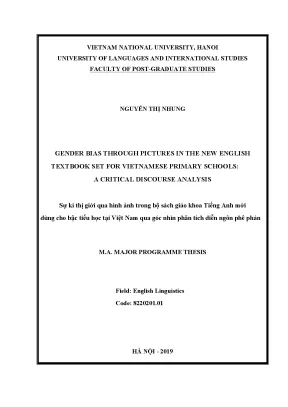
Tải xuống để đọc toàn bộVIETNAM NATIONAL UNIVERSITY, HANOI UNIVERSITY OF LANGUAGES AND INTERNATIONAL STUDIES FACULTY OF POST-GRADUATE STUDIES NGUYỄN THỊ NHUNG GENDER BIAS THROUGH PICTURES IN THE NEW ENGLISH TEXTBOOK SET FOR VIETNAMESE PRIMARY SCHOOLS: A CRITICAL DISCOURSE ANALYSIS Sự kì thị giới qua hình ảnh trong bộ sách giáo khoa Tiếng Anh mới dùng cho bậc tiểu học tại Việt Nam qua góc nhìn phân tích diễn ngôn phê phán M. MAJOR PROGRAMME THESIS Field: English Linguistics Code: 8220201.01 HÀ NỘI - 2019 VIETNAM NATIONAL UNIVERSITY, HANOI UNIVERSITY OF LANGUAGES AND INTERNATIONAL STUDIES FACULTY OF POST-GRADUATE STUDIES NGUYỄN THỊ NHUNG GENDER BIAS THROUGH PICTURES IN THE NEW ENGLISH TEXTBOOK SET FOR VIETNAMESE PRIMARY SCHOOLS: A CRITICAL DISCOURSE ANALYSIS Sự kì thị giới qua hình ảnh trong bộ sách giáo khoa Tiếng Anh mới dùng cho bậc tiểu học tại Việt Nam qua góc nhìn phân tích diễn ngôn phê phán M. MAJOR PROGRAMME THESIS Field: English Linguistics Code: 8220201. Huỳnh Anh Tuấn HÀ NỘI - 2019 DECLARATION I hereby state that the thesis, entitled “Gender bias through pictures in the new English textbook set for Vietnamese primary schools: A critical discourse analysis” was carried out in partial fulfillment of the requirements for the degree of Master of Art at the University of Languages and International Studies, Vietnam National University, Hanoi.
This work is original and all the sources that I used in the paper were documented by means of references. Hà Nội, 2019 Nguyễn Thị Nhung ACKNOWLEDGEMENTS To complete this scientific research, I owe profound indebtedness to many people for their tremendous support during the conduct of my study. First and foremost, I would like to express my deepest gratitude towards my devoted supervisor, Dr. Huỳnh Anh Tuấn for his intellectual consultancy and constant encouragement, which were the decisive factors in the completion of this paper.
Second, my sincere thanks go to all of the lecturers at the University of Languages and International Studies, Vietnam National University, Hanoi for their invaluable lessons that have established a solid base for my research work. Last but not least, I would like to thank all of my beloved family members and friends for their tremendous love, care and support during the time of conducting this research paper. ii ABSTRACT The attempt to combat gender inequality in textbooks has recently attracted a lot of researchers’ concern. However, it is worth noticing that research to date has tended to focus on gender bias in textbooks represented through linguistic rather than other non-linguistic features such as visual design.
Educationalists have become gradually aware of the increasing role of visual communication in learning materials of various kinds since they believe that pictures and photographs present meanings of their own. Among such attempts, this research investigates gender bias through pictures in the new English textbook set for Vietnamese primary schools, which aims to 1/ examine how different genders are represented via pictures in the new English textbook set for Vietnamese primary schools, 2/ find out whether gendered visual representations illustrate gender bias in this textbook set. In so doing, qualitative and quantitative content analyses were adopted, in light of multimodal critical discourse analysis to study images involving men and/or women from three English textbooks. By analyzing 1,534 images, the research showed that there was a clear females’ visibility in the workplace and social activities.
Nonetheless, there appeared hidden manifestations of gender bias, mainly towards women in their family roles as mothers, occupational roles, domestic tasks, contribution to the education of children, leisure activities, color representations, and positions of females in illustrations. iii TABLE OF CONTENTS DECLARATION. iii LIST OF ABBREVIATIONS. vi LIST OF TABLES .vii LIST OF FIGURES.
viii CHAPTER 1: INTRODUCTION. Statement of research problem and rationale for the study. Aims and objectives of the study. Scope of the study.
Method of the study. Significance of the study. Structure of the study. 5 CHAPTER 2: LITERATURE REVIEW.
Review of theoretical backgrounds. Critical discourse analysis. Fairclough’s three-dimention model. Multimodal critical discourse analysis.
The grammar of visual images. Gender bias in school textbooks. Review of related studies. Review of related studies worldwide.
Review of related studies in Vietnam. Summary of the chapter. Data collection instrument. Data collection procedure.
Data analysis procedure. Summary of the chapter. 55 CHAPTER 4: DATA ANALYSIS, FINDINGS AND DISCUSSIONS. Frequencies of different genders in illustrations.
Gender representations in social references. Level of employment. Gender representations in activities. Contribution to children education.
Summary of the chapter. For educational authority. For textbook writers and publishers. Limitations of the studies.
I v LIST OF ABBREVIATIONS CDA : Critical Discourse Analysis EFL : English as a Foreign Language ESL : English as a Second Language MCDA : Multimodal Critical Discourse Analysis MOET : Ministry of Education and Training RQ : Research Question US : The United States VG : Visual Grammar vi Page LIST OF TABLES Table 1 Visual social semiotics (Adapted from Kress & van Leeuwen, 2006) 15 An analytical checklist for the identification of sexism (Adapted from Table 2 29 UNESCO, 1986) Table 3 Detailed information about English 3, 4, 5 textbooks 49 Table 4 Distribution of gender representations in illustrations 58 Table 5 Females and males’ family status 60 Table 6 Females and males in occupational roles 65 Table 7 Females and males in different activities 72 Table 8 Females and males’ outfit 82 vii Page LIST OF FIGURES Figure 1 Organization of the study 5 Figure 2 Fairclough’s three dimensional framework (1992) 9 Figure 3 The dimensions of visual space (Kress & van Leeuwen, 1996) 19 Figure 4 Sexist and non-sexist illustrations (UNESCO, 1986) 38 Figure 5 Data collection procedure 51 Data analysis procedure (Adapted from UNESCO, 1986 & Kress & Figure 6 52 van Leeuwen, 2006) Figure 7 Data analysis procedure 54 Figure 8 Distribution of gender representations in illustrations 56 Figure 9 Examples of pictures representing genders in English 3, 4, 5 58 Figure 10 Examples of pictures depicting family roles in English 3, 4, 5 61 Figure 11 Females and males’ level of employment 64 Figure 12 Women at work 68 Figure 13 Men at work 70 Figure 14 Females with domestic tasks 74 Figure 15 Males with domestic tasks 75 Figure 16 Females’ contribution to the education of children 77 Figure 17 Females’ participation in games, sports, travelling and exploration 79 Figure 18 Females’ games 81 viii Figure 19 Colors attached to females 84 Figure 20 Colors attached to males 84 Figure 21 Gender attributes in positioning 86 ix CHAPTER 1: INTRODUCTION 1. Statement of research problem and rationale for the study Sociologists assert that the perception of gender is gradually developed through observation and is predetermined by “gender agents” (Brym & Lie, 2007, p. 97), one of which is textbooks. Gender manifestation in textbooks mirrors the attitude of a particular society towards gender that is subconsciously acquired by learners and is likely to cause long-term negative effects on their performances and social behavior.
Considering the number of 264,000,000 children still having no access to schooling (UNESCO, 2017), it seems that sexism in textbooks is not a critical educational issue. However, the topic has grown in significance in light of recent studies, which have proven the existence of gender inequality in numerous investigated ELT textbooks all over the world (e. Sleeter & Grant, 1991; Sunderlan, 1992; Jones, Kitetu & Sunderland, 1997; Ma, 1998; Cook, 2005; Paivandi, 2008; or Nguyễn Thị Hương, 2004). 346) puts it, “this is an important, nearly universal, remarkably uniform, quite persistent but virtually invisible obstacle camouflaged by taken-for-granted stereotypes about gender roles”.
Indeed, students devote about 80 to 95% of their classroom time using textbooks and a majority of teachers’ instructional decisions are based on textbooks (Sadker & Zittleman, 2007). One’s perception and ideological development is heavily affected by education, with textbooks as its integral instructional medium. Even if largely unnoticed, needless to say, the influence of sexism in textbooks can be a profound hindrance on the road to gender equality in education. More importantly, exposure to ESL/EFL textbooks that fail to correctly portray the movement toward gender equality in the society students are part of and which contain elements that re-enforce sexism would be greatly unfair to students.
1 American activists and educators during the 1970s were the pioneers to systematically document gender bias beneath the camouflage in textbooks by means of content analysis and other more qualitative methodologies. Their attempt to combat gender inequality in textbooks soon attracted other researchers’ interest, including Alrabaa (1985); Kalia (1986); Baldwin & Baldwin (1992); Ross & Shi (2003); Clark & Mahoney (2004); Ahmed (2006); or Blumberg (2007). Nonetheless, it is worth noticing that research to date has tended to focus on gender bias in textbooks represented through linguistic rather than other non-linguistic features such as visual design. Educationalists have become gradually aware of the increasing role of visual communication in learning materials of various kinds.
Kress and van Leeuwen’s book entitled Reading images: The grammar of visual design builds on its reputation as the first systematic and comprehensive account of the grammar of visual design, examining the ways in which images communicate meaning. The authors assert that they see images of whatever kind as entirely within the realm of the realization and instantiations of ideology, as a means for the articulation of ideological positions of complex and potent kind. To put it differently, pictures and photographs present meanings of their own. This view is supported by Fang (1996) who believes visual images utilized in textbooks not only are meant to delight a lesson, to assist a passage or any kinds of activities but also hold the transformative power to shape children’s attitudes, beliefs and values.
Therefore, misapplication of images in textbooks may result in negative impacts on the ideological development of both teachers and students, especially students at primary level whose cognitive development is largely influenced by input data and critical thinking mindset has started to be shaped. Despite Viet Nam’s progress to eliminate gender disparities and achieve gender equality in education, gender discrimination 2 still remains prevalent in certain different forms, one of which is through textbooks. Authors Trần Xuân Điệp (2005) and Nguyễn Thị Hương (2006) were among the Vietnamese pioneers to confirm gender disparity in both verbal and non-verbal forms. The most recent study focusing on the non- linguistic features in English the national English teaching textbooks for upper-secondary schools was carried out by Trần Thị Bích Ngọc (2017).
Following the critical discourse approach, the study also reveals that these textbooks present a gender discriminatory attitude towards women. However, one of the limitations with this study is that it has been not carried out in the new set of English textbook, under the National Foreign Languages 2020 Project where marked renovation in curriculum design and textbook development is claimed to be made in order to improve the quality of teaching and learning foreign languages in general and teaching and learning English in Vietnamese schools in particular. This motivates me to conduct a research paper entitled “Gender bias through pictures in the new English textbook set for Vietnamese primary schools: A critical discourse analysis” to fill in the identified gaps in the local literature. This study focuses on primary school level because according to Kohlberg’s stages of gender development (1966), at the age around six and seven, which is approximately the start of school age for Vietnamese children, children reach the stage of gender consistency.
This phase can be seen as a chance to introduce non-stereotyped female and male images as well as unconventional behaviors. Early intervention in the development of gender bias can save effort in reducing their negative impacts later in life of children (Zemore, Fiske & Kim, 2000).
Nội dung được bảo vệ bản quyền — Tải xuống đầy đủ
Trích dẫn luận án này
Nguyễn Thị Nhung (2019). Sự kỳ thị giới trong sách giáo khoa Tiếng Anh tiểu học Việt Nam [Luận án tiến sĩ, University of Languages and International Studies, Vietnam National University, Hanoi]. LuanAn.net. https://luanan.net/ngon-ngu-hoc/su-ky-thi-gioi-sach-giao-khoa-tieng-anh-tieu-hoc-viet-nam
Câu hỏi thường gặp
Luận án "Sự kỳ thị giới trong sách giáo khoa Tiếng Anh tiểu học Việt Nam" nghiên cứu về vấn đề gì?
Luận văn phân tích thiên kiến giới trong sách giáo khoa tiếng Anh tiểu học VN qua hình ảnh bằng phương pháp phân tích diễn ngôn phê phán.
Luận án "Sự kỳ thị giới trong sách giáo khoa Tiếng Anh tiểu học Việt Nam" được bảo vệ tại trường nào?
Luận án này được bảo vệ tại University of Languages and International Studies, Vietnam National University, Hanoi. Năm bảo vệ: 2019.
Luận án "Sự kỳ thị giới trong sách giáo khoa Tiếng Anh tiểu học Việt Nam" thuộc chuyên ngành gì?
Luận án "Sự kỳ thị giới trong sách giáo khoa Tiếng Anh tiểu học Việt Nam" thuộc chuyên ngành English Linguistics. Danh mục: Ngôn Ngữ Học.
Luận án "Sự kỳ thị giới trong sách giáo khoa Tiếng Anh tiểu học Việt Nam" có bao nhiêu trang?
Luận án "Sự kỳ thị giới trong sách giáo khoa Tiếng Anh tiểu học Việt Nam" có 114 trang. Bạn có thể xem trước một phần tài liệu ngay trên trang web trước khi tải về.
Cách tải luận án "Sự kỳ thị giới trong sách giáo khoa Tiếng Anh tiểu học Việt Nam" về máy như thế nào?
Để tải luận án về máy, bạn nhấn nút "Tải xuống ngay" trên trang này, sau đó hoàn tất thanh toán phí lưu trữ. File sẽ được tải xuống ngay sau khi thanh toán thành công. Hỗ trợ qua Zalo: 0559 297 239.