Hạ tầng đường ống cũ ở Mỹ: Phân tích rủi ro & Tác động của Chính sách, Công lý Năng lượng, MXH
Khám phá rủi ro, chính sách và công lý năng lượng liên quan đến hạ tầng đường ống cũ ở Mỹ. Nâng cao nhận thức về vấn đề quan trọng này.
Michigan Technological University
Environmental and Energy Policy
Luan An
Luận án tiến sĩ
Năm xuất bản
Số trang
169
Thời gian đọc
26 phút
Lượt xem
0
Lượt tải
0
Phí lưu trữ
50 Point
Tổng quan nhanh
- Chủ đề:
- Rủi ro hạ tầng đường ống lão hóa: Mối đe dọa an toàn quốc gia
- Số trang:
- 169 trang
- Trường:
- Michigan Technological University
- Chuyên ngành:
- Environmental and Energy Policy
- Tác giả:
- Brent J. Burns
- Năm:
- 2020
Tóm tắt nội dung luận án
I.Rủi ro hạ tầng đường ống lão hóa Mối đe dọa an toàn quốc gia
Mỹ sở hữu mạng lưới đường ống dẫn dầu khí khổng lồ. Nhiều đường ống đã cũ, hoạt động hàng thập kỷ. Hạ tầng đường ống lão hóa gây rủi ro đáng kể. Tuổi thọ đường ống vượt quá giới hạn thiết kế. Điều này làm tăng nguy cơ sự cố. An toàn đường ống trở thành mối lo ngại quốc gia. Cần đánh giá nghiêm túc các rủi ro vận hành đường ống cũ. Việc bảo trì và nâng cấp hạ tầng là cấp thiết.
1.1. Hiện trạng rủi ro từ đường ống cũ
Hàng nghìn dặm đường ống ở Mỹ đã cũ. Nhiều hệ thống có niên đại từ giữa thế kỷ trước. Rủi ro đường ống dẫn dầu khí tăng lên theo thời gian. Sự cố có thể xảy ra bất cứ lúc nào. Việc đánh giá chính xác phân tích tuổi thọ đường ống là rất quan trọng.
1.2. Hậu quả rò rỉ và tràn dầu khí
Đường ống cũ dễ bị ăn mòn, nứt vỡ. Rò rỉ và tràn dầu khí xảy ra thường xuyên. Các sự cố này gây thiệt hại kinh tế lớn. Chúng đe dọa sức khỏe con người. Hoạt động vận hành đường ống cũ luôn tiềm ẩn rủi ro cao.
1.3. Ô nhiễm môi trường từ đường ống
Sự cố đường ống gây ô nhiễm môi trường nghiêm trọng. Đất, nước, không khí bị ảnh hưởng. Các hệ sinh thái mong manh đối mặt nguy cơ. Chi phí khắc phục ô nhiễm rất tốn kém. Việc bảo vệ môi trường đòi hỏi hành động khẩn cấp. Ô nhiễm môi trường từ đường ống là vấn đề toàn cầu.
II.Thay đổi chính sách năng lượng liên bang ảnh hưởng đường ống
Chính sách năng lượng liên bang ảnh hưởng trực tiếp hạ tầng đường ống. Một cách tiếp cận hỗn hợp chính sách được sử dụng. Cách tiếp cận này giúp hiểu mục tiêu và công cụ chính sách. Nó phân tích sự thay đổi chính sách theo thời gian. Sự nhất quán, mạch lạc của chính sách là quan trọng. Quy định đường ống dẫn dầu khí cần liên tục được xem xét. Cần phản ứng nhanh với các thách thức mới.
2.1. Tiếp cận chính sách hỗn hợp đường ống
Chính phủ sử dụng nhiều công cụ chính sách. Chúng bao gồm quy định, ưu đãi, giám sát. Cách tiếp cận hỗn hợp đánh giá sự tương tác này. Nó xem xét hiệu quả tổng thể của các biện pháp. Điều này giúp xây dựng chính sách bền vững hơn.
2.2. Mục tiêu chính sách quy định đường ống
Các mục tiêu chính sách thay đổi liên tục. Chúng bao gồm an toàn, bảo vệ môi trường, và kinh tế. Quy định đường ống dẫn dầu khí cập nhật thường xuyên. Tuy nhiên, việc áp dụng chúng gặp thách thức. Cần đảm bảo các quy định phù hợp với tình hình hiện tại. Phải cân bằng giữa lợi ích kinh tế và an toàn.
2.3. Ảnh hưởng chính trị lên chính sách năng lượng
Yếu tố chính trị tác động mạnh mẽ đến chính sách. Các ưu tiên chính trị có thể thay đổi mục tiêu. Điều này ảnh hưởng đến sự phát triển, bảo trì đường ống. Sự ổn định chính sách giúp quản lý rủi ro hiệu quả. Chính sách năng lượng liên bang thường bị ảnh hưởng bởi các chu kỳ chính trị.
III.Công lý năng lượng Tác động xã hội từ đường ống cũ
Nghiên cứu công lý môi trường ngày càng quan trọng. Nó tập trung vào sự phân bổ công bằng lợi ích và gánh nặng. Đặc biệt là từ các dự án năng lượng. Các phương pháp định lượng và định tính được sử dụng. Phân tích định lượng nhân quả đang được đẩy mạnh. Công lý năng lượng đòi hỏi sự bình đẳng. Không cộng đồng nào nên gánh chịu gánh nặng quá mức.
3.1. Phương pháp nghiên cứu công lý môi trường
Nghiên cứu về công lý môi trường sử dụng nhiều cách tiếp cận. Phương pháp định tính khám phá sâu các trường hợp. Phương pháp định lượng phân tích dữ liệu lớn. Các phương pháp xác định giúp tìm kiếm nguyên nhân. Chúng hỗ trợ hiểu rõ hơn tác động xã hội.
3.2. Cộng đồng bị ảnh hưởng bởi đường ống
Nhiều cộng đồng chịu tác động trực tiếp từ đường ống. Đặc biệt là các cộng đồng có thu nhập thấp, thiểu số. Rò rỉ và tràn dầu khí ảnh hưởng nghiêm trọng đời sống. Ô nhiễm môi trường từ đường ống làm suy giảm chất lượng sống. Các cộng đồng này thường thiếu tiếng nói chính trị.
3.3. Nâng cao phân tích công lý năng lượng
Cần chuyển dịch sang các phương pháp xác định. Điều này giúp tìm kiếm mối quan hệ nhân quả. Các nghiên cứu hiện tại còn hạn chế. Nâng cao chất lượng phân tích hỗ trợ chính sách. Nó đảm bảo công bằng hơn cho các cộng đồng. Cần công cụ mạnh mẽ hơn để đánh giá công lý môi trường.
IV.Truyền thông xã hội định hình phân tích rủi ro đường ống
Truyền thông xã hội đóng vai trò quan trọng trong các cuộc tranh luận về năng lượng. Nó tạo ra một nền tảng cho công chúng. Các thảo luận trên mạng xã hội ảnh hưởng đến nhận thức. Chúng có thể thúc đẩy hoặc cản trở các quyết định chính sách. Phân tích dữ liệu từ truyền thông xã hội giúp hiểu rõ hơn. Nó hỗ trợ dự đoán các cửa sổ chính sách. Rủi ro vận hành đường ống cũng được tranh luận công khai.
4.1. Vụ việc đường ống Enbridge Line 5
Đường ống Enbridge Line 5 là một ví dụ điển hình. Vị trí của nó ở eo biển Mackinac gây tranh cãi. Rủi ro vận hành đường ống tại đây rất cao. Đây là một vấn đề chính sách công cấp bách. Cuộc tranh luận về Line 5 thu hút sự chú ý của toàn quốc.
4.2. Vai trò của truyền thông xã hội trong tranh luận
Twitter được dùng để phân tích tranh luận. Nó cho thấy cách các thông tin lan truyền. Các sự kiện tập trung tạo ra cửa sổ chính sách. Các "vòng xoáy củng cố" trên mạng xã hội ảnh hưởng nhận thức. Chúng định hình quan điểm công chúng về an toàn đường ống.
4.3. Xác định cơ hội chính sách công
Dữ liệu mạng xã hội giúp nhận diện. Nó chỉ ra thời điểm cửa sổ chính sách mở. Điều này quan trọng cho các nhà hoạch định chính sách. Nó cho phép ứng phó kịp thời với các vấn đề. Các cuộc tranh luận công khai tác động đến quyết định. Khả năng dự báo từ mạng xã hội rất có giá trị.
V.Hướng nghiên cứu giải pháp cho an toàn đường ống Mỹ
Nghiên cứu này cung cấp cái nhìn sâu sắc. Nó chỉ ra các rủi ro từ hạ tầng đường ống lão hóa. Các nhà hoạch định chính sách cần hành động. Cần có quy định đường ống dẫn dầu khí hiệu quả hơn. Chính sách năng lượng liên bang cần chú trọng an toàn. Giải pháp đòi hỏi sự hợp tác đa ngành. Phân tích tuổi thọ đường ống phải là ưu tiên hàng đầu.
5.1. Hàm ý chính sách cho hạ tầng đường ống
Các phát hiện có ý nghĩa quan trọng. Chúng thúc đẩy việc xem xét lại chính sách hiện hành. Cần cải thiện quy định về bảo trì và thay thế. Chính phủ cần đầu tư vào công nghệ mới. Điều này giúp tăng cường an toàn đường ống. Các quyết định chính sách cần dựa trên bằng chứng khoa học.
5.2. Đề xuất nghiên cứu về an toàn đường ống
Nghiên cứu tương lai nên tập trung. Nó cần cải thiện phân tích rủi ro đường ống. Sử dụng dữ liệu định lượng và định tính. Phân tích tuổi thọ đường ống chi tiết hơn. Cần kết hợp các yếu tố chính sách, công lý, và truyền thông. Điều này tạo ra khung phân tích toàn diện. Phải ưu tiên các phương pháp mang tính xác định.
Mục lục chi tiết luận án
Tải xuống file đầy đủ để xem toàn bộ nội dung
Tải đầy đủ (169 trang)Trích đoạn nội dung luận án
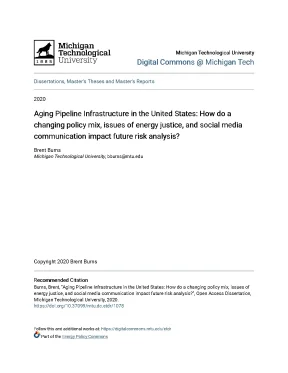
Tải xuống để đọc toàn bộMichigan Technological University Digital Commons @ Michigan Tech Dissertations, Master's Theses and Master's Reports 2020 Aging Pipeline Infrastructure in the United States: How do a changing policy mix, issues of energy justice, and social media communication impact future risk analysis? Brent Burns Michigan Technological University, bburns@mtu.edu Copyright 2020 Brent Burns Recommended Citation Burns, Brent, "Aging Pipeline Infrastructure in the United States: How do a changing policy mix, issues of energy justice, and social media communication impact future risk analysis?", Open Access Dissertation, Michigan Technological University, 2020.etdr/1078 Follow this and additional works at: https://digitalcommons.edu/etdr Part of the Energy Policy Commons AGING PIPELINE INFRASTRUCTURE IN THE UNITED STATES: HOW DO A CHANGING POLICY MIX, ISSUES OF ENERGY JUSTICE, AND SOCIAL MEDIA COMMUNICATION IMPACT FUTURE RISK ANALYSIS? By Brent J. Burns A DISSERTATION Submitted in partial fulfillment of the requirements for the degree of DOCTOR OF PHILOSOPHY In Environmental and Energy Policy MICHIGAN TECHNOLOGICAL UNIVERSITY 2020 © 2020 Brent J. Burns This dissertation has been approved in partial fulfillment of the requirements for the Degree of DOCTOR OF PHILOSOPHY in Environmental and Energy Policy. Department of Social Sciences Dissertation Advisor: Dr.
Adam Wellstead Committee Member: Dr. Chelsea Schelly Committee Member: Dr. Mark Rouleau Committee Member: Dr. Kalim Shah Department Chair: Dr.
Hugh Gorman Table of Contents List of figures. viii List of tables. xiv 1 Aging Pipeline Infrastructure Risk Analysis: How Changing Pipeline Policy Goals, Energy Justice, and Agenda Setting Impact Risk Analysis .1 Policy Change for Aging Pipeline Infrastructure .2 Current Risks of Aging Pipeline Infrastructure .4 Aging Pipeline Infrastructure Problem.8 2 Using a policy mix approach to understand how changing policy goals and politics affect legacy policy regimes .1 Research Questions and Hypothesis .2 Energy Policy Goals .3 Assessing Policy Mixes .4 Political Impact on Policy Goals. Federal Pipeline Policy .4 Data and Methods .2 Policy Goal Coding .3 Policy Instrument Coding .4 Political Characteristic Coding .1 Policy Goal Changes Over Time .1 Summary of Policy Goal Instruments .2 Policy Goal Changes Over Time .2 Policy Instrument Mix .1 Consistency, Coherence, and Congruence of the Policy Mix 41 2.3 Political Impact on Policy Goals.46 3 Advancing the state of energy justice research using deterministic approaches in search of causality .1 Case-Oriented Studies.
Qualitative Methods and Causal Mechanisms.3 Deterministic Approaches and Causality .3 Qualitative Comparative Analysis (QCA) .3 Current State of Energy Justice Methods .3 Geographic Distribution of Case Studies .4 Shifting to Deterministic Approaches .1 Suggested Changes to Specific Energy Justice Articles .1 Favored Policy Mechanisms for Renewable Energy (Sovacool, 2009) .2 Enacting community energy (Forman, 2017) .3 Examining the social acceptance of wind energy: Practical guidelines for onshore wind project development in France (Enevoldsen and Sovacool, 2016) .4 Distributional justice in Swedish wind power development – An odds ratio analysis of windmill localization and local residents’ socio-economic characteristics (Liljenfeldt and Pettersson, 2017).2 Existing Studies Using Deterministic Approaches .3 Framework for Shifting to Deterministic Approaches.77 v 4 Why is the Enbridge Line 5 pipeline crossing at the Straits of Mackinac on the agenda? Using Twitter data to display open policy windows and how they are impacted by reinforcing spirals in social media .1 Research Questions & Hypothesis .1 Multiple Streams Approach and Focusing Events .3 Reinforcing Spirals in Media .4 Data and Methods .1 Phase 1: Determine if the Enbridge Line 5 policy window is open .2 Phase 2: Determine if reinforcing spirals exist in the line 5 policy debate 94 4.2 Reinforcing Spirals in the Line 5 Debate .1 Phase 1: Specific focusing event date ranges for keyword “Line5” 106 4.2 Phase 2: Full Recent Twitter Search for Keywords ‘Enbridge’ AND ‘Line 5 or Line5’ .115 vi 5 Conclusions and Directions for Future Research.1 Policy Implications for Aging Pipeline Infrastructure Risk Analysis .128 A Policy Mix Coding Manual.2 Data inclusion test (PHASE 2): .3 Coding policy instruments (PHASE 3): .131 B Twitter Full Archive Data Acquisition via Twitter Application Programming Interface (API) and NodeXL Analysis .1 Create Twitter Developer accout .2 Create Twitter Developer App (or project) .3 Generate API Key Pair .4 Set up Dev Environment .5 Search Twitter data using Postman interface .1 Create bearer token .2 Submit request to Twitter full archive .3 Data Collection – Move data from Postman into Text Editor .4 Convert Raw Data to Useable Format – unlimited text files .5 Import Text data from Node.js file – convert to delimited text .6 Import Tweet IDs into NodeXL .7 Create Social Network Graph in NodeXL .152 vii List of figures Figure 2.1 Link between policy mix boundaries and consistency/coherence .2 Where pipelines are located in the United States .3 Federal pipeline policy instruments - policy goal change over time (1968- 2016) .4 Instrument target changes over time (cumulative) .5 Overall federal pipeline policy instruments by principal governing resource .6 Overall federal pipeline policy instruments: substantive versus procedural by principal governing resource.7 Substantive/procedural instrument policy mix over time for federal pipeline policy.8 Substantive policy instrument mix over time (1968-2016) (cumulative) *excluding “un-categorized” .9 Procedural policy mix over time (1968-2016) (cumulative) *excluding “un- categorized” .12 Federal pipeline bill sponsor home district region - count .1 Process tracing tests for causal inference (Source: Collier (2011)) .2: Energy Justice Metric (EJM). Source: Heffron et al.3 Top keywords associated with 'energy justice' keywords in Journals .4 Keyword word cloud for energy justice articles.5 Geographic percentage distribution of case studies within 75 energy justice articles .6 Framework for shifting energy justice research to deterministic approaches .1 Time spent per day with digital versus traditional media in the United States from 2011 to 2019.2 Map of Enbridge Line 5 pipeline.3 2018 Protest to shutdown Enbridge Line 5 .4 Example of social network map visualization with Twitter keywords: mentions of #GoBackSBS participants .5 Number of online articles referenced on Twitter focused on Enbridge Line 5 policy problem over time *noting 2020YTD .6 Number of online articles from Twitter referencing Enbridge Line 5 problem, by month over time .7 Word cloud for article headlines with Line 5 problems .8 Timeline of Enbridge Line 5 policy actions (2014-2020) .9 Tweets from selected politicians about Enbridge Line 5 over time .10 Tweet word cloud from politicians regarding Enbridge Line 5 .11 #Line5 Twitter social network graph for focused time frames .12 Social network graph of recent Twitter data for keywords containing 'Enbridge' and 'Line 5 or Line5' from March 9, 2020 - November 28, 2018 .111 ix List of tables Table 1.1 Policy change within policy process theories .1 Taxonomy of pipeline policy instruments. federal pipeline policy legislation .3: Pipeline policy goals and keyword criteria .4 Taxonomy of pipeline safety policy instruments .5 Count of federal pipeline policy instruments organized by policy goal .6 Examples of policy instruments coded as “safety” policy goals .7 Examples of policy instruments coded as “auxiliary” policy goals.8 Examples of policy instruments coded as “economic” policy goals .9 Examples of policy instruments coded as ‘environmental” policy goals .10 Pipeline policy instrument target percentages .11 Policy instrument mixes by share of instrument type .12 Changing policy goals relationship to usage of policy instruments .13 Current federal pipeline policy mix assessment - consistency, coherence, and congruence .14 Political party information during federal pipeline public law passage .15 Federal pipeline bill political party co-sponsors compared to economic policy goals over time .16 Federal pipeline bill political party co-sponsors compared to environmental policy goals over time .1 Summary of 'energy justice' articles by journal publication .2 Summary for energy justice articles .3 Suggested explanatory variables for use in QCA for Sovacool (2009) .1 Focusing events used for Line 5 social network analysis of Twitter data.2 Number of articles on Twitter referencing Enbridge Line 5 policy problem .3 Enbridge Line 5 policy instruments by government source type .4 Line 5 related policy actions between 2014 and 2020 .5 Tweets from select politicians about the Enbridge Line 5 pipeline over time 103 Table 4.6 Tweets for #Line5 during focused time frames .7 Top ten Twitter users centrality measures for #Line5 for focused time frames .8 Top ten Twitter users centrality measures for 'Enbridge' AND 'Line5 or Line 5' recent history .112 xi Preface The following chapters will be submitted to journals in the near future: Chapter 2, Using a policy mix approach to understand how changing policy goals and politics affect legacy policy regimes, will be submitted to Energy Policy. Chapter 3, Advancing the state of energy justice research using deterministic approaches in search of causality, will be submitted to Energy Research and Social Science.
Chapter 4, Why is the Enbridge Line 5 pipeline crossing at the Straits of Mackinac on the agenda? Using Twitter data to display open policy windows and how they are impacted by reinforcing spirals in social media, will be submitted to the Policy Studies Journal. xii Acknowledgements I would like to take this opportunity to acknowledge and thank my committee members. I thank Adam Wellstead (Social Sciences) who served as my advisor and committee members: Chelsea Schelly (Social Sciences) and Mark Rouleau (Social Sciences). A special thanks to the external member, Kalim Shah, who participated in my dissertation defense.
I also thank my colleagues at Michigan Technological University who have supported me along the process, with special thanks to direct supervisors Jim Baker, Jason Carter, and Kathy Halvorsen. I thank them for their support in both approving tuition and allowing flexibility to achieve the many milestones along the path. A special thanks to my good friend Michael McEntee for assisting in programming and navigating the Twitter API used in Chapter 4. Thanks to all those who helped review drafts along the way including my colleague Pete Larsen.
Special thanks to my parents, Bernie and Terry Burns, for not only reviewing dissertation drafts, but more importantly for providing me with the lifelong work ethic, dedication, and motivation to pursue whatever my dreams may be. Lastly, I would like to thank my family, Catherine, Brad, and Lexi, for their patience and encouragement throughout this long journey. xiii Abstract Over two and a half million miles of pipeline cross the United States today, half of which is over fifty years old and thus was designed, located, and debated without today’s modern environmental policies in place. Aging pipeline infrastructure, such as the (infamous in Michigan) Enbridge Line 5 pipeline underwater crossing at Michigan’s Straits of Mackinac, has undergone increased public scrutiny and risk analysis this past decade.
This has led to the potential for policy changes in the historically stable energy services institution associated with pipeline infrastructure regulation. While policy process literature generally describes how policy changes over time, it is missing research on how new goals and new technology, such as energy justice and social media, impact agenda setting and decisions when added to the policy mix. This dissertation first investigates the evolving federal pipeline regime policy goals through an advanced policy mix analysis. Next, it argues that energy justice research can be advanced through deterministic approaches and analyses.
Last, this dissertation uses a social network analysis to explain why aging pipelines are on today’s policy agenda through. By understanding how the pipeline policy mix has changed over time, including through the addition of modern topics such as energy justice and modern technologies such as social media, policy and decision makers can improve prioritization of risk analysis for aging pipeline infrastructure. xiv 1 Aging Pipeline Infrastructure Risk Analysis: How Changing Pipeline Policy Goals, Energy Justice, and Agenda Setting Impact Risk Analysis 1.1 Policy Change for Aging Pipeline Infrastructure The purpose of this dissertation is to advance the scholarly field of policy science within the energy policy discipline, focusing on aging infrastructure. The three empirical chapters will accomplish this goal through 1) conducting a detailed policy mix analysis of the United States oil and gas pipeline policy regime goals, 2) describing how to use energy justice principles with deterministic approaches, and 3) demonstrating the impact of modern social media and actors influencing the agenda setting process.
Chapter two reviews U.
Nội dung được bảo vệ bản quyền — Tải xuống đầy đủ
Trích dẫn luận án này
Brent J. Burns (2020). Hạ tầng đường ống cũ ở Mỹ: Rủi ro, Chính sách & Công lý Năng lượng [Luận án tiến sĩ, Michigan Technological University]. LuanAn.net. https://luanan.net/nang-luong-moi-truong/aging-pipeline-infrastructure-in-the-united-states-how-do-a-chan
Câu hỏi thường gặp
Luận án "Hạ tầng đường ống cũ ở Mỹ: Rủi ro, Chính sách & Công lý Năng lượng" nghiên cứu về vấn đề gì?
Khám phá rủi ro, chính sách và công lý năng lượng liên quan đến hạ tầng đường ống cũ ở Mỹ. Nâng cao nhận thức về vấn đề quan trọng này.
Luận án "Hạ tầng đường ống cũ ở Mỹ: Rủi ro, Chính sách & Công lý Năng lượng" được bảo vệ tại trường nào?
Luận án này được bảo vệ tại Michigan Technological University. Năm bảo vệ: 2020.
Luận án "Hạ tầng đường ống cũ ở Mỹ: Rủi ro, Chính sách & Công lý Năng lượng" thuộc chuyên ngành gì?
Luận án "Hạ tầng đường ống cũ ở Mỹ: Rủi ro, Chính sách & Công lý Năng lượng" thuộc chuyên ngành Environmental and Energy Policy. Danh mục: Năng Lượng & Môi Trường.
Luận án "Hạ tầng đường ống cũ ở Mỹ: Rủi ro, Chính sách & Công lý Năng lượng" có bao nhiêu trang?
Luận án "Hạ tầng đường ống cũ ở Mỹ: Rủi ro, Chính sách & Công lý Năng lượng" có 169 trang. Bạn có thể xem trước một phần tài liệu ngay trên trang web trước khi tải về.
Cách tải luận án "Hạ tầng đường ống cũ ở Mỹ: Rủi ro, Chính sách & Công lý Năng lượng" về máy như thế nào?
Để tải luận án về máy, bạn nhấn nút "Tải xuống ngay" trên trang này, sau đó hoàn tất thanh toán phí lưu trữ. File sẽ được tải xuống ngay sau khi thanh toán thành công. Hỗ trợ qua Zalo: 0559 297 239.