Text and texture an arts based exploration of transformation in
Khám phá nghệ thuật qua văn bản và kết cấu: Hành trình biến đổi sáng tạo. Tìm hiểu sâu sắc sự tương tác, biểu đạt và hình thức nghệ thuật.
Adult and Continuing Education Commons, Art Education Commons
Luan An
Luận án tiến sĩ
Năm xuất bản
Số trang
243
Thời gian đọc
37 phút
Lượt xem
1
Lượt tải
0
Phí lưu trữ
50 Point
Tổng quan nhanh
- Chủ đề:
- Explorations of Transformation in Adult Learning
- Số trang:
- 243 trang
- Trường:
- Lesley University
- Chuyên ngành:
- Adult and Continuing Education Commons, Art Education Commons
- Tác giả:
- Enid E. Larsen
- Năm:
- 2010
Tóm tắt nội dung luận án
I.Explorations of Transformation in Adult Learning
This research delves into transformation's potential. It specifically examines co-transformational dynamics. The study focuses on adult learning environments. An accelerated undergraduate course provided the setting. Imagination and creativity were central to the curriculum. This document explores how arts-based methods foster profound personal change. Such change is critical for adult development. It represents deep, meaningful shifts in understanding and being. The inquiry sheds light on the intricacies of adult educational journeys. It highlights the power of creative engagement.
1.1. Research Focus Adult Transformational Learning
Research investigates transformational learning. It targets adults returning to education. The study explores shifts in perspectives and assumptions. It considers how creative activities spur deep internal change. This includes both individual and collective transformation. The potential for growth is significant. Learning becomes a process of profound evolution.
1.2. Participant Journey Adult Learners and Creativity
Ten female adult learners participated. Their journey involved re-engaging with education. Many needed restoration and reparation. The learning environment offered a supportive space. Creativity acted as a powerful catalyst. Participants explored self through artistic means. They encountered new ways of seeing. These experiences shaped their personal growth.
1.3. Core Concepts Transformation and Co transformation
Transformation is a central theme. It describes shifts in understanding. Co-transformation refers to mutual change. This occurs between participants and the researcher. The process is dynamic and interactive. Assumptions evolve. Perceptions change. Feelings shift. Behaviors are modified. This constant evolution defines the learning experience.
II.Mixed Media Art Collagist Methodology Creative Process
The study utilized specific artistic methods. Collage, assemblage, and mixed media art were paramount. These techniques served as powerful tools. They enabled artistic expression and self-exploration. The research employed a unique methodological approach. It combined artistic practice with academic inquiry. This approach fostered an environment of discovery. It illuminated the dynamic nature of the creative process itself. The chosen methods were integral to understanding personal and collective transformation.
2.1. Methodological Framework Collage and Assemblage
Collage and assemblage formed core methods. They provided tools for artistic expression. These mixed media art forms facilitated self-exploration. Learners expressed complex feelings. Multiple emotions appeared simultaneously. The accelerated experience of perception benefited. This approach proved highly effective in the learning context.
2.2. Research Design Arts Based Artist Teacher Inquiry
The research utilized qualitative methods. It embraced an arts-based approach. The design involved artist-teacher inquiry. The setting was a constructivist art class. Visual auto-ethnography informed the researcher's living inquiry. This perspective shaped the entire study. A collagist methodology guided the research process.
2.3. Guiding Principle The Emergent Creative Process
Process was a key analytic tool. It emerged interpretively from the work. Multiple perspectives informed this analysis. Artwork and student reflections contributed. The artist-teacher researcher's multiple identities also played a role. This focus on process highlighted the dynamic nature of creation. It illuminated the inherent creative process within learning.
III.Artistic Transformation Agency and Self Exploration
The artistic journey fostered significant personal growth. Participants experienced profound artistic transformation. The act of creating provided a space for introspection. It allowed for the exploration of deeply held beliefs. This process enhanced a sense of agency. Learners developed new capabilities. They navigated challenges with greater confidence. The visual manifestations of their work reflected internal changes. This self-exploration was a cornerstone of the learning experience.
3.1. Expressive Power Artistic Transformation through Materials
Artistic transformation occurred through material manipulation. Collage and assemblage offered powerful expressive channels. Learners explored inner landscapes. They externalized complex emotional states. The act of creation fostered significant change. This change manifested as visual metamorphosis. The process allowed deep engagement, facilitating personal insight.
3.2. Increased Agency Navigating Unfamiliarity
The collage process increased learners' sense of agency. They confronted unfamiliarity in their learning journey. Identified impediments to transformational learning became manageable. The creation process empowered individuals. It built self-confidence. Learners found new ways to interact with challenges. This empowered perspective was a direct outcome of the art-making.
3.3. Personal Growth Self Exploration and Perception Shifts
Self-exploration was profound for participants. Learners delved into personal narratives. They encountered new perceptions of self and others. Old assumptions dissolved, making way for new understandings. The artistic journey supported this growth. It provided a tangible record of personal evolution. This journey fostered a rich internal dialogue and development.
IV.Symbolism of Change Collage as a Way of Knowing
Collage emerged as more than an art form; it became a powerful metaphor. It offered a lens through which to understand life's complexities. The fragmented yet cohesive nature of collage mirrored personal journeys. This symbolism of change resonated deeply with adult learners. It facilitated a unique 'way of knowing.' The art process allowed for the integration of diverse experiences. This led to profound personal discoveries. The artwork became a testament to evolving identities.
4.1. Metaphorical Significance Collage for Modern Living
Collage served as a malleable concept. It provided a powerful metaphor. The art form offered an analogy for adult learning. It also resonated with modern living challenges. Its fragmented yet cohesive nature mirrored life's complexities. This metaphorical depth enhanced understanding. It offered new frameworks for interpretation of experiences.
4.2. Experiential Learning A Way of Knowing
Collage contributed to transformation within lives. It functioned as a unique 'way of knowing.' This knowing transcended purely cognitive understanding. It embraced sensory, emotional, and spiritual dimensions. The experiential learning was holistic. It fostered deep personal connections to the material and the self.
4.3. Deeper Understanding Symbolism of Change
The artworks carried rich symbolism of change. Each piece represented an evolving narrative transformation. Learners explored shifts in identity and perspective. The process illuminated personal growth trajectories. It provided a visual language for internal change. This deepened self-awareness and understanding of personal evolution.
V.Textural Art Surface Manipulation for Deep Learning
The tactile nature of textural art played a crucial role. Surface manipulation became a method for discovery. Engaging with various materials fostered deeper learning. It moved beyond purely intellectual engagement. Learners physically interacted with their ideas. This material transformation was pivotal. It allowed for the externalization of internal states. The hands-on approach brought abstract concepts to life. It facilitated a more profound and embodied understanding.
5.1. Material Transformation Textural Art and Mixed Media
Material transformation was central to the process. Textural art forms offered unique avenues for expression. Mixed media elements invited tactile engagement. Learners manipulated surfaces, experimenting with diverse materials. This physical interaction spurred creative thought. It fostered innovative problem-solving skills and artistic exploration.
5.2. Sensory Engagement Surface Manipulation for Insight
Surface manipulation engaged senses deeply. The act of tearing, layering, and adhering brought insights. This sensory involvement bypassed purely verbal processing. It opened pathways to intuitive understanding. The tangible nature of textural art reinforced learning. It provided concrete experiences of change and growth.
5.3. Narrative Transformation Visual Storytelling
Artworks manifested narrative transformation. Learners constructed visual stories. These narratives reflected personal journeys. They conveyed complex feelings non-verbally. The visual storytelling allowed for new self-interpretations. It provided a unique and powerful form of self-expression. Art became a language for personal evolving narratives.
Mục lục chi tiết luận án
Tải xuống file đầy đủ để xem toàn bộ nội dung
Tải đầy đủ (243 trang)Trích đoạn nội dung luận án
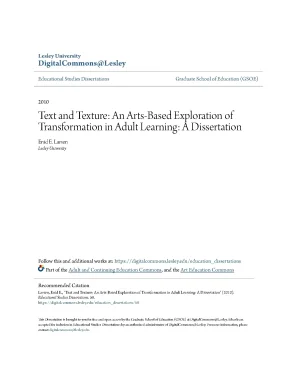
Tải xuống để đọc toàn bộLesley University DigitalCommons@Lesley Educational Studies Dissertations Graduate School of Education (GSOE) 2010 Text and Texture: An Arts-Based Exploration of Transformation in Adult Learning: A Dissertation Enid E. Larsen Lesley University Follow this and additional works at: https://digitalcommons.edu/education_dissertations Part of the Adult and Continuing Education Commons, and the Art Education Commons Recommended Citation Larsen, Enid E., "Text and Texture: An Arts-Based Exploration of Transformation in Adult Learning: A Dissertation" (2010). Educational Studies Dissertations.edu/education_dissertations/58 This Dissertation is brought to you for free and open access by the Graduate School of Education (GSOE) at DigitalCommons@Lesley. It has been accepted for inclusion in Educational Studies Dissertations by an authorized administrator of DigitalCommons@Lesley.
For more information, please contact digitalcommons@lesley. Text and Texture: An Arts-based Exploration of Transformation in Adult Learning A Dissertation submitted by Enid E. Larsen In partial fulfillment of the requirements for the degree of Doctor of Philosophy LESLEY UNIVERSITY May 2010 1 2 Text and Texture: An Arts-based Exploration of Transformation in Adult Learning 3 Abstract This research explored the transformational and co-transformational potential of collage, assemblage and mixed media in an accelerated undergraduate adult course on imagination and creativity. The methods were qualitative and arts- based artist-teacher inquiry within a constructivist art class for ten, female adult learners.
Informed by the researcher’s living inquiry through visual auto- ethnography, a collagist methodology shaped the research, including syllabus construction, course delivery and data gathering. Process was an emergent and interpretive analytic tool, drawn from multiple perspectives of artwork and reflections by the students, and the multiple identities inherent to the artist- teacher researcher. This research indicates that collage and assemblage were effective methods for artistic expression and exploration of self with these adult learners. Collage and assemblage allowed the learners to explore and express multiple, complex feelings simultaneously in an accelerated experience of perception.
Collagist methodology facilitated transformation of assumptions, perceptions, feelings, and behavior within the students’ and the artist-teacher researcher’s living inquiries. These adult learners required significant amounts of restoration and reparation in their return to education. The collage process increased their sense of agency in dealing with unfamiliarity and identified impediments to transformational learning. As a malleable concept, collage provided a metaphor and analogy for adult learning and modern living while simultaneously providing the students with an opportunity for stimulating discovery, profound pleasure and energized spirit.
As a way of knowing, collage contributed to transformation within the students’ lives. 4 Key words: transformation, transformational learning, adult-learning, arts-based, artist-teacher research, collage, living inquiry, way of knowing. 5 Dedication and Acknowledgements I am deeply grateful to everyone who has shown me what possibilities lay within living inquiry - my students, my committee, my dear husband and children, my sister, and especially my mother. "Thank you, Mom, for the trajectory." Life is constant learning Never the lessons end And the more we learn the further we find the bounds of our lives extend.
Hand-written poetry, a literary ruin, found in my mother's china cupboard among her linens, tablecloths and life ephemera. I remember reading it countless times in my childhood ethnographic hunts. 6 Table of Contents Front Page Dissertation Approval Form Title Page Abstract Acknowledgements Table of Contents Poem: The Way It Is Chapter I Introduction to the Research 9 Chapter II Introduction to Literature Reviews 13 Qualitative Research 16 Arts-based Research 24 Transformational Learning 50 Chapter III Visual Autoethnography: An Artful Encounter with Eros 60 Chapter IV: Research Methods 85 Chapter V: Thematic Analysis 104 (themes on continuums of human experience) Cognitive 105 Affective 129 Sensory 147 Spiritual 164 Relational 177 Chapter VI: Discussion and Implications for Future Study 195 References 219 Appendices 229 Consent Form Sample 229 Course Syllabus 231 Image and Photo Index (located in Supplementary File) 7 The Way It Is There’s a thread you follow. It goes among things that change.
But it doesn’t change. People wonder about what you are pursuing. You have to explain about the thread. But it is hard for others to see.
While you hold it you can’t get lost. Tragedies happen; people get hurt or die; and you suffer and get old. Nothing you do can stop time’s unfolding. You don’t ever let go of the thread.
William Stafford 8 Chapter One Introduction to the Research This research is focused on the phenomenon of transformation and exploring the potential for arts and creative processes in transformational and co- transformational learning in adult education. A primary objective is to increase understanding of realities and factors in transformational learning - that is, of perspective change or even deep, paradigmatic change - into clearer understanding and practical usage for adult learners and educators through a deeper understanding of creative art processes in adult learning. At the heart of the research is the challenge of how I can be better equipped to recognize, facilitate and manage learning at the edges of knowing (Eisner, 1997; Berger, 2004; Diaz 2004; ) in constructivist learning environments (Hein, 2002). As a college administrator in a graduate and professional studies school in a Liberal Arts College, as a professor, a Social Work therapist, and a self-taught visual artist, I am deeply appreciative of the many routes that lead to learning and development.
Throughout my interdisciplinary career, which spans over thirty years, I have remained committed to transformational learning within the individual - to the kind of learning that is driven and informed from inside out, and to actualization of the Self - as a means of contributing vibrant, meaningful life back to culture. I want to become more accomplished in facilitating transformational learning because, simply, this is my life’s work, and because individual transformational learning is an important, valuable and threatened component in the education of adult learners. Despite recurring trends towards positivism and pragmatism in educational research and delivery, interest in the phenomenon of transformation continues 9 to grow in post-modern culture, evidenced by socio-cultural and educational disparities, educational debates and reform, spiritual exploration, burgeoning self-help books, a call for ecological renewal, to name a few. When encountering such immediate individual and cultural need, an interest in the phenomenon of transformation can take on idealized, perhaps, even over-whelming forms and scale.
I seek to find my place of contribution in the culture of higher education in realistic and accessible forms to educators of adult learners, and to adult learners, themselves. My research on the phenomena of transformation is a means by which I am making the archetype of transformation more conscious, not only for my own individuation and professional development, but particularly as a contribution to adult learners as a means to increase development of Self (Jung, 1969) in adult learner education. I seek increased perspective and deeper insight about the phenomenon of transformation through creative processes derived from art studio methods - both my own and the work of my adult learning students. To prepare for my research, I began with living inquiry of myself - a self-taught artist, a teaching artist, an artist scholar - each archetype respecting the learning experience and growth of one who learns through experience, and who then shines light on the paths of others coming along on the learning journey.
I identify myself with “life history researchers with deep roots in meaning-making systems that honor the many and diverse ways of knowing - personal, narrative, embodied, artistic, aesthetic - that stand outside sanctioned intellectual frameworks”(Knowles & Cole, 2007, p. I wanted to learn from my most solid point of authority – my own personal experience and the rendering of self – because, in the end, I wanted to be better able to validate and facilitate my 10 students’ knowledge, as it can be gained, from their own rich, personal experiences. Through the genre of artist-teacher research, the following dissertation is an arts-based exploration of transformational learning depicted in two ways: first, through rendering of self in visual autoethnography and second, through living inquiry, arts-based research of ten female adult learners who, upon returning to college to complete their education, completed an art course in imagination and creativity. The studio work and reflections issued from the course provided data for analysis of their processes.
The Chapters Chapter One introduces the research and provides a context and rationale for the exploration of transformational and co-transformational learning in adult learning through creative art processes. Chapter Two provides three literature reviews, beginning with an historical scan of the history of qualitative research, and a second which contextualizes the research in the more recent experimental time frame of arts-based research. A third literature review of transformation explores the phenomena of transformational learning in adult learning, including discussion on attempts to define transformational learning, transformational practices, and the value and challenges of transformational learning. Chapter Three portrays visual autoethnograghy conducted as living inquiry and my initial exploration as a self-taught artist, a teaching artist, and an artist scholar.
The studio experience and the fine arts methods of collage, assemblage 11 and mixed media established the impetus and foundation for the subsequent artist-teacher research in collage and mixed media in an adult learning classroom. The chapter documents the visual autoethnography through photographs of the art work produced and discussion of the work and studio process. Chapter Four depicts research methods used with ten female students in an undergraduate adult learning art class in Art, Collage and Imagination through the question: How can the use of collage, assemblage and mixed media be transformational and co-transformational in an undergraduate adult learning course on imagination and creativity? The methods chapter provides definitions, context, data-gathering activities, assumptions, descriptions of participants, method of analysis, and limitations of the research. Chapter Five is a thematic analysis of the research based on themes on continuums of human experience through ways of knowing that were initially evidenced in the visual auto-ethnography.
Ways of knowing depicted in the research analysis include cognitive, affective, sensory, spiritual, and relational. The analysis is documented through photographs and discussion of the students' art work and studio processes. Chapter Six provides a discussion of transformational and co-transformational learning evidenced in the research through collage and studio experiences in adult learning, both through the research participant and the researcher. The chapter includes photographs of artwork and text that portray and exemplify collagic integration of text and texture.
Implications for future study and the potential of collage as both a method and metaphor in adult learning classrooms are discussed. 12 Chapter Two Introduction to the Literature Reviews My decision to research recursively, along the path of my own experiences, placed me squarely in the stream of educational debate, new ideas and on-going discord regarding validity and credibility in research - not only in the use of art- based methods but particularly on the use of the “I” voice to produce and demonstrate knowledge (Denzin & Lincoln, 2000/2008). What research method will allow me to find my voice, exercise my words and validate myself as an educational researcher and as a visual artist? What is the relationship between researchers and artists? How can I explore my assumptions through the perspective and experience of an artist? My literature reviews were driven not only by my own disenchantment with traditional research methods but also that expressed by my students in both undergraduate adult degree completion programs and master education programs. I learned that, as a program director and educator of adult students, advisement and classroom teaching necessarily includes acknowledgement that research is a frequently maligned requisite in education and an obstacle through which some students require careful guidance and reparative learning experiences.
A practical worry for adult learners is utility - that the investment of time and effort required by a research project will be something apart from their educational and practice goals, and will ultimately compete with the little time they have as adult learners. Worse, is a concern for meaninglessness - that the research process will be an exercise with little connection to their working world and, more so, to their passions and interests.
Nội dung được bảo vệ bản quyền — Tải xuống đầy đủ
Trích dẫn luận án này
Enid E. Larsen (2010). Text and texture an arts based exploration of transformation [Luận án tiến sĩ, Lesley University]. LuanAn.net. https://luanan.net/my-thuat/text-and-texture-an-arts-based-exploration-of-transformation-in
Câu hỏi thường gặp
Luận án "Text and texture an arts based exploration of transformation" nghiên cứu về vấn đề gì?
Khám phá nghệ thuật qua văn bản và kết cấu: Hành trình biến đổi sáng tạo. Tìm hiểu sâu sắc sự tương tác, biểu đạt và hình thức nghệ thuật.
Luận án "Text and texture an arts based exploration of transformation" được bảo vệ tại trường nào?
Luận án này được bảo vệ tại Lesley University. Năm bảo vệ: 2010.
Luận án "Text and texture an arts based exploration of transformation" thuộc chuyên ngành gì?
Luận án "Text and texture an arts based exploration of transformation" thuộc chuyên ngành Adult and Continuing Education Commons, Art Education Commons. Danh mục: Mỹ Thuật.
Luận án "Text and texture an arts based exploration of transformation" có bao nhiêu trang?
Luận án "Text and texture an arts based exploration of transformation" có 243 trang. Bạn có thể xem trước một phần tài liệu ngay trên trang web trước khi tải về.
Cách tải luận án "Text and texture an arts based exploration of transformation" về máy như thế nào?
Để tải luận án về máy, bạn nhấn nút "Tải xuống ngay" trên trang này, sau đó hoàn tất thanh toán phí lưu trữ. File sẽ được tải xuống ngay sau khi thanh toán thành công. Hỗ trợ qua Zalo: 0559 297 239.