Illusion and Disillusionment in Jeff Wall & Gerhard Richter's Postmodern Art - Virginia Adams, UMD 2007
Khám phá ảo ảnh & vỡ mộng trong nghệ thuật Jeff Wall & Gerhard Richter. Phân tích sâu sắc về cách họ thách thức nhận thức và thực tại.
University of Maryland, College Park
Art History and Archaeology
Luan An
Luận án tiến sĩ
Năm xuất bản
Số trang
235
Thời gian đọc
36 phút
Lượt xem
0
Lượt tải
0
Phí lưu trữ
50 Point
Tổng quan nhanh
- Chủ đề:
- Deconstructing Postmodern Art Discourse & Critique
- Số trang:
- 235 trang
- Trường:
- University of Maryland, College Park
- Chuyên ngành:
- Art History and Archaeology
- Tác giả:
- Virginia Adams
- Năm:
- 2007
Tóm tắt nội dung luận án
I.Deconstructing Postmodern Art Discourse Critique
This study offers a meta-critique of significant art discourse. It examines the emergence of large-scale color photography. Concurrently, a "return to painting" developed around 1980. Western avant-garde art shifted from conceptual practices. It moved towards large-scale, figurative painting and photography. This occurred in the late 1970s and early 1980s. A strong discourse arose. It was highly critical of these changes.
Critics viewed the turn to aesthetically-based art forms negatively. They saw it as capitulation to political hegemony. This was linked to conservative administrations. It also connected to a burgeoning international art market. This market was fueled by economic improvements. Criticism often overlooked the art itself. It also ignored artists' stated positions.
This research analyzes critical writings on Jeff Wall and Gerhard Richter. It illuminates the discourse. It clarifies the limits of art-historical writing. Such writing often originates from rigid theoretical positions. The voices of Wall and Richter are given considerable weight. They participate fully in this examination.
1.1. Examining Critical Writings on 1980s Art Shifts
The study mines critical writings about Jeff Wall and Gerhard Richter. These writings shaped perceptions of 1980s art. Key critics include Benjamin Buchloh, Douglas Crimp, Rosalind Krauss, and Jean-François Chevrier. Their perspectives are analyzed. The focus remains on illuminating the prevailing art discourse. This helps understand the era's artistic transformations.
1.2. The Marxist Critique of Aesthetic Art Forms
A significant aspect of the discourse came from Marxist critics and academicians. They viewed aesthetic art forms suspiciously. They saw a capitulation to conservative political power. This also reflected an expanding art market. These critics often disregarded the artists' intentions. The artistic shifts were framed as politically undesirable.
1.3. Beyond Dogmatic Art Historical Positions
The research highlights limitations of art-historical writing. It scrutinizes texts arising from rigid theoretical frameworks. It aims to elucidate where such dogmatic positions restrict understanding. By engaging Wall's and Richter's own writings, a more nuanced perspective emerges. This approach moves beyond predetermined critical lenses.
II.Jeff Wall Richter Picturing Modern Life s Illusions
The art practices of Jeff Wall and Gerhard Richter are central to this study. Both artists engaged with portraying (post)modern life. Their works explore illusion and disillusionment. Wall often employs large-scale, illuminated transparencies. These works resemble cinematic scenes. They are meticulously constructed, often appearing as documentary photographs. Richter's practice spans various styles. It includes abstract paintings, photo paintings, and realist portraits. His work frequently questions photography's objectivity. It also challenges painting's authenticity.
Wall's art often presents staged scenes. They are hyper-realistic yet artificial. This creates a sense of uncanny realism. Viewers encounter familiar situations with subtle distortions. This invites reflection on contemporary experience. Richter, conversely, blurs his photo-based paintings. He often creates a sense of distance. This visual ambiguity suggests the impossibility of a single truth. Both artists, through distinct methods, expose the constructed nature of reality. They invite viewers to question what is seen. Their art reveals inherent tensions in modern representation.
2.1. Wall s Large Scale Photography Cinematic Vision
Jeff Wall's work emphasizes his signature illuminated transparencies. These large-format photographs are meticulously composed. They often reference art history and cinema. Wall constructs elaborate sets and uses actors. The resulting images possess a dramatic, cinematic quality. They depict everyday scenes but with a heightened sense of theatricality. This challenges traditional notions of photographic truth.
2.2. Richter s Diverse Painting Styles Abstraction
Gerhard Richter's oeuvre is marked by its stylistic breadth. He moves between photorealistic paintings and abstract canvases. Richter frequently blurs the boundary between photography and painting. His abstract works explore color, texture, and process. His photo paintings often depict blurred images. This deliberate blurring questions photographic precision. It also addresses memory and perception.
2.3. Illusion Disillusionment in Contemporary Art
Both artists grapple with illusion and disillusionment. Wall’s staged realities highlight the constructed nature of images. Viewers perceive a "truth" that is fabricated. Richter's blurred images and varied styles challenge fixed perspectives. They suggest the elusiveness of definitive meaning. Their art collectively reflects on the complexities of (post)modern existence. It scrutinizes how reality is mediated and understood.
III. Painting
The study closely examines the role of medium in art discourse. It focuses on the intertwined histories of photography and painting. Wall and Richter explore these mediums in unique ways. Their practices challenge strict categorizations. Wall, primarily a photographer, creates images with painterly qualities. He constructs scenes, much like a painter composing a canvas. Richter, a painter, frequently uses photographs as source material. He blurs the lines between photographic reproduction and painterly interpretation.
The period of the late 1970s and early 1980s saw intense debate. Questions arose about what constituted "pure" medium. The shift towards large-scale photography and figurative painting fueled this discussion. Critics often held rigid views on medium specificity. This study argues for a more fluid understanding. It recognizes the complex interplay between different artistic forms. The artists' choices of medium are not merely technical. They are integral to their artistic statements. Medium becomes a subject within their work.
3.1. The Blurring Lines Between Photography Painting
Wall and Richter deliberately blur medium boundaries. Wall's photographic tableaux possess painting's narrative depth. Richter's photo paintings often achieve a painterly abstraction. Their methods challenge traditional distinctions. This cross-pollination of techniques defies conventional art historical classifications. It foregrounds the conceptual aspects of their practices.
3.2. Exploring Medium s Role in Art Interpretation
The study investigates how medium influences interpretation. Critical writings often imposed fixed meanings based on medium. Photography was linked to documentation. Painting was tied to expression. Wall and Richter subvert these expectations. Their works demand a more nuanced reading of medium. They highlight how material choice shapes perception and meaning.
3.3. Reevaluating the Return to Painting Narrative
The "return to painting" discourse is critically re-evaluated. This narrative often presented a simplified view. It suggested a retreat from conceptual art. The study shows a more complex reality. Artists like Richter engaged painting with photographic sensibility. Wall elevated photography with painterly ambition. This indicates an expansion, not a simple return.
IV.Historical Echoes Wall s Montage Richter s Tableau
Both Jeff Wall and Gerhard Richter engage with art history. Their works reference earlier forms of Modernism. This enriches their contemporary statements. Wall’s practice, especially his illuminated transparencies, connects to early twentieth-century theories. German and Russian theories of montage are particularly relevant. Montage, as a technique, involves combining disparate elements. Wall's constructed photographic scenes exemplify this. They bring together various visual components into a unified, yet often unsettling, whole. This echoes the strategic assembly of images seen in historical montage.
Richter’s diverse output also engages historical precedents. His use of photographs as source material and subsequent painterly manipulation revisits debates about realism and representation. The concept of the tableau features prominently for both artists. A tableau often implies a carefully arranged, frozen scene. Wall's photographs are classic examples of the contemporary tableau. They are staged and meticulously composed. Richter's series of paintings, particularly those based on historical events or family photographs, function similarly. They present scenes that are both static and imbued with narrative weight. This historical dialogue provides depth. It anchors their work within a broader artistic tradition.
4.1. Wall s Connection to German Russian Montage Theories
Jeff Wall’s artistic approach shows strong links to montage theories. These theories developed in early 20th-century Germany and Russia. They explored image construction and narrative through assembly. Wall's composite photographs, often appearing seamless, utilize this principle. His "cinematographic photographs" create complex narratives. These narratives are built from carefully selected and arranged visual components.
4.2. Richter s Engagement with Historical Art Forms
Gerhard Richter's art deeply engages with art history. He reinterprets genres like landscape, portraiture, and history painting. His systematic exploration of painting techniques references various periods. Richter's work frequently questions how history is pictured. His "Atlas" project, a collection of source images, highlights this historical dialogue. It showcases his continuous investigation into visual culture.
4.3. The Tableau as a Post Modern Artistic Device
The tableau is a crucial concept for understanding both artists. Wall's large-scale transparencies are quintessential contemporary tableaux. They present dramatic, often ambiguous scenes. Richter’s blurred photo paintings also operate as tableaux. They capture moments, yet distance them through painterly intervention. The tableau format allows for complex narrative and thematic exploration in their (post)modern art.
V.Challenging Rigid Art History Theoretical Positions
This study functions as a critique of art-historical writing itself. It challenges interpretations arising from rigid theoretical positions. Many early critiques of Wall and Richter came from fixed frameworks. These included Marxist or formalist perspectives. Such frameworks often limited a full understanding of the artists' intentions. They sometimes misread the complexity of the artworks. The research aims to illuminate these limitations. It seeks to broaden the scope of art-historical analysis. A central argument involves the need for more flexible interpretative approaches.
The dissertation emphasizes incorporating the artists' own voices. Wall's writings and Richter's interviews are given considerable weight. Their perspectives are crucial for understanding their art. Relying solely on external theoretical constructs can obscure meaning. This study advocates for a dialogue between theory and practice. It suggests that a deeper understanding emerges when artists' statements are acknowledged. The aim is to move beyond overly prescriptive art criticism. It promotes a richer engagement with complex artistic praxes. This encourages a more comprehensive appreciation of Jeff Wall and Gerhard Richter's contributions.
5.1. Unpacking Limits of Fixed Theoretical Frameworks
The study systematically unpacks the limitations of rigid theoretical frameworks. It shows how fixed positions, like some Marxist critiques, failed to fully grasp artistic changes. These frameworks often imposed predetermined political or formal readings. This resulted in a restricted view of the art. The research highlights the need for critical flexibility.
5.2. Incorporating Artists Voices and Intentions
A core aspect involves integrating the artists' direct input. Jeff Wall and Gerhard Richter's statements offer vital insights. Their writings and interviews clarify artistic intentions. These primary sources counter interpretations based solely on external theories. Giving weight to artists' voices provides a more complete understanding.
5.3. A Meta Critique for Deeper Art Understanding
This work serves as a meta-critique. It critiques the critical process itself. By examining past art-historical discourse, it reveals its own biases and blind spots. This critical self-reflection fosters a deeper, more nuanced understanding of the art. It paves the way for richer future scholarship on contemporary art.
Tải xuống file đầy đủ để xem toàn bộ nội dung
Tải đầy đủ (235 trang)Trích đoạn nội dung luận án
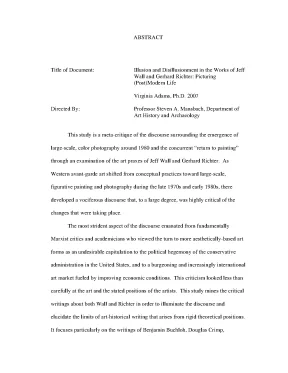
Tải xuống để đọc toàn bộABSTRACT Title of Document: Illusion and Disillusionment in the Works of Jeff Wall and Gerhard Richter: Picturing (Post)Modern Life Virginia Adams, Ph. 2007 Directed By: Professor Steven A. Mansbach, Department of Art History and Archaeology This study is a meta-critique of the discourse surrounding the emergence of large-scale, color photography around 1980 and the concurrent “return to painting” through an examination of the art praxes of Jeff Wall and Gerhard Richter. As Western avant-garde art shifted from conceptual practices toward large-scale, figurative painting and photography during the late 1970s and early 1980s, there developed a vociferous discourse that, to a large degree, was highly critical of the changes that were taking place.
The most strident aspect of the discourse emanated from fundamentally Marxist critics and academicians who viewed the turn to more aesthetically-based art forms as an undesirable capitulation to the political hegemony of the conservative administration in the United States, and to a burgeoning and increasingly international art market fueled by improving economic conditions. This criticism looked less than carefully at the art and the stated positions of the artists. This study mines the critical writings about both Wall and Richter in order to illuminate the discourse and elucidate the limits of art-historical writing that arises from rigid theoretical positions. It focuses particularly on the writings of Benjamin Buchloh, Douglas Crimp, Rosalind Krauss and Jean-François Chevrier.
The writings of Wall and Richter are also given considerable weight and their voices are invoked as full participants. The works of Wall and Richter involve inextricable combinations of photography and painting in very different ways, and the role of medium within the discourse is examined. In addition, the artists’ references in their works to art forms of earlier periods in the history of Modernism are also considered. Although this study focuses on the period 1976 to 1990, it pays considerable attention to connections between early twentieth century German and Russian theories of montage and the art of Jeff Wall, and Wall’s illuminated transparencies are emphasized.
The geographic scope of the study includes North America and West Germany, where much of the controversy about the “return to painting” was generated, and where exhibitions of the work of both Wall and Richter occurred frequently during the study period. ILLUSION AND DISILLUSIONMENT IN THE WORKS OF JEFF WALL AND GERHARD RICHTER: PICTURING (POST)MODERN LIFE By VIRGINIA ADAMS Dissertation submitted to the Faculty of the Graduate School of the University of Maryland, College Park, in partial fulfillment of the requirements for the degree of Doctor of Philosophy 2007 Advisory Committee: Professor Steven A. Mansbach, Chair Professor Saverio Giovacchini Andy Grundberg Professor William Pressly Professor Joshua A. Shannon © Copyright by Virginia Adams 2007 DEDICATION To Neal and Robin ii ACKNOWLEDGEMENTS The help and encouragement of many people stand behind this dissertation.
My professors in the Department of Art History and Archaeology at the University of Maryland provided inspiration and encouragement during my odyssey through art history that followed my career as a corporate lawyer. In particular, I thank Steven A. Mansbach, my dissertation advisor, whose brilliance permeated our discussions of my proposal through defense of the dissertation. I will always be grateful for Steven’s pointedly specific suggestions that emanated from his deep knowledge and understanding of art of the twentieth century, as well as for his perspective on this rather remarkable academic process.
I also wish to thank members of my defense committee, William Pressly, Joshua Shannon, Andy Grundberg and Saverio Giovacchini, for the time that they gave to reading the dissertation and for their very engaged participation and insightful suggestions and questions during the defense. They made the defense not only challenging, but enjoyable. Wendy Grossman and Martha Bari, fellow graduate students who finished before me, provided invaluable friendship, perspective on the process, and opportunities to vent frustration and laugh about writing a dissertation. I look forward to our continued friendship and collaboration.
It goes without saying that I am most grateful to my husband, Neal Friedlander, and our daughter, Robin Friedlander, who understood my desire to study art history in the depth that pursuing this degree has required, and who generously, if somewhat bemusedly, accepted the time that it has taken. iii TABLE OF CONTENTS List of Figures .1 Chapter 1: The Big Picture .13 The Return to Painting .24 The Postmodern Picture.25 The Tableau—an Earlier History.31 The Contemporary Picture as Tableau.35 Jeff Wall’s Pictures .45 Gerhard Richter’s Pictures.52 What Is a Picture? .53 Chapter 2: What’s a Pure Medium?.56 What Is a Medium?.60 The Postmodern Medium.65 Another View of Medium: Rosalind Krauss .67 Krauss Rewrites Clement Greenberg’s Concept of Medium .81 Jeff Wall’s Medium .88 Wall’s Medium Critiqued .95 Rosalind Krauss on Jeff Wall .101 Gerhard Richter’s Photopaintings.106 Critical Response to Richter’s Photopaintings .109 Commentary on Benjamin Buchloh.119 Is There a Pure Medium?.131 Chapter 3: Disillusionment: The Disruption of Scopic Pleasure in Jeff Wall’s Pictures .133 Gestus and Gesture: The Legacy of Brecht and Benjamin. 139 Borders and Wires.157 The Radical Oblique and the Abject Subject.162 Dirt and Washing .188 Transparency and Opacity in Gerhard Richter’s Scopic Disruptions.189 iv Summary Statement .196 v LIST OF FIGURES Chapter One: Fig. Louise Lawler, Why Pictures Now.
Black and white photograph. Gerhard Richter, Table. Oil on canvas. Gerhard Richter, Ema (Nude on a Staircase).
Oil on canvas. Gerhard Richter, Bridge (By the Sea). Oil on canvas. Gerhard Richter, Two Candles.
Oil on canvas. Gerhard Richter, Marian. Oil on canvas. Gerhard Richter, Annunciation after Titian.
Oil on canvas. Chapter Two: Fig. Jeff Wall, Restoration. Transparency in lightbox.
Gerhard Richter, Court Chapel, Dresden. Oil on canvas. Chapter Three: Fig. Jeff Wall, The Destroyed Room.
Transparency in lightbox. Jeff Wall, Mimic. Transparency in lightbox. Jeff Wall, Outburst.
Transparency in lightbox. Jeff Wall, A Villager from Aricakoyu Arriving in Mahmutbey—Istanbul, September, 1997. Transparency in lightbox. Jeff Wall, Steves Farm, Steveston.
Transparency in lightbox. Jeff Wall, Bad Goods. Transparency in lightbox. Jeff Wall, Diatribe.
Transparency in lightbox. Jeff Wall, The Storyteller. Transparency in lightbox. Jeff Wall, Diagonal Composition.
Transparency in lightbox. Jeff Wall, Diagonal Composition no. Transparency in lightbox. Jeff Wall, Diagonal Composition no.
Transparency in lightbox. Jeff Wall, Peas and Sauce. Transparency in lightbox. Jeff Wall, Rainfilled Suitcase.
Transparency in lightbox. Jeff Wall, Man in Street. Transparency in lightbox. Jeff Wall, Just Washed.
Transparency in lightbox. Jeff Wall, Bloodstained Garment. Transparency in lightbox. Jeff Wall, A Wall in a Former Bakery.
Transparency in lightbox. Jeff Wall, Some Beans. Transparency in lightbox. Jeff Wall, An Octopus.
Transparency in lightbox. Black and white photograph. Black and white photograph. Black and white photograph.
Black and white photograph. Jeff Wall, Swept. Transparency in lightbox. Jeff Wall, Housekeeping.
Silver gelatin print. Jeff Wall, Volunteer. Silver gelatin print. Jeff Wall, Morning Cleaning, Mies van der Rohe Foundation, Barcelona.
Transparency in lightbox. Jeff Wall, Blind Window no. Transparency in lightbox. Jeff Wall, Blind Window no.
Transparency in lightbox. Jeff Wall, Blind Window no. Gerhard Richter, Lovers in the Forest. Oil on canvas.
Jeff Wall, Forest. Silver gelatin print. Gerhard Richter, Curtain III (bright). Oil on canvas.
Gerhard Richter, Shadow Painting. Oil on canvas. Gerhard Richter, Four Panes of Glass. Glass and enameled steel.
Each pane 190 x 100 cm. Gerhard Richter, Gray Mirror. Oil on canvas, four panels. Each panel 300 x 100 cm.
Gerhard Richter, Eight Gray. Gray enameled glass and steel. Each panel 500 x 270 x 50 cm. Gerhard Richter, detail from 128 Details from a Picture.
Black and white photograph. viii DISCLAIMER The dissertation document that follows has had referenced material removed in respect for the owner’s copyright A complete version of this document, which includes said referenced material, resides in the University of Maryland, College Park’s library collection. ix ILLUSION AND DISILLUSIONMENT IN THE WORKS OF JEFF WALL AND GERHARD RICHTER: PICTURING (POST)MODERN LIFE Introduction This study is a theoretical analysis of the discourse surrounding the emergence of large-scale, color photography during the late 1970s, as the prevalence of photographically-based Conceptual Art began to wane. The study focuses on the years 1976 to 1990, with 1980 as the pivotal year in the shift away from Conceptual Art that had prevailed from the mid-1960s during the peak of Minimalism and Pop Art and extended through the late 1970s.
The conceptual art movement had valorized work that was typically photographic, utilizing black-and-white, deskilled snapshots frequently combined with text to create art that was not just unaesthetic, but anti- aesthetic. A major goal of Conceptual Art had been to thwart the institution of the museum, the art market and what had come to be termed the “culture industry.” The shift was toward art that was narrative, pictorial, large-scale, and in color. The emergence of the new photographic form occurred in concert with a resurgence of large-scale painting. This study places primary emphasis on the critical and art- historical writings of the period, while paying close attention to the art and writings of Jeff Wall and Gerhard Richter, artists who played key roles in the described shifts.
A plethora of essays chronicled the changes that art historians and curators were observing, and comprised the discourse of the period. Those who evaluated art from a fundamentally Marxist perspective, primarily in reliance upon the writings of Walter Benjamin and other theorists of the first decades of the twentieth century, abjured what appeared to them to be a tidal wave of art that seemed specifically 1 designed for the gallery, the museum and the market. They expressed disdain for conservative developments in the American political regime and changes in the economy as they affected art production and consumption. Other writers, of course, celebrated the resurgence of painting evidenced in numerous exhibitions of West German and American Neoexpressionism and the Italian Transavantgarde.
Methodology The methodology of the study is the creation of a meta-critique through an examination of the key theoretical arguments propounded during the period as they developed, and, particularly, as they were applied to the art production of two artists whose works emblematize the issues at stake. The artists are Jeff Wall, a Canadian photographer whose photographic transparencies derive significant inspiration from historic painting and cinema, and Gerhard Richter, a German painter whose work integrally involves photography. A major purpose of the study is to illuminate the limitations of the criticisms of the resurgence of figurative and pictorial art, which tended to approach it from preconceived theoretical positions, and to gloss over the critical stances that the artists themselves voiced in writings and interviews. Moreover, it is argued that the Marxist historians failed to look seriously at Wall’s art, in particular, thus underestimating its conversance with some of the theoretical positions that the critics themselves espoused.
In examining the theoretical discourse of the period, this study historicizes the works of Wall and Richter by placing them in the context of the moment of 1980. Yet, it is emphatically the case that the discourse engages earlier historical periods to which their work directly relates. For example, Jeff Wall’s transparencies of the early 2 1980s reconstruct, or re-present, some well-known nineteenth-century French paintings made on the cusp of Modernism, and some of his later transparencies appropriate ideas that arose within photography during the early twentieth century. As a painter who incorporates photography integrally within his praxis, Richter also has produced a hybrid art that has addressed art forms that range from the readymade, to Pop Art, to history and landscape painting, to Abstract Expressionism.
Thus, his painting incorporates art-historical as well as photographic models. As a consequence of the complex kinds of works that both Wall and Richter produce, the immediate focus on the critical writing of the period of the study necessarily requires consideration of earlier periods. It pays close attention, however, to the interweaving of the art and the writings of the artists themselves, in order to reveal the strengths and limits of theoretical approaches that eschew full engagement with the art and related writings, and therefore tend to dismiss them. Given the intellectual orientations of the two artists, their voices are fully integrated into the study.
Nội dung được bảo vệ bản quyền — Tải xuống đầy đủ
Trích dẫn luận án này
Virginia Adams (2007). Illusion & Disillusionment in Jeff Wall & Gerhard Richter's Art [Luận án tiến sĩ, University of Maryland, College Park]. LuanAn.net. https://luanan.net/my-thuat/illusion-disillusionment-jeff-wall-gerhard-richter-postmodern-art
Câu hỏi thường gặp
Luận án "Illusion & Disillusionment in Jeff Wall & Gerhard Richter's Art" nghiên cứu về vấn đề gì?
Khám phá ảo ảnh & vỡ mộng trong nghệ thuật Jeff Wall & Gerhard Richter. Phân tích sâu sắc về cách họ thách thức nhận thức và thực tại.
Luận án "Illusion & Disillusionment in Jeff Wall & Gerhard Richter's Art" được bảo vệ tại trường nào?
Luận án này được bảo vệ tại University of Maryland, College Park. Năm bảo vệ: 2007.
Luận án "Illusion & Disillusionment in Jeff Wall & Gerhard Richter's Art" thuộc chuyên ngành gì?
Luận án "Illusion & Disillusionment in Jeff Wall & Gerhard Richter's Art" thuộc chuyên ngành Art History and Archaeology. Danh mục: Mỹ Thuật.
Luận án "Illusion & Disillusionment in Jeff Wall & Gerhard Richter's Art" có bao nhiêu trang?
Luận án "Illusion & Disillusionment in Jeff Wall & Gerhard Richter's Art" có 235 trang. Bạn có thể xem trước một phần tài liệu ngay trên trang web trước khi tải về.
Cách tải luận án "Illusion & Disillusionment in Jeff Wall & Gerhard Richter's Art" về máy như thế nào?
Để tải luận án về máy, bạn nhấn nút "Tải xuống ngay" trên trang này, sau đó hoàn tất thanh toán phí lưu trữ. File sẽ được tải xuống ngay sau khi thanh toán thành công. Hỗ trợ qua Zalo: 0559 297 239.