High ability visual artists a national mixed methods study of se
Nghiên cứu về nghệ sĩ thị giác có khả năng cao tại Việt Nam. Đánh giá sự tương quan giữa khả năng sáng tạo và kỹ năng nghệ thuật của các nghệ sĩ.
University of Missouri-St. Louis
Education with an emphasis in Teaching and Learning
Luan An
Luận án tiến sĩ
Năm xuất bản
Số trang
313
Thời gian đọc
47 phút
Lượt xem
0
Lượt tải
0
Phí lưu trữ
60 Point
Tổng quan nhanh
- Chủ đề:
- 1. Giới Thiệu Nghiên Cứu
- Số trang:
- 313 trang
- Trường:
- University of Missouri-St. Louis
- Chuyên ngành:
- Education with an emphasis in Teaching and Learning
- Tác giả:
- Jennifer Christine Fisher
- Năm:
- 2016
Tóm tắt nội dung luận án
I. Giới Thiệu Nghiên Cứu
Nghiên cứu này tập trung vào việc xác định mức độ tự tin và sự chuẩn bị của giáo viên nghệ thuật trung học khi làm việc với học sinh có khả năng cao trong lĩnh vực nghệ thuật hình ảnh. Thông tin này rất quan trọng để thông báo cho cộng đồng giáo dục nghệ thuật về việc liệu họ có thể đáp ứng nhu cầu của tất cả học sinh hay không.
1.1. Mục Tiêu Nghiên Cứu
Mục tiêu của nghiên cứu là xác định mức độ tự tin và sự chuẩn bị của giáo viên nghệ thuật trung học khi làm việc với học sinh có khả năng cao trong lĩnh vực nghệ thuật hình ảnh.
1.2. Phương Pháp Nghiên Cứu
Nghiên cứu sử dụng phương pháp hỗn hợp, bao gồm thu thập dữ liệu định lượng và định tính để tạo ra một cơ sở thống kê mô tả và thêm chiều sâu cho nghiên cứu.
II. Tóm Tắt Nghiên Cứu
Nghiên cứu cho thấy rằng hầu hết giáo viên nghệ thuật trung học cảm thấy tự tin khi làm việc với học sinh có khả năng cao trong lĩnh vực nghệ thuật hình ảnh, mặc dù họ thiếu sự đào tạo và phát triển chuyên môn.
2.1. Kết Quả Nghiên Cứu
Kết quả nghiên cứu cho thấy rằng giáo viên nghệ thuật trung học cần được đào tạo và phát triển chuyên môn để đáp ứng nhu cầu của học sinh có khả năng cao trong lĩnh vực nghệ thuật hình ảnh.
2.2. Ý Nghĩa Của Nghiên Cứu
Nghiên cứu này có ý nghĩa quan trọng trong việc thông báo cho cộng đồng giáo dục nghệ thuật về việc đáp ứng nhu cầu của học sinh có khả năng cao trong lĩnh vực nghệ thuật hình ảnh.
III. Giáo Dục Nghệ Thuật
Giáo dục nghệ thuật là một phần quan trọng của chương trình giáo dục, giúp học sinh phát triển khả năng sáng tạo và tư duy nghệ thuật.
3.1. Tầm Quan Trọng Của Giáo Dục Nghệ Thuật
Giáo dục nghệ thuật giúp học sinh phát triển khả năng sáng tạo, tư duy nghệ thuật và kỹ năng giao tiếp.
3.2. Phát Triển Chuyên Môn
Giáo viên nghệ thuật cần được đào tạo và phát triển chuyên môn để đáp ứng nhu cầu của học sinh có khả năng cao trong lĩnh vực nghệ thuật hình ảnh.
IV. Phát Triển Khả Năng
Phát triển khả năng là một quá trình quan trọng trong giáo dục nghệ thuật, giúp học sinh phát triển khả năng sáng tạo và tư duy nghệ thuật.
4.1. Quá Trình Phát Triển Khả Năng
Quá trình phát triển khả năng bao gồm việc học tập, thực hành và sáng tạo nghệ thuật.
4.2. Vai Trò Của Giáo Viên
Giáo viên nghệ thuật đóng vai trò quan trọng trong việc phát triển khả năng của học sinh.
V. Kết Luận
Nghiên cứu này cho thấy rằng giáo viên nghệ thuật trung học cần được đào tạo và phát triển chuyên môn để đáp ứng nhu cầu của học sinh có khả năng cao trong lĩnh vực nghệ thuật hình ảnh.
5.1. Kết Quả Chính
Kết quả chính của nghiên cứu là giáo viên nghệ thuật trung học cần được đào tạo và phát triển chuyên môn.
5.2. Hướng Tiếp Cận Mới
Nghiên cứu này đề xuất hướng tiếp cận mới trong việc đào tạo và phát triển chuyên môn cho giáo viên nghệ thuật trung học.
VI. Tài Liệu Thêm
Nghiên cứu này có thể được sử dụng như một tài liệu tham khảo cho các nghiên cứu tương lai về giáo dục nghệ thuật và phát triển khả năng.
6.1. Tài Liệu Tham Khảo
Nghiên cứu này có thể được sử dụng như một tài liệu tham khảo cho các nghiên cứu tương lai về giáo dục nghệ thuật và phát triển khả năng.
6.2. Phát Triển Nghiên Cứu
Nghiên cứu này có thể được phát triển để bao gồm các khía cạnh khác của giáo dục nghệ thuật và phát triển khả năng.
Mục lục chi tiết luận án
Tải xuống file đầy đủ để xem toàn bộ nội dung
Tải đầy đủ (313 trang)Trích đoạn nội dung luận án
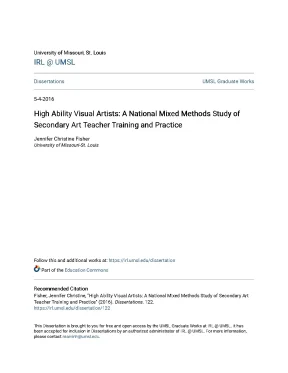
Tải xuống để đọc toàn bộUniversity of Missouri, St. Louis IRL @ UMSL Dissertations UMSL Graduate Works 5-4-2016 High Ability Visual Artists: A National Mixed Methods Study of Secondary Art Teacher Training and Practice Jennifer Christine Fisher University of Missouri-St. Louis Follow this and additional works at: https://irl.edu/dissertation Part of the Education Commons Recommended Citation Fisher, Jennifer Christine, "High Ability Visual Artists: A National Mixed Methods Study of Secondary Art Teacher Training and Practice" (2016).edu/dissertation/122 This Dissertation is brought to you for free and open access by the UMSL Graduate Works at IRL @ UMSL. It has been accepted for inclusion in Dissertations by an authorized administrator of IRL @ UMSL.
For more information, please contact marvinh@umsl. Running head: HIGH ABILITY VISUAL ARTISTS: A NATIONAL MIXED HIGH ABILITY VISUAL ARTISTS: A NATIONAL MIXED METHODS STUDY OF SECONDARY ART TEACHER TRAINING AND PRACTICE by JENNIFER C., Special Education-Gifted, University of Missouri-Columbia, 2011 B., Art Education, Southeast Missouri State University, 2009 A Dissertation Submitted to The Graduate School at the University of Missouri-St. Louis in partial fulfillment of the requirements for the degree Doctor of Philosophy in Education with an emphasis in Teaching and Learning May, 2016 Advisory Committee E. Louis Lankford, Ph.
Chairperson Karen Cummings, Ph. Patricia Kopetz, Ed. Theodore Tarkow, Ph. Fisher, 2016 HIGH ABILITY VISUAL ARTISTS: A NATIONAL MIXED METHODS STUDY ii" Abstract This study sought to determine the confidence levels and preparation of secondary art teachers in working with students who demonstrate high ability in the visual arts.
This information is vital in order to inform the art education community regarding whether or not it does, why it should, and how it can best meet the needs of all students it serves. The study utilized a mixed methods approach. Quantitative data was collected to form a descriptive statistical base. This was necessary due to a paucity of research in the demographic particulars of secondary art teachers’ measured confidence and preparedness in working with students who have high abilities in the visual arts.
Qualitative data, in the form of interviews and field notes was collected in order to add depth and breadth to the research regarding these teachers. The study found that the vast majority of surveyed secondary art educators felt generally confident in their ability to work with high ability visual artists, despite a marked deficit in preservice training and professional development. HIGH ABILITY VISUAL ARTISTS: A NATIONAL MIXED METHODS STUDY iii" Acknowledgements I would like to thank a number of individuals to whom I am forever indebted for their contributions to the development of this research. Without the endless encouragement, guidance, and friendship of Dr.
Louis Lankford, this dissertation would never have happened. Thank you for always encouraging me to live my life and not just go through the motions. Karen Cummings and Dr. Patricia Kopetz, thank you for pushing me toward excellence even when I did not want to be pushed.
Your dedication will not soon be forgotten. Ted Tarkow, thank you for your candor, humor, and faith in me. Many of the best parts of my life have been directly set into motion because of you. To my family at Missouri Scholars Academy, thank you for helping me become a better human being.
To my family at Potosi R-3, thank you for being my figurative and literal cheerleaders. Your support has meant everything to me. To Keeli and Jeff Singer, thank you for mentoring and caring about me for the past 20 years. To Brenda Fatchett, John McDowell, and Greg Kester, thank you for being the inspiration for my career and my education; you all accepted and inspired me beyond the call of duty.
To Sam, Boots, Bernie, and Beth, thank you for your love, patience, and friendship. To Uncle Doc, I kept my promise. To Mom, thank you for being my solid rock for every part of my entire life. To Dad, thank you for always understanding me, even when no one else does.
To Mallory, thank you for your unwavering belief in me, even when I did not believe in myself. To Devin, thank you for supporting me no matter what crazy things I want to do. You remain my best decision, best friend, and the best part of my life. HIGH ABILITY VISUAL ARTISTS: A NATIONAL MIXED METHODS STUDY iv" Table of Contents Abstract.
iii List of Tables. vii List of Figures. viii Chapter 1: Introduction .1 Statement of the Problem.1 Defining High Ability Visual Artists (HAVA).7 Significance of Study .8 Chapter 2: Review of the Literature.9 Part One: Understanding HAVAs .9 Rationale for the Education of HAVAs .10 Visual Arts as a Necessary and Equal Academic Discipline.11 Recognizing HAVA Students.12 Characteristics of HAVA Students and their Artwork.13 Myths Surrounding HAVA Education .14 Screening Practices for HAVA Students .16 Admission Criteria to HAVA Programs.18 History of High Ability Visual Artists .19 Part Two: Current Research and Policy .19 The Getty Center for Education in the Arts .22 Foundations of HAVA Policy .25 Part Three: Challenges and Criticisms.26 Funding Constraints to HAVA Programs.26 Limited Preservice Teacher Education .27 Criticisms of High Ability Visual Arts Programs.28 Elitism and Gifted Education .29 Underrepresentation and Equity in HAVA Programs.32 Part Four: Programming for Academic and Affective Development.34 Evaluating HAVA Programs .34 High Ability Underachievers .36 HIGH ABILITY VISUAL ARTISTS: A NATIONAL MIXED METHODS STUDY v" Bibliotherapy and Videotherapy for Affective Development .36 Self-Perceptions of HAVA Students.38 Parenting HAVA Students.39 Teachers and HAVA Students.39 Curriculum and Instruction of HAVAs.41 Mixed Ability Grouping .43 Ability Grouping for HAVA Students .56 Phase One: Web Based Survey.56 Participants and Sampling Procedures .59 Experiences Working With HAVA Students .60 Level of Confidence .60 Open-Ended Items .61 Survey Development and Pilot .61 Validity and Reliability .61 Survey Data Collection Procedures .62 Survey Data Analysis.62 Quantitative Survey Data Analysis .63 Qualitative Survey Data Analysis.63 Phase Two: Qualitative Data Collection.64 Validity and Reliability .64 Qualitative Data Collection Procedures .65 Qualitative Data Analysis.66 Personal Involvement and Role of the Researcher.68 Chapter 4: Phase One Results .69 Review of Phase One Results .69 Reporting of Phase One Data Collection .71 Section One: Demographic Description of Survey Participants .71 Section Two: Survey Participants’ Perceptions of HAVAs .88 Section Three: Preparation in Working With HAVAs .92 Section Four: Experiences in Working with HAVAs.96 Section Five: Likert Scaled Items.100 Section Six: Qualitative Survey Responses.102 Chapter 5: Phase Two Results.110 Review of Phase Two Data Collection .110 Reporting of Phase Two Data Collection.112 HIGH ABILITY VISUAL ARTISTS: A NATIONAL MIXED METHODS STUDY vi" Victoria .129 Chapter 6: Summary, Conclusions, and Recommendations .134 Summary of the Study.136 Recommendations for Future Action.159 Appendix A: Informed Consent Form for Survey Participants.159 Appendix B: HAVA Identifiers .163 Appendix C: HAVA Behaviors.166 Appendix D: Preservice Training.168 Appendix E: Inservice Professional Development.170 Appendix F: Other Challenges .172 Appendix G: Other Benefits .175 Appendix H: How to Meet Academic and Affective Needs .177 Appendix I: How to Better Prepare Future Art Educators.217 Appendix J: One Piece of Advice for Future Art Educators.232 Appendix K: Other Thoughts to Contribute.241 Appendix L: Interview Transcripts With Victoria.249 Appendix M: Interview Transcripts With Dean.256 Appendix N: Interview Transcripts With Amber .264 Appendix O: Interview Transcript With Kristi.274 Appendix P: Interview Transcripts With Jessica .282 Appendix Q: Interview Transcript With Kelly.292 Appendix R: Survey Questionnaire .298 Appendix S: Interview Questions.304 HIGH ABILITY VISUAL ARTISTS: A NATIONAL MIXED METHODS STUDY vii" List of Tables Table 1 Number of Survey Participants by State .72 Table 2 Likert Scaled Items .100 Table 3 Meeting the Academic and Affective Needs of HAVAs.103 Table 4 Preparing Future Art Educators to Work With HAVAs.105 Table 5 Advice for New Teachers Working With HAVAs .106 Table 6 Additional Thoughts About HAVAs .109 HIGH ABILITY VISUAL ARTISTS: A NATIONAL MIXED METHODS STUDY viii" List of Figures Figure 1 Characteristics of HAVAs and Cited Resources .13 Figure 2 Admission Criteria into HAVA Programs and Cited Resources.18 Figure 3 Characteristics of Educators and Cited Resources .41 Figure 4 Clark and Zimmerman’s Basic Administrative Arrangements for Gifted Child Programming.42 Figure 5 Notification Methods.71 Figure 6 Instructional Level Participating Educators Taught At.75 Figure 7 Setting or Location of Participants’ School(s). 76 Figure 8 Number of HAVAs Taught per Week .77 Figure 9 Number of Students Taught per Week.78 Figure 10 Participants Who Teach at a Public or Private School.79 Figure 11 Participants Teaching at Schools With Strong Fine Arts Emphasis .80 Figure 12 Number of Years Teaching.81 Figure 13 Number of Years Teaching Art.82 Figure 14 Number of Years Teaching Secondary Art.83 Figure 15 Grades Taught .84 Figure 16 Gender of Participants.85 Figure 17 Participants’ Highest Degree Earned .86 Figure 18 Art Certification of Participants .87 Figure 19 Identifiers of HAVAs.89 Figure 20 Behaviors Describing HAVAs .91 Figure 21 Preservice Training and Experience Regarding HAVAs .93 Figure 22 Inservice Professional Development Regarding HAVAs.95 Figure 23 Challenges in Working with HAVAs.97 Figure 24 Benefits to Working with HAVAs.99 Figure 25 Single Responses to Additional Sharing About HAVAs.108 Figure 26 Demographic Data.111 " " HIGH ABILITY VISUAL ARTISTS: A NATIONAL MIXED METHODS STUDY 1! Chapter 1: Introduction Statement of the Problem There is a paucity of research regarding the confidence and preparedness of secondary art educators working with students who have high ability in the visual arts (HAVA).
It is imperative to determine how confident and prepared they are to work with the population of young high ability visual artists in order to ensure that art educators are able to meet the academic and affective needs of all students with whom they work. Meeting the varied needs of all students in a secondary educational environment, including those who have high abilities in the visual arts, is a challenging task. Ensuring that teachers have adequate training in order to meet the needs of all learners is an important step in that process. In 1994, Clark and Zimmerman suggested that the availability of resources that aid secondary art educators in meeting the needs of high ability students is both limited and dated.
Over two decades later, little has been published to rectify this deficit. Additionally, the National Association for Gifted Children (NAGC) estimates that approximately six to ten percent of the United States’ student population has been identified as gifted and talented in one or multiple areas (National Association for Gifted Children, 2014). This statistic is troubling in light of the observance that professional development in working with gifted and talented students is rarely provided to regular education teachers (Gallagher, 2001). Secondary art educators are a subset of regular education teachers; therefore, the deficit in resources and training of secondary art teachers in working with high ability visual artists (HAVA) may prevent these students from receiving the education that best meets their needs.
HIGH ABILITY VISUAL ARTISTS: A NATIONAL MIXED METHODS STUDY 2! Defining High Ability Visual Artists (HAVA) Gifted and talented education is a field that consistently struggles to outline a comprehensive definition of giftedness and talent. In fact, Clark and Zimmerman (1994) point this out as a semantic problem in determining program options for this population of students, as there are no agreed upon definitions. A decade later, these authors (Clark & Zimmerman, 2004) went on to point out that the title of gifted and talented in the arts affected students differently than the title of academically gifted. For example, students surveyed viewed the title of “creative” quite favorably, yet they preferred being labeled “hard working” over the term “intelligent.” It is important to note that this researcher does not condone a separation of “high ability in the visual arts” from “academically gifted and talented” due to the implication that the visual arts are not an “academic” discipline.
Clark and Zimmerman (2004) recommended using the term artistically talented in research relative to these students, but this researcher insists that the inclusion of the term gifted is equally as important in this regard.
Nội dung được bảo vệ bản quyền — Tải xuống đầy đủ
Trích dẫn luận án này
Jennifer Christine Fisher (2016). High ability visual artists a national mixed methods study o [Luận án tiến sĩ, University of Missouri-St. Louis]. LuanAn.net. https://luanan.net/my-thuat/high-ability-visual-artists-a-national-mixed-methods-study-of-se
Câu hỏi thường gặp
Luận án "High ability visual artists a national mixed methods study o" nghiên cứu về vấn đề gì?
Nghiên cứu về nghệ sĩ thị giác có khả năng cao tại Việt Nam. Đánh giá sự tương quan giữa khả năng sáng tạo và kỹ năng nghệ thuật của các nghệ sĩ.
Luận án "High ability visual artists a national mixed methods study o" được bảo vệ tại trường nào?
Luận án này được bảo vệ tại University of Missouri-St. Louis. Năm bảo vệ: 2016.
Luận án "High ability visual artists a national mixed methods study o" thuộc chuyên ngành gì?
Luận án "High ability visual artists a national mixed methods study o" thuộc chuyên ngành Education with an emphasis in Teaching and Learning. Danh mục: Mỹ Thuật.
Luận án "High ability visual artists a national mixed methods study o" có bao nhiêu trang?
Luận án "High ability visual artists a national mixed methods study o" có 313 trang. Bạn có thể xem trước một phần tài liệu ngay trên trang web trước khi tải về.
Cách tải luận án "High ability visual artists a national mixed methods study o" về máy như thế nào?
Để tải luận án về máy, bạn nhấn nút "Tải xuống ngay" trên trang này, sau đó hoàn tất thanh toán phí lưu trữ. File sẽ được tải xuống ngay sau khi thanh toán thành công. Hỗ trợ qua Zalo: 0559 297 239.