Luận án: Đối thoại như Thực hành và Thấu hiểu trong Nghệ thuật Đương đại - John Mark Hammersley
Khám phá đối thoại trong nghệ thuật đương đại. Phân tích thực hành, thấu hiểu vai trò kết nối và tạo ý nghĩa trong sáng tạo nghệ thuật.
Cardiff Metropolitan University
Art & Design
Luan An
Luận án tiến sĩ
Năm xuất bản
Số trang
304
Thời gian đọc
46 phút
Lượt xem
1
Lượt tải
0
Phí lưu trữ
60 Point
Tổng quan nhanh
- Chủ đề:
- Nghệ thuật đương đại: Đối thoại và thực hành đổi mới.
- Số trang:
- 304 trang
- Trường:
- Cardiff Metropolitan University
- Chuyên ngành:
- Art & Design
- Tác giả:
- John Mark Hammersley
- Năm:
- 2015
Tóm tắt nội dung luận án
I.
Tài liệu này khám phá vai trò trung tâm của đối thoại trong nghệ thuật đương đại. Đối thoại không chỉ là một phương pháp mà còn là nền tảng cho sự thấu hiểu. Nó định hình thực hành nghệ thuật hiện đại. Sự chuyển dịch này đòi hỏi xem xét lại cách nghệ thuật tương tác với khán giả. Nghệ thuật ngày nay thường mang tính đa tầng. Nó mời gọi sự tham gia tích cực. Các hình thức như Nghệ thuật sắp đặt và Nghệ thuật trình diễn thường khai thác yếu tố đối thoại. Đối thoại mở ra những không gian mới cho sự sáng tạo. Nó thúc đẩy các hình thức giao tiếp nghệ thuật độc đáo. Nghiên cứu này phân tích những thách thức và tiềm năng của đối thoại. Nó cung cấp một cái nhìn sâu sắc về các thực hành đổi mới.
1.1. Khám phá vai trò đối thoại trong tương tác nghệ thuật.
Đối thoại là yếu tố cốt lõi trong tương tác nghệ thuật. Nó biến khán giả thành người đồng sáng tạo. Tác phẩm nghệ thuật không còn là vật thể tĩnh. Nó trở thành một quá trình năng động. Phản hồi khán giả đóng vai trò thiết yếu. Đối thoại tạo ra một không gian chia sẻ ý nghĩa. Nó khuyến khích sự trao đổi liên tục. Nghệ thuật sắp đặt thường mời gọi khán giả bước vào. Nghệ thuật trình diễn yêu cầu sự phản ứng tức thì. Những hình thức này định nghĩa lại ranh giới nghệ thuật. Trải nghiệm thẩm mỹ trở nên cá nhân hơn.
1.2. Thực hành nghệ thuật đương đại và giao tiếp mới.
Các nghệ sĩ đương đại sử dụng đối thoại như một công cụ. Nó xây dựng cầu nối giữa tác phẩm và thế giới. Giao tiếp nghệ thuật không còn đơn chiều. Nó trở thành một mạng lưới phức tạp. Nghệ thuật khái niệm thường dựa vào sự diễn giải. Đối thoại giúp làm rõ ý tưởng trừu tượng. Nó cũng giúp mở rộng nhận thức. Thực hành giám tuyển cũng thay đổi. Các nhà giám tuyển tạo ra các bối cảnh đối thoại. Điều này làm phong phú thêm tiếp nhận nghệ thuật.
II.
Nghiên cứu này trình bày một phương pháp luận chặt chẽ. Nó xem xét đối thoại như một thực hành và công cụ thấu hiểu. Phương pháp luận này vượt qua các cách tiếp cận truyền thống. Nó xem xét các lập trường của Bourriaud, Kester và Bishop. Những lý thuyết này đóng góp quan trọng. Chúng định hình cách hiểu về đối thoại trong nghệ thuật. Việc phát triển các chủ đề thông qua tương tác trực tiếp là cần thiết. Các cuộc trò chuyện trong lĩnh vực tạo ra nguồn tài nguyên. Những ảnh hưởng này hình thành cách tiếp cận độc đáo. Một khung làm việc xã hội được xây dựng. Nó phản ánh nhiều thực tế và thực hành nghệ thuật. Phương pháp này giúp hiểu rõ hơn về tính chất đa diện của nghệ thuật.
2.1. Đóng góp lý thuyết vào thực hành giám tuyển và phê bình.
Lý thuyết phê bình nghệ thuật là nền tảng. Nó cung cấp công cụ để giải mã đối thoại. Các tác giả như Bourriaud, Kester và Bishop có quan điểm khác nhau. Bourriaud tập trung vào thẩm mỹ quan hệ. Kester nhấn mạnh tính cộng tác. Bishop chỉ ra những thách thức. Những lý thuyết này ảnh hưởng đến thực hành giám tuyển. Các nhà giám tuyển sử dụng chúng để tổ chức triển lãm. Họ tạo ra những trải nghiệm đối thoại. Điều này làm phong phú thêm cách công chúng tiếp nhận nghệ thuật.
2.2. Xây dựng khung nghiên cứu xã hội cho đối thoại nghệ thuật.
Nghiên cứu áp dụng khung làm việc xã hội. Khung này thừa nhận nhiều thực tế trong nghệ thuật. Nó xem xét đối thoại như một trò chơi ngôn ngữ. Điều này giúp lựa chọn và phát triển phương pháp. Quá trình phỏng vấn được thiết kế cẩn thận. Nó thu thập tài liệu từ nhiều người tham gia. Phương pháp quả cầu tuyết được sử dụng để mở rộng nhóm. Điều này đảm bảo tính đa dạng. Các nghiên cứu tình huống hỗ trợ phân tích. Chúng cung cấp cái nhìn sâu sắc về giao tiếp nghệ thuật.
III.
Bối cảnh là yếu tố quan trọng trong đối thoại nghệ thuật. Nó định hình ý nghĩa và cách tiếp nhận nghệ thuật. Tài liệu thảo luận về bối cảnh hiện tại của nghệ thuật đương đại. Bối cảnh này chịu ảnh hưởng của các lý thuyết hậu cấu trúc và hậu hiện đại. Các thực hành đối thoại đã thay đổi mối quan hệ của nghệ thuật. Nó không còn bị giới hạn bởi các bối cảnh lý tưởng. Các không gian xã hội hàng ngày trở thành nơi diễn ra nghệ thuật. Điều này làm xáo trộn các khuôn frameworks phê bình truyền thống. Nó cũng thay đổi hiểu biết về học tập trong bối cảnh học thuật hóa. Việc duy trì căng thẳng giữa các phương thức kiến thức khác nhau là cần thiết. Khung làm việc thực hành phải linh hoạt và thích ứng.
3.1. Chuyển đổi bối cảnh lịch sử và phê bình của nghệ thuật.
Các thực hành đối thoại làm thay đổi lịch sử nghệ thuật. Nó dịch chuyển khỏi các dự án lịch sử truyền thống. Điều này không phải là sự đối lập. Nó là sự tái định hình. Bối cảnh phê bình trở nên ít xa vời hơn. Nó gắn liền hơn với thực tế. Các phương pháp luận đối thoại phá vỡ các khuôn khổ hẹp. Chúng mở rộng không gian cho sự diễn giải. Giao tiếp nghệ thuật trở nên trực tiếp hơn. Tiếp nhận nghệ thuật cũng thay đổi. Khán giả trở nên quan trọng hơn trong việc định hình ý nghĩa.
3.2. Hiểu biết mới về học tập và trải nghiệm thẩm mỹ.
Bối cảnh học thuật hóa hiện tại của nghệ thuật phát triển. Các thực hành đối thoại mang lại hiểu biết mới về học tập. Nó khuyến khích tư duy phản biện. Nó thúc đẩy sự tham gia chủ động. Các cuộc đối thoại tạo ra một trải nghiệm thẩm mỹ sâu sắc hơn. Trải nghiệm này không chỉ là cảm thụ. Nó còn là quá trình suy ngẫm và tương tác. Phản hồi khán giả trở thành một phần của quá trình học tập. Điều này xây dựng một khung làm việc thích ứng. Nó cho phép kiến thức mới xuất hiện.
IV.
Nghiên cứu tiến hành phân tích sâu rộng. Nó chuyển đổi tài liệu thô thành những hiểu biết có ý nghĩa. Quá trình này bao gồm việc sắp xếp các trích đoạn. Nó từ các bản ghi phỏng vấn và nghiên cứu tình huống. Các chủ đề tổ chức rộng được xác định. Sau đó, các mã mở được xây dựng. Chúng dẫn đến các chủ đề tạm thời. Sự củng cố và sắp xếp các chủ đề là bước cuối cùng. Mục tiêu là phát triển các hình thức đối thoại. Nó bao gồm đối thoại mimesis, tag cloud và maieutic. Những phương pháp này giúp diễn giải và tổng hợp thông tin. Chúng cung cấp một cái nhìn toàn diện về đối thoại trong nghệ thuật.
4.1. Thu thập và sắp xếp dữ liệu Phản hồi khán giả.
Việc thu thập tài liệu bắt đầu bằng phỏng vấn. Các bản ghi phỏng vấn cung cấp dữ liệu định tính. Các nghiên cứu tình huống bổ sung cho dữ liệu này. Phản hồi khán giả được ghi lại. Các trích đoạn này được sắp xếp theo chủ đề. Nó tạo thành một cấu trúc tổ chức ban đầu. Mã hóa mở được áp dụng để xác định các khái niệm. Bước này giúp nhận diện những chủ đề ẩn. Nó làm rõ các khía cạnh quan trọng của giao tiếp nghệ thuật.
4.2. Phát triển đối thoại mimesis và maieutic trong nghệ thuật.
Nghiên cứu phát triển các hình thức đối thoại khác nhau. Đối thoại mimesis tái tạo các cuộc trò chuyện. Nó phản ánh sự tương tác ban đầu. Các tag cloud được thiết kế. Chúng giúp phân tích tài liệu và xu hướng. Đối thoại maieutic được phát triển. Nó trở thành đối thoại phản tư. Điều này thúc đẩy sự tự khám phá. Nó mở rộng hiểu biết sâu sắc. Nó đóng góp vào lý thuyết phê bình nghệ thuật. Quá trình này giúp nâng cao trải nghiệm thẩm mỹ.
Tải xuống file đầy đủ để xem toàn bộ nội dung
Tải đầy đủ (304 trang)Trích đoạn nội dung luận án
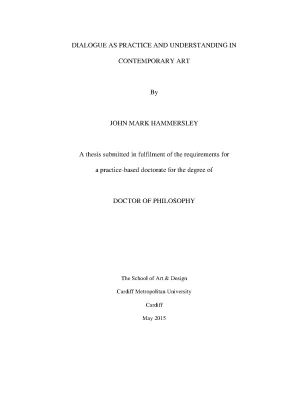
Tải xuống để đọc toàn bộDIALOGUE AS PRACTICE AND UNDERSTANDING IN CONTEMPORARY ART By JOHN MARK HAMMERSLEY A thesis submitted in fulfilment of the requirements for a practice-based doctorate for the degree of DOCTOR OF PHILOSOPHY The School of Art & Design Cardiff Metropolitan University Cardiff May 2015 This research was kindly supported by a BARS research bursary from Cardiff Metropolitan University Candidate’s declaration This is to certify that the work presented here has not already been accepted in substance for any degree and is not being concurrently submitted in candidature for any degree. I state that the contents of the work submitted are the sole result of the candidate’s own investigation, except where otherwise stated. This is to certify; i) that this thesis, if successful, may be made available for inter-library loan, photocopying (subject to the law of copyright) and that the title and summary may be available to outside organisations; ii) that the University may electronically store, copy or translate the thesis to any approved medium or format for the purpose of future preservation and accessibility; that the thesis deposited in the digital repository will be accessible to a wide variety of people and institutions, including automated agents and search engines via the World Wide Web; that once the thesis is deposited, the item and its metadata may be incorporated into public access catalogues or services, such as national databases of electronic theses. or iii) that the thesis, if successful, may be made so available after the expiry of a bar on photocopying and/or access.
Signed: ______________________________ John Hammersley Contents Chapter 1: Prologue 1 Chapter 2: Introduction 10 The positions of the main protagonists in debates on dialogue in art 12 Dialogical art practice as a multi-layered activity 14 Concerns regarding theoretical administration of practice 19 Methodological disposition of this study 21 The presentation of this thesis 22 Chapter 3: Methodology and method 25 Methodology 25 Contemporary art’s near past and emerging present 27 The discourse surrounding dialogue in contemporary art 34 The contribution of Bourriaud, Kester and Bishop’s positions to 36 this thesis Developing themes through engagement and conversation in the 38 field Artistic practices which provide interpretive resources for the 39 construction of this practice Influences of these practices on my approach 42 Developing a socially constructed framework of inquiry 43 Multiple realities and multiple practices 44 How my chosen framework informs my approach to dialogical art 46 practice as research How the philosophical notion of language games contributes to my 48 selection and development of method Method 51 Preparing an ethical framework 53 The generation of material 55 The snowball 57 Description of interview participant group established through the 60 snowball The interview process 63 How I constructed my field study conversation 68 The use of case reflections 72 Interpretation, synthesis and analysis of research material 77 Description of analysis of findings and development of bricolaged 78 dialogues Stage 1 Arrangement of extracts from transcripts and case studies 78 into broad organisational themes Stage 2 Interpretation of extracts from transcripts and case studies 79 leading to the construction of open codes Stage 3 Grouping of open codes into provisional themes 81 Stage 4 Consolidation and ordering of themes 83 Presentation and discussion of material as research texts 86 Phase 1. How I constructed mimetic dialogue 87 Phase 2. The development of tag clouds leading to a discussion of 90 the literature How I designed the tag clouds 91 Phase 3. How I developed maieutic dialogue into reflective dialogue 96 Chapter 4: Context 97 Context dialogue 99 Context tag cloud 106 Contexts: A discussion of the literature 107 The current landscape of contemporary art as context of dialogue 107 The shift of dialogical practices from ideal to everyday social 109 spaces Dialogical practices alter art’s relationship to its historical context 111 Dialogical practices shift away from rather than oppose art’s 114 historical project Dialogical practices disrupt the critical context of contemporary art 117 Dialogical methodologies disrupt narrow critical frameworks 121 Dialogical practices shift our understanding of learning in the 124 academicised context of current art Discussion of the characteristics of context in dialogue 131 The dominance of the post-structural and postmodern landscape 132 Dialogue is changing art’s relationship to its historical narrative 134 The critical context becomes less distant and abstract in dialogue 135 The increasingly academicised context of art 137 New understanding: a reflection on context 139 Maintaining tension between different modes of performing 140 knowledge Constructing an emergent, adaptive and dialogical framework of 141 practice Chapter 5: Meaning-making 144 Meaning-making dialogue 146 Meaning-making tag cloud 167 Meaning-making: A discussion of the literature 168 Dialogical practices are leading to shifts away from the traditional 169 framework of meaning-making in contemporary art Dialogue contributes to an alternative framework of meaning- 171 making Dialogue diffuses the subject matter of art 174 Dialogue implies changing our understanding of our selves and/or 176 changing our relationship with the world Discussion of some characteristics of meaning-making in dialogical art 181 Dialogue shifts away from art’s traditional construction of 182 meaning-making Dialogue diffuses the subject matter of art 184 Dialogue implies changing our understanding of ourselves and/or 186 our relationship with the world New understanding: Implications for the meaning-making process of 188 dialogical art Shifting away from oppositional argument and the emergence of an 188 alternative approach to meaning-making The possible implications of dialogue’s diffusion of thematic 191 concerns Chapter 6: Relating 194 Relating dialogue 196 Relating tag cloud 213 Relating: a discussion of the literature 214 Conversation provides the resources for a more contradictory, and 215 ambivalent relationship to the world Dialogical practices alter the construction of the self in the work of 219 art Dialogue sustains and is sustained by self-risk 222 Dialogue alters the sense of engagement in art 224 The transformational potential and the ethical implications of 227 dialogue Dialogical practices question the ethical exchange of art 228 Dialogue problematises representation in contemporary art 230 Identification as a process of support in dialogue 232 Discussion of some characteristics of relating in dialogical art 235 Conversation provides the resources for a more contradictory, and 236 ambivalent relationship to the world Dialogical practices alter the construction of the self in the work of 238 art Dialogue sustains and is sustained by self-risk 240 Dialogue alters the sense of engagement in art 241 Dialogical practices question the ethical exchange of art 242 The problem of representation and the potential support of 243 identification New understanding: Discussion of the emergent understanding of relating 245 Offsetting concerns of objectification in dialogue through 245 interpersonal conversation Conversational dialogue as an interactive process of discovery and 248 learning Chapter 7: Discussion-conclusion 250 How this thesis was constructed 251 How a socially constructed framework developed out of inquiry 253 Constructing a situated conversational practice of co-participatory 254 learning as a mode of life Synthesising, analysing and presenting research material 256 This inquiry’s findings 258 Implications of these findings 260 Limitations of this inquiry 263 Future research 265 What I gained from doing this research 266 This study’s contribution to understanding and knowledge 267 Tension between singular expert claims to knowledge and the 269 collective performance of knowledge Avoiding rigid concretisations, and foundationalist and essentialist 271 prescriptions of meaning References 274 Appendices List of tables and figures Table 1.
Research participants 61-62 Table 2. Grouping of codes: Critical transformation 82 Table 3. The six steps of simplifying and reordering themes 84 Figure 1. Context tag cloud 93 Figure 2.
Meaning-making tag cloud 94 Figure 3. Relating tag cloud 95 Figure 4. Context tag cloud 106 Figure 5. Meaning-making tag cloud 167 Figure 6.
Relating tag cloud 213 Abstract Dialogue as practice and understanding in contemporary art This study investigates how social constructionist dialogue as art demonstrates a layered mode of practical inquiry, which weaves together interactive and explorative, re-presentational and reflective modes of dialogue in the performance of knowledge. Recent art debates present dialogue as a relational, collaborative and situated mode of meaning-making, and an alternative to traditional constraining frameworks of art. However, artists have been criticised for idealised interpretations of dialogue, which present it as something essentially good and democratic, for insufficiently scrutinising dialogical relationships, and for not providing adequate process accounts for secondary audiences. This study’s multi-layered performance of knowledge draws on thematic insights developed through fourteen interviews and five field conversation artworks from 2008 onwards.
Research material from conversational encounters was combined and presented as three constructed written dialogues, which reflect the tensions and questions that emerge out of enacting such a layered mode of dialogue as art. These tensions are re-presented, and discussed in three central thematic chapters, which frame these themes as issues of context, competing characteristics of meaning- making and relating. The constructed written dialogues provide a platform for further discussion and reflective analysis, which in turn are proposed as an invitation to continued dialogue and socially grounded interaction. The central implication of this study’s contribution to knowledge is that such an approach to practice-led inquiry articulates how dialogue may contribute to the increasing shift in critical art practices towards to more imbricated, uncertain, and performative approaches to knowledge, and provide an alternative to essentialised and foundationalist interpretations of dialogue.
Chapter 1: Prologue This prologue presents the rationale for the underpinning focus on social constructionist theory and dialogic approaches to art study and practice, through setting out the development of my intellectual and practical disposition. What has informed my identification with and development of a constructionist research approach to dialogical practice in contemporary art? Like most artists who enter into research practice I come with a diverse set of prior experiences and practices, which led me to undertake the inquiry in this way. Maxwell (2005) believes that personal experiences and goals play an important part in research studies, in particular sustaining a researcher’s motivation to see through what can be a demanding and challenging process, but also informing a researcher’s disposition. Reflecting on my prior experience has been important for me and sustained my commitment to such an approach.
In this manner, a reflection acts as a point of re-orientation valuable because entering into the complex debates provoked by alternative dialogical approaches to art practice has at times been a bewildering experience. Such a personal and reflective approach to practice may be more familiar to ethnographic approaches to art but such a disposition is not without its critics. Foster (1996) has criticised reflective dialogical practices, which he characterises as an artistic self-othering and accuses of representing a detached narcissism. However Foster also notes in an interview with French et al.
(1997) that art’s co-option of psychoanalytical theories through philosophy often ignores the continuing 1 contribution and changing understanding of those concepts within psychoanalysis and psychodynamic practice. Many relational and socially engaged practices draw on philosophical and anthropological notions of the dialogical self, which construct the self as already an other, an I/Thou. Self-othering is also not necessarily negative and is an understood and necessary dynamic of the psychology of learning. The dialogical self, an I/Thou is variously described in the work of Buber (1996), Levinas (1991) and Bakhtin ([1919] 1990) amongst others and informs contemporary psychodynamic notions of the plural or evolving self (Kegan, 1982) less apparent in contemporary art’s discourse.
The criticisms of ethnographically disposed and reflexive art’s practices may thus be limited by less than contemporary conceptualisations of self- understanding and development in psychoanalytic and psychodynamic perspectives. However, this prologue aims to acknowledge the prior influences and biases that shape and inform human and interpersonal research. This prologue also acknowledges that in interpersonal inquiry the researcher is construed as the instrument of the research (Maxwell, 2005) and method a reconstruction of the artist- researcher. With research that adopts a complex constructed method, personal reflection on the researcher’s prior experience can also provide a useful interpretative resource for readers.
My intention is to highlight how my prior experiential knowledge may have contributed to my methodological decisions and dispositions, without necessarily aiming to summarise these into a grand theory label or perspective.
Nội dung được bảo vệ bản quyền — Tải xuống đầy đủ
Trích dẫn luận án này
John Mark Hammersley (2015). Đối thoại trong nghệ thuật đương đại: Thực hành và thấu hiểu [Luận án tiến sĩ, Cardiff Metropolitan University]. LuanAn.net. https://luanan.net/my-thuat/doi-thoai-nghe-thuat-dang-dai-thuc-hanh-thau-hieu
Câu hỏi thường gặp
Luận án "Đối thoại trong nghệ thuật đương đại: Thực hành và thấu hiểu" nghiên cứu về vấn đề gì?
Khám phá đối thoại trong nghệ thuật đương đại. Phân tích thực hành, thấu hiểu vai trò kết nối và tạo ý nghĩa trong sáng tạo nghệ thuật.
Luận án "Đối thoại trong nghệ thuật đương đại: Thực hành và thấu hiểu" được bảo vệ tại trường nào?
Luận án này được bảo vệ tại Cardiff Metropolitan University. Năm bảo vệ: 2015.
Luận án "Đối thoại trong nghệ thuật đương đại: Thực hành và thấu hiểu" thuộc chuyên ngành gì?
Luận án "Đối thoại trong nghệ thuật đương đại: Thực hành và thấu hiểu" thuộc chuyên ngành Art & Design. Danh mục: Mỹ Thuật.
Luận án "Đối thoại trong nghệ thuật đương đại: Thực hành và thấu hiểu" có bao nhiêu trang?
Luận án "Đối thoại trong nghệ thuật đương đại: Thực hành và thấu hiểu" có 304 trang. Bạn có thể xem trước một phần tài liệu ngay trên trang web trước khi tải về.
Cách tải luận án "Đối thoại trong nghệ thuật đương đại: Thực hành và thấu hiểu" về máy như thế nào?
Để tải luận án về máy, bạn nhấn nút "Tải xuống ngay" trên trang này, sau đó hoàn tất thanh toán phí lưu trữ. File sẽ được tải xuống ngay sau khi thanh toán thành công. Hỗ trợ qua Zalo: 0559 297 239.