Teaching and learning law and business an open resource tool
Khám phá tài nguyên mở về dạy và học luật kinh doanh. Nâng cao kiến thức và kỹ năng kinh doanh, pháp lý với các công cụ học tập toàn diện.
Mitchell Hamline School of Law
Legal Education
Luan An
Dissertation
Năm xuất bản
Số trang
51
Thời gian đọc
8 phút
Lượt xem
0
Lượt tải
0
Phí lưu trữ
40 Point
Tổng quan nhanh
- Chủ đề:
- Law School Preparedness: Bridging Business Skills Gap
- Số trang:
- 51 trang
- Trường:
- Mitchell Hamline School of Law
- Chuyên ngành:
- Legal Education
- Tác giả:
- John O. Sonsteng
- Năm:
- 2020
Tóm tắt nội dung luận án
I.Law School Preparedness Bridging Business Skills Gap
A comprehensive dissertation examines the state of business law education. It reviews surveys, data, and literature to understand its impact. Attorneys across the country report significant gaps in their preparation. Law school coursework often fails to equip them for the business of law. This deficiency affects both firm management and client advisement. The study highlights a persistent disconnect. Law schools promise adequate preparation, yet delivery falls short. This issue persists despite practical changes in legal education since the 1960s. The research seeks to clarify processes for educational transformation. It aims to open doors and reorganize structures. The goal is to better address community needs.
1.1. Attorney Feedback on Business Acumen
Surveys reveal a critical gap. Attorneys consistently report feeling unprepared. Law school coursework often neglects the business of law. This impacts daily practice. Many face challenges managing their own firms. Others struggle advising business clients effectively. The deficiency is widespread. This feedback underscores the urgent need for curriculum reform.
1.2. The Disconnect in Law School Promises
Law schools make promises. They pledge to prepare students for practice. Reality shows a different picture. Graduates often lack practical business skills. This gap persists despite curriculum changes. Educational reforms since the 1960s had limited impact. A significant disconnect remains. This problem affects new lawyers and their potential clients.
1.3. Unfulfilled Expectations for Legal Business
The study clarifies unfulfilled promises. Education should transform lives. It should open new doors. It must reorganize structures. This addresses community needs. Currently, law schools fall short. They fail to equip graduates for the business side. Small to mid-sized businesses suffer. Entrepreneurs find lawyers unprepared. This impacts economic growth.
II.Evolving Business Law Curriculum Practical Skills
The study challenges traditional law school offerings. It argues doctrinal courses alone do not suffice. Practical skills, innovation, and collaboration are driving agents for change. The Business law curriculum needs a fundamental overhaul. It must integrate real-world scenarios and hands-on experience. Partnerships with lawyers, teachers, and businesspeople are crucial. This collaborative approach enhances student readiness. It prepares graduates for the complexities of modern legal practice. The focus shifts from theoretical knowledge to applied competence.
2.1. Call for Skills Based Learning Law Business
The paper advocates for change. Doctrinal courses are insufficient. Practical skills courses are essential. Skills-based learning (law/business) drives change. This includes simulations and real-world partnerships. Collaboration with lawyers and businesspeople is key. It prepares students for actual legal practice. Focus on problem-solving is paramount.
2.2. Integrating Entrepreneurship Education
Entrepreneurship education is vital. Law students need to understand business creation. They must grasp client needs. This prepares them for various roles. It enables success in solo practice. It also helps in advising new ventures. Focus on business models and legal challenges is crucial. This fosters innovation within the legal field.
2.3. Active Learning Strategies for Business Law
Pedagogical innovation is necessary. Active learning strategies engage students. These include problem-based learning. Case studies involving real business scenarios are effective. Group projects foster collaboration. These methods develop critical thinking. They improve practical application of legal principles. This moves beyond passive lecture formats.
III.Open Resource Tools for Modern Legal Education OER
This dissertation serves as an OER for legal education. It promotes open access to valuable resources. The period studied, 2009–2020, saw significant changes. Expansion of online capabilities and distance learning occurred. The global pandemic of COVID-19 further accelerated these trends. Digital learning tools became indispensable. This resource contributes to a growing body of knowledge. It supports the development of future-ready legal professionals. It embraces the principles of sharing and collaboration.
3.1. Utilizing OER for Legal Education Effectively
This resource is an OER for legal education. It supports open access. It provides accessible materials. These tools enhance learning outcomes. They reduce costs for students. They also promote broader knowledge sharing. Open educational practices are central. This makes legal education more equitable and widespread.
3.2. Digital Learning Tools in Legal Business
The period 2009-2020 saw expansion. Online capabilities grew significantly. Distance learning became prominent. The global pandemic accelerated this trend. Digital learning tools became essential. These platforms facilitate access to resources. They support remote collaboration. They are critical for modern legal training and practice.
3.3. Open Educational Practices in Law Curriculum
The study promotes open educational practices. This involves sharing, reusing, and adapting resources. It fosters innovation in curriculum design. It encourages collaboration among educators. This approach enhances the quality of legal education. It makes learning more accessible and relevant. It ensures current information reaches students quickly.
IV.Data Driven Reforms in Legal Business Training
The research employs robust methodologies. It utilizes a multi-layered review of surveys, data, and literature. A quantitative analysis provides compelling evidence. State and countrywide data reveal systemic issues. This evidence supports calls for significant reforms. The study also includes a comprehensive review of relevant literature. Data collection involved archives, interviews, newspapers, published reports, and studies. This rigorous approach ensures findings are well-supported. It provides a strong foundation for future instructional design legal improvements.
4.1. Quantitative Analysis of Attorney Readiness
Research used a quantitative approach. State and countrywide data were analyzed. This provided empirical evidence. It showed attorney readiness deficiencies. The data revealed a systemic problem. It supports the need for curriculum changes. These findings are critical for educational policy makers.
4.2. Insights from Bar Association Partnerships
Research involved key partnerships. The Minnesota and American Bar Associations contributed. Their collaboration yielded valuable insights. Surveys of practicing attorneys were crucial. These insights highlight real-world demands. They emphasize the gap in current legal training. Such partnerships strengthen the relevance of research.
4.3. Systemic Review of Relevant Literature
A comprehensive literature review was conducted. It covered various publications. Archives, interviews, and reports informed the study. This instructional design legal research clarifies challenges. It identifies best practices. It informs future curriculum development. This review ensures a broad understanding of the topic.
V.Innovative Pedagogy for Entrepreneurship in Law
The dissertation emphasizes the need for pedagogical innovation. Traditional teaching methods are insufficient for preparing lawyers for the business world. New approaches must foster practical skills and an entrepreneurial mindset. This involves moving beyond rote memorization. It includes active engagement with real-world problems. Entrepreneurship education is not merely an add-on; it is essential. It equips future lawyers to manage their practices effectively. It also enables them to provide astute advice to business clients. Emphasis on Legal business ethics ensures responsible professional conduct.
5.1. Pedagogical Innovation in Legal Education
The dissertation calls for pedagogical innovation. Traditional methods fall short. Modern legal education needs new approaches. This includes simulations and practical exercises. Experiential learning is paramount. It prepares students for dynamic legal careers. This shift improves engagement and skill retention.
5.2. Emphasizing Legal Business Ethics
Training must include legal business ethics. Lawyers need strong ethical foundations. This applies to both practice management and client advice. Understanding ethical dilemmas in business contexts is crucial. It builds professional integrity. It protects clients and the profession. Ethical considerations are integral to business success.
5.3. Instructional Design Legal for Practical Application
Effective instructional design legal is required. Curriculum must focus on practical application. It should move beyond theoretical knowledge. Modules on business operations are vital. Financial management and marketing skills are necessary. This holistic approach builds competent lawyers. It ensures graduates are market-ready.
Mục lục chi tiết luận án
Tải xuống file đầy đủ để xem toàn bộ nội dung
Tải đầy đủ (51 trang)Trích đoạn nội dung luận án
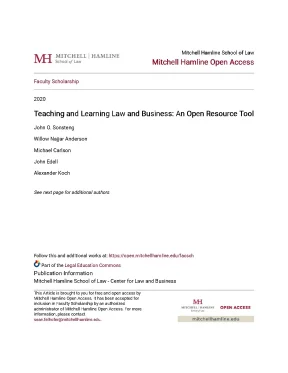
Tải xuống để đọc toàn bộMitchell Hamline School of Law Mitchell Hamline Open Access Faculty Scholarship 2020 Teaching and Learning Law and Business: An Open Resource Tool John O. Sonsteng Willow Najjar Anderson Michael Carlson John Edell Alexander Koch See next page for additional authors Follow this and additional works at: https://open.edu/facsch Part of the Legal Education Commons Publication Information Mitchell Hamline School of Law - Center for Law and Business This Article is brought to you for free and open access by Mitchell Hamline Open Access. It has been accepted for inclusion in Faculty Scholarship by an authorized administrator of Mitchell Hamline Open Access. For more information, please contact sean.
Teaching and Learning Law and Business: An Open Resource Tool Abstract This dissertation examines the impacts of business law education through a multi-layered review of surveys, data, and literature. The authors examine what law schools across the country offer, explore research conducted in partnership with the Minnesota and American Bar Associations, and provide a systemic review of the relevant literature. The data shows attorneys resoundingly do not believe law school coursework prepared them adequately for the business of law. Despite the practical changes that have been made to law school education since the 1960s to the present, there is still a disconnect between what law schools say they will provide and what is delivered.
By examining this issue of how law schools have offered an unfulfilled promise, we clarify the process by which education can transform lives, open doors, and reorganize structures to address the needs of the communities we serve. The period studied: 2009–20 includes the expansion of online capabilities, distance learning, and the global pandemic of COVID 19. Two major research strategies are used: (1) a quantitative analysis of state and countrywide-level data and (2) a review of literature. Data has been collected from archives, interviews, newspapers, published reports, and studies.
This dissertation challenges the proposition that that doctrinal law school course offerings adequately prepare law students to thrive in business for themselves or their clients. Practical skills courses, innovation, collaboration, simulations, and partnerships with lawyers, teachers and businesspeople in the community will be the driving agents for change. Keywords Business of law, Legal practice skills, Practice of law Disciplines Legal Education Authors John O. Sonsteng, Willow Najjar Anderson, Michael Carlson, John Edell, Alexander Koch, Samuel McCollough, and Hannah Mohs Teaching and Learning Law and Business: An Open Resource Tool Professor John Sonsteng Director, Center for Law and Business Mitchell Hamline School of Law B., University of Minnesota, 1964 J., University of Minnesota, 1967 john.edu 651-290-6324 Willow Najjar Anderson Michael Carlson Anderson Law Firm Minnesota State Bar Association J., William Mitchell College of Law, M., William Mitchell College of Law, B., University of Minnesota, 1996 2003 willow@willowandersonlaw., Ripon College, 1993 651-334-3244 mcarlson@mnbars.org 612-278-6336 And John Edell, Mitchell Hamline School of Law, 2021 Alexander Koch, Mitchell Hamline School of Law, 2021 Samuel McCollough, Mitchell Hamline School of Law, 2021 Hannah Mohs, Mitchell Hamline School of Law, 2019 With substantial contributions to this or previous foundation articles by the following: Louis Ainsworth, Doug Belden, Larry Bell, Allen Blair, Terrand Eogie, Angela Bonilla, Sara Dannecker, David Camarotto, June Cicero, Greg Duhl, Oralee Espenheide, Leanne Fuith, Resa Gilats, Hannah Halloran, Holly Hankins, Frank Harris, Roger Haydock, Samuel Heacox, Lisa Heidenreich, Alisha Hennen, Jim Hilbert, Morgan Holcomb, Eric Janus, Leigha Lattner, Katherine Lavigne, John Maclachlan, Paige McAuliffe, Jennifer Miller, Minnesota State Bar Association, Cara Moulton, Christopher Nguyen, Robert Oliphant, Emily Parks, Karl Peters, Michael Peterson, Monali Ralerasakar, Donna Rauch, Denise Roy, Sharon Sandeen, Nigel Savage, Amanda Soderlind, University of Minnesota Center for Survey Research, Anthony Varela, Donna Ward, Anthony Winer, and Jason Zotalis.
Abstract “Teaching and Learning Law and Business: An Open Resource Tool,” (Mitchell Hamline School of Law, July 15, 2020). This dissertation examines the impacts of business law education through a multi-layered review of surveys, data, and literature. The authors examine what law schools across the country offer, explore research conducted in partnership with the Minnesota and American Bar Associations, and provide a systemic review of the relevant literature. The data shows attorneys resoundingly do not believe law school coursework prepared them adequately for the business of law.
Small to mid-sized businesses and entrepreneurs do not find the lawyers law schools produce to be prepared to practice law. Despite the practical changes that have been made to law school education since the 1960s to the present, there is still a disconnect between what law schools say they will provide and what is delivered. By examining this issue of how law schools have offered an unfulfilled promise, we clarify the process by which education can transform lives, open doors, and reorganize structures to address the needs of the communities we serve. The period studied: 2009–20 includes the expansion of online capabilities, distance learning, and the global pandemic of COVID 19.
Two major research strategies are used: (1) a quantitative analysis of state and countrywide-level data and (2) a review of literature. Data has been collected from archives, interviews, newspapers, published reports, and studies. This dissertation challenges the proposition that that doctrinal law school course offerings adequately prepare law students to thrive in business for themselves or their clients. Practical skills courses, innovation, collaboration, simulations, and partnerships with lawyers, teachers and businesspeople in the community will be the driving agents for change.
The Center for Law and Business calls upon partners, collaborators, and innovators to offer advice. Lawyers, alumni, students, faculty, global business partners, and policy reformers may provide input and examples. Contribute in the form of articles, videos, published academic papers, files, unpublished papers, continuing legal education course work, ideas, matrixes for measuring outcomes, and possible solutions. This “Open Resource Tool” will make these materials freely available to anyone.
Just as the computer coding industry has benefited from having source code freely available for possible modification, the Open Resource Tool is also an innovative way to engage participants to collaborate and improve. By propelling change through an array of people, institutions, and infrastructure, these publications and participations will serve law and businesses in this rapidly changing world. Join Us Join the global legal education renaissance. Contribute your ideas, innovations, research, and articles.
Become a partner as a resource for law students and lawyers. Collaborate with us and have discussions with others. The Center for Law and Business Open Resource Tool: mitchellhamline.edu/business-resource Table of Contents Abstract. Introduction: Why Now?.
The Problem: A Summary Of Research And Articles. 2 Proof Of The Problem: Surveys And Studies. What Other Law Schools Are Doing To Integrate Business Curriculum?. 8 University of Arkansas School of Law.
8 Ave Maria School of Law. 8 Chapman University School of Law. 8 Columbus School of Law. Levin College of Law – University of Florida.
9 Indiana University Maurer School of Law. 9 Northwestern University Pritzker School of Law. 9 Texas Tech University School of Law. 10 University of Toledo College of Law.
10 UCLA School of Law. 10 West Virginia University College of Law. 11 Yale Law School. The Case for The Center For Law And Business Mitchell Hamline School of Law: A Way Forward – One Law School’s Solution.
12 The Case for the Center for Law and Business. 12 The Way Forward. 13 The Program and its Context. A Piece of The Solution: The Open Resource Tool.
15 Why An Open Resource?. 15 A Call to Action. 16 How to Use This Open Resource Tool. 16 Contributing Articles or Research.
17 Participating in Discussion Forums. Publishing in The Open Resource Tool: Research, Magazine, Newspaper and Digital Articles. 17 Scope of Operations. Conclusion: Because the Future is Now.
21 Appendix A: Methodology, Data and Results. 22 Identified Sources of Law Practice Management Skills Training—Full Tables Showing Results of the 1997– 99 , 2013 and 2018/19 Surveys. 26 Appendix B: Mitchell Hamline School of Law Curriculum. 1 Center for Law and Business Certificate.
1 Practical Experience Requirement. 3 Student Engagement Requirement. 4 Supporting Research: Articles, Studies, Books. 1 Articles and Books.
Introduction: Why Now? We are amid an unplanned legal education renaissance. One that is more autonomous, virtual, and client centered. In a world where law and business are closely intertwined, lawyers must understand business principles, business ethics, and what it takes to run a business. As the price of law school education mounts, economies depress, technology expands, and businesses modernize, our legal practice and legal education institutions must respond to the obvious needs of our clients.
The resounding evidence shows, however, that legal education in the United States as it stands does not provide law students with the knowledge and skills to successfully run a law practice or support business clients. A law practice, after all, is a business which encompasses all the work and knowledge that a successful business requires. It is not enough just to think like a lawyer. To be successful, one must act like a lawyer and businessperson.
Law schools must provide students with the knowledge and practical experience necessary to do this. While important for all attorneys, national and state employment statistics demonstrate that an understanding of business is crucial for attorneys in business. Through this research, we have identified the unfulfilled promise made by law schools and what law schools are currently offering. We offer preliminary solutions to a crisis that began well before COVID-19 and is now accelerating with unprecedented speed.
For law and businesses alike, we know these factors to be likely in our future. • There will be downturn in economies. A global depression means there will be fewer funding mechanisms for tuition and bricks and mortar institutions. • Businesses and educational institutions are acknowledging that they must create learning and working environments that safeguard public health for the future.
• Alliances with transatlantic partners and cross-cultural exchanges could fray as nations turn inward and close borders to travel. • Doing nothing will accelerate the failure of legal education to fulfill its promise to educate and train lawyers for the practice and business of law. At this historical transition, there are indeed options. We aim to make the different options more visible and collaborative.
Law schools, institutions, and individuals cannot make the critical and necessary changes by working alone. We offer this open resource tool to manage uncertainty in a complex and volatile environment. We aim to connect the legal profession and its business partners so that we can be strategically agile and make better decisions that protect and advance common interests. Law schools and the legal profession worldwide can forge alliances on a coordinated plan.
A sustainable development goal of revitalizing legal education is within reach if we open our resources. The Problem: A Summary Of Research And Articles Law schools must assure that students achieve vital business practice competencies through the legal curriculum and effective teaching and learning protocols. The competencies include understanding business, business forms, business terminology and the ability to deliver practical skills such as drafting, client communication, and problem solving. Students must have an understanding of the range of career opportunities available in the business field as well as the legal field.
While some of these competencies can be taught in the classroom setting, most need to be taught and learned through innovative teaching and learning protocol. Business and financial literacy, practical skills, and client communication skills should be taught by those who have real practical experience and understand how to educate today’s students. Many articles suggest pairing law school faculty with practicing attorneys to provide students a wide variety of legal practice skills. Programs which allow law students to take courses at, or learn from professors who teach at, various other graduate schools can offer students a new perspective.
While the JD/MBA option is available, few students can afford to take this option, whether for monetary reasons or because of the extra time commitment.
Nội dung được bảo vệ bản quyền — Tải xuống đầy đủ
Trích dẫn luận án này
John O. Sonsteng, Willow Najjar Anderson, Michael Carlson, John Edell, Alexander Koch, Samuel McCollough, Hannah Mohs (2020). Teaching and learning law and business an open resource tool [Luận án tiến sĩ, Mitchell Hamline School of Law]. LuanAn.net. https://luanan.net/luat-hoc/teaching-and-learning-law-and-business-an-open-resource-tool
Câu hỏi thường gặp
Luận án "Teaching and learning law and business an open resource tool" nghiên cứu về vấn đề gì?
Khám phá tài nguyên mở về dạy và học luật kinh doanh. Nâng cao kiến thức và kỹ năng kinh doanh, pháp lý với các công cụ học tập toàn diện.
Luận án "Teaching and learning law and business an open resource tool" được bảo vệ tại trường nào?
Luận án này được bảo vệ tại Mitchell Hamline School of Law. Năm bảo vệ: 2020.
Luận án "Teaching and learning law and business an open resource tool" thuộc chuyên ngành gì?
Luận án "Teaching and learning law and business an open resource tool" thuộc chuyên ngành Legal Education. Danh mục: Luật Học.
Luận án "Teaching and learning law and business an open resource tool" có bao nhiêu trang?
Luận án "Teaching and learning law and business an open resource tool" có 51 trang. Bạn có thể xem trước một phần tài liệu ngay trên trang web trước khi tải về.
Cách tải luận án "Teaching and learning law and business an open resource tool" về máy như thế nào?
Để tải luận án về máy, bạn nhấn nút "Tải xuống ngay" trên trang này, sau đó hoàn tất thanh toán phí lưu trữ. File sẽ được tải xuống ngay sau khi thanh toán thành công. Hỗ trợ qua Zalo: 0559 297 239.