Luật Cạnh tranh EU và Pháp quyền: Luận án Tiến sĩ của Ryan R Stones tại LSE
Luật Cạnh tranh EU & Pháp quyền: Luận án LSE khám phá mối liên hệ giữa các quy định EU và nguyên tắc pháp quyền. Phân tích sâu sắc các vụ án.
London School of Economics and Political Science
Luật (Department of Law)
Luan An
Luận án tiến sĩ
Năm xuất bản
Số trang
302
Thời gian đọc
46 phút
Lượt xem
0
Lượt tải
0
Phí lưu trữ
60 Point
Tổng quan nhanh
- Chủ đề:
- Luật cạnh tranh EU và pháp quyền: Lý tưởng và thực tiễn
- Số trang:
- 302 trang
- Trường:
- London School of Economics and Political Science
- Chuyên ngành:
- Luật (Department of Law)
- Tác giả:
- Ryan R Stones
- Năm:
- 2018
Tóm tắt nội dung luận án
I.Luật cạnh tranh EU và pháp quyền Lý tưởng và thực tiễn
Luận án khám phá lý do và cách hiện thực hóa lý tưởng pháp quyền hình thức trong Luật Cạnh tranh EU. Hình thức can thiệp thị trường rất quan trọng. Nó xác định tính hợp pháp của hành vi kinh doanh. Cơ quan thực thi châu Âu chưa luôn đánh giá đúng ý nghĩa này. Luận án bảo vệ khát vọng về pháp quyền hình thức trong chính sách cạnh tranh. Mục tiêu là xác định tính hợp pháp thông qua các chuẩn mực tổng quát, áp dụng bình đẳng và dễ hiểu. Việc này phải chịu sự xét lại tư pháp mạnh mẽ. Hình thức can thiệp này có thể không hoàn hảo. Nó có thể cấm các hành vi hiệu quả và cho phép hành vi kém hiệu quả. Tuy nhiên, các quyết định về tính hợp pháp được kiềm chế và cấu trúc hóa. Điều này tạo điều kiện hiện thực hóa các giá trị quan trọng khác. Tính chắc chắn pháp lý cho doanh nghiệp được tăng cường. Sự kiểm soát tư pháp trở nên minh bạch hơn.
1.1. Khám phá vai trò của pháp quyền hình thức
Pháp quyền hình thức là một lý tưởng trung tâm. Nó đòi hỏi việc áp dụng các chuẩn mực pháp lý tổng quát. Các chuẩn mực này phải áp dụng bình đẳng cho mọi chủ thể. Doanh nghiệp cần dễ dàng hiểu chúng. Việc này phải đi kèm với kiểm soát tư pháp chặt chẽ. Lý tưởng này bảo vệ doanh nghiệp khỏi sự can thiệp tùy tiện. Nó cung cấp cơ sở dự đoán cho hành vi kinh doanh. Vai trò này đặc biệt quan trọng trong lĩnh vực Luật Cạnh tranh EU.
1.2. Can thiệp thị trường và hành vi doanh nghiệp
Hình thức can thiệp vào thị trường ảnh hưởng trực tiếp đến hành vi doanh nghiệp. Khi pháp luật cạnh tranh áp dụng các quy tắc rõ ràng, doanh nghiệp có thể dự đoán hậu quả hành động của mình. Ngược lại, sự can thiệp tùy ý tạo ra sự không chắc chắn. Điều này cản trở đầu tư và đổi mới. Luận án chỉ ra rằng các cơ quan thực thi EU chưa luôn đánh giá cao tầm quan trọng này. Cần có sự nhất quán trong áp dụng pháp luật. Điều này giúp thúc đẩy môi trường kinh doanh công bằng và hiệu quả.
II.Nền tảng pháp quyền trong luật cạnh tranh EU
Phần đầu của luận án biện minh cho việc tiếp cận lý tưởng pháp quyền hình thức. Chính sách cạnh tranh đòi hỏi sự rõ ràng trong quy định. Các trường phái tư tưởng lớn ủng hộ điều này. Chúng bao gồm Trường phái Chicago về chống độc quyền và chủ nghĩa Ordoliberal của Đức. Cả hai đều nhấn mạnh việc thực thi thông qua các chuẩn mực tổng quát. Các chuẩn mực này phải dễ quản lý và dễ hiểu đối với doanh nghiệp. Những quan điểm này được lồng ghép vào các công trình rộng hơn về luật học, lý thuyết hiến pháp tự do và kinh tế học thể chế. Điều này chứng minh ý nghĩa chính trị và kinh tế của lý tưởng pháp quyền hình thức. Nó rất quan trọng đối với việc thực thi Luật Cạnh tranh EU. Tính minh bạch trong pháp luật EU được đề cao.
2.1. Quan điểm của trường phái Chicago và Ordoliberalism
Trường phái Chicago ủng hộ cách tiếp cận dựa trên hiệu quả kinh tế. Tuy nhiên, họ cũng nhấn mạnh sự cần thiết của các quy tắc rõ ràng. Điều này nhằm giảm thiểu sự tùy tiện. Chủ nghĩa Ordoliberal của Đức tập trung vào tạo ra một trật tự thị trường cạnh tranh. Họ tin rằng điều này đạt được thông qua một khuôn khổ pháp luật mạnh mẽ. Các chuẩn mực tổng quát, có thể quản lý, dễ hiểu là cốt lõi. Chúng đảm bảo thị trường hoạt động hiệu quả và công bằng. Cả hai trường phái đều chỉ ra tầm quan trọng của tính chắc chắn pháp lý trong Luật Cạnh tranh EU.
2.2. Ý nghĩa chính trị kinh tế của chuẩn mực tổng quát
Các chuẩn mực tổng quát có ý nghĩa sâu sắc. Về mặt chính trị, chúng đảm bảo sự bình đẳng trước pháp luật. Chúng hạn chế quyền lực của nhà nước. Về mặt kinh tế, chúng giảm chi phí tuân thủ cho doanh nghiệp. Doanh nghiệp có thể dự đoán rủi ro pháp lý. Điều này khuyến khích đầu tư và đổi mới. Pháp quyền EU, thông qua các chuẩn mực này, là nền tảng cho một thị trường chung hoạt động hiệu quả. Nó củng cố niềm tin vào các thủ tục hành chính EU.
III.Áp dụng pháp quyền trong thực thi cạnh tranh EU
Phần thứ hai của luận án đánh giá việc thực hiện lý tưởng pháp quyền trong chính sách cạnh tranh EU. Kết quả cho thấy sự pha trộn. Một mặt, Ủy ban Châu Âu thường ưu tiên hiệu quả. Mục tiêu là làm cho thị trường hoạt động 'tốt hơn'. Ủy ban tìm cách tối đa hóa phạm vi can thiệp tùy ý. Việc này có thể được tạo điều kiện bởi sự xét lại tư pháp chưa đủ nghiêm ngặt. Mặt khác, Luật Cạnh tranh EU có những nỗ lực đáng ghi nhận. Một số giả định và các kiểm tra đa giai đoạn được sử dụng. Chúng kết hợp các cân nhắc về hiệu quả ngay từ đầu. Điều này được đưa vào các chuẩn mực tổng quát. Việc này mang lại tính chắc chắn pháp lý cho các công ty. Đây là những nỗ lực đáng ngưỡng mộ để dung hòa các mục tiêu kinh tế chính xác và phương tiện tiếp cận pháp quyền hình thức.
3.1. Ưu tiên của Ủy ban Châu Âu và can thiệp linh hoạt
Ủy ban Châu Âu là cơ quan thực thi chính. Ủy ban thường đặt hiệu quả kinh tế lên hàng đầu. Điều này đôi khi dẫn đến các quyết định linh hoạt. Ủy ban có thể tìm cách tối đa hóa quyền tùy nghi của mình. Họ tin rằng điều này cần thiết để điều chỉnh thị trường. Cách tiếp cận này có thể mâu thuẫn với yêu cầu về tính chắc chắn pháp lý. Sự thiếu minh bạch trong pháp luật EU đôi khi xuất hiện. Điều này làm tăng sự không dự đoán được cho doanh nghiệp. Cần có sự cân bằng giữa mục tiêu và phương pháp thực hiện.
3.2. Xét lại tư pháp và giới hạn quyền hành chính
Việc kiểm soát tư pháp là rất quan trọng. Tòa án Công lý Châu Âu (CJEU) có vai trò giám sát các quyết định của Ủy ban Châu Âu. Tuy nhiên, việc xét lại tư pháp đôi khi còn quá dè dặt. Điều này có thể cho phép Ủy ban có quá nhiều quyền tùy nghi. Luận án đặt câu hỏi về mức độ trách nhiệm giải trình của Ủy ban. Cần có sự cân bằng để đảm bảo các thủ tục hành chính EU tuân thủ nghiêm ngặt Pháp quyền EU. Việc tăng cường kiểm soát tư pháp sẽ củng cố niềm tin của doanh nghiệp.
IV.Kiểm soát tư pháp và chắc chắn pháp lý EU
Kiểm soát tư pháp đóng vai trò nền tảng trong hệ thống pháp quyền EU. Tòa án Công lý Châu Âu (CJEU) đảm bảo tính hợp pháp của các quyết định hành chính. Đặc biệt là trong Luật Cạnh tranh EU. Việc giám sát này hạn chế quyền tùy nghi của Ủy ban Châu Âu. Nó củng cố niềm tin vào hệ thống pháp luật. Đồng thời, các nguyên tắc pháp quyền đòi hỏi tính chắc chắn pháp lý. Doanh nghiệp cần có khả năng dự đoán các hậu quả pháp lý từ hành động của mình. Sự rõ ràng trong các chuẩn mực pháp lý là tối cần thiết. Điều này giúp các công ty tuân thủ pháp luật hiệu quả hơn. Nó giảm thiểu rủi ro pháp lý và chi phí không cần thiết. Minh bạch trong pháp luật EU cũng là một yếu tố quan trọng.
4.1. Vai trò của Tòa án Công lý Châu Âu CJEU
CJEU là cơ quan tư pháp cao nhất của EU. Tòa án đóng vai trò thiết yếu trong việc đảm bảo Pháp quyền EU. CJEU xem xét tính hợp pháp của các hành động và quyết định của các cơ quan EU. Điều này bao gồm các quyết định của Ủy ban Châu Âu trong lĩnh vực Luật Cạnh tranh EU. Các phán quyết của Tòa án thiết lập các tiền lệ. Chúng định hình việc áp dụng các chuẩn mực pháp lý. Điều này cung cấp sự kiểm soát tư pháp cần thiết. Nó giữ cho Ủy ban chịu trách nhiệm giải trình.
4.2. Đảm bảo tính chắc chắn pháp lý cho doanh nghiệp
Tính chắc chắn pháp lý là yếu tố sống còn cho môi trường kinh doanh. Doanh nghiệp cần biết rõ ràng các quy tắc. Họ phải hiểu cách thức áp dụng các quy tắc đó. Các chuẩn mực tổng quát và các bài kiểm tra đa giai đoạn giúp đạt được điều này. Chúng cung cấp khung pháp lý ổn định. Điều này cho phép doanh nghiệp lập kế hoạch và đầu tư. Nó giảm thiểu sự bất ngờ và tranh chấp pháp lý. Tính minh bạch trong pháp luật EU, cùng với các thủ tục hành chính EU rõ ràng, củng cố tính chắc chắn pháp lý.
V.Hài hòa hiệu quả kinh tế và pháp quyền EU
Luận án đề xuất một cách tiếp cận cân bằng. Nó dung hòa giữa mục tiêu hiệu quả kinh tế và lý tưởng pháp quyền hình thức. Chính sách cạnh tranh tìm cách đạt được hiệu quả thị trường. Tuy nhiên, phương pháp thực hiện phải tuân thủ các nguyên tắc pháp luật. Việc này đòi hỏi sự đánh đổi. Các quyết định có thể không hoàn toàn tối ưu về kinh tế. Nhưng chúng được đưa ra trong một khuôn khổ pháp lý vững chắc. Các giả định và bài kiểm tra đa giai đoạn trong Luật Cạnh tranh EU thể hiện sự cân bằng này. Chúng tích hợp các cân nhắc về hiệu quả từ trước. Đồng thời, chúng tạo ra các chuẩn mực tổng quát. Điều này cung cấp tính chắc chắn về mặt quy phạm cho các công ty. Nó là một nỗ lực để đạt được hiệu quả kinh tế chính xác thông qua các phương tiện phù hợp với pháp quyền hình thức.
5.1. Cân bằng mục tiêu kinh tế và nguyên tắc pháp quyền
Luật cạnh tranh luôn đối mặt với thách thức. Nó phải cân bằng giữa việc thúc đẩy hiệu quả kinh tế và duy trì các nguyên tắc pháp quyền. Mục tiêu làm cho thị trường hoạt động 'tốt hơn' cần được thực hiện một cách có trách nhiệm. Điều này có nghĩa là tuân thủ các nguyên tắc như tính chắc chắn pháp lý, minh bạch trong pháp luật EU và kiểm soát tư pháp. Nguyên tắc cân xứng đóng vai trò hướng dẫn. Nó đảm bảo các biện pháp can thiệp là cần thiết và phù hợp với mục tiêu.
5.2. Các nỗ lực điều chỉnh chuẩn mực hiệu quả
Hệ thống pháp luật cạnh tranh EU đã phát triển. Nó bao gồm các cơ chế tinh vi. Ví dụ, các giả định và bài kiểm tra đa giai đoạn. Chúng cho phép tích hợp cân nhắc hiệu quả vào các chuẩn mực pháp lý. Điều này không làm mất đi tính tổng quát của chúng. Thay vào đó, nó cung cấp một khuôn khổ có cấu trúc. Khung này cho phép đánh giá hành vi một cách khách quan hơn. Các nỗ lực này thể hiện cam kết đối với Pháp quyền EU. Đồng thời, chúng cố gắng đáp ứng nhu cầu kinh tế của thị trường chung.
Mục lục chi tiết luận án
Tải xuống file đầy đủ để xem toàn bộ nội dung
Tải đầy đủ (302 trang)Trích đoạn nội dung luận án
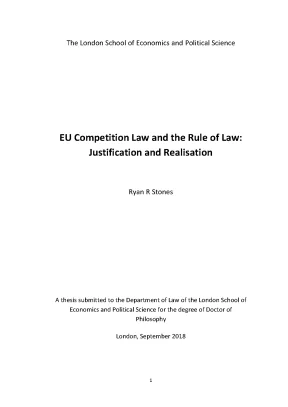
Tải xuống để đọc toàn bộThe London School of Economics and Political Science EU Competition Law and the Rule of Law: Justification and Realisation Ryan R Stones A thesis submitted to the Department of Law of the London School of Economics and Political Science for the degree of Doctor of Philosophy London, September 2018 1 Declaration I certify that the thesis I have presented for examination for the PhD degree of the London School of Economics and Political Science is solely my own work other than where I have clearly indicated that it is the work of others (in which case the extent of any work carried out jointly by me and any other person is clearly identified in it). The copyright of this thesis rests with the author. Quotation from it is permitted, provided that full acknowledgement is made. This thesis may not be reproduced without my prior written consent.
I warrant that this authorisation does not, to the best of my belief, infringe the rights of any third party. I declare that my thesis consists of 99,998 words. 2 Abstract This thesis explores the justification for and realisation of the formal rule of law ideal in EU competition law. It argues that the form of market intervention for determining the legality of business conduct matters, although European enforcement has not always appreciated its significance.
It defends aspirations towards the formal rule of law in the fundamentally economic endeavour of competition policy: determining lawfulness through the application of generalised, equally-applicable, and comprehensible norms, subject to robust judicial review. While this less-discriminating form of market intervention is necessarily imperfect when compared with conduct-specific evaluations of competitive consequences, thus inaccurately prohibiting the efficient and permitting the inefficient, more restrained and structured determinations of legality facilitate the realisation of other important values. Part I justifies efforts to approximate the formal rule of law ideal in competition policy. Both the Chicago School of antitrust and German Ordoliberalism indicate support for enforcement through the application of generalised norms that are administrable and comprehensible to businesses.
Their perspectives on the legitimate form of market intervention are woven into broader works of jurisprudence, liberal constitutional theory, and institutional economics, thereby demonstrating the political and economic significance of the formal rule of law ideal for competition enforcement. Part II evaluates its mixed realisation in EU competition policy. On the one hand, the Commission has often prioritised the effective pursuit of its ends to make markets work “better”, seeking to maximise the scope for discretionary interventions as it deems necessary and perhaps facilitated by deferential judicial review. On the other hand, certain presumptions and multi-stage tests for determining legality in EU competition law incorporate efficiency considerations ex ante into generalised norms that afford normative certainty to firms.
Albeit imperfect, these are interpreted as admirable attempts to optimally reconcile economically-accurate ends and a means approximating the formal rule of law. 3 Acknowledgements This thesis is a result of the intellectually-stimulating environment found at the Law Department of the London School of Economics. It is the product of eight years of affiliation with the LSE, born of inspiring teaching on my undergraduate degree, and brought to fruition on the PhD programme through careful supervision, rigorous training, and collegiate support. The key figure throughout has been my lead supervisor, Professor Pablo Ibáñez Colomo.
He has not only shared his enlightening thoughts, sparked fascinating lines of enquiry, and unfailingly read countless drafts, but is also responsible for introducing me to the field of competition law in the first place. I am immensely grateful for his inspiration, guidance, and support since my very first day at the LSE in 2010, and look forward to many more years of scholarly discussions. This thesis has also benefitted from the wisdom and critique of Professor Martin Loughlin, my second supervisor. Indeed, Part I is largely the result of his earlier scepticism that the formal rule of law should have anything to do with competition enforcement.
It has been improved immensely by his comprehensive knowledge of all things theoretical. I would also like to acknowledge the support of the wider LSE Law Department: Professor Susan Marks as Doctoral Programme Director; Rachel Yarham as Doctoral Programme Administrator; my readers at the upgrade stage, Dr Orla Lynskey and Professor Tom Poole; Dr Niamh Dunne, for both chairing my third year presentation in January 2017 and for frequently discussing many of the ideas raised in this thesis; and my fellow students on the PhD programme for their collegiality and mutual support. I am also grateful for the receipt of a LSE PhD Studentship to fund this period of study. Furthermore, I would like to thank my family and friends for their unfailing interest and encouragement throughout the past four years.
Although my parents, Anthony and Julie, have struggled to understand the subject matter of this thesis, their intrigue and pride has been endless. Most of all, I would like to acknowledge the role of my inspirational partner, Lauren Scarlett Thomas, for what has truly been a joint effort. This long and at times difficult process would not have been possible without her love, care, and support. 4 Table of Contents Introduction 9 Chapter I: Competition Policy: Economic Orthodoxy and Formal Indeterminacy 16 I.
Basic Microeconomic Price Theory and the Need for Market Intervention 17 III. The Limits of Neo-Classical Price Theory and Contemporary Competition Microeconomics: Context is Key 22 A) Necessarily Unrealistic Assumptions 22 B) Important Considerations Excluded 23 C) Contemporary Competition Microeconomics: Context is Key 24 IV. The Unanswered Question: What Form of Market Intervention? 26 Chapter II: The Chicago School of Antitrust: An Economic ‘Subordination’ of Law? 29 I. The History, Approach, and Implications of the Chicago School of Antitrust 31 A) A Brief History of the Chicago School 32 B) The Chicagoan Approach: Economic Method and Legal Motivation 34 C) Legal Implications of the Chicago School Approach 37 III.
The Chicagoan Rejection of ad hoc, Subject-Specific Determinations of Legality 41 A) Posner’s Response to Sylvania 42 B) Bork versus Williamson and his Peculiar Conceptualisation of the Rule of Reason 45 C) Post-Chicago Complexity and Easterbrook’s ‘Workable Antitrust’ School 49 IV. The Chicago School and the Rule of Law 53 A) Bork and Easterbrook: On “Good” and “Bad” Law 54 B) The Chicago School of Economics and Liberal Political Theory 57 C) Posner: The Rule of Law as Incentive Calibration and Effective Intervention 60 V. Conclusion: The Chicagoan Form of Market Intervention and its Limits 64 Chapter III: Ordoliberalism: Ambiguous Economics and the Rechtsstaat Tradition 66 I. Ordoliberalism as a Family of Shared Concepts 68 A) Historical Account 68 B) Conceptual Account 70 III.
The Ambiguous Substance of Ordoliberal Competition Policy 79 IV. The Form of Ordoliberal Competition Policy: Contextualisation and Extrapolation 85 A) Kant and the Rechtsstaat in German Constitutional Theory 87 B) From the Formal Rechtsstaat to Freiburg 93 V. Conclusion: Rival Schools? 103 Chapter IV: The Rule of Law Ideal: Rationality, Restraint, and Robust Review 105 I. A Tripartite Conceptualisation of the Formal Rule of Law Ideal and its Critique 106 III.
The Rule of Law Ideal in Liberal Political Theory 113 A) Principle I - Comprehensible Norms: Respecting Rationality 115 B) Principle II - Generalisation and Equal Application: “Belt-and-Braces” Restraint 119 C) Principle III: The Instrumental Virtue of Robust Review 124 IV. Convergence: The Formal Rule of Law in New Institutional Economics 133 A) New Institutional Economics: An Overview 133 B) NIE and the Rule of Law 137 V. Conclusion to Part I: From Justification to Realisation 146 Chapter V: Effective Ends and Discretionary Means: Disregarding the Formal Rule of Law in EU Competition Policy 149 I. Introduction: Effective Realisation of Immaterial Ends 149 II.
Enforcement of Article 101 TFEU 152 A) Pre-Modernisation Commission Decisions: Exercising Discretion via Exemption Decisions 152 B) Judicial Review of Article 101 Decisions 161 III. Enforcement of Article 102 TFEU 169 A) Commission Decisions: Building Discretion 169 B) Judicial Review: Who Interprets the Law of Article 102? 176 IV. Commitment Decisions in the Post-Modernisation Era: More Effective Ends, Same Problematic Means, 182 A) Effective Ends I: Competition Enforcement without Competition Law 184 6 B) Effective Ends II: The Remedial Potential of Commitment Decisions 192 C) Problematic Means: Systemic Detriment to the Rule of Law 197 D) Judicial Review: A Missed Opportunity? 205 V. Conclusion 210 Chapter VI: Ex Ante Optimisation of Efficiency and the Rule of Law: Celebrating Imperfection in EU Competition Policy 212 I.
Efficiency “Perfectionism” and “Optimisation” in EU Competition Scholarship 215 A) Efficiency Perfectionism: Effective Ends and Problematic Means Redux 215 B) Efficiency Optimisation: Imperfect Ends and More Comprehensible Means 219 III. Optimising Ends and Means in EU Competition Law 224 A) Mixing Forms of Market Intervention: The Commission’s Soft Law Guidelines 225 B) Presumptions of Legality under Article 101 230 C) Presumptions of Illegality 235 D) More Discriminating Determinations of Legality: Multi-Stage Tests 246 IV. Conclusion: Less is More 256 Conclusion 258 Bibliography 262 I. Books, Articles, and Papers 262 II.
EU Legislation 295 III. European Commission Documents 296 A) Guidelines, Guidance, and Notices 296 B) Reports, Working Papers, and Briefs 296 C) Press Releases, Speeches, and Memos 296 IV. Decisions of the European Commission 298 A) Pre-Regulation 1/2003 Decisions 298 B) Article 7 Prohibition Decisions 299 C) Article 9 Commitment Decisions 299 D) Other Decisions under Regulation 1/2003 299 V. Judgments of the European Courts 300 A) Judgments of the Court of Justice of the European Union 300 7 B) Judgments of the General Court (formerly Court of First Instance) 301 VI.
Cases from the US 302 8 Introduction Scholarly interest in EU competition policy derives from its location at the intersection between law and economics, which brings together a suite of contrasting concepts and methods to make markets work “better”. Most decisions of the European Commission or judgments of the EU Courts pursuant to Articles 101 and 102 TFEU 1 can be interpreted as complex, sometimes tense, interdisciplinary syntheses. Exploring such frictions has been a perennial occupation of competition scholars. Since the inclusion of competition provisions within the Treaty of Rome, countless commentators have considered the substantive relationship between law and economics in the field.
For example, how should the economic goal/s pursued by EU competition law be understood? Do particular decisions, cases, and legal doctrines cohere with economic learning? Does economics reveal “gaps” where anticompetitive conduct escapes legal prohibition? In these enquiries, law is an empty vessel. As it lacks an essential substantive content of its own, 2 the question is the extent to which EU competition law has accurately absorbed contemporary economic thinking. Alternatively, scholars have also routinely addressed the appropriate form of market intervention: of how the economic goal/s of competition policy ought to be realised through the medium of law. Consider two reflections: “…competition policy cannot be based on economics alone.
The rule of law is a pillar of the constitutional system: it makes the enforcement of competition policy predictable and allows economic actors to adapt their behaviour.” 3 “…traditional lawyers remain reluctant to use economic analysis since it may make the outcome of real-life cases less predictable and thus fly in the face of legal certainty… The lack of flexibility resulting from the use of traditional legal concepts makes it impossible to profit fully from important economic insights.” 4 1 Article 101 Treaty on the Functioning of the European Union (“TFEU”) (prohibiting agreements, concerted practices, and decisions of trade associations with the object or effect of restricting competition); Article 102 TFEU (prohibiting the abuse of a dominant position). 2 It could be argued that rights of defence and due process are necessary “legal” elements, but these procedural requirements are not in conflict with an economically-informed substance. 3 Evans and Grave [2005] 136. 4 Van den Bergh [2002] 34-35.
9 Albeit offering different analyses, both extracts point to a particular tension within competition policy.
Nội dung được bảo vệ bản quyền — Tải xuống đầy đủ
Trích dẫn luận án này
Ryan R Stones (2018). Luật Cạnh tranh EU và Pháp quyền: Luận án LSE [Luận án tiến sĩ, London School of Economics and Political Science]. LuanAn.net. https://luanan.net/luat-hoc/luat-canh-tranh-eu-phap-quyen-lse
Câu hỏi thường gặp
Luận án "Luật Cạnh tranh EU và Pháp quyền: Luận án LSE" nghiên cứu về vấn đề gì?
Luật Cạnh tranh EU & Pháp quyền: Luận án LSE khám phá mối liên hệ giữa các quy định EU và nguyên tắc pháp quyền. Phân tích sâu sắc các vụ án.
Luận án "Luật Cạnh tranh EU và Pháp quyền: Luận án LSE" được bảo vệ tại trường nào?
Luận án này được bảo vệ tại London School of Economics and Political Science. Năm bảo vệ: 2018.
Luận án "Luật Cạnh tranh EU và Pháp quyền: Luận án LSE" thuộc chuyên ngành gì?
Luận án "Luật Cạnh tranh EU và Pháp quyền: Luận án LSE" thuộc chuyên ngành Luật (Department of Law). Danh mục: Luật Học.
Luận án "Luật Cạnh tranh EU và Pháp quyền: Luận án LSE" có bao nhiêu trang?
Luận án "Luật Cạnh tranh EU và Pháp quyền: Luận án LSE" có 302 trang. Bạn có thể xem trước một phần tài liệu ngay trên trang web trước khi tải về.
Cách tải luận án "Luật Cạnh tranh EU và Pháp quyền: Luận án LSE" về máy như thế nào?
Để tải luận án về máy, bạn nhấn nút "Tải xuống ngay" trên trang này, sau đó hoàn tất thanh toán phí lưu trữ. File sẽ được tải xuống ngay sau khi thanh toán thành công. Hỗ trợ qua Zalo: 0559 297 239.