The origins and antecedents of joachim of fiores 1135 1202 his
Khám phá nguồn gốc và tiền đề tư tưởng của Joachim xứ Fiore (1135-1202), nhà thần học có ảnh hưởng sâu sắc đến lịch sử tư tưởng châu Âu.
Andrews University
Religious Thought, Theology and Philosophy of Religion
Luan An
Luận án
Năm xuất bản
Số trang
381
Thời gian đọc
58 phút
Lượt xem
0
Lượt tải
0
Phí lưu trữ
60 Point
Tổng quan nhanh
- Chủ đề:
- Joachim of Fiore: Prophetic Interpretation & Impact
- Số trang:
- 381 trang
- Trường:
- Andrews University
- Chuyên ngành:
- Religious Thought, Theology and Philosophy of Religion
- Tác giả:
- Dojčin Živadinović
- Năm:
- 2018
Tóm tắt nội dung luận án
I.Joachim of Fiore Prophetic Interpretation Impact
Joachim of Fiore (1135-1202) initiated a pivotal shift in biblical exegesis. His works, created in an age dominated by allegorical hermeneutics, profoundly influenced medieval eschatology. This Cistercian monk's approach provided a new lens for understanding prophetic texts. His historical-continuous method offered a systematic framework. It moved beyond purely allegorical readings. This innovation directly impacted the development of both Catholic and Protestant eschatology. His concepts shaped the understanding of end-time prophecies. Joachim's thought became a cornerstone for apocalypticism. The Florensian Order, which he founded, continued to propagate his unique prophetic thought. Understanding his impact requires examining his origins.
1.1. Shifting Biblical Exegesis in the Middle Ages
Biblical idealism previously defined hermeneutics. Allegorical interpretation was the prevailing method. Joachim of Fiore introduced a novel approach. His exegesis diverged from the common practice. It brought a historical dimension to prophetic interpretation. This represented a critical re-evaluation of scripture. Prophetic thought gained new structures. Joachim's work prompted a re-examination of established traditions. His Cistercian background likely informed his deep textual engagement. This shift had lasting consequences for theological scholarship.
1.2. The Influence on Catholic and Protestant Eschatology
Joachim's eschatological views left an indelible mark. Both Catholic and Protestant traditions integrated his ideas. His interpretations of Daniel and Revelation proved highly influential. They provided new frameworks for understanding the late Middle Ages. Apocalypticism gained systematic structure through his writings. Future theologians engaged extensively with his prophecies. The Florensian Order, established by Joachim, perpetuated his distinctive prophetic thought. This widespread influence underscores his importance. His legacy continues to be a vital area of study in medieval theology.
II.Unraveling Joachim s Eschatological Origins
Joachim of Fiore's impact on late medieval eschatology is well-documented. However, the specific antecedents of his groundbreaking ideas remain largely unexplored. Scholars have expressed clear interest in his influence. Few have deeply investigated the intellectual roots that shaped his distinctive method. This includes his unique historical-continuous interpretation of prophecy. The origins of his application of the year-day principle also require further examination. Understanding these precursors provides crucial context. It reveals the broader intellectual landscape that informed his innovations. This research aims to fill this scholarly gap.
2.1. The Problem Unexplored Roots of His Ideas
Joachim of Fiore's theological contributions are significant. His profound influence on medieval eschatology is undeniable. Yet, a crucial gap in scholarship exists. The precise antecedents of his interpretive method are not fully understood. Few scholars have explored the sources of his historical-continuous approach. The application of the year-day principle also lacks comprehensive study regarding its origins. This problem highlights a need for deeper historical inquiry. Uncovering these roots is essential for a complete understanding of Joachim's genius. It sheds light on the development of his prophetic thought.
2.2. Purpose Identifying Influential Literary Traditions
This study aims to investigate the origins of Joachim's eschatological views. Its purpose is to identify the sources and literary traditions that shaped his thought. The focus lies on how he developed a systematically historical scheme. This scheme was primarily for interpreting the book of Revelation. By exploring these potential influences, the study offers new insights. It clarifies the intellectual lineage of Joachim's innovative method. This research helps situate his work within a broader historical context. It contributes to understanding the evolution of medieval prophetic thought.
III.Biblical Exegesis Joachim s Historical Continuous Approach
Joachim of Fiore's method of prophetic interpretation stands apart. It combines distinct principles that differentiate it from contemporary approaches. His historical-continuous interpretation applies a specific framework to biblical texts. This framework seeks chronological links within prophecy. It views scripture as a continuous unfolding of divine plan. The method involves systematic comparison. It evaluates Joachim's interpretation against earlier and contemporary sources. This analytical process illuminates the unique aspects of his exegesis. It highlights how his vision of the Three Ages of History emerges from this approach.
3.1. Depicting Joachim s Method of Interpretation
The dissertation first accurately details Joachim's prophetic method. This step involves a precise description of his hermeneutical framework. It outlines how Joachim approached the books of Daniel and Revelation. His focus on historical continuity distinguishes his exegesis. This method contrasts sharply with the prevalent allegorical interpretations. It represents a structured and systematic way of understanding prophetic texts. Depicting this method is crucial for subsequent comparative analysis. It provides a foundation for tracing its antecedents.
3.2. Year Day Principle and Systematic Historical Scheme
Joachim's method incorporates the year-day principle. This principle, often converting prophetic days into historical years, is central. It allows for a systematic historical scheme. This scheme interprets the book of Revelation chronologically. It connects prophetic visions to real-world events. This innovative biblical exegesis became a hallmark of his apocalypticism. It supported his comprehensive vision of history. The development of the Three Ages of History is intrinsically linked to this approach. This method reshaped medieval prophetic thought and its application.
IV.Diverse Antecedents of Joachim s Prophetic Thought
Joachim's hermeneutical framework did not emerge in a vacuum. Analysis reveals a combination of diverse sources. His system integrates historical periodization, drawing from various Christian traditions. It incorporates elements from Latin medieval Revelation exegesis. Crucially, Near-Eastern Christian and Jewish traditions also played a significant role. These multiple streams contributed to his complex prophetic thought. They shaped his unique approach to biblical texts. This synthesis demonstrates his broad engagement with existing theological landscapes. Understanding these diverse antecedents clarifies the originality and influences behind his work.
4.1. Historical Periodization Across Christian Traditions
Joachim's framework notably incorporates historical periodization. This division of Church history into distinct eras was not unique. It characterized expositors in the Latin High Middle Ages. Early Byzantine period commentators also employed it. Near-Eastern Christian exegesis showed similar patterns of historical structuring. These widespread traditions provided a foundation. Patristic influences might have contributed to early forms of this thought. Joachim synthesized these existing patterns. He adapted them to his unique eschatological vision.
4.2. Latin Medieval and Near Eastern Exegetical Roots
Joachim's hermeneutics draw from the Latin medieval tradition. This tradition placed strong emphasis on Revelation exegesis. The recapitulation principle frequently dominated its interpretation. Additionally, Near-Eastern Christian sources offered crucial insights. Armenian, Syrian, and Coptic traditions are particularly noted. These traditions contributed significantly to his prophetic understanding. Their methods of biblical exegesis provided valuable antecedents. They helped shape his specific approach to apocalyptic literature.
4.3. Jewish Prophetic Interpretation and Millennial Views
A significant antecedent lies in the Jewish tradition. Jewish systems of prophetic interpretation utilized the 'year-day' principle. This principle also featured in Near-Eastern Christian thought. This concept, associating prophetic days with historical years, was vital. It often coupled with the expectation of a future Sabbatical period. This period is sometimes referred to as the millennium. These elements from both Jewish and Near-Eastern sources deeply informed Joachim's apocalypticism. They provided fundamental building blocks for his complex eschatological framework. This integration shows a broad engagement with diverse theological currents.
V.Joachim s Legacy in Medieval Eschatology Apocalypticism
Joachim of Fiore's system of interpretation does not stem from a single, direct antecedent. Instead, it represents a sophisticated synthesis of multiple sources. His genius lay in combining existing traditions into a cohesive new framework. The historicist method, though rare in the early Latin Middle Ages, saw a revival. This revival was particularly prominent in Byzantine and Near-Eastern Christian traditions. Joachim's work further solidified this approach. His legacy profoundly shaped medieval eschatology. It provided new avenues for prophetic thought and apocalypticism. Neglected areas of study continue to offer fresh insights into his complex origins.
5.1. No Single Antecedent A Synthesis of Sources
Joachim's interpretive system lacks a singular direct antecedent. It represents a complex synthesis of various sources. This indicates a profound intellectual effort. His method skillfully combined different streams of prophetic thought. This amalgamation resulted in a uniquely comprehensive system. His original contribution was in weaving these diverse elements together. This synthesis showcases his capacity for innovative biblical exegesis. It highlights the depth of his engagement with historical and theological traditions.
5.2. Revival of Historicism Byzantine and Near Eastern Links
The historicist method of biblical interpretation experienced a resurgence. It was rare in the early Latin Middle Ages. However, it gained prominence in the High Middle Ages. Biblical historicism was particularly strong in Byzantine and Near-Eastern Christian traditions. These traditions frequently applied it to Revelation. Potential similarities between Joachim and these Eastern expositors are surprising. This suggests a broader intellectual exchange. These links illuminate the context for Joachim's development of his own historical-continuous method.
5.3. Future Research Neglected Areas in Joachite Studies
The connections between Joachim and Near-Eastern Christian expositors remain understudied. Few contemporary scholars have explicitly linked Joachim's ideas with these Eastern commentaries. This represents a significant, yet neglected, area for future Joachite studies. Exploring these links can further illuminate the origins of his historical-chronological thought. This research can provide new insights into medieval eschatology. It enhances understanding of the cross-cultural influences on prophetic thought and apocalypticism during this period.
Tải xuống file đầy đủ để xem toàn bộ nội dung
Tải đầy đủ (381 trang)Trích đoạn nội dung luận án
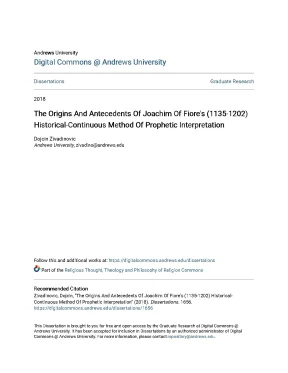
Tải xuống để đọc toàn bộAndrews University Digital Commons @ Andrews University Dissertations Graduate Research 2018 The Origins And Antecedents Of Joachim Of Fiore's (1135-1202) Historical-Continuous Method Of Prophetic Interpretation Dojcin Zivadinovic Andrews University, zivadino@andrews.edu Follow this and additional works at: https://digitalcommons.edu/dissertations Part of the Religious Thought, Theology and Philosophy of Religion Commons Recommended Citation Zivadinovic, Dojcin, "The Origins And Antecedents Of Joachim Of Fiore's (1135-1202) Historical- Continuous Method Of Prophetic Interpretation" (2018).edu/dissertations/1656 This Dissertation is brought to you for free and open access by the Graduate Research at Digital Commons @ Andrews University. It has been accepted for inclusion in Dissertations by an authorized administrator of Digital Commons @ Andrews University. For more information, please contact repository@andrews. ABSTRACT THE ORIGINS AND ANTECEDENTS OF JOACHIM OF FIORE’S (1135-1202) HISTORICAL-CONTINUOUS METHOD OF PROPHETIC INTERPRETATION by Dojčin Živadinović Adviser: P.
Gerard Damsteegt ABSTRACT OF GRADUATE STUDENT RESEARCH Dissertation Andrews University Seventh-day Adventist Theological Seminary Title: THE ORIGINS AND THE ANTECEDENTS OF JOACHIM OF FIORE’S (1135-1202) HISTORICAL-CONTINUOUS METHOD OF PROPHETIC INTERPRETATION Name of researcher: Dojčin Živadinović Name and degree of faculty adviser: P. Gerard Damsteegt, Th.D Date completed: December 2017 Problem In an age of biblical idealism dominated with allegorical hermeneutics, the works of Joachim of Fiore (1135-1202) created a shift in biblical exegesis, directly impacting the development of both Catholic and Protestant eschatology. Although a clear interest has been expressed concerning the influence of Joachim of Fiore on the eschatology of the late Middle Ages, very few scholars have attempted to explore the antecedents of Joachim’s ideas, specifically his historical-continuous interpretation of Daniel and Revelation and the application of the year-day principle. The purpose of this study is to explore the origins of Joachim’s eschatological views and to suggest the sources or literary traditions that might have influenced him in developing a systematically historical scheme for interpreting the book of Revelation.
Method This dissertation attempts to highlight and evaluate similarities between Joachim’s biblical historicism and early medieval and Early Church eschatological sources. This is achieved in two steps. The first step is to accurately depict Joachim’s method of prophetic interpretation. The second step is to systematically compare Joachim’s method of interpretation with the sources antecedent and contemporary to Joachim.
Included is an analysis and evaluation of commentaries on Revelation from the Latin, Byzantine, and Near-Eastern Christian sources, as well an examination of sources from the medieval Jewish tradition. Results The analysis of the eschatological commentaries antecedent to Joachim of Fiore reveals that besides a number of unique features, Joachim’s hermeneutical framework primarily combines: (1) the historical periodization of Church history characteristic of the expositors in the Latin High Middle Ages, in the early Byzantine period, and Near- Eastern Christian exegesis, (2) Latin medieval tradition of Revelation exegesis dominated by the recapitulation principle and, (3) a Near-Eastern Christian (Armenian, Syrian, and Coptic) and Jewish system of prophetic interpretation using the “year-day” principle, coupled with the expectation of the future Sabbatical period, sometimes referred to as the millennium. Conclusions Joachim’s system of interpretation does not have a direct antecedent but instead has several sources. The historicist method of biblical interpretation, although rare in early Latin Middle Ages, appears to revive in the High Middle Ages.
Biblical historicism was s particularly prominent approach to the book of Revelation in the Byzantine and Near-Eastern Christian tradition. Potentially surprising are several similarities between Joachim and Near-Eastern Christian expositors. This seems to be a neglected area in the field of Joachite studies, as very few contemporary scholars have linked Joachim’s historical-chronological ideas with the Near-Eastern commentaries of the book of Revelation. © Copyright by Dojčin Živadinović 2017 All Rights Reserved Andrews University Seventh-day Adventist Theological Seminary THE ORIGINS AND ANTECEDENTS OF JOACHIM OF FIORE’S (1135-1202) HISTORICAL-CONTINUOUS METHOD OF PROPHETIC INTERPRETATION A Dissertation Presented in Partial Fulfillment of the Requirements for the Degree Doctor of Philosophy by Dojčin Živadinović THE ORIGINS AND ANTECEDENTS OF JOACHIM OF FIORE’S (1135-1202) HISTORICAL-CONTINUOUS METHOD OF PROPHETIC INTERPRETATION A dissertation presented in partial fulfillment of the requirements for the degree Doctor of Philosophy by Dojčin Živadinović APPROVAL BY THE COMMITTEE: ______________________________ ________________________________ Faculty Adviser, Director of PhD/ThD Religion Program P.
Gerard Damsteegt Thomas Shepherd Associate Professor of Church History ______________________________ _______________________________ John Reeve Dean, Theological Seminary Chair, Department of Church History Jirí Moskala ______________________________ John V. Matthews Professor of Religious Education ______________________________ _______________________________ E. Randolph Daniel Date approved Professor Emeritus of Church History University of Kentucky TABLE OF CONTENTS LIST OF TABLES. viii LIST OF ABBREVIATIONS.
1 Background of the Problem. 4 Scope and Delimitations. 5 Introduction to the Literature. RELIGIOUS AND SOCIAL CONTEXT SURROUNDING JOACHIM AND HIS WORKS.
9 The Norman Kingdom. 10 Normans and the Church. 11 Culture and Religion in the Norman Kingdom. 14 Joachim’s Early Life.
15 Joachim and Eastern Christianity. 16 Joachim and Judaism. 17 Pilgrimage to Palestine. 19 Joachim and Monastic Life.
23 Rise of the Cistercians. 23 Joachim in the Monastery. 25 Rise to Prominence. 27 Joachim’s Method of Bible Study.
28 Joachim and the Papacy. 31 Joachim Visits the Pope. 33 Joachim and the Crusades. 38 Joachim’s Order of Fiore.
40 Joachim’s Death and Fame. 43 iii Minor Works. THE ESCHATOLOGY OF JOACHIM OF FIORE. 49 Joachim and the Typology of “Concords”.
50 The Theory of Three Status. 52 Joachim’s Interpretation of the Book of Revelation. 55 The Seven Churches. 56 The Seven Seals.
60 The First Four Seals (AD 1-752). 61 The Fifth Seal. 62 The Sixth Seal (AD 1200-1260). 68 The Seven Trumpets.
70 The First Four Trumpets (AD 1-752). 70 The Fifth Trumpet (AD 752-1200). 71 The Sixth Trumpet (AD 1200-1260). 73 The Angel with the “Little Scroll” (Rev 10).
74 The “Measuring of the Temple” (Rev 11:1-2). 75 The Two Witnesses. 76 The Seventh Trumpet (AD 1260 -?). 79 Revelation 12−The Dragon and the Woman.
81 The First Four Heads of the Dragon (AD 1-752). 82 The Fifth Head (AD 762-1200). 84 The Sixth Head (AD 1200-1260). 87 The Seventh Head−The Antichrist (AS 1260 -?).
89 The Union of the Sixth and the Seventh Heads. 90 Revelation 13−The Two Beasts. 92 The Beast with the “Deadly Wound” (Rev 13:1-10). 92 The Beast Coming Out of the Earth (Rev 13:11).
93 Double Adversaries at Each Stage of History. 95 The Image and the Mark of the Beast. 96 The “Eternal Gospel” and the “Fall of Babylon”. 97 The 144,000 and the “Eternal Gospel”.
97 The Fall of Babylon (Revelation 14:8; 17:15-17, and 18:1-21. 99 The Vision of the Harvest (Revelation 14:14-20). 101 The Seven Vials (Revelation 16-18). 102 The Millennium, Second Advent and Eternity.
105 The Second Advent (Rev 19). 105 Millennium or the “Age of the Spirit”. 106 Conversion of the Jews. 109 The “Final Antichrist,” After the Millennium.
111 Summary and Implications. JOACHIM AND THE EARLY CHURCH ESCHATOLOGY. 121 Ante-Nicene Fathers. 123 Irenaeus of Lyons.
135 Origen of Alexandria. 139 Victorinus of Pettau. 147 Ante-Nicene Fathers and the Year-Day Principle. 149 Post-Nicene Fathers.
153 Athanasius and Hillary of Poitiers. 154 Cyril of Jerusalem. 158 Ambrose of Milan. 167 Augustine of Hippo.
169 Opposing Augustine’s Amillennialism. 175 Theodoret of Cyrrhus. 176 Post-Nicene Fathers and the Year-Day Principle. 177 Summary and Implications.
180 Joachim and the Early Church Eschatology. 180 The Year-Day Principle in the Early Church. JOACHIM AND MEDIEVAL ESCHATOLOGY IN THE LATIN WEST. 186 Early Latin Commentaries on the Book of Revelation.
188 Caesarius of Arles. 203 Minor Idealist Commentaries. 206 The Venerable Bede. 206 v Beatus of Liebana.
210 Iberian Apocalyptic Views (9th-11th century). 214 Haymo of Auxerre. 215 Berengaud of Ferriere. 220 The Crisis of the Year 1000.
224 Expositors Contemporary to Joachim. 226 Anselm of Laon. 226 The “Glossa Ordinaria”. 227 Richard of Saint Victor.
230 Bruno of Segni. 232 Rupert of Deutz. 236 Anselm of Havelberg. 240 Gerhoh of Reichersber vs.
Guibert of Nogent. 241 Summary and Implications. THE EASTERN AND NEAR EASTERN COMMENTATORS. 251 Major Byzantine Commentators.
252 Andrew of Caesarea. 256 Arethas of Caesarea. 260 Minor Byzantine Commentaries. 262 Didascale of Jacob.
263 Near-Eastern Christian Commentaries. 266 Apocalypse of Pseudo-Athanasius. 267 Anonymous Syriac Commentary on Apocalypse. 268 Dionysius Bar Salibi.
272 Nerses of Lambron. 274 Bulus al-Bushi and the Coptic Tradition. 277 Jewish Expositors Prior to Joachim. 281 Summary and Implications.
SUMMARY, CONCLUSION, AND IMPACT. 292 Implications of Joachim’s Hermeneutics. 298 Biblical Historicism Prior to Joachim. 311 Historicism and the Modern Christian Thought.
322 Viability of Biblical Historicism for Today. 331 vii LIST OF TABLES 1. The Seven Churches. The Seven Seals.
The Seven Trumpets. The Seven Heads of the Dragon. The Seven Plagues. The Last Three Enemies of the Church.
Comprehensive View of Joachim’s Interpretation. Seven Seals in the Early and High Latin Middle Ages. Seven Trumpets in the Early and High Latin Middle Ages. The Seven Kings in the Early and High Latin Middle Ages.
The Seven Seals in the Eastern Christian Tradition Compared to Joachim. Predominant Hermeneutics of Expositors Before Joachim. 304 viii LIST OF ABBREVIATIONS ANF Ante-Nicene Fathers, 10 vols. Peabody: Hendrickson Publication, 1994.
CCSL Corpus Christianorum Series Latina. Turnhaut, Belgium: Brepols, 1954-? DSS Joachim of Fiore. De Septem Sigilis. Edited by Marjorie Reeves and Beatrice Hirsch-Reich.
Recherche en théologie ancienne et médiévale 21 (1954): 239-247. DUT Joachim of Fiore. De Ultimis Tribulationibus. Edited by Randolph E.
Daniel, “Abbot Joachim of Fiore” The De Ultimis Tribulationibus” in Prophecy and Millenarianism: Essays in Honour of Marjorie Reeves. Edited by Ann Williams, 165-89. London, UK: Longman, 1980. EA Joachim of Fiore.
Expositio in Apocalypsim. Reprint, Frankfurt: Minerva, 1964. LC (D) Joachim of Fiore. Liber Concordiae Novi ac Veteris Testamenti.
Translated by Randolph E. Philadelphia: The American Philosophical Society, 1983. LC (V) Joachim of Fiore. Liber Concordiae Novi ac Veteris Testamenti.
Venice, Italy: De Lucre, 1519. Reprint, Frankfurt, Germany: Minerva, 1964. LF Joachim of Fiore. Edited by Luca Tondelli, Marjorie Reeves, and Beatrice Hirsch-Reich.
Il Libro delle Figure dell' Abate Gioacchino da Fiore, volume 2. Turin, Italy: Società editrice internazionale 1953. NPNF Nicene and Post-Nicene Fathers. Vita Beati Joachim Abbatis (c.
Edited by Herbert Grundmann, “Zur Biographie Joachims von Fiore und Rainers von Ponza.” Deutsches Archiv für Erforschung des Mittelalters 16 (1960): 528-538. VBJS Luca de Cosenza. Virtutum Beati Joachimi Synopsis (ca. Edited by Herbert Grundmann.
“Zur Biographie Joachims von Fiore und Rainers von Ponza.” Deutsches Archiv für Erforschung des Mittelalters 16 (1960): 539-544. ix CHAPTER 1 INTRODUCTION A Cistercian abbot from Calabria in southern Italy, Joachim of Fiore (AD 1135- 1202), is considered to be one of the most important apocalyptic expositors of the Middle Ages.1 Often associated with the development of the historical-continuous2 method of the interpretation of apocalyptic prophecies, Joachim’s writings3 contributed heavily to the overturn of the medieval idealistic interpretations of the book of Revelation, a tradition that had dominated Latin Christianity since the time of Augustine (AD 354-430).4 1 Bernard McGinn, Visions of the End: Apocalyptic Traditions in the Middle Ages (New York, NY: Colombia University, 1979), 126; Antonio Crocco, Gioacchino da Fiore: la più singolare ed affascinante figura del medioevo cristiano (Naples, Italy: Empireo, 1960). 2 Biblical historicism, also known as historical-continuous or historical-chronological method of prophetic interpretation, portrays apocalyptic passages of the book of Daniel and Revelation of John as chronological and successive periods and events of world and church history.
Nội dung được bảo vệ bản quyền — Tải xuống đầy đủ
Trích dẫn luận án này
Dojčin Živadinović (2018). The origins and antecedents of joachim of fiores 1135 1202 h [Luận án tiến sĩ, Andrews University]. LuanAn.net. https://luanan.net/lich-su/the-origins-and-antecedents-of-joachim-of-fiores-1135-1202-his
Câu hỏi thường gặp
Luận án "The origins and antecedents of joachim of fiores 1135 1202 h" nghiên cứu về vấn đề gì?
Khám phá nguồn gốc và tiền đề tư tưởng của Joachim xứ Fiore (1135-1202), nhà thần học có ảnh hưởng sâu sắc đến lịch sử tư tưởng châu Âu.
Luận án "The origins and antecedents of joachim of fiores 1135 1202 h" được bảo vệ tại trường nào?
Luận án này được bảo vệ tại Andrews University. Năm bảo vệ: 2018.
Luận án "The origins and antecedents of joachim of fiores 1135 1202 h" thuộc chuyên ngành gì?
Luận án "The origins and antecedents of joachim of fiores 1135 1202 h" thuộc chuyên ngành Religious Thought, Theology and Philosophy of Religion. Danh mục: Lịch Sử.
Luận án "The origins and antecedents of joachim of fiores 1135 1202 h" có bao nhiêu trang?
Luận án "The origins and antecedents of joachim of fiores 1135 1202 h" có 381 trang. Bạn có thể xem trước một phần tài liệu ngay trên trang web trước khi tải về.
Cách tải luận án "The origins and antecedents of joachim of fiores 1135 1202 h" về máy như thế nào?
Để tải luận án về máy, bạn nhấn nút "Tải xuống ngay" trên trang này, sau đó hoàn tất thanh toán phí lưu trữ. File sẽ được tải xuống ngay sau khi thanh toán thành công. Hỗ trợ qua Zalo: 0559 297 239.