Pilgrimage and change war peace and environment
Hành hương & Đổi Thay: Chiến tranh, Hòa bình và Môi trường. Khám phá mối liên hệ sâu sắc giữa hành trình tâm linh, xung đột và bảo vệ hành tinh xanh.
University of Montana
Environmental Studies
Luan An
Luận văn thạc sĩ
Năm xuất bản
Số trang
127
Thời gian đọc
20 phút
Lượt xem
0
Lượt tải
0
Phí lưu trữ
40 Point
Tổng quan nhanh
- Chủ đề:
- Hành trình thiêng liêng: Chuyển hóa bản thân và xã hội
- Số trang:
- 127 trang
- Trường:
- University of Montana
- Chuyên ngành:
- Environmental Studies
- Tác giả:
- John Francis
- Năm:
- 1986
Tóm tắt nội dung luận án
I.Hành trình thiêng liêng Chuyển hóa bản thân và xã hội
Tài liệu này khám phá sâu sắc khái niệm hành hương. Nó xem xét hành trình thiêng liêng như một quá trình biến đổi. Các cá nhân trải nghiệm sự thay đổi sâu sắc. Hành trình không chỉ là về địa điểm. Nó tập trung vào sự thức tỉnh tinh thần. Du lịch tôn giáo thúc đẩy sự phát triển cá nhân. Các địa điểm linh thiêng thu hút sự mộ đạo. Sự mộ đạo dẫn đến sự tự suy ngẫm. Tài liệu nhấn mạnh ý nghĩa xã hội của hành hương. Nó tạo ra các tác động lan tỏa. Chuyến đi hành hương có thể thay đổi quan điểm. Các cộng đồng cũng trải qua sự biến đổi. Khủng hoảng môi trường phản ánh một khủng hoảng tinh thần. Hành hương có thể là một giải pháp. Nó giúp tái kết nối con người với mục đích sống. Tài liệu đề xuất đây là một con đường hướng tới hòa bình.
1.1. Khám phá hành trình tâm linh cá nhân
Hành hương định hình ý thức. Nó khuyến khích sự tự khám phá. Hành trình tạo ra một không gian nội tâm. Đây là nơi cá nhân đối mặt với bản thân. Sự biến đổi cá nhân là trọng tâm. Các tín đồ tìm kiếm sự giác ngộ. Sự giác ngộ thay đổi cuộc sống. Nó mang lại sự bình yên nội tâm.
1.2. Phát triển ý thức môi trường
Hành hương kết nối con người với Trái đất. Nó nuôi dưỡng ý thức bảo vệ môi trường. Các chuyến đi thường qua các vùng hoang dã. Điều này làm tăng sự tôn trọng thiên nhiên. Sự mộ đạo không chỉ hướng về thần thánh. Nó còn hướng về môi trường tự nhiên. Sự quản lý Trái đất trở thành một phần của đức tin.
1.3. Biến đổi xã hội qua hành hương
Hành hương có tác động lớn đến xã hội. Nó thúc đẩy các giá trị chung. Hành trình tập hợp nhiều người lại. Họ chia sẻ một mục tiêu chung. Sự biến đổi xã hội diễn ra từ từ. Nó bắt đầu từ sự thay đổi cá nhân. Điều này tạo ra một làn sóng chuyển hóa.
II.Hành hương và môi trường Thúc đẩy sự sống bền vững
Tài liệu phân tích mối liên hệ giữa hành hương và môi trường. Nó coi hành hương là công cụ bảo vệ môi trường. Hành trình thiêng liêng thường diễn ra trong tự nhiên. Điều này thúc đẩy mối quan hệ sâu sắc với Trái đất. Du lịch tôn giáo có thể nâng cao nhận thức. Nó khuyến khích thực hành bền vững. Việc thăm các địa điểm linh thiêng đòi hỏi sự tôn trọng. Sự tôn trọng mở rộng sang môi trường xung quanh. Khủng hoảng môi trường là một cuộc khủng hoảng tinh thần. Hành hương có thể hàn gắn vết thương này. Nó khơi dậy ý thức trách nhiệm. Trách nhiệm này hướng đến hành tinh. Các thay đổi nhỏ tạo ra tác động lớn. Mục tiêu là sự sống hòa bình với thiên nhiên. Con người học cách trở thành người quản lý tốt hơn.
2.1. Kết nối con người với thiên nhiên
Hành hương đặt con người vào thiên nhiên. Nó tạo ra sự gắn kết sâu sắc. Các trải nghiệm trong tự nhiên là có ý nghĩa. Chúng làm phong phú thêm cuộc sống. Sự phụ thuộc vào môi trường được nhận thức rõ hơn. Một sự kết nối tâm linh được hình thành.
2.2. Trách nhiệm bảo vệ môi trường
Hành trình thiêng liêng truyền cảm hứng cho sự quản lý. Người hành hương trở thành người bảo vệ. Họ mang thông điệp bảo vệ về nhà. Các cộng đồng địa phương cũng tham gia. Sự mộ đạo gắn liền với việc chăm sóc Trái đất. Điều này thúc đẩy các sáng kiến xanh.
2.3. Giải pháp cho khủng hoảng sinh thái
Hành hương đưa ra một quan điểm mới. Nó giúp hiểu rõ nguyên nhân khủng hoảng. Giải pháp không chỉ là công nghệ. Nó còn là sự biến đổi tinh thần. Hành trình này là một bước tiến. Nó hướng tới một tương lai bền vững. Khủng hoảng có thể được giải quyết bằng sự thay đổi tâm hồn.
III.Hành hương Vai trò trong xung đột hòa bình toàn cầu
Tài liệu xem xét vai trò của hành hương trong xung đột và hòa bình. Nó phân tích cách hành trình thiêng liêng có thể ảnh hưởng đến các cuộc chiến. Hành hương có tiềm năng hàn gắn vết thương. Nó thúc đẩy sự hiểu biết giữa các nhóm. Các địa điểm linh thiêng thường là nơi gặp gỡ. Nơi đây có thể giảm thiểu xung đột vũ trang. Tác động xã hội của hành hương là đáng kể. Nó tạo ra không gian cho đối thoại. Du lịch tôn giáo có thể xây dựng cầu nối. Cầu nối giữa các nền văn hóa, tôn giáo khác nhau. Mục tiêu cuối cùng là một thế giới hòa bình. Hành hương góp phần vào sự chấm dứt khủng hoảng nhân đạo. Nó thúc đẩy sự hợp tác và lòng trắc ẩn. Sự biến đổi này cần sự thích nghi. Một thế giới không còn chiến tranh là khả thi.
3.1. Hành hương như phương tiện hòa giải
Người hành hương từ nhiều nơi gặp nhau. Họ chia sẻ không gian, mục tiêu. Điều này tạo điều kiện cho sự hòa giải. Các xung đột có thể được giải quyết. Hành trình này là một biểu tượng hy vọng. Nó phá vỡ rào cản chia rẽ. Mối quan hệ được xây dựng từ sự hiểu biết chung.
3.2. Chấm dứt xung đột vũ trang
Hành hương làm mềm lòng con người. Nó thúc đẩy sự đồng cảm. Các giá trị chung được củng cố. Điều này có thể ngăn chặn chiến tranh. Nó tạo ra một phong trào hòa bình lớn hơn. Sự mộ đạo vượt qua biên giới. Các cuộc chiến tranh có thể được thay thế bằng đối thoại.
3.3. Tạo dựng nền hòa bình bền vững
Hành trình thiêng liêng xây dựng nền tảng hòa bình. Nó thay đổi trái tim và khối óc. Sự thay đổi này lan tỏa ra cộng đồng. Hòa bình không chỉ là không có chiến tranh. Nó là sự thịnh vượng và hiểu biết. Một nền hòa bình lâu dài có thể được thiết lập.
IV.Tác động xã hội của hành hương và du lịch tôn giáo
Tài liệu khám phá tác động xã hội rộng lớn của hành hương. Nó phân tích vai trò của du lịch tôn giáo. Các địa điểm linh thiêng trở thành trung tâm hoạt động. Chúng thu hút một lượng lớn người mộ đạo. Sự hiện diện này tạo ra biến đổi. Biến đổi về kinh tế, văn hóa, xã hội. Hành hương khuyến khích sự tương tác. Các nền văn hóa khác nhau gặp gỡ. Điều này thúc đẩy sự trao đổi kiến thức. Nó cũng có thể gây ra thách thức. Thách thức liên quan đến bảo tồn di sản. Tuy nhiên, lợi ích thường vượt trội. Hành trình thiêng liêng góp phần vào sự phát triển. Nó tạo ra sự tiến hóa văn hóa. Các cộng đồng địa phương được hưởng lợi. Họ phải thích nghi với dòng khách. Tác động đa chiều này cần được quản lý cẩn thận.
4.1. Ảnh hưởng đến cộng đồng địa phương
Hành hương mang lại sinh kế. Nó tạo ra cơ hội kinh tế. Các dịch vụ du lịch phát triển. Người dân địa phương có công ăn việc làm. Họ cũng phải quản lý tác động. Sự cân bằng giữa phát triển và bảo tồn là cần thiết.
4.2. Khuyến khích sự đa dạng văn hóa
Các cuộc hành trình đưa mọi người lại gần. Sự đa dạng văn hóa được tôn vinh. Các truyền thống được chia sẻ. Sự hiểu biết lẫn nhau tăng lên. Điều này làm giàu thêm xã hội. Nó thúc đẩy một cái nhìn rộng mở hơn về thế giới.
4.3. Đóng góp vào kinh tế địa phương
Du lịch tôn giáo là một ngành công nghiệp. Nó mang lại doanh thu đáng kể. Các khoản tiền này hỗ trợ cộng đồng. Chúng giúp duy trì các địa điểm linh thiêng. Sự phát triển kinh tế bền vững là mục tiêu. Nó tạo ra giá trị cho cả người hành hương và người dân.
V.Biến đổi văn hóa Hành hương và thích nghi toàn cầu
Tài liệu này khảo sát cách hành hương thúc đẩy biến đổi văn hóa. Nó khám phá sự thích nghi cần thiết. Các chuyến đi thiêng liêng không chỉ là nghi lễ. Chúng là động lực cho sự phát triển xã hội. Hành hương thách thức các quan niệm cũ. Nó mở ra những ý tưởng mới. Sự tiến hóa văn hóa diễn ra liên tục. Hành trình này góp phần vào quá trình đó. Nó buộc các cá nhân và cộng đồng phải thích nghi. Thích nghi với môi trường, với các nền văn hóa khác. Du lịch tôn giáo là một phần của sự biến đổi. Nó tạo điều kiện cho sự trao đổi. Sự trao đổi dẫn đến sự thay đổi. Các cuộc khủng hoảng như chiến tranh hay môi trường đòi hỏi sự thích ứng. Hành hương cung cấp một khuôn khổ. Khuôn khổ cho sự đổi mới và phục hồi. Nó giúp định hình lại thế giới.
5.1. Thúc đẩy tiến hóa văn hóa
Hành hương mang lại kiến thức mới. Nó tạo ra các quan điểm khác nhau. Văn hóa liên tục được làm mới. Các truyền thống phát triển. Hành trình này là một động lực chính. Nó tạo ra một dòng chảy văn hóa liên tục. Sự phát triển diễn ra không ngừng.
5.2. Khả năng thích ứng với thay đổi
Thế giới liên tục biến đổi. Hành hương dạy sự linh hoạt. Người hành hương học cách đối mặt với thử thách. Sự thích nghi là chìa khóa để tồn tại. Nó củng cố khả năng phục hồi. Điều này giúp các cộng đồng vượt qua khó khăn.
5.3. Xây dựng tương lai chung
Hành trình thiêng liêng có thể tạo ra tầm nhìn chung. Nó vượt qua rào cản. Mọi người làm việc cùng nhau. Họ hướng tới một tương lai tốt đẹp hơn. Tương lai hòa bình và bền vững. Mục tiêu này được chia sẻ rộng rãi. Hành hương là một công cụ mạnh mẽ cho sự hợp tác.
Mục lục chi tiết luận án
Tải xuống file đầy đủ để xem toàn bộ nội dung
Tải đầy đủ (127 trang)Trích đoạn nội dung luận án
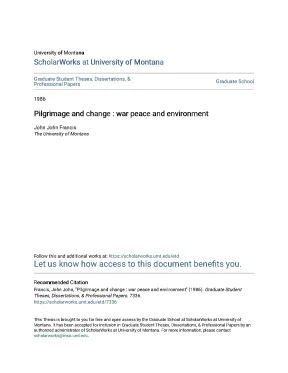
Tải xuống để đọc toàn bộUniversity of Montana ScholarWorks at University of Montana Graduate Student Theses, Dissertations, & Professional Papers Graduate School 1986 Pilgrimage and change : war peace and environment John John Francis The University of Montana Follow this and additional works at: https://scholarworks.edu/etd Let us know how access to this document benefits you. Recommended Citation Francis, John John, "Pilgrimage and change : war peace and environment" (1986). Graduate Student Theses, Dissertations, & Professional Papers.edu/etd/7336 This Thesis is brought to you for free and open access by the Graduate School at ScholarWorks at University of Montana. It has been accepted for inclusion in Graduate Student Theses, Dissertations, & Professional Papers by an authorized administrator of ScholarWorks at University of Montana.
For more information, please contact scholarworks@mso. COPYRIGHT ACT OF 1976 THIS 1S AN UNPUBLISHED MANUSCRIPT IN WHICH COPYRIGHT SUB- SISTS. ANY FURTHER REPRINTING OF ITS CONTENTS MUST BE APPROVED BY THE AUTHOR. MANSFIELD LIBRARY UNIVERSITY _OF MONTANA DATE: 19 Reproduced with permission of the copyright owner.
Further reproduction prohibited without permission. Reproduced with permission of the copyright owner. Further reproduction prohibited without permission. Pilgrimage and Change: War Peace and Environment by John Francis B., Southern Oregon State College, 1981 Presented in partial fulfillment of the requirements for the degree of Master of Science University of Montana 1986 Approved by wet Ch@Airm¥n, Board of Examiners BOL bes sO Dean, Graduate Lipa ed A, LG SL Date J Reproduced with permission of the copyright owner.
Further reproduction prohibited without permission. UMI Number: EP38137 All rights reserved INFORMATION TO ALL USERS The quality of this reproduction is dependent upon the quality of the copy submitted. In the unlikely event that the author did not send a complete manuscript and there are missing pages, these will be noted. Also, if material had to be removed, a note will indicate the deletion.
DMI TTC Di ion Publish UMI EP38137 Published by ProQuest LLC (2013). Copyright in the Dissertation held by the Author. Microform Edition © ProQuest LLC. All rights reserved.
This work is protected against unauthorized copying under Title 17, United States Code ProQuest ProQuest LLC. 789 East Eisenhower Parkway P. Box 1346 Ann Arbor, MI 48106 - 1346 Reproduced with permission of the copyright owner. Further reproduction prohibited without permission.
Reproduced with permission of the copyright owner. Further reproduction prohibited without permission. Acknowledgements I want to thank my committee members, Dr. Ron Erickson (Environmental Studies) and Professor Mary Birch (Social Work) for their support, suggestions, and criticisms.
I especially want to thank my advisor and committee chairperson, Professor Roger Dunsmore (Humanities). Without his tireless giving, guidance and dedication, this paper may never have been written. My gratitude also goes to Dr. Paul Lauren (History) for broadening my understanding of war and the pursuit of peace, to Dr.
Paul Dietrich (Religious Studies) who aided me in discovering pilgrimage as a social process, and to Dr. Tom Birch who taught me to question it all, including myself, My appreciation also goes to Dr. Dexter Roberts for the winter walks, his presence and editorial comments, and to Karen Boice for her support and what seemed to be an endless job of typing and editing. Finally, I want to thank Sara Miller for her work as sign language interpreter at my final defense.
ii Reproduced with permission of the copyright owner. Further reproduction prohibited without permission. Table of Acknowledgements.e Bamboo and Silence. Thousand-Mile Summer.,“° Teachings in the Wilderness.
School of Reflection. War, Peace, and Environment.2cceeene iii c8 6 °Àđeđ} 61 “6ˆ 606 oeoeee a ee Reproduced with permission of the copyright owner. Further reproduction prohibited without permission. Page ii 32 48 59 63 71 99 105 119 Chapter I Introduction The environmental crisis is an outward manifestation of a crisis of mind and spirit.
There could be no greater misconception of its meaning than to believe it to be concerned only with endangered wildlife, human-made ugliness, and pollution. These are part of it, but more importantly, the crisis is concerned with the kind of creatures we are and what we must become if we are to survive. Caldwell I have begun a pilgrimage -- an eighteen-year around-the-world walking and sailing journey -- as part of my education to raise environmental consciousness, promote earth stewardship, and world peace. How I came to be on this journey, as well as the meaning which the experience and the concept of pilgrimage has for me and society, is the subject of this paper.
The concept of pilgrimage is not new. It is as old as the urge to wander, and has roots in alli major historical religions as well as a number of the smaller tribal cultures including those of Egypt and Meso-America. The amount of pilgrimage and related literature written by theologians, historians, social scientists and others is staggering. In recent times, Belgian ethnographer Arnold van Gennep (Rites of Passage) and anthropologist Victor Turner (Dramas, Fields, and Metaphors) have added much to the empirical 1 Reproduced with permission of the copyright owner.
Further reproduction prohibited without permission. understanding of pilgrimage as a social process. Van Gennep was able to define three distinct phases through which every pilgrim must ‘pass. The first phase was that of separation or detachment from the familiar; the second he referred to as liminal.
a sort of ambiguous state during which the pilgrim is part of no fixed social structure, and the third was that of reaggregation, which occurs when the pilgrimage is completed and the pilgrim returns to society. It is the separation from the familiar with which the story of my pilgrimage begins. The transition to van Gennep°s second phase is slow and its boundaries may be unclear, but it is where I find myself at this writing. In the second or liminal phase Turner recognized the power of pilgrimage as an agent of social change or an “anti-structure"” because it is a structure that by its very nature questions all other social structural rules and suggests new possibilities.
Of these new possibilities, one most mentioned by researchers and pilgrims is the experience of total brotherhood. It is what Turner calls "communitas," an intense feeling of kinship and community that transcends place and time, uniting pilgrims from all ages. In attempting to understand pilgrimage there is a danger in a strictly empirical approach. Such investigations can yield a certain knowledge of the objects and events, but will usually ignore the spirit or creative.
Reproduced with permission of the copyright owner. Further reproduction prohibited without permission. force with which they are imbued. While Turner is comfortable with empirical investigation, in his study of pilgrimage he also recognizes the importance of personal documents, explanations, or interpretations of the phenomena, which he says gives the viewpoint of the actors.
"These would constitute a further set of social facts. So would one's own feelings and thoughts as an observer and as a participant.184) While reading the Autobiography of Malcolm X, I was impressed with the complete change in Malcolm's former anti-white attitude to one of global brotherhood that occurred during his own pilgrimage (hajj). He was the first American Black Muslim to journey to Mecca, and he writes: Love, humility, and true brotherhood was almost a physical feeling wherever I turned.All ate as One, and slept as One, Everything about the pilgrimage atmosphere accented the Oneness of Man under One God.Never have I witnessed such sincere hospitality and overwhelming spirit of true brotherhood as is practiced by people of ail colors and races, here in this Ancient, Holy Land, the home of Abraham, Muhammad, and all the other prophets of the Holy Scriptures.325, 330, 339) Like Malcolm X, I experienced similar feelings of "communitas," as those around me became aware of my journey. However, this paper is not about Malcolm X; it is about pilgrimage, its history and its present as understood by a pilgrim.
It is not an attempt to discover “communitas" or Ww "purity of motive, but rather to uncover the Reproduced with permission of the copyright owner. Further reproduction prohibited without permission. 4 ethical justification o£ my choices and actions through a method of "experiential reflection" of the life experiences that have nurtured, awakened, and delivered me onto this path of a pilgrim. Pilgrimage, as we will see, is a process.
In looking for what philosopher Henry Bugbee calis “the moment of obligation in experience," “experiential reflection," with its retrospective orientation, is the method of choice because the ultimate justification in acting is primarily delivered out of the experience of acting. Throughout this paper are woven the circumstances of tragedy, death, and realizaton in which we explore the finitude of life and are humbled. All serve the experience of life and make it whole. In that wholeness we may find "the moment of obligation." Looking back, then, this is how it began.
Reproduced with permission of the copyright owner. Further reproduction prohibited without permission. Chapter If A Beginning The geographical pilgrimage is the symbolic acting out of an inner journey. The inner journey is the extrapolation of the meaning and signs of the outer pilgrimage, one can have one without the other.
It's best to have both. Thomas Merton 1964 Low clouds and dense fog hugged the northern California coast, not unusual for mid-January. One expected the mild winters to be cloudy and wet. This year was no exception.
The day before, rain fell off and on between snatches of sun and blue sky. But by evening a high-pressure ridge that stretched from the western plateau across the state had changed all that. Shrouded by fog and night's darkness two oil tankers collided beneath the Golden Gate. Eight hundred and forty thousand gallons of crude spilled into San Fancisco Bay.
The sickly sweet smell of oil hidden in the morning fog drifted up from the water. My head swam and my stomach churned like when I was a kid squeezed between two fat relatives in the back seat of a hot summer car -- air conditioner failing, windows barely open. My small body bounced at each dip and pothole. 5 Reproduced with permission of the copyright owner.
Further reproduction prohibited without permission. The incoming tidal flow was nearly over. The oil reached only four and a half miles into the bay, then slowly drifted seven miles to sea before it flooded back onto the coast. Like others who had heard the news over morning coffee, I had come to watch, but in the end was grateful for the fog that gathered close and hid the dying birds, the fish and seals whose bodies cluttered the rocky shores, mouths and lungs filled with tar -- curdled black iridescence, Within hours after the collision, thousands of unsolicited volunteers swarmed spontaneously along the beaches to rescue stranded waterfowl and to help with clean-up operations.
Schools dismissed classes so students and teachers could take part. A girl with waist-length hair waded neck deep in dark water to capture distressed birds. Attempting to escape her grasp they flapped their sodden wings and slipped further beneath the surface. On the shore, armed with shovels and pitchforks, workers collected straw dropped onto the oil by helicopters and small craft.
Kneeling in the sand, a grown man cried as a blackened Grebe died in his hands. I was six when I saw my first death -~ a robin crushed beneath an automobile's wheel on a city street. It had fallen out of its parents’ nest. They hovered anxiously around.
I begged my mother if I could take it in to care Reproduced with permission of the copyright owner. Further reproduction prohibited without permission. for it until it could fly. "Yes," she said; but it was too late.
The car's wheel rolled slowly and crushed the life from the small feathered body. Standing on my parents' porch the neighbors heard me cry, and sighed in concert, as if I had lost my closest friend. Blood rushed to my head. My heart and stomach knotted.
The driver had stopped, blue eyes wide and mouth slightly open.
Nội dung được bảo vệ bản quyền — Tải xuống đầy đủ
Trích dẫn luận án này
John Francis (1986). Pilgrimage and change war peace and environment [Luận án tiến sĩ, University of Montana]. LuanAn.net. https://luanan.net/lich-su/pilgrimage-and-change-war-peace-and-environment
Câu hỏi thường gặp
Luận án "Pilgrimage and change war peace and environment" nghiên cứu về vấn đề gì?
Hành hương & Đổi Thay: Chiến tranh, Hòa bình và Môi trường. Khám phá mối liên hệ sâu sắc giữa hành trình tâm linh, xung đột và bảo vệ hành tinh xanh.
Luận án "Pilgrimage and change war peace and environment" được bảo vệ tại trường nào?
Luận án này được bảo vệ tại University of Montana. Năm bảo vệ: 1986.
Luận án "Pilgrimage and change war peace and environment" thuộc chuyên ngành gì?
Luận án "Pilgrimage and change war peace and environment" thuộc chuyên ngành Environmental Studies. Danh mục: Lịch Sử.
Luận án "Pilgrimage and change war peace and environment" có bao nhiêu trang?
Luận án "Pilgrimage and change war peace and environment" có 127 trang. Bạn có thể xem trước một phần tài liệu ngay trên trang web trước khi tải về.
Cách tải luận án "Pilgrimage and change war peace and environment" về máy như thế nào?
Để tải luận án về máy, bạn nhấn nút "Tải xuống ngay" trên trang này, sau đó hoàn tất thanh toán phí lưu trữ. File sẽ được tải xuống ngay sau khi thanh toán thành công. Hỗ trợ qua Zalo: 0559 297 239.