Luận án phát triển quân sự hậu chiến Mỹ - Nghiên cứu về kế hoạch và thực hiện
Khám phá nghiên cứu quân sự Mỹ thời hậu chiến: chiến lược, công nghệ và ảnh hưởng toàn cầu. Phân tích sâu sắc các sự kiện lịch sử quan trọng.
Năm xuất bản
Số trang
417
Thời gian đọc
1 giờ 3 phút
Lượt xem
0
Lượt tải
0
Phí lưu trữ
60 Point
Tổng quan nhanh
- Chủ đề:
- Vai trò quân đội Mỹ trong quy hoạch hậu chiến
- Số trang:
- 417 trang
- Trường:
- Kansas State University
- Chuyên ngành:
- History
- Tác giả:
- Walter M. Hudson
- Năm:
- 2010
Tóm tắt nội dung luận án
I.Vai trò quân đội Mỹ trong quy hoạch hậu chiến
Quân đội Mỹ đã thống trị việc lập kế hoạch chiếm đóng sau Thế chiến II. Cơ quan này định hình chính sách, bất chấp sự dè dặt ban đầu từ tổng thống. Ảnh hưởng của Quân đội đến từ sức mạnh tổ chức nội bộ và các mệnh lệnh văn hóa. Quân đội ưu tiên sự hiểu biết và các ưu tiên chiến lược của mình trong nỗ lực chiếm đóng. Giai đoạn này đánh dấu một bước ngoặt quan trọng trong Lịch sử quân sự Mỹ hậu Thế chiến II.
1.1. Ưu thế của Quân đội Hoa Kỳ
Quân đội Mỹ trở thành cơ quan chính của chính phủ Hoa Kỳ cho việc quy hoạch chiếm đóng hậu Thế chiến II. Ưu thế này xuất phát từ các yếu tố nội bộ mạnh mẽ. Năng lực xây dựng học thuyết mạch lạc là một điểm mạnh. Quân đội đã tự khẳng định vai trò lãnh đạo trong chính phủ.
1.2. Các yếu tố góp phần định hình chính sách
Nhiều yếu tố đã củng cố vị thế của Quân đội. Điều này bao gồm văn hóa tổ chức, thúc đẩy chuyên nghiệp hóa. Việc chấp nhận các tiêu chuẩn pháp lý cho xung đột cũng quan trọng. Kinh nghiệm thực tế từ các vấn đề dân sự ở Bắc Phi (1942-1943) là một yếu tố khác. Các cơ quan dân sự khác có năng lực tương đối yếu hơn.
1.3. Tầm nhìn và quyền lực tổng thống
Dù Tổng thống Roosevelt có những e ngại, Quân đội vẫn chiếm ưu thế. Một số thành viên nội các có ảnh hưởng cũng chia sẻ mối lo ngại này. Tuy nhiên, phong cách lãnh đạo và cá tính của Tổng thống Roosevelt đã góp phần vào kết quả này. Điều này ảnh hưởng đến việc định hình chiến lược quốc phòng Mỹ giai đoạn này.
II.Ảnh hưởng chiến lược quân sự Mỹ thời hậu chiến
Quân đội Mỹ đã phát triển một khuôn khổ toàn diện cho chính phủ quân sự. Khung khổ này hoạt động ở cả cấp chiến lược và chiến thuật. Đây là kết quả của sự hiểu biết sâu sắc về tổ chức quân sự. Học thuyết quân sự Hoa Kỳ được áp dụng trực tiếp vào quản lý các vùng chiếm đóng. Cách tiếp cận này đảm bảo sự đồng bộ trong thực thi.
2.1. Phát triển học thuyết và tổ chức nội bộ
Quân đội đã tạo ra các chương trình huấn luyện và giáo dục nội bộ. Các học thuyết cụ thể được xây dựng để hỗ trợ chính phủ quân sự. Các tổ chức chuyên trách được thành lập cho mục đích này. Năng lực tổ chức này giúp triển khai chính sách chiếm đóng hiệu quả. Đây là một phần quan trọng trong cải cách quân đội Mỹ.
2.2. Kỹ năng lãnh đạo và kinh nghiệm thực chiến
Các nhà lãnh đạo quân sự có kinh nghiệm và được đào tạo bài bản. Điều này đảm bảo việc thực hiện chính sách một cách nhất quán. Năng lực này giảm thiểu sự mơ hồ trong các hoạt động chiếm đóng. Kinh nghiệm thực chiến trước đó cũng đã đóng góp. Sự chuyên nghiệp hóa là yếu tố then chốt.
III.Phát triển học thuyết quân sự Mỹ cho chiếm đóng
Quân đội đã thiết lập các tiêu chuẩn pháp lý cho xung đột từ thế kỷ 19. Việc này củng cố năng lực của họ trong việc quản lý hậu chiến. Drive hướng tới chuyên nghiệp hóa là động lực chính. Đây là một phần quan trọng trong cải cách quân đội Mỹ thời kỳ đó. Các nguyên tắc này định hướng hành động quân sự.
3.1. Tiêu chuẩn hóa và chuyên nghiệp hóa quân đội
Quân đội đã chấp nhận các tiêu chuẩn pháp lý cho xung đột. Điều này diễn ra từ thế kỷ 19 đến đầu thế kỷ 20. Sự thúc đẩy chuyên nghiệp hóa là một động lực văn hóa. Điều này tạo ra một nền tảng vững chắc cho việc quản lý các hoạt động chiếm đóng. Tiêu chuẩn hóa nâng cao hiệu quả.
3.2. Học thuyết nội bộ và sự thống nhất
Khả năng tạo ra học thuyết nội bộ mạch lạc của Quân đội là then chốt. Điều này đảm bảo sự thống nhất trong chỉ đạo và thực thi. Các kế hoạch chiếm đóng được triển khai theo một khuôn khổ rõ ràng. Sự thống nhất này giúp Quân đội đạt được mục tiêu. Học thuyết quân sự Hoa Kỳ được định hình rõ ràng.
IV.Thực thi chiếm đóng quân sự Mỹ Đức Áo Hàn Quốc
Các cuộc chiếm đóng ở Đức, Áo và Hàn Quốc minh họa sự thống trị của Quân đội Mỹ. Quân đội đã lên kế hoạch và thực hiện chính phủ quân sự tại các quốc gia này. Kết quả của những hoạt động này định hình sâu sắc lợi ích của Mỹ. Đây là những ví dụ điển hình về phân tích xung đột Mỹ trong giai đoạn hậu chiến. Việc thực hiện rất phức tạp.
4.1. Chiếm đóng Đức và Áo
Ở Đức và Áo, chính phủ quân sự Mỹ đã triển khai các chính sách. Các chính sách này phản ánh sự hiểu biết của Quân đội. Việc này tạo ra nền tảng cho sự ổn định khu vực. Các hoạt động này cũng là nơi tương tác ban đầu với Liên Xô. Chính phủ quân sự đối mặt với nhiều thách thức.
4.2. Chính phủ quân sự tại Hàn Quốc
Tại Hàn Quốc, Quân đội Mỹ cũng áp dụng mô hình chính phủ quân sự. Các hành động của lực lượng chiếm đóng đã có tác động lớn. Điều này định hình tương lai chính trị và xã hội của đất nước. Đây là một điểm khởi đầu cho Chiến tranh Lạnh và Mỹ ở châu Á. Ảnh hưởng này kéo dài.
4.3. Tương tác Mỹ Liên Xô và chính sách
Tương tác với các đối tác Liên Xô ở các vùng chiếm đóng là một mối quan tâm lớn. Các tương tác này diễn ra vào đầu Chiến tranh Lạnh. Chúng đã định hình chính sách của Mỹ trong giai đoạn đó. Điều này ảnh hưởng đến chiến lược đối ngoại lâu dài. Các cuộc đàm phán rất quan trọng.
V.Định hình chính sách Mỹ trong bối cảnh Chiến tranh Lạnh
Các hoạt động chiếm đóng hậu Thế chiến II của Mỹ có ảnh hưởng lâu dài. Chúng không chỉ định hình lợi ích quốc gia mà còn ảnh hưởng đến chính sách. Đặc biệt, các tương tác ban đầu với Liên Xô là quan trọng. Đây là một phần quan trọng trong chiến lược quốc phòng Mỹ thời kỳ đầu Chiến tranh Lạnh. Chính sách này phản ánh tầm nhìn mới.
5.1. Ảnh hưởng lên lợi ích quốc gia Mỹ
Các cuộc chiếm đóng đã định hình sâu sắc lợi ích của Mỹ tại các quốc gia này. Các quyết định quân sự có tác động chính trị to lớn. Điều này tạo ra một tiền đề cho các mối quan hệ quốc tế sau này. Lợi ích quốc gia được củng cố. Việc này giúp ổn định khu vực.
5.2. Tác động đến chính sách trong Chiến tranh Lạnh
Các hành động của chính phủ quân sự Mỹ đã định hình chính sách Mỹ. Điều này đặc biệt đúng trong giai đoạn đầu Chiến tranh Lạnh. Các bài học từ việc quản lý các vùng chiếm đóng được áp dụng. Điều này ảnh hưởng đến học thuyết quân sự Hoa Kỳ tiếp theo. Chính sách ngoại giao được định hình.
Tải xuống file đầy đủ để xem toàn bộ nội dung
Tải đầy đủ (417 trang)Trích đoạn nội dung luận án
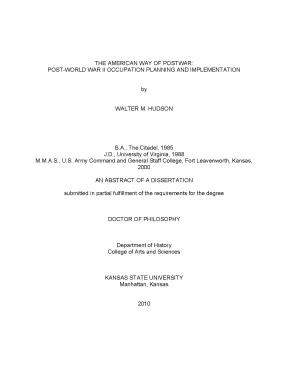
Tải xuống để đọc toàn bộTHE AMERICAN WAY OF POSTWAR: POST-WORLD WAR II OCCUPATION PLANNING AND IMPLEMENTATION by WALTER M., University of Virginia, 1988 M. Army Command and General Staff College, Fort Leavenworth, Kansas, 2000 AN ABSTRACT OF A DISSERTATION submitted in partial fulfillment of the requirements for the degree DOCTOR OF PHILOSOPHY Department of History College of Arts and Sciences KANSAS STATE UNIVERSITY Manhattan, Kansas 2010 Abstract The United States Army became the dominant U. government agency for post- World War II occupation planning. Despite President Roosevelt’s own misgivings, shared by several influential members of his Cabinet, the Army nonetheless prevailed in shaping occupation policy in accordance with its understanding and priorities.
The Army’s primacy resulted from its own cultural and organizational imperatives, to include its drive towards professionalization and its acceptance of legalized standards for conflict in the nineteenth and early twentieth centuries. Other related factors included the Army’s ability to create coherent internal doctrine, the training and experience of its leaders, the relative weakness of comparative civilian agencies, the real-world experiences of civil affairs in North Africa in 1942-43, and the personality and leadership style of President Roosevelt himself. As a result, the Army created internal training and education, doctrine, and organizations that operated both at the strategic and tactical level to implement military government in accordance with the Army’s institutional understanding. The Army’s planning and implementation of military government in Germany, Austria, and Korea show the effects of the Army’s dominance in planning and implementing the postwar occupations.
Furthermore, in these three occupations (unlike Japan’s), of particular concern were how the Americans interacted with their Soviet counterparts in the occupied territories at the beginning of the Cold War. As these three occupations reveal, American military government in those locations, as well as the actions of the occupants themselves, profoundly shaped American interests in those countries and thus profoundly shaped American policy during the early Cold War. THE AMERICAN WAY OF POSTWAR: POST-WORLD WAR II OCCUPATION PLANNING AND IMPLEMENTATION by WALTER M., University of Virginia, 1988 M. Army Command and General Staff College, Fort Leavenworth, Kansas, 2000 A DISSERTATION submitted in partial fulfillment of the requirements for the degree DOCTOR OF PHILOSOPHY Department of History College of Arts and Sciences KANSAS STATE UNIVERSITY Manhattan, Kansas 2010 Approved by: Major Professor Dr.
Mark Parillo Copyright WALTER M. HUDSON 2010 Abstract The United States Army became the dominant U. government agency for post- World War II occupation planning. Despite President Roosevelt’s own misgivings, shared by several influential members of his Cabinet, the Army nonetheless prevailed in shaping occupation policy in accordance with its understanding and priorities.
The Army’s primacy resulted from its own cultural and organizational imperatives, to include its drive towards professionalization and its acceptance of legalized standards for conflict in the nineteenth and early twentieth centuries. Other related factors included the Army’s ability to create coherent internal doctrine, the training and experience of its leaders, the relative weakness of comparative civilian agencies, the real-world experiences of civil affairs in North Africa in 1942-43, and the personality and leadership style of President Roosevelt himself. As a result, the Army created internal training and education, doctrine, and organizations that operated both at the strategic and tactical level to implement military government in accordance with the Army’s institutional understanding. The Army’s planning and implementation of military government in Germany, Austria, and Korea show the effects of the Army’s dominance in planning and implementing the postwar occupations.
Furthermore, in these three occupations (unlike Japan’s), of particular concern were how the Americans interacted with their Soviet counterparts in the occupied territories at the beginning of the Cold War. As these three occupations reveal, American military government in those locations, as well as the actions of the occupants themselves, profoundly shaped American interests in those countries and thus profoundly shaped American policy during the early Cold War. Table of Contents List of Figures. x Chapter 1 - Introduction: The American Army, Strategic Culture, and the Post-World War II Occupations.
1 Chapter 2 - Military Government Planning Prior to 1940. 32 Chapter 3 - Military Government Doctrine, Training, and Organization. 83 Chapter 4 - FDR, Interagency Conflict, and Military Government. 137 Chapter 5 - The Civil Affairs Division: Representing the Army’s Interests in the Interagency and Intergovernmental Arena.
186 Chapter 6 - Planning and Implementing Military Government in Germany, 1943-46. 234 Chapter 7 - Planning and Implementing Military Government in Austria, 1943-1946. 277 Chapter 8 - Planning and Implementing Military Government in Korea, 1943-1946. 385 vi List of Figures Figure 1- Proposed Theater-Level Military Govt.
66 Figure 2- Major General Gullion's Recruitment Letter. 111 Figure 3- Military Government Division, 1943. 114 Figure 4- Office of Provost Marshal General, 1943. 115 Figure 5- Services of Supply/Army Service Forces & Provost Marshal General.
187 Figure 6- War Department Hierarchy Showing Position of Civil Affairs Division. 204 Figure 7- Organization of Civil Affairs Division. 207 Figure 8- Troop Concentrations within Germany per ECLIPSE Plan. 244 Figure 9- Allied Occupation Zones in Germany.
255 Figure 10- Allied Routes of Penetration into Austria. 291 Figure 11- Austrian Zones of Occupation. 292 Figure 12- Units Designated for Occupation Duties in Japan and Korea. 329 Figure 13- The Division of Korea Along the 38th Parallel.
334 vii Acknowledgements I gratefully acknowledge the help and support of the following: my faculty committee, Dr. Mark Parillo, Dr. Brent Maner, Dr. David Stone, and Dr.
I particularly benefited from taking classes from the first three of these scholars and from reading some of the work of the fourth. Sue Zschoche’s Cold War course challenged me to look at the conflict and era in a new way, and Dr. Robert Baumann’s course on military frontiers provided me insights about partitions and zonal divisions during postwar occupations. I also acknowledge in particular my advisor and mentor while attending the U.
Army War College from 2009-2010, Dr. Sommers especially provided me with his time and his prodigious intellect while I researched and wrote this dissertation. James Kievet and Dr. Brent Bankus, also from the Army War College, provided useful comments on my research into the development of the Civil Affairs Division.
Captain Steve Knott’s (USN) Army War College elective on the 1944-45 European Campaign was especially helpful. Colonel Mike MacMahon provided insights into systematic operational design. Colonel Harry Leach provided me key texts on political constructivist theory. Commander Traci Keegan provided me useful information on organizational theory.
Conversations with Dr. Henry Gole were especially useful regarding the interwar years. I also acknowledge the librarians and assistants of the libraries and archives, where I researched, especially Ms. Jane Yates of The Citadel Archives, as well as the librarians and archivists at the U.
Army War College Library and the U. Army Heritage and Education Center at Carlisle Barracks, PA. I would be remiss if I failed to acknowledge the mentorship and viii friendship of Colonel Dave Diner in particular, without whom this dissertation could not have been written. Others have provided counsel and friendship, to include seminar mates in classes at Kansas State University and at the U.
Army War College. I acknowledge also the great soldiers and civilians at I Corps, Joint Base Lewis-McChord, Washington, especially those at the Office of the Staff Judge Advocate there, for their great support. My family has been supportive throughout, especially my father and mother, Colonel (ret. Lastly, and most importantly, I acknowledge my wonderful wife, Laura, to whom this dissertation is dedicated, and our beautiful daughter, Anna Frances.
Both daily bring joy and meaning to my life. ix Dedication To my wife Laura, whom everyday provided me with unwavering love and support while I worked to complete this dissertation. x Chapter 1 - Introduction: The American Army, Strategic Culture, and the Post-World War II Occupations In the immediate aftermath of World War II, the United States Army became the principal executor of American postwar governance policy throughout the world. It administered the military occupations of not only the defeated Axis powers of Germany and Japan but also of Austria, Korea, and many nations liberated by American military forces in their drives across Europe and the Pacific.
1 Generals such as Lucius Clay in Germany, Douglas MacArthur in Japan, Mark Clark in Austria, and John Hodge in Korea presided over occupied territories as American viceroys. And because of these occupational responsibilities, the Army’s influence over American foreign policy in the early Cold War period was profound, though in ways not usually understood. 2 President Roosevelt had deep misgivings about postwar occupations being run by the Army. And Roosevelt was not alone: many within his administration and outside of it opposed such military rule as well.
George Kennan said, “[T]he ruling of distant peoples is not our dish…there are many things we Americans should beware of, and among them is the acceptance of paternalistic responsibility to anyone, be it even in the form of military occupation, if we can possibly avoid it.” 3 Many in the public indicated as such. An article in the October 1943 issue of Harper’s magazine asked: “Somehow the job [postwar occupation] must be done. But why should it be done by the Army? The Army is specialized in destroying enemy armies. Why should it be presumed to be specialized in the most complex and gigantic task of reconstruction the world has ever seen?” 4 Even high ranking officials in the Army were skeptical about the prospect of American soldiers governing vast expanses of territory.
Marshall 1 expressed such concern in a discussion with the chief of the Civil Affairs Division, Major General John Hilldring: Our countrymen, our fellow citizens, are not afraid of us. They don’t harbor any ideas that we intend to alter the government of the country or the nature of this government…We are completely devoted, we are a member of a priesthood really, the sole purpose of which is to defend the Republic. … And I don’t want to permit the enormous corps of military governors that you are in the process of training and that you are going to dispatch all over the world, to damage this high regard in which the professional soldiers in the Army are held by our people, and it could happen … if you don’t understand what you are about. 5 Despite such resistance and skepticism, at war’s end, the Army administered the occupation of both liberated and conquered countries, and that administration would have major implications for the United States in the postwar world.
The literature on the postwar occupations, particularly of Germany and Japan, is vast and deep, ranging from major works of synthesis to monographs on particular topics, but these studies tend to focus on the specific occupation experiences themselves; and they do not connect either backwards in time to reveal how the Army came to those occupations or outwards in scope to reveal how the Army’s particular doctrine, leadership, and implementation of policy had larger foreign policy consequences. 6 There is also a significant body of literature on the high diplomacy of the war years, especially the Allied conferences at Yalta and Potsdam. Undoubtedly, these conferences of the Allied national leaders resulted in many of the key decisions that led to the construction of the postwar world. 7 But these conferences provided broad and often rather unclear guidance that required interpretation by an administrator.
And for the United States, it was the American Army that specifically became the predominant administrator of postwar policy, and as a result not only enacted, but greatly influenced policy outcomes. 2 As the historical evidence indicates, the Army became the dominant US government actor in postwar occupation policy due to a variety of factors and circumstances that go beyond diplomatic documents or even the apparent national interests of the United States.
Nội dung được bảo vệ bản quyền — Tải xuống đầy đủ
Trích dẫn luận án này
Walter M. Hudson (2010). Nghiên cứu quân sự hậu chiến - Mỹ [Luận án tiến sĩ, Kansas State University]. LuanAn.net. https://luanan.net/lich-su/nghien-cuu-quan-su-hau-chien-my
Câu hỏi thường gặp
Luận án "Nghiên cứu quân sự hậu chiến - Mỹ" nghiên cứu về vấn đề gì?
Khám phá nghiên cứu quân sự Mỹ thời hậu chiến: chiến lược, công nghệ và ảnh hưởng toàn cầu. Phân tích sâu sắc các sự kiện lịch sử quan trọng.
Luận án "Nghiên cứu quân sự hậu chiến - Mỹ" được bảo vệ tại trường nào?
Luận án này được bảo vệ tại Kansas State University. Năm bảo vệ: 2010.
Luận án "Nghiên cứu quân sự hậu chiến - Mỹ" thuộc chuyên ngành gì?
Luận án "Nghiên cứu quân sự hậu chiến - Mỹ" thuộc chuyên ngành History. Danh mục: Lịch Sử.
Luận án "Nghiên cứu quân sự hậu chiến - Mỹ" có bao nhiêu trang?
Luận án "Nghiên cứu quân sự hậu chiến - Mỹ" có 417 trang. Bạn có thể xem trước một phần tài liệu ngay trên trang web trước khi tải về.
Cách tải luận án "Nghiên cứu quân sự hậu chiến - Mỹ" về máy như thế nào?
Để tải luận án về máy, bạn nhấn nút "Tải xuống ngay" trên trang này, sau đó hoàn tất thanh toán phí lưu trữ. File sẽ được tải xuống ngay sau khi thanh toán thành công. Hỗ trợ qua Zalo: 0559 297 239.