Knowing children children knowing nineteenth century british chi
Nghiên cứu về con người trẻ trong thế kỷ 19 Anh, khám phá cách thức trẻ em nhận thức và học hỏi trong thời đại đó.
Năm xuất bản
Số trang
211
Thời gian đọc
32 phút
Lượt xem
1
Lượt tải
0
Phí lưu trữ
50 Point
Tổng quan nhanh
- Chủ đề:
- Victorian Childhood: Law, Literature, and Society
- Số trang:
- 211 trang
- Trường:
- City University of New York
- Chuyên ngành:
- English
- Tác giả:
- Donna Paparella
- Năm:
- 2015
Tóm tắt nội dung luận án
I.Victorian Childhood Law Literature and Society
The mid-nineteenth century marked a pivotal period. Society developed an intense preoccupation with "the child." This era witnessed the genesis of modern family law. Simultaneously, an explosion of children's representations permeated art and literature. Early scientific studies of childhood also began during this time. These developments collectively reshaped the understanding of children's roles and rights. The era established foundational concepts for child welfare and child development. Nineteenth-century British society grappled with evolving perceptions of children. This period laid groundwork for contemporary debates regarding parenting styles and child protection. Understanding this historical context offers a lens for current societal concerns about children. The changing dynamics significantly influenced the social history of British childhood.
1.1. Shifting Societal Focus on Children
British society's focus on children intensified in the 1800s. Children moved from being mere miniature adults to subjects of unique attention. This shift spurred new discussions about child development 19th century Britain. Societal values began to prioritize children's well-being and legal standing. This preoccupation manifested across various domains, including legal, artistic, and scientific fields. The changing perceptions of children Victorian era led to significant reforms and cultural output. Early considerations of children's rights started to take shape.
1.2. New Legal Frameworks for British Children
The mid-19th century saw the establishment of crucial family law principles. These laws addressed issues like custody, guardianship, and child protection. They marked a departure from previous legal structures. The legal reforms were often intertwined with broader social changes. These frameworks aimed to formalize the legal status of 19th century British children. They offered foundational legal protections. This period's legislative efforts influenced Victorian family life profoundly, restructuring familial responsibilities and children's legal identities.
II.British Child Law Reform in the Nineteenth Century
Nineteenth-century British child law reform represents a significant historical area. This reform movement fundamentally altered children's legal standing. Novelists and autobiographers frequently engaged these legal changes. They used legal developments as creative opportunities within their narratives. Issues of childhood and personhood were central to these legal debates. The law grappled with concepts of children's freedom and choice. These discussions often intersected with the realities of child labor Victorian Britain and the need for protective legislation. The legal system slowly recognized children as distinct individuals with specific rights. This evolution in law paved the way for more comprehensive child welfare systems.
2.1. Emergence of Modern British Family Law
Modern British family law traces its origins to the 19th century. Early statutes began to define legal relationships between parents and children. Custody law, initially a byproduct of divorce reform, expanded. It moved beyond merely marital disputes to focus more on the child's welfare. This shift represented a foundational change in legal philosophy. It provided a legal framework for addressing child-related disputes. The law gradually recognized a child's right to protection and appropriate care within the Victorian family life structure.
2.2. Legal Debates on Childhood and Personhood
Nineteenth-century legal discourse actively debated childhood and personhood. These debates explored when a child became a legal person. Discussions encompassed children's capacity for independent thought and action. Legal scholars and reformers questioned traditional views of children as property. The arguments contributed to a more nuanced understanding of child development 19th century Britain. These legal struggles sought to define the scope of children's autonomy. They ultimately shaped the social history of British childhood.
2.3. Child s Rights and Choice in Law
The concept of children's rights began to gain traction. Legal reforms started to acknowledge children's capacity for choice in certain matters. This included considerations in custody cases. The law moved towards recognizing children's individual interests. This marked a significant departure from previous patriarchal legal traditions. It highlighted a growing societal recognition of children's distinct status. Legal provisions slowly granted children more agency within legal processes.
III.Children s Narratives in Victorian Literature
Nineteenth-century literary narratives frequently depicted children. These stories often featured children grappling with difficult circumstances. Bad parents, dead parents, absent parents, and surrogate parents appeared prominently. These literary portrayals reflected and influenced societal concerns about children. Victorian children's literature served as a powerful medium. It explored the evolving perceptions of children Victorian era. Authors used their works to engage with legal and social debates. They provided unique insights into the emotional and psychological lives of 19th century British children. The narratives marked a fundamental change in how childhood was understood and represented in culture. These literary efforts often anticipated contemporary thinking on child welfare.
3.1. Literary Portrayals of Challenged Childhoods
Victorian literature created vivid depictions of challenged childhoods. Orphans, neglected children, and children facing familial hardship were common tropes. These characters often served to highlight societal injustices or moral lessons. Representations of childhood art during this period also mirrored these themes. Authors used these narratives to evoke empathy and encourage reform. The literary emphasis on vulnerability underscored the need for protection for 19th century British children.
3.2. Authors Engaging Legal Debates Through Plots
Novelists actively integrated legal debates into their plots and forms. They used fictional scenarios to explore the implications of new child laws. Characters' struggles with custody, guardianship, or autonomy reflected real legal issues. This engagement provided a public forum for discussing child law reform. Literature thus became a tool for influencing public opinion. Authors critiqued or championed legal changes through their narratives. This dynamic interaction enriched both the legal and literary spheres concerning Victorian childhood.
3.3. Formal Innovation in Child Centric Literature
Child-centric literature spurred significant formal innovation. Narratives began to explore childhood consciousness in new ways. Authors experimented with perspectives and narrative structures. This allowed for deeper psychological insights into children's experiences. These literary forms contributed to new ways of structuring families in fiction. They also offered alternative narrative forms, moving beyond traditional plots centered solely on adults. This innovation impacted the broader landscape of Victorian children's literature.
IV.Challenging Past Interpretations of Victorian Childhood
Existing scholarship on law and literature often overlooked the direct link between child law reform and children's narratives. Previous analyses frequently treated literary representations of the child as secondary. They often connected child themes to marriage or divorce plots, or the "woman question." This approach sometimes created an ahistorical view. It did not fully capture the distinct importance of the child. This alternative history positions child-centric literature as primary and generative. It argues the child offered an entirely new narrative plot. Understanding this primary role changes perceptions of children Victorian era. It also reconfigures the social history of British childhood. This perspective highlights the child's agency and distinct significance in the 19th century.
4.1. Critique of Ahistorical Law and Literature Studies
Much law and literature criticism suffered from an ahistorical approach. It often narrowly focused on a few texts. This limited scope failed to capture the broader societal implications of legal changes. Critiques also pointed to treating literature merely as 'culture.' This diluted the specific relationship between legal statutes and narrative creation. A more rigorous historical lens clarifies the direct interplay between 19th century British children's legal status and literary output.
4.2. Reframing the Child s Centrality in Narratives
The child is often presented as primary, not secondary, to other literary plots. Narratives focused on children were not simply byproducts of divorce or women's rights movements. These stories offered unique insights into child development 19th century Britain. They explored the evolving understanding of children's rights and personhood. This reframing highlights the inherent value and complexity of Victorian children's literature centered on young protagonists. It asserts the child as a distinct and powerful subject in British literature.
4.3. Beyond Divorce Child as a Primary Literary Focus
Custody law was often viewed as solely an extension of a wife's rights. Literary representations of children were frequently integrated into marriage plots. This perspective minimizes the child's independent significance. This project offers an alternative. It argues child-centric literature addresses the child as a main concern. It explores the child's perspective and experience directly. This approach reveals a richer, more complex picture of Victorian family life and children's roles within it.
V.The Reciprocal Link Law Literature and Children
A reciprocal relationship existed between nineteenth-century child law and literature. Despite distinct discourses, these fields mutually influenced each other concerning children. Child-centric literature actively participated in new ways of thinking about families. It also contributed to innovative narrative forms. When read in historical context, these narratives reveal a changing understanding of childhood. This shift anticipates contemporary thinking about child welfare. These historical roots offer a crucial lens. They allow for a deeper understanding of formal literary invention. The interaction demonstrates how legal changes inspired artistic expression. Conversely, literature shaped public perceptions, potentially influencing further legal reform. This dynamic exchange enriched the cultural landscape surrounding 19th century British children.
5.1. Mutual Influence of Legal and Literary Discourses
Legal discourses provided frameworks for children's rights and status. Literary works explored the human impact and moral dilemmas arising from these laws. This created a powerful feedback loop. Legal reforms informed fictional plots. Fictional narratives, in turn, highlighted gaps or injustices in the law. This mutual influence shaped public understanding of 19th century British children. It also fostered a more nuanced appreciation of both legal and literary forms.
5.2. Historical Antecedents for Modern Child Welfare
The historical examination reveals the origins of modern concerns regarding child welfare. Nineteenth-century debates on childhood and personhood directly connect to current child protection issues. The struggles over children's freedom and choice resonate today. Understanding these historical antecedents provides valuable context for contemporary child development 19th century Britain policies. It shows the long evolution of societal commitment to children's well-being. This early period was crucial for establishing child-centric priorities.
5.3. Understanding Formal Literary Invention
The interaction between law and literature illuminates formal literary invention. Authors responded to legal changes with creative plot devices and narrative structures. This context explains why particular literary forms emerged or gained prominence. It deepens appreciation for how Victorian children's literature evolved. The legal landscape provided fertile ground for artistic experimentation. This interplay offers insights into the intricate relationship between societal change and creative expression. It enriches the study of representations of childhood art.
Mục lục chi tiết luận án
Tải xuống file đầy đủ để xem toàn bộ nội dung
Tải đầy đủ (211 trang)Trích đoạn nội dung luận án
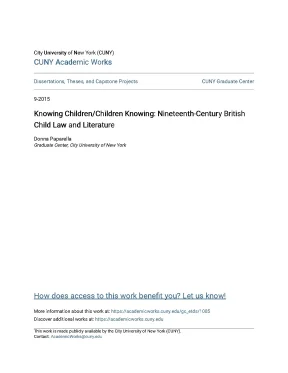
Tải xuống để đọc toàn bộCity University of New York (CUNY) CUNY Academic Works Dissertations, Theses, and Capstone Projects CUNY Graduate Center 9-2015 Knowing Children/Children Knowing: Nineteenth-Century British Child Law and Literature Donna Paparella Graduate Center, City University of New York How does access to this work benefit you? Let us know! More information about this work at: https://academicworks.edu/gc_etds/1085 Discover additional works at: https://academicworks.edu This work is made publicly available by the City University of New York (CUNY). Contact: AcademicWorks@cuny.edu KNOWING CHILDREN/CHILDREN KNOWING: NINETEENTH-CENTURY BRITISH CHILD LAW AND LITERATURE by DONNA PAPARELLA A dissertation submitted to the Graduate Faculty in English in partial fulfillment of the requirements for the degree of Doctor of English, The City University of New York 2015 Paparella ii © 2015 DONNA PAPARELLA All Rights Reserved Paparella iii This manuscript has been read and accepted for the Graduate Faculty in English to satisfy the dissertation requirement for the degree of Doctor of Philosophy. Talia Schaffer ___________________ ______________________ Date Chair of Examining Committee Mario DiGangi ___________________ ______________________ Date Executive Officer Talia Schaffer Rachel Brownstein Anne Humpherys Supervisory Committee THE CITY UNIVERSITY OF NEW YORK Paparella iv Abstract KNOWING CHILDREN/CHILDREN KNOWING: NINETEENTH-CENTURY BRITISH CHILD LAW AND LITERATURE by Donna Paparella Adviser: Professor Talia Schaffer Why are nineteenth-century literary narratives filled with children’s accounts of bad parents, dead parents, absent parents, and surrogate parents? What are the origins of our current preoccupation with children as evidenced, for example, in Ian McEwan’s new novel, The Children Act; New York State’s recent amendments to the name and role of “Attorney for the Child”; and today’s vehement debates over parenting styles? The mid-nineteenth century was a period of intense preoccupation with “the child”: it engendered family law; it generated an explosion of representations of children in art and literature; and it witnessed the beginnings of the scientific study of childhood. Knowing Children/Children Knowing: Nineteenth-Century British Child Law and Literature pursues the relatively uncharted relation between nineteenth- century Anglo-American child law reform and Victorian literary representations of childhood and childhood consciousness, arguing that this relation is the origin of our present concerns.
Examining issues of childhood and personhood, freedom, and choice, and using primary literary, legal, and historical sources, I argue that novelists and autobiographers used changes in the law as a creative opportunity, engaging legal debates about children in their plots, in their forms, and in their portrayals of childhood. These narratives, when read in their historical context, mark a Paparella v change in the understanding and representation of childhood that anticipate contemporary thinking about child welfare. Correlatively, these historical roots give us a lens through which to see and understand formal literary invention. This project begins to fill a gap in the disciplinary intersection of Victorian family law and literature.
In a 2007 Victorian Literature and Culture review of law and literature criticism, Simon Petch proclaimed that “Victorian Studies seems to have gained very little from the Law and Literature movement,” because of the movement’s narrow focus on a handful of texts. Much law and literature criticism has two main issues: it is oftentimes ahistorical and, as Petch points out, it treats “literature” as “culture.” For example, Kieran Dolin’s work is based on his assumption that law, like literature, is a fiction. Ian Ward, writing “as a member of the legal academy,” notes that the “‘law and literature’ movement has been nurtured in the main, from within this academy,” and challenges literary scholars to take up this relationship. Although there has been work on divorce law in the nineteenth century and much work done on “the child” by literary critics, these two are rarely considered together: custody law is most often viewed as a by-product of divorce reform and understood primarily as an expansion of a wife's rights developed by Victorian suffragism.
Likewise, in this context, literary representations of the child are often treated as part of the marriage and/or divorce plot or of “the woman question.” I present an alternative history, arguing that literary treatments of the child are primary and generative: the child is not secondary to these other plots but offers us another plot entirely. Child-centric literature participates in new ways of thinking about and structuring families and new ways of organizing narrative form. Maintaining the differences between legal and literary discourses, I read a reciprocal relationship between law and literature concerning children: child-centric literature is both influenced by child law and influences child law. As the law recognized that Paparella vi children have a voice and that childhood interests exist, literature gave expression to the child’s voice and interests.
The history of custody law shows us that there is a rhetoric of personhood that developed with specific applications to childhood, which has to do both with the child as such, as well as with the symbolic nature of the child as a figure of fundamental human being-ness. At the same time that the law acknowledged childhood subjectivity, it also considered children as dependents and in need of protection. In response, the court became parens patriae—literally, “parent of the nation”—displacing biological parents. By the early twentieth century the conception of the child changed from that of an object of possession to (paradoxically) that of an object in need of guardianship who is also a subject: as a result, children’s lives became regulated by the state more than by their parents.
The literary works I am examining have a stake in making adults understand the child’s perspective and, in doing so, invite the reader to use this as the key to understanding one’s own development. Childhood became necessary; it needed to be protected and managed because it was essential in formulating personhood in both real and symbolic ways. As such, childhood is a crucial component of modern identity itself. Paparella vii Acknowledgments I am so fortunate to have worked with a dream dissertation committee and I am incredibly grateful to them.
My advisor, Talia Schaffer, is a true mentor. Her profound generosity, encouragement, and intelligence have infused every page of this project. It has been a privilege to work with Rachel Brownstein, who has read everything and knows everything. Anne Humpherys’s exacting readings of my early work on this project set the highest standards.
I am grateful to my dear friends Kirsten Tranter, Tanya Agathocleous, and Bob Bettendorf, who have sustained me with their friendship, love, and intellectual and emotional support over many years. Bob Bettendorf read a portion of this project in the meticulous way that only he can do. My thanks to Jeremy Glick for his early input and continued interest in this work. I thank my colleagues in office 1436 at Hunter College, who have made daily life and work infinitely happier, especially Jason Ueda, Josh Ginsberg, Jen Mitchell, Joost Burgers, Kathryn Narramore, and Liz Goetz.
Thank you to my friend, Barbara Wilding, who, when I was at a crossroads in my life, gave me the advice I needed to take on this project. I also wish to thank my family—Linda, Anthony, Phoebe, Eileen, and my father—for their enthusiasm and support for my work. My mother and grandparents would be very proud. Most of all, I am grateful to my son, Sam, who has made my life and writing more meaningful, worthwhile, and wonderful than anything I could ever have imagined.
I dedicate this to him. Paparella viii TABLE OF CONTENTS 1. The Empire of the Child: British Court Intervention in Nineteenth-Century Custody Law 1 2. Inventing Motherhood: Moral Crimes and the Maternal Plot 44 3.
Splitting the Baby: What Maisie Knew about Joint Custody 92 4. “O how I do hate that Law”: Rewriting the Law of the Father 137 Epilogue: Our Children/Ourselves 185 Bibliography 192 Paparella 1 1. The Empire of the Child: British Court Intervention in Nineteenth-Century Custody Law The legal power of a father,—for a mother, as such, is entitled to no power, but only to reverence and respect; the power of a father, I say, over the persons of his children ceases at the age of twenty-one: for they are then enfranchised by arriving at years of discretion, or that point which the law has established, as some must necessarily be established, when the empire of the father, or other guardian, gives place to the empire of reason. Yet, till that age arrives, this empire of the father continues even after his death; for he may by his will appoint a guardian to his children.
(William Blackstone, Commentaries on the Laws of England, 1765) The first education is the most important and this first education belongs incontestably to women; if the Author of nature had wanted it to belong to men, He would have given them milk with which to nurse the children. The laws—always so occupied with property and so little with persons, because their object is peace not virtue—do not give enough authority to mothers. However their status is more certain than that of fathers; their duties are more painful; their cares are more important for the good order of the family; generally they are more attached to the children. Fathers’ ambition, avarice, tyranny, and false foresight, their negligence, their harsh insensitivity are a hundred times more disastrous for children than is the blind tenderness of mothers.
(Jean-Jacques Rousseau, Emile, 1762) The next century will be the century of the child, just as this century has been the women’s century. When the child gets his rights, morality will be perfected. (Amelia Barr, The Lion’s Whelp, 1901) Why are nineteenth-century literary narratives filled with children’s accounts of bad parents, dead parents, absent parents, and surrogate parents? What are the origins of our current preoccupation with children as evidenced, for example, in Ian McEwan’s recent novel, The Children Act; New York State’s recent amendments to the name and role of “Attorney for the Child”; and our current vehement debates over parenting styles? The mid-nineteenth century was a period of intense preoccupation with “the child”: it engendered family law; it generated an explosion of representations of children in art and literature; and it witnessed the beginnings of the scientific study of childhood. From Philippe Ariès on, there has been extensive consideration of the child in almost all disciplines.
What has remained relatively uncharted, however, is the relation between nineteenth-century child law reform and Victorian literary representations of Paparella 2 childhood and childhood consciousness. While critics of Victorian literature have produced much work on divorce law in the nineteenth century and much work on “the child,” they often treat child custody law as a derivative of divorce law reforms and/or the feminist movement. In this context, they often are concerned with the literary figure of the child only insofar as it is part of the marriage plot. I present here an alternative history, arguing that literary treatments of the child are primary and generative: the child is not secondary to the marriage plot but offers another plot entirely.
Writers of literature found creative opportunities in changes in child custody and welfare laws and they engage legal debates about children in their plots, in their forms, and in their representations of childhood. Child-centric literature, like child law, participates in new ways of thinking about and structuring families and, focusing on the child offers writers new ways of organizing narrative form. Children are born on the borderlands of humanity. In the context of conceptualizing children, law and literature have a special connection: both endeavor to construct children as subjects, as “persons”—and in doing so, reveal the paradox of such a project.1 Thus, what is at stake is not only defining “child,” but defining “person” as well, which entails navigating the relationship between what Barbara Johnson calls “a lyric ‘person’—emotive, subjective, individual—and a legal ‘person’—rational, rights bearing, institutional” (Persons and Things 189).
Historian Anna Davin describes “childhood” as mutable: the “properties” of childhood, she claims, “are multiple and elusive; its limits elastic. There is no absolute definition of childhood, whether subjective or official, because it is always lived and defined in cultural and economic contexts” (qtd.
Nội dung được bảo vệ bản quyền — Tải xuống đầy đủ
Trích dẫn luận án này
Donna Paparella (2015). Knowing children children knowing nineteenth century british [Luận án tiến sĩ, City University of New York]. LuanAn.net. https://luanan.net/lich-su/knowing-children-children-knowing-nineteenth-century-british-chi
Câu hỏi thường gặp
Luận án "Knowing children children knowing nineteenth century british" nghiên cứu về vấn đề gì?
Nghiên cứu về con người trẻ trong thế kỷ 19 Anh, khám phá cách thức trẻ em nhận thức và học hỏi trong thời đại đó.
Luận án "Knowing children children knowing nineteenth century british" được bảo vệ tại trường nào?
Luận án này được bảo vệ tại City University of New York. Năm bảo vệ: 2015.
Luận án "Knowing children children knowing nineteenth century british" thuộc chuyên ngành gì?
Luận án "Knowing children children knowing nineteenth century british" thuộc chuyên ngành English. Danh mục: Lịch Sử.
Luận án "Knowing children children knowing nineteenth century british" có bao nhiêu trang?
Luận án "Knowing children children knowing nineteenth century british" có 211 trang. Bạn có thể xem trước một phần tài liệu ngay trên trang web trước khi tải về.
Cách tải luận án "Knowing children children knowing nineteenth century british" về máy như thế nào?
Để tải luận án về máy, bạn nhấn nút "Tải xuống ngay" trên trang này, sau đó hoàn tất thanh toán phí lưu trữ. File sẽ được tải xuống ngay sau khi thanh toán thành công. Hỗ trợ qua Zalo: 0559 297 239.